
American pitcher plants are the tall, trumpet-shaped carnivores of sunny bogs in the eastern United States, and some of the most rewarding plants you can grow outdoors. The International Carnivorous Plant Society (ICPS) calls them “among the easiest carnivorous plants to grow,” and adds that if you have a spot outside in full sun and access to water low in minerals, “there is no excuse not to grow these spectacular plants.” Good Sarracenia care is mostly about copying that bog: strong sun, wet and nutrient-poor soil, and a cold winter rest.
This is the first guide in our Sarracenia series: how the traps work, the main species, and the basics of light, water, soil, winter care, feeding, and common problems.
The Short Answer
Grow Sarracenia outdoors in full sun, ideally 6 or more hours of direct sun a day. Stand the pot in a tray of rainwater, distilled water, or reverse osmosis water so the soil never dries out, and plant it in a fertilizer-free mix of peat with sand or perlite, never ordinary potting soil. Let it go dormant every winter: Sarracenia Northwest, a specialist nursery, says Sarracenia “require a winter dormancy each year.” Outdoors the pitchers catch their own insects, so there is no need to feed, and the ICPS warns against fertilizing the soil of adult plants because it can lead to rhizome rot.

| Need | What to give it | Source |
|---|---|---|
| Light | Full sun outdoors; 6 or more hours of direct sun, or 4 plus bright light the rest of the day | Sarracenia Northwest, California Carnivores |
| Water | Rain, distilled or reverse osmosis water (tap water only if under 50 ppm); never let the pot dry out | Sarracenia Northwest, ICPS |
| Tray | Pot standing in water all season, about 1.5 to 2.5 inches (4 to 6 cm) deep | ICPS |
| Soil | Peat with sand or perlite, about half and half; no potting soil, compost or fertilizer | ICPS, Sarracenia Northwest |
| Pot | 6 to 8 inches (16 to 20 cm) wide for mature plants; deep, for long roots; drainage holes | ICPS, Carnivorous Plant Nursery, Sarracenia Northwest |
| Temperature | About 20 to 80 °F (minus 7 to 27 °C); brief spells up to 100 °F (38 °C); long, warm summers | ICPS, California Carnivores |
| Humidity | Not critical; grows well in low humidity outdoors | Sarracenia Northwest |
| Dormancy | Every winter, about three months, cool but with some light | Barry Rice, California Carnivores |
| Feeding | Catches its own insects; never fertilize the soil of adult plants | California Carnivores, ICPS |
| Repotting and division | Every 3 to 4 years, just before spring growth; at least three growth points per division | ICPS, Sarracenia Northwest |
How the Pitcher Trap Works
Each pitcher is a modified leaf. Barry Rice, author of the Carnivorous Plant FAQ, explains that the pitchers “mimic flowers”: they are brightly coloured and carry sugar-secreting glands called extrafloral nectaries, concentrated near the mouth.
The lid does not snap shut. Rice says it works as a landing pad and “probably also as a rain shield,” with even more nectar glands on its underside, so feeding insects end up hanging over the opening. The inside of the tube is extremely slippery, and further down, downward-pointing hairs stop prey from climbing out. At the bottom, Rice describes fluid containing digestive enzymes plus bacteria and insect larvae that help break the prey down, though he is not sure the enzymes have been confirmed in every species.
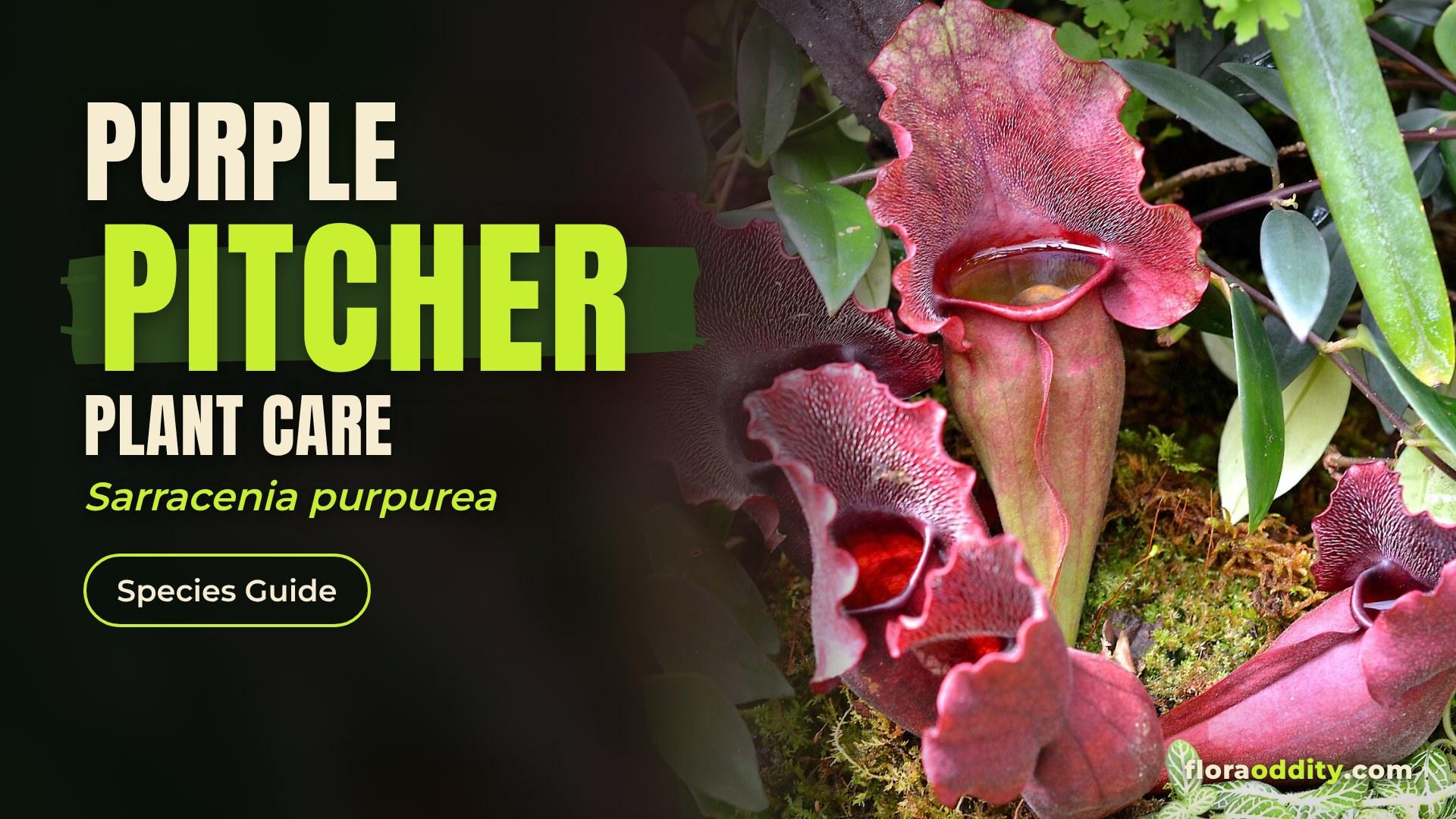
The ICPS adds that the tall, thin Sarracenia traps hold “only a small amount if any free water and essentially starve their prey to death.” Two species work differently. S. purpurea has an open pitcher with a pool of water (see our purple pitcher plant care guide), and S. psittacina uses what the ICPS calls a lobster pot trap: the dark entrance is hard for prey to find again, and inward-pointing hairs push them down the tube.
Which Sarracenia Do You Have?
The ICPS says the genus has 15 species and subspecies, found only in North America and centred on the Gulf of Mexico coast, plus “thousands of Sarracenia hybrids.” Where a species comes from decides how much cold it can take.
S. flava, the yellow pitcher plant. Rice calls it “probably the grandest species of the genus”: a tall, slender trumpet that “can easily be more than a meter tall” (over 3 feet), with a large lid and big yellow flowers that, Rice says, are famous for a strong smell like cat urine. It puts most of its effort into a few pitchers early in the year, then makes flat, sword-shaped leaves without pitchers, called phyllodia, for the winter.
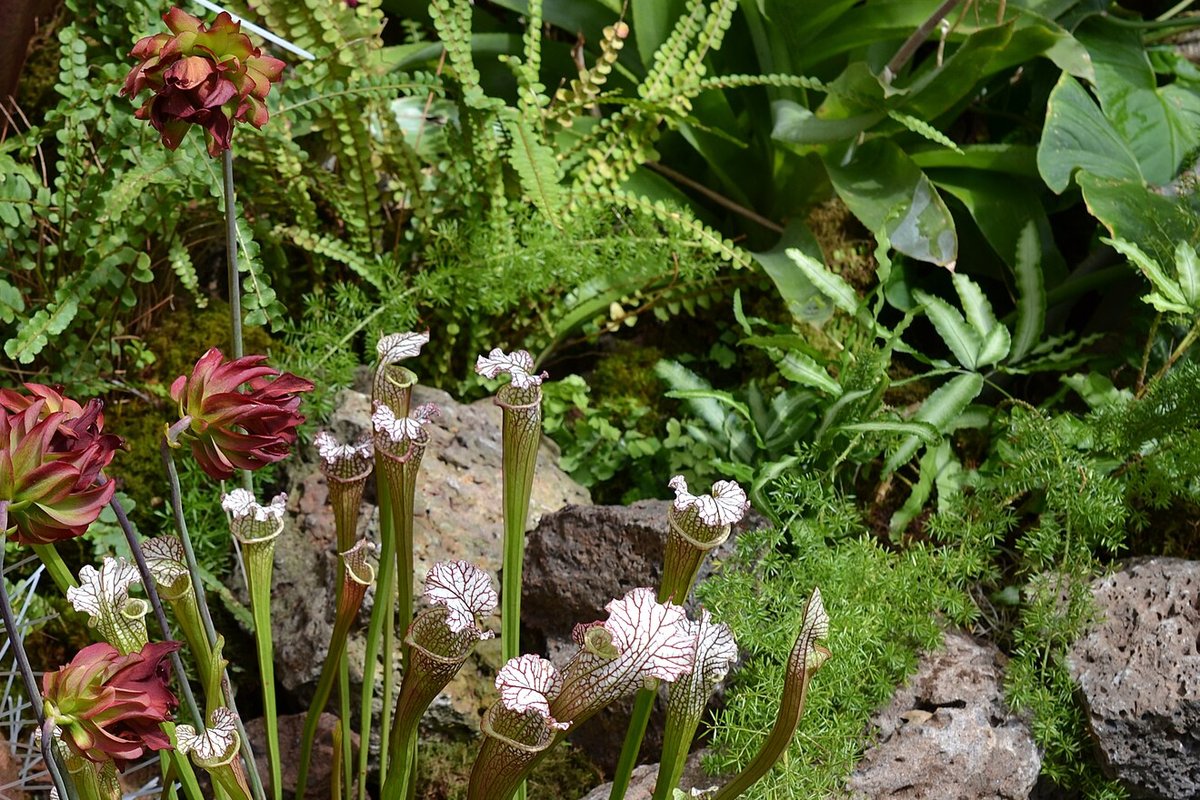
S. leucophylla, the white-topped pitcher plant. The top third or more of each pitcher is white, veined with green or red, and Rice notes “a distinctly frilly lid margin.” It makes two crops of pitchers: lanky ones in spring and much larger ones in late summer. It is a Gulf Coast plant, and the ICPS says some clones may need winter protection even in zone 7.
S. purpurea, the purple pitcher plant. Small, squat pitchers up to about 12 inches (30 cm) long, according to Rice, with an upright hood that does not shield the opening; the ICPS classes it as an open trap with a pool of water. Its pitchers can last up to two years. It has by far the widest range: the ICPS describes subsp. purpurea, from the northeastern United States and southern Canada, as “very cold temperate.”
S. alata, the pale pitcher plant. Tall, upright pitchers with a small lid and cream, greenish, or yellow flowers. Rice says its veins are mostly vertical pinstripes, which helps tell it from S. rubra. It grows in Texas, Louisiana, Mississippi, and Alabama.
S. minor, the hooded pitcher plant. The lid curves down over the mouth like a hood, and the upper pitcher is marked with white spots. Rice gives the typical variety about 12 inches (30 cm) tall, while var. okefenokeensis reaches about 28 to 31 inches (70 to 80 cm).
S. psittacina, the parrot pitcher plant. Rice calls it “the most deviant plant in the genus”: a flat rosette of horizontal pitchers with a rounded, parrot-like head. The ICPS warns it is “freeze sensitive,” but recommends it, with S. rosea, for growing indoors under lights all year.
S. rubra, the sweet pitcher plant. A slender plant with pitchers of 10 to 18 inches (26 to 45 cm) in the typical subspecies, and small red flowers that Rice describes as “sweet-raspberry smelling.”
S. oreophila, the green pitcher plant. Similar to S. flava, but found far inland, mostly in Alabama. Its pitchers appear in spring and, according to the US Fish and Wildlife Service, wither by late summer and are replaced by curved phyllodia. It is listed as Endangered, and Rice is blunt: you “cannot field collect” it.
Hybrids. Rice says all Sarracenia species can hybridize and that the hybrids are fertile. His advice is simple: “grow Sarracenia hybrids just like you grow the pure species.”
The chart below sums up how the main species differ.
| Species | Pitchers | Where it fits | Hardiness | Watch for |
|---|---|---|---|---|
| S. flava | Tall yellow trumpets, over 3 feet (1 m) possible | Sunny patio, bog garden | Zones 6 to 9 (NC State) | Flat winter leaves (phyllodia) instead of pitchers |
| S. leucophylla | White tops, frilly lids; best crop in late summer | Full sun, warm summers | Zone 7; some clones need protection (ICPS) | Freeze damage to the rhizome |
| S. purpurea | Short, squat, open pitchers that hold water; last up to two years | Outdoors, even in cold areas | subsp. purpurea: zone 5 and colder (ICPS) | Remove pitchers only once they are brown |
| S. alata | Tall, pale, vertical veins | Full sun outdoors | Zone 7 (ICPS) | Often makes its best pitchers in fall |
| S. minor | Hooded, white spots | Long, warm seasons | Zone 8 (ICPS) | Early or late freezes |
| S. psittacina | Low rosette, parrot-head traps | Indoors under lights, greenhouse | Freeze sensitive (ICPS) | Frost; prefers pure peat |
| S. rubra | Slender, 10 to 18 inches (26 to 45 cm) | Full sun outdoors | Zone 7 (ICPS) | Dense thatch of old leaves |
| S. oreophila | Like S. flava; pitchers wither by late summer | Full sun outdoors | Zone 6, in mulched bogs (ICPS) | Endangered: buy from a nursery |
Light
Sarracenia are sun plants. California Carnivores recommends “full sun,” and Sarracenia Northwest asks for “6 or more hours of direct sunlight each day,” with an absolute minimum of 4 hours plus bright light for the rest of the day. Its rule of thumb is easy to remember: if a spot gets enough sun to grow tomatoes, it is bright enough for Sarracenia. Rice goes further, calling inadequate light “the single underlying cause for most carnivorous plant deaths at the hands of beginning growers.”
Expect a little scorching at first. California Carnivores says it is common for pitcher lids to “burn” and die back when a plant is first moved into full sun, and that it will soon grow new pitchers. The ICPS adds that in very hot, dry areas some afternoon shade can help.
Water and the Tray Method
Use water low in dissolved minerals. Sarracenia Northwest recommends rainwater, distilled water, or reverse osmosis water, and accepts tap water only if it “contains less than 50 parts per million (ppm) of dissolved minerals.” NC State notes that pitcher plants are sensitive to dissolved salts in chlorinated water, and the ICPS lists salty water among the causes of rhizome rot.
The easiest way to keep the soil wet is the tray method. “The most common way to grow Sarracenia is in pots sitting in water,” says the ICPS, adding that pots should always stand in about 1.5 to 2.5 inches (4 to 6 cm) of water, and that Sarracenia “should never be allowed to dry out.” Sarracenia Northwest lets the level rise and fall naturally, but says it “should generally remain no more than halfway up the pot.”
Soil and Pots
To work out how much of each ingredient your pots need, try our soil mix calculator.
The ICPS calls a 1:1 mix of peat and sand the “default soil for Sarracenia,” and says perlite can replace the sand for plants outdoors, where rain flushes the soil. Sarracenia Northwest uses 1 part sphagnum peat moss to 1 part perlite. Whatever you choose, avoid anything with nutrients: California Carnivores warns, “Never pot them into regular potting soil as the nutrients and fertilizers will kill them over time.”
For mature plants, the ICPS says pots 6 to 8 inches (16 to 20 cm) wide “work best,” and Carnivorous Plant Nursery recommends a deeper, large pot of the same size “because of their long roots.” Sarracenia Northwest adds that the pot needs drainage holes and enough room for the rhizome to keep growing. Carnivorous Plant Nursery plants the rhizome near the edge of the pot with the growing tip pointing to the centre, partly exposed at the top, like an iris.
Temperature and Outdoor Growing
The ICPS says Sarracenia “appreciate long growing seasons and warm to hot summer temperatures.” California Carnivores says they thrive from about 20 to 80 °F (minus 7 to 27 °C) and can take freezes and up to 100 °F (38 °C) for brief periods. Humidity is not a concern outdoors: answering a reader in dry Colorado, Sarracenia Northwest wrote that “Sarracenia purpurea and other varieties of Sarracenia grow well in low humidity.”
How far north you can leave them outside depends on the species. The ICPS says most species are fully hardy to USDA zone 7, S. minor and S. rosea to zone 8, and S. psittacina is freeze sensitive. In zone 6, it suggests sticking to S. flava, S. oreophila, S. jonesii, S. purpurea subsp. purpurea, and their hybrids, grown in the ground and mulched. In zone 5 and colder, only S. purpurea subsp. purpurea can stay outdoors all year. “It is the early and late freezes that can be deadly,” the ICPS warns, and snow is a friend because it insulates the plants.
Bog gardens
Sarracenia also grow well planted in the ground. The ICPS describes artificial bogs made from plastic pond shells, plastic sheeting, or pond liner, and recommends keeping the water level 3 to 7 inches (7 to 18 cm) below the soil surface, adding water on the side opposite the drain. Carnivorous Plant Nursery says they grow “exceeding well in a bog box or bog garden in the yard.” Sarracenia Northwest, by contrast, suggests keeping plants in containers rather than planting them in ordinary garden soil, though pots can stand at the edge of a pond as long as the crown stays above the water.
Dormancy
To check whether your climate gives a natural winter rest, try our dormancy checker.
Sarracenia are temperate perennials, and a winter rest is not optional. California Carnivores says dormancy is “essential to their health,” triggered by “shorter photo periods and colder temperatures from October to February.” Rice gives Sarracenia, like Venus flytraps, “a cool dormancy period of about three months,” with chilly temperatures but some sunlight. He warns that a plant kept growing through its rest will “languish and perhaps even die.” Much of our Venus flytrap dormancy guide applies here too.
The simplest approach is to leave the plants outside. California Carnivores says to do so if night temperatures stay above about 20 °F (minus 7 °C); otherwise, use a sunny windowsill in an unheated room or garage, or, as a last resort, store the bare rhizome wrapped in damp sphagnum moss in a bag in the refrigerator. Sarracenia Northwest keeps the soil moist but not as wet as in summer, and says the bigger danger in severe cold is “dehydration from cold, drying winds and repeated cycles of freezing and thawing.”
Our Sarracenia dormancy guide covers dormancy timing, storage methods, and waking plants up in spring in more detail.
Feeding
For a quick plan, try our carnivorous plant feeding guide: pick your plant and see what to feed, how often and what never to give.
Outdoors, Sarracenia feed themselves. California Carnivores says they “will catch all of their own food,” and Carnivorous Plant Nursery notes that even indoors they “will attract and capture an occasional fly or other insect.” If you want to feed, Carnivorous Plant Nursery suggests a few dead crickets, wasps, or similar insects, or freeze-dried pet shop food, but never meat or cheese, which “will likely rot and kill the trap.”
Do not fertilize the soil of adult plants. The ICPS says there is “little benefit to soil fertilization of mature Sarracenia,” and that fertilizer touching dead plant material such as old leaf bases “can encourage rhizome rot.” Pouring fertilizer into tall pitchers does not get around this, because the plant pumps the liquid into the soil. The one exception the ICPS makes is the S. purpurea group, which benefits from a little fertilizer or a slurry of dried bloodworms in the pitchers, though too much can burn them.
Flowers and Seeds
Flowers come first in spring. Rice says the first thing a mature plant does when growth resumes is make flowers, which reward pollinators with pollen and nectar, and only then grows its new pitchers. NC State describes the flower as an upside-down umbrella on a stalk 6 to 24 inches (15 to 61 cm) tall.
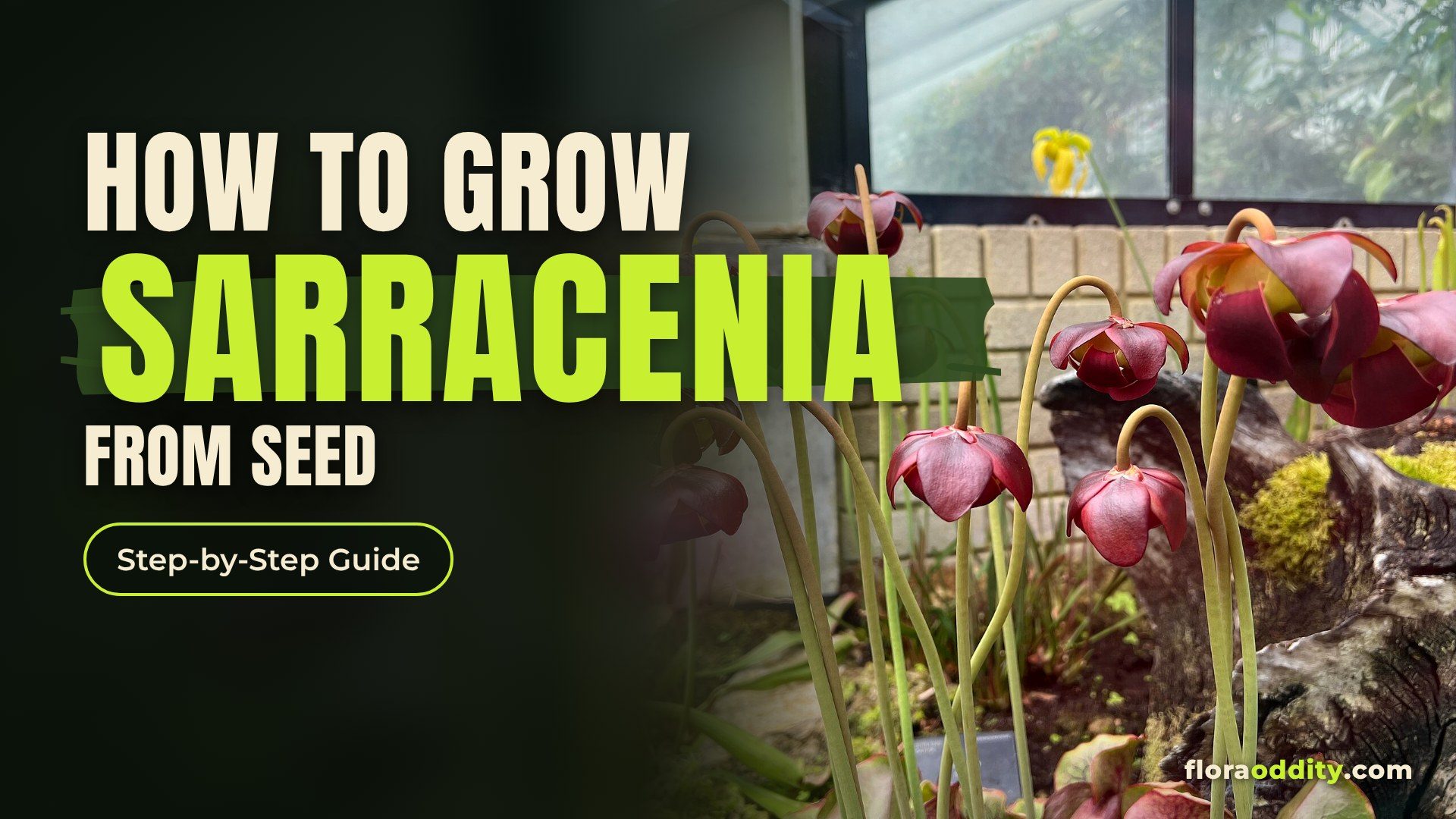
The ICPS says Sarracenia flowers do not pollinate themselves and need certain bumblebees, so without them, or without you playing bumblebee with a natural bristle brush, there will be no seed. Seed also takes patience: it needs 4 weeks of cold, damp stratification, and the ICPS estimates at least 4 years from pollination to a blooming plant. Our guide on how to grow Sarracenia from seed covers stratification and sowing step by step. Carnivorous Plant Nursery suggests removing the flower stalk on potted plants, because it “draws energy from the plant”; see Where Sources Differ.
Repotting and Division
Not sure if it is time? Our repotting advisor checks the timing for your hemisphere and the signs that a plant has outgrown its pot.
Well-grown Sarracenia fill their pots. The ICPS says they need dividing about every three years, because rhizomes in the middle of a crowded clump “grow over each other resulting in weak growth.” Its timing is precise: “The best and only good time of the year to divide Sarracenia is just before the plants start growing in the spring.”
To divide, the ICPS pulls the plant from its pot and works the clump back and forth to find weak points in the old rhizome, aiming for “at least three growth points on each division,” which recover much better than single growth points. Peel off all old brown leaves while you are at it, because that thatch is “an excellent breeding ground for mealybugs.” Our guide on how to repot and divide Sarracenia walks through each step.
Common Problems
Brown pitchers
Some browning is normal. Sarracenia Northwest says individual pitchers “naturally age and die,” and browning increases as plants enter dormancy. S. oreophila is an extreme case: Rice says its pitchers “often die off long before summer is even half over.” Rice notes that pitchers overloaded with prey can be damaged by their rotting contents. Trim only the brown parts. “The plants recover nutrients in old leaves to use with new growth,” the ICPS explains, so cutting off green tissue can starve a plant. Our guide to Sarracenia pitchers turning brown works through every cause.
No pitchers
Check the season and the species first. S. flava and S. oreophila make flat phyllodia instead of pitchers late in the year, and S. leucophylla saves its best pitchers for late summer. If a plant makes thin, green leaves in midsummer, light is the likely cause: California Carnivores says pitchers “looking stretched out and too green” are not getting enough sun, and Sarracenia Northwest describes a terrarium-grown plant with “thin, elongated, green leaves that sometimes don’t form pitchers.” For every cause, see why a Sarracenia is not making pitchers.
Floppy pitchers
NC State says that when S. leucophylla is grown in part shade, “leaf coloring does not develop as it should and pitchers droop.” The ICPS notes that some seedlings simply grow tall, skinny pitchers that fall over, and that overfilling pitchers with water while feeding can also tip them over. Moth larvae are another cause: Rice says Exyra caterpillars eat the pitcher walls, “causing the top of the pitcher to topple over.”
Pests
Twisted or deformed new pitchers usually mean aphids or thrips feeding on young growth. Sarracenia Northwest treats both with a ready-to-use neem product, sprayed in the evening out of direct sun. Carnivorous Plant Nursery warns that mealybugs hide “in the tight crevices of the lower portions of pitcher plant traps near the rhizome,” and suggests removing them with a cotton swab dipped in alcohol. For Exyra moths, it advises cutting off and disposing of infested pitchers. Outdoors, the ICPS warns that squirrels and raccoons “will trash your plants if given the chance.”
Rhizome rot
The ICPS says rhizome rot is usually triggered by over-fertilizing or salty water, which lets weak fungal pathogens attack old rhizome tissue, and that freeze damage turns the rhizomes of cold-sensitive species mushy. Firm, white rhizome can be saved: cut away anything soft or brown and replant.
Where Sources Differ
Good sources disagree on several details. Each row gives the context the sources themselves state.
| Topic | One view | Another view | Context the sources give |
|---|---|---|---|
| How wet | ICPS: pots always in 1.5 to 2.5 inches (4 to 6 cm) of water, never dry | NC State: “The biggest mistake is keeping the plants too wet”; they are “not aquatic plants” | ICPS says the plants “do not mind total immersion for short periods”; NC State says they “grow best in bog gardens” and describes their soil as “mostly sand” |
| Soil mix | ICPS: 1 peat to 1 sand; Sarracenia Northwest: 1 peat to 1 perlite | Carnivorous Plant Nursery: 3 peat to 1 sand; California Carnivores: 4 peat to 1 perlite | ICPS allows perlite outdoors where rain flushes the soil; Carnivorous Plant Nursery says its plants “grow better, when the peat content is higher” |
| Flower stalks | Carnivorous Plant Nursery: remove the spike on potted plants | ICPS: leave flowers if you want seed, and pollinate them by hand | Carnivorous Plant Nursery is writing about potted plants; the ICPS page is a seed-growing guide |
| Fertilizer | ICPS: no soil fertilizer for adult plants; Rice: “never fertilize” | California Carnivores: MaxSea on the leaves and pitchers once a month, not through the soil | ICPS allows careful soil feeding for seedlings and juveniles only; California Carnivores also avoids the soil |
| Indoor growing | Sarracenia Northwest: not suited to terrariums or year-round indoor growing | ICPS: S. psittacina and S. rosea can grow indoors under lights all year | ICPS limits this to two low-growing species and says tall species are hard to light |
| When to divide | ICPS division guide: just before spring growth, the “only good time” | ICPS rhizome rot page: in zones 9 and 10 or a greenhouse, divide in late fall | The fall advice is for mild climates, where the page says divisions then have all winter to callus |
| Number of species | ICPS: 15 species and subspecies | Rice and NC State: 8 to 11 species | Rice says the count depends on the species concept each botanist uses |
Common Mistakes
- Using tap water without checking it. Sarracenia Northwest’s limit is 50 ppm of dissolved minerals.
- Fertilizing the soil. The ICPS links soil fertilizer on adult plants to rhizome rot.
- Growing them in a terrarium or a dim room. Low light gives weak, green pitchers.
- Skipping dormancy. California Carnivores says the winter rest is essential to their health.
- Cutting off green pitchers. The ICPS says plants recover nutrients from old leaves, so trim only the brown parts.
- Collecting from the wild. Rice says the federally Endangered species, including S. oreophila, cannot be field collected; buy from a nursery.
FAQ: Sarracenia Care
Can I grow Sarracenia indoors?
Not easily. Sarracenia Northwest says they are “not good candidates for terrariums or year-round indoor growing,” and the ICPS says tall species are hard to light well. If you have no outdoor space, the ICPS recommends the small S. psittacina and S. rosea under lights, and NC State notes that indoor plants still need winter dormancy.
Do Sarracenia need to be fed?
Not outdoors, where California Carnivores says they catch all their own food. Indoors, a few dead insects are fine, but never fertilize the soil of an adult plant.
Can Sarracenia stay outside in winter?
Usually, yes. The ICPS says most species are hardy to zone 7 and S. purpurea subsp. purpurea survives zone 5 and colder. Protect plants from early and late freezes and from cold, drying winds.
Why are my Sarracenia pitchers turning brown?
Usually because they are old or the plant is heading into dormancy, which Sarracenia Northwest calls normal. In midsummer, it suggests checking sunlight, water quality, pests, and the age of the pitchers.
The Bottom Line
Sarracenia care is simple once you think like a bog: put the plant outside in as much sun as you can give it, stand it in a tray of rain, distilled, or reverse osmosis water, and pot it in fertilizer-free peat with sand or perlite. Let it rest through a cold winter, divide it every few years just before spring growth, and let it catch its own insects. Choose species that suit your winters, S. purpurea for the coldest regions and S. flava, S. leucophylla, and their hybrids where winters are milder, and you avoid the most common problems.
Sources & Further Reading
- International Carnivorous Plant Society: Growing Sarracenia
- International Carnivorous Plant Society: Dividing Sarracenia Step-by-Step
- International Carnivorous Plant Society: Growing Sarracenia from Seed
- International Carnivorous Plant Society: Sarracenia Soil Fertilization
- International Carnivorous Plant Society: Sarracenia Rhizome Rot
- International Carnivorous Plant Society: Carnivorous Plant Trapping Mechanisms
- Barry Rice, The Carnivorous Plant FAQ: Introducing the North American pitcher plants
- Barry Rice, The Carnivorous Plant FAQ: Sarracenia species lists
- Barry Rice, The Carnivorous Plant FAQ: Sarracenia alata
- Barry Rice, The Carnivorous Plant FAQ: Sarracenia flava
- Barry Rice, The Carnivorous Plant FAQ: Sarracenia leucophylla
- Barry Rice, The Carnivorous Plant FAQ: Sarracenia minor
- Barry Rice, The Carnivorous Plant FAQ: Sarracenia oreophila
- Barry Rice, The Carnivorous Plant FAQ: Sarracenia psittacina
- Barry Rice, The Carnivorous Plant FAQ: Sarracenia purpurea
- Barry Rice, The Carnivorous Plant FAQ: Sarracenia rubra
- Barry Rice, The Carnivorous Plant FAQ: Sarracenia hybrids
- Barry Rice, The Carnivorous Plant FAQ: About dormancy requirements
- Barry Rice, The Carnivorous Plant FAQ: About light
- Barry Rice, The Carnivorous Plant FAQ: About fertilizer and hamburger meat
- Barry Rice, The Carnivorous Plant FAQ: What about field collecting Endangered Sarracenia?
- Sarracenia Northwest: Sarracenia Care
- Sarracenia Northwest: Q&A 110, Sarracenia not growing well in a terrarium
- Sarracenia Northwest: Q&A 93, Deformed pitchers on a Sarracenia
- California Carnivores: American Pitcher Plants (Sarracenia) Growing Tips
- Carnivorous Plant Nursery: Growing Tips for Sarracenia
- Carnivorous Plant Nursery: Pests on Carnivorous Plants
- NC State Extension Gardener Plant Toolbox: Sarracenia
- NC State Extension Gardener Plant Toolbox: Sarracenia flava
- NC State Extension Gardener Plant Toolbox: Sarracenia leucophylla
- US Fish and Wildlife Service: Green Pitcher-plant (Sarracenia oreophila)
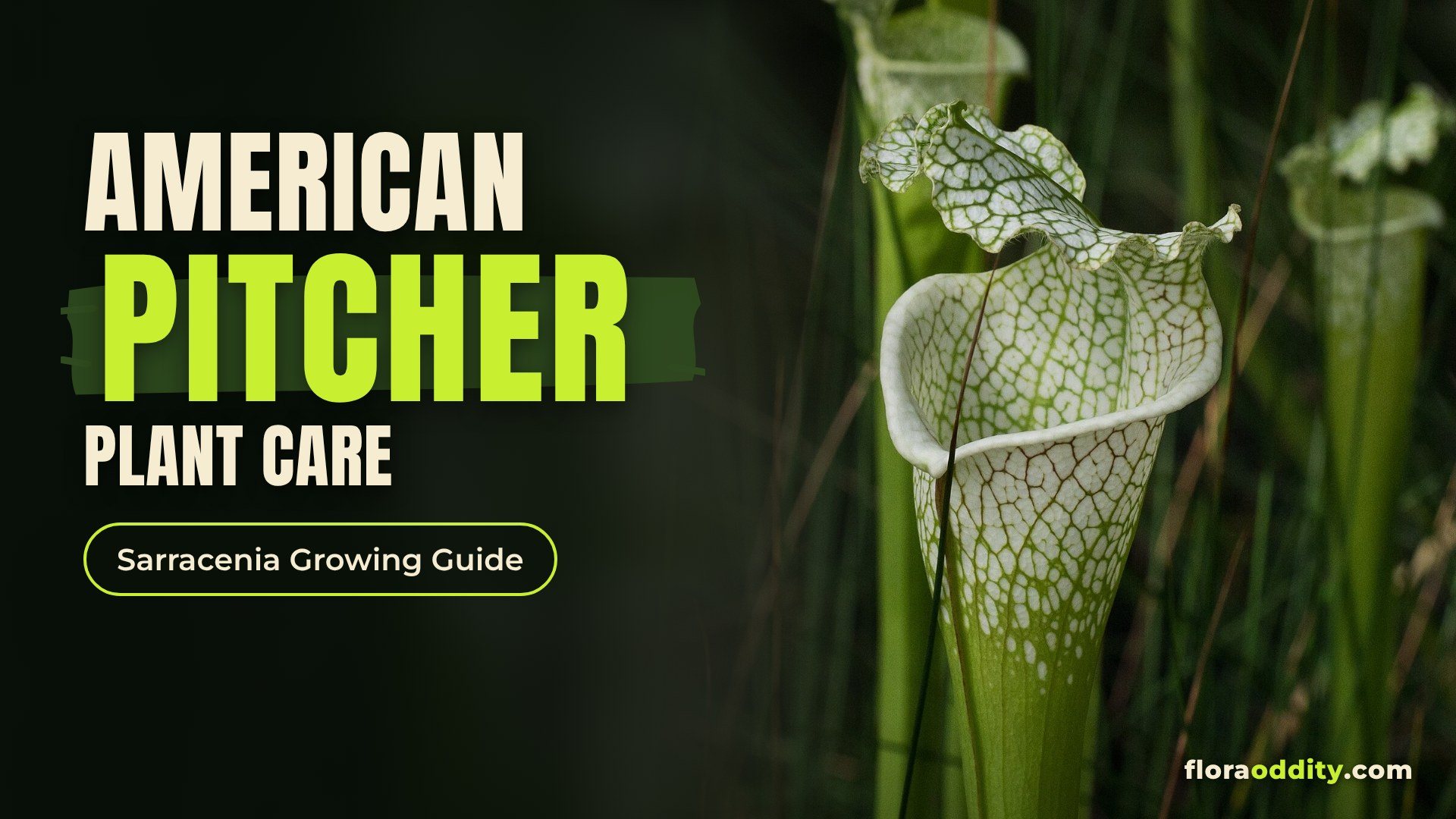
Featured image based on a photo of a white-topped pitcher plant (Sarracenia leucophylla) by Rhododendrites via Wikimedia Commons, CC BY-SA 4.0, cropped with a dark gradient and typography added by FloraOddity. The adapted featured image is shared under the same licence.
Final articles are editorially reviewed and factual claims are checked against cited sources. Last reviewed: October 2026.
12 Comments