
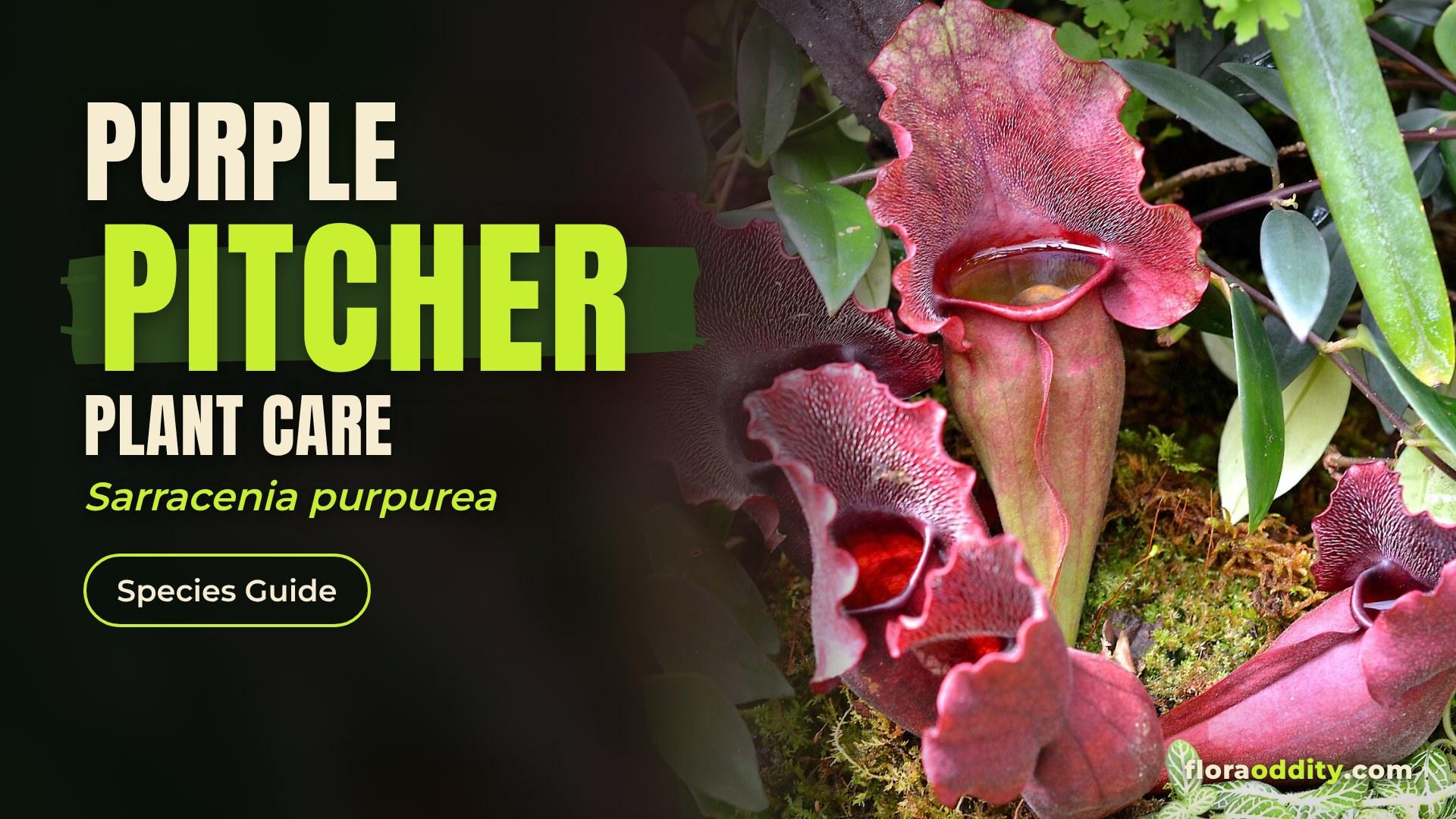
The purple pitcher plant does not look much like its tall cousins. Instead of upright trumpets, it makes a low rosette of fat, curved pitchers that sit open to the sky and fill with rain. Barry Rice, in his Carnivorous Plant FAQ, warns that it “may appear to be a simple, primitive pitcher plant,” but calls it “a very complicated and subtle plant” and “clearly the most successful of all the Sarracenia,” because its range is so much larger than any other species’. Sarracenia Northwest calls the northern form “one of the toughest plants in the nursery.”
Good Sarracenia purpurea care follows the same basics as every American pitcher plant, so this guide does not repeat them. Our Sarracenia care guide covers the genus, and which Sarracenia do you have helps you confirm your plant. Here we focus on what is different about S. purpurea: its water-filled pitchers, its subspecies, its exceptional cold hardiness, and the one feeding rule it breaks.
The Short Answer
Grow S. purpurea outdoors in full sun, in a peat mix kept wet with rain or distilled water. The International Carnivorous Plant Society (ICPS) says the northern subspecies, S. purpurea subsp. purpurea, is the only Sarracenia you can leave outdoors all year in USDA zone 5 and colder; the southern subspecies, subsp. venosa, is far less hardy. Its pitchers can last up to two years, so remove them only once they turn brown. Unlike other adult Sarracenia, it benefits from a little food or fertilizer placed in the pitchers, never in the soil. A very sunny windowsill can work, but terrariums do not.
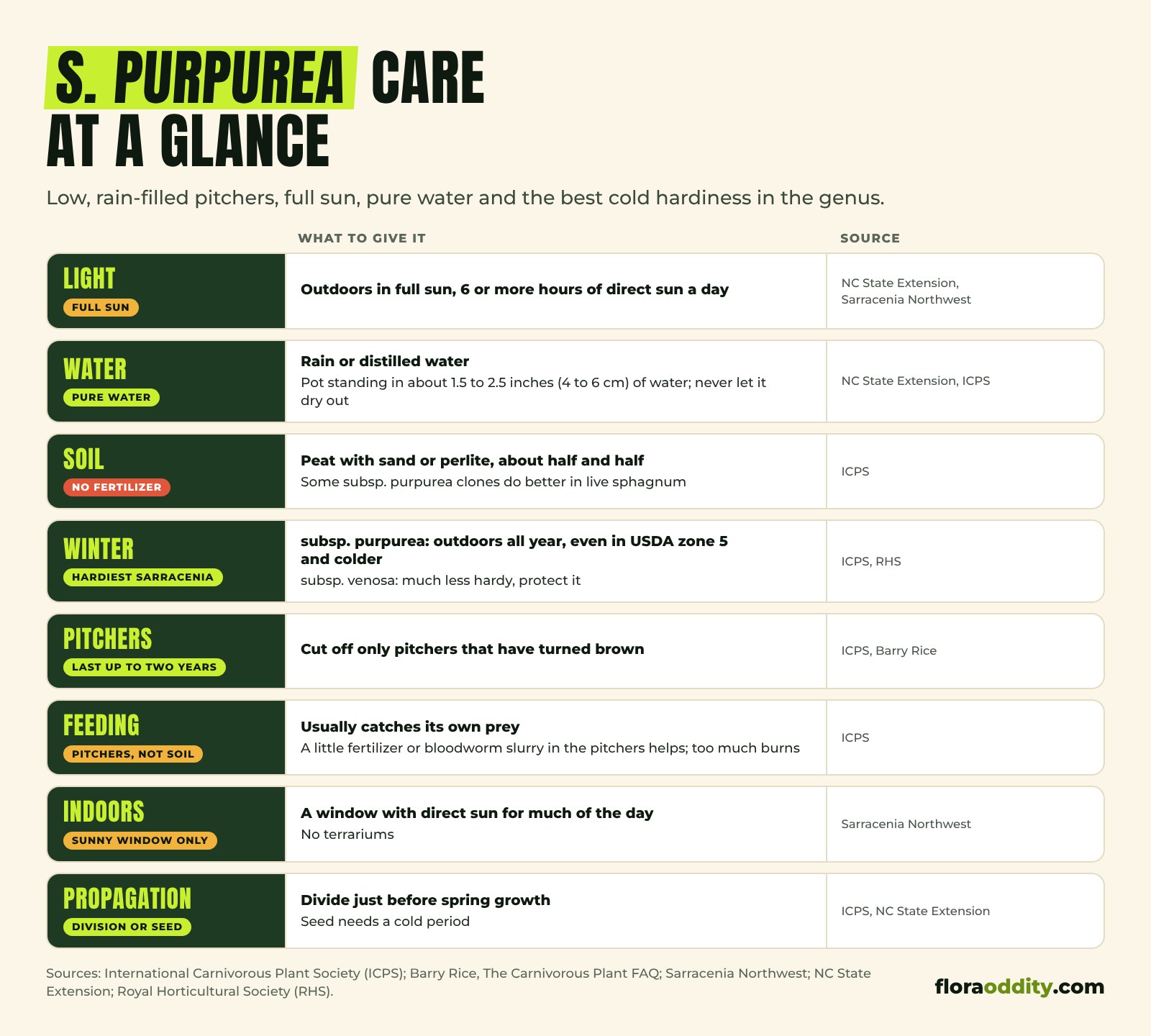
| Need | Key point | What to give it | Source |
|---|---|---|---|
| Light | Full sun | Outdoors in full sun, 6 or more hours of direct sun a day | NC State Extension, Sarracenia Northwest |
| Water | Pure water | Rain or distilled water; pot standing in about 1.5 to 2.5 inches (4 to 6 cm) of water; never let it dry out | NC State Extension, ICPS |
| Soil | No fertilizer | Peat with sand or perlite, about half and half; some subsp. purpurea clones do better in live sphagnum | ICPS |
| Winter | Hardiest Sarracenia | subsp. purpurea: outdoors all year, even in USDA zone 5 and colder; subsp. venosa: much less hardy, protect it | ICPS, RHS |
| Pitchers | Last up to two years | Cut off only pitchers that have turned brown | ICPS, Barry Rice |
| Feeding | Pitchers, not soil | Usually catches its own prey; a little fertilizer or bloodworm slurry in the pitchers helps; too much burns | ICPS |
| Indoors | Sunny window only | A window with direct sun for much of the day; no terrariums | Sarracenia Northwest |
| Propagation | Division or seed | Divide just before spring growth; seed needs a cold period | ICPS, NC State Extension |
What Makes the Purple Pitcher Plant Different
An open pitcher that holds rainwater
Rice explains that in S. purpurea, unlike in the tall, erect pitcher plants, the lid “does not shield the pitcher opening.” It stands upright instead, as a hood “beautifully veined with treelike patterns” and covered with stiff hairs that point towards the opening. The ICPS sorts carnivorous traps by type and puts S. purpurea and S. rosea with the open pitfall traps that hold “pools of water to drown victims,” while it says most tall Sarracenia hold little free water.
The US Forest Service describes how this works in the wild: “The hollow pitchers fill naturally with rainwater.” Insects land on the broad lip and crawl in, and stiff, downward-pointing hairs stop them leaving.
A whole community inside each pitcher
The water in a purple pitcher is not sterile. Rice writes that S. purpurea “produces digestive enzymes,” at least for part of each pitcher’s first year, and that digestion is helped, “especially during the second year, by the commensal organisms that live in the pitchers.” The best known is the mosquito Wyeomyia smithii, whose larvae swim in the pitcher fluid. The larvae of a midge, Metriocnemus knabi, live there too.
The Forest Service describes the same food web: microorganisms feed on the decaying insects and “may actually increase the nutrients available to the plant by further digesting its prey,” while mosquito and midge larvae prey on the microorganisms. It adds that the plant’s digestive enzymes affect neither insect.
Pitchers that last two years
Rice says most Sarracenia pitchers last a year at most, but those of S. purpurea “survive in fine shape for two years” unless fire or extreme cold damages them. The ICPS gives the practical rule that follows: S. purpurea, S. rosea and S. psittacina “should only have their pitchers removed when they turn brown.” For the general reasons pitchers brown, see our guide to Sarracenia pitchers turning brown.
A low rosette
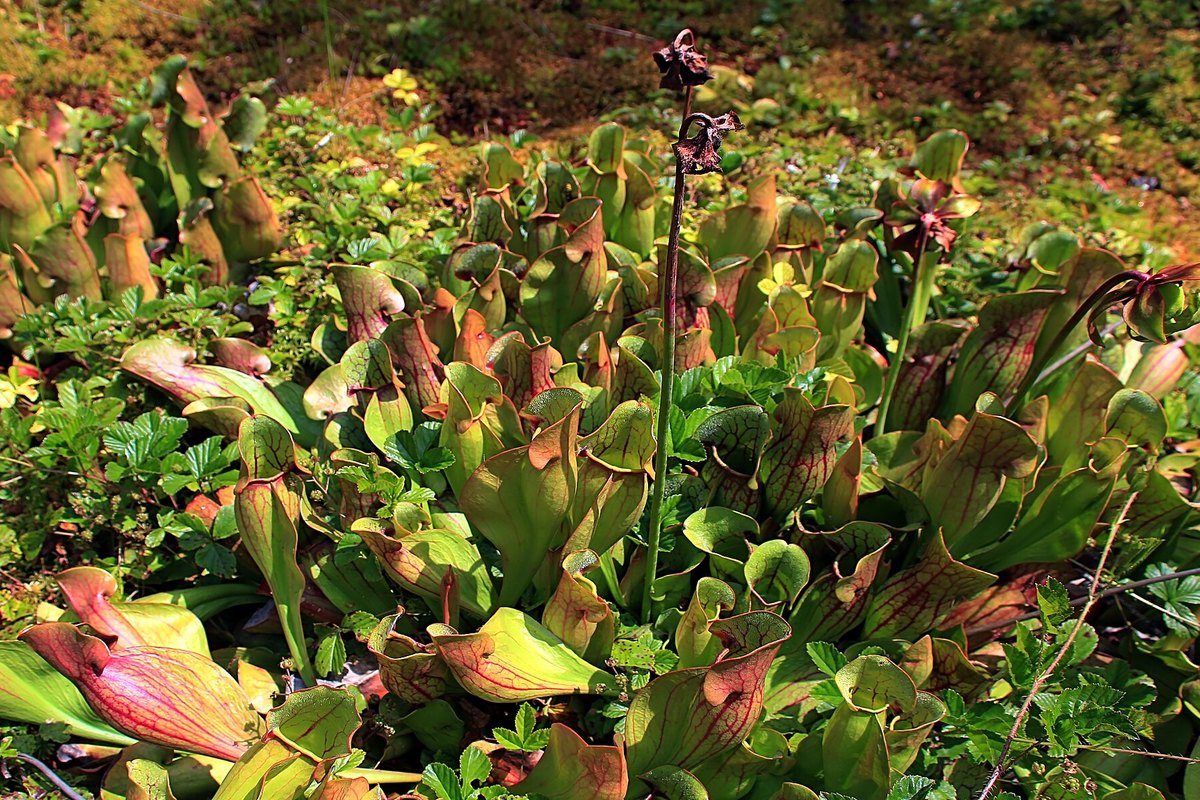
NC State Extension describes leaves that “recline on the surface of the ground with the trap opening upward,” growing in rosettes. It lists the plant at 9 to 18 inches (23 to 46 cm) tall and 1 to 2 feet (30 to 61 cm) wide, and says offsets from the rhizomes form small colonies. Rice gives pitchers up to 12 inches (30 cm) long. Sarracenia Northwest says that while other species grow taller, it grows “broader and denser.”
Subspecies and Forms
Rice says only two subspecies are generally recognized: S. purpurea subsp. purpurea in the north and S. purpurea subsp. venosa in the south. Citing Aaron Ellison, he notes that subsp. purpurea grows in areas that were recently glaciated, while subsp. venosa is found only in unglaciated areas.
S. purpurea subsp. purpurea, the northern purple pitcher plant. Rice lists it from Delaware and Maryland north to Maine and west to Minnesota, and across Canada. Sarracenia Northwest says Newfoundland has made it its provincial flower, and describes “short, smooth, waxy pitchers.” Rice’s field marks agree: a smooth, glossy, waxy outer pitcher, a smaller hood whose side “ears” barely touch when pinched together, pitchers about three times longer than the width of the mouth, and darker red or purple flowers.
S. purpurea subsp. venosa, the southern purple pitcher plant. Rice gives its range as New Jersey to Georgia, with a rough or hairy outer pitcher, a hood whose ears usually overlap, and less elongated pitchers. Answering a grower in Serbia, Sarracenia Northwest said the leaves of subsp. venosa are thinner than those of subsp. purpurea, that it is deciduous, and that it “will drop its pitchers in autumn after a series of overnight frost.” Where the two ranges meet, from New Jersey towards Virginia, Rice says intermediate plants are common.
Mountain plants. A few populations grow in the mountains of North Carolina, Georgia and South Carolina, sometimes named S. purpurea subsp. venosa var. montana. Rice is not fully convinced the variety holds up in the wild.
Green and yellow forms. In the northern subspecies, Rice describes an occasional plant with no red pigment, S. purpurea subsp. purpurea f. heterophylla, with “amazingly electric green leaves and yellow flowers.” The southern equivalent, f. pallidiflora, has never been found in the wild.
S. rosea. This Gulf Coast plant looks very like S. purpurea and is sometimes referred to as S. purpurea subsp. venosa var. burkii. Rice treats it as a separate species, with a thicker lip and pink petals; he says it is the only Sarracenia with pink petals, apart from some hybrids. Care differs too. The ICPS rates S. rosea fully hardy only to USDA zone 8, and Sarracenia Northwest says it “will go dormant and will drop its leaves during significant frost.”
Light
Give it full sun. NC State Extension says purple pitcher plants “prefer full sun during the growing season,” and lists full sun as 6 or more hours of direct sunlight a day. At Sarracenia Northwest in Oregon, S. purpurea is grown outdoors all year and gets “around 10 hours of sun on a sunny day in the summer just like all the other Sarracenia.”
Low light shows quickly. When a grower asked about a S. purpurea kept in a terrarium, Sarracenia Northwest said it showed “all the signs of having been growing in poor lighting,” with “thin, elongated, green leaves that sometimes don’t form pitchers,” and added that the pitchers “should be stout and dark red.”
Water and Soil
Use pure water and keep the soil wet. NC State Extension says rainwater or distilled water “must be used in place of tap water, as the plants are sensitive to minerals and chemicals in household water,” and that a potted plant “must never be allowed to dry out.” The ICPS says Sarracenia pots should always sit in about 1.5 to 2.5 inches (4 to 6 cm) of water.
In the wild, the Forest Service says pitcher plants grow mainly in sphagnum bogs, but also in “any wetland with long periods of standing water, including roadside ditches.” NC State Extension adds that the plant “can survive seasonal flooding” and grows in soil that is acidic and low in nutrients.
For pots, the ICPS default is a 1:1 mix of peat and sand, with perlite instead of sand for plants outdoors, where rain flushes the soil. It singles out this species: “Some clones of Sarracenia purpurea subsp. purpurea and S. minor may do better in live sphagnum.” Humidity is not a concern. Sarracenia Northwest says “Sarracenia purpurea and other varieties of Sarracenia grow well in low humidity.”
Cold Hardiness and Winter
The hardiest Sarracenia
This is where S. purpurea stands apart. The ICPS describes subsp. purpurea, “found in the northeastern USA and southern Canada,” as “very cold temperate but does well in areas with moderate winters.” In USDA zone 5 and colder, it says, the “only option for plants outdoors year round” is S. purpurea subsp. purpurea. Sarracenia Northwest says some carnivorous plants tolerate temperatures as low as minus 30 °F (minus 34 °C) in the wild, and names the northern purple pitcher plant as one of them.
The Royal Horticultural Society (RHS) rates subsp. purpurea H6, “hardy in all of UK and northern Europe,” a rating it defines as minus 4 to 5 °F (minus 20 to minus 15 °C). It rates subsp. venosa only H3, “hardy in coastal and relatively mild parts of the UK,” or 23 to 34 °F (minus 5 to 1 °C). So check which subspecies you have before you trust a plant to a hard winter.
The northern plant also looks better in winter than most. Sarracenia Northwest says it “will also retain its gorgeous pitchers throughout winter.” Carnivorous Plant Nursery agrees that it “can stay in good condition through most winters.” Like every Sarracenia it still needs its winter rest; our Sarracenia dormancy guide covers the methods, and the pillar’s dormancy section gives the short version.
Outdoors in very cold climates
In colder areas, the ICPS favours plants in the ground. For zone 6, it recommends cold-tolerant plants including S. purpurea subsp. purpurea, “best grown in artificial bogs in the ground and heavily mulched and/or covered with row cover during the winter.” “It is the early and late freezes that can be deadly,” it warns, and it calls snow “a great insulator.”
The ICPS also profiles the bog garden of a past president, Carl Mazur, on the Niagara Peninsula in Ontario, in zone 6B. His bogs are kiddie pools sunk in the ground, with holes punched a third of the way down the sides so excess water can drain, filled with pure peat below and a peat and sand mix above. When hard freezing weather threatens, he buries the plants in pine needles, and snow covers them for most of the winter. For plants that need deep cover, the ICPS recommends a pile of pine needles 8 inches (20 cm) or more deep, because a deep layer “does not pack or rot or compost” the way bark mulch would. In his experience, places with frequent freezing and thawing all winter are the difficult ones, which he calls “very hard on the plants.”
Building a bog garden
The ICPS says Sarracenia can be grown “in the ground in artificial bogs made from molded plastic pond shells, plastic sheeting, or pond liner.” It recommends keeping the water level 3 to 7 inches (7 to 18 cm) below the soil surface and adding water on the side opposite the drain.
Feeding: The S. purpurea Exception
For most adult Sarracenia, the ICPS sees “little benefit to soil fertilization,” and warns that fertilizer poured into tall pitchers simply gets pumped into the soil. S. purpurea is the exception. In the ICPS’s words, “Sarracenia purpurea complex plants like water added to their pitchers and do benefit from some fertilizer in the pitchers.” It suggests “a slurry of dried blood worms (fish food)” in the pitchers and warns that “too much may burn the pitchers.”
Dried bloodworms are midge larvae, according to the ICPS feeding guide. For Cephalotus, it grinds a few worms to a powder and carries tiny pieces into the pitcher on a damp toothpick, and it says the same “dusting method” is used for S. purpurea.
Feeding is an option, not a requirement. The ICPS soil fertilization page says adults are better given “some dilute fertilizer into the pitchers if the plants are not catching insects,” and the main guide ends: “In general, it is best to make sure your plants get as much sun as you can give them and that they have access to prey.” Keep fertilizer out of the soil of adult plants either way. The ICPS says fertilizer touching old leaf bases “can encourage rhizome rot.”
Can You Grow S. purpurea Indoors?
Outdoors is best, but a very sunny window can work. Sarracenia Northwest’s general guide says Sarracenia “are not good candidates for terrariums or year-round indoor growing.” Yet in its answer to the grower whose S. purpurea had declined in a terrarium, it also called this “one of the few Sarracenia that will do ok on a windowsill indoors if you have a window that gets direct sun for a significant part of the day.”
The plan it gave that grower is a useful model. Move the plant outdoors in full sun for the growing season, in a saucer of water. In autumn, let it experience a week of frosty nights so it goes dormant, then bring it in to a sunny window, set “as close to the window pane as possible” to keep it cool and away from heat vents. “Do NOT use the glass bell jar,” it added. In spring, after the risk of frost, it goes back outside.
If you can only grow indoors, consider S. rosea. Rice calls it “very easily grown in terraria” and “probably the easiest of all Sarracenia to grow.” Sarracenia Northwest has grown it on a south-facing kitchen windowsill all year without a dormancy, and the ICPS recommends S. rosea, with S. psittacina, for growing indoors under lights.
Propagation
NC State Extension lists division and seed as the recommended methods. The ICPS says the best time to divide is “just before the plants start growing in the spring,” and it likes at least three growth points on each division, because single growth points “struggle for the first year or two.” Our guide to repotting and dividing Sarracenia walks through the process.
From seed, NC State Extension notes that S. purpurea seeds “will germinate after a period of cold stratification.” The New England Carnivorous Plant Society (NECPS) points out that Sarracenia flowers do not self-pollinate. Never dig plants from the wild: NC State Extension says that, like all pitcher plants, this species “is protected in the wild” and should be bought from a reputable carnivorous plant nursery.
Where Sources Differ
| Topic | One view | Another view | Context |
|---|---|---|---|
| Feeding | ICPS: S. purpurea complex plants “do benefit from some fertilizer in the pitchers” | NC State Extension: “The plants should not be fertilized, nor should it be ‘fed’ insects or food” | The ICPS soil page suggests dilute fertilizer in the pitchers “if the plants are not catching insects”; NC State says to “Allow the plant to trap its own food” |
| Terrariums | Carnivorous Plant Nursery: “Consider low growing S. purpurea or S. psittacina for the terrarium” | Sarracenia Northwest: Sarracenia are “not good candidates for terrariums” | Carnivorous Plant Nursery is comparing them with tall species, which it says are hard to light evenly; Sarracenia Northwest’s S. purpurea case had grown thin and green in a terrarium |
| Where to grow subsp. purpurea | RHS: “Grow under glass” | ICPS: the only Sarracenia to keep outdoors all year in USDA zone 5 and colder | The same RHS page adds that most Sarracenias “can be grown outside in milder parts of the country” and rates subsp. purpurea H6 |
| How long pitchers last | Rice: S. purpurea pitchers “survive in fine shape for two years” | Sarracenia Northwest: subsp. venosa “will drop its pitchers in autumn after a series of overnight frost” | Sarracenia Northwest says venosa leaves are thinner than those of subsp. purpurea; Rice’s figure is for the species as a whole |
| S. rosea | Rice: a separate species, S. rosea | McPherson and Schnell (as summarised by Rice): a variety, S. purpurea subsp. venosa var. burkii | Rice cites allozyme studies and Aaron Ellison’s habitat research for keeping S. rosea separate |
Common Mistakes
- Keeping it in a terrarium. Sarracenia Northwest’s terrarium case ended with thin, green, pitcherless leaves, and the nursery told the grower to stop “using any sort of terrarium setup.”
- Cutting off green pitchers. They work for up to two years. The ICPS says to remove S. purpurea pitchers only “when they turn brown.”
- Fertilizing the soil. The pitcher exception does not extend to the pot. Fertilizer in contact with old leaf bases “can encourage rhizome rot,” the ICPS warns.
- Overfeeding the pitchers. A little helps; the ICPS says too much “may burn the pitchers.”
- Treating every purple pitcher plant as equally hardy. The RHS rates subsp. purpurea H6 but subsp. venosa only H3, and S. rosea is hardy only to USDA zone 8, according to the ICPS.
- Using tap water. NC State Extension says the plants are sensitive to minerals and chemicals in household water.
FAQ: Sarracenia purpurea Care
Can a purple pitcher plant stay outside all winter?
The northern subspecies can, even in very cold places. The ICPS says subsp. purpurea is the only Sarracenia to keep outdoors all year in USDA zone 5 and colder, and in zone 6 it favours in-ground bogs with heavy mulch or row cover. Subsp. venosa and S. rosea need more protection.
Should I fill the pitchers with water?
Outdoors, rain does it for you; the Forest Service says the pitchers “fill naturally with rainwater.” The ICPS says S. purpurea complex plants “like water added to their pitchers”; use the same rain or distilled water you give the pot.
Why is my S. purpurea so slow in spring?
That is normal for the northern plant. Sarracenia Northwest says that in cultivation it “grows very slowly and is usually one of the last plants to break dormancy,” and that its dark red flowers come in mid to late spring.
Is S. rosea just a pink-flowered S. purpurea?
Botanists disagree, as the table above shows. For growers the difference matters: S. rosea comes from the hot Gulf Coast and is far less cold hardy.
The Bottom Line
Sarracenia purpurea care starts with the basics of the whole genus: full sun, wet peat, pure water and a cold winter. What sets it apart is that it thrives where other Sarracenia cannot. The northern subspecies can stay outdoors through winters too cold for its tall relatives, especially in an in-ground bog under mulch and snow, while the southern subspecies and S. rosea need gentler treatment. Let its rain-filled pitchers do their work for two seasons, cut them only when brown, and if your plant is short of insects, add a pinch of food to the pitchers, never the soil.
Sources & Further Reading
- International Carnivorous Plant Society: Growing Sarracenia
- International Carnivorous Plant Society: Carnivorous Plant Trapping Mechanisms
- International Carnivorous Plant Society: Sarracenia Soil Fertilization
- International Carnivorous Plant Society: Feeding Dried Blood Worms Step-by-Step
- International Carnivorous Plant Society: Growing Carnivores in Canada
- International Carnivorous Plant Society: Dividing Sarracenia Step-by-Step
- Barry Rice, The Carnivorous Plant FAQ: Sarracenia purpurea
- Barry Rice, The Carnivorous Plant FAQ: Sarracenia rosea
- Sarracenia Northwest: Sarracenia purpurea purpurea
- Sarracenia Northwest: Sarracenia rosea
- Sarracenia Northwest: Sarracenia Care
- Sarracenia Northwest: Q&A 110, Sarracenia not growing well in a terrarium
- Sarracenia Northwest: Q&A 126, Sarracenia purpurea has brown spots
- Carnivorous Plant Nursery: Growing Tips for Sarracenia
- NC State Extension Gardener Plant Toolbox: Sarracenia purpurea
- US Forest Service, Celebrating Wildflowers: Purple Pitcherplant
- Royal Horticultural Society: Sarracenia purpurea subsp. purpurea
- Royal Horticultural Society: Sarracenia purpurea subsp. venosa
- New England Carnivorous Plant Society: American Pitcher Plants care sheet
Featured image based on a photo of purple pitcher plants (Sarracenia purpurea) by incidencematrix via Wikimedia Commons, CC BY 2.0, cropped with a dark gradient and typography added by FloraOddity.
Final articles are editorially reviewed and factual claims are checked against cited sources. Last reviewed: October 2026.

One Comment