
In autumn, a healthy Mexican butterwort can look as if it is falling apart. The broad, sticky leaves stop coming, and a small knot of thick, dry leaves takes their place. Sarracenia Northwest reassures growers that a smaller rosette of succulent leaves “does not necessarily mean your Pinguicula is dying.” A temperate butterwort looks even worse: Barry Rice, writing in Carnivorous Plant Newsletter, describes its summer leaves rotting away to “a stringy muck” once its winter bud has formed.
Butterwort dormancy takes three different forms, depending on where the plant comes from, and each needs its own winter care. This second guide in our Butterwort series picks up where our butterwort care guide leaves off, covering the winter half of the year in detail.
The Short Answer
Mexican butterworts form a tight rosette of small, non-sticky, succulent leaves as the days shorten. Keep them bright and a little cooler, and water much less, from “just slightly damp” to “bone-dry” depending on the plant, as California Carnivores puts it. Resume normal watering when sticky leaves return.
Cold temperate butterworts such as P. vulgaris and P. grandiflora shrink to a winter bud, a hibernaculum, and need real cold. The International Carnivorous Plant Society (ICPS) puts it plainly: “the plant needs cold winter temperatures to survive!” Overwinter them outdoors where winters are cold, or in a refrigerator, as Carnivorous Plant Nursery and Rice describe. Southeastern US species stay in leaf, a little smaller, and want slightly cooler, drier conditions with the soil still moist.
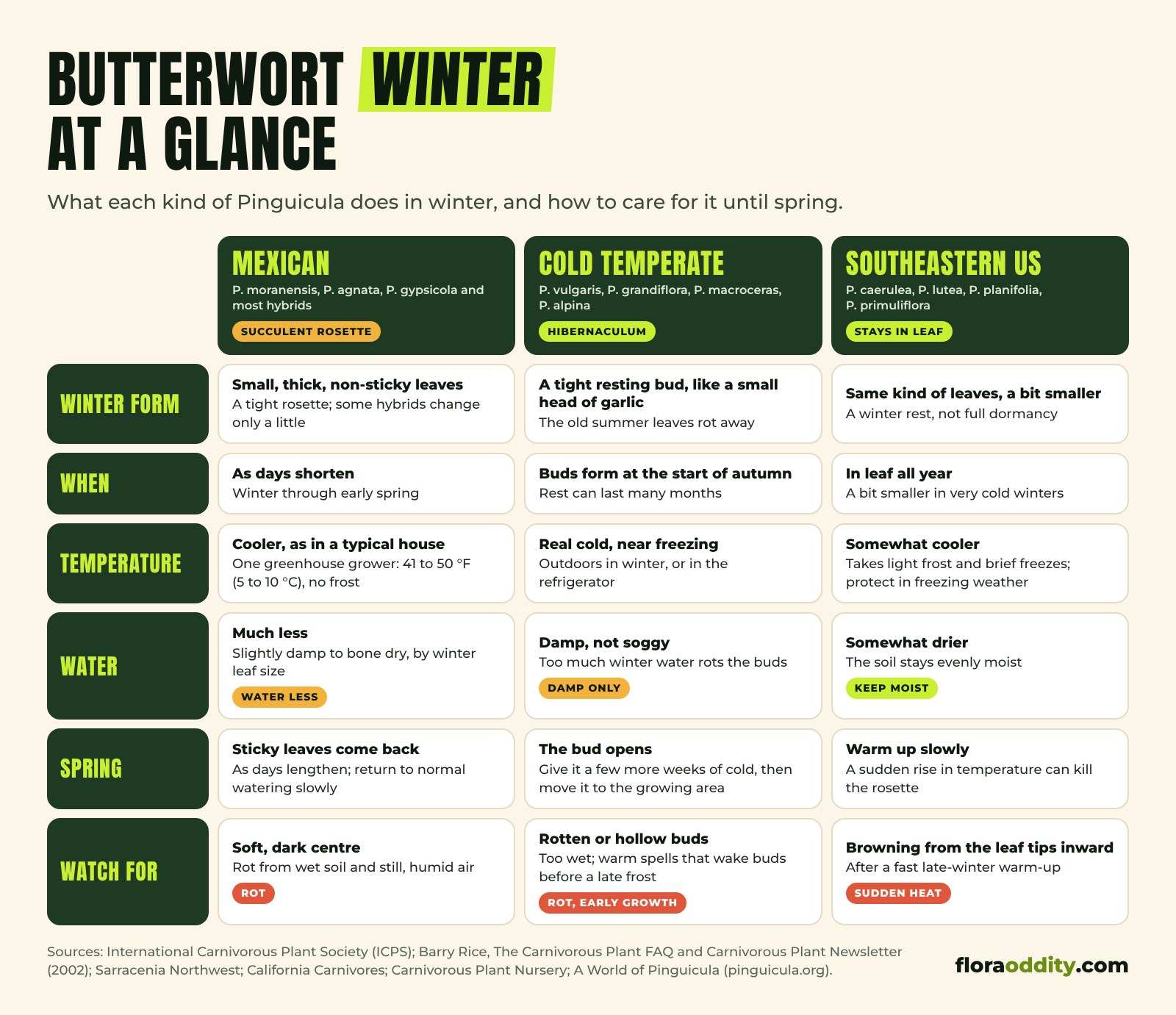
| Mexican | Cold temperate | Southeastern US | |
|---|---|---|---|
| Examples | P. moranensis, P. agnata, P. gypsicola and most hybrids | P. vulgaris, P. grandiflora, P. macroceras, P. alpina | P. caerulea, P. lutea, P. planifolia, P. primuliflora |
| Winter form | Succulent rosette: small, thick, non-sticky leaves; some hybrids change only a little | Hibernaculum: a tight resting bud, like a small head of garlic; the old summer leaves rot away | Stays in leaf: the same kind of leaves, a bit smaller; a winter rest, not full dormancy |
| When | As days shorten; succulent from winter through early spring | Buds form at the start of autumn; the rest can last many months | In leaf all year; a bit smaller in very cold winters |
| Temperature | Cooler, as in a typical house; one greenhouse grower keeps 41 to 50 °F (5 to 10 °C), with no frost | Real cold, near freezing: outdoors in winter, or in the refrigerator | Somewhat cooler; takes light frost and brief freezes; protect in freezing weather |
| Water | Much less: slightly damp to bone dry, depending on the size of the winter leaves | Damp, not soggy; too much winter water rots the buds | Somewhat drier, but the soil stays evenly moist |
| Spring | Sticky leaves come back as days lengthen; return to normal watering slowly | The bud opens; give it a few more weeks of cold, then move it to the growing area | Warm up slowly; a sudden rise in temperature can kill the rosette |
| Watch for | A soft, dark centre: rot from wet soil and still, humid air | Rotten or hollow buds; warm spells that wake buds before a late frost | Browning from the leaf tips inward after a fast late-winter warm-up |
| Sources | ICPS, Sarracenia Northwest, California Carnivores, A World of Pinguicula | ICPS, Barry Rice, Carnivorous Plant Nursery, A World of Pinguicula | ICPS, Barry Rice, Carnivorous Plant Nursery, California Carnivores, A World of Pinguicula |
Which Kind of Winter Does Your Butterwort Have?
To check what kind of winter rest your butterwort needs, try our dormancy checker.
Winter care depends on the group. Our pillar guide explains how to tell which butterwort you have; here is the winter version.
The ICPS describes most Mexican species as heterophyllous: “the summer leaves are slimy and carnivorous; the winter leaves are succulent and not carnivorous.” Cold temperate species, the ICPS says, come from places “that typically have distinct, cold winters,” and “at the beginning of autumn these species form winter buds so the plants can survive being frozen.” Warm temperate species, many of them from the southeastern United States, “have the same type of leaves the whole year round and don’t have any special adaptations to survive freezing weather.”
The Mexican Winter Succulent Stage
What it looks like
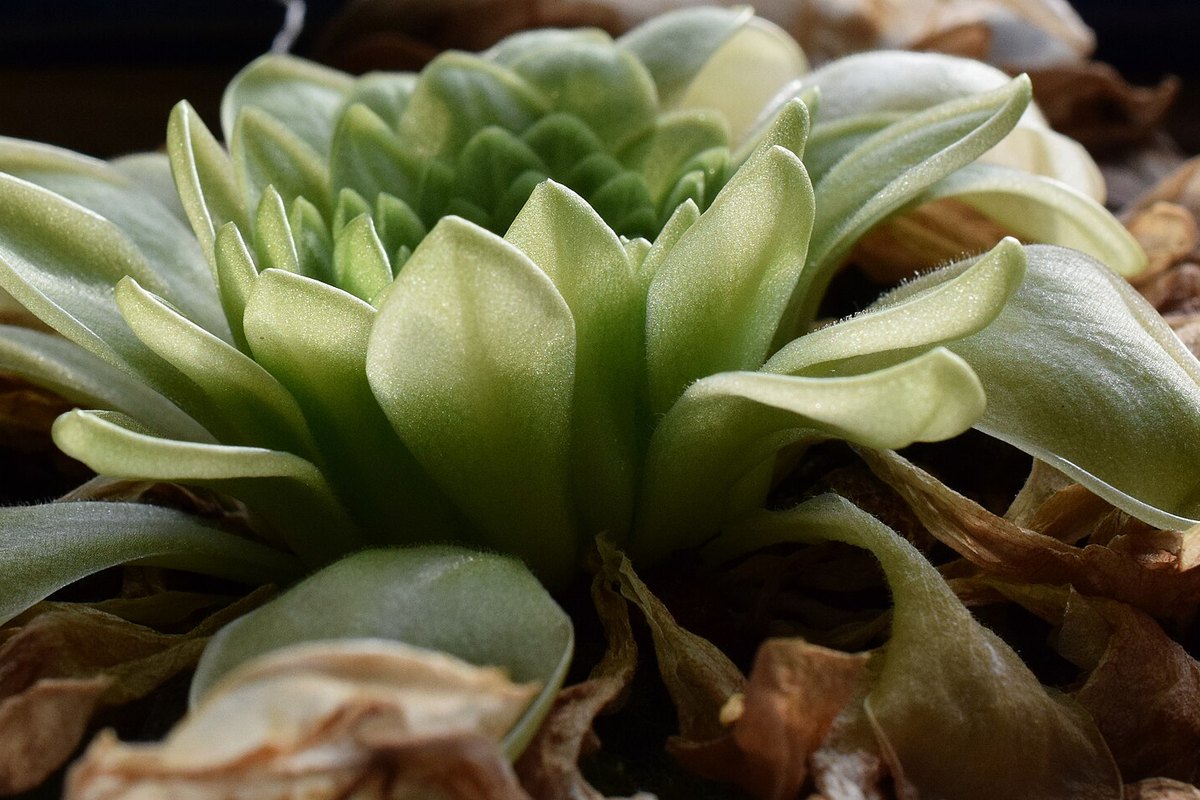
Sarracenia Northwest says that as days become shorter, many Mexican butterworts “may stop producing their broad, sticky carnivorous leaves and form a tight rosette of smaller, thicker, succulent-like leaves instead.” Rice says P. colimensis “regresses to a structure that essentially looks like a bulb,” while the dormancy leaves of P. agnata and P. gigantea are “only marginally smaller” than their summer leaves. Sarracenia Northwest adds that hybrids especially “may show only a subtle change.”
Why it happens
The rosette is a dry-season survival form. Rice explains that these species grow where “they experience a relatively wet season and a dry season,” and that they become “more or less dormant” to get through the dry months. Carnivorous Plant Nursery describes habitat summers of 75 to 100 °F (24 to 38 °C) cooling to 45 to 75 °F (7 to 24 °C) in winter, when the plants “form a dense cluster of smaller succulent leaves in the cool, dry Winter.”
The switch is driven by light. Carnivorous Plant Nursery says “seasonal changes in light, not moisture, trigger the switch between carnivorous and succulent leaves.”
When it starts and ends
The ICPS says that with proper light cues, most species carry carnivorous leaves “from mid spring through fall,” and succulent leaves from winter through early spring. Eric Partrat, who grows Mexican species in a greenhouse and writes on A World of Pinguicula, stops watering between September or October and March or April, and says the exact dates depend on your local climate and your plants.
The winter stage is not always a quiet one. Sarracenia Northwest says many species, “such as P. laueana, will bloom profusely” during their winter phase.
Light and temperature
Leave the plant in its bright spot. The ICPS says heterophyllous species need seasonal light cues, from a greenhouse, a sunny window, or plant lights on a timer whose on and off times change with the seasons. What matters is “slowly increasing or decreasing day length”; plants under an unchanging light period “will essentially get stuck in the non-carnivorous phase.”
The ICPS says plants in the succulent state “should be kept cooler and drier,” and that these conditions “are typical of those in a house.” In his greenhouse, Partrat finds 41 to 50 °F (5 to 10 °C) best during the winter rest, “if the substrate is dry enough,” and keeps frost out with a small heater.
Watering less
Water is the part to change. California Carnivores says “we wait for the butterworts to go dormant before we stop watering,” then keeps the soil “on the dry side, dampening them only slightly and occasionally.” It uses the winter leaves as a guide: tight, small-leaved rosettes such as P. gypsicola, and the bulb-like P. heterophylla and P. macrophylla, “require bone-dry conditions,” while species with larger winter leaves, such as some P. moranensis forms and P. agnata, like their soil “just slightly damp.”
Tray growers can simply stretch the gaps. The author of the ICPS guide keeps up to about 0.75 inch (2 cm) of water in the trays while the plants are carnivorous, then lets the trays “dry out for a week or so between waterings” in the succulent phase. Sarracenia Northwest takes the gentlest line: let the soil become “somewhat drier between waterings, but do not allow the plant or soil to remain completely dry for extended periods.”
What not to do
- Do not soak a resting rosette. Partrat warns that in autumn some rosettes sit low in the mix, “not always visible from the surface,” and that “watering at this stage can induce the rotting of the rosette.”
- Do not keep the air humid and still. Partrat says high winter humidity in his greenhouse “can be source of rotting the resting rosette,” so he lowers it to 50 to 60% and runs a fan.
Winter is a good time to handle many of these plants. The ICPS calls the succulent stage of P. cyclosecta “the best time to propagate and repot the plant,” but warns that P. ehlersiae “can fall apart during the winter if repotted.”
Temperate Butterworts and Their Hibernacula
What a hibernaculum is
Rice writes that boreal butterworts “rest as tight buds called hibernacula (singular: hibernaculum).” He describes them in his Carnivorous Plant FAQ as looking “like small heads of garlic.” In most species, he says, the buds “are usually loosely attached to the ground, and detach readily.”
The first sign is a change in growth. Rice watches for plants that “stop producing full-size leaves, and instead form a tightly packed hibernaculum.” A few to several weeks later, the summer leaves rot away. Many plants also make tiny daughter buds, called gemmae, before dormancy; Rice says they can be “less than 1 mm long,” and he marks them with tiny bits of white plastic on the soil so he does not lose them.
How much cold they need
These plants cannot skip winter. Rice says they “require frigid winters to survive,” that the rest can last many months (some of his plants from near the Arctic Circle rested for nine months of the year), and that grown without seasonal change, “these plants would die within a year.” Carnivorous Plant Nursery calls for “cold temperatures near freezing.”
Overwintering outdoors
Where winters are naturally cold, the plants can stay outside. A garden page on A World of Pinguicula, where temperate species grow in plastic boxes, stresses two points: “It is important to have sun also in winter or you’ll have many rotten plants,” and while the water level is kept high in the growing season, “in winter it is important to remove all the water.”
Iwein Coppens, describing a 2004 experiment on the same site, kept temperate butterworts on porous rocks outdoors all winter, in an insulated box with a glass lid, shielded from rain. He watered very little, the rocks were “bonedry” by late winter, and he had “no losses due to this dry treatment.” He also warns that “too much water in winter will cause the hibernacula to rot.”
The refrigerator method
Rice grew boreal butterworts in the Sonoran Desert, where summers hover near 115 °F (46 °C), and wrote that “the principle device you need to grow boreal plants is a little space in your refrigerator.” In his FAQ, written from a mild Mediterranean climate, he still refrigerates his plants “until they resume growth.” His method:
- Once the summer leaves have rotted, remove weeds and rotten leaves and look over the bud. Collect any gemmae, and repot now if needed; he repots every second year or so.
- Store the plant, “pot and all, in a sealed plastic bag” in the refrigerator.
- Check each bag once a month and remove leaves as they die.
Carnivorous Plant Nursery offers a bare-bud version: the hibernacula “may be cleaned and stored in damp peat in a refrigerator.” In his general advice on refrigerator dormancy, Rice adds a firm “not the freezer!” and says a plant in that deep dormancy does not need sunlight, “but the soil should be kept moist.” For a similar method with pitcher plants, see our Sarracenia dormancy guide.
Indoors, you can prompt the buds. For terrarium plants, Rice suggests cutting the light period in autumn to about 75% of the summer value; he moves his from sixteen hours to twelve.
When they wake
Do not rush it. Rice writes: “First the hibernaculum will open,” but do not take the plant out of the refrigerator yet; “Wait another few weeks first.” Back in the growing area, the first weeks of growth “can be amazingly frantic.” Flowers, if any, come early in the season, and the growing period is short before the plant drowses back into dormancy.
Outdoors, the danger is a false spring. Coppens warns that warm late-winter days make plants “start growing too early” so that they “can be surprised by late frost,” and notes that “some people keep the hibernacula in the refrigerator until the risk of frost is gone.”
Southeastern US Butterworts in Winter
These plants never form a bud. Rice says they “are in leaf year-round, although they tend to become a bit smaller during the winter if the conditions become very cold.” Carnivorous Plant Nursery calls it a “winter rest with smaller leaves, rather than full dormancy,” and says the plants “should be kept somewhat cooler and drier, but the soil should remain evenly moist.”
They are not frost-proof. California Carnivores says the US warm temperate species “tolerate light frost and brief freezes” and do best outdoors where winters are mild, and the ICPS suggests protecting outdoor plants during freezing weather.
Spring can be the riskiest moment. A disease page on A World of Pinguicula, by Laurent Legendre with additions by Eric Partrat, describes a sudden “rosette edge-to-center death” in southeastern US butterworts that appears “in late winter/early spring when the temperature is raised too rapidly.” No pathogen was found, and “slower elevations of temperature are the only way of preventing” it.
Waking Up in Spring
For Mexican butterworts, Sarracenia Northwest says that “after several weeks or months, increasing day length and warmer conditions will usually encourage the plant to resume producing its larger carnivorous leaves.” Then “gradually return to your normal active-growth watering routine.” California Carnivores restarts its tray watering once carnivorous leaves begin to grow.
The transition can look alarming. In one reader case from April, a P. ‘Alfred Lau’ that looked “really sad” to its owner was, Sarracenia Northwest said, simply “transitioning out of its winter succulent growth and beginning its spring growth.”
Winter Problems
The basics of rot and pests are in our pillar guide’s common problems section. These are the ones that belong to winter.
Dormant or dead?
For Mexican types, look at the centre. Sarracenia Northwest says “small, healthy succulent leaves usually indicate normal seasonal growth,” while “soft tissue, rapid browning, or a deteriorating crown indicates a genuine problem.”
For temperate types, rotting leaves are expected. Rice describes the summer leaves rotting to muck a few weeks after the bud forms, so judge the hibernaculum itself, not the mess around it.
Rot
Most winter rot comes back to water and still air. For Mexican butterworts, Partrat blames watering a buried rosette and humid winter air; for temperate buds, Coppens blames too much winter water, and the A World of Pinguicula garden page links a lack of winter sun to “many rotten plants.”
Hollow hibernacula
The A World of Pinguicula disease page describes a strange one: “an healthy hibernaculum in winter revealing in early spring an empty hibernaculum,” its heart eaten away, which the page blames on the fungus Pythium. “Most of the time, the plant is able to produce new plantlets few weeks later,” it says, though sometimes the whole plant rots. That page suggests a preventive treatment; the ICPS, by contrast, says “Do NOT ever use any kind of fungicide on Pinguicula” (see Where Sources Differ).
Fungus gnats
Sarracenia Northwest notes that succulent leaves “use less water,” and reads gnats as a warning sign: “If you have a problem with fungus gnats (or springtails), the soil of your butterwort is too wet.” The ICPS says the larvae prefer “wet, peaty soils,” damage Pinguicula with leaves touching the soil, and can be kept out with a layer of medium to coarse horticultural sand about 0.2 inch (5 mm) deep.
Where Sources Differ
Each row gives only the context the sources themselves state.
| Topic | One view | Another view | Context the sources give |
|---|---|---|---|
| Is it dormancy? | California Carnivores: Mexican butterworts “have a winter dormancy”; Partrat: “The plants need a winter dormancy period” | Sarracenia Northwest: the P. agnata rosette “is not dormancy”; Carnivorous Plant Nursery, tropical butterworts: “Dormancy: No,” a winter “rest” | Sarracenia Northwest says the phase “was historically described as ‘dormancy'” but the plant stays physiologically active and may flower; Carnivorous Plant Nursery contrasts the rest with hibernation |
| Winter water, Mexican types | Partrat: stop watering from September or October to March or April; Carnivorous Plant Nursery: “In Winter let the soil go dry”; California Carnivores: bone dry for small-leaved rosettes | Sarracenia Northwest: do not leave the plant or soil completely dry for extended periods; Rice: some master growers “do not withhold water during the winter and they do just fine” | Partrat grows in a greenhouse at 41 to 50 °F (5 to 10 °C), with humidity lowered to 50 to 60% and a fan; California Carnivores ties dryness to the size of the winter leaves |
| Winter moisture, temperate types | Carnivorous Plant Nursery: hibernacula stored in damp peat in a refrigerator; Rice: pot and all in a sealed bag | Coppens: very little water; rocks “bonedry” by late winter with no losses | Coppens’s plants were outdoors on porous rocks in an insulated, glass-covered box, shielded from rain, in a 2004 experiment; he also says too much winter water rots hibernacula |
| Leaving the refrigerator | Rice: wait a few weeks after the bud opens, then return the plant to the growing area | Coppens: some growers keep hibernacula in the refrigerator until the risk of frost is gone | Coppens describes plants outdoors, where warm late-winter days can wake them before a late frost |
| Treating winter rot | ICPS: “Do NOT ever use any kind of fungicide on Pinguicula,” which “includes all Pinguicula species” | A World of Pinguicula disease page: treats hibernacula preventively each winter against Pythium | The disease page describes hollow hibernacula caused by Pythium and calls the product it uses “very rare”; the ICPS says fungicides are “death even in the soil” |
Common Mistakes
- Watering a succulent rosette like a summer plant. Wait for the winter leaves, then water much less.
- Keeping Mexican butterworts under unchanging light hours. They can get stuck in the non-carnivorous phase, and may stay succulent long into spring.
- Keeping temperate butterworts warm all winter. Without a cold rest, Rice says, they die within a year.
- Throwing out a temperate pot full of rotting leaves. Check the bud first; the old leaves are supposed to rot.
- Taking hibernacula out of the refrigerator the moment they open. Rice waits a few more weeks.
- Warming southeastern species too fast in late winter. A slow rise in temperature is the only prevention for rosette edge-to-center death.
FAQ: Butterwort Dormancy
Do all butterworts go dormant in winter?
No. Cold temperate species go fully dormant as hibernacula. Most Mexican species make a succulent winter rosette that some sources call dormancy and others call a rest. Southeastern US species stay in leaf.
How long does butterwort dormancy last?
For Mexican butterworts, the ICPS puts succulent leaves from winter through early spring, and Partrat waters again in March or April. Temperate species rest much longer: Rice says the dormant period “can last many months,” up to nine months for some arctic plants.
Should I water my butterwort in winter?
It depends on the type. Mexican types need much less, from slightly damp to bone dry depending on the size of the winter leaves, and some growers stop watering altogether. Southeastern US species stay evenly moist. Temperate buds should be damp, not wet; Coppens warns that too much winter water rots them.
Can I put my butterwort in the fridge for winter?
The refrigerator method in these sources is for temperate species with hibernacula: Rice stores them pot and all in a sealed bag, and Carnivorous Plant Nursery stores cleaned buds in damp peat. For Mexican butterworts, the ICPS simply recommends cooler, drier conditions like those of a house.
The Bottom Line
Butterwort dormancy is three different things. Mexican butterworts become small succulent rosettes that need bright light, slowly changing day length, cooler air and much less water until sticky leaves return. Cold temperate butterworts retreat into hibernacula that need months of real cold, outdoors or in a refrigerator, damp but not wet. Southeastern US species stay in leaf and want a cooler, slightly drier but still moist winter and a gentle warm-up in spring.
Sources & Further Reading
- International Carnivorous Plant Society: Growing Mexican Pinguicula
- International Carnivorous Plant Society: Growing cold temperate Pinguicula
- International Carnivorous Plant Society: Growing warm temperate Pinguicula
- International Carnivorous Plant Society: Growing Pinguicula alpina
- International Carnivorous Plant Society: Mexican Pinguicula Leaf Pullings
- International Carnivorous Plant Society: Fungus Gnat Larvae
- Barry Meyers-Rice (2002), Cold Pinguicula in a Hot Climate, Carnivorous Plant Newsletter 31(1): 25 to 27 (PDF)
- Barry Rice, The Carnivorous Plant FAQ: Heterophyllous species of Mexico and Central America
- Barry Rice, The Carnivorous Plant FAQ: Pinguicula of the USA and Canada
- Barry Rice, The Carnivorous Plant FAQ: Temperate and Arctic species
- Barry Rice, The Carnivorous Plant FAQ: Pinguicula cultivation
- Barry Rice, The Carnivorous Plant FAQ: Dormancy tricks that may work
- Sarracenia Northwest: How to Grow Tropical Butterworts (Pinguicula)
- Sarracenia Northwest: Pinguicula agnata
- Sarracenia Northwest: Q/A #76, Pinguicula and Sundew Are Looking Sad
- Sarracenia Northwest: Q/A #20, Spider Mite Web?
- California Carnivores: Butterworts (Pinguicula) Growing Tips
- Carnivorous Plant Nursery: Growing Tips for Tropical Butterworts
- Carnivorous Plant Nursery: Growing Tips for Temperate Butterworts
- A World of Pinguicula: Growing Mexican Pinguicula (Eric Partrat)
- A World of Pinguicula: An Alternative Cultivation Method for European Pinguicula (Iwein Coppens)
- A World of Pinguicula: Growing Pinguicula in a Garden
- A World of Pinguicula: Diseases (Laurent Legendre and Eric Partrat)
Featured image based on a photo of a Mexican butterwort (Pinguicula moranensis) in its winter succulent phase by incidencematrix via Wikimedia Commons, CC BY 2.0, cropped with a dark gradient and typography added by FloraOddity.
Final articles are editorially reviewed and factual claims are checked against cited sources. Last reviewed: October 2026.


3 Comments