Learning how to water Lithops means learning to read a calendar that the plant keeps for itself. A living stone is a single pair of swollen leaves that stores water for months, and once a year it grows a new pair inside the old one. Susan Mahr of University of Wisconsin Extension calls over-watering “the chief cause of early demise,” and Gardeners’ World names watering at the wrong time of year as the main problem. Most failures come from water given at the wrong moment, not from too little of it.
This guide covers when to water in each phase, how much to give, and how to read the plant.
The Short Answer
- Leaf change (winter into spring): no water. The new pair draws its water from the old pair, so the soil should stay dry until the old leaves have shrivelled to thin papery skins.
- Spring, once the old skins are dry: start again with a thorough soak, then let the pot dry out completely before the next one.
- High summer: sources differ. Many say the plants rest in strong heat and should get little or no water; a UK greenhouse grower waters weekly through the summer.
- Late summer and autumn: the main growing and flowering season. Water thoroughly whenever the pot has dried out.
- After flowering into winter: stop, and keep the pot dry until the next leaf change is finished.
Each time you water, soak the pot until water runs out of the bottom, never leave it standing in water, and wait until the mix is fully dry before watering again. If in doubt, do not water.
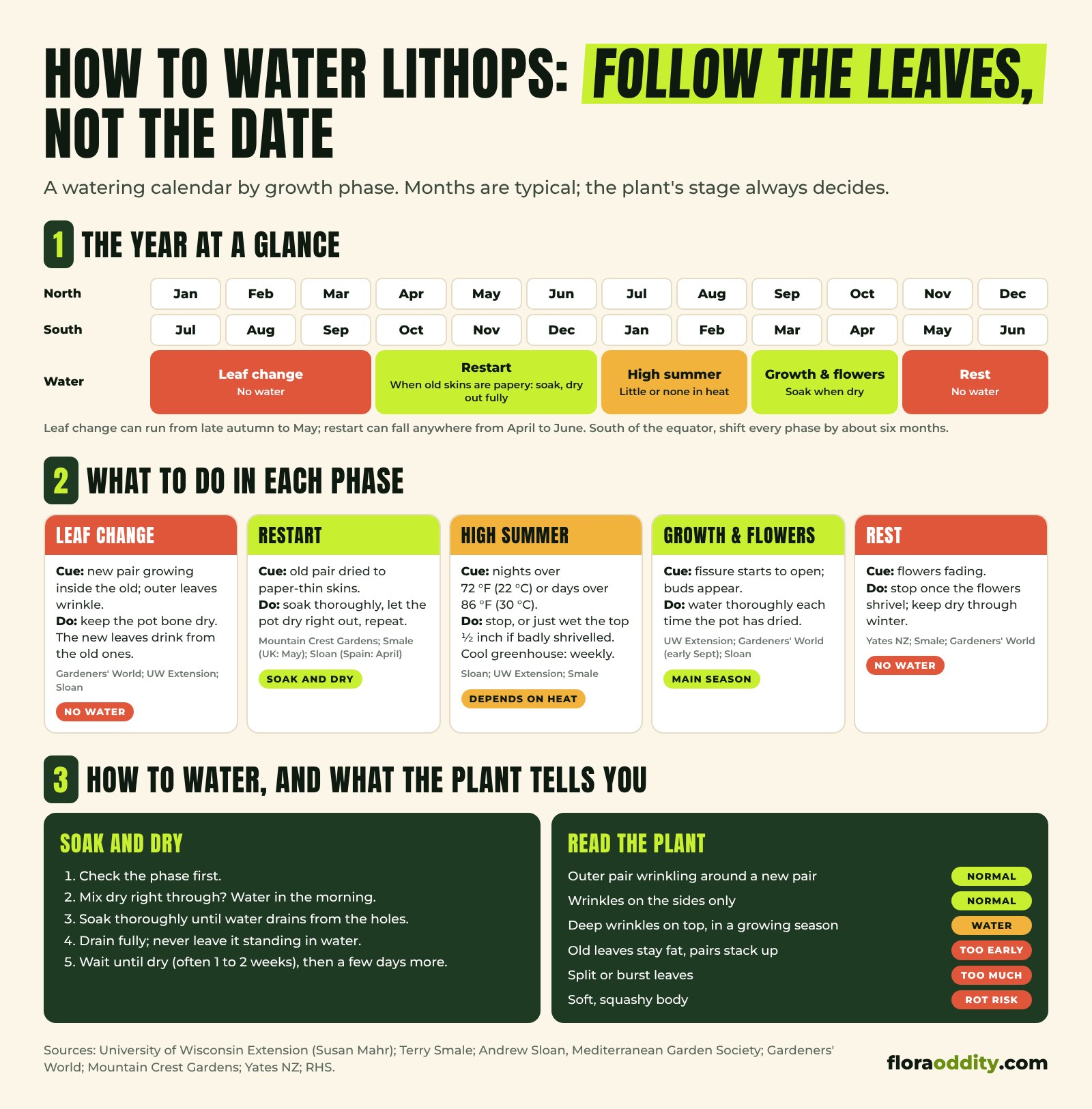
| Phase | Typical months (Northern Hemisphere) | What the plant is doing | Watering |
|---|---|---|---|
| Leaf change | December to April | New pair grows inside the old one, which shrivels | None |
| Restart | April to June, when old skins are papery | New pair fully out, roots waking | Soak, then dry out fully |
| High summer | July and August | Slow or resting in heat | Light or none in heat; regular in a cool greenhouse |
| Autumn growth and flowering | September and October | Fissure opens, buds and flowers | Soak each time the pot dries |
| Winter rest | November and December | Flowers over, new pair starting | None |
The months are a rough guide from the sources below. Follow the plant, not the date.
Why Lithops Need a Calendar
Lithops come from dry parts of southern Africa. University of Wisconsin Extension says rainfall where they grow is “generally less than 20 inches annually,” mostly in spring and autumn, and that the thick leaves “can store enough water for the plants to survive for months without rain.”
That storage is why timing matters more than quantity. Wisconsin Extension describes a yearly cycle in which it is “essential to water only during certain stages and to keep the soil dry at other stages.” Too much water at the wrong stage and the plants rot or “produce new bodies at the wrong time of year.” Too little and they become stunted.
The key event is the leaf change. Wisconsin Extension explains that after flowering the plant rests while at least one new body forms, and in spring the old leaves are reabsorbed as the new pair pushes out through the fissure. Gardeners’ World adds the detail that drives the whole calendar: the new pair “grows by drawing water from the old pair, so the soil should be very dry.”
The Watering Calendar, Phase by Phase
Leaf change: winter into spring
This is the phase where most plants are lost. From late autumn the new pair grows inside the old one, and the old leaves slowly wrinkle, thin and dry out. Watering now does not help the new leaves. Wisconsin Extension warns that “if water is given too soon, the old leaves will try to continue to grow and the plant will not develop properly.”
Gardeners’ World says not to water at all from October until the old pair has completely withered, “often not until the following May.” Terry Smale, a UK grower of mesembs whose Lithops cultivation notes were first published in the RHS journal The Garden, keeps pots “completely dry through the winter until the next May.” Andrew Sloan keeps the soil “bone-dry no matter how shrivelled the plants become.” Mountain Crest Gardens, a succulent nursery, says simply: do not water in winter or while a Lithops is splitting.
A wrinkled outer pair at this stage is normal. It is the old leaves being emptied into the new ones.
Restart: when the old skins are papery
Start watering again only when the old pair has dried to a thin, papery sheath around the new leaves. Mountain Crest Gardens says to begin “only when the older, outer leaves have shriveled into paper-thin sheets,” and Wisconsin Extension says to resume “once the remains of the old body are completely shriveled and dry.”
When that happens depends on your conditions. Smale’s UK greenhouse plants usually reach this point “sometime during May.” Sloan, growing under cover in southern Spain, reaches it in April and then waters “thoroughly a few times, saturating the pots but letting them dry between each watering,” so the leaves plump up before the heat.
High summer: the season sources argue about
Here the sources split, and the split is about temperature.
Wisconsin Extension, Gardeners’ World and Sloan all describe a summer dormancy. Wisconsin Extension says to stop watering when the plant goes dormant in summer, and if it “really shrivels,” to give just enough to restore its firm look, wetting only “about the top one-half inch of the soil.” Sloan warns that regular watering in this phase “would cause them to rot and turn into mush,” and that a light watering is safe only if marked shrivelling appears. Mountain Crest Gardens allows very sparing summer water only for severe wrinkling on the top of the leaves.
Smale describes something quite different in an English greenhouse: watering continues from May “until October,” with pots allowed almost to dry between waterings, and “during high summer, watering will usually be required at least once per week.”
Sloan’s own thresholds help explain the gap. In southern Spain, Sloan switches to a no-watering summer regime when night-time temperatures are over 72 °F (22 °C) and/or daytime temperatures over 86 °F (30 °C).
Late summer and autumn: growth and flowers
As heat eases, Lithops wake up. Wisconsin Extension says to resume watering in late summer to early autumn, and that “the first sign of growth is when the fissure between the leaves begins to separate in preparation for flowering.” Gardeners’ World suggests a good watering in early September. Sloan waters “thoroughly several times” in this second growing season, saying it gives the plants energy to flower.
Smale notes that, depending on species, flowers appear “between July and December in the northern hemisphere.” Smale says each flower lasts about a fortnight, and Sloan gives one to two weeks.
Winter rest: stop after flowering
When flowering ends, so does the watering. Yates New Zealand gives the cue: “Once the flowers have started to shrivel, stop watering.” From here the pot stays dry, and the calendar loops back to the leaf change.
The RHS gives similar advice for indoor cacti and succulents as a group: a rest from November to the beginning of March, with “minimal or no watering” and water only to stop plants shrivelling. Lithops-specific sources are stricter than that general rule during the leaf change.
Northern and Southern Hemisphere Notes
Nearly every source here gives Northern Hemisphere months. South of the equator the seasons are reversed, so go by the plant’s phase rather than the month.
Smale notes that although a few species grow in winter-rainfall parts of South Africa, “in practice, all lithops can be treated as summer-growing for cultivation purposes.” A Southern Hemisphere supplier tells the same story in its own seasons: Yates New Zealand says flowers appear in autumn and recommends a light drink every two weeks from mid spring into summer, stopping when the flowers fade.
Near the tropics or in mild coastal climates the seasons blur. Smale notes that growers in warmer climates such as California “sometimes need to give a very small amount of water” in winter.
How Much Water, and How to Give It
Soak and dry
Lithops are not sipped; they are soaked and then left alone. Wisconsin Extension’s method is to “drench the plant and leave it to dry out completely (probably 1 to 2 weeks),” then wait a couple more days before watering again. The RHS, writing about indoor succulents in general, says to water thoroughly and let the excess drain away.
How often that adds up to depends on climate and pot. Smale’s greenhouse plants need water at least weekly in high summer, while a cool windowsill pot can take far longer to dry. Wisconsin Extension’s rule covers both: how often you water “depends on how quickly the potting medium dries out.”
Step by step
- Check the phase. If the old leaves are still fleshy around a new pair, or the plant has just finished flowering, stop here.
- Check the pot. The mix should be dry right through, not just on top.
- Water in the morning. Wisconsin Extension suggests mornings so that excess water evaporates and the upper soil dries fairly quickly.
- Soak the whole pot. Pour water evenly until it drains from the holes.
- Drain fully. The RHS says cacti and succulents should never be left standing in water.
- Wait. Let the mix dry completely, then add a few more days before the next soak.
Mix and pot shape how fast that drying happens. Wisconsin Extension recommends a gritty cactus mix and pots 3 to 5 inches (about 8 to 13 cm) deep with drainage holes, because the roots are extensive. Gardeners’ World prefers terracotta because it dries faster than plastic or glazed pots.
Water quality
None of the Lithops-specific sources we read sets a limit on dissolved minerals. For indoor cacti and succulents in general, the RHS advises “tepid rainwater,” because “the minerals in tap water can build up to damaging levels in the compost.”
Reading the Plant
No calendar fits every windowsill, so read the plant. These are the signs the sources describe.
| What you see | What it usually means | What to do |
|---|---|---|
| Outer pair wrinkling, new pair visible in the fissure | Normal leaf change | No water until the old pair is papery |
| Wrinkling on the sides only | Normal part of the cycle (Mountain Crest Gardens) | Nothing |
| Deep wrinkling on the top, in a growing season | Thirsty | Soak, then let dry |
| Plant sinking lower in the mix | Using its stored water | Check the phase; water if in growth |
| Plump, standing tall, firm | Well watered | Do not water yet |
| Old leaves still fat over new ones, several pairs stacked | Watered during the leaf change | Stop watering until the old pairs dry |
| Leaves split or burst open | Too much water taken up | Stop watering; keep dry and bright |
| Soft, squashy, sunken body | Likely rot | Stop watering; check the roots |
Wrinkling. Wrinkles can mean thirst or simply the leaf change, so check the phase first. Mountain Crest Gardens draws the line by location: severe wrinkling on the top is a reason to water lightly; wrinkles on the sides “are a normal part of their annual cycle.” Wisconsin Extension adds that in drought the leaves shrivel and shrink below soil level.
Splitting. Mountain Crest Gardens says Lithops need well-draining soil “in order to prevent their fleshy leaves from exploding.” A split across the top during the growing season is a sign the plant took up more water than it could hold.
Softness. A healthy plant is firm. Wisconsin Extension and Sloan both link too much water to rot, and Sloan describes overwatered summer plants turning “into mush.”
Indoors, Outdoors and Under Glass
Windowsills. Wisconsin Extension suggests a south-facing window or an unobstructed east-facing one, with 4 or 5 hours of direct sun.
Outdoors. Rain is watering you cannot control. Sloan grows Lithops outdoors in southern Spain but under a roof, so “they do not receive any rain” and the watering stays under control. Sloan adds that the climate suits them provided they are protected from winter rain. Wisconsin Extension warns never to allow the plants to freeze.
Greenhouses. Smale says most growers try to keep a minimum of 39 to 41 °F (4 to 5 °C) in their greenhouses, and stresses good ventilation in warm spells. Sloan notes that many Northern European collectors grow Lithops this way, ventilating in summer and heating in winter.
How Lithops Compare With Other Plants We Cover
Lithops are not carnivorous, but two plants on FloraOddity share their logic of storing water and resting dry.
Mexican butterworts. Many Mexican Pinguicula swap their sticky leaves for a tight succulent rosette in winter. As our butterwort dormancy guide explains, that switch is triggered by day length, and the soil is kept anywhere from slightly damp to bone dry depending on the species.
Ant plants. Hydnophytum and Myrmecodia store water in a swollen tuber, and the advice is again to avoid wet roots. But as our guide on how to water ant plants shows, their epiphytic mix should not stay bone dry for long.
Put simply: all three store water and dislike wet roots, but only Lithops ask for a completely dry pot for months at a time, through every leaf change and winter.
What Growers Report
These are single growers’ conditions and results, not rules.
- One grower who kept a large mesemb collection warns that watering while the old skin is being absorbed makes the old leaves “suck up the water and try to stay alive,” so the plant stacks several years of leaves and the new growth is squeezed. The same grower watered only when the tops had pulled down almost level with the gravel, using a mineral mix that dried in 2 to 3 days. (swords, TerraForums, April 2009 and December 2012)
- After the old skins dry, that grower’s routine was to give “a little bit of water in the soil to ‘wake up’ the roots,” then a deep soak a week or two later. (swords, TerraForums, December 2012)
- A grower whose plant had taken a lot of rain found it had turned squishy; another member replied, “Watering, rain, it’s all the same thing to the lithop.” The original poster later reported that the plant died soon after. (ChronoKiento and wickedthistle, TerraForums, August 2004)
- Growing under a roof in southern Spain, Andrew Sloan stops watering in winter when night minimums drop below 50 °F (10 °C), and in summer once nights pass 72 °F (22 °C) or days pass 86 °F (30 °C), watering thoroughly in the spring and autumn growing seasons in between. (Andrew Sloan, The Mediterranean Garden, April 2020)
Our takeaway: experienced growers time water by the plant’s stage and by temperature, never by a fixed date, and they treat rain as water.
Where Sources Differ
| Topic | One view | Another view | Context |
|---|---|---|---|
| Summer water | Wisconsin Extension, Gardeners’ World, Sloan: summer dormancy, little or no water | Smale: water from May to October, at least weekly in high summer | Sloan’s heat thresholds (nights over 72 °F (22 °C), days over 86 °F (30 °C)) explain the difference |
| Main season | Gardeners’ World: growth starts in autumn | Wisconsin Extension, Sloan, Mountain Crest: two seasons, spring and autumn | All agree water follows the old leaves drying, and autumn growth |
| Winter | Most sources: completely dry | Smale: California growers sometimes give a very small amount; RHS (all succulents): water only to stop shrivelling | Smale ties the exception to warmer climates such as California |
Common Mistakes
- Watering because the plant looks wrinkled during the leaf change. The old pair is supposed to shrivel.
- Watering on a fixed schedule. Wisconsin Extension ties frequency to how fast the mix dries, not to a date.
- Forgetting about rain. An uncovered outdoor pot can be soaked for days.
- Copying a cool greenhouse routine on a hot windowsill. Weekly summer water suits growing plants, not resting ones.
FAQ: How to Water Lithops
How often should I water Lithops?
There is no fixed interval. In a growing season, soak the pot and wait until it is completely dry, which Wisconsin Extension puts at roughly 1 to 2 weeks, then wait a few more days. A UK greenhouse in summer may need it weekly, according to Smale. During the leaf change and in winter, do not water at all.
Should I water Lithops when they are splitting?
No. When the new pair appears in the fissure, the plant is feeding it from the old leaves. Keep the pot dry until the old pair has dried to papery skins, then start again.
Can I use tap water for Lithops?
The Lithops sources we read do not say. For indoor succulents in general, the RHS prefers tepid rainwater for indoor succulents because tap water minerals can build up in the compost. If your water is hard, collect rainwater when you can.
Why is my Lithops wrinkled even after watering?
If the plant is in its leaf change, wrinkling outer leaves are normal and more water will not fix them. If it is in a growing season, deep wrinkling on the top may need one more soak, as Mountain Crest Gardens suggests for severe top wrinkling. If it is soft and wrinkled in wet mix, suspect rot, not thirst.
The Bottom Line
How to water Lithops comes down to reading the plant’s year. Keep the pot dry while new leaves grow inside the old ones, start again with a deep soak once the old skins are papery, water sparingly or not at all in real heat, soak freely in the autumn growing and flowering season, and stop when the flowers fade. Each time, soak, drain and wait until the mix is completely dry. When in doubt, wait another week.
Sources & Further Reading
- Susan Mahr, University of Wisconsin Extension: Living Stones, Lithops
- Terry Smale: Cultivation of Lithops
- Andrew Sloan, Mediterranean Garden Society: Lithops Cultivation (The Mediterranean Garden No. 100)
- Gardeners’ World: How to grow lithops
- Mountain Crest Gardens: Lithops, Living Stones
- Yates New Zealand: How to grow Lithops
- Royal Horticultural Society: How to grow cacti and succulents (houseplants)
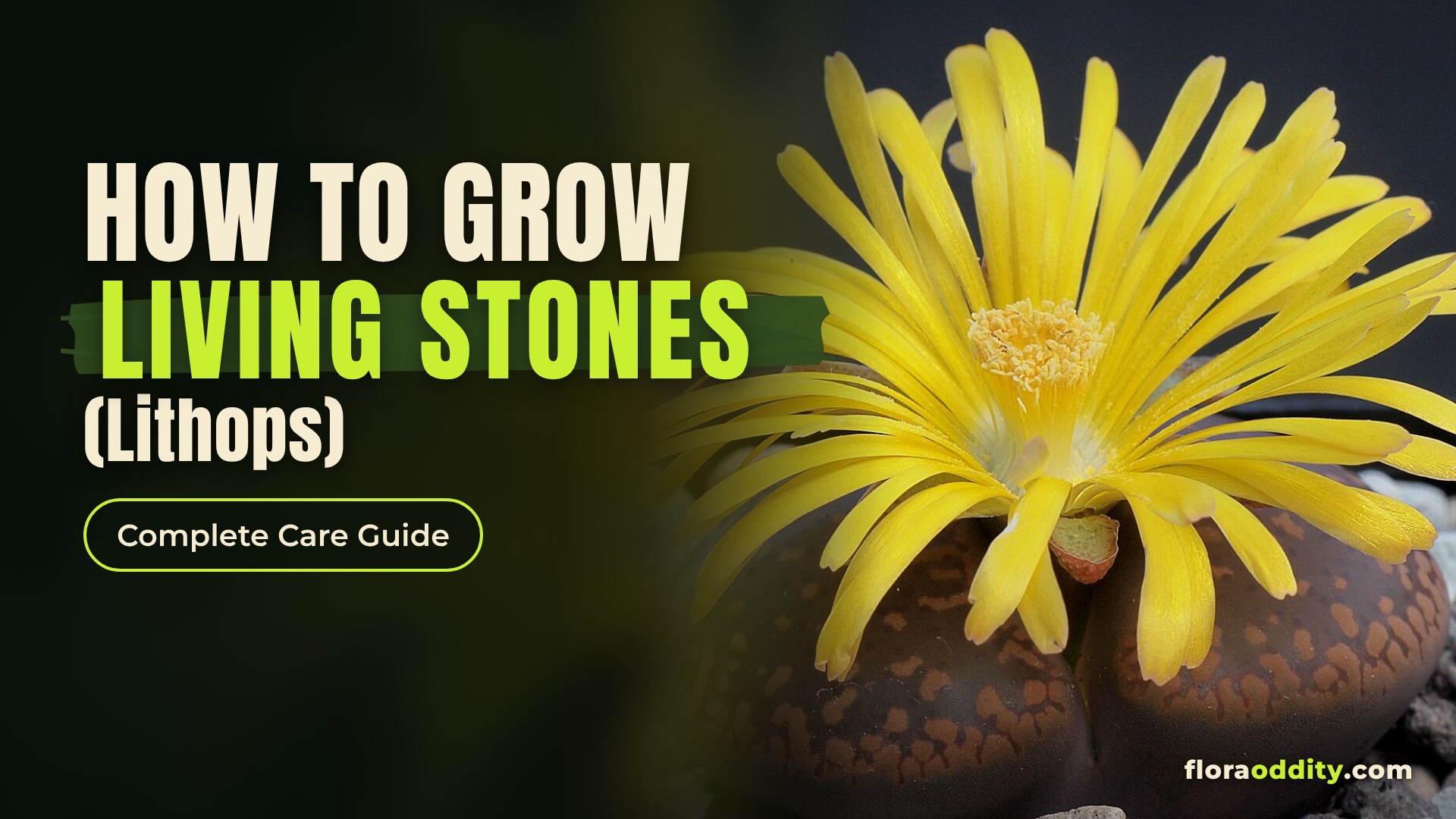
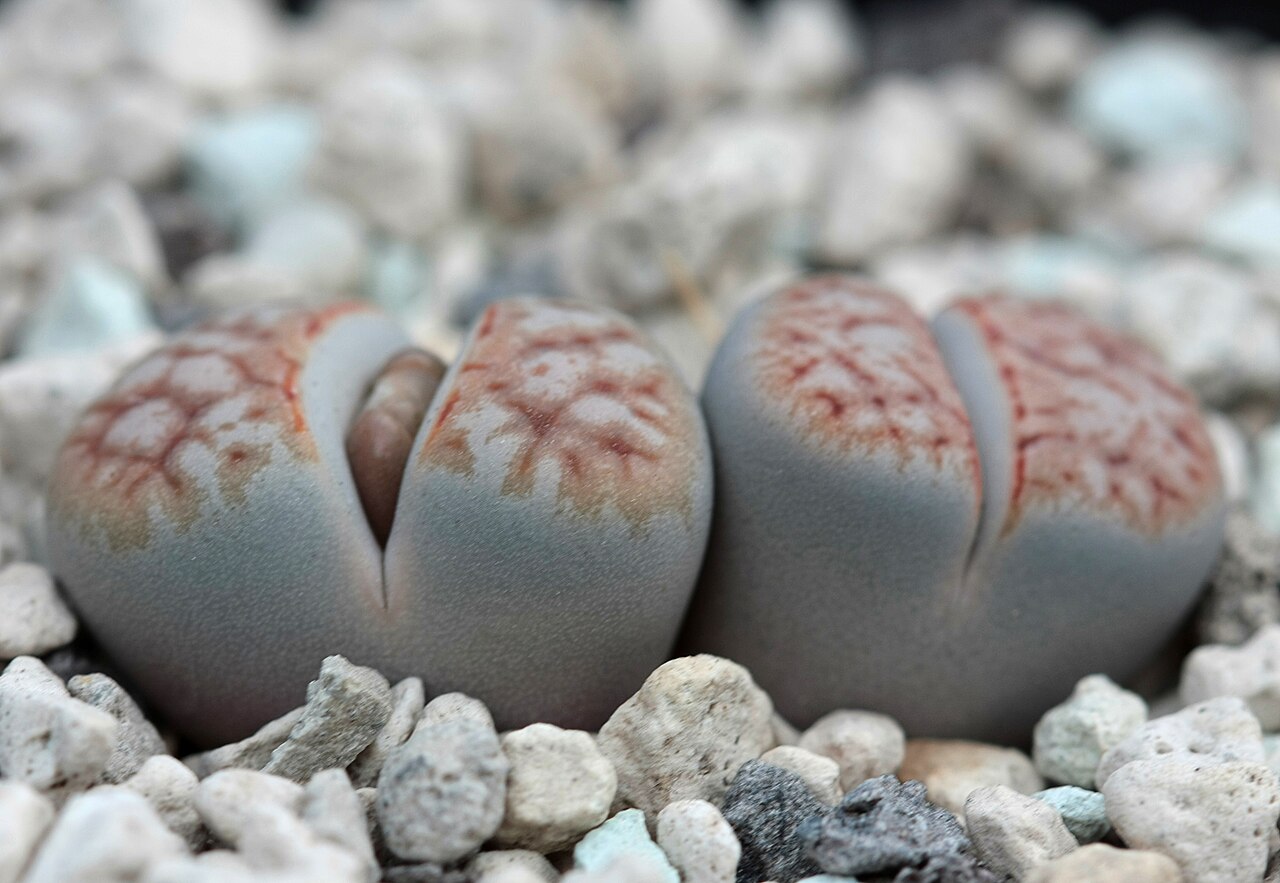
Featured image based on a photo of Lithops julii by Averater via Wikimedia Commons, CC BY-SA 3.0, with typography added by FloraOddity; the adapted image is offered under the same licence.
Final articles are editorially reviewed and factual claims are checked against cited sources. Last reviewed: October 2026.