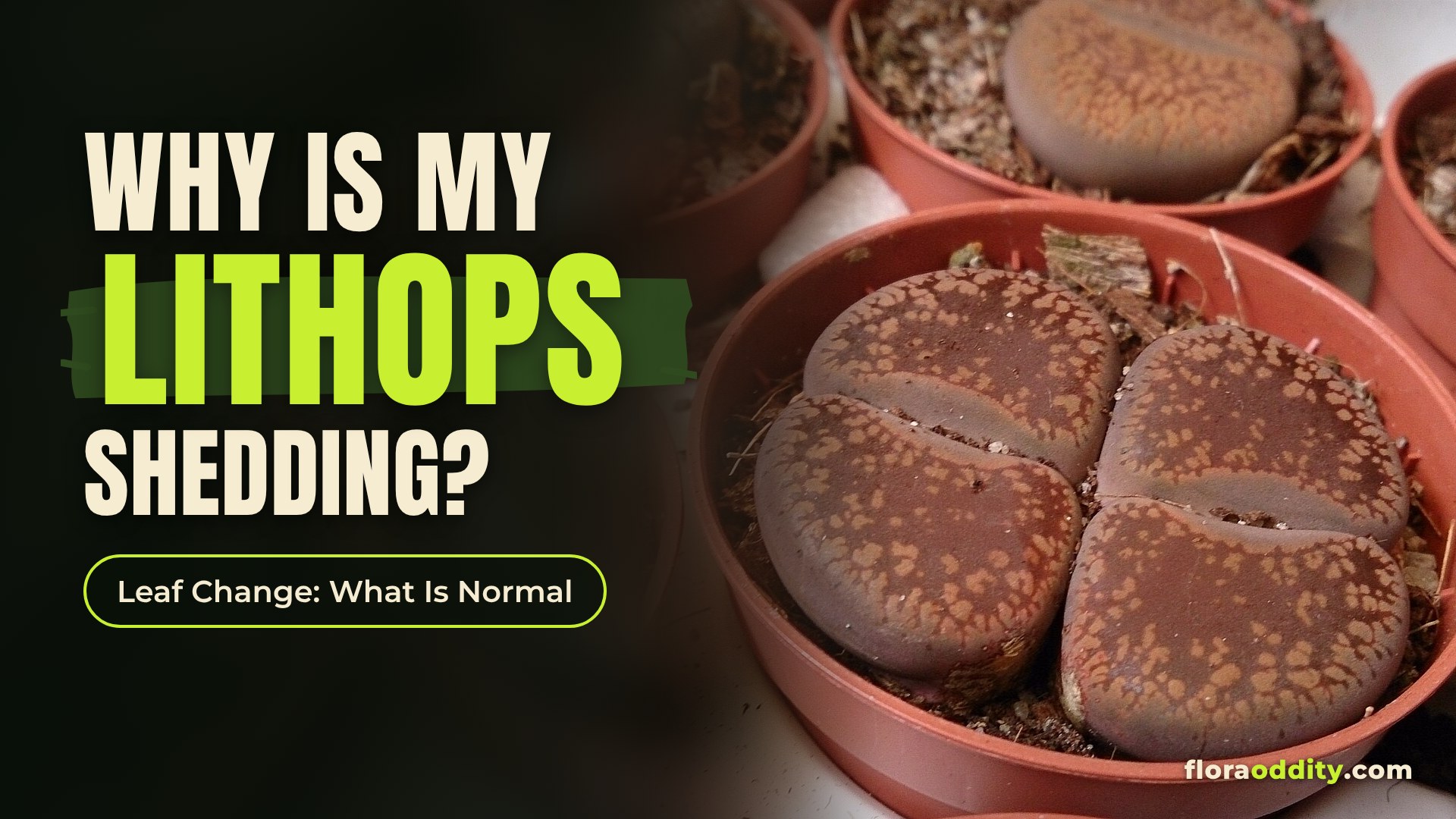
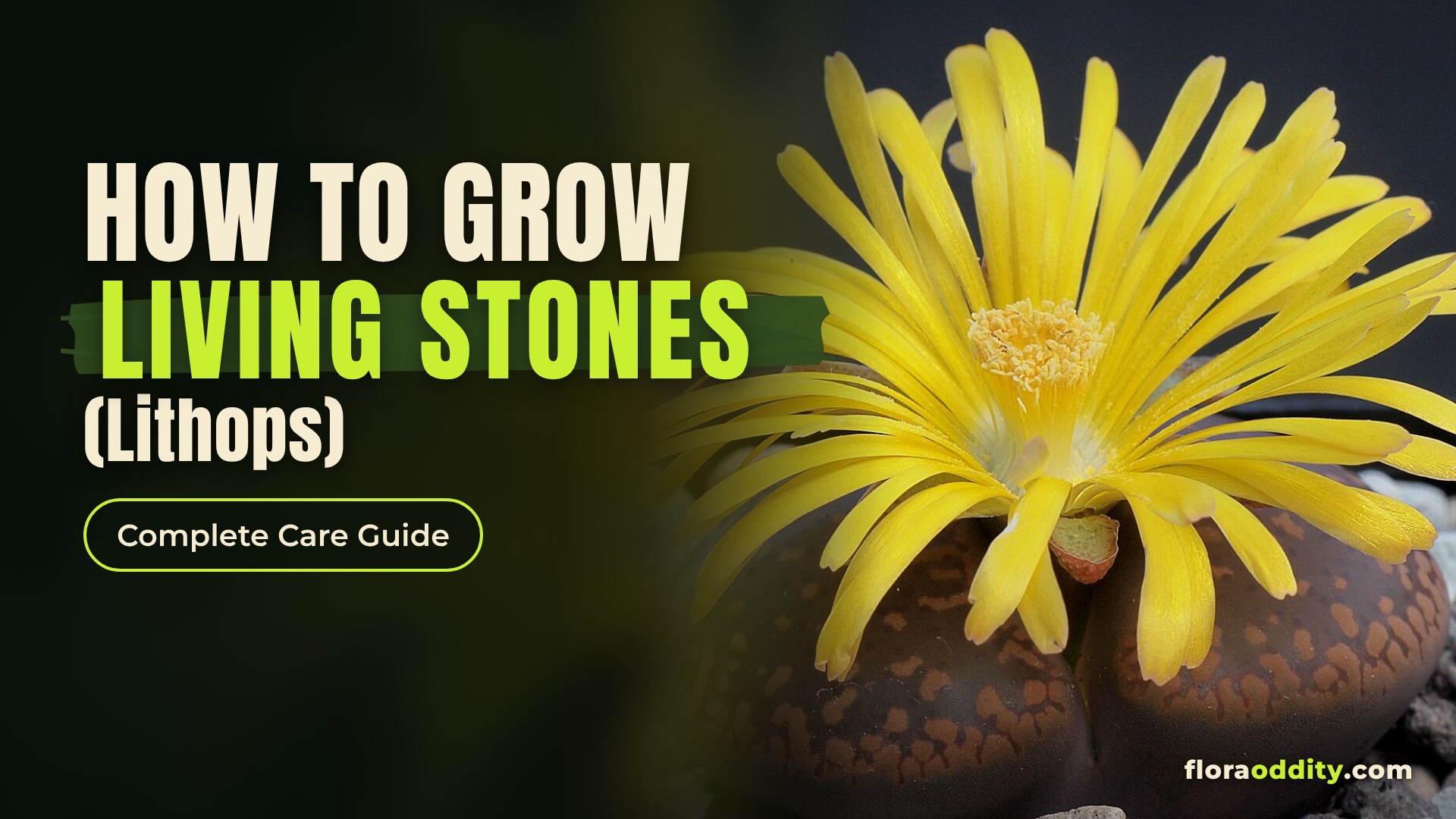
Lithops look like a pair of pebbles with a crack across the top, and that is exactly the point. In the dry parts of southern Africa where they grow, looking like a stone keeps them from being eaten. On a windowsill the disguise hides a plant with a strict yearly rhythm, and most losses come from water given at the wrong moment, not from neglect.
Good Lithops care is mostly about timing. The University of Wisconsin Extension calls them “relatively easy to grow indoors,” but stresses that it is essential to water only during certain stages of the year and to keep the soil dry at others. Learn the cycle, give them as much sun as you can, and the rest is simple.
The Short Answer
Give Lithops the brightest spot you have: Wisconsin Extension suggests about 4 or 5 hours of direct sun, BBC Gardeners’ World about five hours, and the New York Botanical Garden (NYBG) at least six. Plant them in a fast-draining, gritty mix in a pot with a drainage hole and enough depth for the long taproot. Water only while the plant is actively growing, usually in spring after the old leaves have shrivelled and again in late summer to autumn when the flower bud appears. Keep them dry while the new leaf pair forms inside the old one, and give little or no water during the summer rest. Keep them frost-free, feed sparingly or not at all, and when in doubt, do not water.

| Need | What to give it | Source |
|---|---|---|
| Light | Full sun: about 4 to 6 hours of direct sun or more; south or east window; strong lamps for 14 to 16 hours if light is poor | Wisconsin Extension, Gardeners’ World, NYBG |
| Watering | Only during active growth; soak, then let the mix dry out completely | Wisconsin Extension, Mediterranean Garden Society |
| Leaf change | No water while the new pair grows inside the old one | Wisconsin Extension, Gardeners’ World, NYBG |
| Summer | A rest for most growers: little or no water | Wisconsin Extension, Gardeners’ World, NC State Extension |
| Soil | Cactus mix or a gritty, mostly mineral mix; no fertilizer-enriched mixes | Wisconsin Extension, Terry Smale, NYBG |
| Pot | Deep, about 3 to 5 inches (8 to 13 cm), with a drainage hole | Wisconsin Extension, NYBG |
| Temperature | Normal room warmth; frost-free; plenty of fresh air in heat | Wisconsin Extension, NC State Extension, Terry Smale |
| Feeding | Sparing, low nitrogen, or none | Wisconsin Extension, Terry Smale, NYBG |
| Flowering | Late summer to early winter, from the fissure; plants about 3 years old | Wisconsin Extension, Gardeners’ World |
| Main risk | Overwatering, or water at the wrong stage | Wisconsin Extension, Gardeners’ World, NYBG |
What Are Lithops and Where Do They Grow?
Lithops are small succulents in the ice plant family, Aizoaceae. Wisconsin Extension notes that William John Burchell found the first one in 1811 near Prieska in South Africa’s Northern Cape, at first taking it for a cracked brown stone. The name joins the Greek lithos, stone, and opsis, like; the RHS also lists pebble plant, stone plant and living rock.
Each plant is a single pair of very thick leaves fused into an inverted cone, with a fissure across the top where new leaves and flowers emerge, and a taproot below. In habitat they grow only about ½ to 1 inch (1 to 2.5 cm) high, flush with the ground, so the flat leaf tips carry translucent “windows” that let light into the leaf, Wisconsin Extension explains.
They come from Namibia and South Africa, mostly the Nama Karoo and Succulent Karoo, according to Wisconsin Extension. Rainfall there is generally under 20 inches (500 mm) a year, and a few species depend mainly on mist or fog. Their colours match the local stones: specialist grower Terry Smale notes that Lithops marmorata, with white to pale grey leaves, grows among white quartzite pebbles.
Smale counts 37 species and 53 further subspecies and varieties (other sources say 36 to 38 species). For care, what matters is that they share one body plan and one yearly rhythm.
The Lithops Growth Cycle
Everything in Lithops care follows from this cycle. Smale explains where it comes from: most Lithops grow where rain falls mainly in summer and winters are dry, while a few species come from the winter-rainfall areas of the Western and Northern Cape. “In practice, all lithops can be treated as summer-growing for cultivation purposes,” he writes.
The year as most sources describe it (Northern Hemisphere months):
- Spring (about April to May). The new leaf pair, which formed inside the old one over winter, is now fully out, and the old leaves have dried to papery skins. Watering can begin. Smale says that in UK greenhouses this is usually some time in May.
- Summer. Many plants slow down or rest in the hottest weeks. Gardeners’ World says Lithops go dormant in summer, during the most extreme heat of their native habitat.
- Late summer to autumn. Growth picks up again. Wisconsin Extension says the first sign is the fissure starting to open as a flower bud gets ready to push through. Smale gives a flowering window of July to December in the Northern Hemisphere, depending on species.
- Winter to early spring. After flowering, a new pair of leaves develops inside the old pair, using the water stored in the old leaves. The plant needs little or no water from you.
Northern and Southern Hemisphere
The months above, and in nearly every source we used, are Northern Hemisphere months (the UK, Spain and the United States). South of the equator the seasons are reversed, so go by the plant’s stage rather than the month: whether the old leaves have shrivelled, whether the fissure is opening for a bud, whether a new pair is forming.
Andrew Sloan, writing for the Mediterranean Garden Society from southern Spain, uses temperature instead of dates. He stops winter watering once minimum temperatures fall below 50 °F (10 °C), and stops summer watering when nights stay above 72 °F (22 °C) or days go above 86 °F (30 °C).
Leaf Change: Old Leaves Feeding New Ones
Leaf change is the moment that alarms new owners. In late winter the old leaf pair starts to wrinkle and split, and a fresh pair appears in the gap. Wisconsin Extension describes the details: the new fissure forms at about 90 degrees to the old one, and the old leaves slowly wither to a dry, papery sheath at the sides of the new body. Some plants produce two new pairs instead of one, and that is how a single head becomes a clump over the years. Smale mentions a record plant of Lithops salicola with more than 350 heads.
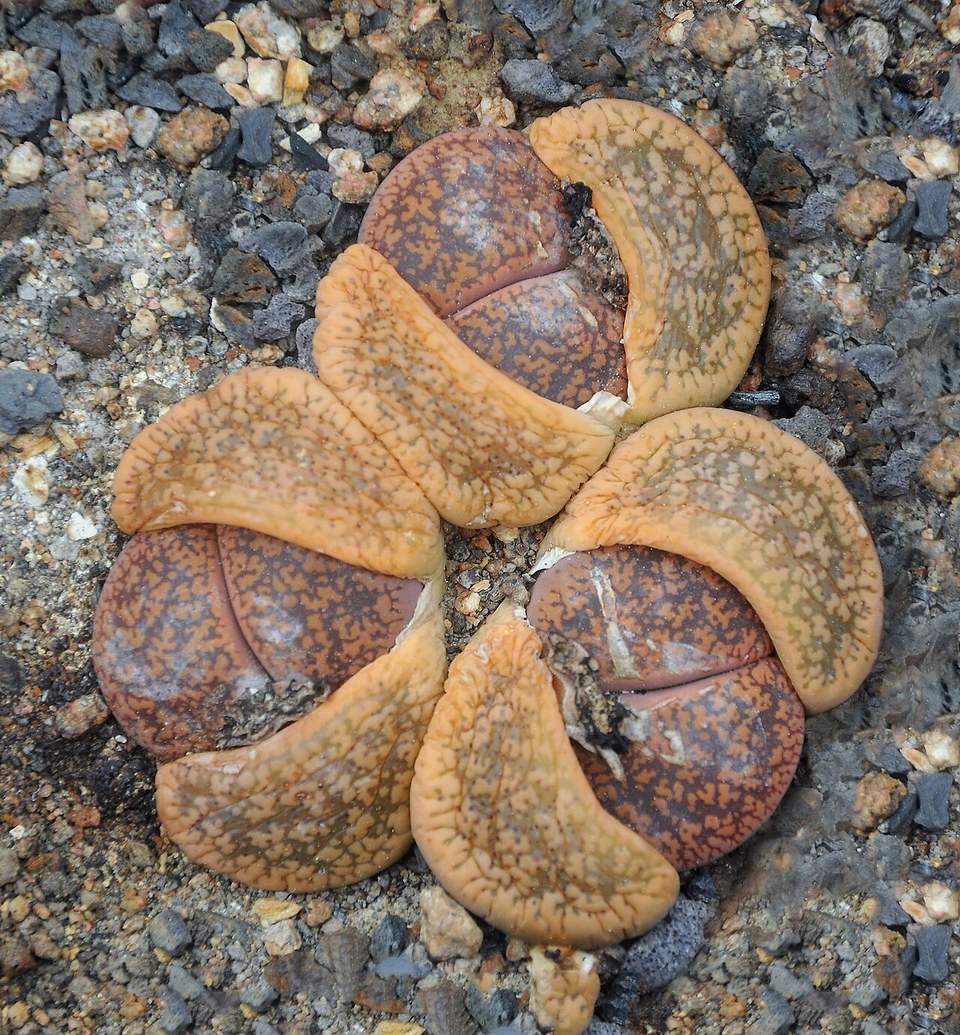
The new leaves grow by drawing water from the old ones. Gardeners’ World puts it plainly: the new pair “actually grows by drawing water from the old pair, so the soil should be very dry.” Water at this stage, and the plant takes up more than it needs. Wisconsin Extension warns that if water is given too soon, the old leaves will try to keep growing and the plant “will not develop properly.” Instead of shrinking away, the old pair stays fat and the new pair is squeezed. NYBG agrees: no water after flowering and during the emergence of new leaves, “or it will disrupt the process.”
So the rule is simple: let the old leaves shrivel completely, and only then start watering again. Wisconsin Extension says to resume once the remains of the old body are “completely shriveled and dry.”
Light
How much. Wisconsin Extension suggests a spot with about 4 or 5 hours of direct sun in the early part of the day and partial shade in the afternoon, usually a south-facing window, with an unobstructed east window as an alternative. Gardeners’ World aims for “around five hours of direct sun per day” from a south- or east-facing windowsill. NYBG is stricter, asking for “a minimum of six hours of sunlight per day,” and wants that light to continue through the winter rest.
Signs of too little. Wisconsin Extension says plants grow tall and narrow, lean toward the light and turn greenish; Gardeners’ World adds that they lose their markings.
Grow lights. If your sunniest window is not enough, NYBG suggests a white fluorescent light 6 to 12 inches (15 to 30 cm) above the plants, alone or with daylight. Because artificial light is weaker than sun, it has to run “for at least 14 to 16 hours per day.”
Avoid sudden changes. Wisconsin Extension warns that moving a plant abruptly into brighter light can sunburn it fatally, so increase light gradually.
Watering by Season
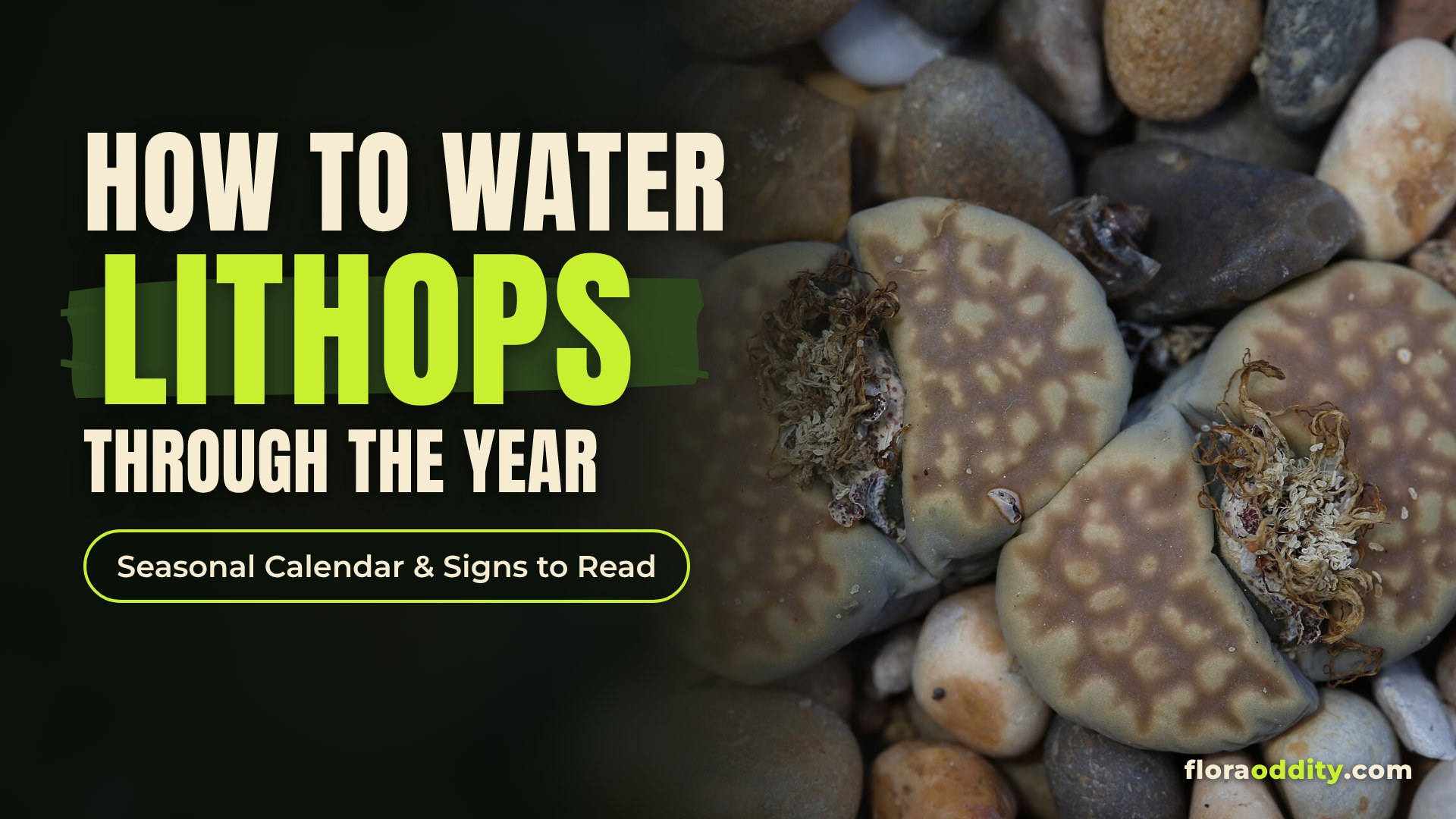
Overwatering is the problem every source names first. Wisconsin Extension calls it “the chief cause of early demise,” and NYBG “the most frequent cause of lithops failure.” The method is soak and dry: Wisconsin Extension drenches the plant, lets the mix dry out completely, “probably 1 to 2 weeks,” then waits a couple more days, preferably watering in the morning. Its summary: “If in doubt….don’t!”
Spring. Start once the old leaves are completely dry. Gardeners’ World suggests watering “a little at a time”; Sloan soaks his pots a few times in April, letting them dry in between.
Summer. Most sources stop or nearly stop. Wisconsin Extension says that if a dormant plant really shrivels, give just enough to restore its firm look, wetting only the top half inch (1 cm) of soil. Sloan warns that regular summer watering makes plants “rot and turn into mush.”
Late summer and autumn. The second watering season starts when plants grow and bloom again (Wisconsin Extension). Gardeners’ World suggests “a good drink in early September,” and NC State Extension about every 2 weeks while plants grow and flower.
Winter. After flowering, stop. Gardeners’ World says not to water from October until the old leaves have withered, often not until May. Sources disagree on summer and winter details (see Where Sources Differ), so treat the season as a guide and the plant as the final word.
Soil and Pots
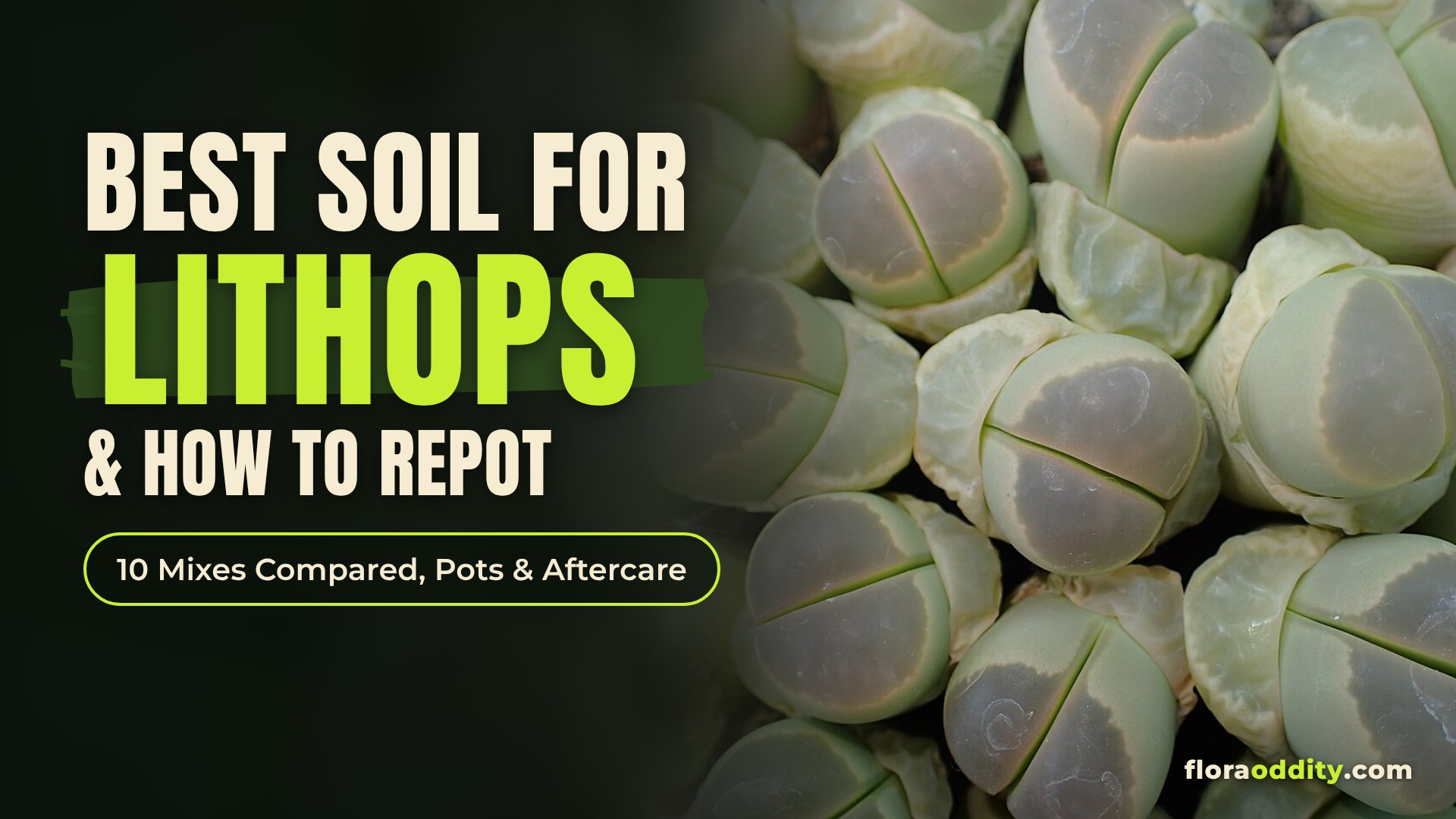
Lithops need a mix that drains fast and stays mostly mineral. Wisconsin Extension recommends a cactus and succulent mix, or standard potting mix improved with extra sharp sand or perlite. NYBG warns against mixes with added fertilizer. Beyond that, growers use quite different recipes:
- Loam-based compost and grit, 1 to 1. Smale uses equal parts John Innes No. 2 and 4 mm grit, and finds peat-based composts “not very satisfactory for long-term use.”
- Mostly pumice. Sloan uses 90% pumice and 10% cactus potting soil.
- Equal parts potting soil and sand, NYBG’s general suggestion.
Pots. Lithops have a bigger root system than the body suggests. Wisconsin Extension recommends pots about 3 to 5 inches (8 to 13 cm) deep with drainage holes, and Gardeners’ World prefers terracotta, which dries faster. NYBG suggests a layer of pebbles on top so the leaves do not touch wet soil. Repotting is rare: Smale repots about every two years, just before the first watering of the season, and NYBG about every four.
Temperature
Lithops handle heat better than cold, as long as the air moves. Wisconsin Extension says they “can tolerate very high temperatures as long as there is plenty of fresh air,” and that they must never freeze. NC State Extension gives numbers: they thrive between 65 and 80 °F (18 and 27 °C), tolerate 90 to 100 °F (32 to 38 °C), and should not go below 40 °F (4 °C).
Smale explains why ventilation matters even at night. Like most succulents, Lithops open their pores (stomata) only at night to take in carbon dioxide, and this normally happens below about 64 °F (18 °C). On hot summer nights, open the window or greenhouse vents. Smale says most growers keep their greenhouses at a minimum of 39 to 41 °F (4 to 5 °C), while NYBG, writing for houseplants, says to keep them above 50 °F (10 °C).
Feeding
Lithops need very little feeding. Wisconsin Extension advises fertilizing “sparingly” with a low nitrogen, high potassium formula. Smale finds occasional feeding with a low-nitrogen liquid fertilizer during the growing season helpful. NYBG goes further and calls feeding “unnecessary,” because the plants get the little they need from the soil.
Propagation in Brief
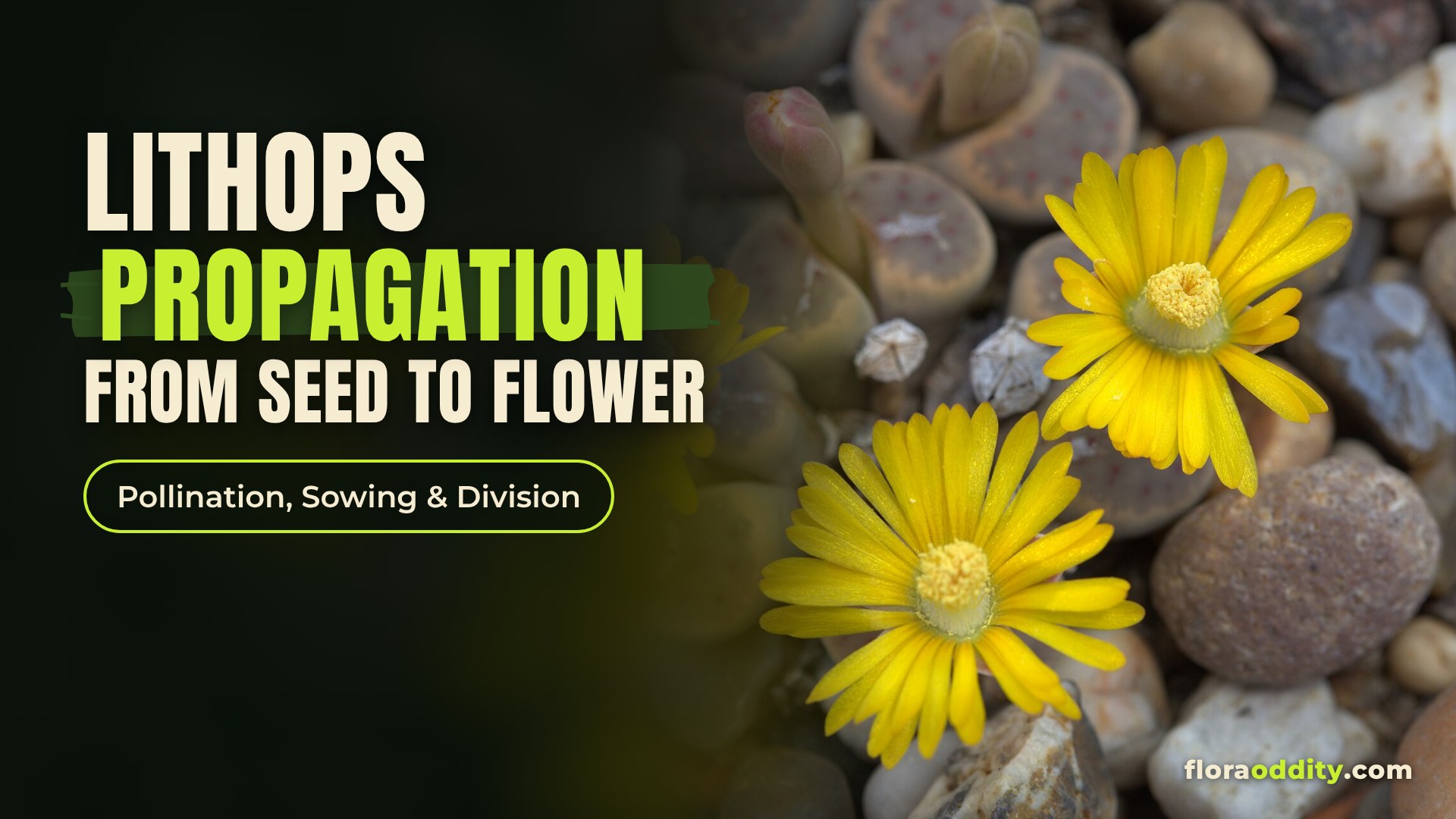
Seed is the usual method. Lithops are self-sterile, so two different plants must be cross-pollinated to set seed (Wisconsin Extension). The seed capsule opens only when wet, which in habitat lets raindrops splash the seeds out. Smale sows in spring at about 68 °F (20 °C) on a fine, gritty mix, keeps the pots moist and enclosed until germination after about one to two weeks, then gives good air movement to prevent damping off. Wisconsin Extension sows in summer and notes that stragglers can take up to a year to germinate. Expect flowers in 2 to 3 years (Smale) or 3 to 4 years (Wisconsin Extension).
Division works on clumps. Gardeners’ World says to make sure each piece keeps a viable taproot, and Wisconsin Extension says to replant the divisions immediately.
Common Problems in Brief
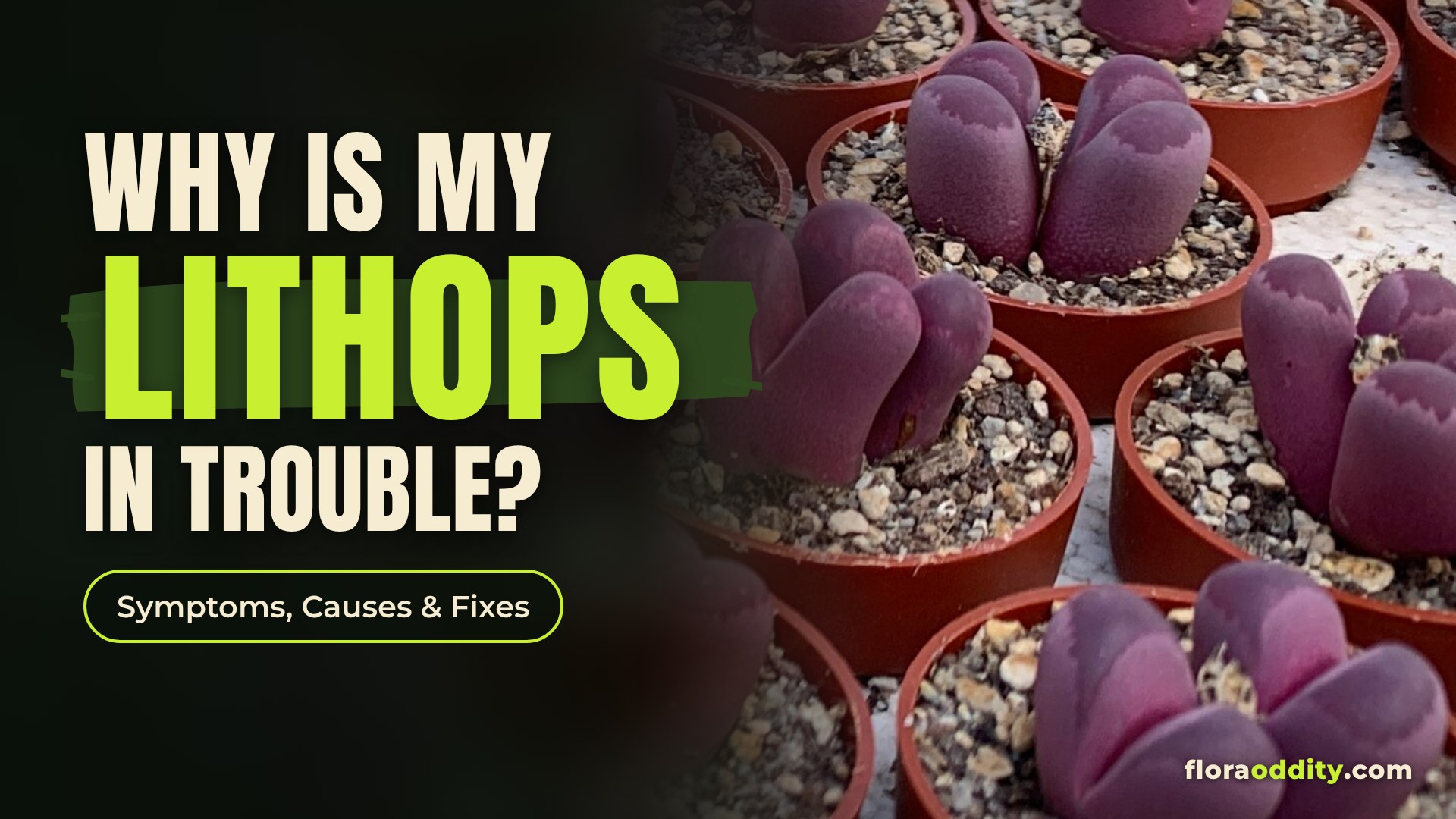
- Rot and mushy leaves. NC State Extension links overwatering with yellowing, mushy leaves, brown spots, split leaves and root rot. NYBG adds fungal stem rot, especially with too much water or humidity or with temperature extremes.
- Old leaves that stay plump instead of shrivelling. Wisconsin Extension says this happens when water is given too soon, during leaf change.
- Tall, pale, leaning plants. Too little light.
- Pests. Smale names mealybugs and western flower thrips, and suggests removing dry old leaves, where mealybugs hide, and dead flowers. Gardeners’ World adds red spider mite under glass.
- Notoriously hard species. Smale says most Lithops are easy but that L. comptonii and L. viridis are “notoriously intractable.”
A Year of Lithops Care: Checklist
Months are Northern Hemisphere; in the Southern Hemisphere, go by the plant’s stage rather than the month.
- Late winter (February to March): hands off. Wrinkling and splitting are normal. Keep the pot dry and the light strong.
- Spring (April to May): first water. When the old leaves are papery skins, soak and let the mix dry out fully between waterings. Repot first, if needed.
- Early summer: slow down. As heat builds, water less. Ventilate well.
- High summer: rest. Little or no water. A light drink only if the plant shrivels hard.
- Late summer to autumn (August to October): second season. When the fissure opens or a bud shows, water thoroughly again and let it dry between soaks.
- After flowering (November to January): taper and stop. Twist off dead flowers. The new pair is now forming inside, so the soil stays dry.
What Growers Report
These are single growers’ conditions and results, not rules.
- Growing in an open, south-east facing garage in southern Spain with sun all morning and no rain, one grower waters thoroughly in April and again in autumn, keeps the soil bone-dry in winter, and stops summer watering once nights pass 72 °F (22 °C) or days pass 86 °F (30 °C). (Andrew Sloan, The Mediterranean Garden, April 2020)
- A grower with four seedlings about a year old broke the no-winter-water rule when the plants were “shriveling severely,” and reported that by the next day the new leaves had come up and “tripled the size of the lithops,” while the old leaves stayed shrivelled at the sides. (wickedthistle, TerraForums, February 2003)
- Another grower kept 10 named Lithops watered “every week” from July into September in a west-facing living room window, in a mix of half cactus mix and half pumice, and reported them blooming. (cockatielmother, TerraForums, September 2005)
- A third grower who buys plants from shops finds they are “almost always over watered and not given enough light,” and waits until they start to wrinkle before offering any water. Wrinkling from the top, this grower notes, usually means a split is coming; wrinkling from the bottom with a full top may mean real thirst. (James H, TerraForums, February 2012)
Our takeaway: these growers watered in very different amounts, but each one watched the plant’s stage, and the one who watered weekly in summer used a fast-draining, pumice-rich mix.
Where Sources Differ
Each row gives only the context the sources themselves state.
| Topic | One view | Another view | Context the sources give |
|---|---|---|---|
| Summer water | Wisconsin Extension, Gardeners’ World, NC State Extension: stop during summer dormancy | Smale: water from May until October, “at least once per week” in high summer | Smale writes about UK greenhouses; Sloan in hot southern Spain stops above 72 °F (22 °C) nights or 86 °F (30 °C) days |
| Winter dryness | Sloan: keep the soil “bone-dry”; Wisconsin Extension: let plants dry totally | NYBG Plant Information Service: never let the soil go bone dry, water very lightly to keep root hairs alive | NYBG adds that plants under lights may need a little more in winter; Smale says California growers sometimes give a very small amount |
| Light hours | Wisconsin Extension: about 4 or 5 hours, morning sun | NYBG: at least six hours | Gardeners’ World sits between, at about five hours |
| Minimum temperature | Smale: greenhouse minimum 39 to 41 °F (4 to 5 °C) | NYBG: keep above 50 °F (10 °C) | NC State Extension: not below 40 °F (4 °C); all agree on no frost |
| Soil | Smale: loam-based compost and grit, 1 to 1 | Sloan: 90% pumice; NYBG: equal parts potting soil and sand | All stress fast drainage |
| Feeding | Wisconsin Extension, Smale: sparing, low nitrogen | NYBG: unnecessary | None of the sources recommends heavy feeding |
| Repotting | Smale: about every two years | NYBG: about every four years | Wisconsin Extension: one pot can last 10 to 20 years |
Common Mistakes
- Watering during leaf change. The old leaves stay fat and the new pair cannot develop properly.
- Watering on a fixed weekly schedule all year. Water follows the growth cycle, not the calendar.
- Too little light. A bright room is not a sunny window.
- Rich, peaty compost or a pot without a hole. Water lingers and the roots rot.
- Panicking at shrivelling. Wrinkled old leaves in late winter are normal.
FAQ: Lithops Care
How often should I water Lithops?
Only during active growth, usually in spring after leaf change and in late summer to autumn. Wisconsin Extension’s method is to soak the pot, let it dry out completely (often 1 to 2 weeks), then wait a couple more days.
When do Lithops flower?
Mostly in autumn and early winter. Smale gives a window of July to December in the Northern Hemisphere, depending on species. Gardeners’ World and Sloan say plants need to be about three years old before they flower.
Can Lithops grow indoors?
Yes, on a sunny south- or east-facing windowsill, or under strong lights for 14 to 16 hours a day. NYBG notes that light is where many succulent growers fall short.
Should I remove the old leaves?
Let them dry completely first. Sloan removes the papery remains carefully in spring, and Smale removes dry old leaves to deny mealybugs a hiding place.
The Bottom Line
Lithops care comes down to sun, grit and timing. Give them several hours of direct sun or a strong lamp, a fast-draining mineral mix in a deep pot with a hole, and frost-free, airy conditions. Then water to the cycle: after the old leaves have shrivelled in spring, again when buds appear in late summer and autumn, and little or nothing during the summer rest and while new leaves form. Watch the plant more than the calendar, especially if you garden south of the equator. As Sloan puts it, these are “among the most drought-tolerant plants on earth.”
Sources & Further Reading
- University of Wisconsin Extension (Susan Mahr): Living Stones, Lithops
- North Carolina Extension Gardener Plant Toolbox: Lithops
- New York Botanical Garden, Mertz Library: Living stones (Lithops spp.)
- New York Botanical Garden Plant Information Service: How can I care for my lithop?
- Royal Horticultural Society: Lithops plant profile
- Terry Smale, Xerophytes and Geophytes: Cultivation of Lithops
- Andrew Sloan, Mediterranean Garden Society: Lithops Cultivation
- BBC Gardeners’ World Magazine: How to grow lithops
Featured image based on a photo of Lithops aucampiae in flower by Dornenwolf via Wikimedia Commons, CC BY 2.0, with typography added by FloraOddity.
Final articles are editorially reviewed and factual claims are checked against cited sources. Last reviewed: October 2026.