Every year a healthy living stone seems to fall apart. The plump pair of leaves you bought wrinkles, sinks and splits open, and something new pushes out of the middle. It looks like a plant in trouble, but it is the most normal thing a Lithops does. The University of Wisconsin-Madison Extension describes the sequence simply: the plant reabsorbs its old leaves as the new ones develop, until the old pair withers “to a dry, papery sheath on the side of the new body.”
Lithops shedding, usually called leaf change or regeneration by growers, is also the stage where most plants are lost, because owners see a shrivelled plant and reach for the watering can. This guide covers what is happening inside the plant, when it happens in each hemisphere, how long it takes, how water fits in, and how to tell normal shrivelling from stacking, rot and sunburn.
The Short Answer
A Lithops grows one new pair of leaves each year inside the old pair. The new pair takes the water and nutrients stored in the old leaves, so the old leaves shrink, wrinkle and finally dry to paper. In the northern hemisphere this runs from late autumn through winter into spring, with the old leaves usually finished around April. In the southern hemisphere the seasons are reversed, so leaf change runs from autumn to spring there too.
Keep the plant dry while it happens. Nick Rowlette’s cultivation guide puts it bluntly: “No water at all should be given during the winter,” and the soil should stay bone dry “no matter how shrivelled the plants become.” Start watering again, lightly at first, once the old leaves are thin papery shells. Do not peel the old leaves while they still hold any moisture.
The Leaf Change Timeline
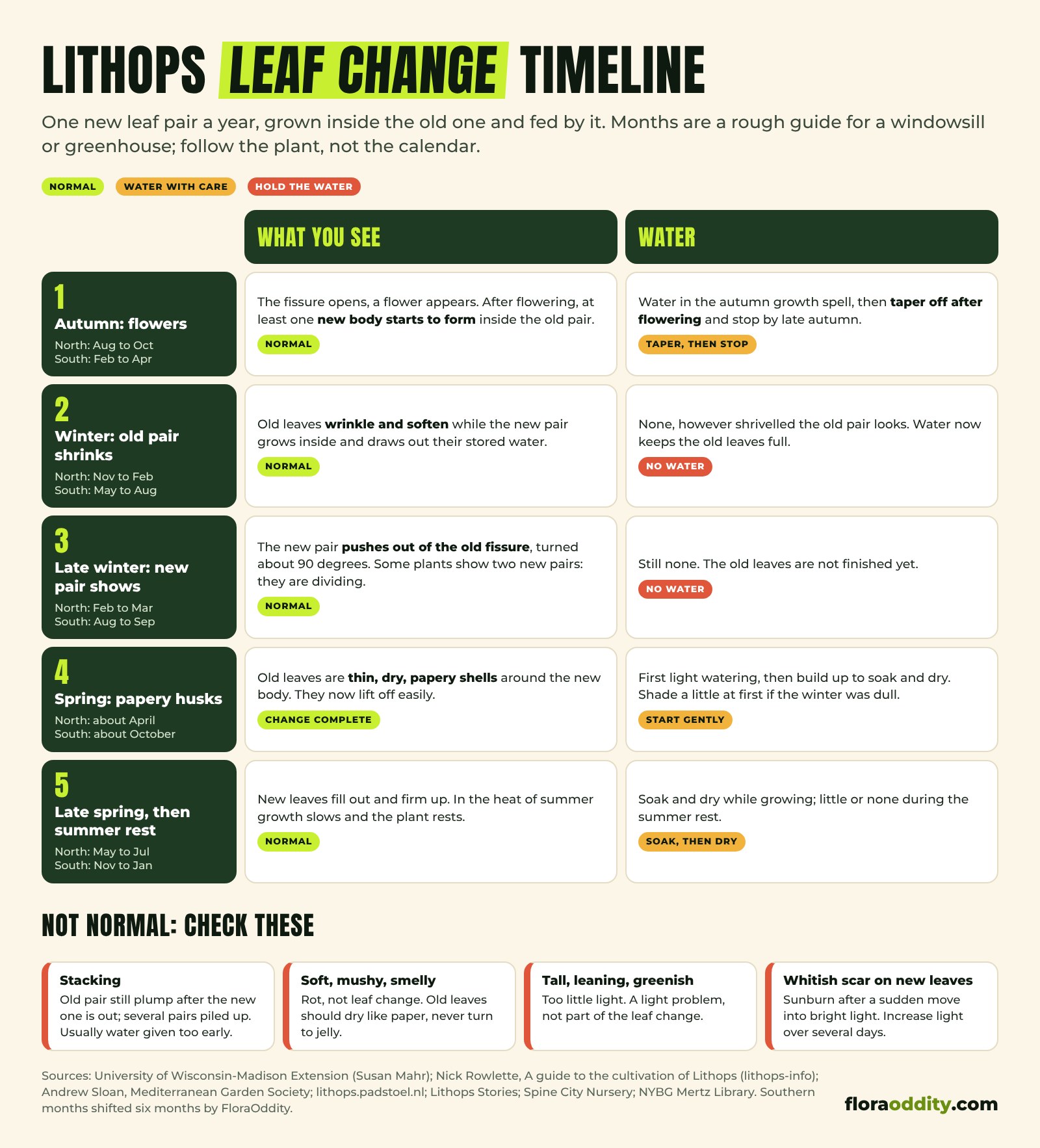
| Stage | Northern hemisphere months | What you see | Water |
|---|---|---|---|
| 1. Flowering | Aug to Oct | Fissure opens, flower appears; a new body starts to form inside | Water in growth, taper after flowering, stop by late autumn |
| 2. Old pair shrinks | Nov to Feb | Old leaves wrinkle and soften as the new pair grows inside | None |
| 3. New pair shows | Feb to Mar | New pair pushes out of the old fissure at about 90 degrees; sometimes two pairs | None |
| 4. Papery husks | About April | Old leaves are thin dry shells that lift off easily | First light watering, then build up |
| 5. Growth, then summer rest | May to Jul | New leaves fill out; growth slows in summer heat | Soak and dry in growth; little or none in the rest |
The northern months come from the University of Wisconsin-Madison Extension, Rowlette’s guide on lithops-info, Andrew Sloan in the Mediterranean Garden Society journal, the Dutch grower site lithops.padstoel.nl and the Lithops Stories blog. In the southern hemisphere the seasons are reversed; Spine City Nursery in Australia places leaf change from autumn to spring. Rowlette stresses that each species keeps its own timetable: some flower as early as July, others as late as November.
What Is Actually Happening Inside the Plant
A Lithops body is two thick leaves joined at the base, with a slot, the fissure, between them. The Wisconsin Extension describes the whole plant as a water store: the leaves hold enough water for the plant to survive for months without rain. When the plant makes a new pair, it does not build it from water it takes up through the roots. It builds it from the reserve in the old pair.
Rowlette’s guide explains the mechanism in one line: “The new body actually draws out the water stored in the old leaves to continue growth.” The guide adds that the new body keeps extracting “the water and nutrient stored in the old leaves” until those leaves are reduced to “thin papery shells.” That is why the old leaves look worse and worse through winter while the plant is, in fact, growing. The Lithops Stories blog makes the same point from the windowsill: winter is a period of active growth underneath, and “the wrinklier the old leaves, the bigger the new ones.”
The new pair does not sit in line with the old one. According to the Wisconsin Extension, the fissure of the new leaves forms “at about 90 degrees to the old fissure.” So when the new pair breaks through, you will often see a slot running crosswise to the old one, and the old leaves are pushed apart to the sides.
Why does the plant work this way? In habitat, Rowlette writes, Lithops rest through a long period of heat with little or no rain, living on stored water, and grow again as days get cooler and shorter.
When It Happens: Season and Hemisphere
Leaf change follows flowering. The Wisconsin Extension says most Lithops flower in autumn and early winter, and that after flowering the plant goes into a rest during which at least one new body develops; in spring it reabsorbs the old leaves as the new ones grow. Rowlette describes northern-hemisphere plants starting to grow in August or September, flowering, and then spending the winter months with the new bodies growing as the old outer leaves begin to shrivel.
Growers in different climates give slightly different dates:
- Andrew Sloan, growing in southern Spain, writes in the Mediterranean Garden Society journal that winter is when “the outer leaves shrivel and new leaves appear,” and that the old leaves are papery shells by spring, “April for me.”
- The Dutch grower behind lithops.padstoel.nl calls November to mid April “the regeneration season,” with “No watering at all.”
- The Lithops Stories blog, writing about a windowsill collection in the northern hemisphere, says to stop watering “mid- or late October,” and that “Around April the old leaves will be gone.” The author adds that it can be a little earlier or later.
In the southern hemisphere the seasons are reversed. Spine City Nursery, an Australian grower, lists the cycle as “Autumn to Spring: Leaf change occurs,” followed by active growth from spring to autumn. Whatever the hemisphere, Rowlette notes that each species’ timetable “is nearly impossible to alter.”
How Long It Takes
Expect months, not weeks. The Lithops Stories blog describes regeneration as “a long process that takes several months to complete.” The padstoel calendar, from November to mid April, gives about five months from the last watering to the first new one.
For much of the winter you will see only wrinkling; the Wisconsin Extension says the new body “should be visible” by early spring. The Lithops Stories author suggests that if old leaves are still not fully absorbed by June, it is time to treat the change as finished and carry on with the growing season.
How to Water During Leaf Change
Keep this short and strict: no water while the old pair is still being absorbed. The reason is not that water hurts the new leaves directly. It is that water keeps the old leaves alive. The Wisconsin Extension warns that if water is given too soon, “the old leaves will try to continue to grow and the plant will not develop properly.” The Lithops Stories blog gives the result: “If water keeps coming old leaves will never dry up and then stacking begins.”
When to start again:
- Wait until the old leaves are dry, thin and papery, not just wrinkled.
- Give a first, light watering. The padstoel calendar calls this “a first tentative watering” in April for plants whose old leaves are dried out.
- Build up from there. Rowlette suggests starting lightly and “working up to several good drenchings during mid spring,” letting the soil dry between waterings.
Plants that have sat dry through winter are also slow to react at first. The Lithops Stories author writes that the roots regrow quickly and the plant reacts to water “after the second watering at the latest.”
Normal or Worrying?
| What you see | Normal or not | Why |
|---|---|---|
| Old pair wrinkled, soft, sinking in winter | Normal | The new pair is drawing water from it (Rowlette, Lithops Stories) |
| Old pair splits open at the top; new pair visible | Normal | New pair emerging through the fissure (Wisconsin Extension) |
| New fissure crosswise to the old one | Normal | New leaves form at about 90 degrees to the old fissure (Wisconsin Extension) |
| Two new pairs inside one old pair | Normal | The plant is dividing (Wisconsin Extension, Rowlette) |
| Old leaves dry, papery, brown or tan | Normal | Leaf change complete (Rowlette, Sloan) |
| Old pair still plump after the new pair is out | Worrying | Stacking, usually from water given too early (Wisconsin Extension, Lithops Stories) |
| Soft, slimy, smelly tissue | Worrying | Rot, not leaf change; padstoel describes a plant turning soft and slimy very fast (Rowlette, padstoel) |
| Tall, leaning, greenish plant | Worrying | Too little light (Wisconsin Extension, Rowlette) |
| Whitish scar on fresh new leaves | Worrying | Sunburn after a sudden jump in light (Rowlette) |
Two of these are worth a closer look. The Wisconsin Extension says a Lithops without enough sun grows “slender and elongated,” leans and turns greenish. Sunburn is the opposite risk. Rowlette explains that plants lose resistance to bright light after a dull winter, and a sudden clear day can burn them, “causing a whitish scar tissue to form on the surface of the plant.” That makes spring, when the change finishes, the time to raise light gradually over several days, as Rowlette recommends.
One Body Becoming Two: Multiple Heads and Splitting
Leaf change is also when a Lithops multiplies. The Wisconsin Extension says many plants “will also divide at this time, to produce more than one leaf pair so that a single body gradually becomes a small cluster.” Rowlette describes how it begins: one plant produces two pairs of new leaves, and “The plant will then have two ‘bodies’ attached to one root system.”
So if you open the old pair in spring and find two new pairs side by side, nothing has gone wrong. Over many years this builds clumps; Rowlette mentions collection plants with ten or more bodies, but says that takes many years. The Wisconsin Extension adds that a multi-headed plant can be divided by cutting through the roots, though there is no need to do it.
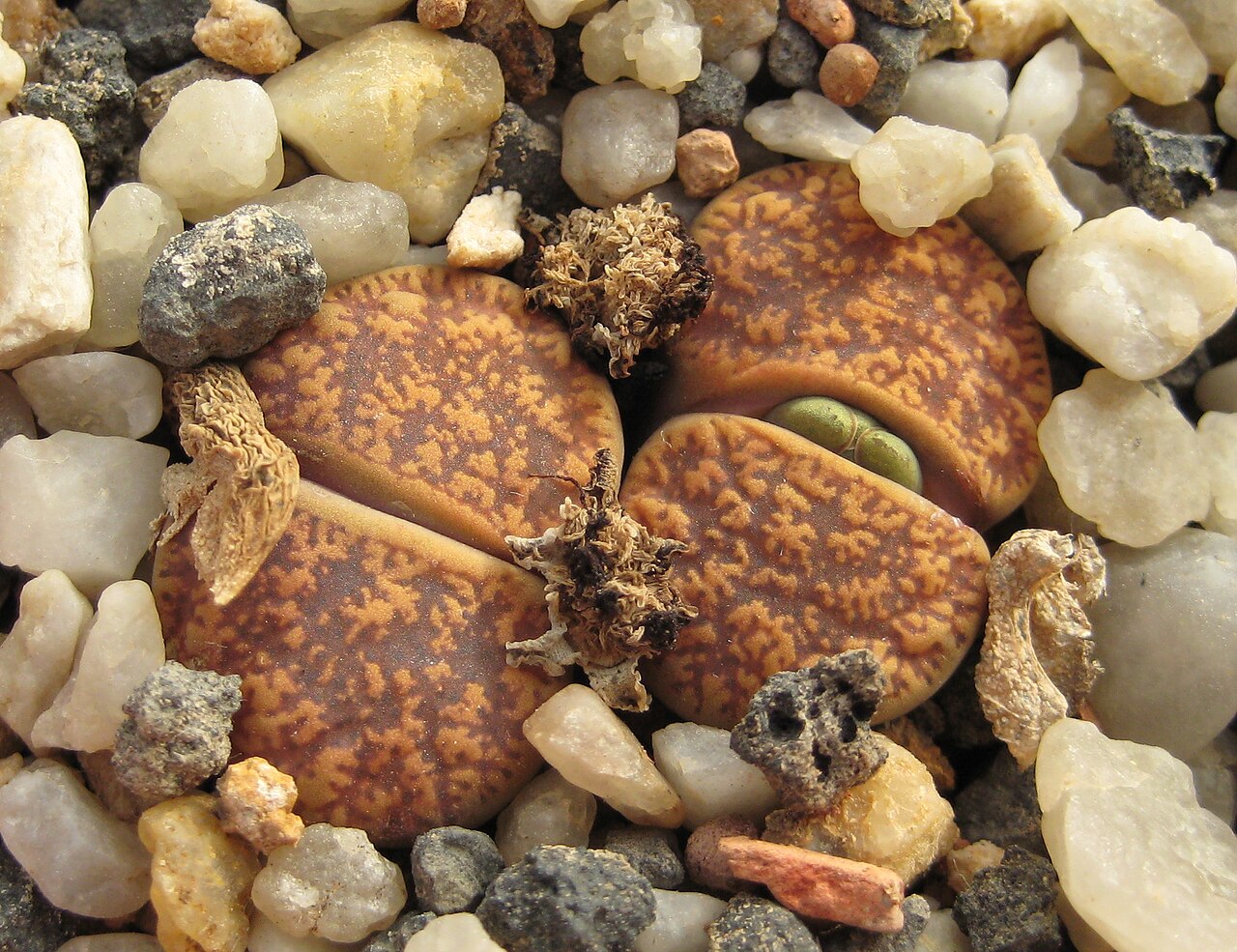
“Splitting” is also used for the ordinary opening of the old pair when the new one emerges. That split runs down the original fissure and is normal. Growth in the wrong place or at the wrong time is a different matter: the Wisconsin Extension warns that with too much water, plants “rot or produce new bodies at the wrong time of year.”
Stacked Leaves
Stacking is the main way leaf change goes wrong. If the plant gets water while the old pair is still being absorbed, the old leaves stay plump, the new pair cannot drain them, and the plant ends up wearing two or more sets of leaves at once. The Lithops Stories blog describes the end of that road: the new leaves “choke on the old ones and the plant stretches, rots and dies.”
The prevention is simple: no water from the end of flowering until the old leaves are papery. If old leaves do stay on into the growing season, the Lithops Stories author’s advice is to cut off what is left by June rather than keep the plant dry forever.
Some plants simply stall, with no water involved. The author of the My Life Among the Lithops blog lists three options other growers suggested for a stuck plant: leave it alone, give it water, or cut the old leaves open, and calls leaving it alone “the safest.”
How to Help Without Peeling the Old Leaves
Do not tidy up the old leaves while they still hold any moisture. Rowlette writes that the new body draws water from the old leaves, “so do not remove the shriveled leaves.” Spine City Nursery gives the same rule: “If old leaves don’t come off easily, leave them. Forcing them can damage the plant.”
What does help:
- Keep it dry. Stop watering after flowering and keep the soil dry until the old leaves are papery.
- Give steady, bright light. The Wisconsin Extension recommends about 4 or 5 hours of direct sun in the early part of the day with partial shade in the afternoon. Good light keeps the new pair compact.
- Do not move it into sudden bright light. Raise light over several days, especially in spring, to avoid scarring the new leaves.
- Keep it cool, not cold. Rowlette says Lithops should not go below 40 °F (5 °C) and suggests moving plants back from a window in freezing weather.
- Wait for papery husks. Once the old leaves are thin dry shells, Rowlette says they “can then be easily removed.” Lift them off with fingers or tweezers only if they come away with no resistance.
- Do not cut open a healthy plant. Surgery is reserved for genuinely stuck plants, and growers who have tried it report slow regrowth afterwards (see below).
How It Compares With Butterworts
Lithops are not the only plants on FloraOddity that trade one set of leaves for another in a dry rest. Mexican butterworts swap their sticky summer leaves for a tight rosette of small succulent leaves in winter, and our butterwort dormancy guide describes cutting water back to between “slightly damp” and “bone-dry” while they are in that state. Cold temperate butterworts go further and shrink to a winter bud, a hibernaculum, while their summer leaves rot away.
The difference is in how dry. For Mexican butterworts the guide scales winter water to the rosette, from slightly damp to bone-dry. The Lithops sources here, apart from NYBG, keep the soil completely dry for the whole change, because the new pair takes its water from the old leaves. Put simply: both rest on less water, but a Lithops in leaf change rests on almost none.
What Growers Report
These are single growers’ experiences, in their own conditions, not rules.
- A TerraForums member warned a new owner in winter not to water “until those outer bodies completely shrivel up otherwise it will keep the old ones full,” so the plant will “stack” several years’ bodies together. The same post says the old leaves can be tugged off once they “look like dried autumn leaves,” then the roots woken with a little water before a deep soak a week or two later. (swords, TerraForums, December 2012)
- Growing in southern Spain, Andrew Sloan keeps the plants dry through the winter shrivelling, then waters thoroughly a few times in April once the old leaves are papery shells. Sloan finds the plants then “plump up” enough to get through the hot summer with little or no water. (Andrew Sloan, The Mediterranean Garden, April 2020)
- The author of the My Life Among the Lithops blog tried all three fixes for stuck plants. One stalled plant, left alone for months, suddenly made “big new leaves” and absorbed the old ones “in less than a week”; another stuck group “just turned to goo” when watered; plants whose old leaves were cut open survived but their new leaves grew “very slowly.” (My Life Among the Lithops blog, July 2013)
Put simply: across these reports, the safest help is dry soil and patience, and the old leaves come off by themselves once they are paper.
Where Sources Differ
The sources agree on the cycle but not on how dry the plant should be.
- Bone dry or a little water. Rowlette, Sloan and the padstoel site all keep the soil completely dry through leaf change. The NYBG Mertz Library’s answer is gentler: it says to water “very lightly, just enough to keep the root hairs alive” in winter, and warns “you never want the soil to become bone dry.” Spine City Nursery takes a middle line with “a light misting technique,” saying the goal is “to preserve the roots, not to hydrate the plant,” and that water “should never reach the bottom of the pot.” The padstoel calendar likewise allows windowsill plants a little spray now and then, at temperatures above 59 °F (15 °C). The padstoel site itself draws the line by setting: no water at all in the greenhouse, an occasional spray on the windowsill. Put simply: none of these sources gives a normal watering during leaf change.
- When to stop. Rowlette stops by about late September, Lithops Stories in mid to late October, and padstoel in November. All three tie it to the end of flowering.
- What to do with a slow plant. Lithops Stories says to cut off what is left of the old leaves if they are not absorbed by June. The My Life Among the Lithops author prefers to leave stuck plants alone, having seen surgery slow them down.
Common Mistakes
- Watering a wrinkled plant in winter. Wrinkles during leaf change mean the new pair is working, not that the plant is thirsty.
- Peeling old leaves too early. Leaves that resist are still feeding the new pair.
- Watering as soon as the new pair appears. The new pair showing is not the end of the change; wait for papery husks.
- Sudden full sun in spring. After a dull winter, plants burn easily; raise light over several days.
- Mistaking rot for shedding. Old leaves dry out; they do not turn soft, slimy or smelly.
FAQ: Lithops Shedding
Is Lithops shedding normal?
Yes. Every adult Lithops replaces its leaf pair once a year. The Wisconsin Extension describes the old leaves withering to a dry, papery sheath as the new body grows, so a shrivelling outer pair in winter or spring is expected.
Should I water my Lithops while it is changing leaves?
No, or only the tiniest amount. Most of the sources here keep the soil dry until the old leaves are papery, because water keeps the old leaves plump and can cause stacking. Begin with a light watering once the change is finished.
Can I pull off the old leaves?
Only when they are thin, dry and come away with no effort. Rowlette says the shrivelled leaves feed the new body and should not be removed until they are papery shells.
How long does Lithops leaf change take?
Several months: roughly late autumn to April in the northern hemisphere, and from autumn to spring in the southern hemisphere, according to Spine City Nursery in Australia.
The Bottom Line
Lithops shedding is the plant renewing itself from the inside. The new pair grows within the old one and drains it, the old leaves wrinkle and dry to paper, and the plant comes out of spring with fresh leaves and sometimes an extra head. Your job is mostly to stay out of the way: no water while the old pair is being absorbed, steady bright light without sudden jumps, and no peeling until the husks lift off by themselves. Plump old leaves next to new ones, soft or smelly tissue, stretching and white scars are the signs that need attention.
Sources & Further Reading
- University of Wisconsin-Madison Extension: Living Stones, Lithops (Susan Mahr)
- Nick Rowlette, A guide to the cultivation of Lithops (lithops-info, hosted by mesemb.com)
- Andrew Sloan, Lithops Cultivation, Mediterranean Garden Society (The Mediterranean Garden No. 100, April 2020)
- Growing lithops, lithops.padstoel.nl
- Lithops Stories: Lithops Cultivation Guide
- Spine City Nursery: How to grow Lithops
- NYBG Mertz Library: How can I care for my lithop?
- My Life Among the Lithops: Lithops, Sometimes They Get Stuck
Featured image based on a photo of Lithops aucampiae by Mokkie via Wikimedia Commons, CC BY-SA 3.0, with typography added by FloraOddity; the adapted image is offered under the same licence.
Final articles are editorially reviewed and factual claims are checked against cited sources. Last reviewed: October 2026.