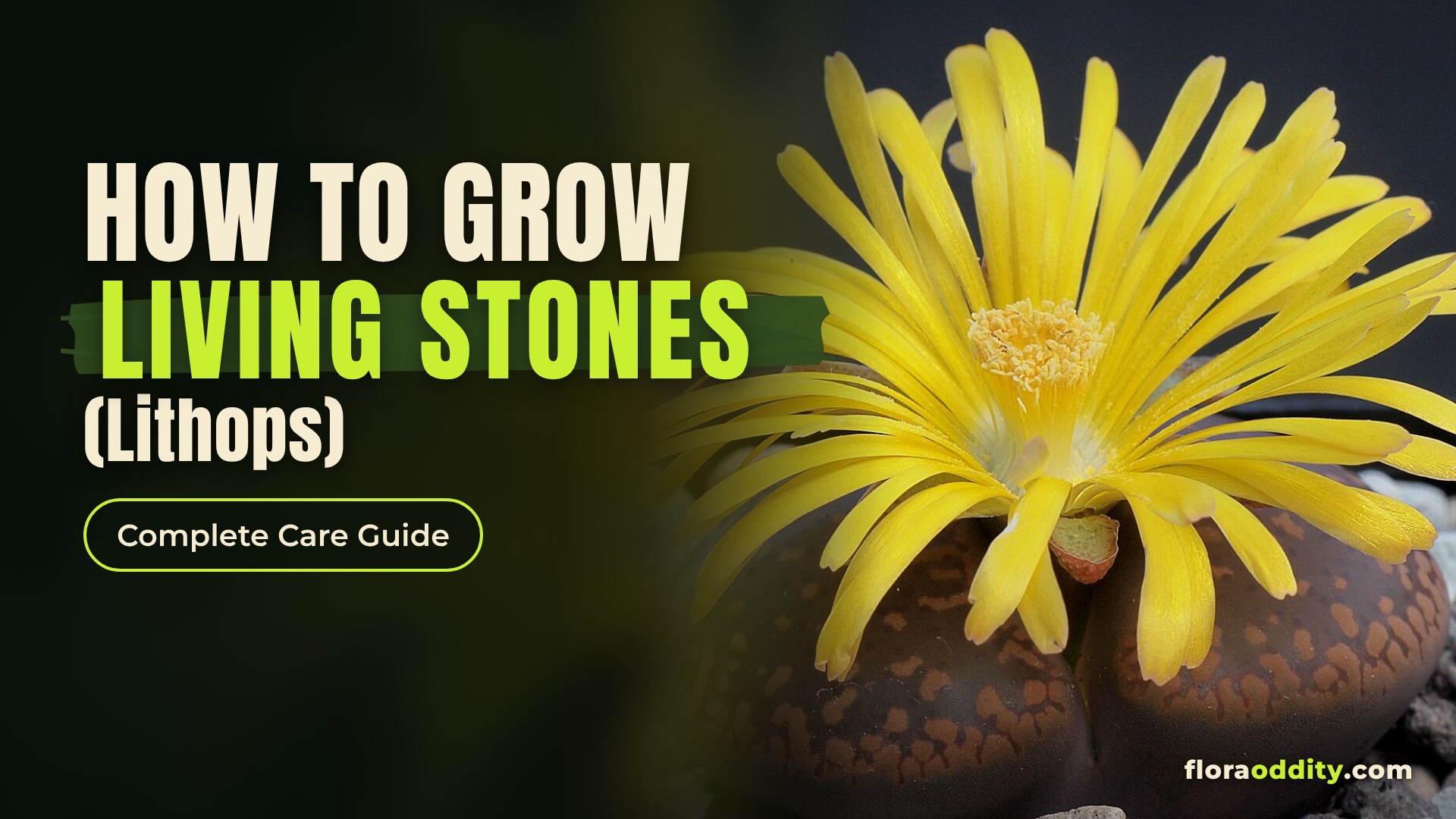
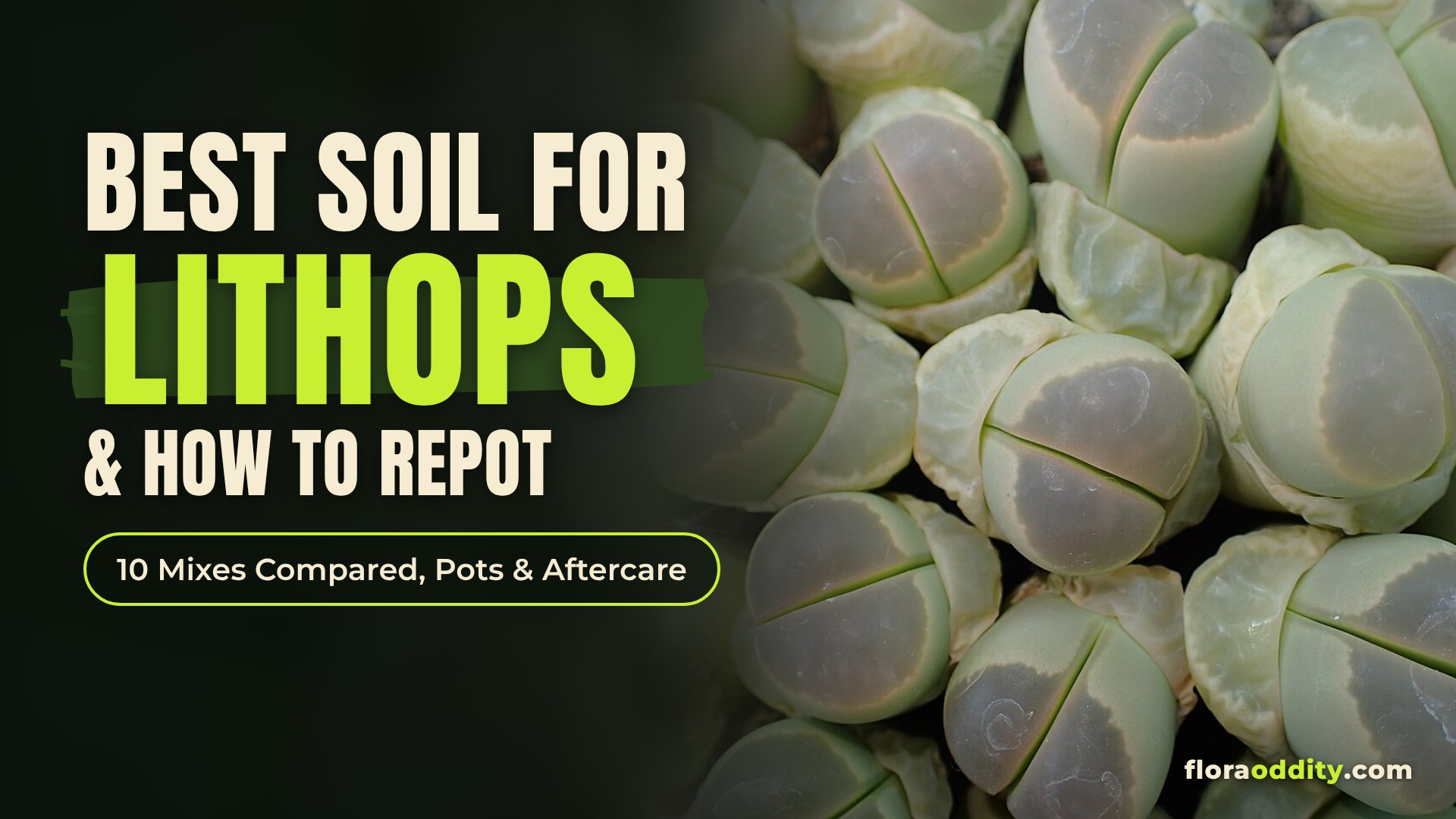
Lithops soil has one job above all others: let the roots dry out between waterings, every time. These plants store almost all their water in two fused leaves, and the University of Wisconsin Extension names good soil drainage, bright light and proper watering as the three things their health in cultivation depends on. Get the mix and the pot right, and every watering decision after that becomes easier.
Published advice ranges from cactus compost with added sand to pure pumice. This guide compares those recipes, then covers pots, repotting and aftercare.
The Short Answer
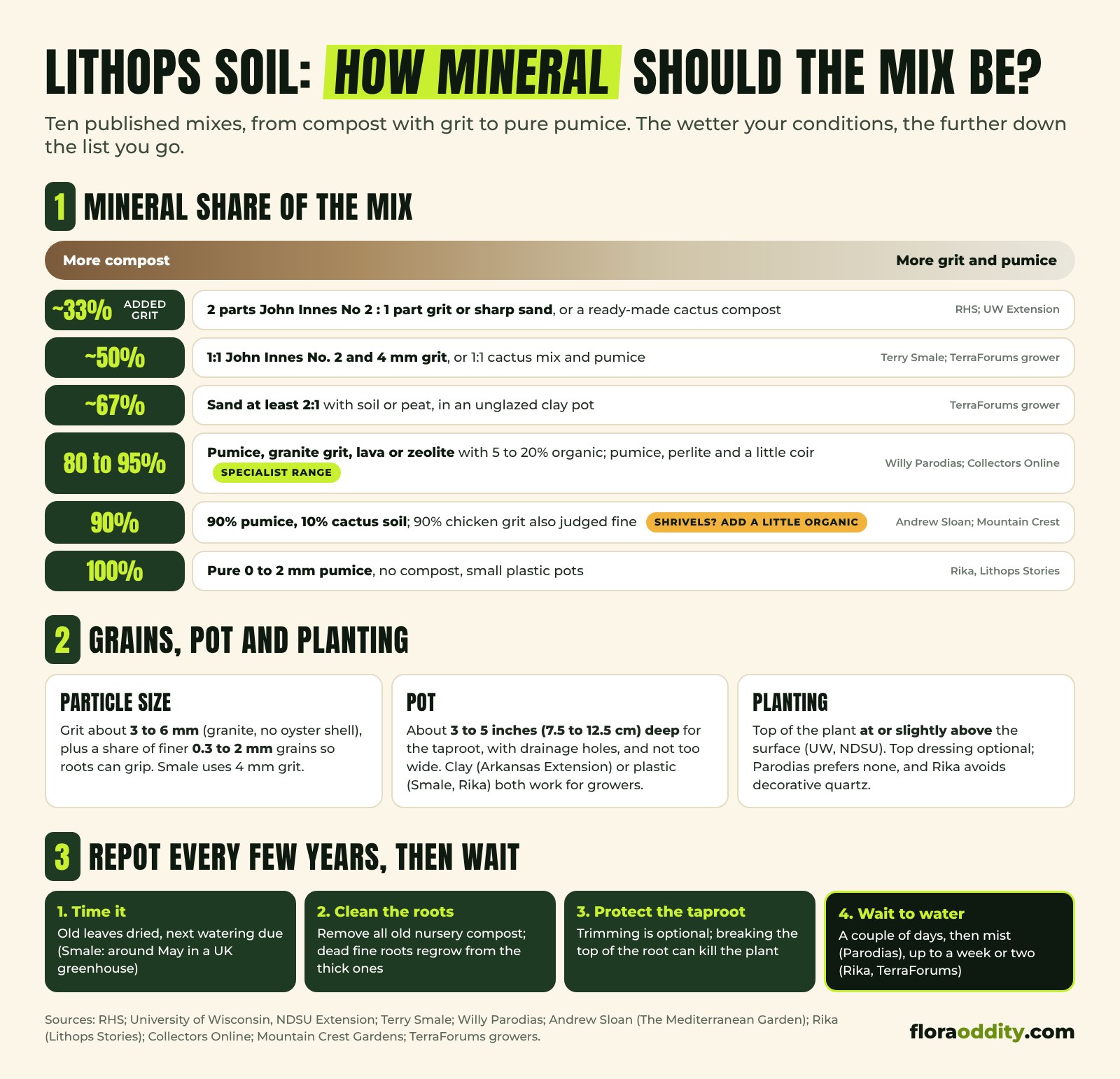
Use a mostly mineral, fast-draining mix. Mainstream sources such as the RHS and the University of Wisconsin Extension start from a cactus compost or a loam-based compost with extra grit, sharp sand or perlite. Specialist growers go further: Belgian grower Willy Parodias advises roughly 80 to 90% mineral material and 10 to 20% organic, and some windowsill growers use pure pumice. The right point on that scale depends on how humid your climate is and how often you water.
Use grit of roughly 3 to 6 mm with some finer particles mixed in, a pot about 3 to 5 inches (7.5 to 12.5 cm) deep with drainage holes, and set the plant so its top sits at or slightly above the surface. Repot only every few years, ideally just before the first watering of the growing season, wash off old nursery compost, and wait several days to a couple of weeks before watering again.
| Recipe | Mineral share (approx.) | Ingredients | Source |
|---|---|---|---|
| Cactus compost or amended potting mix | Not stated | Cactus and succulent mix, or standard potting media with extra sharp sand or perlite | University of Wisconsin Extension |
| RHS cactus compost | About one third grit | 2 parts peat-free John Innes No 2 to 1 part horticultural grit or sharp sand | RHS (cacti and succulents) |
| Loam and grit | About half grit | 1:1 John Innes No. 2 and 4 mm grit | Terry Smale |
| Sandy mix for clay pots | Sand at least two thirds | Sand at least 2:1 with garden soil or peat | mark.ca, TerraForums |
| Half and half | About half | 1:1 cactus mix and pumice | cockatielmother, TerraForums |
| Gritty mineral mix | 80 to 90% | Pumice, perlite and a little potting mix or coco coir | Collectors Online (nursery) |
| Mineral with a little compost | 80 to 95% | Pumice, granite chicken grit, lava, zeolite or similar, plus 5 to 20% organic | Willy Parodias |
| Pumice and cactus soil | 90% | 90% pumice, 10% cactus potting soil, in 10 cm deep pots | Andrew Sloan, The Mediterranean Garden |
| Mostly grit | About 90% | 90% chicken grit judged acceptable | Mountain Crest Gardens (staff answer) |
| Pure pumice | 100% | Pumice stones with pumice sand, about 0 to 2 mm | Rika, Lithops Stories |
Why Lithops Need a Mineral Mix
The University of Wisconsin Extension describes Lithops habitat as quartz grit or gravelly flats, stony ridges, sand, decomposed granite, shale and limestone, with average rainfall generally under 20 inches (about 500 mm) a year. NC State Extension adds that they are “accustomed to full sun, rocky soil, and droughts.”
Each plant is a pair of thick, fused leaves on a taproot, able to store water for months, so a damp mix brings little benefit and real risk. The Wisconsin guide calls overwatering “the chief cause of early demise,” and NC State lists root rot, mushy leaves and splitting among the results.
Organic matter is where the danger hides. Willy Parodias, a Belgian grower with a detailed Lithops soil page, explains that in a mix rich in organic material the surface dries quickly while the deeper layers stay almost soaking wet. Parodias checks deep in the pot with a bamboo skewer.
A mix can also be too lean. Asked about 90% chicken grit, Mountain Crest Gardens staff said it should be fine, but if the plant shrivels and watering does not help, repot into “a slightly more organic soil.”
Mineral vs Organic: Finding Your Ratio
The recipes above fall into three broad groups.
Compost with extra grit. The RHS recommends a peat-free, loam-based potting compost “with added extra grit” for Lithops lesliei, and for cacti and succulents in general a proprietary peat-free cactus compost or 2 parts peat-free John Innes No 2 to 1 part horticultural grit or sharp sand. The University of Wisconsin Extension and NDSU Extension both accept a cactus mix, also suggesting potting soil amended with sharp or coarse sand.
Half grit, half loam. Terry Smale, a British mesemb grower whose Lithops article first appeared in the RHS journal The Garden, uses a 1:1 mix of John Innes No. 2 and 4 mm grit. Smale finds peat-based composts, often used by commercial nurseries for propagation, “not very satisfactory for long-term use.”
Mostly or wholly mineral. Parodias advises the “very general 90:10 or 80:20 ratios” of mineral to organic, or even 95:5 in a very wet climate. Collectors Online, an Australian nursery, recommends a mix that is 80 to 90% inorganic, made from pumice, perlite and a small amount of potting mix or coco coir. Andrew Sloan, writing for the Mediterranean Garden Society from southern Spain, pots young plants in 90% pumice and 10% cactus potting soil. At the far end, the windowsill grower behind the Lithops Stories blog uses pure pumice with “absolutely no compost.”
How do you choose? Parodias ties the ratio to your local climate and “your unstoppable urge to water.” The more humid your air and the heavier your hand with the watering can, the further toward the mineral end you should go. A TerraForums grower, swords, made the same point from the other side: the grower’s main Lithops supplier, working at 6 to 10% relative humidity, could use far more peat than swords could in Minnesota.
The Ingredients, One by One
Pumice. A natural volcanic foam. Parodias values it because tiny water reserves can enter its pores and be held there for a while, unlike hard rock such as granite. Rika of Lithops Stories finds that in pumice rot “rarely happens,” because the roots can draw moisture from the stones without sitting in water.
Grit and chicken grit. Smale uses 4 mm grit. NDSU describes chicken grit as a mixture of coarse sand, pebbles and small chunks of rock that can be used as potting soil. Parodias sets two conditions: a grain size of about 3 to 6 mm, and a non-alkaline hard stone such as granite. Avoid grit sold with oyster shell, which Parodias warns is pure calcium carbonate.
Sand and loam. The University of Wisconsin Extension and the RHS specify sharp sand; the RHS notes it is not the same as builders’ sand. John Innes composts, the base for the RHS and Smale, are loam-based.
Perlite. The University of Wisconsin Extension lists perlite as a drainage additive. Parodias disagrees: perlite and vermiculite can store “as much as 300% of their own weight in water,” and perlite is so light that it floats to the surface when you water.
Akadama. None of the extension or society sources mention it. Rika tried akadama and called it “a bad idea,” because the product sold locally was “full of chemicals and slime.”
Other minerals. Parodias also lists lava, zeolite, tuff, broken terracotta, diatomite and fired molar clay (some cat litters). For fired clay granules, Parodias suggests a simple test: leave a handful in a cup of water for 24 hours, stirring now and then, and use it only if it still shows separate beads rather than mud.
Particle Size and Top Dressing
Smale uses 4 mm grit for adult plants and 1 mm grit for seed compost. Parodias aims for 3 to 6 mm grit but warns that a mix of only large particles, such as pea gravel or coarse pumice with 10% potting soil, may not hold moisture long enough to encourage new roots. Parodias sieves the mineral fraction so that it keeps some material in the 0.3 to 1 mm range. Rika uses 0 to 2 mm pumice and notes that material that is too small will not let roots anchor properly. The lesson: include some finer grains for roots to grip, not just big chunks.
Top dressing. The University of Wisconsin Extension says Lithops “look nice topdressed with gravel or stones,” and the RHS tops grouped succulent containers with grit or fine gravel. Parodias advises against top layers altogether, because the mix should be able to breathe and lose water freely. Rika warns that decorative quartz on top makes it impossible to see whether a pot has been watered recently.
Pots: Depth, Material and Drainage
Depth. The University of Wisconsin Extension says Lithops have an extensive root system and recommends pots about 3 to 5 inches deep with drain holes. Sloan uses 10 cm (about 4 inch) deep pots “to allow room for the taproots.” Rika uses square pots of 5 by 5 by 8.5 cm (about 2 by 2 by 3.3 inches), noting that Lithops “roots go deep.”
Width. Do not go big. The RHS warns that the extra compost in an oversized pot can stay too wet and cause rot. Rika lost plants to overwatering whenever larger pots were tried.
Material. Sources split here. Arkansas Extension notes that, because overwatering is a constant threat, Lithops are usually kept in small clay pots, and TerraForums grower mark.ca used unglazed clay. Smale says most enthusiasts use plastic pots, though clay might be safer for a large specimen. Rika prefers plastic, finding it dries quicker on that windowsill, is lighter and is easier to unpot.
Drainage. Every source that discusses pots says they need drainage holes. Parodias puts a layer of moist potting soil no more than about 0.5 cm (1/5 inch) thick at the bottom of the pot to stop very granular mix from washing out through the holes.
Planting Depth: Raised or Sunk?
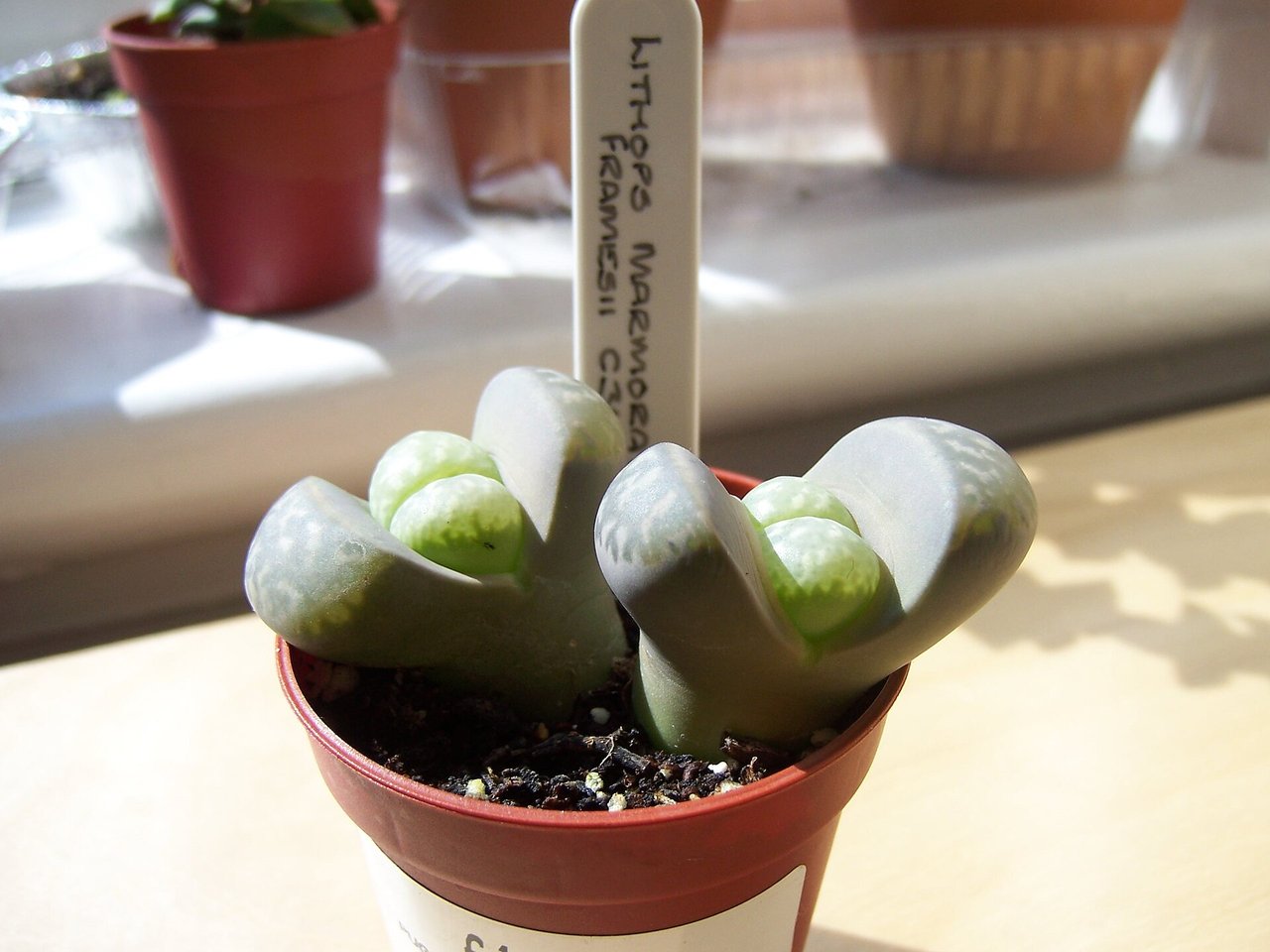
In the wild, NDSU Extension notes, Lithops grow buried up to the top of their bodies. In a pot, the University of Wisconsin Extension recommends setting the top of the plant slightly above the soil surface rather than flush with it, and NDSU says plants grown indoors should be raised out of the soil to prevent rot.
Parodias plants deeper, up to the discoloration mark on the side of the body, to keep the plant cooler in summer.
When to Repot
Lithops need repotting rarely. The University of Wisconsin Extension says a plant can stay in the same pot for 10 to 20 years. Smale repots about once every two years, and Rika refreshes the substrate roughly every three years.
Timing. Smale repots “just before the first watering is due,” which in UK greenhouses is around May, once the new leaves are well developed and the old ones have more or less dried up. The RHS gives spring as the best time for cacti and succulents in general. A TerraForums grower, Copper, preferred winter while the new leaves were emerging, when the plants get very little water anyway. Sloan transplants young plants in autumn or spring.
New plants. Rika unpots every newly bought plant straight away, even from a specialist nursery, because what works in a greenhouse may not work on a windowsill. Parodias likewise removes all old organic soil from bulk nursery plants.
How to Repot Lithops, Step by Step
- Pick your moment. Ideally the old leaves have dried, the plant is dry and the next watering is due.
- Prepare the mix. Parodias stresses a uniform mix rather than layers. Use a pot with drainage holes.
- Unpot gently. Loosen the old mix. Parodias washes dense nursery compost off the roots, using a toothpick between them if needed.
- Inspect the roots. Smale removes all the old compost and does not worry about dead fine roots after the dry rest, because they “will soon regrow from the thicker permanent ones.” Trimming is optional. Parodias sometimes cuts off the side roots and shortens the taproot to about 2 cm (under 1 inch), but warns that breaking the taproot at the top can destroy the growing point.
- Let the roots dry. Parodias dries washed plants in an airy, bright place out of direct sun before potting.
- Plant. Fill the pot with dry mix, make a hole for the root, and set the plant at the right height. Leave only about 0.5 cm (1/5 inch) of rim showing, Parodias advises, so water does not wash over the edge.
- Top dressing is optional. Parodias prefers none, so the mix can breathe.
- Hold off watering. See the next section.
If you are dividing a clump, the University of Wisconsin Extension says to lift the plant, carefully cut through the roots and replant the pieces immediately. Parodias advises against splitting unless there is a good reason, because the central root is hard and woody and a head that loses all its root tissue will die.
Aftercare: When to Water After Repotting
Do not water straight away. Rika keeps freshly potted plants in dry pumice and leaves them unwatered for “at least a week.” Copper, on TerraForums, gave no water for a week or two after transplanting. Parodias waits a couple of days, then mists lightly and watches how the plant responds.
Parodias adds that a freshly planted Lithops will not settle in within a week. Gentle misting, or a tiny amount of moisture given from below, encourages the new roots to grow into the mix. After that, follow the plant’s normal seasonal cycle. If the repot fell during the winter leaf change, keep it dry as usual; Smale keeps pots completely dry through the winter until about May.
Planting Lithops in Groups
Smale notes that very small pots are hard to manage and that some growers put several plants in a larger pot, or arrange a large pan of specimens with matching grit and pebbles. The RHS suggests grouping succulents into a container just large enough to hold them all.
Rika takes grouping further, potting several plants of the same species and size in each small pot, usually four single-headed plants or two two-headed plants per 5 cm pot. What one plant cannot drink, its neighbor will. The key condition is to group plants with similar needs. One TerraForums grower, swords, recommended separating mixed plants so each could be watered according to its own condition.
How Lithops Compare With Mexican Butterworts
Mexican butterworts also spend part of the year in a compact, succulent winter stage. As our butterwort soil mix guide explains, windowsill growers usually use a peat-based mix such as 1 part peat to 2 parts perlite, while many greenhouse growers use all-mineral mixes, some of them 100% pumice, and repot during the succulent stage. For Lithops the mineral mix is the norm and compost the small addition. Put simply: both groups rest in a mix that does not stay wet.
What Growers Report
These are single growers’ conditions and results, not rules.
- A Minnesota grower lost Lithops left in nursery compost or repotted into 50/50 peat and perlite, which “rot off at the soil line,” and switched to a mineral mix. The same grower suggested testing several mixes in empty pots and choosing the one “totally dry or driest you can get throughout” in about 3 days. (swords, TerraForums, May and June 2009)
- A windowsill grower used “1/2 cactus mix and 1/2 pumice” and kept ten named varieties going from July onward with weekly watering, blooming on a west-facing living room windowsill. (cockatielmother, TerraForums, September 2005)
- Another grower used to take plants out of the “too enriched soil” they came in and put them in a sandy mix in an unglazed clay pot, with sand “at least 2:1.” (mark.ca, TerraForums, May 2009)
- A grower on a southeast-facing windowsill with no artificial light grows everything in pure 0 to 2 mm pumice in small plastic pots and found that “anytime I tried something bigger I lost the plants to overwatering.” (Rika, Lithops Stories, September 2019)
Our takeaway: no single recipe wins. What these growers share is a mix and pot that dry right through within a few days in their own conditions.
Where Sources Differ
| Topic | One view | Another view | Context |
|---|---|---|---|
| Organic share | RHS, UW Extension: cactus or loam-based compost with grit, sand or perlite | Parodias, Sloan, Collectors Online: 80 to 95% mineral; Rika: 100% pumice | Humid, cool or windowsill conditions favor more mineral |
| Perlite | UW Extension: a drainage additive | Parodias: holds a lot of water and floats | Parodias prefers pumice or hard grit instead |
| Pot material | Arkansas Extension, mark.ca: clay | Smale, Rika: plastic | Rika finds plastic dries quicker on a windowsill; Smale sees clay as safer for large specimens |
| Pot depth | UW Extension: 3 to 5 inches; Sloan: 10 cm | Collectors Online: shallow pots are usually enough | Most sources stress room for the taproot |
| Planting depth | UW, NDSU: top slightly above the surface | Parodias: up to the discoloration mark | Parodias plants deep to keep plants cooler in summer |
| Top dressing | UW Extension: gravel looks nice; RHS: grit mulch | Parodias: avoid; Rika: hides watering | Rika’s objection is that a decorative layer hides whether the pot was watered |
| Repot frequency | Smale: about every two years | UW Extension: possibly 10 to 20 years in one pot | Smale repots just before the first watering of the season |
Common Mistakes
- Leaving a new plant in nursery compost. Rika and Parodias both unpot new plants and remove the old mix.
- Using an oversized pot. Extra mix stays wet longer, as the RHS warns.
- A shallow pot for a deep root. Give the taproot 3 to 5 inches (7.5 to 12.5 cm) of depth.
- Thick decorative top layers. Glass, marbles or quartz hide the mix and slow drying.
- Watering right after repotting. Wait several days to a couple of weeks.
- Breaking the taproot. Handle the root gently, especially when dividing.
FAQ: Lithops Soil
What is the best Lithops soil?
A mostly mineral, fast-draining mix. Parodias advises about 80 to 90% mineral material such as pumice or granite grit with 10 to 20% organic, while the RHS uses 2 parts John Innes No 2 to 1 part grit and Smale, growing in a UK greenhouse, uses 1:1 John Innes No. 2 and 4 mm grit. The wetter your conditions, the more mineral the mix should be.
Can I use regular cactus soil for Lithops?
The University of Wisconsin Extension and NC State Extension accept a cactus mix. Specialist growers such as Parodias and Sloan add far more pumice or grit.
How often should Lithops be repotted?
Every few years at most: about every two years for Smale, about three for Rika, and the University of Wisconsin Extension says a plant can stay in one pot for 10 to 20 years.
When should I water Lithops after repotting?
Wait. Growers wait from a couple of days (then light misting) to a week or two before the first real watering, and then follow the plant’s normal seasonal cycle.
The Bottom Line
The best Lithops soil is mostly mineral: grit or pumice of a few millimetres, with a small, controlled share of compost that you adjust for your climate. Put it in a pot deep enough for the taproot but not too wide, keep the plant’s top at or above the surface, and repot rarely, just before a growing season, leaving the plant dry for days afterwards. Get those basics right and the watering routine becomes much more forgiving.
Sources & Further Reading
- University of Wisconsin Extension: Living Stones, Lithops (Susan Mahr)
- NC State Extension Plant Toolbox: Lithops
- University of Arkansas Cooperative Extension: Plant of the Week, Living Stones
- NDSU Extension, The Dakota Gardener: Living Stones
- RHS: Lithops lesliei
- RHS: How to grow cacti and succulents
- Terry Smale: Cultivation of Lithops
- Andrew Sloan: Lithops, The Mediterranean Garden No. 100 (Mediterranean Garden Society)
- Willy Parodias: Soil and Potting, Lithops in Belgium
- Rika: Lithops Cultivation Guide, Lithops Stories
- Collectors Online: Living Stones, a Guide to Lithops and Other Mesembs for Collectors
- Mountain Crest Gardens: staff answer on 90% chicken grit for Lithops
Featured image based on a photo of Lithops olivacea by Krzysztof Ziarnek, Kenraiz via Wikimedia Commons, CC BY-SA 4.0, with typography added by FloraOddity; the adapted image is offered under the same licence.
Final articles are editorially reviewed and factual claims are checked against cited sources. Last reviewed: October 2026.