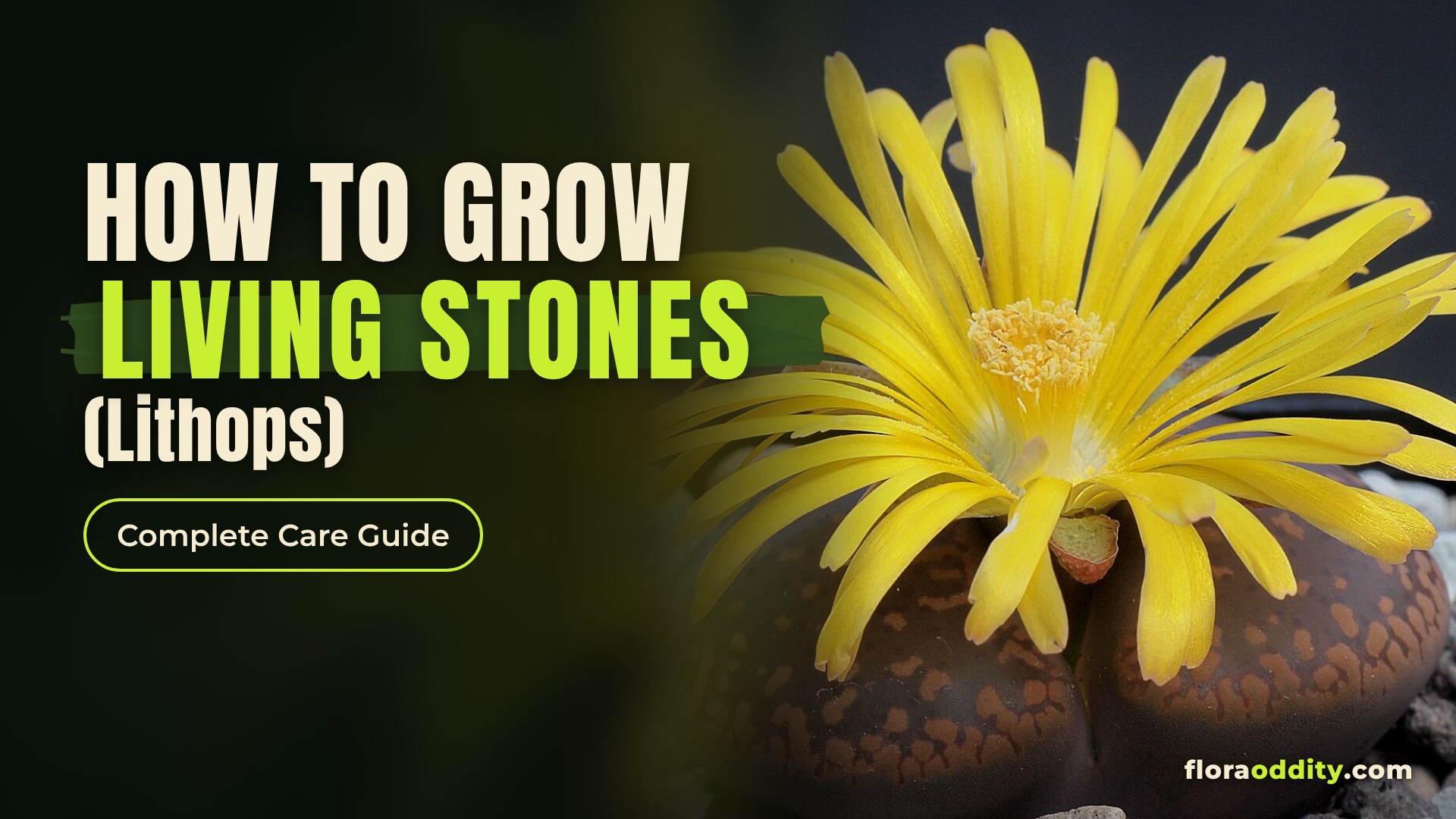
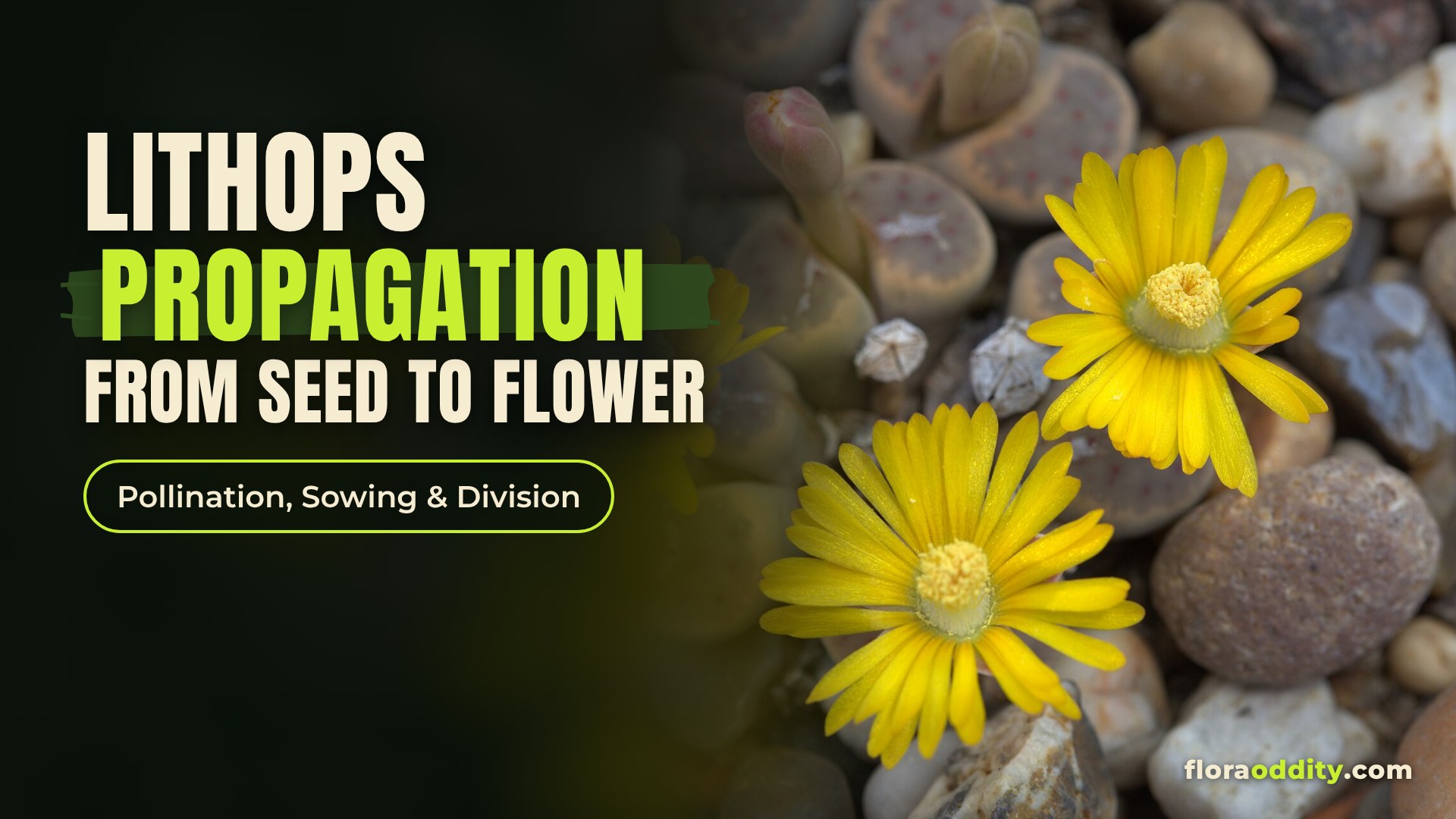
A Lithops in flower looks almost too large for the plant underneath it. A daisy-like yellow or white bloom pushes out of the slit between the two leaves, usually in autumn, and for a week or two the stone becomes the most conspicuous thing on the windowsill. That flower is also the start of nearly every new Lithops in cultivation: Wikipedia’s Lithops article notes that because a plant only offers cuttings after it has split into several heads naturally, “most propagation is by seed.”
Lithops propagation therefore comes down to three skills: getting a flower pollinated, sowing dust-fine seed so that it actually comes up, and keeping tiny seedlings alive through their first two years. This guide follows the cycle from the first bud to the first flower on a plant you raised, and covers division of clumps.
The Short Answer
Most Lithops flower in autumn and early winter, and a plant usually needs to be about three years old first. They are self-sterile, so you need two different clones of the same species in flower at the same time and must carry pollen between them by hand. The seed ripens in a capsule over roughly nine months, and the capsule opens only when it gets wet.
Sow the seed on the surface of a gritty, well-drained mix, kept warm at about 68 °F (20 °C), bright, and humid under a clear cover. Most seed comes up within a few weeks, but stragglers can take months. Take the cover off once the seedlings are up, let the mix dry a little more as they grow, and transplant at about one year. Expect first flowers after 3 to 4 years. Division works only on plants that have already formed several heads, which is why growers rarely rely on it.
| Stage | When | What happens | What you do | Sources |
|---|---|---|---|---|
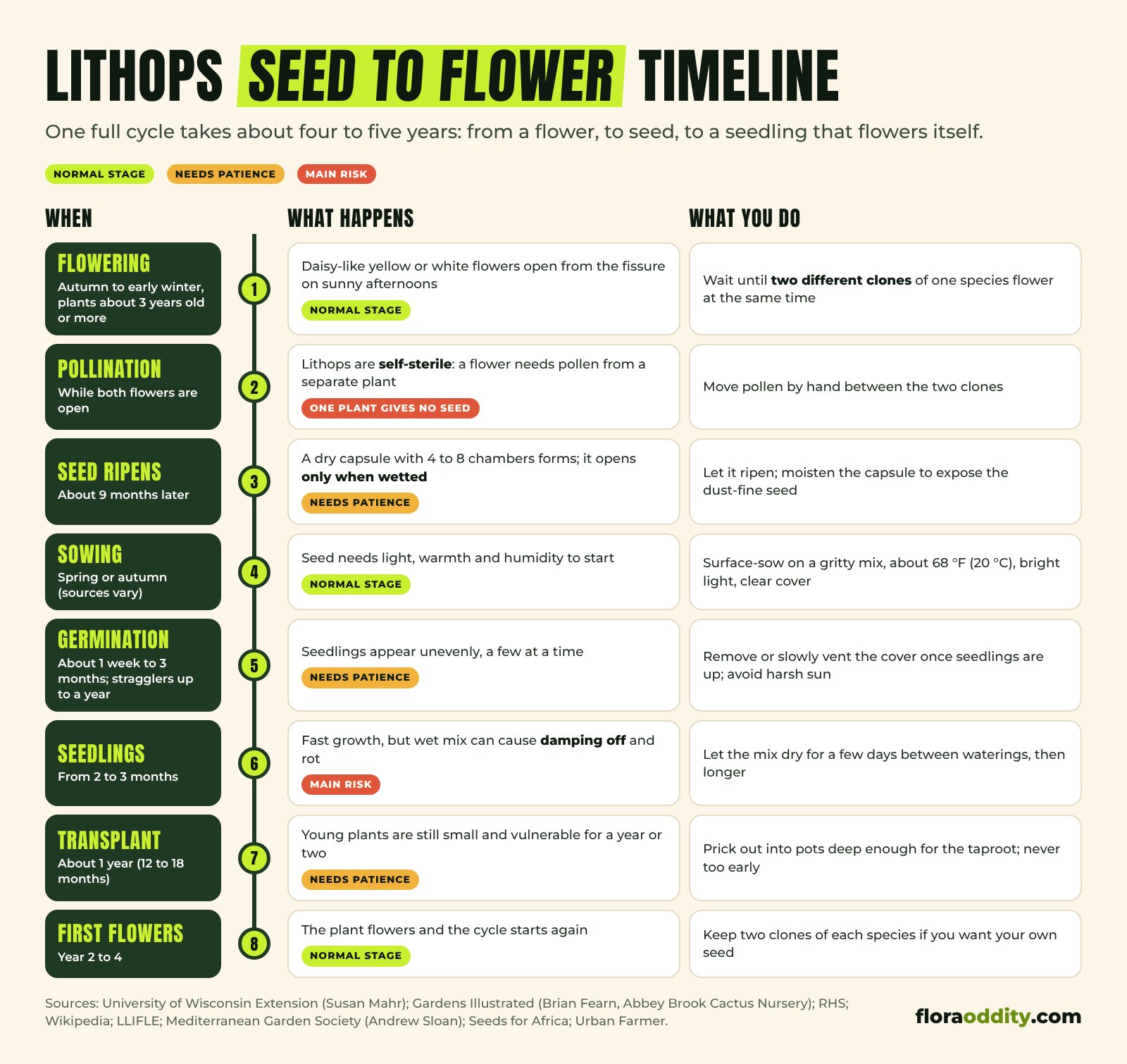
| Flowering | Autumn and early winter on plants about 3 years old or more | Flowers open in the afternoon on sunny days and close again later in the day | Watch for the fissure opening and a bud rising | Wisconsin Extension, Mediterranean Garden Society, Wikipedia |
| Pollination | While two clones flower together | Lithops are self-sterile; a flower needs pollen from a different plant | Move pollen by hand between two separate clones of the same species | Wisconsin Extension, Wikipedia |
| Seed ripening | About 9 months after pollination | A dry, chambered capsule forms; it opens only when moistened | Leave the capsule to ripen; wet it to expose the seed | Wikipedia, Wisconsin Extension, Mediterranean Garden Society |
| Sowing | Spring or autumn (sources vary) | Seed is dust-fine and needs light | Surface-sow on a gritty mix, keep at about 68 °F (20 °C), cover for humidity | Gardens Illustrated, RHS, LLIFLE |
| Germination | From about a week to three months; stragglers up to a year | Seedlings appear unevenly | Remove or vent the cover once seedlings are up | Gardens Illustrated, Urban Farmer, Wisconsin Extension |
| Seedlings | 2 to 3 months onward | Seedlings grow fast but are prone to damping off | Let the mix dry for a few days between waterings, more as they grow | Wisconsin Extension, LLIFLE |
| Transplanting | About 1 year (12 to 18 months) | Young plants are small and vulnerable | Prick out into pots deep enough for the taproot | Wisconsin Extension, Gardens Illustrated, Mediterranean Garden Society |
| First flowers | Year 2 to 4 | The cycle starts again | Keep two clones of each species if you want seed | Wikipedia, Mediterranean Garden Society, Wisconsin Extension |
When and Why Lithops Flower
The season
Susan Mahr, writing for University of Wisconsin Extension, says most Lithops flower “during autumn and early winter,” with daisy-like yellow, pale orange or white flowers that emerge from the fissure between the leaves. The flowers open in the afternoon of sunny days and close again in late afternoon, and some are scented. Mahr gives their size as roughly ½ to 1½ inches (about 1 to 4 cm), depending on the species and conditions. The RHS entry for Lithops karasmontana likewise lists white flowers about 1.2 to 1.6 inches (3 to 4 cm) across “in autumn.”
Not every species keeps to that calendar. Wikipedia’s Lithops article states that flowering is “usually in autumn,” but that it can come before the summer solstice in L. pseudotruncatella and after the winter solstice in L. optica.
What sets it off
Flowering sits inside the yearly growth cycle. Mahr describes how growth resumes in late summer to early autumn, and “the first sign of growth is when the fissure between the leaves begins to separate in preparation for flowering.” Andrew Sloan, growing Lithops in southern Spain and writing in the Mediterranean Garden Society’s journal, describes the autumn watering as what “gives the plants energy to flower”: the fissure separates, a bud forces its way up, and the flower opens in the afternoons “for one to two weeks.”
After flowering, a new leaf pair forms inside the old one, so each plant gives one chance at seed per year.
How old a plant has to be
A Lithops grown from seed will not flower in its first year or two. Wikipedia says seedlings “will not flower until at least two or three years old,” and Sloan writes that Lithops “must usually be three years old before they begin flowering.” Mahr is the most specific: plants “can be expected to flower in 3 to 4 years under optimal conditions.”
Cross-Pollination: Why You Need Two Clones
Self-sterile flowers
Mahr states it plainly: “Lithops are self-sterile, so must be pollinated to produce seed.” Wikipedia calls them “obligate outcrossers” that “require pollination from a separate plant.” A single plant, however healthy, will not set seed on its own pollen.
The important word is “separate.” Wikipedia puts the practical rule this way: Lithops “can readily be pollinated by hand if two separate clones of a species flower at the same time.” A clone here means a genetically distinct individual. A clump that has divided into several heads is still one plant genetically, so two flowers on the same clump do not count as two clones.
Doing it by hand
Hand pollination means moving pollen from the flower of one plant onto the flower of the other. Because Mahr notes that the flowers open only in the afternoons of sunny days, that is the window for the job: both flowers need to be open at the same time.
Wikipedia notes that some of the selected seed strains sold as pattern cultivars are hybrids.
The Seed Capsule and How to Collect Seed
A capsule that opens in the rain
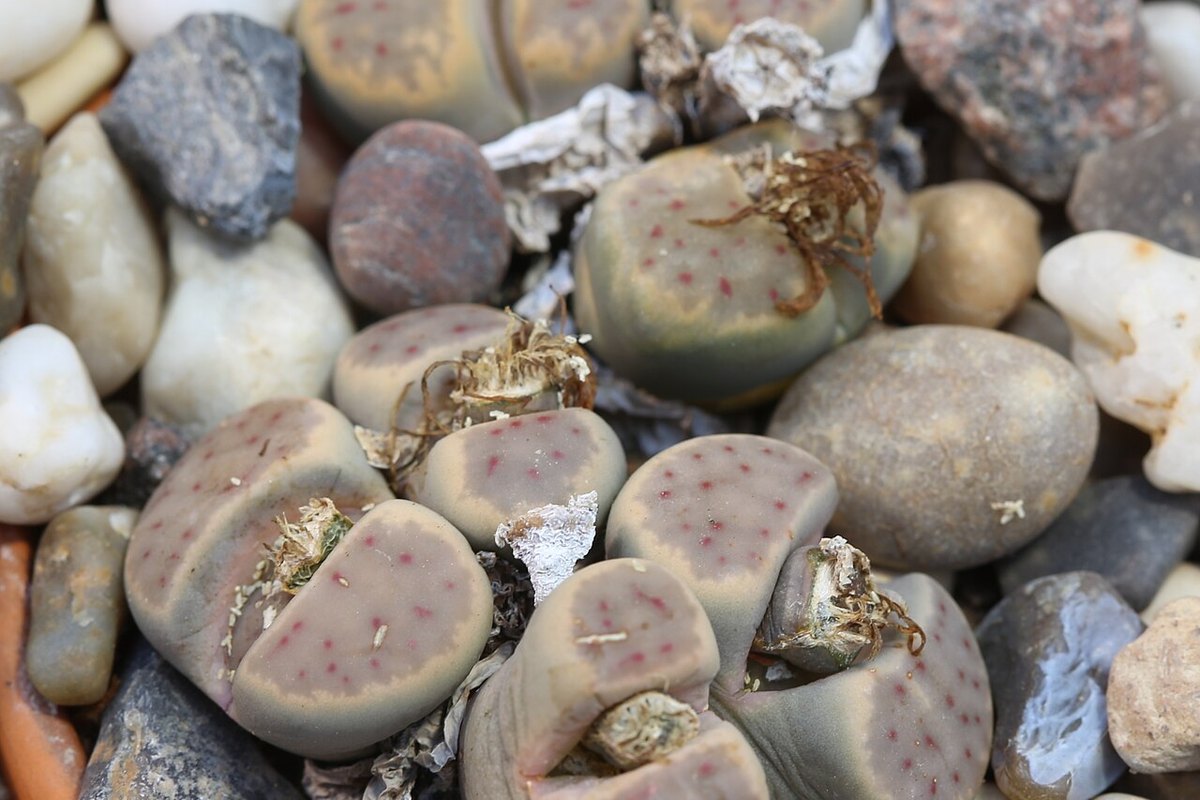
After a successful pollination, the flower fades and a capsule develops in its place. Mahr describes it as a “hydrochastic 4-8 chambered fruiting capsule, which only opens when moistened, exposing the tiny seeds.” In the wild, Mahr adds, falling raindrops splash the seed out “to a distance of an inch to up to a few feet from the parent plant,” and once the capsule dries it closes again, protecting the seed that is left until the next rain. LLIFLE’s species page for L. karasmontana records capsules that are mostly 5-chambered, sometimes 4 or 6, holding seed it describes as “minuscule, yellow-brown.”
Wikipedia adds that capsules may also detach and travel intact, or “disintegrate after several years.”
Collecting it
The ripening takes most of a year. Wikipedia says seed “will be ripe about 9 months later.” Sloan explains why the rain-opening capsule is handy for growers: it is a seed-saving mechanism in the wild, “but can be used in cultivation to access the seeds.” Put simply: let the capsule dry and ripen on the plant, then moisten it when you want the seed, and the chambers open to expose it.
Gardens Illustrated, drawing on Brian Fearn of Abbey Brook Cactus Nursery, notes that Lithops seed “resembles dust,” so mixing it with silver sand makes it easier to spread evenly when you sow.
Sowing Lithops Seed Step by Step
When to sow
Sources give several sowing windows, and each one comes down to warmth. Gardens Illustrated says autumn or spring. The RHS recommends sowing at 66 to 70 °F (19 to 21 °C) “in early spring.” LLIFLE gives October or April for L. karasmontana. Mahr suggests summer. Sloan sows in spring when temperatures are above 68 °F (20 °C). Seeds for Africa, a South African seed supplier, notes that growers have had success sowing year-round.
The steps
- Prepare a gritty mix. Gardens Illustrated recommends a half-and-half mix of good cactus compost and ready-dampened fine grit or sand. Sloan uses 70% pumice and 30% cactus potting soil, sterilized in a microwave or oven and cooled before use; Seeds for Africa also advises sterilizing the substrate if possible.
- Wet the mix before sowing. Seeds for Africa recommends watering the soil before adding the seed, because a strong stream of water washes the tiny seeds away. Sloan waters from below by standing pots in a tray.
- Sow on the surface. Scatter the seed, ideally mixed with silver sand, over the top. Gardens Illustrated says to press it onto the surface without covering it, because the seed needs light to germinate. Others add a very thin covering; see “Where Sources Differ” below.
- Cover for humidity. Put the pot in a plastic bag or under a clear lid (Gardens Illustrated), or cover it with clear plastic or glass, even cling wrap (Seeds for Africa). LLIFLE describes covering with glass for the first 3 to 4 days, then replacing it with light shade cloth and misting once or twice a day.
- Keep it warm. Gardens Illustrated suggests a heated propagator or heat mat to hold the seed at a steady 68 °F (20 °C), and the RHS gives 66 to 70 °F (19 to 21 °C).
- Give bright light, not hot sun. Mahr suggests a warm, sunny spot with the mix “moist but not soggy.” Sloan places the bagged pots in a spot that is light but not sunny, and the Urban Farmer growing guide recommends bright, filtered light.
LLIFLE also mentions watering from below with a fungicide to prevent damping off. That is a common practice in its advice, not a universal one; the other sources here do not mention it.
How long germination takes
Germination times vary widely between sources and between seeds in the same pot. Urban Farmer gives “7 to 21 days.” LLIFLE says most seed should have germinated after about two weeks of misting. Gardens Illustrated allows “anything from a couple of weeks to three months.” Mahr says seed generally begins to germinate “in a few weeks,” but that germination can be spread out, “with stragglers taking as long as a year.”
Put simply: count on a few weeks, and do not throw a pot away just because the first flush is over.
Seedling Care and the First Years
Taking the cover off
Once seedlings appear, the humid cover has done its job. Gardens Illustrated says to remove the bag or lid once the seeds have sprouted, and Sloan removes the bag once germination is under way. Urban Farmer prefers a slower approach: increase ventilation over several weeks and “vent gradually after germination rather than removing humidity all at once,” while avoiding harsh direct sun.
Watering in the first months
The young seedlings need steady, light moisture, then gradually more drying. Mahr describes the sequence:
- Once seedlings are growing fast, let the top ¼ inch of mix dry while the lower mix stays moist. Excess water at this stage can cause damping off.
- At 2 to 3 months old, start letting them “dry out completely for a few days between waterings,” and gradually lengthen the dry spells.
LLIFLE describes a similar taper for misting: after the first two weeks, mist every second day, then every third day as the plants grow. Sloan keeps watering seedlings from below on a regular basis, with the mix neither drying out completely nor staying soaking wet, “as this can cause rot.”
Transplanting
Do not hurry the first move. Mahr says young plants “can be transplanted when they are about a year old.” Seeds for Africa agrees that seedlings are ready for transplanting within a year, and warns that transplanting too soon can stunt their growth. Gardens Illustrated suggests leaving them in place until they are ready for pricking out, “12-18 months after sowing.” Sloan transplants after one year, in autumn or spring, into pots 4 inches (10 cm) deep “to allow room for the taproots.”
The first two years
Wikipedia sums up the risk: seed is easy to germinate, “but the seedlings are small and vulnerable for the first year or two.”
How Lithops seed compares with other plants we cover
Our guide to growing Venus flytraps from seed describes surface sowing in a bag in bright light at 68 to 77 °F (20 to 25 °C), with most seed up in 4 to 8 weeks, and plants that stay tiny for years, much as Lithops do. Ant plant seed is the opposite: LLIFLE reports germination within a week, often within 24 hours, and it germinates equally well in light or darkness, and it must be sown fresh. Lithops seed, by contrast, needs light to start, and can wait in a closed capsule until rain arrives.
Division of Multi-Headed Plants
How plants divide
A single Lithops can become a clump without any help from you. Mahr notes that during the yearly leaf change many plants divide “to produce more than one leaf pair so that a single body gradually becomes a small cluster.” LLIFLE records L. karasmontana forming clumps with up to 12 or more heads, usually 2 to 6.
How to divide
The RHS lists offsets as an option alongside seed, and Mahr gives the method: “Lift the plant, carefully cut through the roots and replant them immediately.” LLIFLE’s L. turbiniformis page adds that each piece should have one or more heads and part of the root, and should dry for a couple of days before going back on the soil.
Why it is rarely done
Division has three drawbacks. First, it only works on a plant that has already formed several heads. Wikipedia says cuttings “can only be used to produce new plants after a plant has naturally divided to form multiple heads, so most propagation is by seed.” Second, it is not easy: LLIFLE calls rooting Lithops cuttings “relatively difficult” and “generally pointless as well, so quick are they from seed.” Third, every piece of a divided clump is the same clone, so dividing gives you more of one plant but never a second clone to pollinate it with.
Put simply: in these sources, seed is the main route to new plants, while division only multiplies a clone you already have.
How Long From Seed to Flower
Put simply, from the sources above: seed ripens about nine months after pollination, seedlings are transplanted at about a year, and they flower at about three to four years old. From one flower to a flower on its offspring is a cycle of about four to five years.
Mahr points out the other side of that patience: Lithops are long-lived, and “can persist for up to 40 to 50 years.”
What Growers Report
These are individual growers’ public accounts. Each one describes one grower’s conditions and results, not a rule.
- Andrew Sloan grew Lithops from seed in southern Spain, sowing in spring on a sterilized pumice and cactus soil mix, lightly covered with sand, watered from below and sealed in a clear bag in a light but not sunny spot. The grower reports that “Healthy seeds germinate fairly quickly and the bag can be removed,” and that one batch gave about 100 seedlings of six species. (Andrew Sloan, The Mediterranean Garden, April 2020)
- One grower sowed a mixed packet in a shallow bowl of potting soil, perlite and a sand top layer, slid it into a plastic bag tented with plant labels, and set it slightly off to one side under grow lights at room temperature. Three seedlings were up “Already on the 4th day after sowing.” (allegedhuman, TerraForums, March 2009)
- Another grower, germinating seed on mostly sand in a plastic container, reported that the “seeds germinated in 4 days!” (wickedthistle, TerraForums, June 2002)
- In the same period, a third grower reported a much lower yield from one batch: “Out of about 100 seeds I have maybe 8 or 9 babies.” (Dyflam, TerraForums, June 2002)
Put simply: fresh seed in warm, humid, bright conditions can come up within days, but the number that survive varies a great deal from batch to batch.
Where Sources Differ
| Topic | One view | Another view | Context the sources give |
|---|---|---|---|
| Covering the seed | Gardens Illustrated: press onto the surface “without covering,” because the seed needs light; Urban Farmer: “do not cover” | Mahr: cover with “a very thin layer of fine sand”; LLIFLE: “a very fine layer of grit”; Sloan: lightly cover with sand or gravel | Sloan says the covering supports the seedlings after germination; all sources keep the seed at or near the surface |
| Best time to sow | RHS: early spring; Sloan: spring above 68 °F (20 °C) | Gardens Illustrated: autumn or spring; LLIFLE: October or April; Mahr: summer; Seeds for Africa: year-round has worked | Every source ties the timing to warmth, at about 66 to 70 °F (19 to 21 °C) or more |
| Germination time | Urban Farmer: 7 to 21 days; LLIFLE: most within about two weeks | Gardens Illustrated: up to three months; Mahr: stragglers up to a year | The shorter figures describe the first flush; the longer ones include late seeds |
| Removing the cover | Gardens Illustrated and Sloan: remove once seeds have sprouted | Urban Farmer: vent gradually over several weeks | Urban Farmer adds a warning against harsh direct sun during this stage |
| First flowering | Wikipedia: at least two or three years | Sloan: usually three years; Mahr: 3 to 4 years under optimal conditions | All agree that seedlings do not flower in their first year |
Common Mistakes
- Expecting seed from a single plant. Lithops are self-sterile; you need two different clones of the same species flowering together.
- Counting two heads of one clump as two plants. A divided clump is one clone, so its flowers cannot pollinate each other.
- Burying the seed. At most, add a very thin layer of fine sand or grit; the seed needs light.
- Washing the seed away. Wet the mix first and water from below or with a fine mist.
- Keeping seedlings sealed and wet for too long. Damping off and rot follow; open the cover once they are up and let the surface dry a little.
- Dividing a plant to get more plants quickly. Seed is faster and more reliable, and gives new clones.
FAQ: Lithops Propagation
What is the easiest method of Lithops propagation?
Seed. Cuttings work only once a plant has formed several heads, and LLIFLE calls them relatively difficult compared with seed.
Can I get seed from just one Lithops?
No. Lithops are self-sterile; you need two different clones of the same species flowering at the same time.
How long do Lithops seeds take to germinate?
Often one to three weeks, but some seeds take months, and Mahr notes stragglers of up to a year.
When can I repot Lithops seedlings?
At about a year old, or 12 to 18 months after sowing, into pots deep enough for the taproot.
How long until a seed-grown Lithops flowers?
Usually about three years, sometimes four.
The Bottom Line
Lithops propagation is slow but simple. Two clones of one species in flower, pollen moved by hand and about nine months of patience give a capsule of dust-fine seed that opens when wetted. Sow it on the surface of a gritty mix, keep it warm, bright and humid until it comes up, then wean the seedlings toward drier conditions and leave them alone for about a year. Three or four years later, they should flower themselves. Division only multiplies an existing clone; seed is how most new living stones are made.
Sources & Further Reading
- Susan Mahr, University of Wisconsin Extension: Living Stones, Lithops
- Jane Perrone, Gardens Illustrated: How to grow lithops from seed
- Royal Horticultural Society: Lithops karasmontana
- Wikipedia: Lithops
- LLIFLE Encyclopedia of Succulents: Lithops turbiniformis
- LLIFLE Encyclopedia of Succulents: Lithops karasmontana
- Andrew Sloan, The Mediterranean Garden Society: Lithops (The Mediterranean Garden No. 100)
- Seeds for Africa: How To Grow Lithops (Stone Plants) From Seeds
- Urban Farmer: How to Grow Lithops, Seed to Living Stone
Featured image based on a photo of Lithops dinteri by Averater via Wikimedia Commons, CC BY 4.0, with typography added by FloraOddity.
Final articles are editorially reviewed and factual claims are checked against cited sources. Last reviewed: October 2026.