Barry Rice’s Carnivorous Plant FAQ lists 23 named Heliamphora species, plus a hairy variety of H. minor, and the International Carnivorous Plant Society (ICPS) counts “at least 23 species” and many natural hybrids. Only a handful of them turn up regularly at nurseries, and the gap between the easiest and the hardest is large. A heterodoxa hybrid can grow fast on a cool windowsill. A Neblina species may sit for years without making an adult pitcher.
This guide compares the Heliamphora species and hybrids that growers actually meet: where each comes from, how big it gets, what its nectar spoon and pitcher hairs look like, which ones the sources recommend for a first plant, and how care shifts between them. It also explains why identification is harder than a label suggests. For the basics of growing any sun pitcher, start with our Heliamphora care guide.
The Short Answer
Start with a hybrid or with a typical selection of H. heterodoxa, H. nutans or H. minor. The ICPS calls these the easiest Heliamphora and says “beginners should start with these plants,” and Barry Rice and Brian Barnes, writing in Carnivorous Plant Newsletter, both recommend a hybrid first.
The species differ most in size (from compact H. minor to H. tatei, which Rice says can reach 5 feet (1.5 m) on scrambling stems), in the shape of the nectar spoon, and in how cool they need their nights. Barnes found H. hispida, H. ionasi, H. neblinae and H. elongata needed a bigger nightly temperature drop than other species and hybrids.
Be careful with identification. William Baumgartl warned in Carnivorous Plant Newsletter that leaf shape and size are “unreliable” for telling species apart, and that juvenile plants “cannot be identified with any certainty.” Buy from a seller who states the species and locality, and keep the label.
Heliamphora Species at a Glance
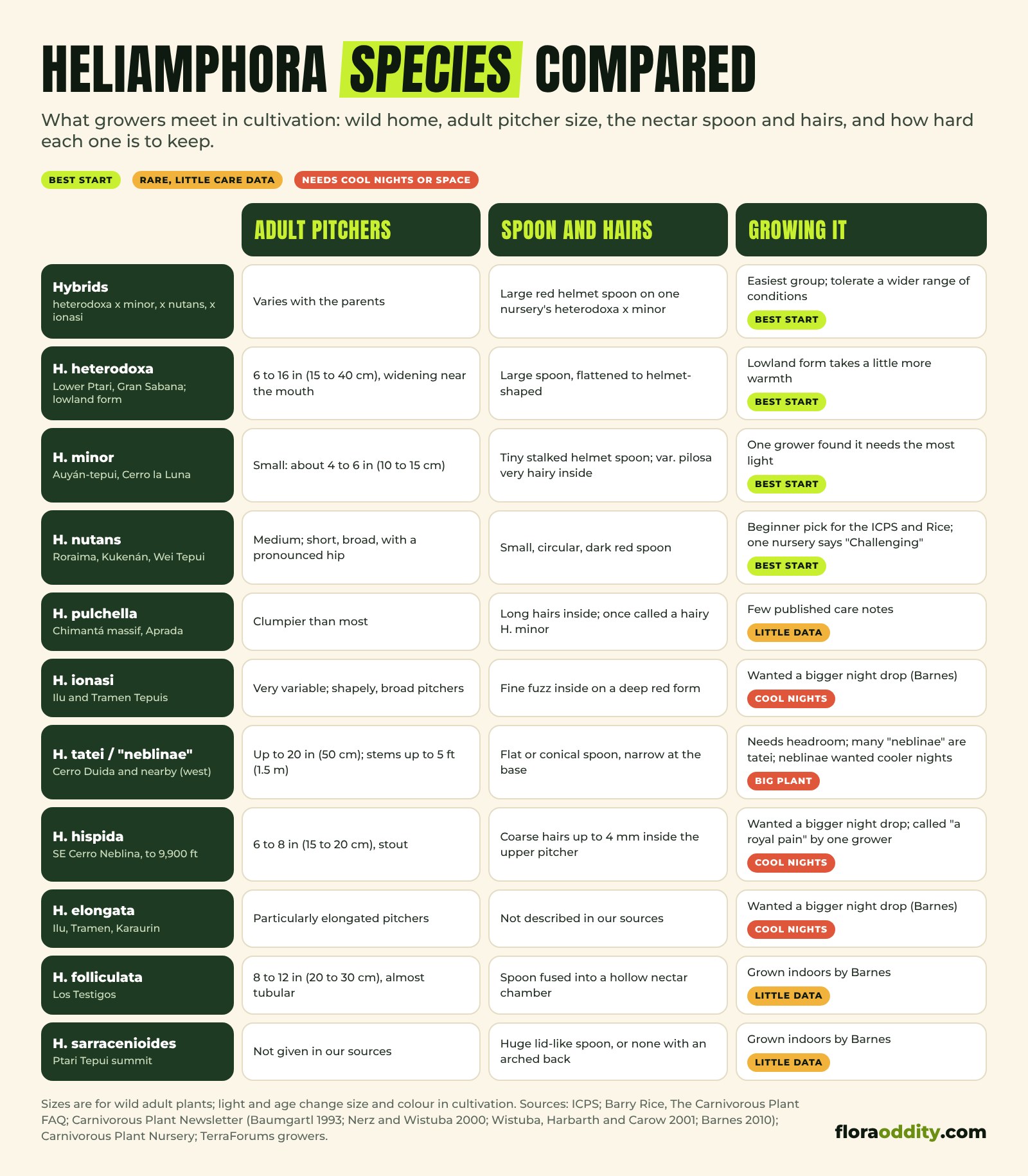
The table covers the plants growers discuss most. Sizes come from the botanical descriptions and Rice’s notes on wild plants; cultivated plants can be smaller or larger depending on light and age.
| Plant | Wild home | Adult pitchers | Nectar spoon and hairs | What the sources say about growing it | Sources |
|---|---|---|---|---|---|
| Hybrids (heterodoxa x minor, heterodoxa x nutans, heterodoxa x ionasi and others) | Man-made or natural crosses | Varies with the parents | One nursery’s heterodoxa x minor has a large red helmet spoon | Easiest group; recommended first plant | ICPS, Rice, Barnes, Carnivorous Plant Nursery |
| H. heterodoxa | Lower Ptari Tepui and the Gran Sabana; includes the lowland form | 6 to 16 in (15 to 40 cm) | Large, flattened to helmet-shaped spoon | One of the easiest species; the lowland form tolerates more warmth | ICPS, Wistuba et al., Carnivorous Plant Nursery, California Carnivores |
| H. minor (var. minor and var. pilosa) | Auyán-tepui and Cerro la Luna | Small, about 4 to 6 in (10 to 15 cm) | Tiny, strongly helmet-shaped, stalked spoon; var. pilosa very hairy inside | Beginner list; one grower found it needs the most light | ICPS, Rice, Wistuba et al. |
| H. nutans | Roraima, Kukenán, Yuruani, Wei Tepui and nearby plateaus | Medium; short, broad, with a pronounced hip | Small, circular, dark red spoon | Beginner list for the ICPS and Rice; rated “Challenging” by one nursery | ICPS, Rice, Carnivorous Plant Nursery |
| H. pulchella | Chimantá massif, Aprada and Araopán Tepuis | Not given in our sources | Long hairs inside; once treated as a hairy H. minor | Clumpier than most | Rice, ICPS |
| H. ionasi | Cliff walls and valley between Ilu and Tramen Tepuis | Variable; up to 20 in (50 cm) in Baumgartl’s 1993 figures | Fine fuzz inside, marked on a deep red form | Wanted a bigger night drop in one indoor setup | Rice, Baumgartl, Barnes |
| H. tatei (and plants sold as H. neblinae) | Cerro Duida, Huachamacari and Marahuaca in the west | Up to 20 in (50 cm); stems up to 5 ft (1.5 m) | Flat or conical spoon, narrow at the base | Big plant; many “neblinae” in cultivation are really tatei | Rice |
| H. hispida | South-east Cerro Neblina, up to about 9,900 ft (3,014 m) | 6 to 8 in (15 to 20 cm), sometimes 10 in (25 cm) | Small spoon; coarse hairs up to 4 mm inside the upper pitcher | Wanted a bigger night drop; growers disagree on ease | Nerz and Wistuba, Rice, Barnes |
| H. folliculata | Los Testigos (Aparaman group) | 8 to 12 in (20 to 30 cm), almost tubular | Spoon fused to the pitcher as a hollow nectar chamber | Grown indoors by Barnes; little care data | Wistuba et al., Rice, Barnes |
| H. elongata | Ilu, Tramen and Karaurin Tepuis | “Particularly elongated” | Not described in our sources | Wanted a bigger night drop | Rice, Barnes |
| H. sarracenioides | Ptari Tepui summit only | Not given in our sources | Huge lid-like spoon, or an arched pitcher back with no spoon | Grown indoors by Barnes; little care data | Rice, Barnes |
Beginner-Friendly or Demanding?
The easy group: hybrids, heterodoxa, nutans and minor
The sources agree on where to start, though they explain it in different ways. The ICPS names hybrids and the generic or typical selections of H. heterodoxa, H. nutans and H. minor as the easiest Heliamphora. Rice suggests a hybrid for a first-time grower and finds H. minor and H. nutans “relatively forgiving,” at least for the clones in Rice’s own collection. Barnes calls H. heterodoxa x minor “a great, hardy plant” that teaches a beginner what the genus likes and dislikes “without costing you too much if it dies.”
Carnivorous Plant Nursery gives the reason hybrids are easier: its H. heterodoxa x minor tolerates “a wider range of conditions than some pure species.” The same nursery describes pure H. heterodoxa, a clone from the Gran Sabana, as “relatively easy to grow” and rates it “Easy to Moderate,” while it rates H. minor and the heterodoxa x minor hybrid “Moderate to Challenging” and H. nutans “Challenging.” These ratings sit on the nursery’s product listings, so they describe that nursery’s plants and customers rather than the whole genus.
Watch for tissue-culture vigour
Many plants on sale come from tissue culture. Rice warns that such plants show “unnatural vitality for about a year” before slowing down, and the ICPS notes that the hormones used in sterile culture make young plants form clumps. A first-year plant that grows like a weed tells you less about your conditions than its second year will.
The demanding end
Barnes, who grew eight kinds of Heliamphora in sideways aquariums in Florida, found that H. hispida, H. ionasi, H. neblinae and H. elongata “seem to require more of a nightly temperature drop than most other species and hybrids” in that setup. Those four are the clearest warning in the published material: if your nights stay warm, they are a poor choice.
H. tatei is demanding mainly because of its size. Rice describes it as “a giant” with pitchers up to 20 inches (50 cm) tall, and a TerraForums grower advised a beginner in 2002 that it “would probably get too big for your tank.” Rarer species such as H. folliculata and H. sarracenioides have very little published care data at all; Barnes grew both indoors, but beyond that the sources say almost nothing about how they behave in a home.
How the Species Differ
Size and shape
Size varies enormously, and not always where you would expect. Rice writes that the old rule of tall pitchers in the western ranges and short, stout pitchers in the east “has been found to be invalid.” H. hispida is a stout western species at 6 to 10 inches (15 to 25 cm), while the eastern H. elongata has “particularly elongated pitchers.”
Wistuba, Harbarth and Carow’s 2001 description of H. folliculata gives side-by-side figures for three eastern species. H. minor pitchers run 8 to 20 cm (3 to 8 inches), slightly bulging at the base and narrowly widening to a tube. H. heterodoxa pitchers run 15 to 40 cm (6 to 16 inches), widening near the mouth. H. folliculata pitchers are 20 to 30 cm (8 to 12 inches) and almost cylindrical in their upper two thirds, often pressed in at the front so the mouth looks kidney-shaped from above.
Shape is easier to see than to measure. Rice describes H. ionasi and H. nutans as among the most “shapely” species, with H. ionasi the more exaggerated, and calls H. glabra a plant with “extremely slender pitchers.” Carnivorous Plant Nursery describes H. nutans pitchers as “short and broad with a pronounced hip.”
Colour
Colour is a poor guide on its own, because light changes it so much. Baumgartl saw wild plants in full sun develop “more intense coloration and smaller size,” and recorded a fourfold difference in size for the same species under different conditions. The ICPS notes that its plants grown under 3000K lights come out “somewhat shorter and redder” than those under 6500K. Low light makes plants greener, as our guide to green Heliamphora pitchers explains.
A few species do have distinctive colour patterns. Rice writes that young H. glabra pitchers are “banana-yellow” and age to crimson, and that H. hispida pitchers are either green and red or completely red. Nerz and Wistuba’s description of H. hispida adds that plants in exposed habitats turn dark red. Carnivorous Plant Nursery describes H. heterodoxa as yellow-green with a bright red edge, midrib and wing.
The nectar spoon
The spoon is the most useful feature for identification, and it varies widely:
- H. minor: tiny, 0.5 to 1 cm long, strongly helmet-shaped and narrowed into a stalk at the base (Wistuba et al.).
- H. heterodoxa: larger, 1 to 3.5 cm long, flattened to helmet-shaped (Wistuba et al.); Carnivorous Plant Nursery calls it a “large vibrant red helmet.”
- H. nutans: small, circular and dark red (Carnivorous Plant Nursery).
- H. tatei: flat or conical, narrow at the base (Rice).
- H. folliculata: the back of the spoon is fused to the pitcher as a hollow chamber running 5 to 10 mm down the outside, apparently used to store nectar, a structure the describing authors say had never been seen in Heliamphora or any other member of the family.
- H. purpurascens: an unusually large spoon, which Rice says sets it apart from “nearly all the other species.”
- H. exappendiculata: no pronounced spoon at all (Rice).
- H. sarracenioides: interpreted either as a huge spoon like a Sarracenia lid or as no spoon, with the back of the pitcher arched forward (Rice).
Spoons only appear on adult pitchers, so a young plant cannot show you any of this. Rice also notes that plants in inadequate light “do not produce the leaf morphology characteristic of their species.”
Hairs inside and outside the pitcher
Look into the upper pitcher with a hand lens. H. minor var. pilosa is “conspicuously hairy on the insides,” according to Rice, and H. pulchella was long treated as a hairy form of H. minor before being separated. H. hispida takes its name from the coarse, bristly hairs that line the upper half of the pitcher, occasionally up to 4 mm long, Nerz and Wistuba report. At the other extreme, Rice describes H. glabra and H. ceracea as having almost no hairs, or none, on the inner pitcher surface. H. ciliata is named for the long hairs on the backs of its pitchers.
Highland and Lowland Forms
Nearly every Heliamphora is a highland plant. California Carnivores says that “with the exception of the lowland form of Heliamphora heterodoxa,” all of them come from the tepuis. The ICPS puts most species at 4,000 to 9,200 feet (1,200 to 2,800 m), with a few on slopes and other highland areas above 2,500 feet (800 m). Rice places H. ciliata at “relatively low elevations (900m).”
The lowland form is not truly tropical lowland. Baumgartl found H. minor and H. heterodoxa in the Gran Sabana at elevations as low as 4,000 feet (1,200 m), where days ran 70 to 90 °F (21 to 32 °C) and nights 50 to 70 °F (10 to 21 °C). Baumgartl added that these plants always grew in seeping ground water, so their real root climate is probably cooler than the air figures suggest. Carnivorous Plant Nursery lists its H. heterodoxa as coming from “open plains at the bases of the Tepuis” and gives it hardiness zones 11 to 12, against 9 to 11 for its H. minor and H. nutans.
In practice, “lowland” on a label means a little more heat tolerance, not a plant for a hot room. Our Heliamphora temperature and humidity guide covers night temperatures and cooling for every type.
How to Identify Your Heliamphora
Start with the label and the locality
The most reliable identification is the one that came with the plant. Many plants are sold with a tepui name attached, and Rice’s range tables tie most species to one or a few mountains: H. minor to Auyán-tepui, H. purpurascens and H. sarracenioides to the summit of Ptari Tepui, H. folliculata to the Los Testigos group. A plant labelled with a species and a matching locality from a reputable seller is a better record than anything you can work out at home.
Then check adult features
Without a reliable label, wait for adult pitchers and check them in this order:
- Size and growth habit of mature pitchers, bearing in mind Baumgartl’s warning that the same species can vary fourfold.
- Nectar spoon: tiny and stalked (minor), small and round (nutans), large helmet (heterodoxa), hollow chamber (folliculata), very large or missing (purpurascens, exappendiculata, sarracenioides).
- Hairs: dense long hairs inside (minor var. pilosa, pulchella, hispida) or a nearly bare upper pitcher (glabra, ceracea).
- Flowers, if your plant blooms. Baumgartl’s 1993 key relies on flower features such as anther length and hairs on the flower stalk, because leaf shape and size proved unreliable.
Accept some uncertainty
Even experts struggle. Rice notes that the most complete monograph on the genus, McPherson and colleagues’ 2011 work, “has no botanical keys,” so identification often comes down to matching photos. Rice adds that many plants sold as H. neblinae “are actually H. tatei,” that H. hispida may form hybrid swarms with H. tatei, and that H. collina pitchers look very much like H. folliculata. Natural hybrids are common: Rice lists wild hybrids involving H. ionasi, H. heterodoxa, H. pulchella, H. nutans and many others. If your plant does not match any description, it may be a hybrid, a juvenile, or a plant short of light.
How Care Differs by Species
The basics are the same across the genus: bright light without heat, cool roots, pure water and an airy, moisture-holding mix. The differences sit at the edges.
- Night temperatures. The four species Barnes names (hispida, ionasi, neblinae, elongata) want cooler nights than the rest. Tony Paroubek, a long-time TerraForums grower, wrote that Gran Sabana heterodoxa and its hybrids are easiest “because they don’t need it as cold.”
- Light. Joachim, a TerraForums grower, found that H. minor needed the highest light of the three species kept with that grower’s Nepenthes. Carnivorous Plant Nursery, by contrast, says H. nutans “prefers light shade” and can be stunted in full sun. Our climate checker has a Heliamphora option for testing your local summer.
- Space. H. tatei and other tall species need headroom; H. minor and many hybrids fit a small terrarium.
- Fertilizer. The ICPS warns that “some species are more sensitive to soil fertilization than others,” so go especially gently with an unfamiliar species.
- Propagation. Butch Tincher writes in Carnivorous Plant Newsletter that some species “almost divide themselves,” while others form tight clumps around a central root mass. The ICPS finds leaf pullings succeed well with some species and poorly with others, and Rice notes that H. chimantensis rarely sets seed and spreads mainly by division. See our Heliamphora propagation guide for methods.
How This Compares with Nepenthes
Nepenthes growers face a similar choice. As our guide to highland and lowland Nepenthes explains, most Nepenthes sold for homes are hybrids that tolerate a wider temperature range than wild species, and the safe range narrows once you grow a named highland or lowland species. Heliamphora work the same way, with one difference: there is no truly warm-growing group. Even the lowland heterodoxa comes from cool, seeping ground at about 4,000 feet, so the safest Heliamphora is still a cool-growing plant. For more genera side by side, see carnivorous plant care compared.
What Growers Report
These are single growers’ plants and conditions, not rules.
- Tony Paroubek ranked the species in a personal collection: heterodoxa and its hybrids were easiest, minor was “fairly small (also fairly easy),” and the largest H. ionasi in that collection was only just making its first adult-type leaf. H. hispida proved “a royal pain” in that collection, a plant that “grows but refuses to get larger.” (Tony Paroubek, TerraForums, August 2002)
- A grower who kept a nutans clone, heterodoxa and its hybrids at days of about 80 °F (27 °C) with a drop at night found the nutans grew “faster than any of the other Helis.” The same grower wrote that almost all nutans in general cultivation are the “giant clone,” described as the only easy form to grow. (Vic Brown, TerraForums, August 2002)
- A grower in the San Francisco Bay Area who had grown most available species for more than a decade, in a 2:1:1 mix of live sphagnum, perlite and pumice, advised starting with hybrids such as nutans x minor, heterodoxa x nutans or heterodoxa x ionasi, which “grow fairly rapidly” and are “far more forgiving of rookie mistakes.” (BigBella, TerraForums, August 2008)
- A grower who kept H. ionasi, H. nutans and H. minor in a terrarium with Nepenthes, with nights normally below 61 °F (16 °C), placed them in the brightest spot and found H. minor needed the most light. (Joachim, TerraForums, August 2002)
Put simply: these growers found hybrids, heterodoxa and nutans the easiest, and the one species that disappointed, H. hispida, is also one Barnes found needed cooler nights.
Where Sources Differ
| Topic | One view | Another view | Context the sources give |
|---|---|---|---|
| H. nutans for beginners | ICPS and Rice: among the easiest or “relatively forgiving” | Carnivorous Plant Nursery rates it “Challenging” | A grower in 2002 said most cultivated nutans are one easy “giant clone”; nursery stock may differ |
| H. hispida | A 2002 TerraForums reply: “apparently easy” (not grown by that poster) | Tony Paroubek: “a royal pain”; Barnes: needs a bigger night drop | The only first-hand reports point to a fussy plant |
| Size of H. minor | Rice: pitchers only 4 to 6 in (10 to 15 cm) | Baumgartl: reported “over 30 cm tall”; Wistuba et al.: 8 to 20 cm | Baumgartl notes that plants from the Chimantá area mix minor and heterodoxa traits |
| Light for H. nutans and H. minor | Carnivorous Plant Nursery: nutans “prefers light shade” | Joachim (TerraForums): minor needs the highest light of three species | Different species, and Rice says poor light stops plants showing their typical form |
Common Mistakes
- Buying a rare species first. The four species Barnes singles out for cooler nights are poor first plants in a warm home.
- Identifying a juvenile. Wait for adult pitchers with spoons before deciding what you have.
- Trusting colour. Light and lamp type change colour more than species does.
- Throwing away the label. Species and locality names are the best identification you will ever have.
- Judging a tissue-culture plant in year one. Early vigour fades, as Rice warns.
- Treating “lowland” as warm-growing. The lowland heterodoxa still comes from cool ground at about 4,000 feet.
FAQ: Heliamphora Species
How many Heliamphora species are there?
Barry Rice’s checklist names 23 species plus H. minor var. pilosa, and the ICPS counts “at least 23 species” and many natural hybrids. Only a few are common in cultivation.
What is the easiest Heliamphora for beginners?
A hybrid such as heterodoxa x minor, or a typical H. heterodoxa, H. nutans or H. minor. The ICPS, Rice and Barnes all point beginners to these.
Which Heliamphora species are the hardest to grow?
Barnes found H. hispida, H. ionasi, H. neblinae and H. elongata needed cooler nights than the rest. H. tatei is hard mainly because of its size.
Is there a lowland Heliamphora?
Only the lowland form of H. heterodoxa, says California Carnivores, and Baumgartl found it at about 4,000 feet in seeping water. It takes a little more warmth than other species but is still a cool grower.
How can I tell which Heliamphora species I have?
Keep the seller’s label, then check adult pitchers for spoon shape, interior hairs and size. Baumgartl warned that leaf shape and size are unreliable and juveniles cannot be identified with certainty.
The Bottom Line
The Heliamphora species you choose decides how hard the genus will be. Hybrids and typical heterodoxa, nutans and minor forgive mistakes; hispida, ionasi, neblinae and elongata want colder nights; tatei wants space. To tell them apart, rely on the label first, then on the nectar spoon and the pitcher hairs of adult pitchers, and treat colour and size as clues rather than proof.
Sources & Further Reading
- International Carnivorous Plant Society: Growing Heliamphora (John Brittnacher)
- Barry Rice, The Carnivorous Plant FAQ: The big Heliamphora checklist
- Barry Rice, The Carnivorous Plant FAQ: Heliamphora, the various ranges and tepuis
- Barry Rice, The Carnivorous Plant FAQ: Heliamphora from the western ranges
- Barry Rice, The Carnivorous Plant FAQ: Heliamphora from the eastern ranges
- Barry Rice, The Carnivorous Plant FAQ: Heliamphora cultivation
- William Baumgartl: The genus Heliamphora, Carnivorous Plant Newsletter 22(4), 1993
- Joachim Nerz and Andreas Wistuba: Heliamphora hispida, a new species from Cerro Neblina, Carnivorous Plant Newsletter 29(2), 2000
- Andreas Wistuba, Peter Harbarth and Thomas Carow: Heliamphora folliculata, a new species from the Los Testigos table mountains, Carnivorous Plant Newsletter 30(4), 2001
- Brian Barnes: Growing Heliamphora indoors year-round, Carnivorous Plant Newsletter 39(1), 2010
- Butch Tincher: My techniques for the indoor cultivation of Heliamphora, Carnivorous Plant Newsletter 42(4), 2013
- California Carnivores: Sun Pitchers (Heliamphora) Growing Tips
- Carnivorous Plant Nursery: Heliamphora heterodoxa
- Carnivorous Plant Nursery: Heliamphora heterodoxa x minor
- Carnivorous Plant Nursery: Heliamphora minor
- Carnivorous Plant Nursery: Heliamphora nutans
- Carnivorous Plant Nursery: Heliamphora collection with difficulty ratings
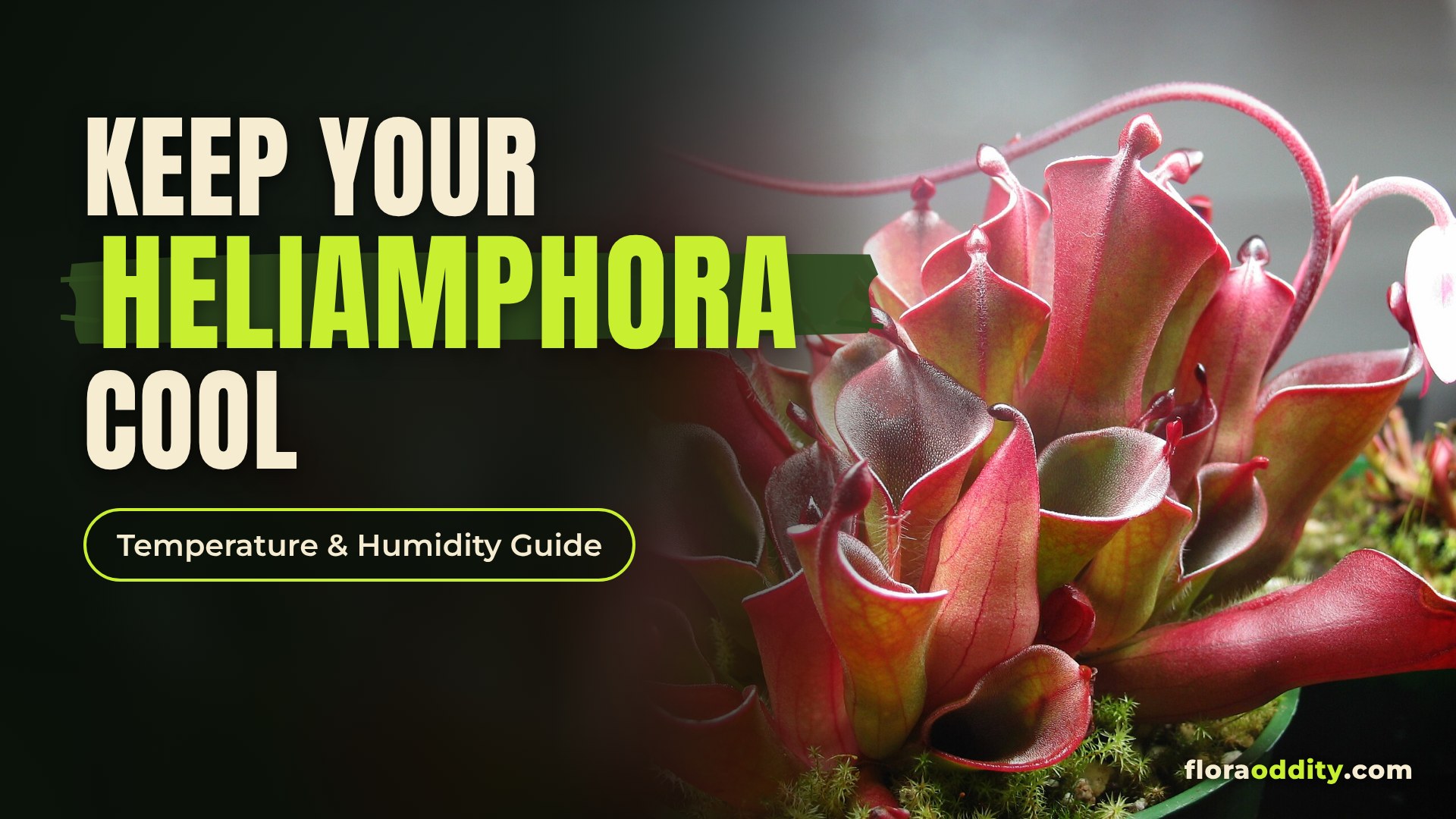
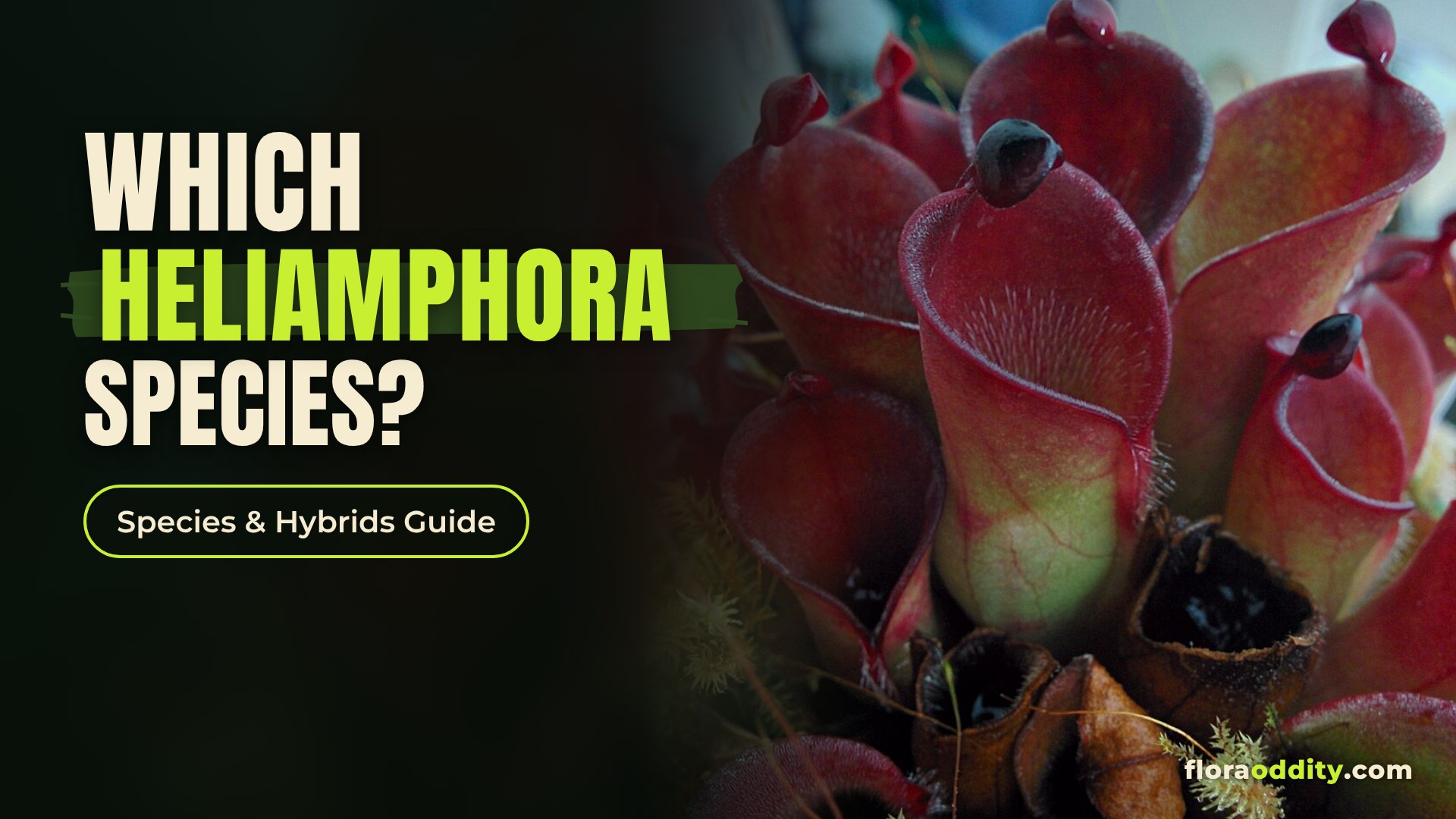
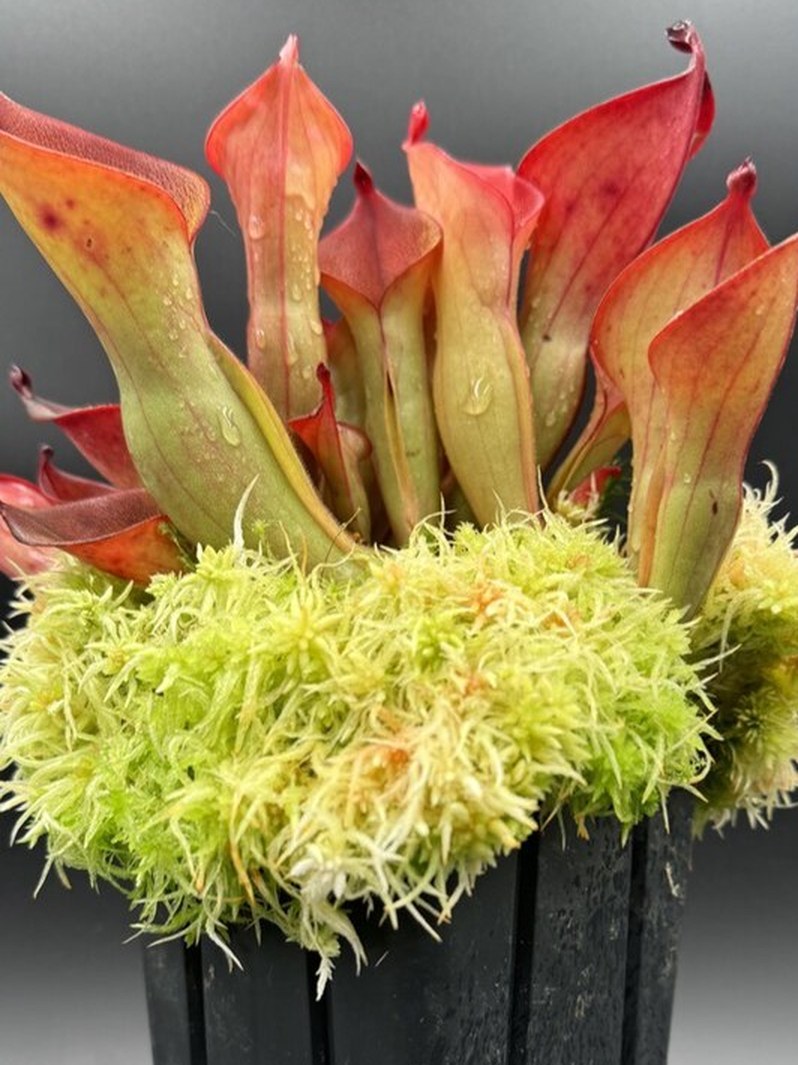
Featured image based on a photo of Heliamphora pulchella by Dals093838 via Wikimedia Commons, CC BY-SA 4.0, with typography added by FloraOddity; the adapted image is offered under the same licence.
Final articles are editorially reviewed and factual claims are checked against cited sources. Last reviewed: October 2026.