
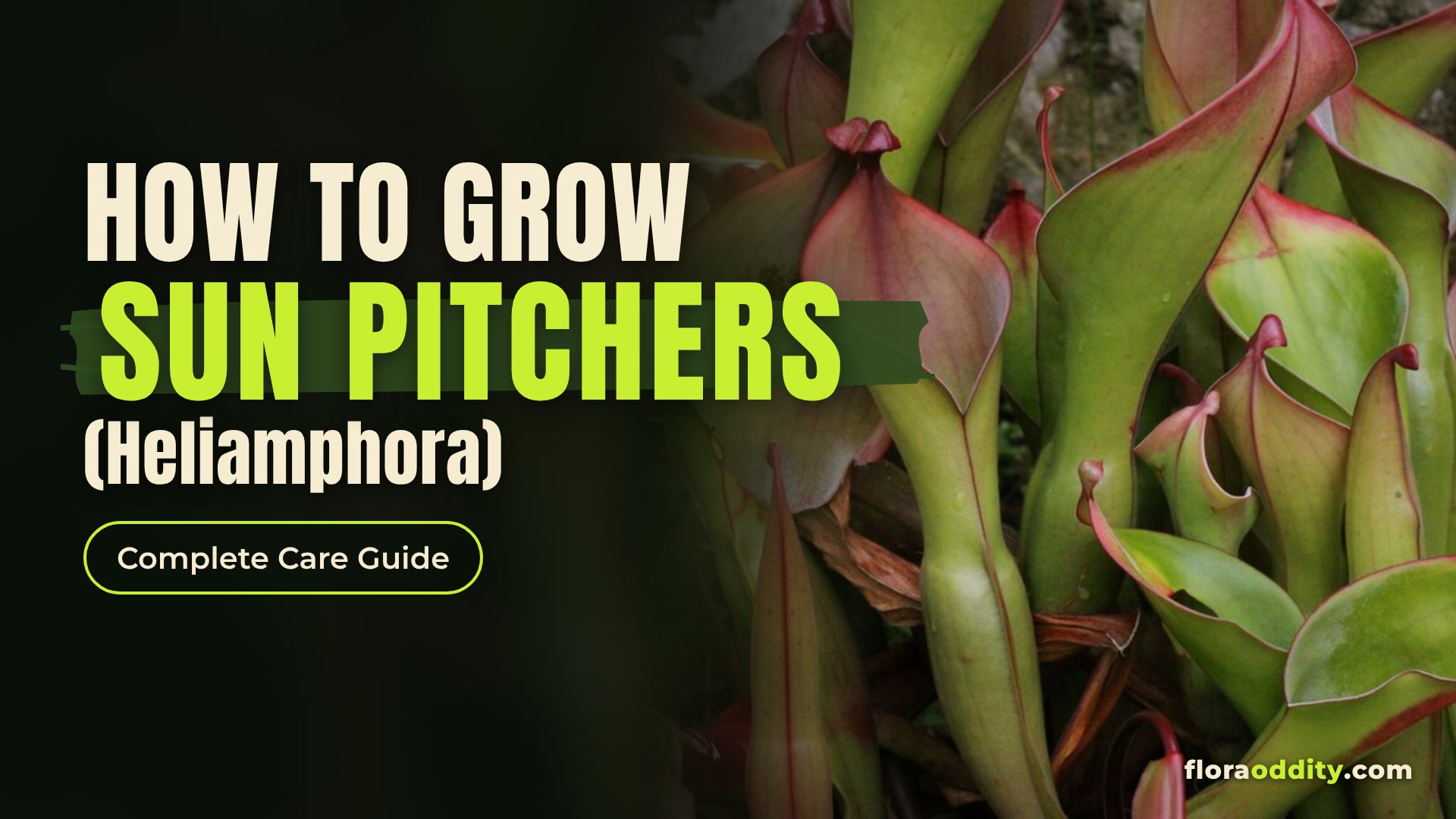
Heliamphora look like the simplest pitcher plants: a rolled leaf, a little red cap on top, and no real lid. That impression is misleading. They come from the cloud-washed summits of the tepuis, flat-topped sandstone mountains in South America, and in cultivation they want a combination that is hard to give in most homes: very bright light without heat. Barry Rice, author of the Carnivorous Plant FAQ, puts it bluntly: keeping them “very bright, humid, but cool” is “not easy,” but for growers who manage it, Heliamphora is “a veritable unkillable beast.”
Good Heliamphora care starts with knowing that the plant’s real enemy is warmth, not dryness or hunger. The International Carnivorous Plant Society (ICPS) says Heliamphora “can be one of the easier carnivores to grow, or one the harder, depending on the conditions you can provide,” and adds that much of what has been written about their culture “is wrong or misleading.”
The Short Answer
Give Heliamphora very bright light, ideally from the side as well as from above, and keep them cool: Sarracenia Northwest and Barry Rice both aim for about 60 to 80 °F (16 to 27 °C), and the ICPS warns that large plants can die after long spells above 79 °F (26 °C). Use pure, low-mineral water and an airy, moisture-holding mix based on long-fibred sphagnum. Keep the soil constantly moist but never stagnant. Humidity helps, but stable temperatures and moving air matter at least as much. Feed lightly, mostly through the pitchers. No winter dormancy is needed.

| Need | What to give it | Source |
|---|---|---|
| Light | Very bright, without heat; light from the sides as well as the top; LEDs work well indoors | ICPS, Sarracenia Northwest, California Carnivores |
| Temperature | About 60 to 80 °F (16 to 27 °C); avoid long spells above 79 °F (26 °C) | Sarracenia Northwest, Barry Rice, ICPS |
| Humidity | Moderate to high; an enclosure if room humidity is low, with good air movement | ICPS, Sarracenia Northwest, Carnivorous Plant Nursery |
| Water quality | Reverse osmosis, distilled or rain water; no softened or well water | ICPS, Sarracenia Northwest |
| Watering | Constantly moist, never dry and never stagnant; methods vary (see below) | ICPS, Sarracenia Northwest, California Carnivores |
| Soil | Long-fibred sphagnum with perlite, or live sphagnum; no potting soil or compost | Sarracenia Northwest, ICPS |
| Pot | Large and deep; light-coloured pots stay cooler | California Carnivores, Carnivorous Plant Nursery |
| Feeding | Light; in-pitcher feeding for adult plants; never heavy soil fertilizer | ICPS, Sarracenia Northwest |
| Winter | No dormancy; slower growth in cooler months is normal | California Carnivores, Carnivorous Plant Nursery |
| Propagation | Division of mature clumps; leaf pullings; seed is slow | ICPS |
What Are Heliamphora?
The ICPS counts “at least 23 species” of Heliamphora, plus many natural hybrids, found only in the Guiana Highlands of Venezuela and neighbouring Guyana and Brazil. Most grow at 4,000 to 9,200 feet (1,200 to 2,800 m) on tepuis, sandstone plateaus that rise hundreds of metres above the surrounding land. Despite sitting a few degrees from the equator, the summits generally range from 45 to 74 °F (7 to 23 °C) and do not drop below freezing, and rain averages about 0.8 to 1.6 inches (2 to 4 cm) a day. The ICPS notes that Stewart McPherson calls the habitat a “rain desert”.
Rice explains the two common names: George Bentham meant “marsh pitcher” (helos, marsh), but the name is widely read as “sun pitcher” (helios, sun).
The nectar spoon and the overflow slit
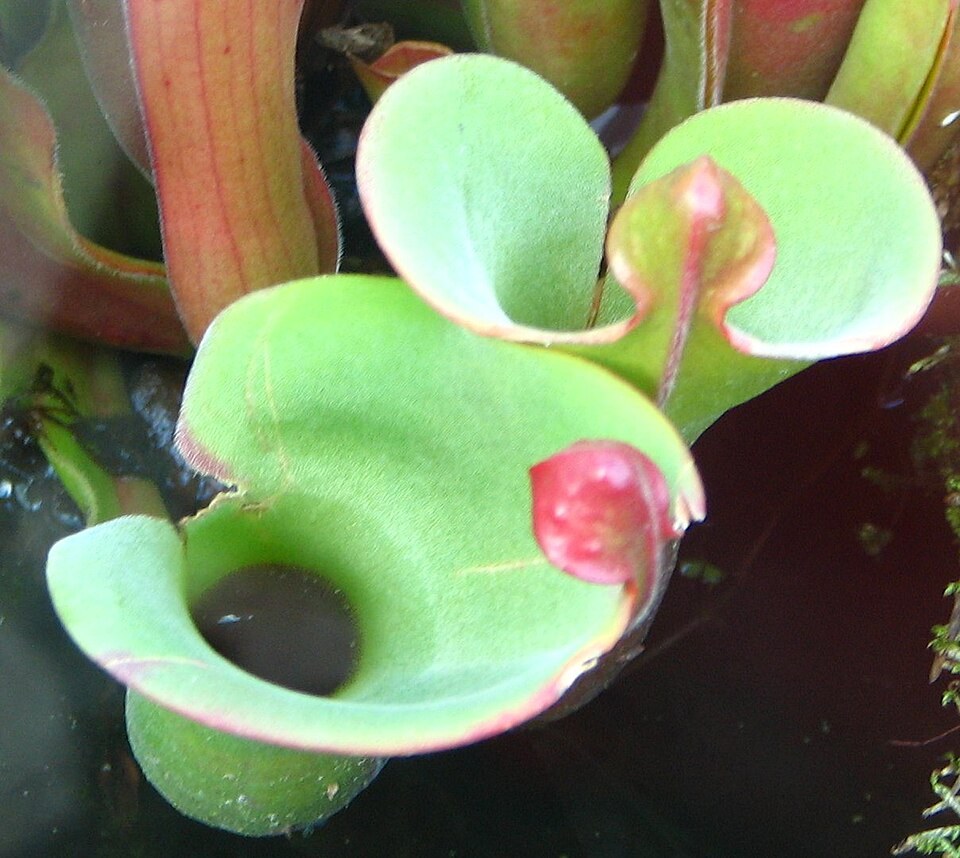
Instead of a large lid, an adult Heliamphora pitcher carries a small cap called the nectar spoon (or nectar roll). Rice describes how flying insects visit its nectar glands, lose their footing, and fall past downward-pointing hairs into the fluid below, where they drown. Digestion is mainly by bacteria, although Rice notes some evidence that Heliamphora tatei makes its own enzymes.
The pitchers also have a feature no other pitcher plant genus shares: a small pore or slit partway down that works as an overflow spout, so tepui rain cannot flood the trap. The ICPS adds that Heliamphora does not pump water into its traps; it relies on rain, and the slit has hairs to keep prey from washing out.
Which Heliamphora Do You Have?
For a first plant, the sources agree. The ICPS says the easiest are hybrids and the typical selections of Heliamphora heterodoxa, H. nutans and H. minor, and that beginners should start with these. Rice suggests starting with a hybrid and finds H. minor and H. nutans “relatively forgiving.” California Carnivores notes that the lowland form of H. heterodoxa is the one exception to the tepui-top rule, coming from lower ground.
Rice divides the genus into a western range, around Cerro Duida and Cerro de la Neblina, and an eastern range of fragmented tepuis rising from the Gran Sabana, home to H. nutans and H. minor.
One warning from Rice: plants fresh from tissue culture (sold as “TC” plants) show “unnatural vitality for about a year,” then slow down. Do not judge your conditions too early.
How Heliamphora Differ from Sarracenia and Nepenthes
According to the ICPS, Heliamphora belongs to the family Sarraceniaceae with Sarracenia and Darlingtonia, and its juvenile pitchers look like small Sarracenia pitchers. The care, though, is very different:
- Sarracenia are North American plants. The ICPS grows them in pots “always sitting in about 4 to 6 cm” (about 1.5 to 2.5 inches) of water, often outdoors in full sun, with a winter dormancy. Heliamphora want no winter rest, and most sources keep them out of deep standing water. The ICPS adds that Heliamphora cannot tolerate the fertilizer levels Sarracenia appreciates. See our Sarracenia care guide and its dormancy section.
- Nepenthes are unrelated. Rice says Heliamphora culture “is much like growing highland Nepenthes” (large pots, sphagnum-rich mixes, little seasonal change), but in temperature and light they are “more like Darlingtonia.” Our guide to highland vs lowland Nepenthes temperatures shows the closest Nepenthes comparison.
For eight plants side by side, see carnivorous plant care compared.
Light
Light shapes the whole plant. Rice says plants in poor light “do not produce the leaf morphology characteristic of their species,” and California Carnivores notes they can grow in less light but “will remain much greener.”
Windowsills. Sarracenia Northwest says a bright window can work if it stays mild, with morning sun easier to manage than hot afternoon sun through glass: “increasing light should not mean increasing heat.”
Grow lights. This is where most growers succeed. The ICPS calls indoor growing under artificial light “the easiest way to grow Heliamphora.” In an enclosure with reflective sides, it recommends at least 20 watts of LED or 1,200 lumens per square foot for 15 hours a day, with lights about 4 to 6 inches (10 to 15 cm) above the plants. Sarracenia Northwest starts with white LED shop lights of about 2,500 lumens or more, about 12 inches (30 cm) above the plants, on a timer for about 14 hours a day.
Side light. One detail is easy to miss. The ICPS warns that light only from the top “will not be very effective because the pitchers need light from the side as well as the top.” Reflective walls or side-mounted strips help. Our light checker can help you judge a spot.
Temperature
Heliamphora are cool-growing plants. The ICPS reports that root temperatures in the wild stay around 60 to 68 °F (16 to 20 °C) while air temperatures swing more widely, and it stresses that “taking care of the roots is what is most important.” Citing grower Andreas Wistuba, it says plants tolerate up to 86 °F (30 °C), that temperatures above 104 °F (40 °C) are fatal for most species, and that large plants can die with prolonged temperatures above 79 °F (26 °C). On the cold side, they survive light frosts.
Sarracenia Northwest aims for about 60 to 80 °F (16 to 27 °C) and says prolonged heat matters more than brief swings. California Carnivores grows its best plants with days in the 70s °F and nights in the 40s to 50s °F.
Two practical cooling tricks come from California Carnivores. It waters with cold water, even refrigerated water on hot days, and prefers light-coloured pots that warm up less. Our climate checker includes a Heliamphora heat option if you want to test your local summer. For heat limits, night temperatures, humidity and cooling setups in depth, see our Heliamphora temperature and humidity guide.
Humidity and Terrariums
Here the sources pull in different directions. The ICPS says that unless the room is above 70% humidity, plants grown indoors under lights “will need to be in an enclosure such as a terrarium.” Carnivorous Plant Nursery lists “medium to high” humidity and recommends a vented terrarium in an air-conditioned room. Sarracenia Northwest takes the opposite view: extremely high humidity “is not essential,” and plants can acclimate to normal household humidity if temperatures are stable, the roots stay moist and light is good.
Butch Tincher, writing in Carnivorous Plant Newsletter, offers a middle path. Heliamphora “can be grown in moderate humidity levels,” he says, but for the best growth and nectar spoon development he adds humidity, running a humidifier together with fans.
Whatever the humidity, keep air moving. Carnivorous Plant Nursery says sun pitchers prefer good air circulation, and Tincher runs two fans on separate power supplies so one failure cannot overheat his enclosed rack.
Water and Water Quality
The ICPS is clear: “Always use pure water (reverse osmosis is most common)” or tap water very low in dissolved minerals. It warns that well water is generally too salty and that filtering or softening “will not make the water less salty.” Sarracenia Northwest names distilled, reverse osmosis and rain water, and says to avoid hard or softened tap water. Not sure about yours? Try our water checker.
Tincher is more relaxed about purity. He finds Heliamphora “do not seem too picky about water quality” and prefers about 10 to 20 ppm, but he also notes that hard water slowly builds mineral salts in his mix.
How to water. The aim is soil that never dries out yet never turns sour. The ICPS keeps its own plants sitting in “a few mm of water all the time,” while other growers water daily or every other day and let the excess drain. Sarracenia Northwest waters thoroughly from the top, lets it drain, and says Heliamphora “should not sit continuously in a tray of water.” Tincher explains why draining helps: as water runs out, fresh air is drawn into the root zone. A sour smell at repotting means the watering and the mix do not match. Our Heliamphora soil and watering guide compares the watering methods and published mixes in detail.
Soil and Pots
There is no single correct mix. The ICPS says the right ratio depends on what you can buy and how you water, and that the soil “should never dry out,” should be rooted through, and “should never be stinky.” Common choices:
- Long-fibred sphagnum and perlite, about equal parts, or live sphagnum alone (Sarracenia Northwest). Rice prefers pure live or long-fibred sphagnum.
- Equal parts long-fibred sphagnum, perlite and aquatic planting medium, a clay-based pond product that holds moisture without breaking down. The ICPS calls this Butch Tincher mix the current consensus among North American growers.
- Mostly long-fibred sphagnum with some pumice or lava rock to keep the mix open and cool (California Carnivores).
- 2 parts perlite, 2 parts sand, 1 part peat (Carnivorous Plant Nursery).
Never use ordinary potting soil, compost or mixes with added fertilizer, Sarracenia Northwest warns.
A live sphagnum top layer is popular, though the ICPS notes it can smother small plants. Use the soil mix calculator to work out amounts.
Pots. Go big. California Carnivores grows single plants in 6 to 8 inch pots and says “the bigger the pot the better,” because a larger mass resists warming. Tincher uses 6 by 6 by 6 inch (15 cm) pots and says root-bound plants dry out much faster. Carnivorous Plant Nursery recommends a deep pot of 4 to 6 inches (10 to 15 cm) or more to keep roots above any standing water.
Repot rarely. Sarracenia Northwest repots only when the mix breaks down or the plant outgrows its pot, and Carnivorous Plant Nursery says root disturbance can set plants back for several months. The repotting advisor can help you time it.
Feeding
This is another area of real disagreement. The ICPS says Heliamphora “requires fertilization to grow well” in lean modern mixes, and for adult plants it prefers feeding into the pitchers. It warns that one of the easiest ways to kill a Heliamphora is too much fertilizer in the soil. Sarracenia Northwest calls feeding optional and says weak growth is far more likely to come from poor light or heat than from hunger. Carnivorous Plant Nursery notes that wild plants are often weak feeders, about once a month is enough, and you should never use meat or cheese, which rot.
Our feeding guide covers the options.
Propagation in Brief
Division. The ICPS notes that healthy mature Heliamphora divide naturally, especially when they bloom. Divide when plants are at their peak and temperatures are relatively low; avoid late spring and summer if your plants get above 79 °F (26 °C). Water well the day before, find the natural break points, separate the growths gently, pot them without air pockets, and bag them for about a month if humidity is below 85%.
Leaf pullings. Small juvenile leaves pulled off with their whole base can root in sphagnum in a sealed bag under lights. The ICPS warns that they can take 6 months to a year, and that large pitchers rarely work.
Seed. Flowers must be hand-pollinated; Rice notes that a tuning fork is often used to shake pollen from the anthers. The ICPS says plants from seed grow very slowly unless started in sterile culture. Our Heliamphora propagation guide covers division, leaf pullings and seed step by step.
Dormancy: None Needed
California Carnivores states it simply: “No dormancy is required.” Carnivorous Plant Nursery agrees but suggests slightly cooler winter temperatures and expects slow growth in winter. Tincher found that changing day length had “no effect” on flowering in his setup.
Common Problems in Brief
- Heat and sudden collapse. The ICPS describes a fungus in the plant’s vascular system; in experiments by Andreas Fleischmann, infected plants could die “in less than 10 days” at a constant 82 °F (28 °C) with high humidity. Plants can be infected from soil, rainwater and other plants, and reused soil and overhead watering can spread it. Tincher writes that temperatures above 79 °F (26 °C) have long been thought to be one trigger for “Heliamphora Sudden Death Syndrome.”
- Green, floppy or spoonless pitchers. Usually too little light (Sarracenia Northwest, Rice).
- Brown, mottled leaves. Sarracenia Northwest says this can mean spider mites, and that a single brown, spreading spot may be a pitcher rotting around oversized prey.
- Broken pitchers. Carnivorous Plant Nursery warns that pitchers and roots are “very stiff and brittle.”
Sarracenia Northwest advises looking at the newest growth before judging the plant, because old pitchers naturally decline. Our guide to Heliamphora problems goes through each symptom, from heat stress to rot, and our symptom checker can help narrow a cause.
What Growers Report
These are single growers’ setups and results, not rules.
- A grower in the desert keeps plants in normal indoor air at about 20 to 45% humidity, 64 to 70 °F (18 to 21 °C) in winter and 74 to 82 °F (23 to 28 °C) in summer, under LEDs, and says, “I haven’t found any helis unable to acclimate to those conditions.” (Werdna, TerraForums, February 2023)
- In the same thread, a grower in Brazil moved a heterodoxa x minor from an LED terrarium to a window with about 3 hours of direct sun, noon highs near 86 °F (30 °C) and nights near 72 °F (22 °C). Older leaves developed dry patches and the plant turned yellowish, and the grower concluded that “temperature rather than humidity” was likely the bigger stress. (gbaiao, TerraForums, February 2023)
- A grower in Scotland grew H. minor on a bright windowsill with one small reflector lamp, “primarily to extend the otherwise short day length during Scottish winters,” and a heterodoxa x ionasi hybrid on the same sill with no extra light. (mobile, TerraForums, March 2012)
- A Florida grower kept eight kinds of Heliamphora in sideways aquariums with lights resting on the glass, a fan running about 22 hours a day, misting several times daily for 60 to 65% humidity in winter, and watering with lightly chilled water of about 59 °F (15 °C) before lights out. (Brian Barnes, Carnivorous Plant Newsletter, March 2010)
Our takeaway: humidity ranged from desert rooms to misted tanks, but the successful growers all kept light strong and roots cool, and the one who struggled was fighting heat.
Where Sources Differ
Each row gives only the context the sources themselves state.
| Topic | One view | Another view | Context the sources give |
|---|---|---|---|
| Standing water | ICPS: plants sit in “a few mm of water all the time”; California Carnivores: “Use the tray method” | Sarracenia Northwest: never sit continuously in a tray; Carnivorous Plant Nursery: avoid standing in water for long; Rice: top-water instead of trays | The ICPS ties its method to a matching soil mix and says other growers water daily and drain |
| Humidity | ICPS: an enclosure unless room humidity is above 70% | Sarracenia Northwest: extremely high humidity “is not essential” | Sarracenia Northwest stresses stable temperatures and airflow; Tincher says moderate humidity works but extra helps spoon development |
| Night cooling | California Carnivores: “Even cooler nights are ideal”; Carnivorous Plant Nursery: a 10 °F (5 °C) day and night difference | ICPS: “not necessary to cool the plants at night” | The ICPS adds the condition: as long as soil temperatures did not rise during the day |
| Water purity | ICPS: pure water, reverse osmosis most common | Tincher: about 10 to 20 ppm, “not too picky” | Tincher still warns that hard water builds salts in his mix |
| Feeding | ICPS: fertilization is required to grow well | Sarracenia Northwest: feeding is optional | The ICPS links its advice to lean, neutral mixes; Carnivorous Plant Nursery says plants with access to insects feed themselves |
| Soil | ICPS: sphagnum, perlite and aquatic planting medium | Rice: pure sphagnum; Carnivorous Plant Nursery: perlite, sand and peat | The ICPS: “There is no magic mix” |
Common Mistakes
- Chasing light with heat. A hot, sunny window can do more harm than a cooler spot with a lamp.
- Treating it like a Sarracenia. No cold winter, and no deep tray around the crown.
- Sealing a tank without airflow. Sarracenia Northwest stresses airflow as much as humidity.
- Heavy soil fertilizer. Feed the pitchers lightly instead.
- Lighting only from above. Tall pitchers need side light too.
- Repotting or moving the plant often. Root disturbance can set plants back for several months.
FAQ: Heliamphora Care
Is Heliamphora hard to grow?
It depends on your conditions: the challenge is bright light without heat. Hybrids are the best start.
Do Heliamphora need a terrarium?
Not always. The ICPS recommends an enclosure when room humidity is below 70%, while Sarracenia Northwest grows them without one if temperatures are stable and the light is good.
Do Heliamphora need dormancy?
No. California Carnivores and Carnivorous Plant Nursery both say no dormancy is required; growth simply slows in cooler months.
How hot is too hot for Heliamphora?
The ICPS warns that large plants can die after long spells above 79 °F (26 °C), and that above 104 °F (40 °C) is fatal for most species. Short peaks are less dangerous than long heat.
The Bottom Line
Heliamphora care comes down to a cool, bright mountaintop in a pot: strong light from the top and sides, temperatures mostly between 60 and 80 °F (16 and 27 °C), pure water, an airy sphagnum-based mix that never dries out or sours, moving air, and light feeding. Skip the winter rest, start with a hybrid or one of the easier species, and watch the newest pitchers. As the ICPS puts it, Heliamphora plants are “pretty tough” and “preadapted to cool human house temperatures.”
Sources & Further Reading
- International Carnivorous Plant Society: Growing Heliamphora (John Brittnacher)
- International Carnivorous Plant Society: Evolution of the Ericales Carnivores
- International Carnivorous Plant Society: Growing Sarracenia
- Barry Rice, The Carnivorous Plant FAQ: Heliamphora, the marsh (or sun) pitchers
- Barry Rice, The Carnivorous Plant FAQ: Heliamphora, the various ranges and tepuis
- Barry Rice, The Carnivorous Plant FAQ: Heliamphora species from the eastern ranges
- Barry Rice, The Carnivorous Plant FAQ: Heliamphora cultivation
- Sarracenia Northwest: How to Grow Heliamphora
- California Carnivores: Sun Pitchers (Heliamphora) Growing Tips
- Carnivorous Plant Nursery: Growing Tips for Heliamphora
- Butch Tincher: My techniques for the indoor cultivation of Heliamphora, Carnivorous Plant Newsletter 42(4), 2013
- Brian Barnes: Growing Heliamphora indoors year-round, Carnivorous Plant Newsletter 39(1), 2010
Featured image based on a photo of Heliamphora nutans at Kew Gardens by Derek Keats via Wikimedia Commons, CC BY 2.0, with a dark gradient and typography added by FloraOddity.
Final articles are editorially reviewed and factual claims are checked against cited sources. Last reviewed: October 2026.


4 Comments