
Nepenthes are not especially pest-prone, but an indoor plant is an easy place for a few sap-sucking insects to settle in unnoticed. There are no predators, no rain to knock them off, and plenty of sheltered crevices where leaves meet the stem. By the time you notice white fluff or sticky leaves, the colony may have been there for a while.
Treating pests on a Nepenthes also takes a little more care than treating an ordinary houseplant. Carnivorous plants can react badly to products that would be harmless on a pothos. This guide helps you work out which pest you are dealing with, where to look for it, and how to get rid of it with the gentlest method that works.
The Short Answer
The pests that most often turn up on Nepenthes are mealybugs, scale insects, aphids, and thrips, with spider mites appearing now and then. Isolate the plant, identify the pest, and start with physical removal: a cotton swab dipped in isopropyl alcohol for mealybugs and scale, and a strong spray of water for aphids and mites. Repeat every few days, because one round rarely catches everything. Move to a product only if mechanical methods fail, and test it on one leaf first, since carnivorous plants can be sensitive to soaps, oils, and the solvents in liquid pesticides.
How to Tell Which Pest You Have
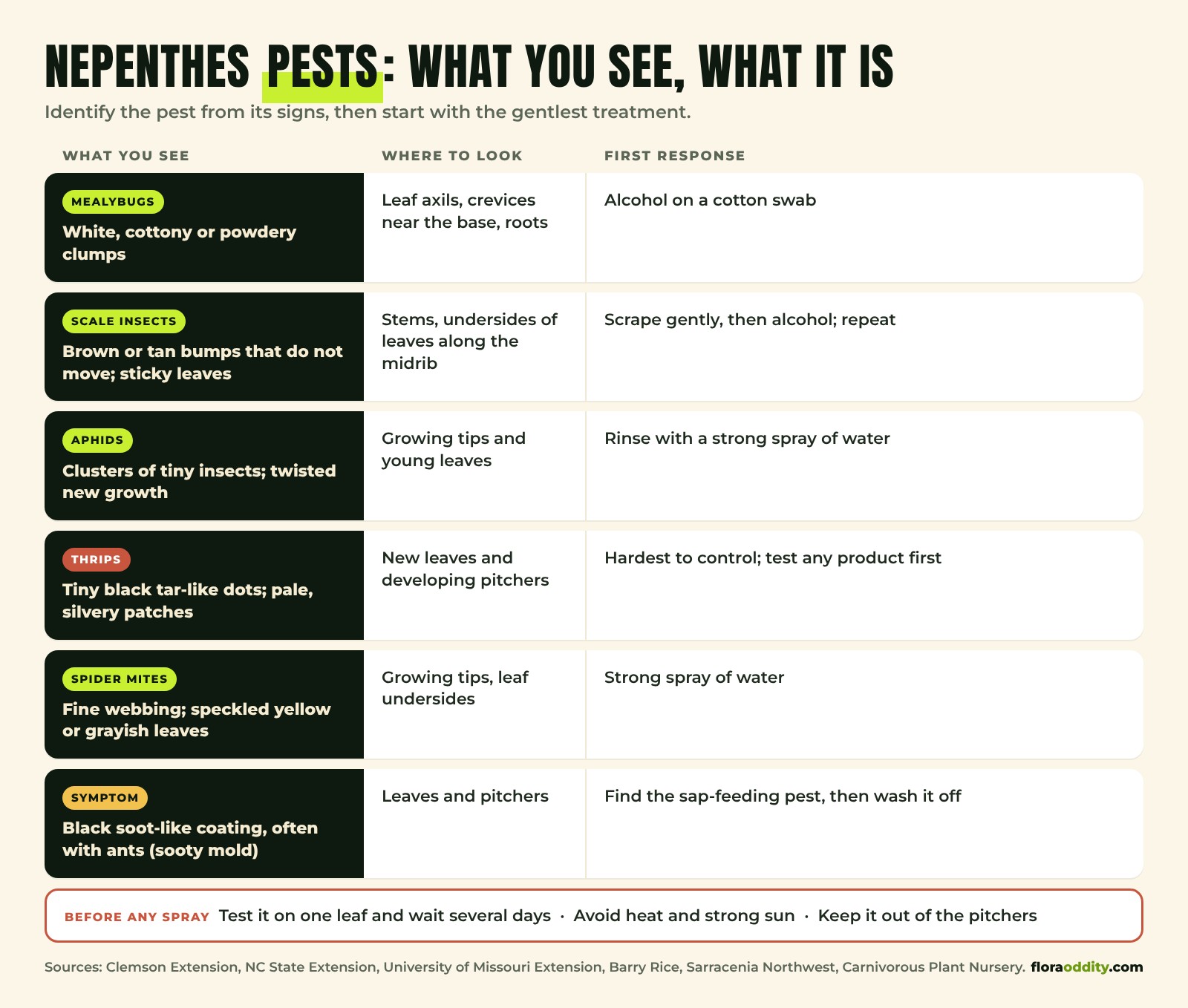
Most pests are easier to identify from their signs than from the insect itself. Use the chart and table below to match what you see on your plant.
| What you see | Likely pest | Where to look | First response |
|---|---|---|---|
| White, cottony or powdery clumps | Mealybugs | Leaf axils, crevices near the base, and roots | Alcohol on a cotton swab |
| Small brown or tan bumps that do not move; sticky leaves | Scale insects | Stems and the undersides of leaves along the midrib | Scrape gently, then use alcohol, and repeat |
| Clusters of tiny insects on new growth; twisted or stunted leaves | Aphids | Growing tips and young leaves | Rinse with a strong spray of water |
| Tiny black tar-like dots; pale, bleached, or silvery patches | Thrips | New leaves and developing pitchers | Check closely and consider a tested product |
| Fine webbing; speckled yellow or grayish leaves | Spider mites | Growing tips and leaf undersides | Strong spray of water |
| Black, soot-like coating; ants visiting | Sooty mold from a sap-feeding pest | Leaves and pitchers | Find the pest underneath, then wash the mold off |
Clemson Cooperative Extension and NC State Extension both name aphids, mealybugs, thrips, and scale insects as the pests to watch for on tropical pitcher plants, so those four deserve most of your attention.
The Most Common Nepenthes Pests
Mealybugs
Mealybugs are often the first pest indoor growers notice, because their white fluff stands out. In Barry Rice’s Carnivorous Plant FAQ, he describes them as close relatives of scale insects that cover themselves in a waxy, powdery coating instead of a hard shell. Unlike scale, they crawl around, and heavy infestations show up as white, cottony masses.
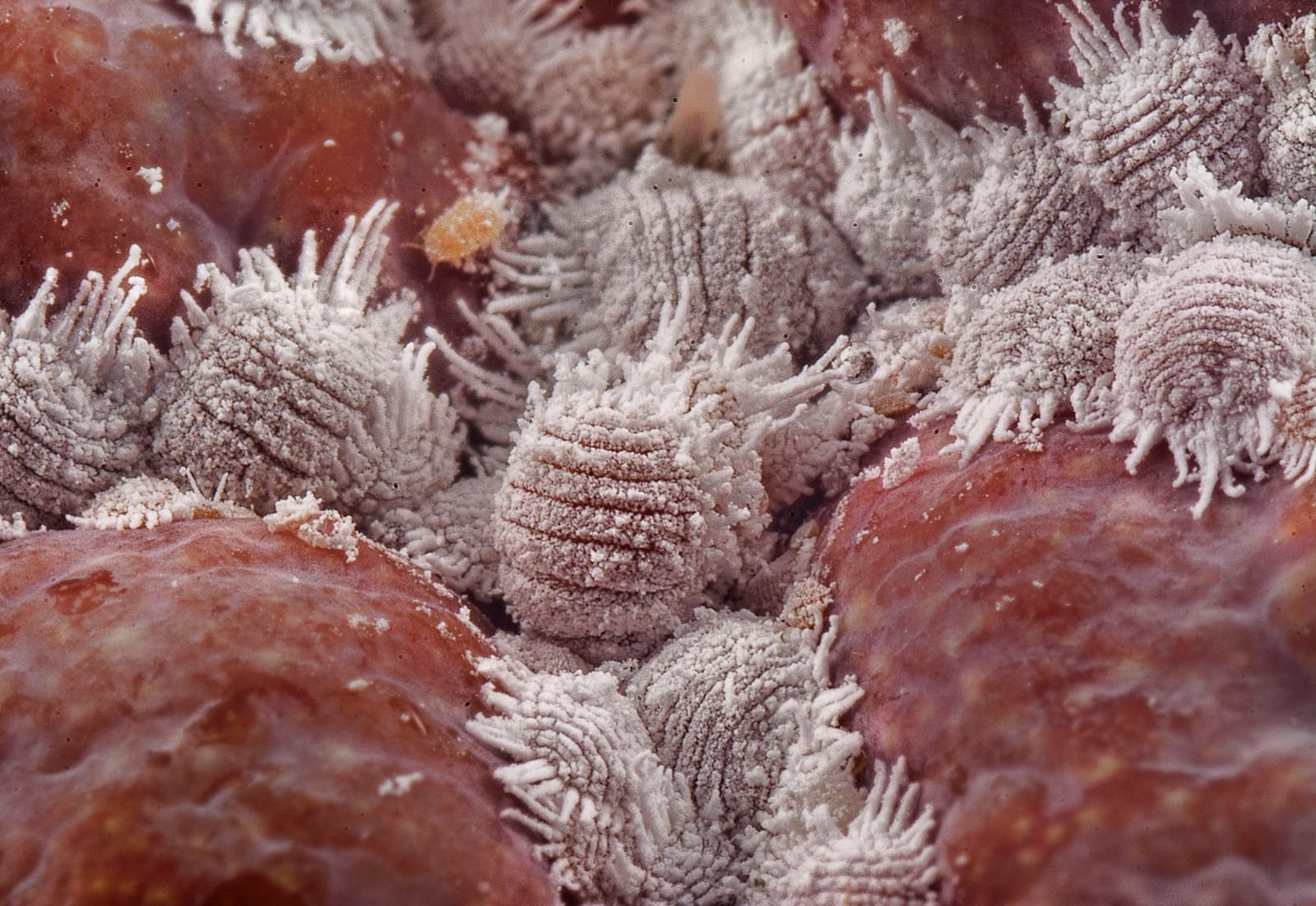
The real problem is where they hide. Carnivorous Plant Nursery notes that mealybugs often tuck themselves into tight crevices near the base of pitcher plants, which makes them easy to miss until damage appears. Barry Rice adds that they can infest roots as well. Check the leaf axils, the point where the stem meets the potting mix, and the undersides of older leaves.
Treatment: Dab every visible mealybug with a cotton swab dipped in isopropyl alcohol. This is the method Barry Rice recommends, and the University of Missouri Extension gives the same advice for small infestations on indoor plants. Go back every few days and treat any new ones you find. If the plant keeps declining with no visible insects above ground, inspect the roots. Our guide on how to repot a Nepenthes explains how to do that with minimal disturbance.
Scale insects
Scale insects look less like bugs and more like part of the plant. Adult females attach themselves, stop moving, and develop a protective covering. Barry Rice describes a heavy infestation as countless circular or elliptical brown discs. Carnivorous Plant Nursery compares a single one to a small fish scale stuck to the plant. Colors and shapes vary between species, so do not rule out scale just because the bumps are paler than you expected.
Scale feed on sap and release sticky droppings, which is why leaves under an infestation often feel tacky and may develop black sooty mold.
Treatment: Scrape the scales off gently with a fingernail, a soft toothbrush, or a cotton swab, as both Carnivorous Plant Nursery and the University of Missouri Extension suggest. Follow up with alcohol on a cotton swab. Barry Rice notes that alcohol may work against scale but usually needs several treatments. Scale is persistent, so plan on repeated checks for several weeks.
Aphids
Aphids are small, soft-bodied insects that gather in groups on the newest growth. Barry Rice notes they are usually 2.5 mm or smaller and cause twisted, abnormal, stunted growth when numbers build up. Carnivorous Plant Nursery points out that the white shed skins they leave behind are often the first clue, and that aphids are more common on Venus flytraps and sundews than on many other carnivorous plants.
Treatment: Rinse them off with a strong spray of water, then dab any stragglers with alcohol. Check the growing tip again a few days later.
Thrips
Thrips are tiny, fast, and hard to see, so you usually notice their damage first. Barry Rice describes small black tar-like spots on the plant and foliage that gradually turns whitish, as if it is being bleached. Carnivorous Plant Nursery describes streaks along the leaves and veins.
On Nepenthes, thrips matter because they target new tissue. In Sarracenia Northwest’s Q/A #14, Jacob Farin notes that thrips can damage new growth and developing pitchers, which can lead to deformed traps.
Treatment: Thrips are the hardest pest on this list to control. Barry Rice admits in his pest control FAQ that he does not know good controls for indoor infestations. Sarracenia Northwest suggests neem oil and describes it as safe to use on Nepenthes. Because other sources warn about oils and soaps on carnivorous plants, test any product on a single leaf first, as explained below.
Spider mites
Spider mites are not insects but tiny arachnids. They gather at the growing tips and spin fine webbing. Carnivorous Plant Nursery describes the damage as tiny holes that leave leaves with yellow spots or a grayish look.
Treatment: Barry Rice’s FAQ includes a reader’s tip worth trying first: hit the mites with a strong jet of water to wash them off. Repeat regularly and check the leaf undersides each time.
Fungus gnats
Small black flies hovering over the pot are usually fungus gnats, whose larvae live in damp potting mix. Barry Rice recommends leaving them alone on established plants because they rarely cause significant problems, and saving treatment for seedlings. If they are everywhere, it can be a sign that the mix stays wetter than it should. Our guide on how to water a Nepenthes indoors covers drainage and watering rhythm.
Why Treating Nepenthes Is Different
Many houseplant pest guides treat insecticidal soap or neem oil as a safe default. Some Nepenthes guides do the same: Plants for All Seasons suggests insecticidal soap or neem oil for aphids, mealybugs, spider mites, and scale alike.
Specialist sources are more cautious, and they do not all agree:
- Barry Rice writes that carnivorous plants are very sensitive to chemicals, that soaps “seem to be deadly to carnivorous plants,” and that the solvents in liquid pesticide formulations can harm the plant more than the active ingredient. He almost never uses pesticides himself and stresses that what works for one grower may not work for another (Carnivorous Plant FAQ).
- Sarracenia Northwest recommends neem oil for thrips on Nepenthes and calls it safe to use on the genus.
- The University of Missouri Extension, writing about indoor plants in general, warns that oils and insecticidal soaps can injure plants when used at the wrong stage of growth or when temperatures are too high.
These views fit together better than they seem to. Barry Rice is writing about carnivorous plants as a whole, including very delicate sundews and bladderworts, while Sarracenia Northwest is speaking specifically about Nepenthes. And even a product that is safe for most plants can cause damage in heat or on tender new growth.
The practical answer is to test before you treat. Apply any product to a single leaf, wait several days, and check for spotting, browning, or burned edges before you use it on the whole plant. Apply it in cooler conditions, keep it out of the pitchers, and never use it on a plant that is already stressed from repotting or a recent move.
A Step-by-Step Treatment Plan
- Isolate the plant. Move it away from your other plants right away. Pests like mealybugs and spider mites can move between neighboring pots.
- Identify the pest. Use the table above. A magnifying glass or a phone camera on zoom helps a lot with thrips and mites.
- Remove what you can by hand. Use alcohol on a cotton swab for mealybugs and scale, gentle scraping for scale, and a strong spray of water for aphids and spider mites. Cut off any badly damaged leaves or pitchers that are already dying.
- Check the hiding places. Look at the leaf axils, the base of the stem, the undersides of leaves, and the top of the potting mix.
- Repeat every few days. Eggs and hidden insects will keep appearing for a while. Several rounds are normal.
- Use a product only if needed. If the numbers are not falling after a couple of weeks of mechanical control, test a product on one leaf before treating the whole plant.
- Keep it isolated until it stays clean. Do not return the plant to the group until you have gone a few weeks without finding new pests.
When to Consider Stronger Products
If an infestation keeps coming back, some growers turn to systemic insecticides, which are absorbed into the plant and act on insects as they feed. Barry Rice reports good results with the systemic insecticide imidacloprid, and David Fefferman of Carnivorous Plant Resource describes using a systemic product in several applications spaced one to one and a half weeks apart against stubborn scale.
Treat these as a last resort rather than a first step. Read and follow the product label exactly, check whether the product is approved for indoor use where you live, test it on one leaf first, and keep the plant isolated while you treat it. If you are unsure, it is usually better to keep repeating mechanical removal for longer than to reach for something stronger.
How to Prevent Pests
- Quarantine new plants. The University of Missouri Extension recommends quarantining and treating new plants before placing them among established ones. David Fefferman suggests keeping new arrivals separate for one to one and a half months, because scale can survive an initial cleaning.
- Inspect regularly. A quick look at the leaf axils and undersides every time you water catches problems while they are small.
- Keep air moving. NC State Extension notes that poor air circulation can lead to fungal problems. Our Nepenthes humidity guide explains how to raise humidity without creating stagnant air.
- Keep the potting mix fresh. A broken-down, soggy mix invites fungus gnats and weakens roots. See our guide to the best potting mix for Nepenthes.
- Take sooty mold as a signal. Sooty mold usually appears where sap-feeding insects have left sticky droppings. Barry Rice describes it as more of a symptom than a problem in itself, and notes it may take some light scrubbing to remove it from Nepenthes pitchers.
Common Mistakes
- Spraying first, identifying later. Different pests need different approaches, and some do not need spraying at all.
- Treating once and calling it done. Almost every pest on this list needs repeated treatment.
- Using soap or oil sprays without a test. Try any product on one leaf and wait several days before treating the whole plant.
- Spraying in strong sun or heat. This raises the risk of leaf burn from many products.
- Ignoring the base of the plant and the roots. Mealybugs in particular hide where you do not look.
- Returning the plant to the group too early. A plant that looks clean after one week may still carry eggs or hidden insects.
FAQ: Nepenthes Pests
What are the white fluffy things on my Nepenthes?
Most likely mealybugs. They look like small tufts of cotton or white powder and gather in leaf axils and near the base of the plant. Dab them off with a cotton swab dipped in isopropyl alcohol and check again every few days.
What are the brown bumps on my Nepenthes leaves?
If the bumps do not move and come away when you scrape them gently, they are probably scale insects. Sticky leaves or black sooty mold nearby are another sign. Scrape them off, follow up with alcohol, and repeat over several weeks.
Is neem oil safe for Nepenthes?
Sarracenia Northwest describes neem oil as safe to use on Nepenthes, while other carnivorous plant sources warn that oils and soaps can damage sensitive plants. Test it on a single leaf first, avoid using it in heat or strong sun, and keep it out of the pitchers.
Can I use insecticidal soap on a pitcher plant?
Be cautious. Barry Rice warns that soaps seem to be deadly to carnivorous plants, even though general houseplant guides often recommend them. If you decide to try one, test it on a single leaf and wait several days before treating the whole plant.
Will a Nepenthes recover from a pest infestation?
Usually, yes. Once the pests are gone, new leaves and pitchers should grow normally, although damaged older leaves will not repair themselves. If the plant has also lost pitchers, our guide to why Nepenthes pitchers turn brown or dry up explains what recovery looks like.
The Bottom Line
Most Nepenthes pest problems can be solved with patience rather than chemicals. Identify the pest from its signs, isolate the plant, and remove what you can with alcohol, gentle scraping, or a strong spray of water. Repeat every few days until no new pests appear. Carnivorous plants can be sensitive to soaps, oils, and solvents, so if you do need a product, test it on one leaf first and use it only as a last step. And quarantine every new plant, because the easiest infestation to treat is the one that never reaches your collection.
Sources & Further Reading
- Clemson Cooperative Extension: Tropical Pitcher Plants (Nepenthes spp.)
- NC State Extension Gardener Plant Toolbox: Monkey Cups (Nepenthes)
- University of Missouri Extension: Least-Toxic Control Methods to Manage Indoor Plant Pests
- Barry Rice, The Carnivorous Plant FAQ: What is this bug eating my carnivorous plants?
- Barry Rice, The Carnivorous Plant FAQ: How do I kill bug XXX?
- Barry Rice, The Carnivorous Plant FAQ: What pesticides or other bug-killing methods work?
- Sarracenia Northwest: Q/A #14, Nepenthes truncata with Weird Pitchers
- Carnivorous Plant Nursery: Carnivorous Plant Pests and Insects
- David Fefferman, Carnivorous Plant Resource: How to Treat Scale Damage on Nepenthes
- Plants for All Seasons: Common Nepenthes Diseases and Pests
Final articles are editorially reviewed and factual claims are checked against cited sources. Last reviewed: October 2026.

8 Comments