
A yellow or blackened leaf on a Nepenthes can look alarming, especially if the plant otherwise seemed fine. But leaf color changes on a pitcher plant mean very different things depending on where they appear. An old leaf at the bottom of the stem turning yellow is usually part of normal growth. A new leaf with a black tip is a much more serious sign. And a new leaf that comes in red can actually be good news.
This guide shows you how to read those differences, what the most common causes are, and what to do about each one.
The Short Answer
If one or two of the oldest leaves at the bottom of the plant are slowly turning yellow and then brown while new leaves keep growing normally, that is usually natural aging. If several leaves are yellowing at once, new growth has stalled, or new leaves have black tips, the roots are the first place to look: in several grower cases, a dense, waterlogged potting mix turned out to be behind serious leaf problems. Red or bronze color on otherwise healthy new leaves is often simply a response to bright light.
First, Look at Where the Color Change Is
The single most useful clue is the position of the affected leaves. Old growth and new growth tell you different things, and a pattern across many leaves means something different from a single leaf.
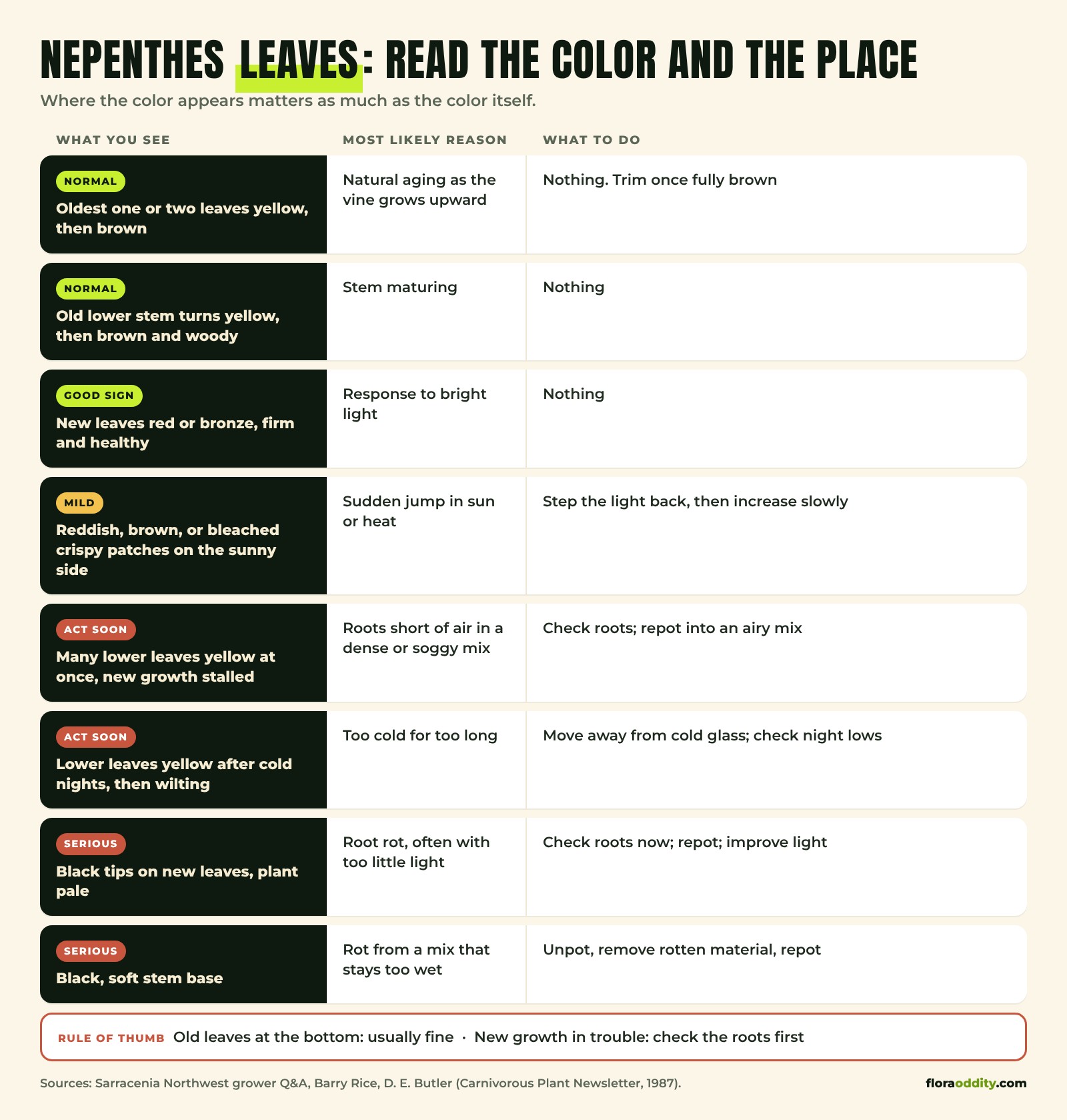
| Where | What you see | Most likely reason | How worried to be |
|---|---|---|---|
| One or two of the lowest leaves | Yellowing, then browning, one at a time | Normal aging as the vine grows upward | Not at all |
| The old lower stem | Yellow, then brown and woody | Normal maturing of the stem | Not at all |
| New leaves | Red or bronze, but firm and healthy | A response to bright light | Usually a good sign |
| Many lower leaves at once, new growth stalled | Yellowing | Root trouble from a dense or waterlogged mix | Act soon |
| Tips of new leaves, plant looks pale | Black | Root rot, often with too little light | Serious |
| Base of the stem | Black and soft | Rot from a mix that stays too wet | Serious |
| Patches on the side facing the light | Reddish, brown, or bleached, crispy | A sudden increase in sun or heat | Mild |
| Lower leaves after cold nights | Yellowing, then wilting | Too cold for too long | Act soon |
When Yellow or Brown Is Normal
Nepenthes are climbing vines. As the stem grows upward and adds new leaves at the tip, the oldest leaves at the bottom eventually die off. In Sarracenia Northwest’s Q/A #44, a grower worried about lower leaves turning reddish or brown and dying, and Jeff Dallas explained that this was simply an old leaf on the lower part of the plant dying off as part of the normal growth cycle.
The same applies to the stem itself. In Q/A #86, a grower noticed the older part of a cutting turning yellow. Dallas explained that older stem sections naturally turn yellow and then brown as the vine matures and toughens.
What makes this normal is the pattern: the oldest leaves go first, one at a time, while the growing tip keeps producing healthy new leaves. If that describes your plant, there is nothing to fix. You can trim a dead leaf once it has fully browned.
When Red Is a Good Sign
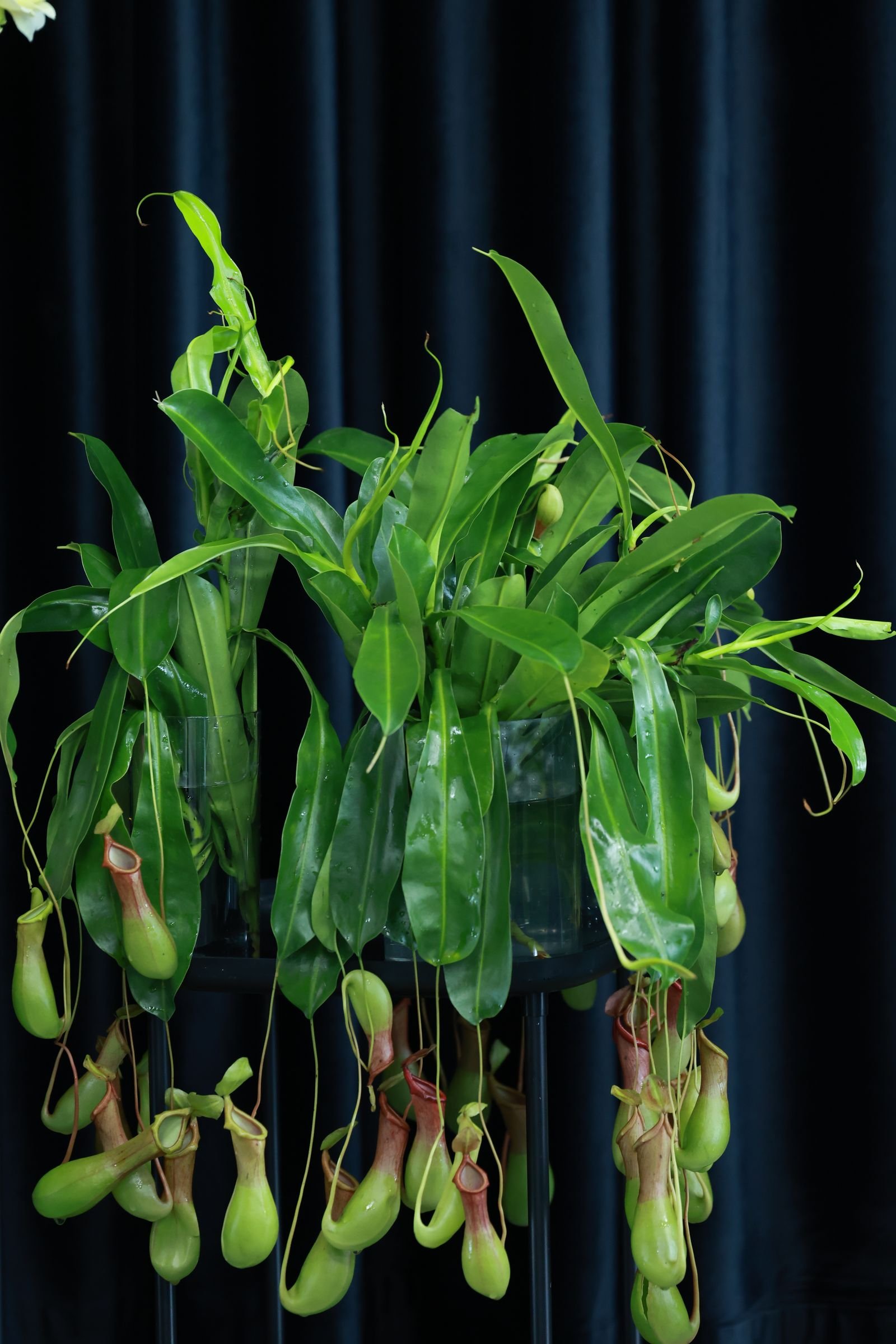
Many growers panic when new leaves come in red, but this is often a sign that the plant is getting good light. In Q/A #100, a grower’s Nepenthes ‘Gaya’ was producing dark red new leaves. Jeff Dallas explained that this plant naturally grows reddish leaves in bright sunlight, and that related plants such as N. sanguinea can show similar bronze tones under bright conditions.
The key is the condition of the leaf. Red or bronze color on firm, healthy leaves is not a problem. Red patches combined with crispy, dry, or bleached areas on the side facing the light are different, and are covered under sunburn below. If you want to understand how much light your plant can use, our guide on how much light a Nepenthes needs goes into detail.
When Yellow Leaves Point to the Roots
When yellowing is not limited to the oldest leaf, the roots are often the culprit.
Sarracenia Northwest’s case study, Rescuing a Nepenthes with Yellow Leaves, is a clear example. A grower’s plant had been potted in pure sphagnum moss for about nine months. Its lower leaves turned yellow and new growth stopped. Jacob Farin explained that the moss had become too dense and wet, the roots had rotted, and the damaged roots could no longer supply enough water, so the plant began shutting down its lower leaves. His recommended fix was to repot into equal parts sphagnum moss and perlite.
Q/A #44 points the same way: Jeff Dallas notes that this kind of decline can develop when the soil is excessively wet, and recommends watering from the top and not leaving the plant sitting in a water tray for long periods.
Signs that the roots are involved include:
- Several leaves yellowing at the same time, not just the oldest one
- New growth slowing down or stopping
- A potting mix that stays wet for a long time, looks compacted, or smells sour
- Leaves that look limp even though the mix is moist
If this sounds familiar, gently check the roots. As a general rule, rotting roots look dark and feel soft or mushy, while healthy ones are firm. Our guides to the best potting mix for Nepenthes and how to repot a Nepenthes explain how to fix the mix with as little disturbance as possible.
Black Leaf Tips and Black Stems
Black is the color to take most seriously, especially on new growth.
In Q/A #131, a grower described a plant with black leaf tips and an overall pale look. Jeff Dallas called the black leaf tips “a pretty bad sign” and identified three linked problems: not enough light, a potting mix of equal parts peat and perlite that did not give the roots enough air, and root rot as a result. He suggested the plant might be too far gone, though recovery was still possible if conditions improved.
A black, soft stem base is another warning sign. In Q/A #67, the base of a plant looked rotted and black. The cause was a potting medium of softwood bark that had broken down from being too wet. The fix was to repot into equal parts long-fiber sphagnum moss and perlite.
If you find black, mushy tissue at the base of the stem, act quickly. Remove the plant from its pot, check the roots, discard the old mix, and repot into fresh, airy media.
Other Causes Worth Ruling Out
Too much sun or a sudden move to brighter light
Sunburn usually appears on the side of the leaves facing the light, as reddish, brown, or bleached patches that may turn crispy. In Q/A #13, a plant moved to a sunny balcony picked up mild burn on a few leaves, while the rest of the plant stayed healthy. The fix is to step back the light and increase it gradually.
Cold nights
Nepenthes vary in how much cold they can take, but long stretches of cool nights can cause yellowing. In a 1987 article for Carnivorous Plant Newsletter, grower David E. Butler described lower leaves turning yellow as the first sign of warm-growing plants being kept too cool, followed by rot. In Q/A #44, Jeff Dallas also warns that night temperatures in the 40s to low 50s °F (about 4 to 12 °C) can harm some Nepenthes. Our guide to Nepenthes temperature explains which types handle cool nights and which do not.
Mineral buildup
Tap water and fertilized soil can leave minerals in the potting mix over time. In Q/A #14, Jacob Farin explains that minerals can build up in the mix, especially when water is not allowed to drain through completely, and recommends repotting into fresh media. Our guide on how to water a Nepenthes indoors covers water quality and drainage.
Dry air
Barry Rice’s Carnivorous Plant FAQ notes that with inadequate humidity, leaves tend to burn on the edges. Some sources, such as Carnivory.eu, also list low humidity and high temperatures among the causes of blackening leaves. Check roots and light first, but very dry air can add to the problem.
Fertilizer or pests
Strong fertilizer can burn leaves, which is why our guide on how to feed a Nepenthes recommends starting with very dilute solutions. Sap-feeding insects such as mealybugs and scale can also cause yellowing. If you see white fluff, small bumps, or sticky leaves, see our guide to Nepenthes pests.
What to Do Next, Step by Step
- Find where the color change is. Oldest leaves only, new leaves, the stem, or many leaves at once?
- Check the new growth. If the growing tip is healthy and producing new leaves, the plant is probably fine.
- Feel the potting mix. Is it constantly soggy, compacted, or sour-smelling? If so, check the roots.
- Check the roots if needed. Firm roots are healthy. Soft, dark, mushy roots point to rot.
- Review the light. Is the plant pale and getting only dim light, or was it recently moved into strong sun?
- Check the night temperature. Was the plant near a cold window or in an unheated room?
- Change one thing at a time. Fix the most likely cause first and give the plant time before changing anything else.
How Long Recovery Takes
Damaged leaves do not turn green again, so recovery shows up in new growth. In the yellow-leaf case study, Jacob Farin warned that a plant recovering from root rot might look lanky and unsightly for six to twelve months while new roots regrow. A plant with a milder problem, such as a short spell of too much sun, usually recovers much faster.
The signs that recovery has started are a healthy new leaf at the growing tip, firm tendrils, and eventually new pitchers. Our guide to why Nepenthes pitchers turn brown or dry up explains what to expect from the pitchers while the plant recovers.
Common Mistakes
- Treating every yellow leaf as an emergency. One old leaf at the bottom is normal.
- Mistaking healthy red leaves for damage. Check whether the leaf is firm before assuming something is wrong.
- Watering more when leaves droop. If the roots are rotting, more water makes things worse.
- Leaving the plant in a water-filled tray. This keeps the mix waterlogged.
- Ignoring a black stem base. It is one of the more serious signs, so deal with it quickly.
- Changing light, water, and the pot all at once. You lose track of what helped.
FAQ: Nepenthes Leaf Color Problems
Why are the bottom leaves of my Nepenthes turning yellow?
If it is just the oldest one or two leaves and new growth is healthy, it is normal aging. Nepenthes are vines, and the lowest leaves die off as the plant grows upward. If many leaves are yellowing or growth has stopped, check the roots and potting mix.
Why are my Nepenthes leaf tips turning black?
Black tips on new leaves are a warning sign. Sarracenia Northwest links them to root rot, often combined with poor light and a dense potting mix. Check the roots and repot into a fresh, airy mix if they are soft or dark.
Is it bad if my Nepenthes leaves are turning red?
Not necessarily. Some Nepenthes, such as N. ‘Gaya’ and N. sanguinea, develop red or bronze tones in bright light. As long as the leaves are firm and healthy, red color is usually a sign of good light rather than damage.
Should I cut off yellow Nepenthes leaves?
Wait until the leaf has fully browned and dried, then trim it off close to the stem. A leaf that is only partly yellow can still photosynthesize.
Can a Nepenthes recover from root rot?
Often, yes, if enough healthy roots remain. Repot into a fresh, airy mix, keep conditions stable, and expect slow progress. Sarracenia Northwest notes that recovery can take six to twelve months.
The Bottom Line
Leaf color changes on a Nepenthes are only alarming when they appear in the wrong place. An old leaf yellowing at the bottom is normal, and red new leaves often mean good light. Yellowing across many leaves, black leaf tips, or a black stem base often point to the roots, especially when the potting mix stays too wet or too dense. Check the roots first, then light and temperature, and change one thing at a time. The new growth will tell you when you have got it right.
Sources & Further Reading
- Sarracenia Northwest: Rescuing a Nepenthes with Yellow Leaves
- Sarracenia Northwest: Q/A #13, Nepenthes Identified with Sunburn
- Sarracenia Northwest: Q/A #14, Nepenthes truncata with Weird Pitchers
- Sarracenia Northwest: Q/A #44, Nepenthes Leaves Are Turning Red and Dying
- Sarracenia Northwest: Q/A #67, Nepenthes Stem Looks Rotted and Black
- Sarracenia Northwest: Q/A #86, Nepenthes Stem Looks Yellow
- Sarracenia Northwest: Q/A #100, Nepenthes Gaya’s Leaves Are Turning Red
- Sarracenia Northwest: Q/A #131, Nepenthes Seems to Be Dying
- Barry Rice, The Carnivorous Plant FAQ: Nepenthes
- Butler, D. E. (1987). A Rainforest in the Basement: Nepenthes Cultivation Under Lights. Carnivorous Plant Newsletter 16: 83 to 87
- Carnivory.eu: Why are the leaves and cups of my Nepenthes turning black?
Final articles are editorially reviewed and factual claims are checked against cited sources. Last reviewed: October 2026.
2 Comments