
A Nepenthes growing on a windowsill rarely catches much. A stray fruit fly or a wandering ant might end up in a pitcher now and then, but nothing close to the steady supply of insects a pitcher plant receives in a tropical forest. So it is natural to wonder whether you should be feeding it yourself, and if so, with what.
The good news is that feeding is optional, and a healthy plant will keep growing without it. The better news is that, done carefully, feeding can give a healthy plant a real boost. This guide explains why feeding helps, when it is worth doing, how the main methods compare, and the mistakes that turn a well-meant meal into a rotten pitcher.
The Short Answer
You do not have to feed a Nepenthes, but it can benefit from small, occasional feeding while it is actively growing. The safest options are a few small insects dropped into open pitchers, or a weak fertilizer solution applied to the leaves and pitchers once or twice a month. Keep everything light and dilute, never feed meat or cheese, and skip feeding entirely if the plant was just bought, just repotted, or is struggling with its basic conditions.
Why Feeding Helps a Nepenthes
Nepenthes evolved in places where the soil is poor in nutrients. The pitchers are a workaround: insects that fall in are broken down in the pitcher fluid, and the plant absorbs the nitrogen and minerals that are released.
This is not just a theory from care sheets. In a 2020 study published in Annals of Botany, Capó-Bauçà and colleagues took nutrient-starved Nepenthes × ventrata plants and either fed them insects or watered them with a mineral nutrient solution. Both treatments raised chlorophyll and the proteins the plant uses for photosynthesis, and both increased how much carbon the plants could take in. In plain terms, a well-nourished Nepenthes can photosynthesize more efficiently than a hungry one.
The pitcher fluid itself is a working digestive system. Researchers writing in PLOS ONE in 2015 identified enzymes called nepenthesins as the main protein-digesting enzymes in Nepenthes pitcher fluid, and found that protease activity rose significantly after fruit flies were added to pitchers.
Roots matter too. A 2010 study in Photosynthetica by Pavlovič and colleagues found that Nepenthes talangensis plants deprived of prey could take up substantial nitrogen through their roots, and that fertilized plants photosynthesized better and built more biomass. That finding becomes important later, when we get to the debate over putting fertilizer on the potting mix.
Does Your Nepenthes Actually Need Feeding?
For a quick plan, try our carnivorous plant feeding guide: pick your plant and see what to feed, how often and what never to give.
Feeding is a booster, not a cure. It helps most when the rest of the plant’s care is already right, and it does very little for a plant that is short of light, sitting in soggy mix, or still adjusting to a new home.
Feeding is most likely to be worthwhile when:
- The plant grows indoors and rarely catches insects on its own.
- It is actively producing new leaves and pitchers.
- Its light, water, and humidity are already in a good range.
- It has been in your care long enough to settle in.
Hold off on feeding when:
- The plant just arrived. Shipping and a change of environment are stressful enough. Grower Dan DiPietro, who fertilizes his collection heavily, still recommends fertilizing only healthy plants that are already acclimated (Carnivorous Journey).
- You just repotted it. Give damaged roots time to recover first. Our guide on how to repot a Nepenthes covers what that recovery period looks like.
- It has stopped making pitchers. This is usually a light, humidity, root, or acclimation issue rather than a hunger problem. Our guide to why a Nepenthes is not producing pitchers walks through the real causes, and how much light a Nepenthes needs is usually the first place to look.
If you are unsure, do nothing for now. An unfed plant in good conditions will keep growing. A fed plant in poor conditions will not.
Four Ways to Feed, Compared
Sources describe four main approaches. They are not equally safe, and they do not all suit the same grower. The table below compares them using the guidance of the extension services, nurseries, and growers cited throughout this article.
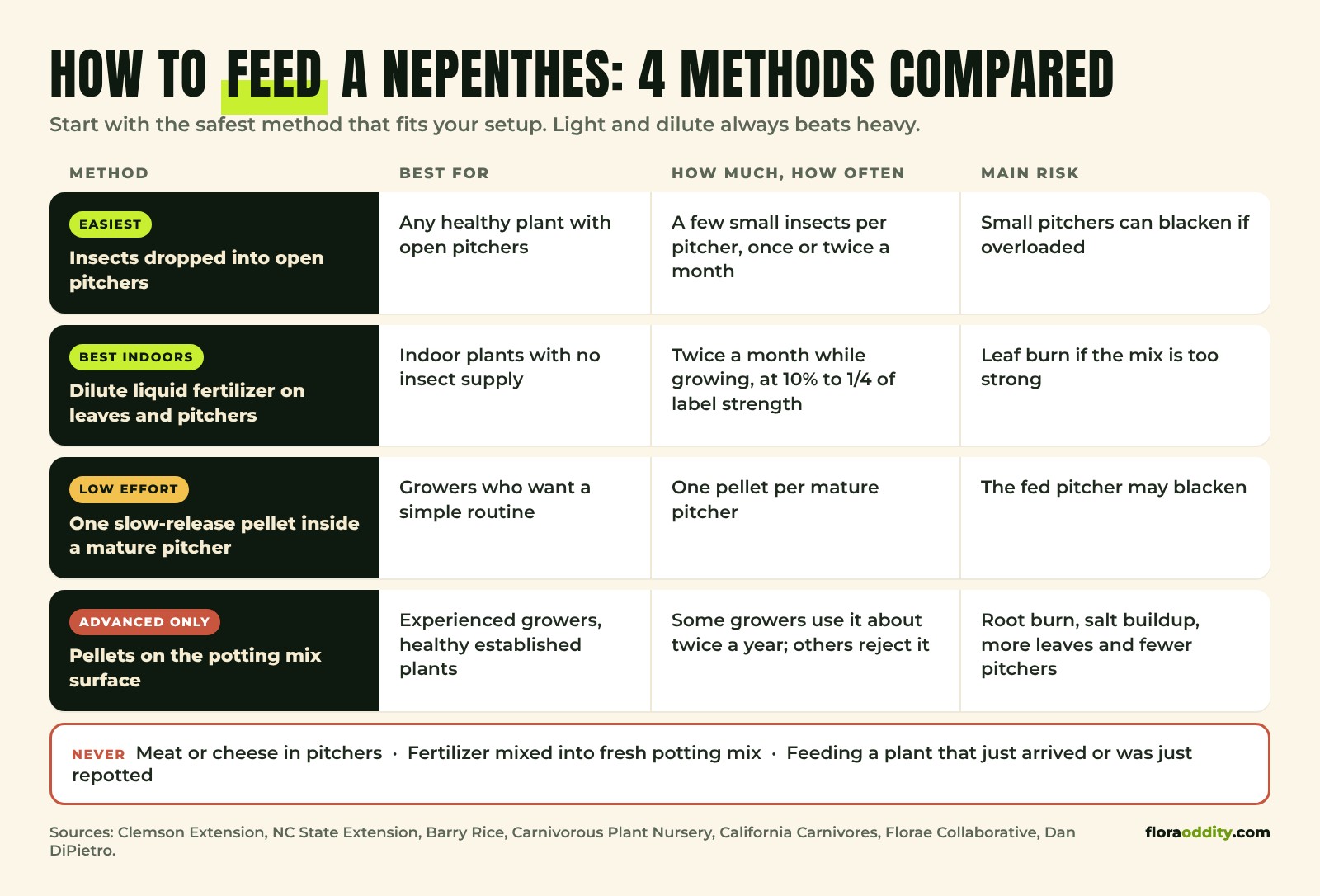
| Method | Best for | What sources suggest | Main risk |
|---|---|---|---|
| Insects dropped into pitchers | Any healthy plant with open pitchers | A few small insects per pitcher, once or twice a month | Small pitchers can blacken or rot if overloaded |
| Dilute liquid fertilizer on leaves and pitchers | Indoor plants with no insect supply | Twice a month in the growing season, at a fraction of label strength | Leaf burn if the mix is too strong |
| One slow-release pellet inside a mature pitcher | Growers who want a low-effort routine | One pellet per mature pitcher | The pitcher may blacken, especially smaller ones |
| Pellets on the potting mix surface | Experienced growers with healthy, established plants | Used by some growers about twice a year; rejected by others | Root burn and salt buildup; growth may shift toward leaves instead of pitchers |
There is one thing none of the sources recommend: mixing fertilizer into the potting medium when you pot the plant. As our guide to the best potting mix for Nepenthes explains, the root medium should stay airy and low in nutrients. Feeding is a separate decision.
How to Feed Insects
Feeding insects is the most natural option and the easiest to get right.
What to use
Clemson Cooperative Extension lists crickets, sow bugs, mealworms, and various dried insects as suitable food. Carnivorous Plant Nursery suggests freeze-dried bloodworms, dead crickets, wasps, or similar insects. Dried and freeze-dried insects sold as reptile or fish food are convenient because you can keep them on a shelf and use a pinch at a time.
How much to give
Less than you think. One or two small insects, or a small pinch of dried food, is enough for a typical pitcher. Match the size of the meal to the size of the pitcher, and leave tiny pitchers alone. California Carnivores notes that small pitchers may burn back after feeding, even though the plant still benefits from the nutrients.
Which pitchers to feed
Feed fully opened pitchers that already contain some of their own fluid. Do not try to force food into a pitcher whose lid has not opened yet. If a pitcher is dry inside, Barry Rice’s Carnivorous Plant FAQ notes that well-grown Nepenthes pitchers should start producing their own fluid within a month or so, and suggests improving humidity rather than filling pitchers by hand.
You do not need to feed every pitcher. Feeding one or two at a time spreads out the risk: if a pitcher reacts badly, you lose one trap, not the whole set.
How to Use Fertilizer Safely
Fertilizer is the practical choice for indoor growers who have no steady insect supply. The key is dilution.
Choosing a fertilizer
Sources favor two broad types:
- Organic liquid fertilizers. Clemson Extension lists fish emulsion, seaweed extract, and kelp extract. NC State Extension also recommends an organic fertilizer if insects are not available.
- Orchid or epiphyte fertilizers. Barry Rice suggests an orchid or epiphytic fertilizer. Several specialist nurseries, including California Carnivores and Florae Collaborative, use Maxsea, a seaweed-based, water-soluble fertilizer.
Mix any fertilizer with the same pure water you use for watering. Our guide on how to water a Nepenthes indoors explains why mineral-rich tap water is a problem for carnivorous plants.
How dilute is dilute?
This is where sources differ, so start at the weakest end. Carnivorous Plant Nursery recommends orchid fertilizer at 10 percent strength. Florae Collaborative dilutes Maxsea to one quarter of the label strength. Clemson Extension also gives one quarter of the recommended strength as its starting point.
A sensible approach is to begin at about 10 percent of label strength, watch the plant for a few weeks, and only then consider moving closer to one quarter. If you see burnt leaf tips or blackening pitchers, go back down.
Spraying leaves and pitchers
Foliar feeding means spraying or wiping the dilute solution onto the leaves and into open pitchers. Clemson Extension recommends applying fertilizer to the leaves and open pitchers twice a month during the growing season, and Carnivorous Plant Nursery recommends the same frequency for a dilute orchid fertilizer spray. Florae Collaborative also pours a little of its solution into mature pitchers, filling them about one quarter full.
Spray early in the day so the foliage can dry, and keep air moving around the plant. NC State Extension notes that poor air circulation can lead to fungal problems.
Pellets inside pitchers
A slow-release pellet dropped into a mature pitcher is the lowest-effort option. California Carnivores suggests adding slow-release Osmocote pellets to pitchers with a bit of distilled water, and Florae Collaborative uses a single pellet of a balanced 14-14-14 fertilizer per pitcher. Expect some pitchers to blacken afterward. Florae describes this browning as a normal reaction to a concentrated dose that does not harm the plant, but it is another reason to use only mature pitchers and only one pellet at a time.
The potting mix debate
This is the most contested part of Nepenthes feeding.
On one side, Florae Collaborative says never to fertilize the growing media, on the reasoning that nutrients should reach the plant through its pitchers rather than its roots. On the other, Dan DiPietro places slow-release pellets on the surface of the potting mix twice a year and reports much faster growth in his highland plants.
The research helps explain both views. Roots clearly can take up nutrients, as the 2010 Photosynthetica study showed. But in the 2020 Annals of Botany study, plants fertilized through their roots invested more of their new growth in leaves rather than pitchers. DiPietro reports something similar from his own collection, noting that heavy fertilizing may reduce pitcher production.
For most home growers, the conservative path is the right one: keep fertilizer out of the potting mix and feed through the pitchers and leaves instead. Top-dressing is a technique for experienced growers with healthy, established plants who are willing to watch closely and flush the pot if something goes wrong.
How Often to Feed, Season by Season
The pattern most sources follow is simple:
- Active growing season: once or twice a month. This is the frequency given by Clemson Extension, Carnivorous Plant Nursery, Barry Rice, and Florae Collaborative.
- Slower months: cut back. Florae Collaborative drops to once a month in winter.
- Pellets: much less often. Pellets are slow-release by design, and DiPietro applies his surface pellets only twice a year.
Indoors, the season is defined by what the plant is doing rather than the calendar. If it is producing new leaves steadily, it is in its growing season. If growth has slowed because of shorter days or cooler nights, ease off. Our guide to Nepenthes temperature explains how cool nights affect growth.
Signs You Are Overdoing It
Too much food or too strong a fertilizer usually shows up quickly. Watch for:
- Fed pitchers blackening or rotting from the top, especially small ones. One pitcher reacting is not a crisis. Several in a row means you are giving too much.
- Burnt leaf tips or edges after a foliar spray, which points to a solution that is too strong.
- Big, lush leaves but fewer pitchers, which can follow heavy feeding, especially through the roots.
- A foul smell from a pitcher, which suggests the contents are rotting rather than being digested.
If you see these signs, stop feeding, remove any rotting material, and let the plant settle before trying again at a lower dose. If you are seeing browning pitchers and are not sure whether feeding is the cause, our guide to why Nepenthes pitchers turn brown or dry up helps you read the pattern.
What Never to Feed a Nepenthes
- Meat or cheese. Carnivorous Plant Nursery warns that these will likely rot and kill the trap.
- Regular houseplant fertilizer poured onto the potting mix. This is the opposite of the low-nutrient root zone Nepenthes need.
- Food that is too big for the pitcher. California Carnivores notes that even normal meals can make small pitchers burn back, so oversized ones are an easy way to lose a trap.
You may come across the claim that Nepenthes cannot digest protein. NC State Extension’s plant toolbox, for example, states that they do not digest protein and should not be fed meat. The advice not to feed meat is sound, but the reasoning does not match the research: the 2015 PLOS ONE study found that the main enzymes in Nepenthes pitcher fluid are protein-digesting proteases. The practical problem with meat is that it tends to rot in the pitcher, which is exactly what Carnivorous Plant Nursery warns about.
Common Mistakes
- Feeding instead of fixing conditions. No amount of food makes up for low light or stagnant roots.
- Using fertilizer at full label strength. Start at the weakest end of the range and work up slowly.
- Feeding every pitcher at once. Spread meals out so one bad reaction does not cost you every trap.
- Feeding a stressed plant. New arrivals and freshly repotted plants need time, not nutrients.
- Topping up pitchers with tap water. If a pitcher is dry, improve humidity rather than filling it, and never use mineral-rich water.
- Adding slow-release fertilizer to fresh potting mix. Keep the root medium low in nutrients.
FAQ: Feeding Nepenthes
Do I have to feed my Nepenthes?
No. A Nepenthes in good light, with the right water and a healthy root system, will keep growing without being fed. Feeding is an optional boost for plants that are already doing well.
Can I use regular houseplant fertilizer?
It is better to choose a fertilizer that sources recommend for Nepenthes, such as an orchid fertilizer or an organic option like fish emulsion or seaweed extract, and to dilute it heavily. Whatever you use, apply it to the leaves and pitchers rather than mixing it into the potting medium.
Can I feed my Nepenthes meat or cheese?
No. Meat and cheese tend to rot inside the pitcher and can kill it. Use small insects, dried insects, or freeze-dried bloodworms instead.
Should I put water in the pitchers?
Usually not. Healthy pitchers produce their own fluid. Barry Rice’s Carnivorous Plant FAQ suggests raising humidity rather than filling Nepenthes pitchers by hand if they stay dry.
How often should I feed a Nepenthes?
Once or twice a month while the plant is actively growing is the frequency most sources give for insects and dilute fertilizer. Feed less often when growth slows.
Can I feed a pitcher that has not opened yet?
No. Wait until the lid has opened and the pitcher contains some of its own fluid. Feeding a pitcher before it is ready is more likely to damage it than help it.
The Bottom Line
Feeding a Nepenthes is optional, but it can make a healthy plant stronger. Research shows that better nutrition improves photosynthesis, and the pitcher fluid is fully capable of digesting insect protein. The safest routine is light and dilute: a few small insects in mature pitchers, or a weak organic or orchid fertilizer on the leaves and pitchers once or twice a month while the plant is growing. Keep fertilizer out of the potting mix, never feed meat, and get light, water, and roots right first. Feeding works best as the last step, not the first.
Sources & Further Reading
- Clemson Cooperative Extension: Tropical Pitcher Plants (Nepenthes spp.)
- NC State Extension Gardener Plant Toolbox: Monkey Cups (Nepenthes)
- Barry Rice, The Carnivorous Plant FAQ: Nepenthes
- Barry Rice, The Carnivorous Plant FAQ: Should I put water in my pitcher plant leaves?
- Carnivorous Plant Nursery: Growing Tips for Nepenthes
- California Carnivores: Tropical Pitcher Plants (Nepenthes) Growing Tips
- Florae Collaborative: How to Fertilize Nepenthes
- Dan DiPietro, Carnivorous Journey: You’re Not Fertilizing Your Nepenthes Enough
- Capó-Bauçà et al. (2020). Biochemical and mesophyll diffusional limits to photosynthesis are determined by prey and root nutrient uptake in the carnivorous pitcher plant Nepenthes × ventrata. Annals of Botany
- Pavlovič et al. (2010). Root nutrient uptake enhances photosynthetic assimilation in prey-deprived carnivorous pitcher plant Nepenthes talangensis. Photosynthetica
- Buch et al. (2015). Nepenthesin Protease Activity Indicates Digestive Fluid Dynamics in Carnivorous Nepenthes Plants. PLOS ONE
Final articles are editorially reviewed and factual claims are checked against cited sources. Last reviewed: October 2026.
4 Comments