
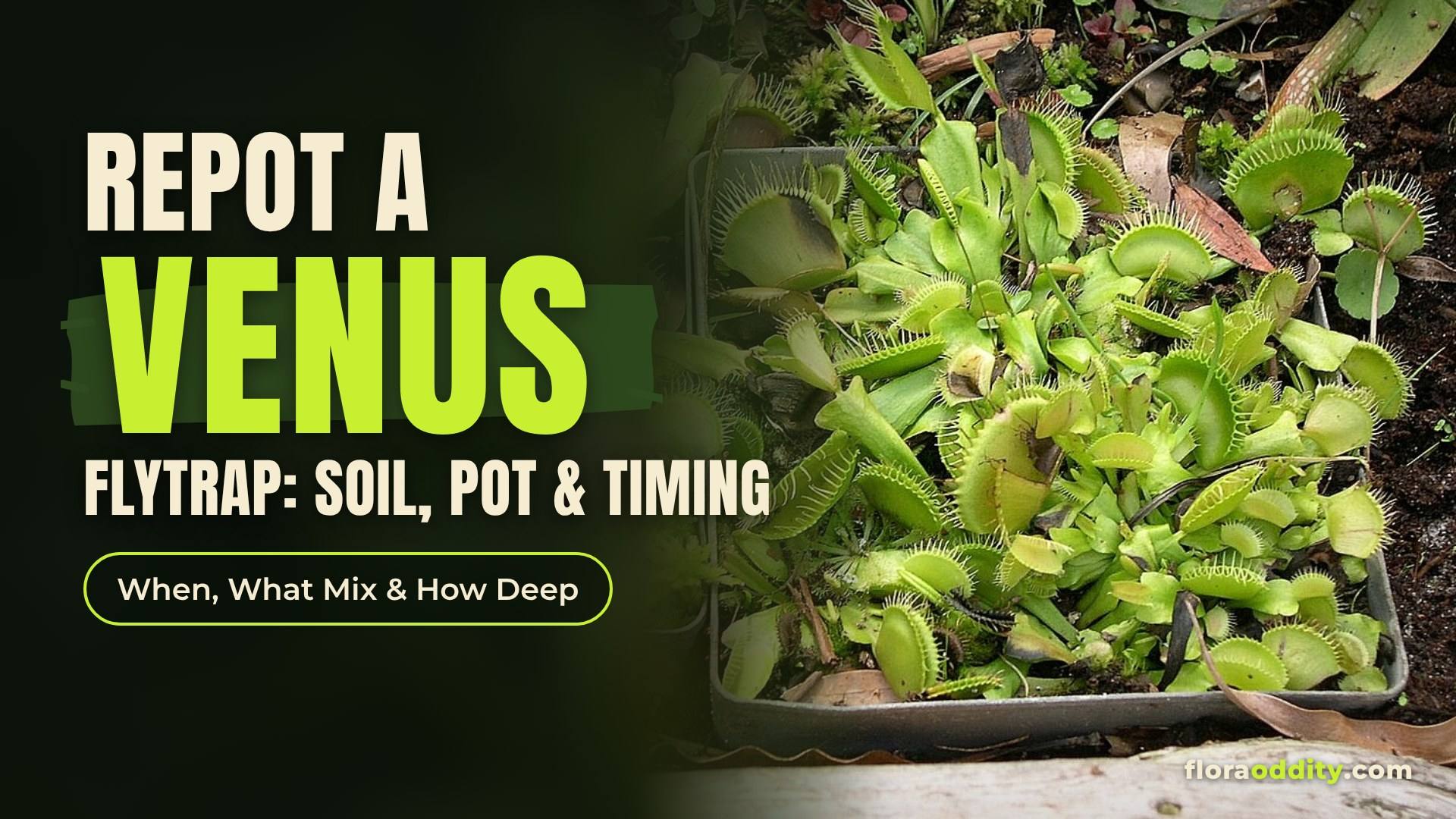
Repotting a Venus flytrap is simple, but the wrong soil or sand can finish a plant that was doing fine. Barry Rice, author of the long-running Carnivorous Plant FAQ, warns that a flytrap moved into ordinary “potting soil,” or anything with fertilizer, “is almost certainly going to die” unless it is replanted.
This guide covers when to repot, which soil and pot to use, the steps, dividing a crowded plant and aftercare, checked against the International Carnivorous Plant Society (ICPS), extension services and specialist nurseries. For the full growing routine, see our Venus flytrap care guide.
The Short Answer
Repot in early spring, as the plant comes out of winter dormancy, and only when it needs it: it has grown to the edge of the pot, the soil is old or salty, or it is in the wrong mix. The ICPS says a well kept plant “will need to be repotted every year or so”; some nurseries stretch that to every few years. Use roughly equal parts fertilizer-free sphagnum peat moss and washed silica or horticultural sand, in a plastic pot with a drainage hole that is deeper than it is wide, about 3 to 4 inches (8 to 10 cm) across. Keep the white leaf bases in the soil and the green parts above it, water with pure water, and put the pot straight back in its tray. A plant you just bought can usually wait.
When to Repot a Venus Flytrap
Not sure if it is time? Our repotting advisor checks the timing for your hemisphere and whether your pot is tall enough.
Best time of year
Most sources say early spring. Rice writes that “The best time to repot is early spring, just when they are starting to come out of dormancy,” and the New York Botanical Garden (NYBG) says “if you do repot, do it in spring.” Carnivorous Plant Nursery prefers spring “before active growth begins,” and Tom Bennet of Tom’s Carnivores repots at the end of the winter rest, before growth begins in March. California Carnivores goes earlier, repotting “in January or winter,” and recommends against it “during the spring-summer months.” Rice lists late summer as a time not to repot. For the winter rest behind this timing, see our guide to Venus flytrap dormancy.
How often
The ICPS growing guide, written by John Brittnacher, says “A well kept VFT will need to be repotted every year or so,” and adds that “The more you feed them, the larger they get and the more often they need to be repotted.” California Carnivores says “every 1-3 years,” and Carnivorous Plant Nursery says “every few years,” because “the peat breaks down and can create poor drainage.”
Signs it needs repotting
- It has reached the edge of the pot. The ICPS checklist names this as a main reason to repot: “the growth point of the plant has hit the edge of the pot.”
- New traps fail to develop. The ICPS guide says that when the soil turns salty, “the traps on new leaves will fail to develop.” Brittnacher, in Carnivorous Plant Newsletter, advises fresh soil “as soon as possible if the plant will not eat.”
- The soil is spent. Rice notes that “After a few years, peat in a carnivorous plant pot gets old and mucky.”
- It is in the wrong soil. For potting soil or fertilized mix, Rice says “you must replant your plant, regardless of the season.”
A plant you just bought
Leave it for now. The ICPS checklist says “Keep the tiny pot,” because the plant “will not get root-bound in that pot,” and to wait “until the plant has acclimated to your conditions and is growing well.” Rice adds that “Your plant is not a new goldfish for your aquarium,” and that the nursery grower “was probably using a good mix.” California Carnivores says its plants do not need repotting “for at least a year.” If you must repot early, the ICPS suggests keeping the plant “in a plastic bag for a few weeks after repotting.”
The Right Soil Mix
To work out how much of each ingredient your pots need, try our soil mix calculator.
Peat and sand
The standard mix is about half sphagnum peat moss and half sand. NYBG suggests “equal parts peat moss or sphagnum moss and coarse, horticultural-grade sand,” and the ICPS checklist calls for “50% peat moss and 50% coarse silica sand with a 1 cm (half inch) layer of coarse silica sand on the top.” NC State Extension lists “whole-fiber sphagnum moss or a mix of equal parts peat moss and coarse vermiculite or sharp sand.”
The ratio is flexible. Carnivorous Plant Nursery says it “is not critical” and that “Flytraps prefer a bit more sand.” Brittnacher uses “more sand in shallower pots and more peat in deeper pots.” The ICPS guide notes the plant “isn’t very picky about soil” and also grows in pure Sphagnum moss or pure peat, but says to avoid pure peat or pure Sphagnum “in short pots.”
Peat: the ICPS soil page says to make sure “it is Canadian sphagnum peat and there is no fertilizer added,” and to beware any medium “from companies that specialize in fertilizer.” Rice and Carnivorous Plant Nursery both warn against sedge peat, and Rice says small bags of peat “are sometimes treated with wetting agents.”
Sand: the ICPS wants “a sharp silica or quartz sand with grain sizes in the 1.5 to 2 mm range.” Finer sand packs down: the ICPS says “Pool filter sand is too fine” and fines “will make the soil mix like concrete.” Rice says to “avoid ocean sand” because of salt, Carnivorous Plant Nursery says “Never use beach sand,” and the ICPS checklist rules out “play sand or builders sand.”
Perlite: yes or no?
Nurseries split here. California Carnivores uses “four parts fertilizer free peat moss to one part perlite,” Sarracenia Northwest uses “1 part sphagnum peat moss to 1 part perlite,” and Tom’s Carnivores uses sand or perlite. The ICPS guide says to “Avoid perlite, pumice, and other potentially salty soil components,” and Brittnacher writes that “Perlite and pumice are generally too salty, and many brands add fertilizer.” The ICPS soil page still calls perlite “a good alternative to sand” if washed; its author puts it in water and says to “only use the material that floats.”
What to avoid
The ICPS step-by-step says “NEVER use standard planter mix. It has added lime and fertilizer.” Sarracenia Northwest says potting soil, compost, manure or fertilizer “can severely damage or kill the plant.” Read every label and buy peat “without added fertilizer,” as the ICPS checklist puts it.
Wet the mix before you use it. Rice says dry peat “is difficult to wet,” and suggests working it with an equal volume of water in a tray, squeezing handfuls under water until they soak it up.
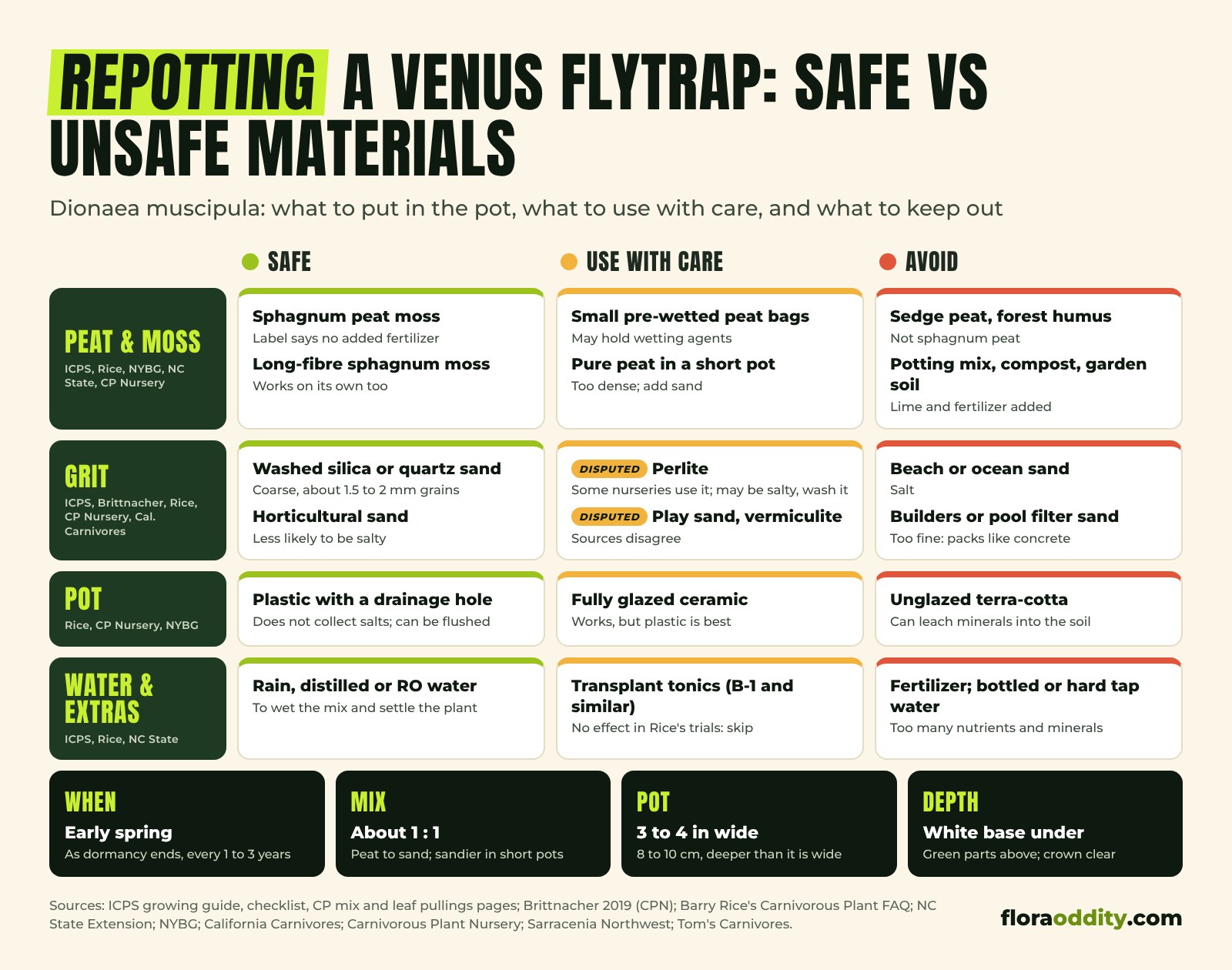
Safe and unsafe repotting materials
| Material | Verdict | Why | Source |
|---|---|---|---|
| Sphagnum peat moss, no fertilizer | Use | Base of the standard mix | ICPS, Rice, NYBG |
| Long-fibre sphagnum moss | Use | Works on its own | ICPS, NC State |
| Washed silica or quartz sand, 1.5 to 2 mm | Use | Keeps the mix open and wet, not soggy | ICPS |
| Horticultural sand | Use | Less likely to contain salt | Rice, NYBG |
| Perlite | Care | Used by some nurseries; often salty, so wash it | California Carnivores, Sarracenia Northwest; ICPS, Brittnacher |
| Play sand | Disputed | ICPS says no; Carnivorous Plant Nursery calls it “great” | ICPS, Carnivorous Plant Nursery |
| Vermiculite | Care | Listed by NC State; “breaks down into mush” | NC State, Brittnacher |
| Potting mix, compost, garden soil | Avoid | Lime and fertilizer | ICPS, Sarracenia Northwest |
| Sedge peat | Avoid | Not sphagnum peat | Rice, Carnivorous Plant Nursery |
| Beach sand | Avoid | Salt | Rice, Carnivorous Plant Nursery |
| Builders or pool filter sand | Avoid | Too fine; packs like concrete | ICPS |
| Plastic pot with drainage hole | Use | Does not collect salts; can be flushed | Rice, Carnivorous Plant Nursery |
| Unglazed terra-cotta | Avoid | Can leach minerals | Carnivorous Plant Nursery |
| Rain, distilled or RO water | Use | Pure water only | ICPS |
| Transplant tonics (B-1, SUPERthrive) | Skip | No effect in Rice’s trials | Rice |
Pot Type and Depth
Rice says “in nearly all cases you should use plastic pots,” because they “do not accumulate harmful impurities or salts,” and wants a drainage hole “so you can flush water through the pot when necessary.” Carnivorous Plant Nursery warns that terra-cotta can “leach minerals into the soil,” though “A completely glazed ceramic pot will work.”
The ICPS checklist suggests “8 cm (3 inches) in diameter and 10 cm (4 inches) tall,” and Tom’s Carnivores says a 4 inch (10 cm) pot “is sufficient for adult plants.” NYBG says “The pot shouldn’t be too big,” and California Carnivores advises sizing “up only a few inches at a time.”
Depth matters more. The ICPS guide says what counts is “how far the crown of the plant is from the water level,” and that the tray water “should always be more than 5 cm (2 inches) below the surface of the soil.” Carnivorous Plant Nursery gives mature plants “a deeper pot of 4-6″ (10-15cm),” and California Carnivores says flytraps “do well in tall pots.” Rice adds that a bigger pot means “fewer moisture and temperature fluctuations.”
How to Repot a Venus Flytrap, Step by Step
1. Prepare the mix and pot
Moisten the mix with pure water; Carnivorous Plant Nursery warns that “Dry soil can pull moisture from the plant and may kill it.” Fill the pot, water it, and, as Rice puts it, “pat it down with a firm hand” without packing it hard.
2. Lift the plant out
The ICPS uses planting forceps, which it finds “less messy.” Rice simply turns the pot over so the plant and soil slide out.
3. Keep the root ball, or wash it
If the old soil was good, Rice’s gentle method keeps the root ball whole: dig a hole the size of the old pot, set it in and firm it. He mocks the houseplant habit of slicing or fluffing roots: “Grow tomatoes instead.” If the plant was in potting mix or fertilized soil, wash the old soil off, give a final rinse in purified water, and “do not let it dry out!”
4. Trim the old rhizome
On an older plant, the ICPS notes that “The old part of the rhizome rots as the plant grows” and breaks that part off. Brittnacher writes that “you will need to reduce the size of the bulb.”
5. Plant at the right depth
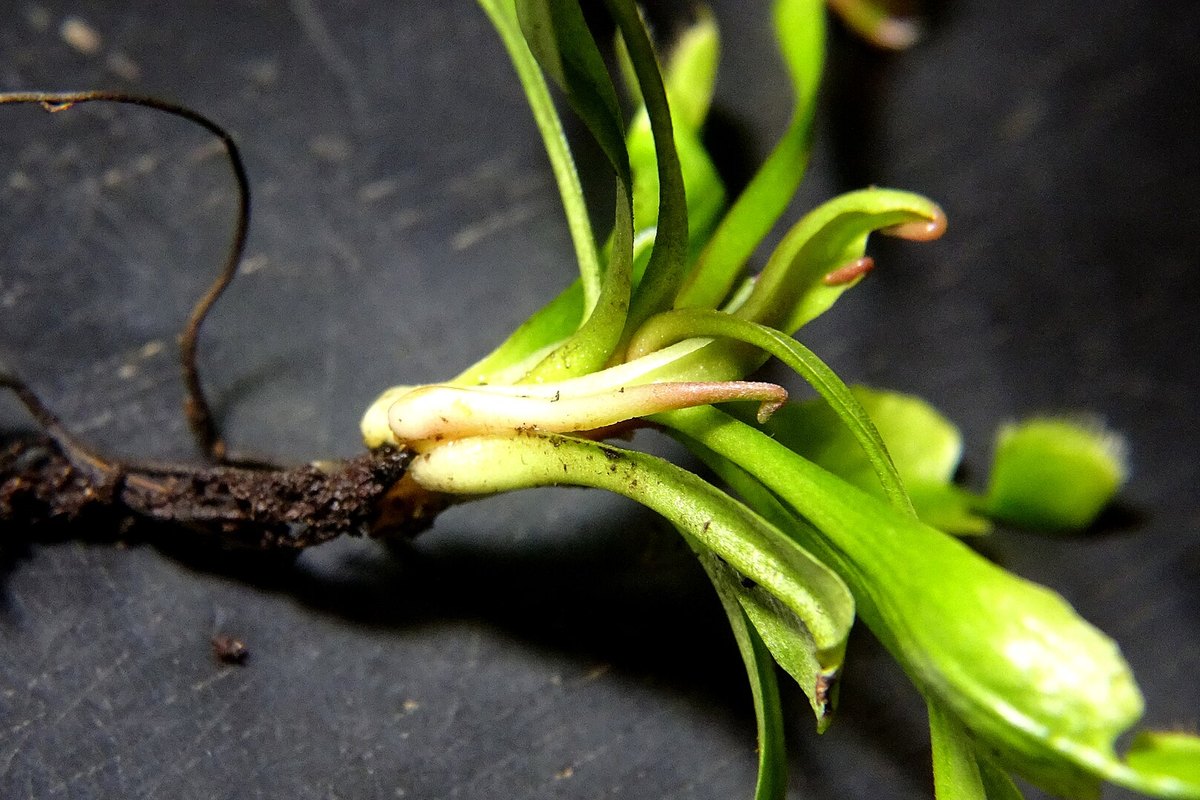
Carnivorous Plant Nursery’s rule: “The green portion stays above the soil, and the white portion goes under the soil,” without burying the crown. The ICPS sets the soil level so the rhizome is “just into the soil,” and plants slightly off centre, with the growing point aimed at the middle, because the plant “will continue growing in that direction.”
6. Add a sand cap (optional)
Brittnacher tops his pots “with about 2 cm of pure sand,” which he says “helps keep the older part of the bulb from rotting” and does not attract fungus gnats. The ICPS notes that many growers simply fill to the top with peat and sand, also with success.
7. Water in and return to the tray
Water gently to settle the soil, then put the pot into its tray, which the ICPS does “immediately so peat can start fully hydrating.” Use rain, distilled or reverse osmosis water. The ICPS checklist warns that “Bottled drinking water is death to VFT’s.”
Dividing a Crowded Plant While You Repot
Repotting is the natural time to split a plant. The ICPS says “Repotting is a good time to divide off any side plants and to take leaf pullings,” and Carnivorous Plant Nursery agrees it is “a good time to divide the corm.”
Do not rush a young split, though. Rice says that when a second rosette appears, “Resist this impulse and wait a few years,” because dividing too soon means you “rip the plants apart and risk the lives of both plants to infection.” Give them “plenty of time to form separate root systems.”
Each division needs a growing point. The ICPS guide shows a plant split so one piece “has the growth point and enough old leaf bases to get it off to a good start.” Leaf pullings must include the white base: the ICPS says to “Pull out and down so the whole leaf comes off in one piece.” Its photos show pullings ready to separate after five months.
Aftercare: The First Few Weeks
Expect it to look worse. Rice says repotted flytraps “usually look worse since their traps are mostly triggered closed because of your jostling,” but “They should recover.”
Keep the tray full. The ICPS checklist keeps pots in 1 to 2 cm (half to 1 inch) of water and says “DO NOT EVER LET THE DISH DRY OUT.”
Skip tonics and fertilizer. Rice tested transplant products such as B-1 and SUPERthrive in “large-scale, controlled experiments” and “never found them to have any effectiveness at all.” The ICPS says “Do not fertilize your plant.”
Feed before, not just after. Brittnacher’s routine for a plant that still eats is to “feed it well, then after a few weeks repot it.” Once it is growing again, see how to feed a Venus flytrap.
Throw out the old soil. Brittnacher says “Do not reuse the soil,” though it can go in the garden.
In one Sarracenia Northwest case, a weak, low-light flytrap was moved to a 5 or 6 inch pot, had all its leaves cut off and went into full sun, with “the first new healthy trap” expected in about a month. That was a rescue for one plant, not standard practice.
Where Sources Differ
| Topic | One view | Another view |
|---|---|---|
| Timing | Rice, NYBG, Carnivorous Plant Nursery: early spring | California Carnivores: January or winter |
| Frequency | ICPS: every year or so | California Carnivores: every 1 to 3 years; Carnivorous Plant Nursery: every few years |
| Perlite | California Carnivores, Sarracenia Northwest: fine | ICPS, Brittnacher: avoid, often salty |
| Play sand | Carnivorous Plant Nursery: “Play box sand is great” | ICPS: do not use play sand |
| Vermiculite | NC State: works with peat | Brittnacher: “breaks down into mush” |
These are mostly differences of context. Brittnacher grows mainly indoors under strong lights, where plants grow all year and use up soil faster. The nurseries write for their own climates and sell their own mixes, while the ICPS warns that “In some areas it is hard to find perlite that is not salty.”
Common Mistakes
- Repotting a new plant at once. Rice’s advice for a first flytrap is “Do not repot.”
- Potting mix or fertilized peat. Check every label.
- The wrong sand. Beach sand brings salt; fine sand packs hard.
- A wide, shallow pot. Depth keeps the crown above the water.
- Burying the crown. Only the white leaf bases go under.
- Splitting a second rosette too early. Rice says to wait years.
- Topping up with tap or bottled water. Use pure water only.
FAQ: Repotting a Venus Flytrap
Can I repot a Venus flytrap while it is dormant?
Some growers do, near the end of dormancy. California Carnivores repots “in January or winter,” and Tom’s Carnivores before growth starts in March. Rice and NYBG prefer early spring.
Can I use regular potting soil or Miracle-Gro?
No. The ICPS says standard planter mix “has added lime and fertilizer,” and Rice says a flytrap in potting soil or fertilized mix “is almost certainly going to die” unless replanted.
Can I use perlite instead of sand?
Many nurseries do, including California Carnivores and Sarracenia Northwest. The ICPS and Brittnacher avoid it because it is often salty; if you use it, wash it first.
How big should the pot be?
About 3 to 4 inches (8 to 10 cm) across and deeper than it is wide for most plants, following the ICPS and Tom’s Carnivores.
The Bottom Line
To repot a Venus flytrap well, wait for early spring and a real reason: the plant has hit the edge of the pot, the soil is old or salty, or it is in the wrong mix. Use fertilizer-free sphagnum peat with washed silica or horticultural sand at roughly 1:1, in a plastic pot that is deeper than it is wide. Keep the white leaf bases in the soil, water with pure water, and put the pot straight back in its tray. Then leave it alone and judge the repot by the new traps that follow.
Sources & Further Reading
- International Carnivorous Plant Society: Checklist for Growing Dionaea muscipula
- International Carnivorous Plant Society: Growing Dionaea muscipula
- International Carnivorous Plant Society: Peat, Sand, Perlite (CP mix)
- International Carnivorous Plant Society: Dionaea Leaf Pullings Step-by-Step
- Brittnacher, J. (2019). Grow Venus flytraps indoors. Carnivorous Plant Newsletter 48(4): 178 to 182
- Rice, B. The Carnivorous Plant FAQ: Should I transplant my Venus flytrap for other reasons?
- Rice, B. The Carnivorous Plant FAQ: How do I replant my new carnivorous plant?
- Rice, B. The Carnivorous Plant FAQ: I goofed by using bad soil or water. What should I do now?
- Rice, B. The Carnivorous Plant FAQ: What kind of pot should I use?
- Rice, B. The Carnivorous Plant FAQ: About peat
- Rice, B. The Carnivorous Plant FAQ: About sand
- Rice, B. The Carnivorous Plant FAQ: How do I vegetatively propagate my Venus flytrap?
- NC State Extension Gardener Plant Toolbox: Dionaea muscipula
- New York Botanical Garden: Advice on growing and caring for a Venus flytrap
- California Carnivores: Venus Flytrap (Dionaea muscipula) Growing Tips
- Carnivorous Plant Nursery: Growing Tips for Venus Flytraps
- Carnivorous Plant Nursery: How to Pot a Carnivorous Plant
- Tom’s Carnivores: The Venus Flytrap, Complete Care Guide
- Sarracenia Northwest: Venus Flytrap Care
- Sarracenia Northwest: Q/A #55, Venus Flytrap Is Looking Strange
Featured image based on a photo of Venus flytraps by Jay Sturner via Wikimedia Commons, CC BY 2.0, cropped with a dark gradient and typography added by FloraOddity.
Final articles are editorially reviewed and factual claims are checked against cited sources. Last reviewed: October 2026.
One Comment