
A single leaf can become a new butterwort. The International Carnivorous Plant Society (ICPS) calls leaf pullings “the easiest way to propagate Mexican Pinguicula,” and Barry Rice, author of the Carnivorous Plant FAQ, says the temperate species make tiny winter buds called gemmae that are “an excellent way to propagate the plants.” Seed works too, but it needs hand pollination for most Mexican species and a cold winter for the northern ones.
The best way to propagate butterworts depends on which group your plant belongs to. Our butterwort care guide covers the basics briefly; this guide takes each method step by step.
The Short Answer
For Mexican butterworts and their hybrids, take leaf pullings. Gently pull whole leaves, including the pale base, ideally in early spring while the plant still has its small succulent winter leaves. Lay them on a damp, airy mix in a closed clear box out of direct sun, and expect small plants in 1 to 2 months, the ICPS says.
For cold temperate species such as P. grandiflora and P. vulgaris, collect the gemmae, the tiny buds that form around the base of the winter bud, and plant them separately. Offsets can simply be split off and potted. Seed is the slow route: Mexican seed is sown on the surface at 60 to 80 °F (15 to 25 °C), while cold temperate seed needs 8 to 12 weeks of cold first.
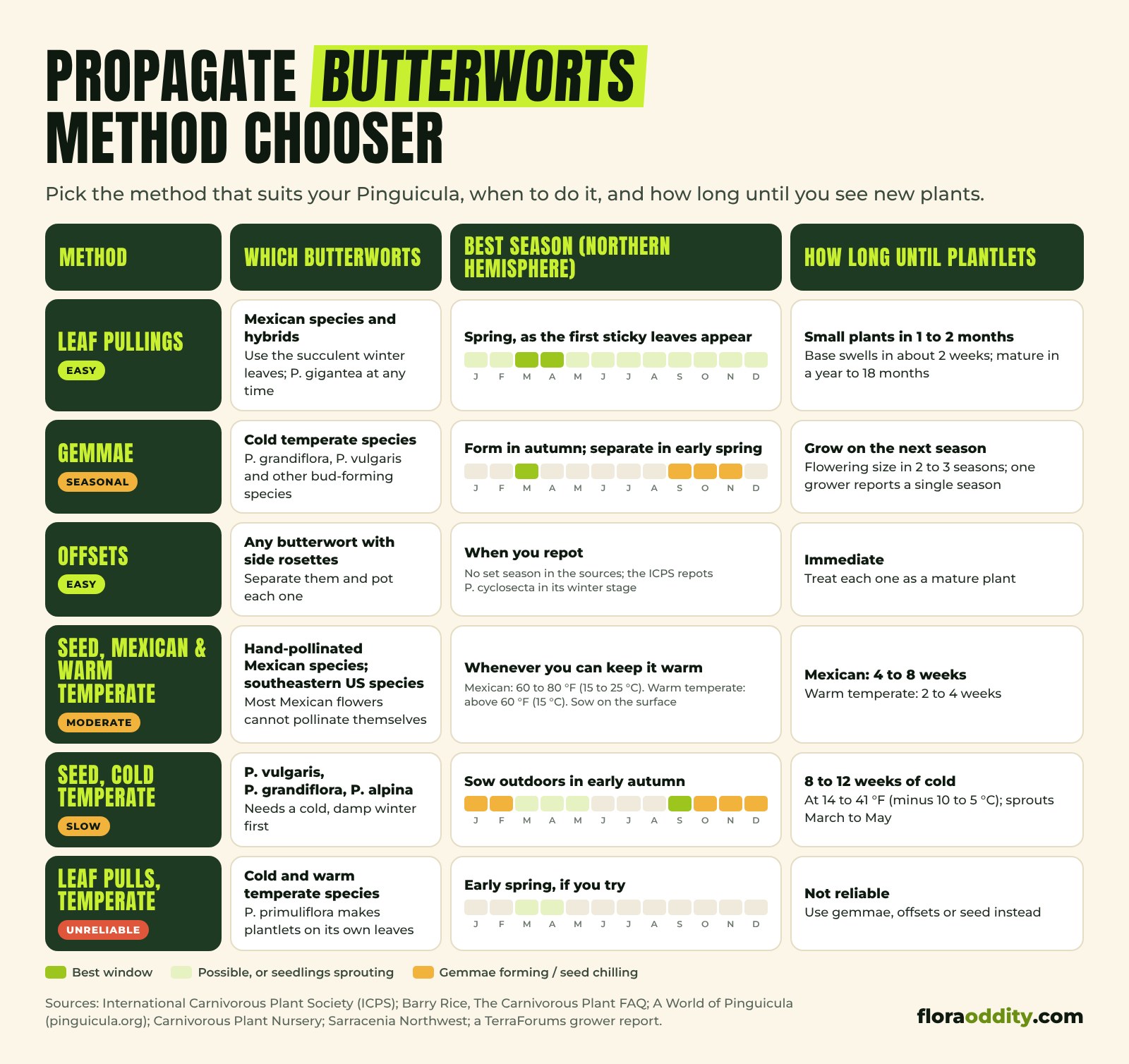
| Method | Best for | Best season (northern hemisphere) | Time to plantlets or sprouts | Difficulty | Source |
|---|---|---|---|---|---|
| Leaf pullings | Mexican species and hybrids; P. gigantea at any time | Spring, just before or as the first carnivorous leaves appear (late March to early April) | First swelling in about 2 weeks; small plants in 1 to 2 months; mature in a year to 18 months | Easy | ICPS, A World of Pinguicula, Carnivorous Plant Nursery |
| Leaf pulls, temperate species | Cold and warm temperate species | Early spring | Not reliable; P. primuliflora makes plantlets on its own leaves | Unreliable | Carnivorous Plant Nursery, Barry Rice |
| Gemmae | Cold temperate species that form winter buds | Formed at the base in autumn; separated and replanted in early spring | Hibernacula reach flowering size in 2 to 3 seasons; one grower reports gemmae doing it in one | Easy, seasonal | Barry Rice, ICPS, Iwein Coppens |
| Offsets and division | Any butterwort that forms side rosettes | When repotting | Immediate: treat each piece as a mature plant | Easy | Sarracenia Northwest, Barry Rice |
| Seed, Mexican | Hand-pollinated Mexican species, e.g. P. moctezumae | No season given; needs 60 to 80 °F (15 to 25 °C) | 4 to 8 weeks | Moderate | ICPS |
| Seed, warm temperate | Southeastern US species and P. lusitanica | No season given; above 60 °F (15 °C), indoors or out | 2 to 4 weeks | Moderate | ICPS |
| Seed, cold temperate | P. vulgaris, P. grandiflora, P. alpina | Sow outdoors in early autumn, or chill in the refrigerator in winter | 8 to 12 weeks of cold; sprouts March to May outdoors | Slow | ICPS |
Which Method Suits Your Butterwort?
Start by working out which group your butterwort belongs to, because the groups split cleanly by method.
Mexican butterworts are the leaf pulling group. Rice puts it plainly: “It is important to use leaf pullings for the leaves of Mexican Pinguicula,” ideally the succulent winter leaves. Cold temperate butterworts are the gemmae group; Carnivorous Plant Nursery says temperate butterworts “can be propagated from leaf pulls, but this is not reliable.” Southeastern US species are short-lived, and the ICPS advises growers to “pollinate the flowers and collect seed if you want to have plants long term.”
Leaf pullings, gemmae and offsets all give copies of the parent; Rice notes that plants propagated asexually from the same parent are genetically identical. Seed gives new individuals.
Leaf Pullings for Mexican Butterworts
When to take them
Most Mexican butterworts grow sticky carnivorous leaves in summer and small, thick, non-sticky leaves in winter (our butterwort dormancy guide explains the winter stage). The ICPS says “using the winter leaves late in the season works best for all species,” and puts the best time in spring “just before or as the very first summer carnivorous leaves start emerge”: late March and early April in the temperate northern hemisphere, for greenhouse plants and plants on a natural light cycle. Serge Lavayssiere, writing on A World of Pinguicula (pinguicula.org), agrees that winter leaves “give the best chances.”
Summer leaves can work too, but the ICPS warns they may sprout more slowly “or the leaves could be too thin and just rot.” P. gigantea, which does not form succulent winter leaves, can be propagated “at any time of the year.”
How to pull a leaf
- Lift a dormant plant. For dormant P. moranensis types, the ICPS pulls up the whole plant and peels off the outer leaves. Lavayssiere first cleans away old dead leaves.
- Take the whole leaf, base and all. Lavayssiere stresses taking the leaf “including the white base as the plantlets will sprout from this area.” Carnivorous Plant Nursery tears each leaf away “with a small section of the stem still intact.”
- Be gentle. With P. ehlersiae, the ICPS teases leaves off with the fingers: “If you are too rough the whole plant can fall apart.”
- Take no more than half. Both the ICPS and Lavayssiere say up to half the leaves can go without harming the plant.
- Let the wound dry. Lavayssiere leaves fresh pullings on a clean, dry surface for 15 to 30 minutes so the torn base can heal.
The ICPS warns that P. gigantea can fall apart if repotted in summer, and P. ehlersiae in winter.
Setting them up
The goal is a leaf that is neither wet nor dry. John Brittnacher, author of the ICPS guide, suspects “that any method of keeping the leaves from being too wet or too dry will work.” He lays leaves on a damp mix of 1 part vermiculite to 2 parts perlite, or on the usual Pinguicula mix in small clear lidded containers, which fog up and keep the air humid while the leaves stay dry. Large, fleshy leaves can go in a plastic bag, closed if the leaves are fairly dry and propped open with a clip if they are wet, with a piece of blue paper shop towel to soak up extra water. In humid air, a dish with no water is enough.
Lavayssiere uses a closed box with a shallow layer of vermiculite, perlite, sand or adult mix, and lays the leaves “horizontally, not buried.” The medium matters little, he says, because the plantlets first live on the nutrients stored in the mother leaf. Carnivorous Plant Nursery uses moist milled sphagnum under a clear lid.
Keep them out of direct sun “so they don’t cook,” the ICPS says. Skip rooting powder, too. Brittnacher tested rooting hormone and vitamin B1 on P. ehlersiae leaves and “got more and larger plantlets from the untreated leaves.”
What happens next
If a leaf starts to rot, the ICPS says to open the bag more; if leaves shrivel, mist them and close it. In Lavayssiere’s photo sequence, the leaf base swells after about two weeks, the first real leaves show a week later, and a week after that the mother leaves begin to die. Some leaves give more than one plantlet. The ICPS estimate: “It takes 1 to 2 months to get small plants.”
Pot the plantlets in your regular butterwort mix once the mother leaf has deteriorated and roots are visible. With some experimenting, Brittnacher writes, “you should be able to produce mature plants in a year to 18 months.”
How Butterwort Leaf Pullings Compare With Sundew Leaf Cuttings
If you have already tried to propagate sundews, three differences matter.
Pull, do not cut. The ICPS cuts sundew leaves along the stalk with a razor, and plantlets appear on the dewy blade. Rice describes a leaf pulling as “similar to leaf cuttings, but in this case the entire leaf is pulled from the plant instead of being cut.” A butterwort’s new plants form at the leaf base, so a cut that leaves the base behind wastes the leaf.
Damp, not wet. The ICPS calls pure water “the cleanest medium” for sundew cuttings and wants cuttings on peat or moss “kept very wet.” Mexican butterwort pullings want humid air around a leaf that is not wet.
Usually faster. For sundews the ICPS warns that nothing much happens “for the first month or so,” and D. slackii can take 5 months. Mexican butterwort pullings often show plantlets within a few weeks.
Gemmae are the other overlap: Rice notes that both pygmy sundews and hibernaculum-forming butterworts make these small buds that can be planted as new individuals.
Leaf Pulls From Temperate and Southeastern Butterworts
Outside the Mexican group, leaf pulling is a gamble. Carnivorous Plant Nursery calls temperate butterworts “less reliable,” and Rice could not propagate P. pumila or the Caribbean P. filifolia from leaf cuttings.
One southeastern species does the job itself. Rice says P. primuliflora “produces adventitious plantlets on its leaves” when grown well, so freely that it “rapidly becomes a nuisance.” Carnivorous Plant Nursery says such buds can be separated once they have roots of their own.
Gemmae From Temperate Butterworts
Cold temperate butterworts spend winter as tight resting buds called hibernacula. Rice says mature, flowering-sized plants “also produce small daughter hibernacula as they enter dormancy.” These gemmae “are formed at the base of the plant in the fall” and are only “a millimeter or so in length,” resistant to drying and frost but “not indestructible.”
In the wild, Rice explains, the buds detach readily and float off with spring meltwater. In a pot, a grower known as jesse on TerraForums found that most gemmae “will be overgrown by the mother plant and die” once the big bud opens.
How to collect them
- Wait for the winter bud. Gemmae form as the plant enters dormancy; our butterwort dormancy guide covers overwintering.
- Check the base of each bud. jesse finds gemmae both above and below the soil surface, so look right down to the roots.
- Separate and replant. jesse digs out the hibernaculum, carefully scrubs off the gemmae with the edge of a pocket knife, and replants bud and gemmae separately.
- Mind P. alpina. The ICPS says its buds keep their thick, “very fragile” roots: “If too much of the roots break you will loose the plant!”
Give the young plants room. Iwein Coppens, describing an experiment on A World of Pinguicula, planted six small P. grandiflora hibernacula about 1.6 inches (4 cm) apart and found this “far too close” by the second season. He says a hibernaculum becomes a mature, flowering plant after two or three growing seasons, given enough sun the season before. Every young plant still needs the cold winter of the adults; as the ICPS puts it, “the plant needs cold winter temperatures to survive!”
Offsets and Division
Many butterworts make small side rosettes. Answering a reader about little plants around a Mexican hybrid, Sarracenia Northwest said these are “offsets produced by the parent plant,” which can be left as a cluster or “carefully separated and planted into their own pots.” Rice says such daughter plants can be treated “as mature specimens.” Repotting time is the natural moment; the ICPS calls the winter stage of P. cyclosecta “the best time to propagate and repot the plant.”
Growing Butterworts From Seed
Seed is the slow route: the ICPS says most carnivorous plants take “two to six years to reach maturity from seeds.” It suits short-lived southeastern species, home-made hybrids and cold temperate species.
Getting seed: hand pollination
The ICPS says “most if not all Mexican Pinguicula cannot self pollinate their flowers,” because the stigma forms a flap over the anthers; in the wild, hummingbirds usually do the job. Laurent Legendre, writing on A World of Pinguicula, explains how to do it by hand:
- Wait two days. Flowers stay fertile for 3 to 10 days, and the pollen is released more easily once a flower is 2 days old.
- Use a wooden toothpick. Pass it behind the large stigma lip to collect pollen, then spread the pollen on the outer face of the stigma. Once is enough. If the flower tube hides the stigma, tear the lower half of the flower away, a method the ICPS also describes.
- Harvest on time. Seed ripens in 1 to 2 months. Collect it when the capsule and top of the stalk turn brown, before the capsule splits.
A capsule can hold up to 100 seeds. Cross different plants when you can: Rice warns that selfing often lowers vigor, and that crossing two plants propagated from the same parent “is really just the same as selfing.” Among warm temperate species, the ICPS says P. pumila needs a small brush, while P. lusitanica self-pollinates and “can become a weed in collections.”
If no seed forms, Legendre names two causes. Some long-cultivated Mexican species, such as P. esseriana and P. ehlersiae in European collections, will not set seed with their own pollen. Heat is the other: his P. sharpii set full capsules at 68 to 86 °F (20 to 30 °C) and no seed at 104 to 113 °F (40 to 45 °C). He stores seed in a closed plastic box in the refrigerator at about 39 °F (4 °C); his record is 5 years with P. caerulea and P. vulgaris.
Sowing Mexican and warm temperate seed
The ICPS sows Mexican seed on the surface of the usual mix, with the top 0.4 inch (1 cm) sifted finer, keeps the soil “damp and not sopping wet,” and holds the pot at 60 to 80 °F (15 to 25 °C), in a plastic bag if the air is dry. The seeds “germinate in 4 to 8 weeks.” It calls P. moctezumae “easy to propagate from seed,” and notes that its seed leaves already carry glands.
Warm temperate seed needs more than 60 °F (15 °C) and always-damp soil, and germinates in 2 to 4 weeks, the ICPS says. P. lusitanica “can flower a half year after germination.”
Use pure water. The ICPS says carnivorous plants can be killed by water with moderate or high dissolved solids and wants less than 80 ppm, which usually means distilled, reverse osmosis or deionized water. Our water checker helps you test yours.
Cold temperate seed: give it a winter
Rice explains that Pinguicula “from lands where snow falls each winter” need a cold spell to germinate well. The ICPS gives 14 to 41 °F (minus 10 to 5 °C) for 8 to 12 weeks. Where winters are cold, sow in pots outdoors at the beginning of autumn, move them into bright sun in spring, and expect germination between March and May; the soil must stay “very damp.” Otherwise, keep the seed in a small bag with a few pinches of damp peat in the coldest part of the refrigerator for 8 to 12 weeks, ideally in winter so the seedlings grow in step with the seasons.
Caring for seedlings
Keep seedling pots in sealed bags. The ICPS says fungus gnat larvae “love eating the roots of CP seedlings,” and suggests sixteen hours of light a day with fluorescent lamps about 6 to 10 inches (15 to 25 cm) above the pots. Then wait: for many species, it warns, it “can take a year to get a plant large enough you can feed a tiny amount of dried bloodworm.”
What Growers Report
These are single growers’ results under their own conditions, not rules.
- Joseph Clemens, who grows Mexican butterworts, reported “nearly 100% success” from leaf pullings over many hundreds of plantlets, from both summer and winter leaves. His key point: “Too damp and they will quickly rot, before forming plantlets, too dry and they will dry up, before forming plantlets.” (Joseph Clemens, TerraForums, January 2015)
- Peter, posting as pingman, put long P. gypsicola leaves in a bag that was “fairly dry or just barely moist,” without adding water. “It took about a 3 weeks before i saw any plantlets,” and two weeks later the mother leaves were fading. (pingman, TerraForums, December 2006)
- jesse, digging up his cold hardy butterworts in early March, separates the gemmae from their buds and replants them. He reports that “small gemmae can grow to flowering size buds within just one season,” far faster than seed. (jesse, TerraForums, March 2012)
- dvg sowed bought seed of several Mexican species under fluorescent lights in his basement, with no cold treatment, and they germinated “in about 7 to 10 day’s time.” P. agnata germinated well; only three P. lilacina seeds came up. (dvg, TerraForums, October 2011)
Our takeaway: for leaf pullings, moisture control matters more than season or medium, and germination times vary widely between growers.
Where Sources Differ
Each row gives only the context the sources themselves state.
| Topic | One view | Another view | Context the sources give |
|---|---|---|---|
| Winter or summer leaves | ICPS: winter leaves late in the season work best; summer leaves can be too thin and rot | Joseph Clemens (TerraForums): leaf form never really mattered; bannister (TerraForums) got new plants from 8 of 10 carnivorous-phase pullings | The ICPS says success depends on how thick or succulent the leaves are and on the technique; Clemens stresses moisture control |
| Cover the pullings? | ICPS and Lavayssiere: closed container or bag for humid air; Carnivorous Plant Nursery: clear lid | theplantman (TerraForums): leaves root uncovered | theplantman grows in a greenhouse with humidity above 50%; the ICPS also allows an open dish where the air is humid enough |
| Bury the leaf base? | Lavayssiere: lay leaves horizontally, not buried | Rice, general leaf cuttings: “perhaps partly bury it” | Rice’s note covers leaf cuttings of many genera; Lavayssiere’s is specific to Mexican Pinguicula |
| Gemmae to flowering size | jesse (TerraForums): small gemmae can reach flowering size in one season | Coppens: a hibernaculum becomes a mature, flowering plant after 2 to 3 growing seasons | Coppens grew plants on porous rocks in an unheated greenhouse and adds that flowering needs enough sun the season before |
| Cold stratification length | ICPS cold temperate guide: 8 to 12 weeks | ICPS step-by-step sowing guide: 4 to 8 weeks “depending on species” for a group including cold temperate Pinguicula | The step-by-step guide covers several genera; its species-specific Pinguicula guides give 8 to 12 weeks |
| Mexican seed germination | ICPS: 4 to 8 weeks at 60 to 80 °F (15 to 25 °C) | dvg (TerraForums): 7 to 10 days under fluorescent lights | dvg’s seed was recently bought; the ICPS figure covers the group as a whole |
Common Mistakes
- Cutting instead of pulling. The plantlets grow from the leaf base, so take the whole leaf.
- Keeping pullings wet. A sundew-style jar of water or soggy moss invites rot.
- Putting the box in the sun. The ICPS warns the leaves can cook.
- Stripping the parent. Take no more than about half the leaves.
- Leaving gemmae on the bud. Most are overgrown when the mother plant opens in spring.
- Expecting seed from a lone Mexican butterwort. Most need hand pollination.
- Skipping the cold for northern seed. Cold temperate seed germinates poorly without 8 to 12 weeks of cold.
FAQ: Propagating Butterworts
What is the easiest way to propagate butterworts?
Leaf pullings for Mexican butterworts, which the ICPS calls the easiest method, and gemmae from the winter buds for cold temperate species.
Can you propagate a butterwort from a leaf in water?
None of the sources here recommends it. Mexican pullings go on a barely damp mix or in a humid bag, and leaves kept too wet tend to rot. Floating leaves in water is a sundew method.
When is the best time to take butterwort leaf pullings?
In spring, just before or as the first carnivorous leaves appear, using the succulent winter leaves: roughly late March to early April in the northern hemisphere.
How long do butterworts take to grow from seed?
Mexican seed germinates in 4 to 8 weeks and warm temperate seed in 2 to 4 weeks, while cold temperate seed needs 8 to 12 weeks of cold first. Maturity takes far longer: two to six years for most carnivorous plants, the ICPS says.
The Bottom Line
To propagate butterworts, match the method to the group. Mexican butterworts multiply readily from whole leaves pulled in early spring and kept humid but not wet, out of direct sun, giving small plants in a month or two. Cold temperate species are multiplied from the gemmae around their winter buds, separated and replanted with the same cold winter as the adults. Offsets of any butterwort can be split off when repotting, and seed rewards patience: hand-pollinate Mexican flowers, sow on the surface, and give northern seed a winter first.
Sources & Further Reading
- International Carnivorous Plant Society: Mexican Pinguicula Leaf Pullings
- International Carnivorous Plant Society: Growing Mexican Pinguicula
- International Carnivorous Plant Society: Growing cold temperate Pinguicula
- International Carnivorous Plant Society: Growing warm temperate Pinguicula
- International Carnivorous Plant Society: Growing Pinguicula alpina
- International Carnivorous Plant Society: Seed Germination Guide
- International Carnivorous Plant Society: Sowing Carnivorous Plant Seeds Step-by-Step
- International Carnivorous Plant Society: Drosera Leaf Cuttings
- Barry Rice, The Carnivorous Plant FAQ: How do I propagate my plants by asexual reproduction?
- Barry Rice, The Carnivorous Plant FAQ: How do I propagate my plants by sexual reproduction?
- Barry Rice, The Carnivorous Plant FAQ: How do I stimulate seeds to germinate?
- Barry Rice, The Carnivorous Plant FAQ: Pinguicula cultivation
- Barry Rice, The Carnivorous Plant FAQ: Pinguicula of the USA and Canada
- Barry Rice, The Carnivorous Plant FAQ: Temperate and Arctic species
- A World of Pinguicula: Vegetative Reproduction of Mexican Pinguicula (Serge Lavayssiere)
- A World of Pinguicula: Pollination of Pinguicula Flowers (Laurent Legendre)
- A World of Pinguicula: Pinguicula Seed Storage (Laurent Legendre)
- A World of Pinguicula: An Alternative Cultivation Method for European Pinguicula (Iwein Coppens)
- Carnivorous Plant Nursery: Growing Tips for Tropical Butterworts
- Carnivorous Plant Nursery: Growing Tips for Temperate Butterworts
- Carnivorous Plant Nursery: Propagation
- Sarracenia Northwest: Q/A #76, Pinguicula and Sundew Are Looking Sad
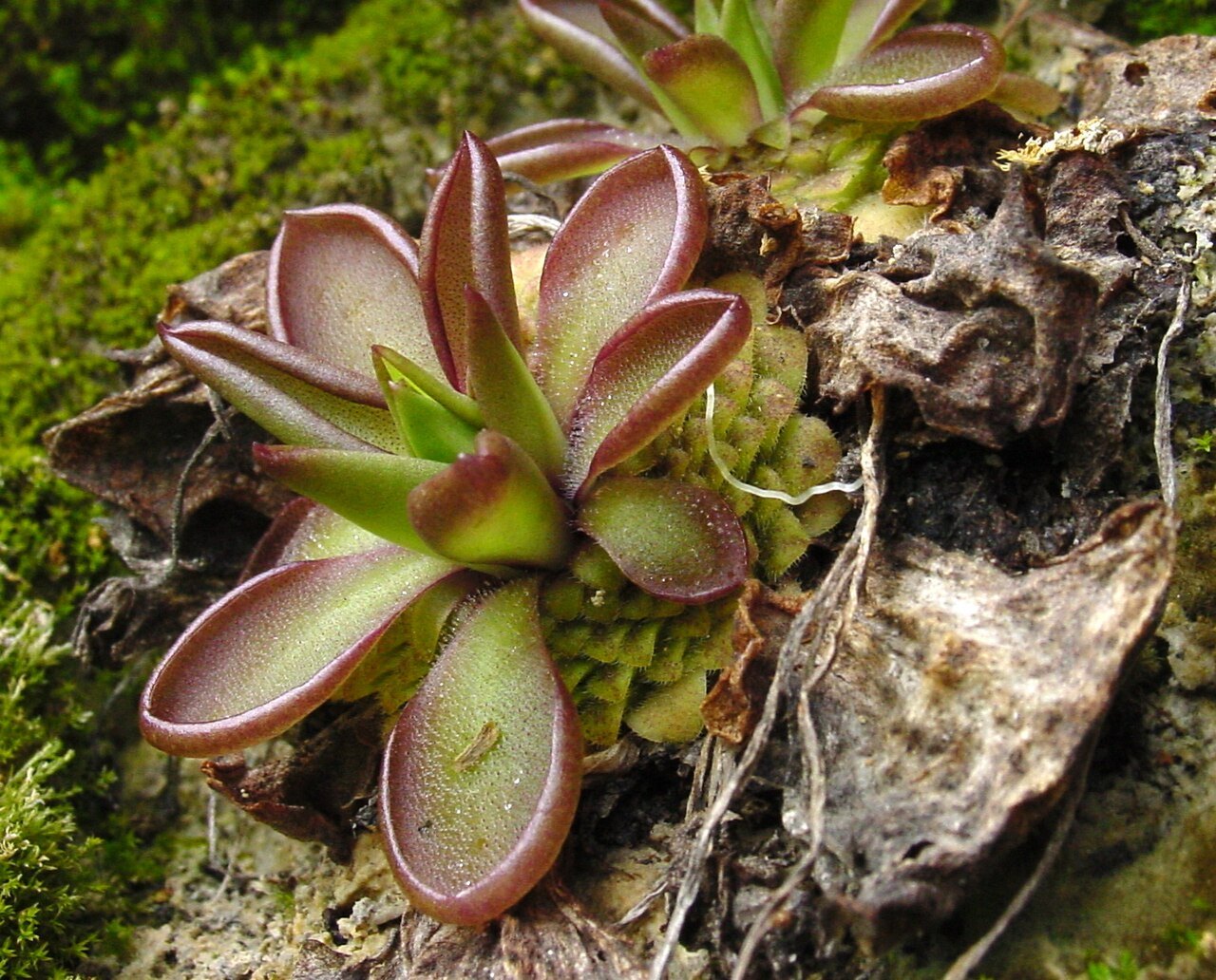
Featured image based on a photo of Pinguicula esseriana in the Botanical Garden of the Jagiellonian University, Kraków, by Agnieszka Kwiecień (Nova) via Wikimedia Commons, CC BY-SA 4.0, cropped with a dark gradient and typography added by FloraOddity; the adapted image is offered under the same licence.
Final articles are editorially reviewed and factual claims are checked against cited sources. Last reviewed: October 2026.
One Comment