
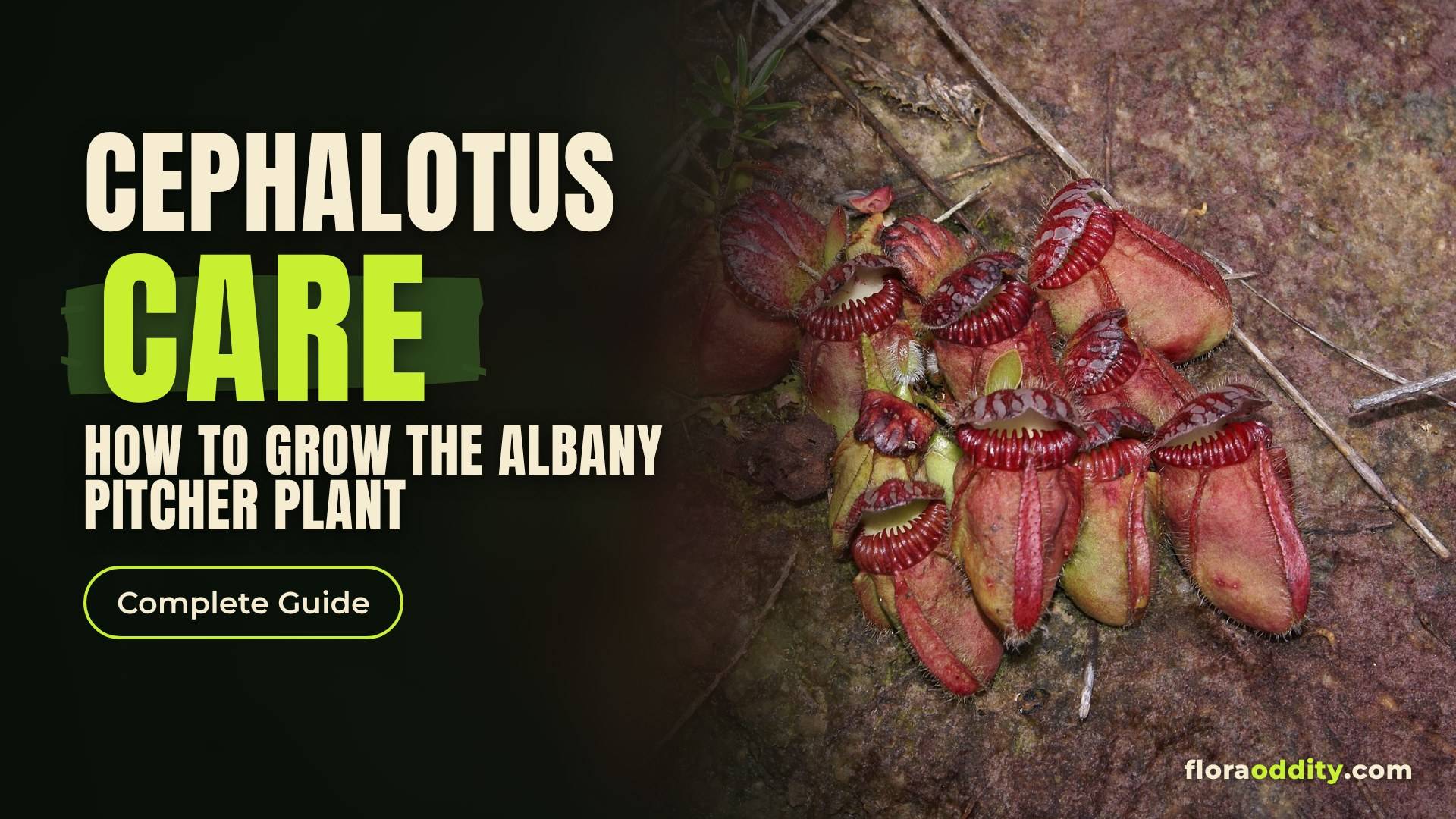
The Albany pitcher plant is small enough to sit on a saucer, yet its pitchers look as elaborate as any tropical Nepenthes. Barry Rice, author of the Carnivorous Plant FAQ, says a pot of them looks so bizarre “you expect their lids to start flapping at you any second.” Cephalotus follicularis is the only species in its genus, and the Western Australian Herbarium’s Florabase notes that it is also the only species in its family.
Good Cephalotus care is about balance: bright light, pure water, a tall pot, and soil that stays damp without going stagnant. It is not a beginner’s plant. Sarracenia Northwest suggests that newcomers start with a Nepenthes or a tropical sundew first, and Rice admits that Cephalotus cultivation “is irritating.” Yet the International Carnivorous Plant Society (ICPS) concludes that once you work out how to grow it in your conditions, “it is a very low maintenance plant.”
The Short Answer
Give Cephalotus about 4 or more hours of direct sun, as Sarracenia Northwest recommends, or bright lights. Use rain, distilled or reverse osmosis water and a tall, well-drained pot of a sandy or airy mix. Keep the soil moist but never stagnant: a shallow tray no more than a quarter of the way up the pot, or top watering with good drainage. Warm days are fine if nights are cool. In winter it slows down and makes flat leaves; let it rest somewhere cooler, away from heaters. Feed sparingly through the pitchers.
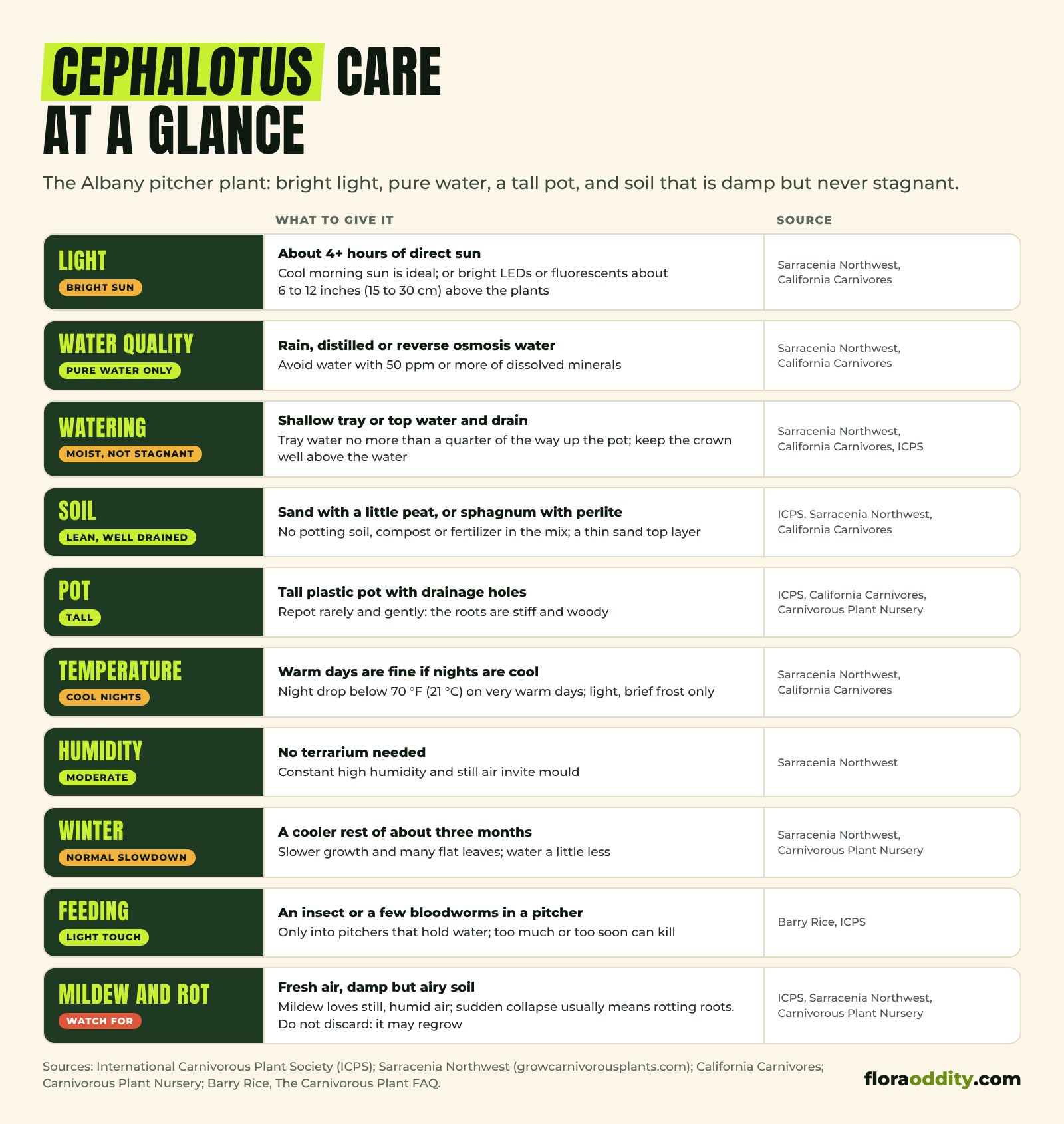
| Need | What to give it | Source |
|---|---|---|
| Light | About 4 or more hours of direct sun, ideally cool morning sun, or bright LED or fluorescent lights about 6 to 12 inches (15 to 30 cm) above the plants | Sarracenia Northwest, California Carnivores |
| Water quality | Rain, distilled or reverse osmosis water; Sarracenia Northwest warns against water of 50 ppm dissolved minerals or more | Sarracenia Northwest, California Carnivores |
| Watering | Moist, never stagnant; tray water no more than a quarter of the way up the pot, or top water and drain | Sarracenia Northwest, California Carnivores, ICPS |
| Soil | Well drained and nutrient free: sand with a little peat, or sphagnum with perlite | ICPS, Sarracenia Northwest, California Carnivores |
| Pot | Tall plastic pot with drainage holes; disturb the roots as little as possible | ICPS, Sarracenia Northwest, Carnivorous Plant Nursery |
| Temperature | Warm days with cool nights; light, brief frost only | Sarracenia Northwest, California Carnivores |
| Humidity | Moderate; constant high humidity and still air invite mildew | Sarracenia Northwest |
| Winter | A cooler rest of about three months with slower growth and flat leaves | Sarracenia Northwest, Carnivorous Plant Nursery |
| Feeding | Occasional insects, bloodworms or a fertilizer pellet in a pitcher that holds water | Barry Rice, ICPS |
| Propagation | Crown divisions, stem or leaf cuttings; seed is slow | ICPS, Barry Rice |
What Is the Albany Pitcher Plant?
Florabase describes Cephalotus as an insectivorous perennial herb up to about 8 inches (0.2 m) high, found on peaty soils around swamps and along streams in Western Australia’s far southwest. Rice puts its range “from Augusta to Cape Riche,” around the town of Albany. Carnivorous Plant Nursery describes a Mediterranean climate with mean temperatures of 68 °F (20 °C) in summer and 53 °F (12 °C) in winter, and most rain in winter.
The ICPS stresses one habitat detail above all: some authors call the sites bogs, others fens, but “in cultivation Cephalotus definitely needs to be treated as a fen plant.” In a fen, water moves through the soil instead of sitting still. Cephalotus “do not like stagnant conditions.”
Fire matters too. Richard Nunn, writing in Carnivorous Plant Newsletter after visiting about 20 sites, found that plants flourish for a few years after a bushfire, then get crowded out by regrowing shrubs and survive in a semi-dormant state, making only flat leaves, “for up to 10 years or more until the next fire.” Rice suspects this fire cycle may be linked to the dormancy that frustrates growers.
How the Pitchers Trap Prey
Rice explains that each rosette has two kinds of leaves: flat, tongue-like foliage leaves and pitchers of similar size. The pitchers are passive pitfall traps. Winged ridges may lead insects up to the toothed rim, the peristome. Inside, downward-pointing projections and an overhanging collar stop prey from climbing out, while the windowed lid lets in light and keeps rain from overfilling the trap. A gland patch near the bottom secretes digestive enzymes. The lid never snaps shut; Rice notes there is “no opening or closing activity associated with trapping.”
What do they catch? The ICPS says that in the wild Cephalotus “specializes in eating ants,” while Rice notes that field researchers report a wider variety of prey. Robert Gibson, writing in Carnivorous Plant Newsletter, opened a pitcher near Albany and found an isopod, small flies, and remains of insects that probably included beetles and ants.
California Carnivores says pitchers reach about 3 inches (7.5 cm) at most; Rice says the largest clumps are about 24 inches (60 cm) across.
How Cephalotus Differs from Sarracenia and Nepenthes
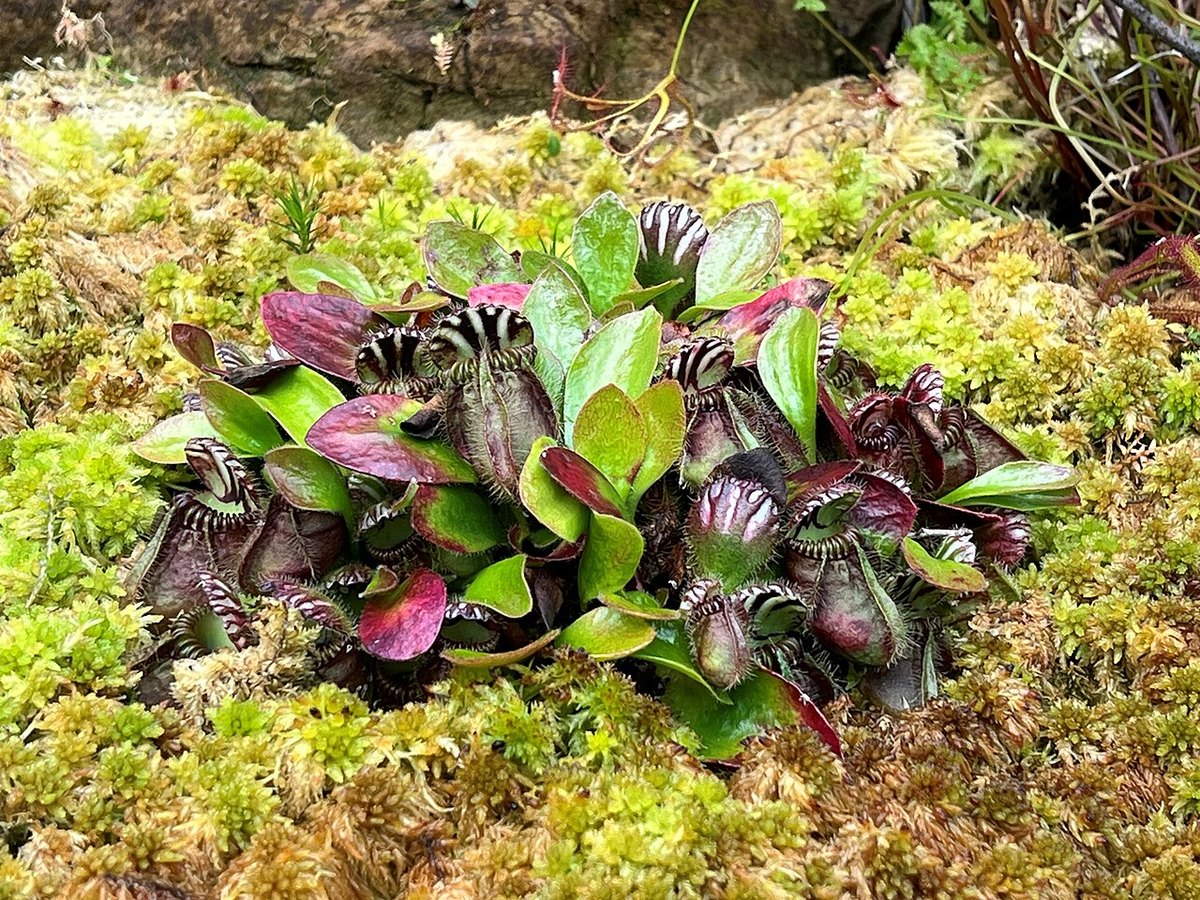
Cephalotus looks like a tiny cousin of the other pitcher plants, but the ICPS explains that DNA places it in the order Oxalidales, with Oxalis, “not related to any other carnivorous plant.” Its pitcher is built differently too: not a folded simple leaf as in Sarracenia and Nepenthes, but a severely modified, Oxalis-like peltate leaf. The three genera arrived at the pitfall trap separately.
That matters for care:
- Sarracenia are North American bog and fen plants. The ICPS keeps their pots always sitting in about 1.5 to 2.5 inches (4 to 6 cm) of water, never dry, with a cool to cold winter. Cephalotus wants a far shallower tray, or none, and the ICPS wants plant parts kept well above the water. See our Sarracenia care guide and its dormancy section.
- Nepenthes are tropical, ranging, the ICPS says, from Madagascar and India to northern Australia, New Caledonia and the Philippines. Sarracenia Northwest says Cephalotus water preferences are “similar to those of Nepenthes and Heliamphora”: moist, not waterlogged. Unlike a tropical plant, though, it benefits from cool nights and a cooler winter. Our guides to Nepenthes humidity indoors and Nepenthes light cover the tropical side.
Sarracenia Northwest sums up the result: Cephalotus straddles “the blurry line between tropical and cold-hardy.”
Light
Light drives both growth and colour. The ICPS says Cephalotus “grows best and are the most colorful with a lot of light,” and names south-facing windowsills as best, with east and west sometimes working. Sarracenia Northwest recommends about 4 or more hours of direct sun and bright filtered light for the rest of the day, and says pitchers darken from green to deep purple in very bright sun.
Under lights, the nurseries keep the lamps close, about 6 to 12 inches (15 to 30 cm) above these low plants depending on light strength. Sarracenia Northwest runs lights 14 hours a day in spring and summer and 12 in fall and winter; the ICPS notes that plants under a constant light period will not bloom. Our Cephalotus light guide covers distances, hours and pitcher colour in detail.
Water and the Tray Method
Use pure water. Sarracenia Northwest says Cephalotus is “very sensitive to water with dissolved mineral levels of 50 ppm or more,” and California Carnivores waters with distilled, reverse osmosis or rainwater only. If you are unsure about your tap or filtered water, run it through our water checker. For every watering method compared, see how to water Cephalotus.
The ICPS says you can use a tray, top watering, or both, as long as the soil mix suits the method:
A shallow tray. California Carnivores uses trays but fills them no more than a quarter of the way up the pot and lets the water evaporate before adding more, because Cephalotus “dislike long periods of being waterlogged.” Sarracenia Northwest gives the same quarter-height limit and warns that if the crown sits closer than about 4 inches (10 cm) to the water table for too long, the roots may rot.
Top watering. Sarracenia Northwest says you can treat Cephalotus like your other houseplants: water from the top, let it drain into a saucer, and never let the soil dry out. In a reader reply it added: avoid wetting the plant itself.
California Carnivores warns that undrained containers “will rot their roots.”
Soil and Pots
To work out how much of each ingredient your pots need, try our soil mix calculator.
The ICPS is frank: “there is no real consensus about what the ideal soil mixture should be.” Its own low-effort method is about 20% peat or chopped long-fibred sphagnum to 80% sand, with the pots always sitting in about 0.4 inch (1 cm) of water and flushed now and then to remove salts. It warns that a 50:50 peat and sand mix degrades and collects salts over time. Sarracenia Northwest prefers equal parts sphagnum moss and perlite, and California Carnivores uses two parts sand to one part peat. All agree on one thing: no ordinary potting soil, compost or fertilizer in the mix, which Sarracenia Northwest says “will kill your plant.” Our Cephalotus soil mix guide compares the recipes, pots and repotting steps in detail.
A thin top layer of sand helps. The ICPS uses about 0.4 inch (1 cm) of pure sand to keep moss from blocking air to the roots, and Carnivorous Plant Nursery uses a sand top dressing to keep the crown dry.
Do Cephalotus need deep pots? Yes, by most accounts. The ICPS says they are “best grown in tall pots” and shows plants in pots 4 to 5 inches (9.5 to 12 cm) tall. Carnivorous Plant Nursery uses a deep 4 to 6 inch (10 to 15 cm) pot, and California Carnivores says they “prefer tall pots.”
Repot rarely and gently. California Carnivores warns that the roots are stiff and woody, and suggests repotting every 3 to 5 years. Sarracenia Northwest changes the soil every other year, in late winter or early spring.
Temperature and Humidity
Heat, especially warm nights, is the danger. Sarracenia Northwest once thought Cephalotus could not take more than 90 °F (32 °C), but found instead that a night drop below 70 °F (21 °C) “is essential if day temperatures are very warm.” Its plants see summer days up to 100 °F (38 °C), but nights usually in the 50s °F (10 to 15 °C). California Carnivores warns that plants “may die in prolonged periods of very hot weather” but enjoy cool summer nights.
Cold is less of a problem. California Carnivores says they tolerate brief light frost down to 20 °F (minus 7 °C), and Sarracenia Northwest calls Cephalotus “technically a warm-temperate plant” for USDA zones 9 and 10.
Humidity is moderate. Carnivorous Plant Nursery lists “medium” humidity, Sarracenia Northwest says a terrarium is not required, and in a reply about mould it warned that constant high humidity “is not at all necessary but can encourage lots of mold issues.” Carnivorous Plant Nursery keeps terrariums vented.
Winter Rest and Dormancy
To check whether your setup gives a natural winter rest, try our dormancy checker, and read our full Cephalotus dormancy guide for a step-by-step winter plan.
Indoors, Cephalotus slows down rather than stopping. Sarracenia Northwest describes about three months of cooler days, 55 to 70 °F (13 to 21 °C), and shorter daylight, when growth slows dramatically and the plant makes “an abundance of flat, non-carnivorous leaves.” It calls this rest “an essential part of this plant’s care,” and suggests that years without a rest might explain why some old plants suddenly die. On a windowsill, shorter days provide the rest naturally; keep the plant away from heaters.
In winter, Carnivorous Plant Nursery reduces watering and lets the tray go dry between waterings, while keeping the soil evenly moist and only slightly cooler. In an unheated cold frame or greenhouse, Sarracenia Northwest says the plant stops growing altogether and can tolerate brief light frost; it heats to a minimum of 35 °F (2 °C) when days fall below freezing.
Not every source sees a rest as necessary. California Carnivores says Cephalotus have “no winter dormancy but may grow slowly in the winter.”
Feeding
For a quick plan, try our carnivorous plant feeding guide: pick your plant and see what to feed, how often and what never to give.
Cephalotus needs little food. Rice drops “a pinch of bloodworms or a few ants now and then” into the pitchers. The ICPS suggests dried bloodworms or a fertilizer pellet placed in a pitcher that holds water.
Soil fertilizer is where advice splits. The ICPS says very dilute, urea-free orchid fertilizer works if the pot is flushed regularly, but warns that it can make plants dark green with “a higher percentage of non-carnivorous leaves.” Sarracenia Northwest says never to use fertilizer at all. Either way, feed sparingly: the ICPS warns that plants have been killed by being fed “too much or too soon.”
Flowers
Florabase describes a flower stem up to about 24 inches (60 cm) tall carrying very small white flowers, which open in the Australian summer. The ICPS says plants under a natural light cycle start blooming in late spring, and each stalk may flower for about a month. Plants under a constant light period will not bloom, and after flowering the stems die back; new stems emerge at or below soil level.
Carnivorous Plant Nursery suggests removing the flower spike on a potted plant, because it draws energy and can weaken the plant badly, and notes that seed needs flowers from separate plants.
Propagation in Brief
Crown divisions and stem cuttings. The ICPS calls this “the easiest and quickest way to propagate Cephalotus,” giving new plants in less than 6 months. Cut growing points from the clump, plant them in nearly pure sand in short pots standing in a few millimetres of water, and cover them with a humidity dome.
Leaf cuttings. Rice prefers leaf cuttings: cut a pitcher or flat leaf as close to the rhizome as you dare, bury the cut end in moist sphagnum, and keep it warm and bright. The ICPS finds leaf pullings slower and less certain.
Seed. Seed is slow. The ICPS says seeds need about 59 °F (15 °C) for 6 to 10 weeks to germinate and that a refrigerator is too cold, and it can take years to raise plants with good-sized pitchers from seed. For step-by-step methods and timings, see our guide on how to propagate Cephalotus.
Common Problems
For a symptom-by-symptom guide with a chart, see why is my Cephalotus dying.
Sudden collapse and root rot
Carnivorous Plant Nursery calls it “sudden death syndrome,” usually caused by unseen root rot from soil that is too damp and poorly aerated, or by long spells of heat. Do not throw the pot away. The nursery says Cephalotus often regrows from the rhizome, which may take several months, and Rice advises holding off on water a little and waiting. If a plant collapses, the ICPS says to unpot it, save healthy stems as cuttings, cut away black or rotting parts, and repot with everything at least 2 inches (5 cm) above any water level.
Powdery mildew and fuzzy mould
The ICPS says Cephalotus is “highly susceptible to mildew,” and that “whole collections have been lost from fungus attacks.” Sarracenia Northwest says stagnant air and high humidity seem to promote it. Its advice: plenty of air movement, moderate humidity, and water on the soil, not the leaves. It says sulfur-based fungicides work best as prevention.
Flat leaves instead of pitchers
In winter this is normal. Otherwise, the ICPS links soil fertilizer to more non-carnivorous leaves and notes that plants in deep shade may make only flat leaves, and Carnivorous Plant Nursery says the largest traps come after the winter rest.
Closed lids and dry pitchers
The ICPS says a healthy, well-adjusted Cephalotus “will keep the pitcher lids open and maintain water in the pitchers.” If not, review watering and soil, or try our symptom checker.
What Growers Report
These are single growers’ results in their own conditions, not rules.
- A grower whose terrarium plant “was inclined to mildew on the new pitchers” moved it to a greenhouse with modest humidity, brighter light and nights in the 50s °F. In winter, “pitcher formation gradually slowed, then ceased by January,” with new flat leaves in March and flowers soon after. (Whimgrinder, TerraForums, June 2012)
- A balcony grower in Istanbul kept Cephalotus in a topless fish tank in a 45% long-fibred sphagnum and 45% perlite mix, with winter temperatures of about 32 to 50 °F (0 to 10 °C) and watering once every 2 to 3 weeks in winter, and called it “my most trouble-free CP” after nine months. (maxima, TerraForums, February 2011)
- One grower raised more than twenty plants on a capillary mat in a tank under fluorescent lights, with summer days of about 95 °F (35 °C) and winters about 25 °F (14 °C) cooler. The mat meant the plants could be left “for two to three months between watering.” (Dick Tran, Carnivorous Plant Newsletter, 2001)
- A nursery in Ho Chi Minh City grows divisions in pure coarse perlite in 8-inch (20 cm) deep planter boxes with a drained water well at the bottom, in a cooled greenhouse with 59 °F (15 °C) nights. The authors say the method goes against accepted practice and offer it as an experiment, “not suggesting this as a foolproof method.” (Richard Nunn and Chiem Nguyen Anh Vu, Carnivorous Plant Newsletter, June 2021)
Our takeaway: the methods differ widely, but each grower matched the watering to the soil mix and the setup, which is exactly what the ICPS advises.
Where Sources Differ
Rice’s FAQ lists several soil mixes and notes that experts have recommended each one “as the mix to use.” Each row gives only the context the sources themselves state.
| Topic | One view | Another view | Context the sources give |
|---|---|---|---|
| Winter dormancy | Sarracenia Northwest: a winter rest of about three months is “essential”; Carnivorous Plant Nursery: “Dormancy: yes” | California Carnivores: “no winter dormancy but may grow slowly in the winter” | Sarracenia Northwest says plants on a windowsill keep growing slowly, while plants in a cold frame stop growing altogether |
| Standing water | ICPS: pots always sitting in about 0.4 inch (1 cm) of water | California Carnivores and Carnivorous Plant Nursery: let the tray dry between waterings | The ICPS ties its method to an 80% sand mix and tall pots, and says the mix must suit the watering method |
| Soil mix | ICPS: about 20% peat to 80% sand | Sarracenia Northwest: equal parts sphagnum and perlite; California Carnivores: 2 sand to 1 peat | The ICPS: “Do not blindly follow someone else’s soil mix advice, including the advice here” |
| Fertilizer | ICPS: dilute, urea-free orchid fertilizer or pellets, with flushing | Sarracenia Northwest: never use fertilizer | The ICPS says soil feeding can increase non-carnivorous leaves |
| Propagation | Rice: leaf cuttings are best | ICPS: crown divisions and stem cuttings are easiest and quickest | The ICPS finds leaf pullings slower; Carnivorous Plant Nursery expects few successes |
| Seed | Rice: seeds “germinate readily with no special treatment” | ICPS: about 59 °F (15 °C) for 6 to 10 weeks; a refrigerator is too cold | The ICPS page describes its own germination method and lists a 2019 study of Cephalotus seed germination |
| Flower stalks | Carnivorous Plant Nursery: remove the spike on potted plants | ICPS: hand-pollinate for seed | The nursery warns that a spike can weaken a potted plant |
Common Mistakes
- Growing it like a Sarracenia. Deep, permanent tray water around the crown invites root rot.
- Hot nights. Very warm days are tolerated only when nights are cool.
- Using tap water or ordinary potting soil.
- Repotting often. The stiff, woody roots dislike disturbance.
- Throwing out a “dead” plant. It may regrow from the rhizome after several months.
FAQ: Cephalotus Care
Is Cephalotus hard to grow?
Sarracenia Northwest finds it trickier than a Nepenthes, but the ICPS says it becomes very low maintenance once you find what works in your conditions.
Does Cephalotus need dormancy?
It benefits from a cooler, shorter-day winter rest, which Sarracenia Northwest calls essential. It does not need a freezing dormancy like a Sarracenia; light, brief frost is the limit.
Should Cephalotus sit in water?
Only shallowly: no more than a quarter of the way up the pot, say Sarracenia Northwest and California Carnivores. Top watering with good drainage works too.
Why is my Cephalotus making flat leaves instead of pitchers?
In winter, that is the normal rest. In the growing season, too little light, deep shade or soil fertilizer can all favour flat leaves, according to the ICPS.
The Bottom Line
Cephalotus care comes down to a fen in a pot: bright light, pure water, a tall, well-drained pot, soil that stays damp without going stagnant, warm days with cool nights, and a cooler winter rest. Feed lightly through the pitchers, keep the air moving, leave the roots alone, and be patient with a plant that sulks. It is not the easiest pitcher plant, but the ICPS calls the end result “well worth the trouble.”
Sources & Further Reading
- International Carnivorous Plant Society: Growing Cephalotus follicularis
- International Carnivorous Plant Society: Evolution of the Oxalidales Carnivore
- International Carnivorous Plant Society: Growing Sarracenia
- International Carnivorous Plant Society: Growing Nepenthes
- Barry Rice, The Carnivorous Plant FAQ: Cephalotus, the Albany pitcher plant
- Barry Rice, The Carnivorous Plant FAQ: Cephalotus cultivation
- Barry Rice, The Carnivorous Plant FAQ: Cephalotus range and conservation status
- Sarracenia Northwest: How to Grow Cephalotus
- Sarracenia Northwest: Q/A #56, Fuzzy Mold on Cephalotus
- California Carnivores: Australian Pitcher Plants (Cephalotus follicularis) Growing Tips
- Carnivorous Plant Nursery: Growing Tips for Cephalotus
- Western Australian Herbarium, Florabase: Cephalotus follicularis
- Western Australian Herbarium, Florabase: In Focus, Plant of the Month
- Richard Nunn: New insights into the growth cycle of Cephalotus follicularis, Carnivorous Plant Newsletter 43(3), 2014
- Robert Gibson: Observations on Cephalotus in the wild, Carnivorous Plant Newsletter 28(1), 1999
- Dick Tran: Cephalotus follicularis, cultivation with capillary mats, Carnivorous Plant Newsletter, 2001
- Richard Nunn and Chiem Nguyen Anh Vu: A new technique for the cultivation of Cephalotus follicularis, Carnivorous Plant Newsletter 50(2), 2021
Featured image based on a photo of Cephalotus follicularis in the wild by Holger Hennern via Wikimedia Commons, CC BY-SA 3.0, with a dark gradient and typography added by FloraOddity; the adapted image is offered under the same licence.
Final articles are editorially reviewed and factual claims are checked against cited sources. Last reviewed: October 2026.

5 Comments