
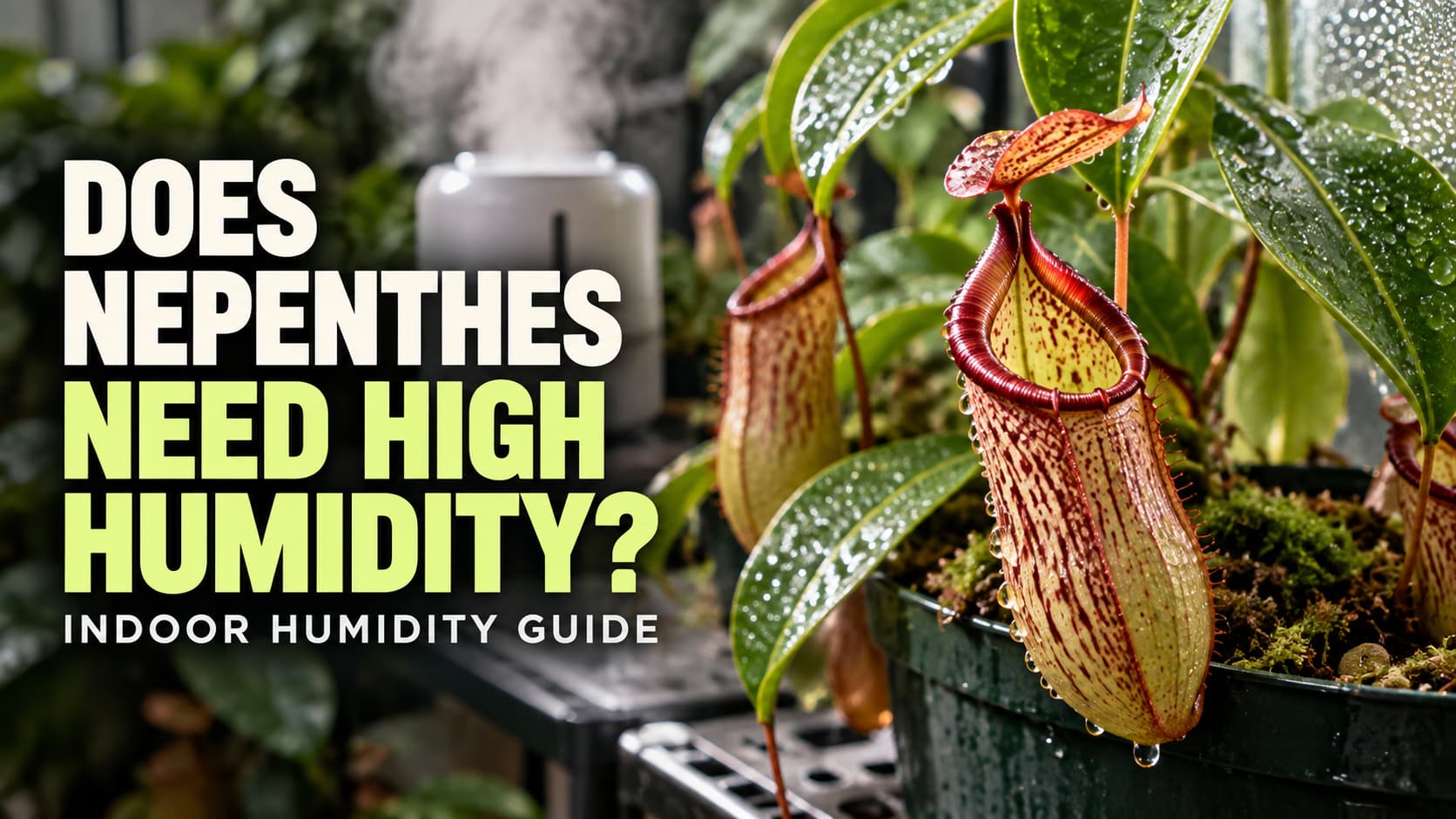
Does a Nepenthes need high humidity to make pitchers? This is one of the most common questions in indoor Nepenthes care, and the answer is more nuanced than “keep it above 60%” or “buy a humidifier.”
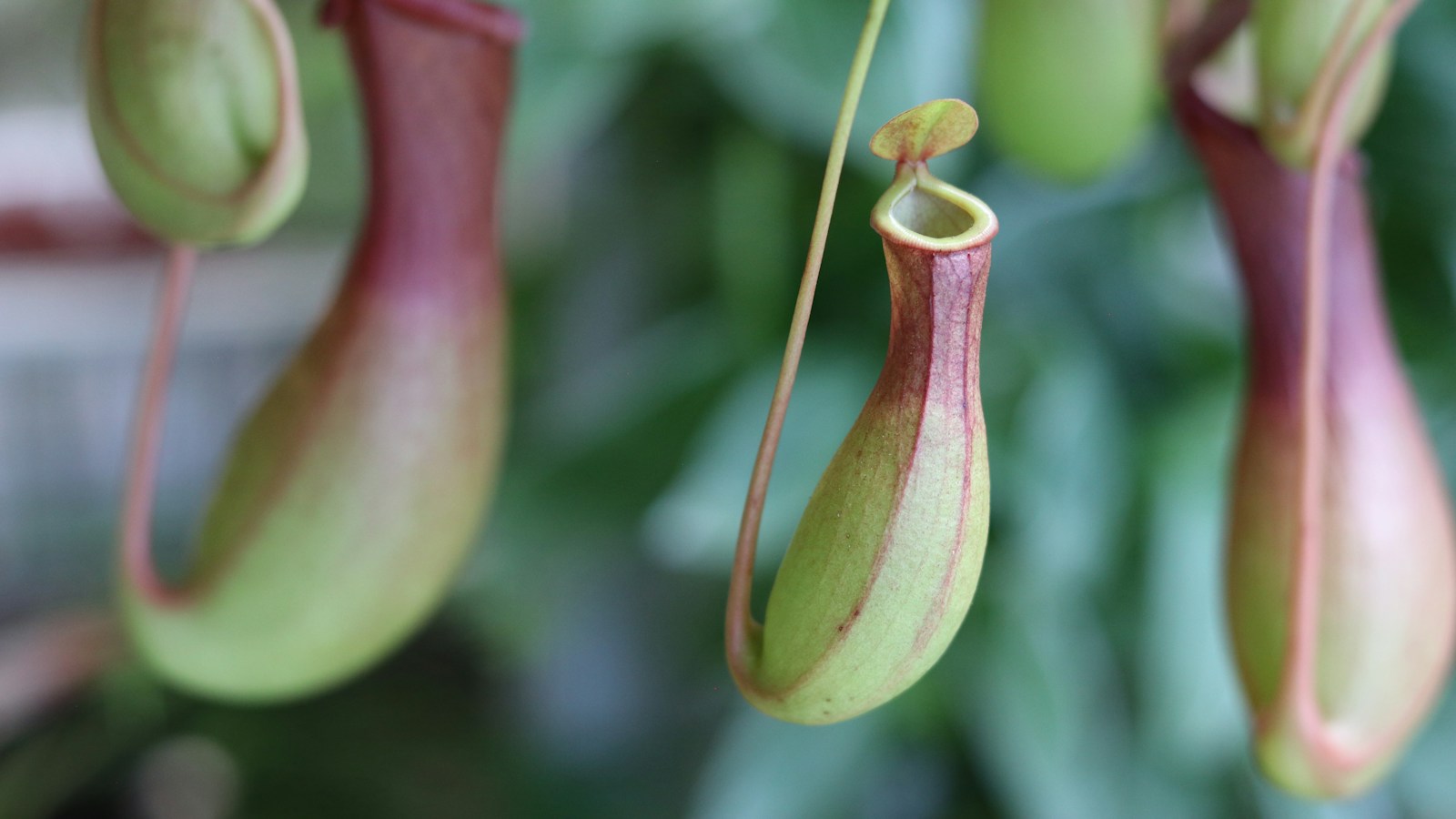
Nepenthes are tropical pitcher plants, so humidity is certainly part of their natural environment. But the humidity level your plant can actually live with indoors depends on the species or hybrid, how quickly it acclimates, the temperature, the available light, watering, airflow, and the condition of the root system.
For many commonly grown Nepenthes, stable growing conditions matter more than chasing a perfect humidity number. Clemson Extension recommends humidity above 60% for indoor tropical pitcher plants, while specialist growers at Sarracenia Northwest report that many commonly available Nepenthes can acclimate to normal household humidity and do not require a terrarium or humidity dome to produce pitchers.
How Much Humidity Does a Nepenthes Need?
There is no single humidity percentage that applies equally to every Nepenthes.
For indoor care, a useful way to think about humidity is as a range and an environmental factor, not a pass-or-fail target. Clemson Extension currently recommends keeping tropical pitcher plants above 60% relative humidity. NC State Extension also describes Nepenthes as requiring warm temperatures and high humidity.
At the same time, specialist growers have documented a different practical experience with common cultivated plants. Sarracenia Northwest says many commonly available Nepenthes can adapt to normal household fluctuations and can continue growing and producing pitchers without artificially high humidity. Their guidance also notes that higher humidity may produce somewhat larger pitchers without necessarily causing the plant to produce more pitchers.
Those recommendations can sound contradictory until you separate two questions:
- Can Nepenthes grow in humid conditions? Yes. They come from tropical habitats, and many cultivation environments are quite humid.
- Must every indoor Nepenthes be kept at very high humidity all day? Not necessarily. Many commonly cultivated plants can acclimate to normal household conditions when light, temperature, watering, and roots are also appropriate.
That distinction is important because a humidity target that works in a greenhouse is not automatically a requirement for a plant sitting on a bright windowsill.
Why Humidity Matters to Nepenthes
Humidity affects how quickly a plant loses water to the air through transpiration. Relative humidity also changes with temperature, which means the same amount of water vapor can correspond to a different relative humidity reading as the room warms or cools. Our Nepenthes temperature guide covers the temperature side of that relationship.
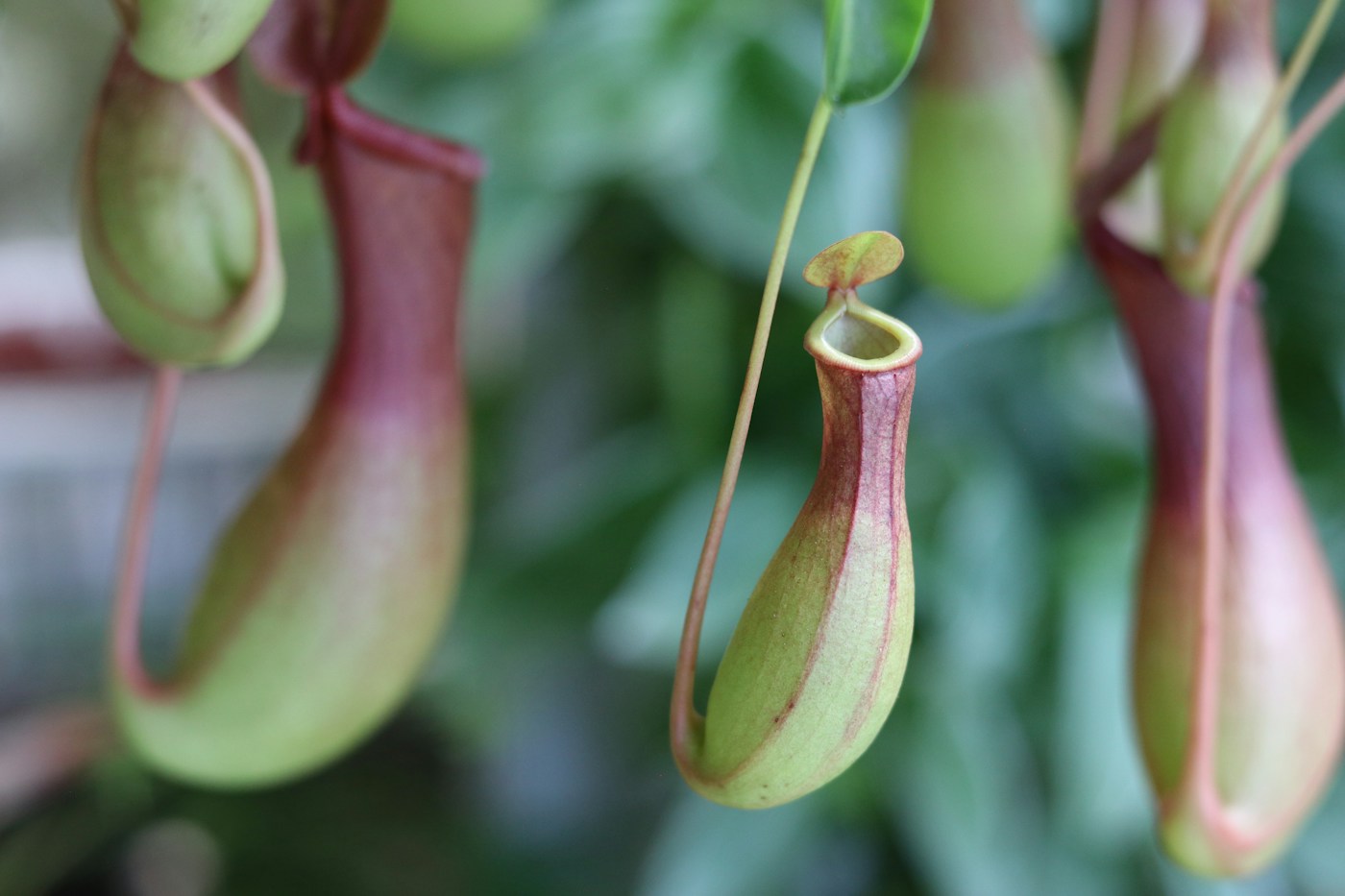
Nepenthes are adapted to moist tropical environments, and humidity can influence pitcher development and the physical condition of the plant. Scientific work on Nepenthes has also shown that air humidity is relevant to the wetness of the pitcher rim, or peristome, which plays a role in trapping prey. In natural conditions, condensation and changes in nighttime humidity can help keep this surface wet.
But that does not mean higher humidity is a magic switch for pitcher production. A plant still needs sufficient light and suitable temperatures. In a recent specialist troubleshooting guide, Sarracenia Northwest specifically puts light and temperature ahead of constant high humidity when diagnosing pitcher production problems in commonly grown Nepenthes.
Can a Nepenthes Grow at 40% Humidity?
Some commonly cultivated Nepenthes can.
Sarracenia Northwest reports that many common Nepenthes can acclimate to periods of relative humidity around 30 to 40% while continuing to grow and produce pitchers. That is an experience-based horticultural claim rather than a universal tolerance threshold for every species.
This is where species and hybrid background matter. A readily available hybrid that has been grown for generations in ordinary nursery or household conditions may respond very differently from a specialized highland species collected from a consistently cool, humid environment.
So if your room occasionally drops into the 40s, don’t automatically conclude that the plant is doomed. Look at what happens to the plant over time. Is it still producing healthy leaves? Are new tendrils developing? Are pitchers forming but remaining smaller? Is growth declining only after a major environmental change?
The plant’s response is more informative than a single number on a hygrometer.
Does Higher Humidity Make Nepenthes Produce More Pitchers?
Not necessarily.
This is one of the most important corrections to make when troubleshooting a pitcherless Nepenthes. Higher humidity may support larger pitchers under otherwise suitable conditions, but it should not be treated as a guaranteed trigger for pitcher production.
If your plant is growing leaves but not pitchers, start with the broader environmental sequence. Light is a major factor, and temperature can matter depending on the type of Nepenthes you grow. Water quality, root health, recent shipping or repotting, and environmental stability can all influence the outcome as well.
FloraOddity’s first guide covers this diagnostic process in detail: Why Is My Nepenthes Not Producing Pitchers? 8 Causes and How to Fix It.
What Humidity Level Should You Aim for Indoors?
For a common indoor Nepenthes, a practical starting point is to avoid both extremes: don’t intentionally keep the air bone-dry around a tropical plant, but don’t turn the pot into a permanently enclosed swamp either.
| Indoor condition | What it can mean | What to check |
|---|---|---|
| Very dry air for long periods | Greater water loss and potentially more stress for some plants | Leaf condition, tendril development, watering, room temperature |
| Moderate household humidity | Many common Nepenthes can acclimate successfully | Light, temperature, roots, and overall growth |
| Humid but well-ventilated | Often a comfortable growing environment | Air movement and whether media is drying appropriately |
| Very humid and stagnant | Can slow drying and create conditions favorable to mold or fungal problems | Airflow, substrate moisture, condensation, plant spacing |
There is no virtue in a humidity meter reading 90% if the root zone stays saturated and air never moves. Likewise, 45% on a meter does not automatically prove that your Nepenthes is the reason for every pitcher problem.
Should You Use a Humidifier for Nepenthes?
A humidifier can be useful, especially in very dry rooms, but it should solve an actual environmental problem rather than be added by default.
Before buying one, measure the room for several days. Record daytime and nighttime humidity and note whether the plant is close to an air-conditioner, heater, open window, or fan. A room that averages 45 to 55% with stable temperatures may be a very different situation from a room that repeatedly drops into the 20s or 30s while hot dry air blows directly across the plant.
If a humidifier is needed, avoid positioning it so that a strong stream of mist continuously wets the foliage or pot. The goal is to change the surrounding air, not to soak the plant.
Also remember that adding humidity can change your watering rhythm. Higher ambient humidity usually means slower evaporation, so a pot that used to dry at a predictable rate may stay wet for longer after you install a humidifier.
That is why humidity should always be considered together with watering. Our guide How to Water a Nepenthes Indoors: Water Type, Frequency, and Drainage explains how to adapt your watering routine to the actual behavior of your pot and substrate.
Do Nepenthes Need a Humidity Dome?
Most commonly available Nepenthes do not need a humidity dome once they are established.
Sarracenia Northwest’s 2026 guidance specifically argues that a humidity dome is unnecessary for many common varieties. Their explanation is useful because an enclosed environment can create secondary problems: the potting mix may dry more slowly, airflow may decrease, and mold or fungal issues can become more likely.
A dome can still have a legitimate use. For example, a newly propagated cutting, a recently shipped plant, or a particularly sensitive specimen may benefit from carefully controlled acclimation. The point is not that domes are always bad. The point is that higher humidity is not automatically better simply because Nepenthes come from humid places.
When a dome may make sense
- You are deliberately acclimating a cutting or very young plant.
- You are growing a species with environmental requirements that genuinely call for controlled conditions.
- Your room is extremely dry and you have already ruled out simpler environmental fixes.
When using an enclosure, pay attention to airflow, condensation, temperature, and how long the substrate remains wet.
Why Stagnant Humidity Can Be a Problem
High humidity and good ventilation are not opposites. In fact, they often work best together.
A humid room with gentle air movement can feel very different to a plant from a sealed container full of condensation. Sarracenia Northwest reports that long-term enclosed conditions can contribute to overly wet media and mold or fungal problems. If you also notice insects, white fluff, or sticky leaves, our guide to Nepenthes pests explains what to look for.
This is also why the phrase “increase humidity” needs to be followed by a second question: increase it how?
Moving a plant closer to a humidifier is not the same as improving its whole microclimate. A small fan that gently circulates room air may be helpful, while a high-speed fan aimed directly at the foliage can create excessive water loss and dry out tender growth.
In most homes, you are trying to create a stable, breathable environment rather than an airtight greenhouse.
Humidity vs. Light: Which Should You Fix First?
When a Nepenthes is producing leaves but not pitchers, humidity often gets blamed first because it is easy to measure with a cheap hygrometer. Light can be harder to judge, especially when the plant is sitting several feet away from a window.
That makes light an easy variable to underestimate.
FloraOddity’s How Much Light Does a Nepenthes Need? Indoor Grow Light Guide explains why “bright room” is not the same thing as strong usable light at leaf level, and why a grow light’s distance and photoperiod matter.
The practical lesson is simple: don’t use humidity as a substitute for adequate light. A humid room cannot compensate for a plant spending most of the day in weak light.
How to Increase Humidity Without Creating New Problems
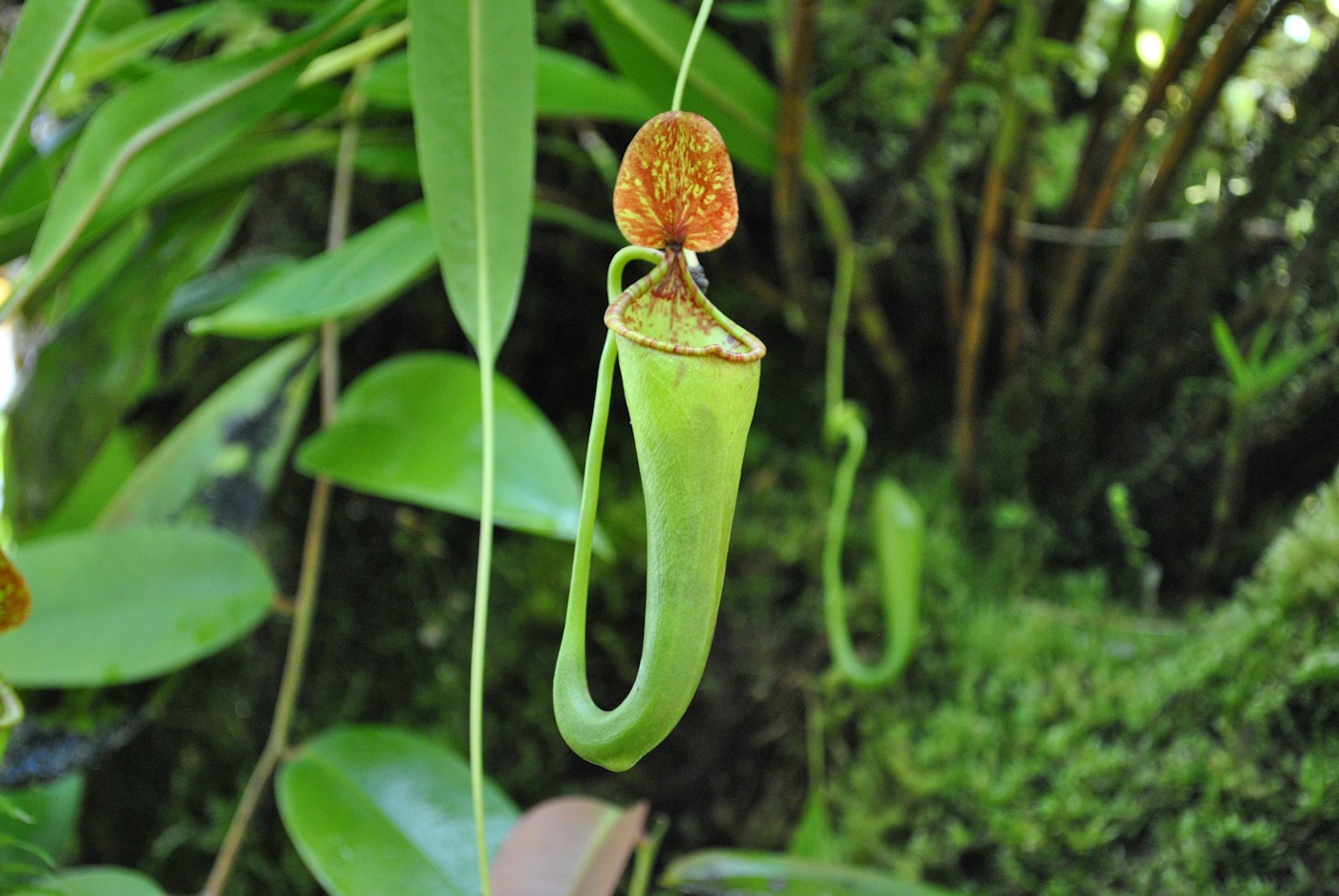
If your measurements and the plant’s response suggest that the air really is too dry, start with the least disruptive changes.
1. Move the plant away from direct hot or cold drafts
Air-conditioning vents, heaters, and other strong drafts can produce a microclimate that is much drier or more unstable than the room average.
2. Group compatible plants
Plants clustered together can create a somewhat more humid local environment through transpiration. This is a gentle change and does not require enclosing the entire collection.
3. Use a humidifier when the room is genuinely dry
A controlled humidifier can be useful in a consistently dry room. Use a hygrometer to observe the result rather than running the machine blindly.
4. Improve the plant’s overall environment
Humidity works best when light, temperature, watering, and airflow are also appropriate. Treat the growing environment as a system instead of trying to solve every problem with one device.
Signs Your Nepenthes May Actually Need More Humidity
Humidity becomes more suspicious when several observations point in the same direction.
- The room is consistently very dry, especially during hot or air-conditioned periods.
- New tendrils repeatedly dry before the pitcher can develop.
- The plant looks noticeably better during naturally humid periods.
- The rest of the environment is already suitable, but new pitcher development repeatedly stalls.
Even then, do not diagnose from one symptom alone. A dried tendril can have multiple causes, including heat, direct drafts, abrupt changes in light, root stress, or acclimation after shipping. If it is existing pitchers drying out rather than tendrils, see why Nepenthes pitchers turn brown or dry up.
Signs Humidity Is Probably Not Your Main Problem
If your Nepenthes is growing actively, making healthy leaves, and occasionally producing pitchers while the room has ordinary household humidity, there may be no reason to build a humidity chamber.
Likewise, if a plant stopped pitchering immediately after a move, repot, or major lighting change, the timeline may point toward acclimation or environmental stress rather than humidity alone.
This is why diagnosis should begin with the whole plant, not the hygrometer.
What Growers Report
Plenty of hobby growers keep Nepenthes outside a terrarium, in rooms far drier than the numbers usually recommended. Here is what four of them reported about moving plants into drier air and how long the plants took to adjust.
An N. rafflesiana that outgrew its terrarium and was moved to a windowsill with cool winters: “I took it out, and it wilted as you’re describing, because the leaves were used to very high humidity and had no protection against drying out. However, it recovered (slowly) and has acclimated to the windowsill, where it survives and even pitchers with temperatures occasionally below 60 in the winter and some pretty low dips in humidity.”
D muscipula, Terraforums, October 2005
A collection grown at household humidity that is usually below 20%: “I have about 99% of my Neps pitchering. The trick is acclimating them… I have had plants do horrible until I bagged them and re-did the entire acclimation process.”
Clue, Terraforums, March 2010
Several Nepenthes on windowsills, in a house with a furnace humidifier and winter humidity of 30 to 50%: “So I started to experiment with growing them as windowsill plants and have had great success with several neps this way. It seems that they take around 3 months to really settle and then start pitchering.”
elgecko, Terraforums, January 2007
Highland Nepenthes on a windowsill in the Netherlands, where the grower aims for at least 50% humidity and rarely gets above 70%: “Because my humidity is lower, I have difficulty getting my neps to pitcher. It takes them at least a year to acclimatize. After that they do actually pitcher in the lower humidity.”
Tropicat, Carnivorous Plants UK forum, June 2018
These are individual experiences, not rules, but they match the points covered above. Many cultivated Nepenthes can acclimate to ordinary household humidity, and in these reports most of the trouble came during acclimation: a plant moved straight out of an enclosure can struggle at first, and a carefully controlled enclosure is one legitimate use for a dome. The time each grower needed, from a few months to a year for highland plants, is a reminder that the type of Nepenthes matters, that the plant’s response over time tells you more than a single hygrometer reading, and that a sudden change in conditions can explain a pause in pitchering better than humidity alone.
How to Measure Humidity Properly
A hygrometer is useful, but where you place it matters.
A sensor sitting across the room tells you the room average. A sensor directly beside a humidifier tells you the humidifier’s local output. Neither necessarily represents the air experienced by the leaves.
Place the sensor near the plant without putting it directly in the mist stream. Check readings at different times of day for several days. Relative humidity naturally changes as temperature changes, so a morning value and an afternoon value can tell a very different story.
If your plant is near a window, AC vent, or heater, compare readings at the plant’s actual position before and after moving it.
A Simple Humidity Setup for an Indoor Nepenthes
For a common Nepenthes in a normal home, keep the setup boring.
- Use a hygrometer to learn the room’s actual humidity.
- Keep the plant away from harsh AC, heater, or fan drafts.
- Give it adequate light.
- Water with appropriate low-mineral water and let the pot drain well.
- Use a humidifier only when measurements show a genuinely dry environment.
- Maintain gentle air movement rather than sealing the plant in a stagnant container.
- Watch the plant over several weeks instead of judging every day.
The last step matters more than it sounds. Pitchers develop over time, and sudden changes can temporarily interrupt the process. Research on Nepenthes rafflesiana found multiple developmental stages and substantial variation in how long early pitcher-development phases can take.
FAQ: Nepenthes Humidity
What humidity is best for Nepenthes indoors?
There is no universal number for every Nepenthes. Clemson Extension currently recommends above 60% for tropical pitcher plants, while specialist growers report that many common Nepenthes can acclimate to normal household fluctuations.
Can Nepenthes live at 40% humidity?
Some common cultivated Nepenthes can acclimate to periods around this level, especially when light, temperature, watering, and roots are appropriate. That should not be treated as a universal tolerance level for every species.
Will a humidifier make my Nepenthes produce pitchers?
Not necessarily. Higher humidity may benefit some plants and can contribute to larger pitchers, but it is not a guaranteed trigger for pitcher production. Check light and temperature as well.
Does Nepenthes need a humidity dome?
Most commonly available Nepenthes do not need one once established. Enclosures can also reduce airflow and keep the potting mix wet for longer.
Can misting replace a humidifier?
No. Misting can temporarily wet surfaces but is not a reliable substitute for controlling room humidity or providing good root-zone watering. It is also not a substitute for adequate light.
Why is my Nepenthes growing leaves but not pitchers even though humidity is high?
High humidity does not rule out other problems. Check usable light, temperature, drafts, watering, roots, substrate, and recent environmental changes before assuming humidity is the missing piece. Start with the diagnostic sequence in our pitcherless Nepenthes guide.
The Bottom Line
Yes, Nepenthes appreciate humidity. No, that does not mean every indoor plant needs a sealed terrarium or a hygrometer reading of 80% all day.
For many common Nepenthes, the better goal is stable, reasonably humid air with good light, suitable temperatures, proper watering, and airflow. If the room is genuinely dry, increase humidity carefully. If the plant is already growing well at ordinary household humidity, there may be no reason to keep changing the setup.
In other words: don’t chase humidity. Build a healthy environment.
Sources & Further Reading
- Clemson Extension: Tropical Pitcher Plants (Nepenthes spp.)
- NC State Extension Gardener Plant Toolbox: Nepenthes
- Sarracenia Northwest: Do Nepenthes Need High Humidity? The Humidity Myth, Part 1
- Sarracenia Northwest: Do Nepenthes Need a Humidity Dome? The Humidity Myth, Part 2
- RHS: Carnivorous Plants
- Bohn & Federle (2004). Insect aquaplaning: Nepenthes pitcher plants capture prey with the peristome. PNAS
- Plants: Ontogeny and Anatomy of the Dimorphic Pitchers of Nepenthes rafflesiana
Final articles are editorially reviewed and factual claims are checked against cited sources.
10 Comments