
Ask five Cephalotus growers what to pot the Albany pitcher plant in and you will get five recipes. Barry Rice, author of The Carnivorous Plant FAQ, lists live sphagnum and five different mixes, from 4 parts perlite to 1 of sphagnum through to 2 parts peat to 1 of perlite, and notes that each one “has been told to me by experts as the mix to use.” The International Carnivorous Plant Society (ICPS) agrees that “there is no real consensus” on the ideal mixture.
That sounds hopeless, but it is not. The recipes fall into a handful of families, and each family suits a particular way of watering. Choose your Cephalotus soil by the watering you can keep up, then pick a tall pot, a top dressing and a gentle repotting routine to match. This guide goes much deeper than the short soil and pots section of our Cephalotus care guide, with recipes, ingredients, pots, repotting steps and aftercare.
The Short Answer
Match the mix to the watering. For a pot that always stands in a little water, the ICPS uses about 20% peat or chopped long-fibred sphagnum to 80% coarse sand. For top watering, Sarracenia Northwest uses equal parts sphagnum moss and perlite. For a shallow tray that you let dry out between fillings, California Carnivores uses 2 parts sand to 1 part peat. All-mineral mixes work too, but only with very frequent watering.
Use a tall plastic pot with drainage holes, about 4 to 6 inches (10 to 15 cm) deep, and keep the crown well above any standing water. A thin layer of pure sand on top keeps moss down and the crown dry. Repot rarely, ideally in late winter or early spring, and disturb the stiff, woody roots as little as you can. Never use ordinary potting soil, compost or fertilized mixes, which Sarracenia Northwest says “will kill your plant.”
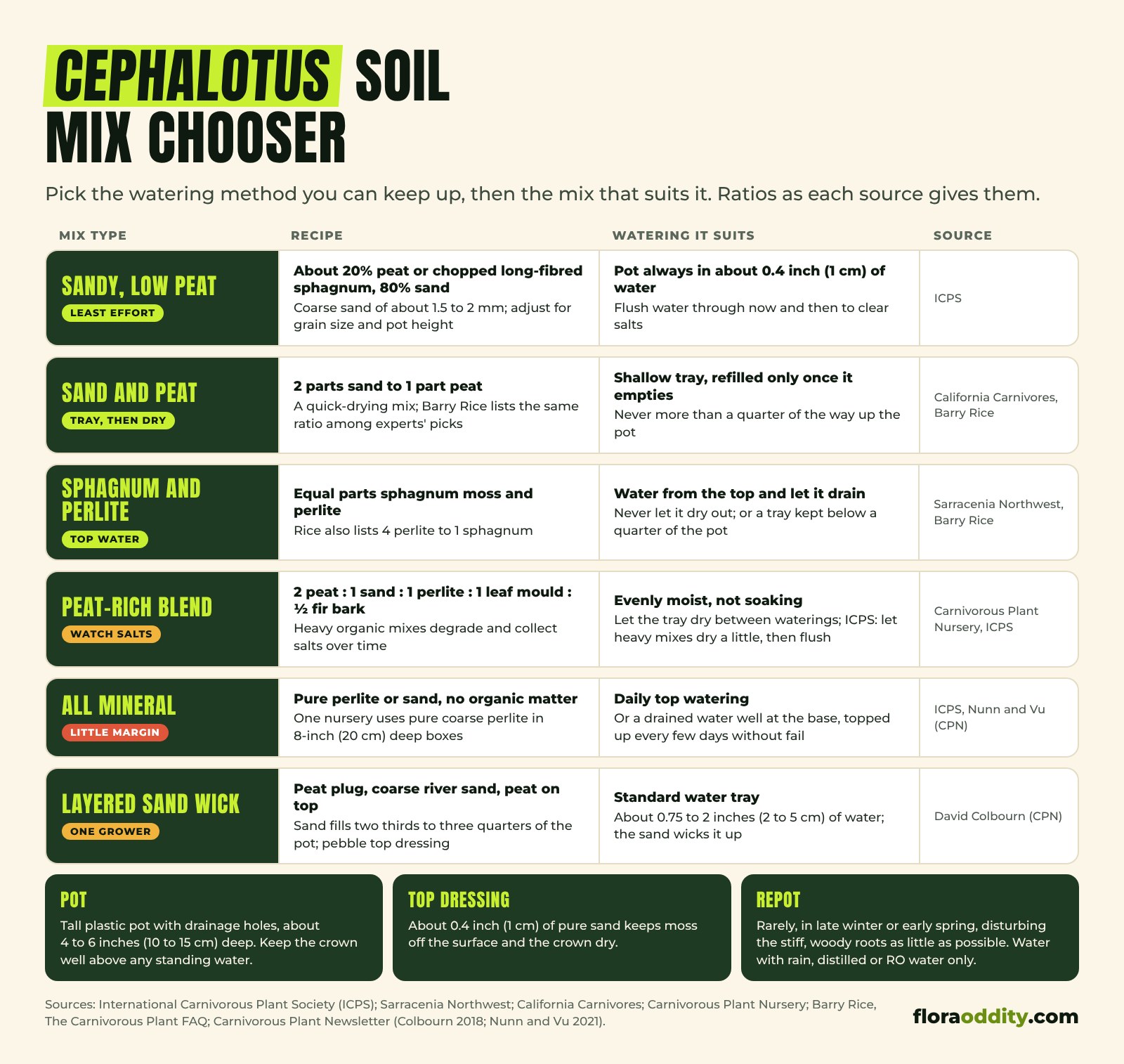
| Mix | Recipe (as the source gives it) | Watering it suits | Source |
|---|---|---|---|
| Sandy, low peat | About 20% peat or chopped long-fibred sphagnum to 80% sand; adjust for sand grain size, peat type and pot height | Pot always in about 0.4 inch (1 cm) of water, flushed now and then to clear salts | ICPS |
| Sand and peat | 2 parts sand to 1 part peat | Shallow tray no more than a quarter of the way up the pot, left to dry before refilling | California Carnivores; also on Barry Rice’s list |
| Sphagnum and perlite | Equal parts sphagnum moss and perlite; Rice also lists 4 perlite to 1 sphagnum | Top water and drain, never letting it dry out; or a tray below a quarter of the pot’s height | Sarracenia Northwest, Barry Rice |
| Peat-rich blend | 2 peat : 1 sand : 1 perlite : 1 leaf mould : ½ fir bark | Evenly moist, not soaking; tray left to dry between waterings | Carnivorous Plant Nursery |
| Other organic blends | 3 perlite : 2 peat : 1 sand : 1 orchid bark; 3 perlite : 2 peat; 2 peat : 1 perlite | Not stated; the ICPS says heavy organic mixes are allowed to dry a bit, then flushed | Barry Rice, ICPS |
| All mineral | Pure perlite, sand or similar, no organic matter | Daily top watering, or pure coarse perlite over a drained water well topped up every few days | ICPS; Nunn and Vu, Carnivorous Plant Newsletter |
| Layered sand wick | Peat plug over the holes, coarse river sand to two thirds or three quarters of the pot, peat on top, pebble dressing | A normal water tray, about 0.75 to 2 inches (2 to 5 cm) deep | David Colbourn, Carnivorous Plant Newsletter |
Why Cephalotus Soil Is So Debated
The wild plant explains a lot. David Colbourn, writing in Carnivorous Plant Newsletter, notes that Cephalotus grows in peat-based soils in swamps where there is “a constant flow of fresh water.” In those swamps it sits slightly above the water table, often at the base of Melaleuca plants, where built-up plant material lifts the soil above the surrounding swamp, and usually on the upstream side where fresh water seeps in. Carnivorous Plant Nursery adds that the moist native soil is a sand and peat mix, “often sandier than peaty.”
So the roots want moving water and air. Every recipe is a compromise between the two, and the ICPS frames the choice clearly. At one extreme are heavy organic mixes; growers who use them let the soil dry a little and then flush water through the pot. At the other extreme are pure mineral “non-mixes”; growers who use them top water every day. The ICPS warns that both extremes have “little margin for error.”
Even the classic 50:50 peat and sand “CP mix” is no easy answer: the ICPS says it may work better at first, but over time the peat breaks down and collects salts from the water.
The Main Mix Families and the Watering Each Suits
Sandy mixes for a pot that always stands in water
The ICPS recommends about 20% peat or chopped long-fibred sphagnum to 80% sand, with pots always sitting in about 0.4 inch (1 cm) of water. It calls this the method that “requires the least effort over time.” Plants can stay in it indefinitely, as long as water is flushed through now and then to remove salts.
The sand has to be the right sand. On its peat, sand and perlite page, the ICPS asks for sharp silica or quartz sand with grains of about 1.5 to 2 mm, recommending #14 sand blasting sand, with #12 and #16 acceptable. It warns against play sand, plaster sand, builders sand used straight, and pool filter sand, which is too fine: fine particles “will make the soil mix like concrete.” The ICPS adds that the ratio should change with the sand grain size, the type of peat or sphagnum, and the height of the pot.
Sand and peat for a tray you let dry out
California Carnivores uses two parts sand to one part peat moss, which it calls “a quick drying soil mix,” and warns against “very water heavy” mixes. It pairs this with the tray method, filling the tray no more than a quarter of the way up the pot and letting the water evaporate before adding more. The same 2:1 sand to peat ratio appears on Rice’s list of expert recipes.
Sphagnum and perlite for top watering
Sarracenia Northwest’s favourite mix is equal parts sphagnum moss and perlite, which it says gives “excellent drainage and aeration.” It fits a houseplant routine: water from the top, let it drain into a saucer, and never let the soil dry out. Rice’s list includes an even airier version, 4 parts perlite to 1 part sphagnum.
Buy both ingredients with care. The ICPS warns that some perlite is salty; its author washes perlite in a bucket, uses only the pieces that float, and avoids fertilizer brands. For sphagnum, the ICPS rates Chilean and New Zealand long-fibred moss highly because they “break down very slowly,” while dried Wisconsin sphagnum breaks apart too easily. It also recommends wearing gloves when handling North American sphagnum, because of sporotrichosis, a disease caused by a soil fungus.
Peat-rich blends
Carnivorous Plant Nursery uses 2 parts peat to 1 part each of sand, perlite and leaf mould, plus half a part of fir bark, and keeps the soil evenly moist but not soaking wet in summer, drier but still damp in winter. Rice’s list adds other organic blends, including one with orchid bark (see the table above).
These hold more water, so they need a lighter hand with the tray. Peat quality matters too: the ICPS buys Canadian (or, in the EU, German) sphagnum peat with no added fertilizer or lime, avoids sedge peat and forest humus, and notes that washing peat lowers its salt content.
All-mineral mixes
A mix with no organic matter holds little water. The ICPS says growers on pure mineral soils such as perlite or sand top water daily. Richard Nunn and Chiem Nguyen Anh Vu, writing in Carnivorous Plant Newsletter, describe a Vietnamese nursery that plants divisions in pure coarse perlite in plastic planter boxes 8 inches (20 cm) deep. The drainage holes are blocked, a grate creates a water well at the bottom, and a side drain hole sits about 2 to 3 inches (5.5 to 8 cm) above the base. Because “perlite does not hold water well,” they water every few days to keep the well full. The authors stress that this goes against accepted practice and is not a “foolproof method.”
The layered sand wick pot
Colbourn’s pot lets Cephalotus share a water tray with sundews and Sarracenia. Colbourn puts a layer of peat or sphagnum at the bottom to block the holes, fills the pot two thirds to three quarters of the way with coarse washed river sand, and tops it to the rim with peat, planting into that top layer and adding a few pebbles as a dressing. The pot stands in the usual 0.75 to 2 inches (2 to 5 cm) of water. His reasoning is that the sand wicks water up while the peat around the roots never touches the tray water, so it stays fresh and aerated.
Pots: Depth and Material
To work out how much of each ingredient your pots need, try our soil mix calculator.
The ICPS says Cephalotus “is best grown in tall pots,” and grows its own plants in pots 4 to 5 inches (9.5 to 12 cm) tall, with #1 nursery pots in a greenhouse. Carnivorous Plant Nursery plants in a deep 4 to 6 inch (10 to 15 cm) pot that drains well, and California Carnivores says the plants “prefer tall pots.”
A tall pot lifts the crown away from the water. Sarracenia Northwest warns that roots may rot if the crown sits closer than about 4 inches (10 cm) to the water table for too long, and the ICPS keeps every plant part at least 2 inches (5 cm) above any water level the pot may see.
For material, Sarracenia Northwest specifies a tall plastic pot, and suggests one that is “preemptively too big” for the plant, so you do not need to repot soon. California Carnivores insists on drained containers, warning that shallow, undrained containers “will rot their roots.”
Top Dressing
A top layer keeps the crown dry and stops other growth from covering the soil. Carnivorous Plant Nursery advises keeping the crown of the plant dry and using a sand top dressing to help. The ICPS uses about 0.4 inch (1 cm) of pure sand on top of its mix, which it says helps “keep down moss that would block air getting to the roots.”
Not everyone uses sand. Colbourn tops the peat with a few pebbles, and Nunn and Vu lay a few strands of live sphagnum around small divisions on the perlite to hold moisture and raise humidity at the surface. Rice notes that many growers grow Cephalotus in live sphagnum in moist conditions.
When to Repot
The sources disagree on how often. Sarracenia Northwest changes the soil every other year, California Carnivores repots every 3 to 5 years, and the ICPS says plants can stay in its sandy mix indefinitely with occasional flushing. Carnivorous Plant Nursery says Cephalotus “seems to grow best when pot-bound.”
So repot for a reason. Good reasons include:
- The mix has broken down or turned salty. The ICPS warns that peat degrades and accumulates salts over time.
- Moss or other growth has taken over the surface, blocking air to the roots.
- The clump is crowded or declining. The ICPS rejuvenates dense, ageing plants with crown divisions and stem cuttings.
- The plant is collapsing. The ICPS says to unpot it as soon as the problem shows, save good stems as cuttings, cut off rotting or black underground parts, and repot what is left in new soil.
Timing matters when the move is planned. Sarracenia Northwest repots in late winter or early spring, while the plant is in its winter rest. For more on that rest, see the dormancy section of our care guide.
How to Repot With Minimal Root Disturbance
California Carnivores warns that Cephalotus have “stiff, woody roots,” so be gentle, and Carnivorous Plant Nursery says it does not like having its roots disturbed. These steps combine the sources’ advice:
- Prepare the mix first. The ICPS keeps potting materials damp, which makes them easier to mix and safer to handle.
- Choose a taller pot. Pick a plastic pot with drainage holes, deep enough to keep the crown at least 2 inches (5 cm) above any standing water (ICPS), and a little larger than you need (Sarracenia Northwest).
- Lift the plant out with its soil. Ease the root ball out in one piece instead of shaking or washing the roots bare, so the woody roots are disturbed as little as possible.
- Check the underground parts. If anything is black or rotting, cut it away as the ICPS describes, and save healthy growing points as cuttings.
- Fill around the root ball. Place it in the new pot, fill around it with fresh mix, and add about 0.4 inch (1 cm) of pure sand on top, as the ICPS does.
- Water it in with mineral-free water (see Aftercare below), then return the pot to its tray or watering routine.
If you divide the plant instead, the ICPS plants crown divisions and stem cuttings in almost pure sand in short pots standing in a few millimetres of water, under a humidity dome. See the propagation section of our care guide for the basics.
Aftercare
A repotted Cephalotus often sulks. Rice says that if a plant appears to die back, “hold off on the water a bit and wait,” and that regrowth may show a few months later. Carnivorous Plant Nursery agrees not to discard a plant that seems dead, since it often regrows from its rhizome over several months.
Keep the watering matched to the new mix; switching methods after repotting undoes the point of choosing it. Use only pure water: Sarracenia Northwest says Cephalotus is “very sensitive” to water with 50 ppm or more of dissolved minerals. If you are unsure about yours, test it with our water checker. In a permanently wet tray, flush water through the pot from time to time, as the ICPS advises, to wash out salts.
How This Compares With Butterworts and Sarracenia
For Mexican butterworts, the ICPS says the main issue is “matching the weight or water holding ability of the soil to the watering method, temperature and humidity,” almost word for word the advice it gives for Cephalotus. In both cases the ICPS finishes the pot with sand: it uses up to 0.2 inch (5 mm) of coarse silica sand on butterworts to discourage fungus gnats, and about 0.4 inch (1 cm) on Cephalotus to keep moss off. The big difference is chemistry. The ICPS adds dolomitic lime to its Mexican butterwort mix, which none of the Cephalotus sources here use. Our butterwort soil mix guide covers those recipes.
Sarracenia sit at the other end. The ICPS default for them is the standard 1:1 peat and sand mix, with pots always sitting in about 1.5 to 2.5 inches (4 to 6 cm) of water and never allowed to dry out. That is the 50:50 mix the ICPS says degrades under Cephalotus, in deeper water than any Cephalotus source accepts. See our Sarracenia care guide for that side.
What Growers Report
These are single growers’ results in their own conditions, not rules.
- One grower kept Cephalotus in 60% perlite and 40% finely chopped long-fibred sphagnum with plain sphagnum on top, leaving the top inch or so “usually crispy dry except after watering” and watering every 5 to 7 days by the weight of the pot. A few months later, repotting plants into a 5.5-inch pot because the mix was drying too fast, the grower found roots about 8 inches (20 cm) long. (31drew31, TerraForums, June and September 2012)
- An experienced grower advised against thoroughly uprooting a plant, suggesting instead to “excavate around the plant in its compost” for a division, and to move the plant with its root ball intact into a larger pot. (BigBella, TerraForums, March 2009)
- A grower answering a question about clay pots said they tend to build up salts in the clay as water evaporates from the surface, until roots touching the clay may stop growing. The same grower warned that packing peanuts at the bottom of a pot reduce root depth and make the mix above them hold more water. (Tony Paroubek, TerraForums, June 2004)
- After more than 20 years with Cephalotus, one grower keeps mature plants in an organic African violet mix of fir bark, redwood compost and sand, in 4 and 6 inch pots watered by tray or wicks, and roots cuttings in 50/50 peat and sand or pure perlite first. (Dick Chan, Carnivorous Plant Newsletter, June 2015)
Our takeaway: the recipes vary widely, but deep roots, dry crowns and intact root balls come up again and again.
Where Sources Differ
| Topic | One view | Another view | Context the sources give |
|---|---|---|---|
| How often to repot | Sarracenia Northwest: change the soil every other year | California Carnivores: every 3 to 5 years; ICPS: the sandy mix can last indefinitely | The ICPS flushes its pots to clear salts; peat-rich mixes degrade faster |
| Pot size | Sarracenia Northwest: a tall pot “preemptively too big” | Carnivorous Plant Nursery: it “seems to grow best when pot-bound” | Both agree the plant dislikes root disturbance; both use deep pots |
| Standing water | ICPS: pots always in about 0.4 inch (1 cm) of water | California Carnivores and Carnivorous Plant Nursery: let the tray dry between waterings | The ICPS ties its method to an 80% sand mix; Colbourn uses deeper water only with a sand wick layer |
| Potting soil | Sarracenia Northwest: never use conventional potting soil or compost | Dick Chan (CPN): mature plants for 20+ years in an organic African violet mix | Chan’s report is one grower’s long-term result, not a general recommendation |
| Organic matter | ICPS: a 50:50 peat and sand mix degrades and collects salts | Carnivorous Plant Nursery: a peat-rich blend works well | The nursery lets its tray dry out between waterings |
Common Mistakes
- Using a bog plant setup. Deep, permanent tray water and a peaty 50:50 mix suit Sarracenia, not Cephalotus.
- Mixing a heavy soil with frequent watering, or an all-mineral mix with occasional watering. The mix and the method must match.
- Buying the wrong sand or perlite. Play sand and pool filter sand pack like concrete, and unwashed perlite can be salty.
- Short or undrained pots. They bring the crown too close to the water.
- Repotting often or stripping the roots bare. The roots are stiff and woody and resent disturbance.
- Throwing out a plant that sulks after repotting. It may regrow from the rhizome after months.
FAQ: Cephalotus Soil
Can I use regular carnivorous plant soil for Cephalotus?
A standard 50:50 peat and sand mix may work at first, but the ICPS warns that the peat degrades and gathers salts over time. The ICPS’s own sandier mix, about 20% peat to 80% sand, can stay in the pot indefinitely if you flush it now and then. Never use ordinary potting soil with fertilizer.
Does Cephalotus need a deep pot?
Yes. The ICPS, California Carnivores and Carnivorous Plant Nursery all recommend tall pots, about 4 to 6 inches (10 to 15 cm) deep, which give the roots depth and keep the crown away from the water.
When is the best time to repot Cephalotus?
Sarracenia Northwest repots in late winter or early spring, during the plant’s winter rest. Repot outside that window only for a reason, such as rot, collapse or a mix that has broken down.
The Bottom Line
The best Cephalotus soil is the one that matches how you water. Use a sandy, low-peat mix for a pot in shallow water, sphagnum and perlite for top watering, or sand and peat for a tray you let dry out. Pick a tall, drained plastic pot, keep the crown high and dry under a thin layer of sand, and repot rarely, moving the roots as little as possible. Then be patient: the ICPS says that once you work out what suits your conditions, Cephalotus becomes “a very low maintenance plant.”
Sources & Further Reading
- International Carnivorous Plant Society: Growing Cephalotus follicularis
- International Carnivorous Plant Society: Peat, Sand, Perlite
- International Carnivorous Plant Society: Sphagnum Moss
- International Carnivorous Plant Society: Growing Mexican Pinguicula
- International Carnivorous Plant Society: Growing Sarracenia
- Barry Rice, The Carnivorous Plant FAQ: Cephalotus cultivation
- Sarracenia Northwest: How to Grow Cephalotus
- California Carnivores: Australian Pitcher Plants (Cephalotus follicularis) Growing Tips
- Carnivorous Plant Nursery: Growing Tips for Cephalotus
- David Colbourn: Sand wick for Cephalotus, Carnivorous Plant Newsletter 47(4), 2018
- Richard Nunn and Chiem Nguyen Anh Vu: A new technique for the cultivation of Cephalotus follicularis, Carnivorous Plant Newsletter 50(2), 2021
- Dick Chan: Giant Cephalotus of unknown origins, Carnivorous Plant Newsletter 44(2), 2015
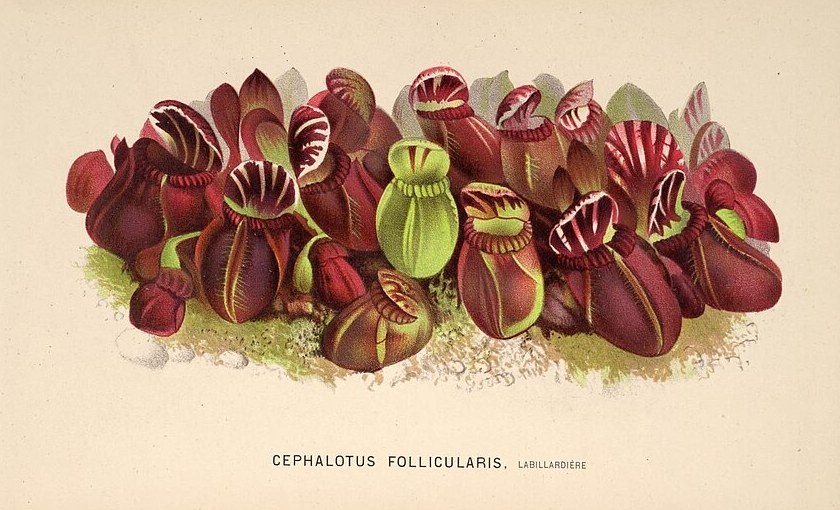
Featured image based on “Cephalotus follicularis” by P. De Pannemaeker, L’Illustration horticole plate 391 (1880), via the Biodiversity Heritage Library on Wikimedia Commons, CC BY 2.0, cropped, with a dark gradient and typography added by FloraOddity; the adapted image is offered under the same licence.
Final articles are editorially reviewed and factual claims are checked against cited sources. Last reviewed: October 2026.
One Comment