
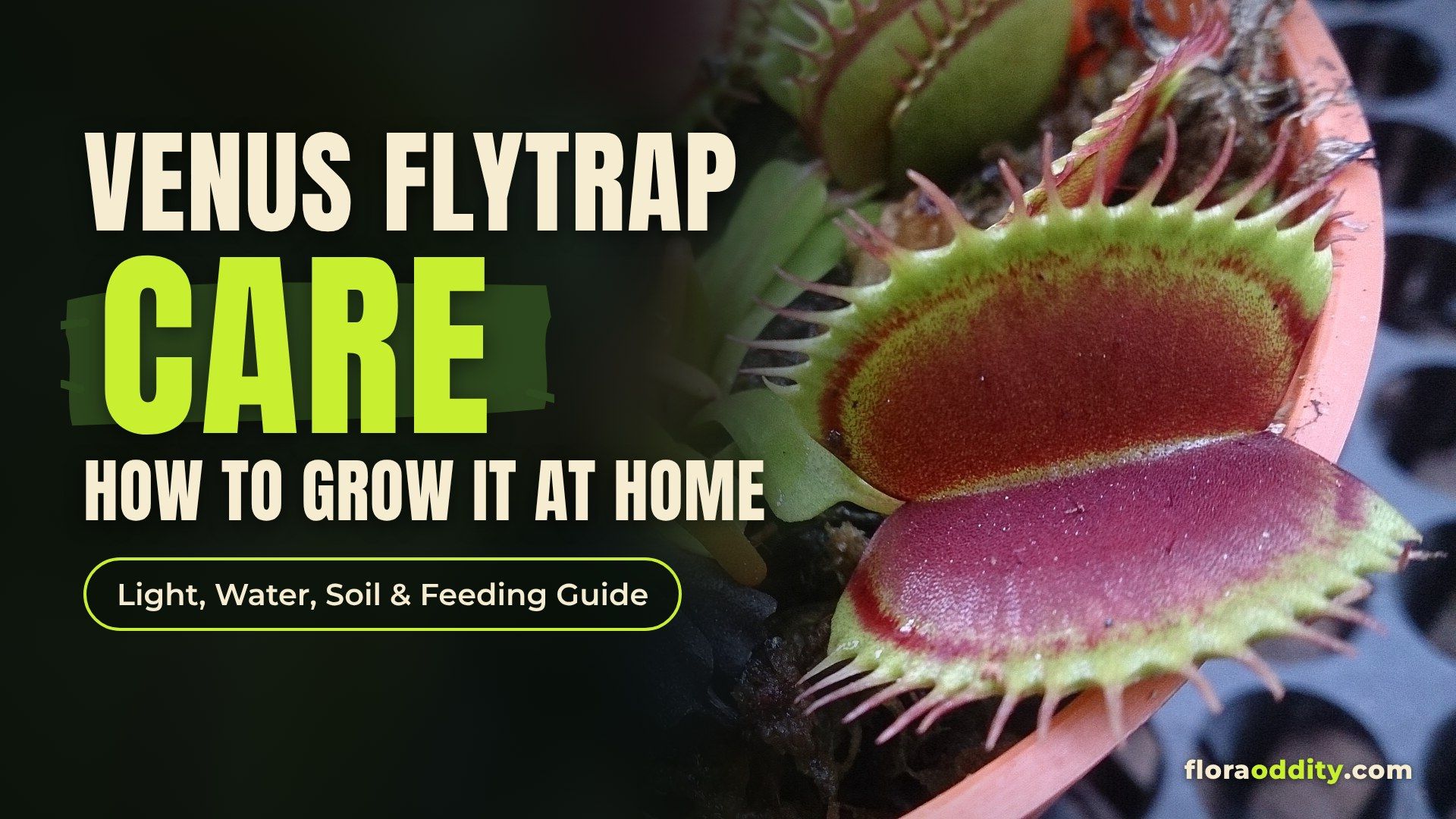
The Venus flytrap has a reputation for dying soon after it comes home from the store. Yet care guides from growers, botanic gardens, and extension services keep returning to the same basics: sun, pure water, poor soil, and no fertilizer. Get those right and Dionaea muscipula can live a long time; the U.S. Fish and Wildlife Service notes that flytraps have survived in cultivation for at least 25 years.
This guide opens our Venus flytrap series and covers everything a beginner needs, from light and water to feeding, flowers, and black traps.
The Short Answer
Give your flytrap at least six hours of direct sun a day, as both the International Carnivorous Plant Society (ICPS) and the nursery California Carnivores advise, or strong white LED light indoors. Stand the pot in a dish of rainwater, distilled water, or reverse osmosis water and never let the dish dry out. Plant it in fertilizer-free peat moss and clean sand, never potting mix, and do not fertilize the soil. If it is not catching insects, feed a trap now and then with a small live insect or rehydrated bloodworms. Outdoor plants in cold climates need winter protection and a dormant rest; whether indoor plants need dormancy is one of the points where sources disagree.
What a Venus Flytrap Is, and Where It Grows Wild
NC State Extension describes the Venus flytrap as “one of the best-known carnivorous plants,” a member of the sundew family (Droseraceae; see our sundew care guide) whose species name means “little mousetrap.” Each leaf ends in a trap of two hinged lobes with bristly edges. NC State gives leaf lengths of 2 to 5 inches (5 to 13 cm), up to 8 leaves per rosette, and notes that the inside of the trap is dark red or green depending on how much sun it gets.
Every wild flytrap grows in the Carolinas: the ICPS places it in the coastal plain of southeastern North Carolina and northeastern South Carolina, and the U.S. Fish and Wildlife Service (USFWS) describes its home as longleaf pine savannas that are “generally flat with wet or moist soils for much of the year.” The ICPS adds that the water table there is “just a few inches below the surface of the soil,” and that the soils are so poor in nutrients that the plants are “not used to dealing with fertilizer.”
Wild status and the law
In 2023 the USFWS decided the species “does not meet the definition of threatened or endangered” under the Endangered Species Act. It still names habitat loss, especially fire suppression, as the main threat, plus poaching. In North Carolina, taking a flytrap or its seed from another person’s land or public land without a permit is a Class H felony under General Statute 14-129.3.
You never need a wild plant. NC State notes flytraps are “widely available from nursery-propagated stock,” and the USFWS advises buying plants grown from tissue culture. It suggests avoiding trays of plants in very different sizes, or pots with natural-looking sandy soil and other species growing in them.
How the Trap Works, and Why It Matters for Care
According to NC State, the trap snaps shut when an insect touches any two of its six trigger hairs. A 2016 Current Biology study by Böhm and colleagues found that closing is only the first step: more than three electrical signals from repeated touches are needed before the plant switches on the genes for its digestive enzymes. A struggling insect supplies those touches; a dead crumb of food does not. That is why feeding advice below involves live prey or massaging the closed trap.
Closing also costs the plant. Science News notes that shutting a trap and making enzymes “consumes energy,” and that traps “fall off after several closures or partial closures and have to be regrown.” Digestion is slow: Science News gives 5 to 12 days, and the USFWS says 3 to 20 days may pass before the trap reopens.
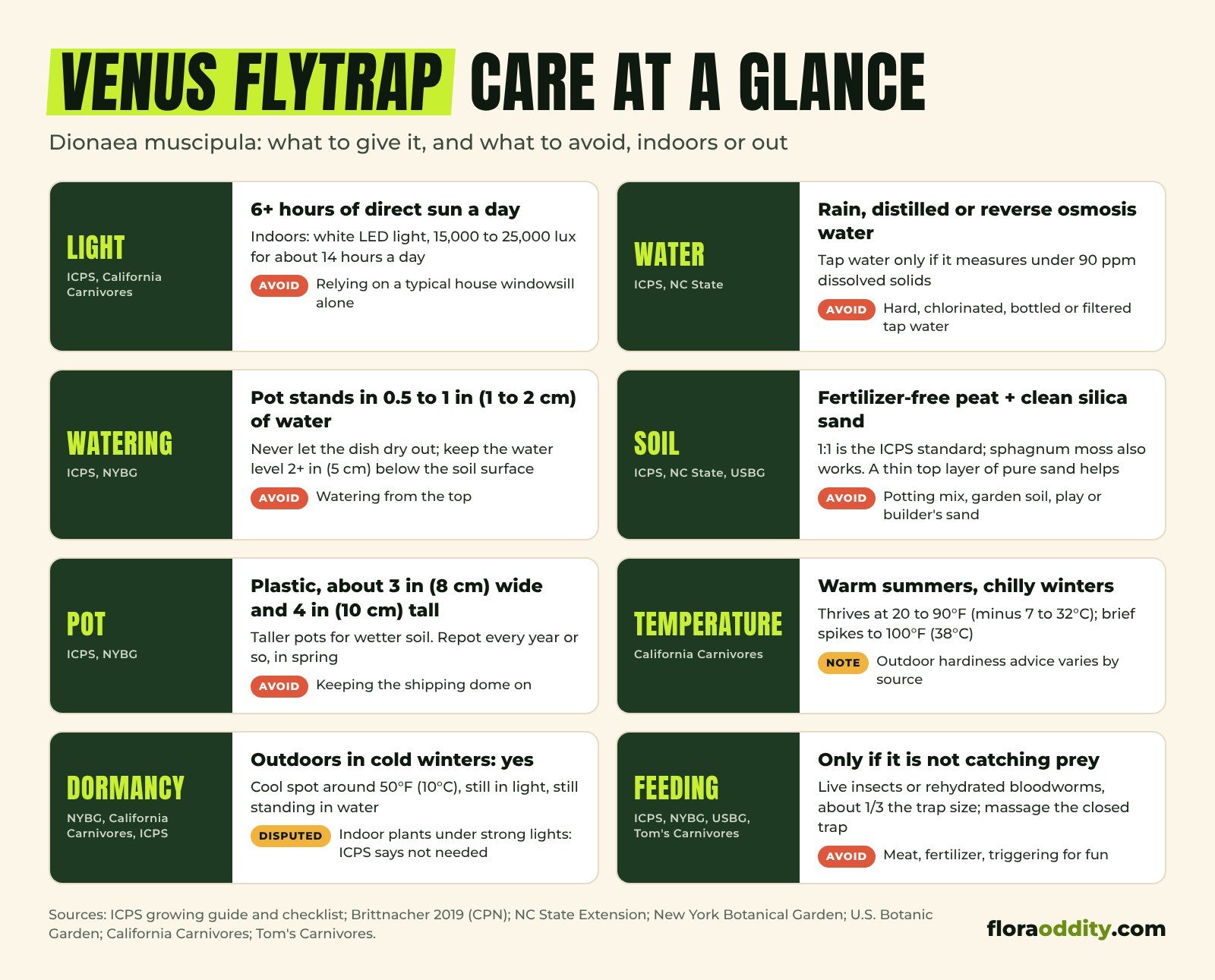
Venus Flytrap Care at a Glance
| Need | What to give it |
|---|---|
| Light | At least 6 hours of direct sun, or 15,000 to 25,000 lux of white LED light for about 14 hours a day |
| Water | Rain, distilled, or reverse osmosis water; tap water only if under 90 ppm dissolved solids |
| Watering | Pot stands in about 0.5 to 1 inch (1 to 2 cm) of water; never let the dish dry out |
| Soil | Fertilizer-free peat with clean silica sand (1:1), or sphagnum moss; never potting mix |
| Pot | Plastic, about 3 inches (8 cm) wide and 4 inches (10 cm) tall or taller |
| Temperature | Warm summers, chilly winters; about 20 to 90 °F (minus 7 to 32 °C) |
| Dormancy | Needed outdoors in cold winters; disputed for indoor plants |
| Feeding | Only if it is not catching prey: live insects or bloodworms about 1/3 the trap size; no meat, no fertilizer |
Light
The New York Botanical Garden (NYBG) calls insufficient light “probably one of the main reasons these plants don’t do well,” and the ICPS warns that a plant short of light “will start declining immediately.”
Outdoors, aim for full sun, which California Carnivores defines as “at least six hours of direct light.” The nursery warns that a plant moved into full sun often loses a few “burned” traps before it grows new ones. In hot, dry climates, the ICPS suggests morning sun and afternoon part shade.
Indoors, the ICPS says a flytrap needs “more light than it can get on a typical house window sill.” Its checklist adds that you do not need a special plant light: “a desk lamp with a standard white LED spotlight works as well,” on for 12 to 16 hours a day. The fuller ICPS guide aims for 15,000 to 25,000 lux of white LED light for about 14 hours a day, roughly 25 actual watts (not “watt equivalents”) per 10 inch (25 cm) circle of growing area. Our Nepenthes grow light guide explains how to read light ratings when shopping.
Water: What Type, and How to Give It
Use pure water
NC State Extension warns that “treated (chlorinated) water or hard water can kill the plant,” and California Carnivores calls flytraps “especially sensitive to their water quality.” Use rainwater, distilled water, or reverse osmosis (RO) water.
The ICPS allows tap water only if its total dissolved solids (TDS) reading is below 90 ppm (ask your water company or use a TDS meter). It also warns that “bottled drinking water is death to VFT’s” and that ordinary filtering “will NOT remove the dissolved salts.” The U.S. Botanic Garden gives the same no tap water, no mineral water rule for all carnivorous plants, and our guide to water for Nepenthes compares rain, distilled, and RO water in more detail.
The tray method
Water from below. The ICPS checklist says to sit the pot in a dish of water about half an inch to 1 inch (1 to 2 cm) deep and “DO NOT EVER LET THE DISH DRY OUT.” NYBG gives the same depth for the growing season and says “top watering is not recommended.”
Wet is not soggy, though. The ICPS guide says the plants “do not enjoy being soggy but must always be wet,” and keeps the water level more than 2 inches (5 cm) below the soil surface. That is why pot height matters.
Soil and Pots
To work out how much of each ingredient your pots need, try our soil mix calculator.
Soil
Sources agree on ingredients and differ on ratios. The ICPS calls 1:1 peat and sand the standard “CP mix” and says flytraps also grow in pure sphagnum moss or pure sphagnum peat. NC State suggests whole-fiber sphagnum or equal parts peat and coarse vermiculite or sharp sand. The U.S. Botanic Garden suggests “about three parts peat moss to one part clean, sharp sand.”
What you leave out matters more. The ICPS checklist says to buy peat “without added fertilizer” and horticultural or silica blasting sand, and never to use potting mix, play sand, or builder’s sand. The U.S. Botanic Garden adds that “garden soil is not suitable for carnivorous plants.”
ICPS growers often top the pot with pure sand, about half an inch (1 cm) in the checklist and about 2 cm in John Brittnacher’s 2019 Carnivorous Plant Newsletter article. The ICPS guide says plants grown this way “are less likely to have their older leaves totally rot.”
Pots
Flytraps have few roots and, according to the ICPS checklist, “will not get root-bound” in the small pot they are sold in. When you do move one, it suggests a pot about 3 inches (8 cm) wide and 4 inches (10 cm) tall. The ICPS rule of thumb is “the wetter the soil the taller the pot,” and it advises against pure peat or sphagnum in short pots. NYBG says “a plastic pot is probably best because it helps the soil retain moisture,” and that the pot “shouldn’t be too big.”
The ICPS checklist also says to remove the plastic dome many store plants come under: terrariums “are not needed by VFT’s and can be dangerous to their health,” and plants will adjust to drier air.
Temperature and Humidity
California Carnivores says flytraps “need warm summers and chilly winters,” thrive between 20 and 90 °F (minus 7 and 32 °C), and tolerate a brief spike to 100 °F (38 °C). Iowa State Extension gives an indoor target of 70 to 75 °F (21 to 24 °C) by day in summer and 55 to 60 °F (13 to 16 °C) in winter.
NC State lists the plant as hardy in USDA zones 7 to 10, and growable in zones 5 and 6 with winter protection. The ICPS recommends growing outside in zone 9 and warmer, calls zones 7 and 8 “problematic” without a greenhouse, and says zone 6 and colder need substantial protection.
Humidity matters less than you might think. NC State lists high humidity as a need, but Brittnacher writes that “VFTs do not need high humidity” and saw no difference between plants with and without terrariums.
Winter Dormancy, in Brief
To check whether your climate gives a natural winter rest, try our dormancy checker.
Outdoors, flytraps rest in winter. NYBG notes that by October or November the traps start dying back, that a dormant plant still needs light, and that a cold window around 50 °F (10 °C) works well. California Carnivores says dormancy is triggered by shorter days and temperatures in the 50s and 60s °F (about 10 to 20 °C).
The ICPS stresses that outdoor plants must be fully dormant before a freeze, and that in zones 7 and 8 in-ground plants should be covered with pine needles or row cover, because “the biggest danger is freeze-drying.” For very cold areas, California Carnivores suggests an unheated room or garage, heavy mulch, or bare-root storage in the refrigerator. Whether indoor plants need dormancy is disputed (see Where Sources Differ), and our Venus flytrap dormancy guide covers it in depth.
Feeding Your Venus Flytrap
For a quick plan, try our carnivorous plant feeding guide: pick your plant and see what to feed, how often and what never to give.
Flytraps make their own food by photosynthesis. Iowa State Extension calls insects “simply a supplemental food source,” and the USFWS says prey supplies nutrients “not readily available in the surrounding environment.” In the wild, the USFWS reports, about 33% of their prey is ants and 30% spiders, with fewer than 5% flying insects.
When and what to feed
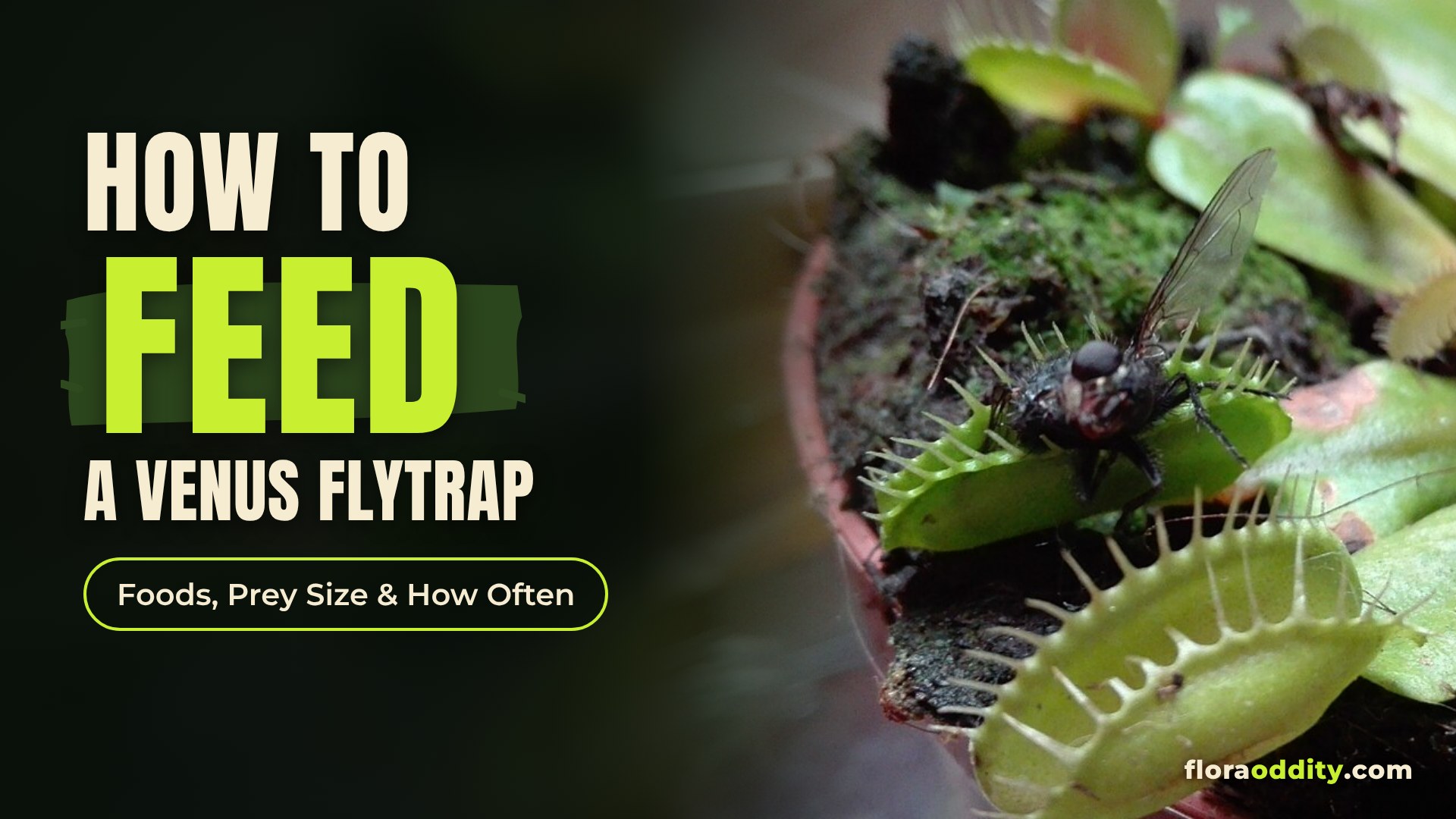
California Carnivores says outdoor plants “will catch plenty of food and do not need supplementation.” Indoors, the ICPS says a plant that is not catching food “needs to be fed in the traps,” and Brittnacher calls strong light and regular feeding “the keys to growing VFTs indoors long term.” Our guide to feeding a Venus flytrap covers prey size and timing in detail. Good options:
- Live insects. California Carnivores recommends live mealworms; NYBG suggests the smallest crickets you can buy, chilled in the fridge for 10 to 15 minutes. The ICPS suggests chilled flies and cautions that worms “can eat their way out.”
- Rehydrated dried bloodworms. The ICPS calls them “the easiest food to use.” Soak a pinch, place a piece about 1/3 the size of the trap inside, then gently massage the closed trap. Without enough stimulation, the ICPS says, the trap reopens after 24 hours with the food undigested. Check the label for additives. The same food works for pitcher plants, as described in how to feed a Nepenthes.
Never feed meat. NYBG warns that beef, chicken, or other animal flesh “will kill the trap,” and the U.S. Botanic Garden says carnivorous plants cannot digest its complex proteins. The grower behind the Tom’s Carnivores blog adds that prey bigger than about 1/3 of the trap, or a leg left poking out, can stop the trap sealing, and suggests feeding no more than one trap per week.
Do not fertilize the soil. NC State and NYBG both say never to fertilize, and the ICPS puts it bluntly: “DO NOT fertilize your plants unless you don’t care if you kill them.”
Should you trigger traps for fun? Better not. Each closure costs energy and traps wear out after several closures, as Science News reports. Tom’s Carnivores warns that if you “trigger the traps for fun without giving them a meal,” some leaves will likely turn black and die, though this is probably not fatal. If traps stop responding, our guide to a Venus flytrap not closing explains why.
Flowers
In spring a healthy flytrap may send up a flower stalk. NC State describes clusters of white, cup-shaped flowers about 0.7 inch (1.8 cm) across on a leafless stalk 4 to 12 inches (10 to 30 cm) tall in May and June, and the ICPS notes that plants tend to grow upright, long-stalked leaves at the same time.
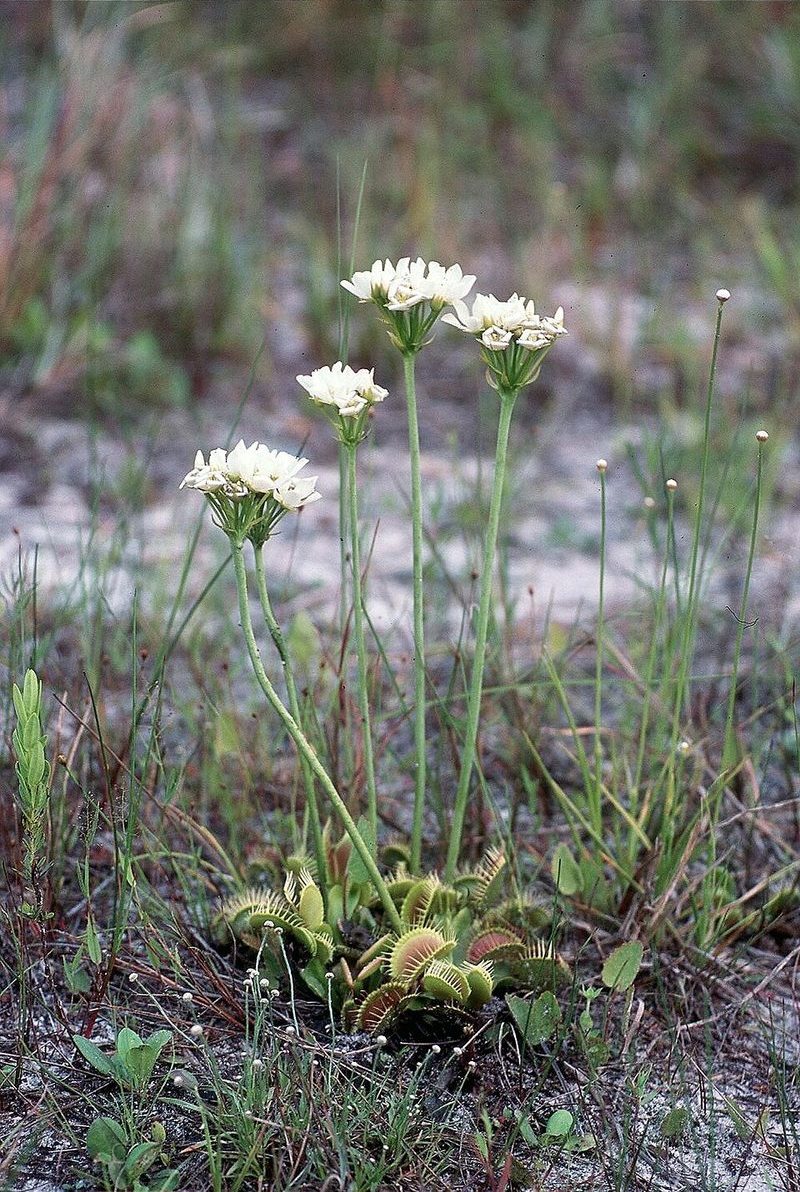
NYBG recommends removing the stalk before the flowers open, because “flowering takes a lot energy from the plant and can reduce the number of leaves being produced,” and the ICPS checklist suggests cutting stalks as soon as you see them. If you want seed, leave it (see how to grow Venus flytrap from seed), but the ICPS warns that seedlings can easily take 5 years to mature.
Repotting
Not sure if it is time? Our repotting advisor checks the timing for your hemisphere and whether your pot is tall enough.
Do not repot a new plant straight away. The ICPS checklist says to wait until it has adjusted and is growing well, and NYBG recommends repotting in spring. After that, the ICPS says a well-kept flytrap “will need to be repotted every year or so,” either because it has grown into the side of the pot or because the soil has become too salty and new traps “fail to develop.” Brittnacher advises repotting promptly “if the plant will not eat” and not reusing old soil. Our guide to repotting a Venus flytrap covers the mix, pot and steps.
Common Problems
Black traps. Some blackening is normal: the ICPS checklist says individual leaves “only last a few months,” and a healthy plant keeps replacing them. Tom’s Carnivores lists the usual causes when it goes further: unsuitable food, prey too big to seal, hard water or low light, autumn dormancy, and overfeeding or triggering traps for fun. Brittnacher adds that salty soil can kill roots so that “the new traps turn black before they open,” a sign to repot. See why a Venus flytrap turns black for each cause in detail.
Slow traps. The ICPS checklist says fast closing means a healthy plant; slow traps may be too young, too old, or short of light (“wants more light”).
Pests. NC State reports no serious problems but says to watch for aphids, spider mites, and black spot, and the ICPS notes that “aphids love VFT’s and will cause deformed leaves.” Our Nepenthes pests guide shows how to spot aphids and mites.
Where Sources Differ
Reputable sources disagree on a few points, usually because they grow in different conditions.
| Topic | One view | Another view |
|---|---|---|
| Dormancy indoors | California Carnivores: indoor plants still need dormancy; without it, long term the plant “will eventually die” | ICPS: flytraps “do not require dormancy to survive long term indoors”; only plants facing freezing outdoors need it |
| Perlite | California Carnivores prefers 4 parts fertilizer-free peat to 1 part perlite | ICPS: “Avoid perlite, pumice, and other potentially salty soil components” |
| Fertilizer | California Carnivores: optional monthly foliar feed of dilute MaxSea, leaves only | ICPS, NC State, NYBG: do not fertilize |
| Triggering traps | ICPS checklist: “It is OK to trigger the leaves as often as you want” | Tom’s Carnivores: triggering for fun can make leaves blacken and die |
| Terrariums | Iowa State Extension suggests an aquarium or terrarium for humidity | ICPS: terrariums are not needed and can be dangerous |
How to read these:
- Dormancy. The ICPS view comes from Brittnacher’s indoor plants, kept under strong LEDs and fed for over 10 years. California Carnivores writes mainly for outdoor and windowsill plants. Outdoors or on a windowsill with seasonal light, plan for dormancy; under strong year-round lights with regular feeding, the ICPS experience suggests it can keep growing.
- Perlite and fertilizer. The ICPS concern is salt and added fertilizer in some products, so plain peat and sand with no feed is the lower-risk choice for beginners.
- Triggering traps. The research reported by Science News supports the energy-cost view. Tom’s Carnivores says the damage is probably not fatal, but repeated empty closures use up leaves.
FAQ: Venus Flytrap Care
Can I use tap water for my Venus flytrap?
Only if it is very pure. The ICPS accepts tap water under 90 ppm of total dissolved solids; otherwise use distilled, RO, or rainwater. Brittnacher warns that bottled drinking water and filtered water “can be deadly.”
How often should I feed a Venus flytrap?
Outdoor plants usually feed themselves. Indoors, Tom’s Carnivores suggests no more than one trap per week, and the ICPS feeds when growth slows.
Can a Venus flytrap live indoors all year?
Yes, with enough light. The ICPS says it makes a good house plant with supplemental lighting and no terrarium, but a typical windowsill alone is not bright enough.
The Bottom Line
Venus flytrap care means recreating a sunny Carolina bog: at least six hours of direct sun or strong white LED light, a pot standing in rainwater, distilled, or RO water, and fertilizer-free peat and clean sand. Feed indoor plants small live insects or bloodworms when growth slows, skip meat and fertilizer, and do not waste traps for fun. Protect outdoor plants in cold winters, repot every year or two, and expect old traps to blacken as new ones grow.
Sources & Further Reading
- International Carnivorous Plant Society: Growing Dionaea muscipula
- International Carnivorous Plant Society: Checklist for Growing Dionaea muscipula
- International Carnivorous Plant Society: Feeding Dried Blood Worms Step-by-Step
- Brittnacher, J. (2019). Grow Venus flytraps indoors. Carnivorous Plant Newsletter 48(4): 178 to 182
- NC State Extension Gardener Plant Toolbox: Dionaea muscipula
- U.S. Fish and Wildlife Service: Venus flytrap
- U.S. Fish and Wildlife Service (2023): Successful Protection and Management Efforts Keep Venus Flytrap off the Endangered Species List
- North Carolina General Statutes § 14-129.3: Felony taking of Venus flytrap
- Böhm, J. et al. (2016). The Venus flytrap Dionaea muscipula counts prey-induced action potentials to induce sodium uptake. Current Biology 26(3): 286 to 295
- Science News: To catch a meal, a Venus flytrap counts to five
- New York Botanical Garden: Advice on growing and caring for a Venus flytrap
- U.S. Botanic Garden: Cultivating Carnivorous Plants
- Iowa State University Extension: How does one care for a Venus flytrap?
- California Carnivores: Venus Flytrap Care
- Tom’s Carnivores: Why is my Venus flytrap turning black or yellow?
Featured image based on a photo of a Venus flytrap by Mokkie via Wikimedia Commons, CC BY-SA 4.0, mirrored and cropped with typography added by FloraOddity; the featured image is shared under the same license.
Final articles are editorially reviewed and factual claims are checked against cited sources. Last reviewed: October 2026.
9 Comments