
You touch a trap and nothing happens. You touch it again, and it creeps half shut, or stays wide open. Barry Rice, author of the long-running Carnivorous Plant FAQ, calls this moment “a let-down.”
Most of the time, a Venus flytrap not closing is not a sick plant. Traps have rules about when they close and a limited number of closures in them. Sometimes, though, slow or dead traps are the first sign that the plant is short of light, water or strength. This guide explains how closing works, which open traps are normal, which are a warning, and what to do about each. For the full growing routine, see our Venus flytrap care guide.
The Short Answer
A trap usually closes only when its trigger hairs are touched twice in quick succession, so one poke often does nothing. Traps also wear out: Rice says a leaf manages the closing routine “about half a dozen times,” and other sources give figures from about 3 to about 12. Very young traps, very old traps, cold days and the slowdown before winter dormancy all make traps slow or unresponsive, and none of these needs fixing. Look for a problem when most mature traps on the plant are slow at once. The International Carnivorous Plant Society (ICPS) says slow closing can mean “your plant wants more light,” and low light, the wrong water, drying out, recent repotting and a declining plant are the main causes to check. Fix those, stop poking, and judge the plant by its new traps.
How a Venus Flytrap Decides to Close
NC State Extension explains that the trap snaps shut when insects or spiders disturb “any two of the six tactile hairs” on the inner surface. Rice describes it the same way: the hairs must be “stimulated twice in rapid succession (within about 30 seconds).” Carnivorous Plant Nursery adds that a single hair touched twice works too: “any one of these trigger hairs must be touched twice, or any two hairs touched one after the other.”
The reason is a short-term memory. The University of Würzburg, reporting a 2020 study in Nature Plants by Hiraku Suda and colleagues, explains that each touch sends a calcium wave across the trap. The wave peaks within a few seconds and “after one minute it has largely died away.” If the second touch arrives while calcium is still raised, the two signals add up past a threshold and the trap shuts. If it comes too late, “the first action potential is erased from the short-term memory,” and in the Würzburg tests a third touch was then needed to cross the threshold.
Carnivorous Plant Nursery notes that a single stroke from “a brisk breeze or raindrop” will not make the plant spend energy closing on non-food. Field work in Carnivorous Plant Newsletter backs this up: Stephen Williams and Bill Scholl found that only 6 to 12% of the traps in their camera view were closed by intense rain.
Closing also happens in stages. Rice lists a snap that “takes less than a second,” a tightening phase of “about 30 minutes,” and a final seal, which only struggling prey brings about. A 2016 study in Current Biology by Jennifer Böhm and colleagues found that two signals close the trap, but “more than three” are needed before the plant turns on the genes for digestive enzymes.
Normal Reasons a Trap Stays Open
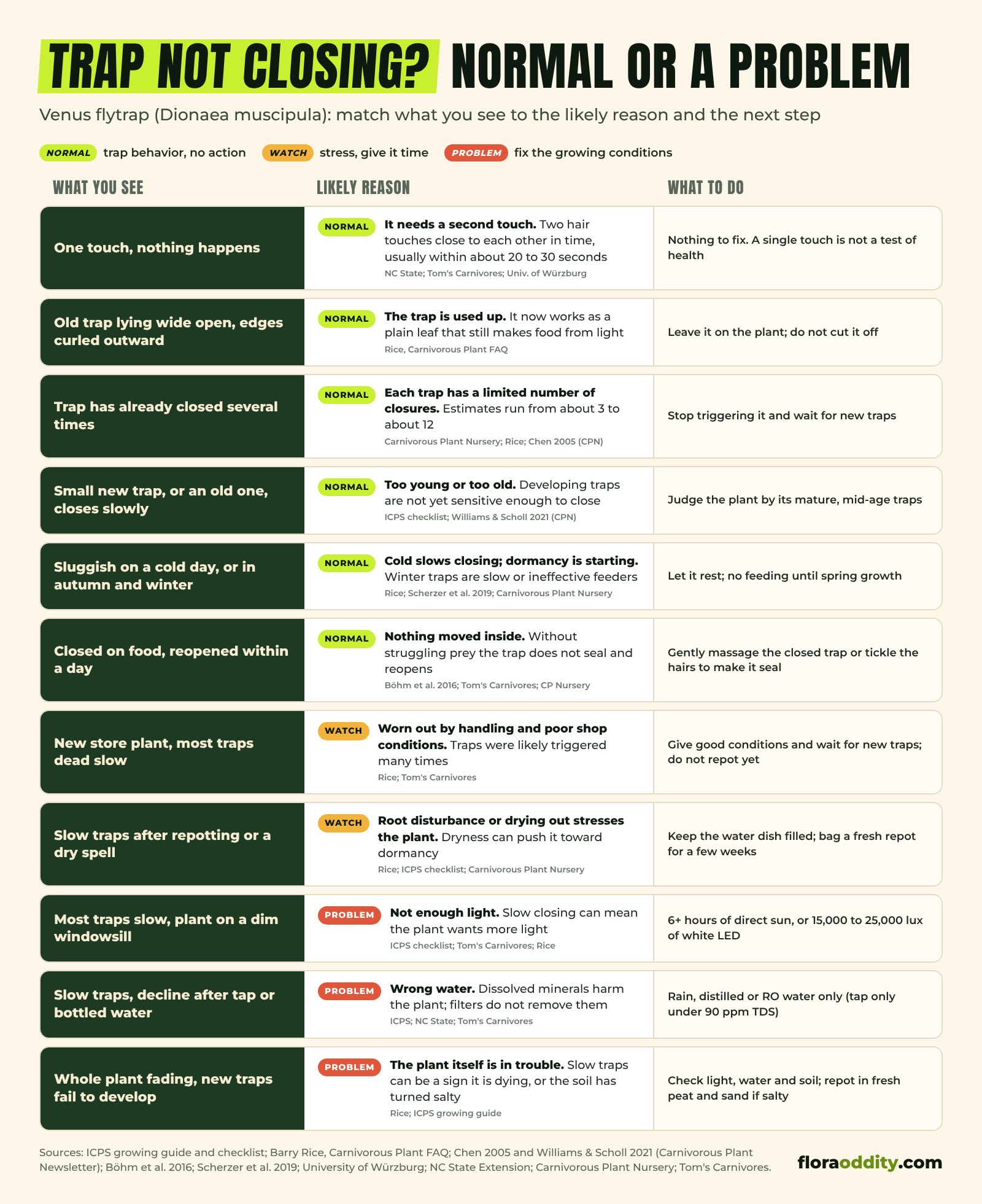
| What you see | Likely reason | Status | What to do | Source |
|---|---|---|---|---|
| One touch, nothing happens | Trap needs a second touch, usually within about 20 to 30 seconds | Normal | Nothing to fix | NC State; Tom’s Carnivores; Univ. of Würzburg |
| Old trap lying wide open, edges curled outward | Trap is used up and now works as a plain leaf | Normal | Leave it on the plant | Rice |
| Trap has already closed several times | Limited number of closures, about 3 to about 12 | Normal | Stop triggering it; wait for new traps | Carnivorous Plant Nursery; Rice; Chen 2005 |
| Small new trap, or an old one, closes slowly | Too young or too old | Normal | Judge the plant by mature traps | ICPS checklist; Williams and Scholl 2021 |
| Sluggish on a cold day, or in autumn and winter | Cold slows closing; dormancy is starting | Normal | Let it rest; no feeding | Rice; Scherzer et al. 2019; Carnivorous Plant Nursery |
| Closed on food, reopened within a day | No struggling prey, so the trap did not seal | Normal | Massage the trap or tickle the hairs | Böhm et al. 2016; Tom’s Carnivores; Carnivorous Plant Nursery |
| New store plant, most traps very slow | Worn out by handling and shop conditions | Watch | Good conditions, wait, do not repot yet | Rice; Tom’s Carnivores |
| Slow traps after repotting or a dry spell | Root disturbance or drying out | Watch | Keep the water dish filled; bag a fresh repot | Rice; ICPS checklist; Carnivorous Plant Nursery |
| Most traps slow, plant on a dim windowsill | Not enough light | Problem | 6+ hours of direct sun or strong white LED | ICPS; Tom’s Carnivores; Rice |
| Slow traps, decline after tap or bottled water | Dissolved minerals | Problem | Rain, distilled or RO water only | ICPS; NC State |
| Whole plant fading, new traps fail to develop | Plant declining or soil turned salty | Problem | Check light, water and soil; repot if salty | Rice; ICPS growing guide |
The trap only got one touch
Tom Bennet of Tom’s Carnivores puts the window at “about 20 seconds” and says that if the touches “occur minutes apart, the plant doesn’t move.”
The trap is worn out
Every trap has a limited number of closures. Rice explains why: after several closings, the plant’s cells “are as elongated and stretched as they can get. They can grow no further.” He adds that a store-bought plant has probably been “triggered by a dozen pencil-wielding humans” before you got it home, so its traps may already be spent.
A spent trap does not die right away. Rice says it “stays green, but gets a funny outer-curling edge,” often opening so the lobes are “about 180° apart.” It then works as an ordinary leaf, making sugars by photosynthesis, and “may persist for many months,” so he advises against cutting it off.
The trap is too young or too old
The ICPS checklist, written by John Brittnacher, says that if traps close slowly, “either the leaf is too young or too old or your plant wants more light.” Williams and Scholl, counting traps in the field, list “Developing traps” as “not mature enough to be sensitive” and old traps as “no longer capable of responding.”
It is cold
Temperature changes how traps respond. Rice notes that “on very cold days traps tend to close very slowly.” A 2019 Nature Plants study by Sönke Scherzer and colleagues found that trigger hairs become less responsive after stimulation and that this “desensitization increased at lower temperatures.” Warmth works the other way: Carnivorous Plant Nursery says “In very warm temperatures one touch may be enough.”
Dormancy is coming
In autumn, traps slow down along with the rest of the plant. Carnivorous Plant Nursery says that as day length and temperature fall, the plant slows its growth, and the traps that stay green through winter “will be slow or ineffective feeders.” That is expected. Our guide to Venus flytrap dormancy explains how to rest the plant.
Problem Reasons: When the Plant Itself Is Struggling
Not enough light
Tom’s Carnivores says garden centre plants “often close slowly (or not at all)” because they are “unhealthy and exhausted,” and lists “Low light” first. The ICPS checklist asks for “at least six hours of direct sunlight every day” and warns that “The plant will start declining immediately if it doesn’t get enough light.” The ICPS growing guide gives indoor growers a target of 15,000 to 25,000 lux of white LED light for about 14 hours a day. Rice traces beginner flytrap deaths to “inadequate lighting” in “nearly all cases.”
A weak plant after shipping or repotting
A plant fresh from a shop can need time to settle. The ICPS checklist says the plastic cup over a store plant is there “to protect the plant during shipping,” not because the plant likes it, and that plants from greenhouses and cups “may take a while to acclimate to drier air.” Repotting adds stress: Rice warns that moving a flytrap into new soil “while tearing up its root system” may shock it, and that a poorly transplanted plant “may quickly die.” The ICPS suggests waiting until the plant is “growing well” before repotting, and if you must repot, putting it “in a plastic bag for a few weeks” afterwards.
Drying out
The ICPS growing guide says the plants “must always be wet,” and its checklist says to sit the pot in a dish of water and, in capitals, “DO NOT EVER LET THE DISH DRY OUT.” Tom’s Carnivores includes “inappropriate or insufficient water” among the reasons shop plants close slowly. Carnivorous Plant Nursery adds that “Dryness, low light, or dramatic changes in temperature can trigger the plant to enter dormancy,” so a plant that dried out may lose its traps and look like it is dying.
The wrong water
Water quality matters as much as quantity. The ICPS checklist says “Bottled drinking water is death to VFT’s; so is most tap water that comes from wells.” NC State Extension warns that “treated (chlorinated) water or hard water can kill the plant.” The ICPS growing guide accepts tap water only below 90 ppm total dissolved solids and notes that ordinary filtering “will NOT remove the dissolved salts.”
A declining or sick plant
Sometimes slow traps are a symptom of a bigger problem. Rice says plainly that “another reason your plant might be so sluggish is that your plant is dying.” His checklist for a dying flytrap is light first, then “a good soil mix like 50:50 peat:sand,” “only purified water,” and no fertilizer. The ICPS growing guide adds that over time the soil can turn salty and “the traps on new leaves will fail to develop,” and recommends dividing and repotting the plant to renew it.
Slow Closing vs No Closing
The two symptoms point in different directions.
A slow trap that still closes is often a matter of age, temperature or light. The ICPS checklist uses speed as a health gauge: “If they close very quickly, your plant is doing very well.” Tom’s Carnivores says healthy traps “can snap shut in less than one-tenth of a second.”
Timing between touches matters too. Carnivorous Plant Nursery notes that “The longer the period between the two stimuli the slower the closure.” A 2020 PLOS Biology paper by Jan Burri and colleagues cites earlier experiments in which touches spaced 2 minutes apart needed at least five deflections to move the trap at all, and the movements “were always slow and/or partial.”
A trap that does not close at all is usually exhausted, too young, dormant or very cold. In a 2005 student experiment published in Carnivorous Plant Newsletter, Emerson Chen also found that “Older traps often required more than two stimulations in order to react, and even then they did not always close completely.” Rice adds that he does not think closing speed shows that a plant is “hungry.”
When a Trap Closes, Then Reopens Without Digesting
A trap that shuts and reopens a few hours later with food still inside has not failed. It simply did not detect a meal. Carnivorous Plant Nursery says that if a trap “captures non-organic matter or misses its prey, it will open usually within 24 hours.” Tom’s Carnivores gives “about 12 hours” for a false alarm. In the field, Williams and Scholl found traps that closed without prey “begin reopening in about 7 hours and completely reopen in 22 hours.”
The fix is to imitate a struggling insect. The ICPS checklist says to “Gently massage the closed trap so it thinks the blood worms are wiggling.” Tom’s Carnivores suggests touching the hairs with a cocktail stick “every 30 seconds or so until the trap is fully sealed,” which you can tell when the gaps between the teeth get smaller. Our guide on how to feed a Venus flytrap covers foods and prey size.
Where Sources Differ
| Topic | One view | Another view |
|---|---|---|
| Time window between touches | Böhm et al. (2016): two signals within 15 to 20 seconds of each other; Tom’s Carnivores: “about 20 seconds” | Rice and Würzburg: about 30 seconds; Carnivorous Plant Nursery: best response “within 40 seconds” |
| How many times a trap can close | Carnivorous Plant Nursery: “about 3 times” | Rice: “about half a dozen times”; Chen (2005): an average of 12.1 in his test |
| Is one touch ever enough? | Most sources: two touches are needed | Burri et al. (2020): under some conditions “one stimulus is sufficient”; Carnivorous Plant Nursery: in very warm weather |
| Number of trigger hairs | NC State: “six tactile hairs” in total | Rice: about 3 to 5 on each lobe; Univ. of Würzburg: three on each half |
| Triggering traps for fun | ICPS checklist: “It is OK to trigger the leaves as often as you want” | Carnivorous Plant Nursery: “Repeated closures without a feeding may kill the plant” |
| Reopening after a false alarm | Tom’s Carnivores: about 12 hours | Carnivorous Plant Nursery: usually within 24 hours; Williams and Scholl: about 22 hours in the field |
These are mostly differences in context. Lab timings come from controlled touches on single traps, nursery figures are rules of thumb, and Chen notes his own count may run high because he re-stimulated traps after only 24 hours. Burri’s single-touch closures came from slow, controlled bends of one hair made with a microrobot; the same single touch did not work at faster speeds. And the ICPS checklist that allows free triggering also tells owners to feed a plant regularly if it catches nothing on its own.
What to Do When Traps Won’t Close
- Test fairly. Touch two different hairs, or one hair twice, within a few seconds, and do it on a mature trap, not the newest or oldest.
- Check the season and temperature. Slow traps on a cold day or from autumn onward are expected. Do not feed a resting plant.
- Raise the light. Aim for the ICPS minimum of six hours of direct sun, or a strong white LED for about 14 hours a day.
- Check the water. Use rain, distilled or reverse osmosis water, and keep the dish from ever drying out.
- Leave a new or repotted plant alone. The ICPS suggests a plastic bag for a few weeks after repotting, so judge the plant by its new growth after that.
- Stop triggering. Let the plant grow new traps; Rice says waiting for them “may take a while.”
Common Mistakes
- Poking traps to “check” them. Carnivorous Plant Nursery says “The plant uses energy to close and reopen. If it does not gain any nutrition, the plant is weakened.” It adds that “One or two closings to show off the plant are okay.”
- Cutting off open, non-working traps. Rice says such a leaf still makes sugars by photosynthesis and “may persist for many months.”
- Feeding to “wake up” slow traps. Rice does not link slow closing to hunger, and dormant traps are poor feeders anyway.
- Dropping dead food in and walking away. Without stimulation the trap reopens with the meal undigested, as Carnivorous Plant Nursery explains.
FAQ: Venus Flytrap Not Closing
How many times can a Venus flytrap close?
Sources disagree. Carnivorous Plant Nursery says about 3 times, Rice about 6, and a small 2005 experiment by Chen averaged about 12. Chen also cites a 2002 book by Donald Schnell, which puts the figure at 8 to 10 closures without feeding and three to four digestions.
Will a trap that stopped closing ever work again?
Usually not as a trap. Rice explains that the cells are already stretched as far as they can go. The leaf keeps photosynthesizing, and the plant replaces it with new traps.
Can heat make a Venus flytrap close?
Yes, but only a sudden jump. The University of Würzburg reports that a rapid rise past about 99 °F (37 °C) triggers an electrical signal, and at 131 °F (55 °C) a second one closes the trap. If the temperature rose slowly, “as on hot summer days, the traps did not react.”
The Bottom Line
A Venus flytrap not closing is usually a trap doing what it is built to do. It ignores single touches, slows down when young, old or cold, rests in winter and retires after a handful of closures. Look closer when most mature traps are slow in the growing season; the usual causes are low light, the wrong water, a dry pot, recent repotting or a plant in decline. Fix those, stop testing the traps, and let new growth show you whether the plant has recovered.
Sources & Further Reading
- International Carnivorous Plant Society: Checklist for Growing Dionaea muscipula
- International Carnivorous Plant Society: Growing Dionaea muscipula
- Rice, B. The Carnivorous Plant FAQ: Why do the leaves on my Venus flytrap snap shut slowly, or not at all?
- Rice, B. The Carnivorous Plant FAQ: How does a Venus flytrap sense prey?
- Rice, B. The Carnivorous Plant FAQ: Exactly how does a Venus flytrap’s leaves close so fast?
- Rice, B. The Carnivorous Plant FAQ: Why isn’t my Venus flytrap growing well?
- Rice, B. The Carnivorous Plant FAQ: My Venus flytrap is dying! What am I doing wrong?
- Rice, B. The Carnivorous Plant FAQ: Should I transplant my Venus flytrap for other reasons?
- Chen, E. (2005). Student experiment project: Number of closures of Dionaea muscipula leaves. Carnivorous Plant Newsletter 34(3): 94 to 95
- Williams, S.E. and Scholl, B. (2021). Can Venus flytraps be triggered to close by raindrops? Carnivorous Plant Newsletter 50(2): 60 to 65
- Williams, S.E. and Scholl, B. (2021). Frequency of trap closure and capture of prey by Dionaea muscipula in the field. Carnivorous Plant Newsletter 50(3): 100 to 110
- Böhm, J. et al. (2016). The Venus flytrap Dionaea muscipula counts prey-induced action potentials to induce sodium uptake. Current Biology 26(3): 286 to 295
- Scherzer, S. et al. (2019). Venus flytrap trigger hairs are micronewton mechano-sensors that can detect small insect prey. Nature Plants 5: 670 to 675
- Suda, H. et al. (2020). Calcium dynamics during trap closure visualized in transgenic Venus flytrap. Nature Plants 6: 1219 to 1224
- Burri, J.T. et al. (2020). A single touch can provide sufficient mechanical stimulation to trigger Venus flytrap closure. PLOS Biology 18(7): e3000740
- University of Würzburg: How the Venus Flytrap Counts
- Biocenter, University of Würzburg: Heat Sensor Protects the Venus Flytrap From Fire
- NC State Extension Gardener Plant Toolbox: Dionaea muscipula
- Carnivorous Plant Nursery: Venus Flytraps
- Carnivorous Plant Nursery: Growing Tips for Venus Flytraps
- Tom’s Carnivores: How do Venus flytraps work?
- Tom’s Carnivores: Can I feed my Venus flytrap dead bugs?
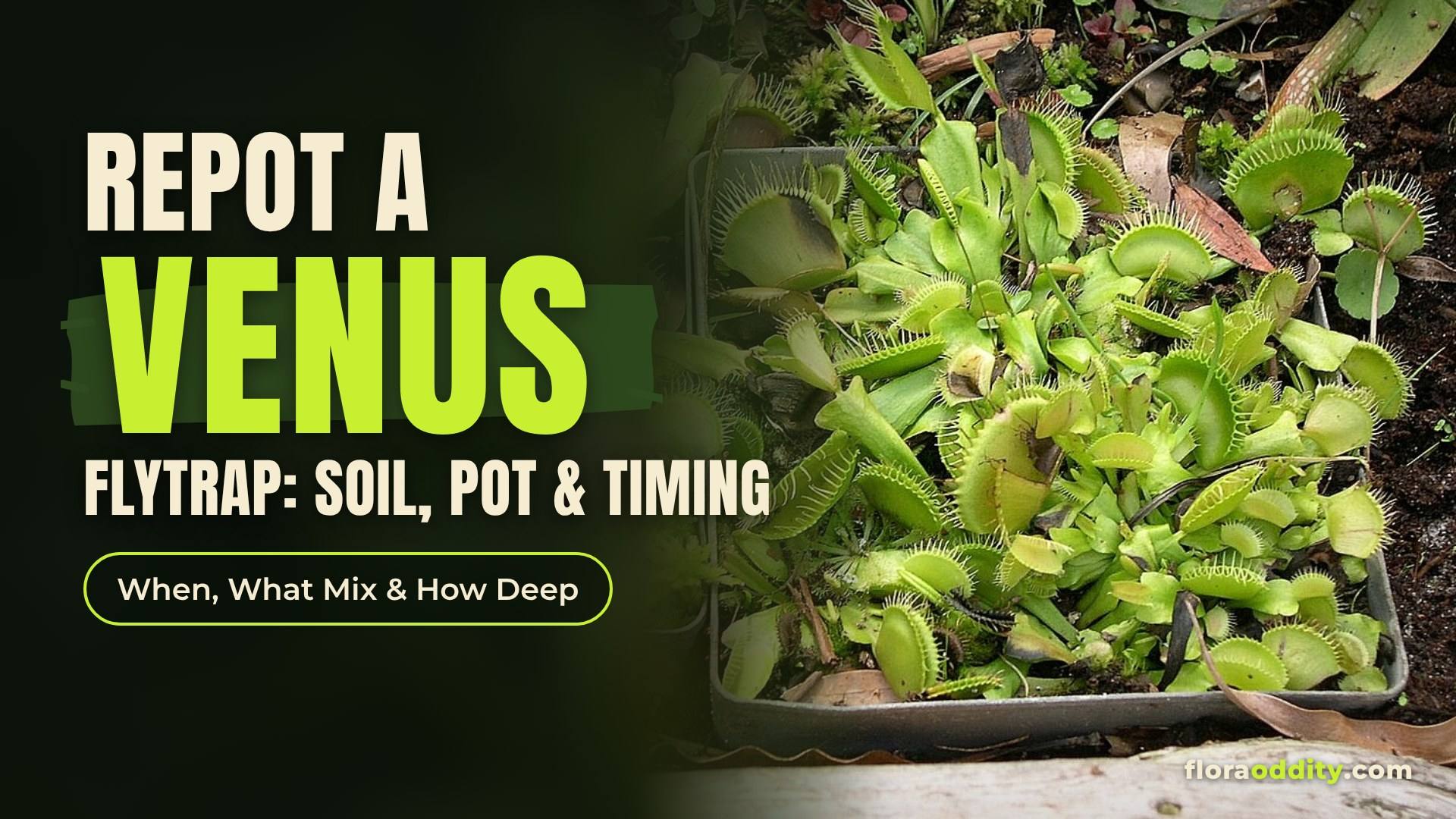
Featured image based on a photo of a Venus flytrap by Tippitiwichet via Wikimedia Commons, CC BY 2.0, cropped with a dark gradient and typography added by FloraOddity.
Final articles are editorially reviewed and factual claims are checked against cited sources. Last reviewed: October 2026.

One Comment