
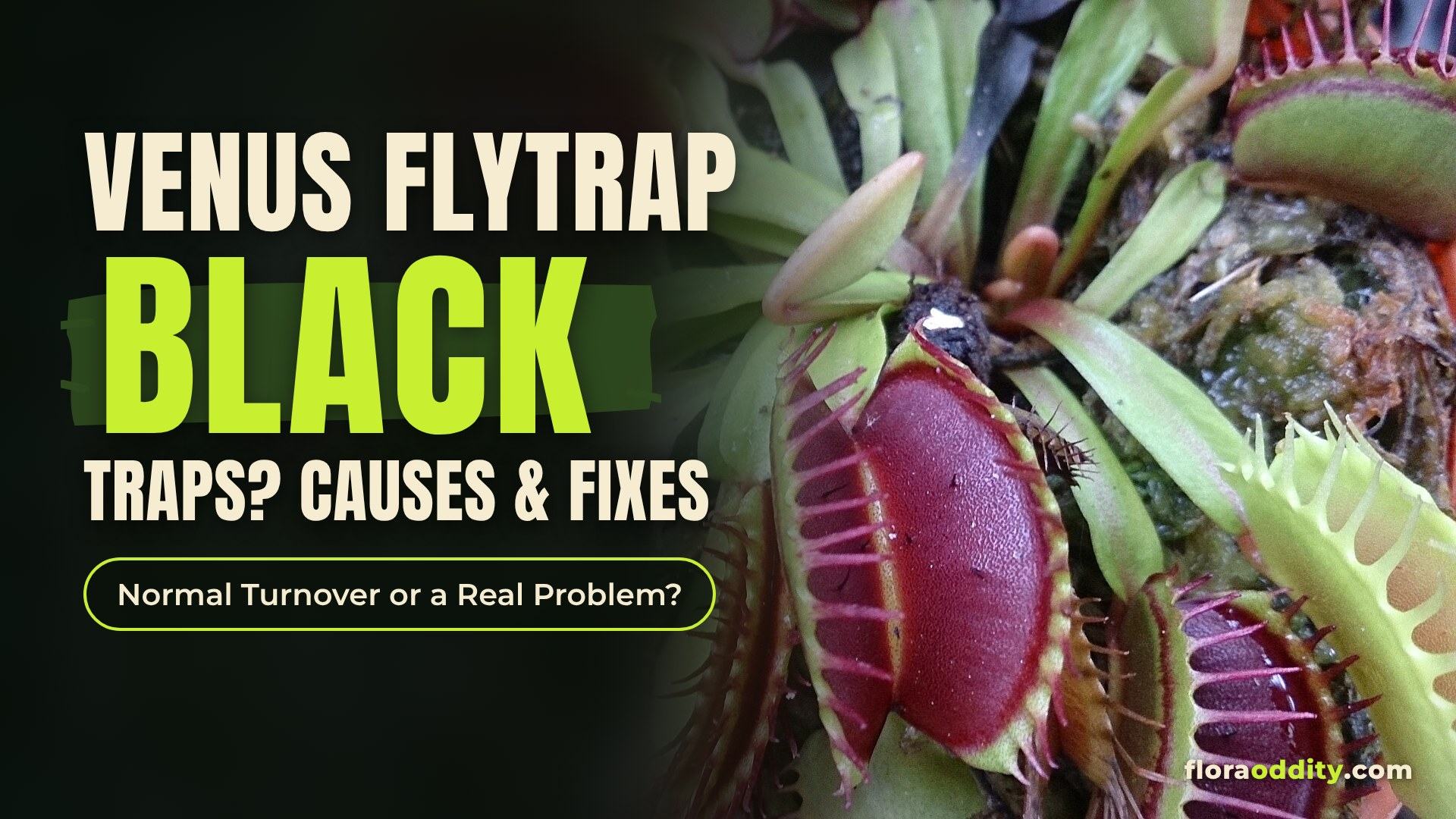
A trap closes on a fly, and a week later it is black and limp. Barry Rice, author of the long-running Carnivorous Plant FAQ, says he “commonly” gets e-mail about exactly this. The good news comes from Tom Bennet of Tom’s Carnivores, who has grown carnivorous plants for over two decades: “Traps can turn black for many different reasons, and most are not fatal to the plant.”
The trick is telling normal blackening from the kind that means something is wrong. This guide covers each common cause and what growers and extension services say to do about it. For the full growing routine, see our Venus flytrap care guide.
The Short Answer
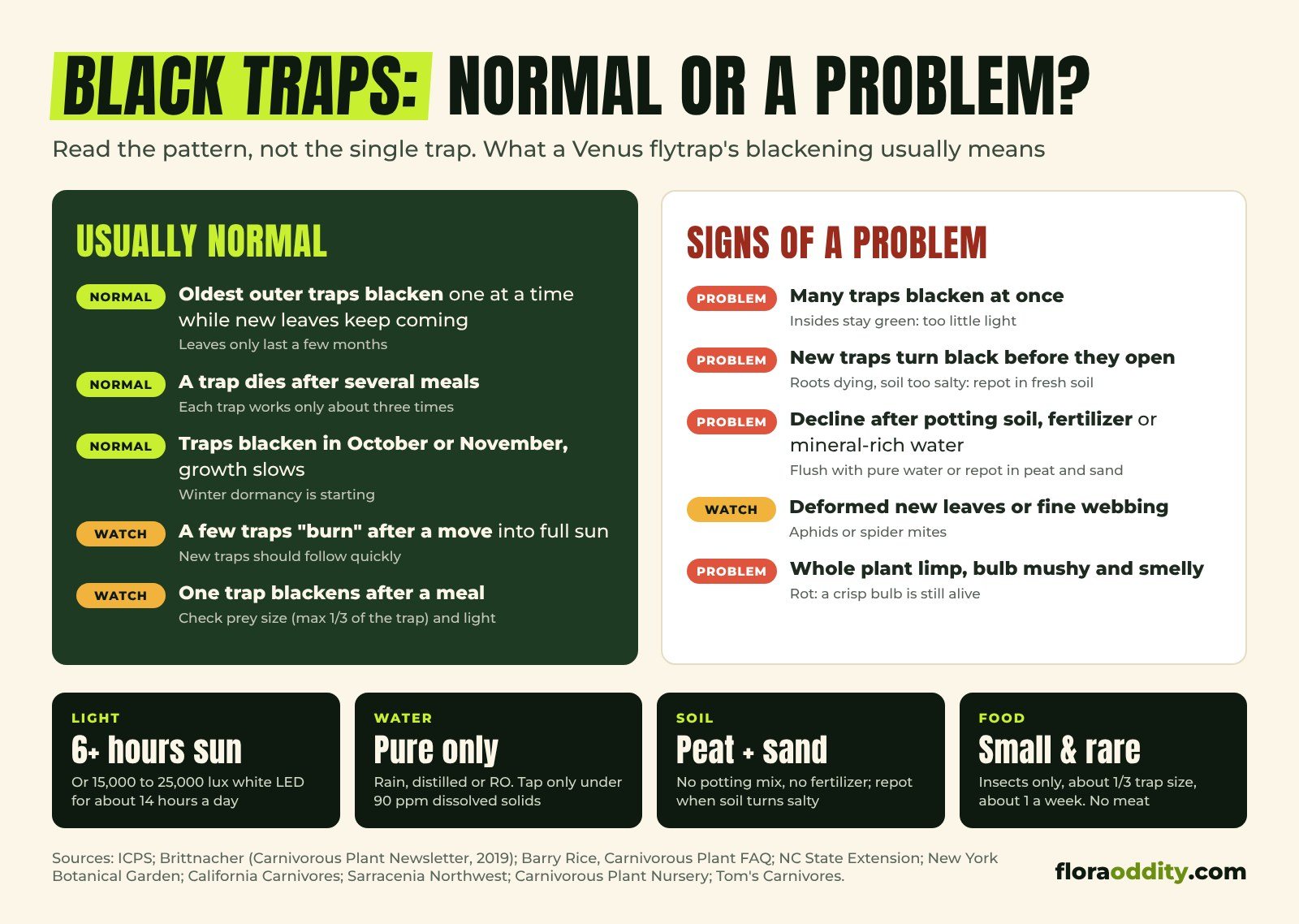
Some black traps are normal. The International Carnivorous Plant Society (ICPS) says individual leaves “only last a few months,” and a healthy plant keeps replacing them. Black traps in autumn usually mean winter dormancy is starting. Blackening is a warning sign when many traps, especially new ones, go black at once, or when the plant stops making new leaves. The usual causes are low light, the wrong food or prey that is too big, impure water, wrong or salty soil, and rot. Fix the growing conditions, trim dead parts if you like, and judge the plant by its new growth, not its old traps.
Why Traps Die: A Leaf Has a Short Life
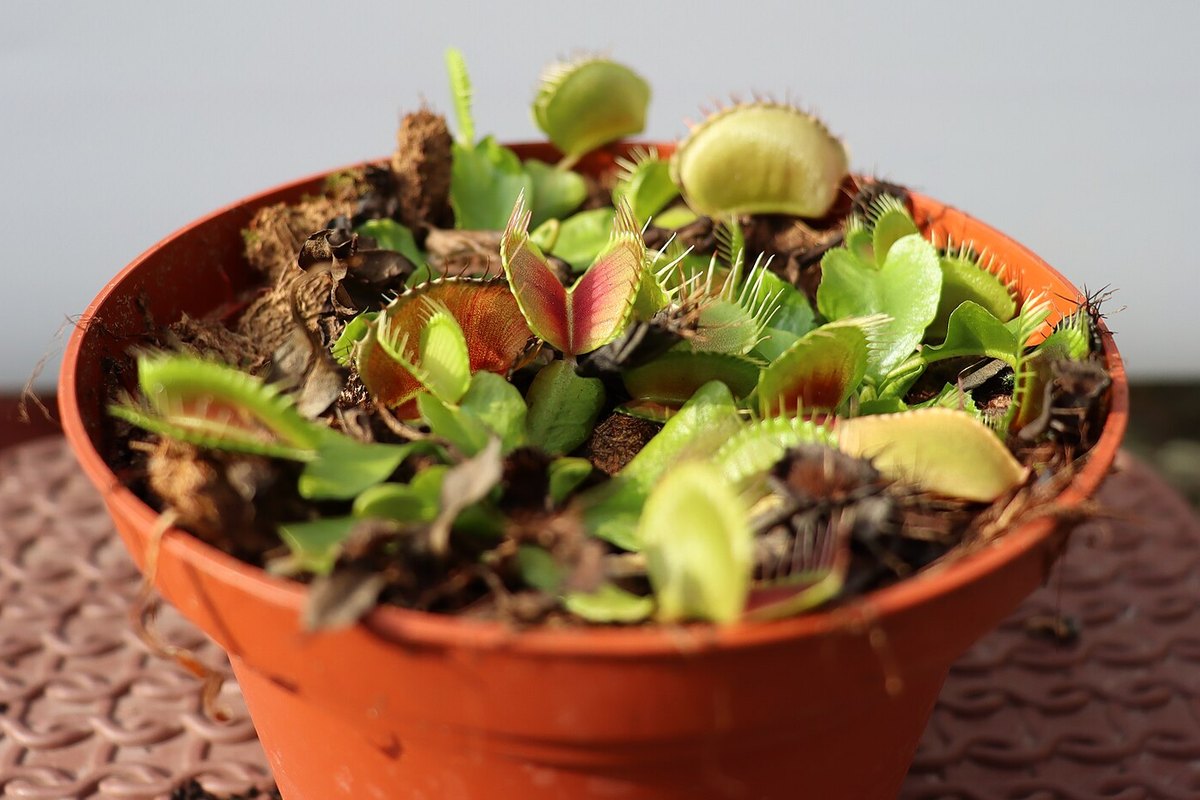
Every trap on a Venus flytrap (Dionaea muscipula) is a leaf, and leaves are temporary. The ICPS checklist puts it plainly: “Leaves on your plant will die and turn black… A healthy plant will be constantly putting on new leaves and the old ones will be dying back. This is what you want to happen.”
Traps also wear out with use. Carnivorous Plant Nursery notes that closing and reopening “takes energy,” and that “each trap only works about three times.” Digesting is hard work too: Rice writes that cultivated flytraps “often get black and dead spots on their leaves when they are digesting food,” a spot that usually “expands until the entire leaf blackens and falls off.” It happens fairly often, he says, even to his own plants.
So one black trap tells you little. What matters is the pattern: which traps blacken, how many, how fast, and whether new leaves keep coming.
Common Causes of a Venus Flytrap Turning Black
1. Normal leaf turnover
The most common and least worrying cause. Tom’s Carnivores says that if the oldest traps in the rosette are turning black, or a trap has already digested several insects, it is “likely a normal part of the trap’s lifecycle.” If the plant keeps putting out new growth, “you have nothing to worry about.”
2. Digestion, oversized prey or the wrong food
A trap that blackens after a meal is common in cultivated plants. Rice says “Sometimes the complicated process of digesting prey is just too much for home-grown Venus flytraps,” especially for a plant that is not getting “lots and lots of light.” He also finds that “large ants sometimes cause the leaf to blacken,” and suggests dropping any bug your plant reacts badly to.
Size matters. Rice warns that “Meals much bigger than about 1/3 the length of a trap can be too big, causing the trap to blacken and die,” and that a leg or wing sticking out “increases the chance that the food being digested will start to decay.” Tom’s Carnivores agrees that a trap which cannot fully seal is likely to die.
The wrong food is worse. The New York Botanical Garden (NYBG) says never to use “beef or chicken or any other animal flesh,” because these “will kill the trap.” Tom’s Carnivores calls human food such as sausage or chocolate “a guaranteed way to cause the trap to rot,” and Rice adds insects laced with pesticides.
3. Overfeeding and triggering for fun
More food is not always better. Tom’s Carnivores warns that if you feed every trap, “or worse, trigger the traps for fun without giving them a meal,” some leaves will likely turn black and die, though this “probably isn’t fatal.” Its fix: stop feeding for a month or two, then feed no more than 1 trap per week.
Rice once put a bug in every trap of a plant that had gone a year without prey. “Within two weeks, nearly every trap blackened and rotted,” and the plant took two months to resume growth. His guideline: “Do not exceed about one bug per week.” Carnivorous Plant Nursery calls “Finger Pokers” possibly “the #1 enemy of the Venus Flytrap,” because empty closures weaken the plant.
4. Hard water or tap water
Tom’s Carnivores says tap and bottled water “often contain high levels of dissolved minerals which can burn your plant’s roots.” NC State Extension warns that “treated (chlorinated) water or hard water can kill the plant.” The ICPS accepts tap water only under 90 ppm total dissolved solids and notes that ordinary filtering “will NOT remove the dissolved salts.” Use rainwater, distilled or reverse osmosis water; our guide to watering with pure water compares them.
If you used the wrong water for only a few weeks, Rice says “the situation isn’t too bad”: flush the pot thoroughly with pure water. After months of bad water and a declining plant, he says the soil must be changed.
5. Wrong soil, fertilizer or salt build-up
Tom’s Carnivores says “Normal potting compost or anything with fertilizer will hurt your plant.” Rice warns that a flytrap left in potting soil or fertilized mix “is almost certainly going to die,” and says to repot into 50:50 peat moss and horticultural sand “regardless of the season.” For a water-soluble fertilizer poured on the soil, “a good water drenching should probably fix the situation.”
Good soil also goes bad. John Brittnacher, writing in Carnivorous Plant Newsletter, says the soil can get too salty, or something else can happen, “so the roots die and the new traps turn black before they open.” His advice: “Repot the plant in fresh soil as soon as possible if the plant will not eat,” and do not reuse the old soil.
6. Not enough light
This is the cause experts name most. Rice writes that “A plant with inadequate light tends to get blackened traps more frequently,” and blames inadequate lighting for beginner flytrap deaths in “nearly all cases.” NYBG calls insufficient light “probably one of the main reasons these plants don’t do well.”
The ICPS checklist asks for “at least six hours of direct sunlight every day,” warning that “The plant will start declining immediately if it doesn’t get enough light.” Indoors, the ICPS recommends 15,000 to 25,000 lux of white LED light for about 14 hours a day. Jeff Dallas of Sarracenia Northwest offers a quick check: traps should show some red inside, and pure green traps are “a dead giveaway that it needs more sun.”
7. Sun shock after a move
More light can cause a few black traps at first. California Carnivores says “It is common for several of the traps to ‘burn’ and die back when you first put it into the sun,” and the plant “will quickly grow new traps.” Sarracenia Northwest says the same of a plant moved into full sun: “Some shock will result from this, but once the newer growth comes out, the plant will look normal.”
In hot, dry climates, the ICPS suggests “full morning sun and then part shade.” California Carnivores says flytraps can take a spike up to 100 °F (38 °C) only “for a brief period.”
8. New plants and repotting stress
Rice warns that transplanting, “while tearing up its root system,” may shock the plant, and that a new plant transplanted poorly “may quickly die.” The ICPS checklist says to wait until the plant “has acclimated to your conditions and is growing well,” and if you must repot sooner, “put it in a plastic bag for a few weeks after repotting.” Both Rice and NYBG say spring is the time to repot. Store plants from plastic domes also need time: the ICPS says they “may take a while to acclimate to drier air but acclimate they will.”
9. Winter dormancy
If blackening starts in autumn, the plant is probably preparing for winter. NYBG says “By October/November the leaves (traps) will be dying. This is normal because light is diminishing and days are getting colder.” Rice says a plant entering dormancy “merely slows in growth, and often the leaves blacken and die over several weeks,” and his plants keep at least a few green leaves all winter. Whether indoor plants need dormancy is disputed (see below).
10. Rot and mold
Rot usually starts at the base. Brittnacher writes that “old leaf bases that make up the bulb will rot in soggy soil,” and tops his pots with about 2 cm (0.8 inch) of pure sand, which “helps keep the older part of the bulb from rotting.”
White fuzzy mold is usually a symptom, not the cause. Rice says it “only eats dead stuff.” Mold on one leaf is nothing to worry about, “But if the whole plant is starting to collapse, and the bases of all the leaves have suddenly gone all limp and nasty, worry.” As Rice puts it, “Killing the fungus will not help your plant”; fix the growing conditions instead.
11. Pests
NC State Extension reports no serious pest problems but says to “Watch for aphids, spider mites, and black spot.” The ICPS checklist says “Aphids love VFT’s and will cause deformed leaves.” Carnivorous Plant Nursery notes aphids attack “the growing tips of new growth,” mostly in spring, and can be squeezed off or washed off with a spray bottle, repeated every week or two.
Spider mites spin “a tell-tale protective silky web,” the nursery says. A 2024 grower survey in Carnivorous Plant Newsletter found all ten spider mite reports came from indoor plants, with damage that turns badly hit leaves “yellow, bronze, or grey.” Go carefully with sprays: Rice warns that “Carnivorous plants are very sensitive to chemicals.” Our Nepenthes pests guide shows how to spot aphids and mites.
Where Sources Differ
| Topic | One view | Another view |
|---|---|---|
| Triggering traps | ICPS checklist: “It is OK to trigger the leaves as often as you want” | Tom’s Carnivores, Carnivorous Plant Nursery: empty closures waste energy and can blacken leaves |
| Feeding amount | Rice, Tom’s Carnivores: about one bug or one trap per week | ICPS (Brittnacher): flytraps “must eat regularly”; he feeds when growth slows |
| Indoor dormancy | California Carnivores: skip it long term and the plant “will eventually die” | ICPS: flytraps do not need dormancy “to survive long term indoors” |
| Perlite | Tom’s Carnivores: peat with sand “and/or perlite” | Brittnacher: perlite is “generally too salty” |
| Trimming | Tom’s Carnivores: “Snip off the dead leaf” | Rice: trimming is “more of a matter of personal aesthetics” |
These are mostly differences in context. Brittnacher grows under strong LEDs, so his plants can use more food, and the ICPS dormancy view refers to plants under strong year-round lights, while California Carnivores writes mainly for outdoor and windowsill growers.
Should You Trim Black Leaves?
You can, but you do not have to. Rice says “the blackening leaf will not spread its death to the rest of the plant,” and left alone, dead leaves “slowly decompose naturally.” His one rule is to “remove only the dead parts” and “not cut into live, green tissue.” Many experienced growers, he adds, only clear dead leaves at the end of each season, when “the whole leaf is dead and easy to remove.”
Dying Plant or Normal Blackening?
Signs the plant is still healthy:
- New leaves keep coming. Tom’s Carnivores and the ICPS both treat new growth as the sign that blackening is normal.
- Traps close quickly. The ICPS checklist says fast closing means “your plant is doing very well”; slow traps may be too young, too old, or short of light.
- Some green remains. Rice says a plant with green above ground is dormant, not dead, and even an all-black one “is not necessarily dead.”
Signs of real trouble:
- New traps black before they open. Brittnacher links this to dead roots and salty soil.
- The whole plant collapses. Rice describes a dying flytrap as “something all mushy and gooey.”
- The bulb is soft. “If the bulb is rotten, mushy, and smelly, you are the owner of a dead plant,” Rice says; “If the bulb is crisp, your plant is sleeping.”
When in doubt, Rice’s advice is patience: wait another month rather than digging, because disturbing the bulb makes “Fungal infection, rot, and death” more likely.
Troubleshooting Black Traps
| Symptom | Likely cause | What to do |
|---|---|---|
| Oldest traps blacken, new leaves grow | Normal turnover (ICPS, Tom’s Carnivores) | Nothing; trim if you like (Rice) |
| Trap blackens after a meal | Digestion stress, worse in low light (Rice) | More light; smaller or different prey (Rice) |
| Fed trap with a leg sticking out dies | Trap could not seal (Rice, Tom’s Carnivores) | Prey no bigger than 1/3 of the trap (Rice) |
| Trap dies after meat or human food | Unsuitable food (NYBG, Tom’s Carnivores) | Snip it off; feed insects only (Tom’s Carnivores) |
| Many fed traps blacken at once | Overfeeding (Tom’s Carnivores, Rice) | Pause a month or two, then 1 trap per week (Tom’s Carnivores) |
| Traps blacken, insides stay green | Too little light (Sarracenia Northwest, Rice) | 6+ hours of direct sun or strong LED light (ICPS) |
| A few traps “burn” after a move outdoors | Adjusting to sun (California Carnivores) | Wait for new traps (California Carnivores) |
| Decline after tap or bottled water | Dissolved minerals (Tom’s Carnivores, ICPS) | Flush with pure water; repot if long term (Rice) |
| Distorted leaves after potting soil or fertilizer | Wrong soil (Rice) | Repot in 50:50 peat and sand now (Rice) |
| New traps turn black before opening | Dead roots, salty soil (Brittnacher) | Repot in fresh soil (Brittnacher) |
| Traps blacken in October or November | Dormancy (NYBG) | Normal; keep cool and in light (NYBG) |
| Deformed new leaves, tiny insects | Aphids (ICPS, Carnivorous Plant Nursery) | Remove by hand or spray off, repeat (Carnivorous Plant Nursery) |
| Fine webbing, grey or yellow leaves | Spider mites (Carnivorous Plant Nursery) | Repeat treatments; go easy on chemicals (Carnivorous Plant Nursery, Rice) |
| Plant limp, bulb mushy and smelly | Rot; likely dead (Rice) | Check the bulb; crisp means alive (Rice) |
FAQ: Venus Flytrap Turning Black
Is it normal for Venus flytrap traps to turn black?
Yes, up to a point. The ICPS says leaves last only a few months and a healthy plant keeps replacing them. It is a concern when many traps blacken at once or new leaves stop appearing.
Will a black trap grow back?
No, but the plant replaces it. Tom’s Carnivores advises snipping out a dead trap and waiting for new growth.
Why did my Venus flytrap turn black after I fed it?
Usually digestion was too much for that trap. Rice links it to low light, prey bigger than about 1/3 of the trap, or parts of the insect sticking out. NYBG adds that meat “will kill the trap.”
The Bottom Line
A Venus flytrap turning black is usually not dying. Old traps blacken as new ones grow, traps that have caught a few meals wear out, and autumn brings dormancy. If new leaves keep coming and the bulb is firm, trim the dead parts if you want and carry on. If many traps blacken, new traps die before opening, or growth stops, check the basics: light, pure water, fertilizer-free soil that is not salty, small insect prey, and a pot that is wet but not soggy.
Sources & Further Reading
- International Carnivorous Plant Society: Checklist for Growing Dionaea muscipula
- International Carnivorous Plant Society: Growing Dionaea muscipula
- Brittnacher, J. (2019). Grow Venus flytraps indoors. Carnivorous Plant Newsletter 48(4): 178 to 182
- Skvarla, M. and Larson, J. (2024). A survey of pesticide use in horticulturally-grown carnivorous plants, with a review of arthropod pests. Carnivorous Plant Newsletter 53(2): 75 to 103
- Rice, B. The Carnivorous Plant FAQ: Why are my Venus flytrap’s traps turning black?
- Rice, B. The Carnivorous Plant FAQ: Why did my Venus flytrap’s leaf get a black spot after I fed it?
- Rice, B. The Carnivorous Plant FAQ: Is it possible to overfeed a Venus flytrap?
- Rice, B. The Carnivorous Plant FAQ: Should I trim off dead or dying leaves?
- Rice, B. The Carnivorous Plant FAQ: What should I do about white fuzzy mold?
- Rice, B. The Carnivorous Plant FAQ: Is my plant dormant or dead?
- Rice, B. The Carnivorous Plant FAQ: I goofed by using bad soil or water. What should I do now?
- Rice, B. The Carnivorous Plant FAQ: Why isn’t my Venus flytrap growing well?
- Rice, B. The Carnivorous Plant FAQ: Should I transplant my Venus flytrap for other reasons?
- Rice, B. The Carnivorous Plant FAQ: What pesticides or other bug-killing methods work?
- NC State Extension Gardener Plant Toolbox: Dionaea muscipula
- New York Botanical Garden: Advice on growing and caring for a Venus flytrap
- Tom’s Carnivores: Why is my Venus flytrap turning black or yellow?
- California Carnivores: Venus Flytrap Care
- Sarracenia Northwest: Q/A #129, New Traps Are Turning Black
- Carnivorous Plant Nursery: Pests on Carnivorous Plants
Featured image based on a photo of a Venus flytrap by Mokkie via Wikimedia Commons, CC BY-SA 4.0, cropped with a dark gradient and typography added by FloraOddity; the featured image is shared under the same license.
Final articles are editorially reviewed and factual claims are checked against cited sources. Last reviewed: October 2026.
One Comment