Growers water Cephalotus with trays, saucers, capillary mats and plain top watering, and some have kept pots standing in water for decades. The International Carnivorous Plant Society (ICPS) accepts most of them: pots can sit in a little water, get regular watering from above, or both. What matters is whether the method suits the soil, the pot and the room.
The rule underneath every method is the same. The ICPS says that in cultivation Cephalotus “definitely needs to be treated as a fen plant,” because it does not like stagnant conditions. So the soil should be damp all the time, the water should be pure, and the crown should stay well clear of standing water. This guide goes deeper than our Cephalotus care guide: which method to pick, how deep and how often, which water to use, and how to read the plant when something is wrong.
The Short Answer
Use rain, distilled or reverse osmosis water. Sarracenia Northwest says Cephalotus is “very sensitive” to water with 50 ppm or more of dissolved minerals. Then pick one of three main methods and match the soil to it:
- Permanent shallow water: the ICPS keeps pots in about 0.4 inch (1 cm) of water all the time, in a mix of roughly 80% sand and 20% peat.
- Fill-and-dry tray: fill the tray no more than a quarter of the way up the pot, then let it evaporate before refilling (California Carnivores).
- Top watering: water from above like a houseplant, let it drain into a saucer, and never let the soil dry out (Sarracenia Northwest).
Whatever you choose, keep the crown at least about 4 inches (10 cm) above the water table, avoid splashing the plant itself, and water a little less in winter while keeping the soil damp.
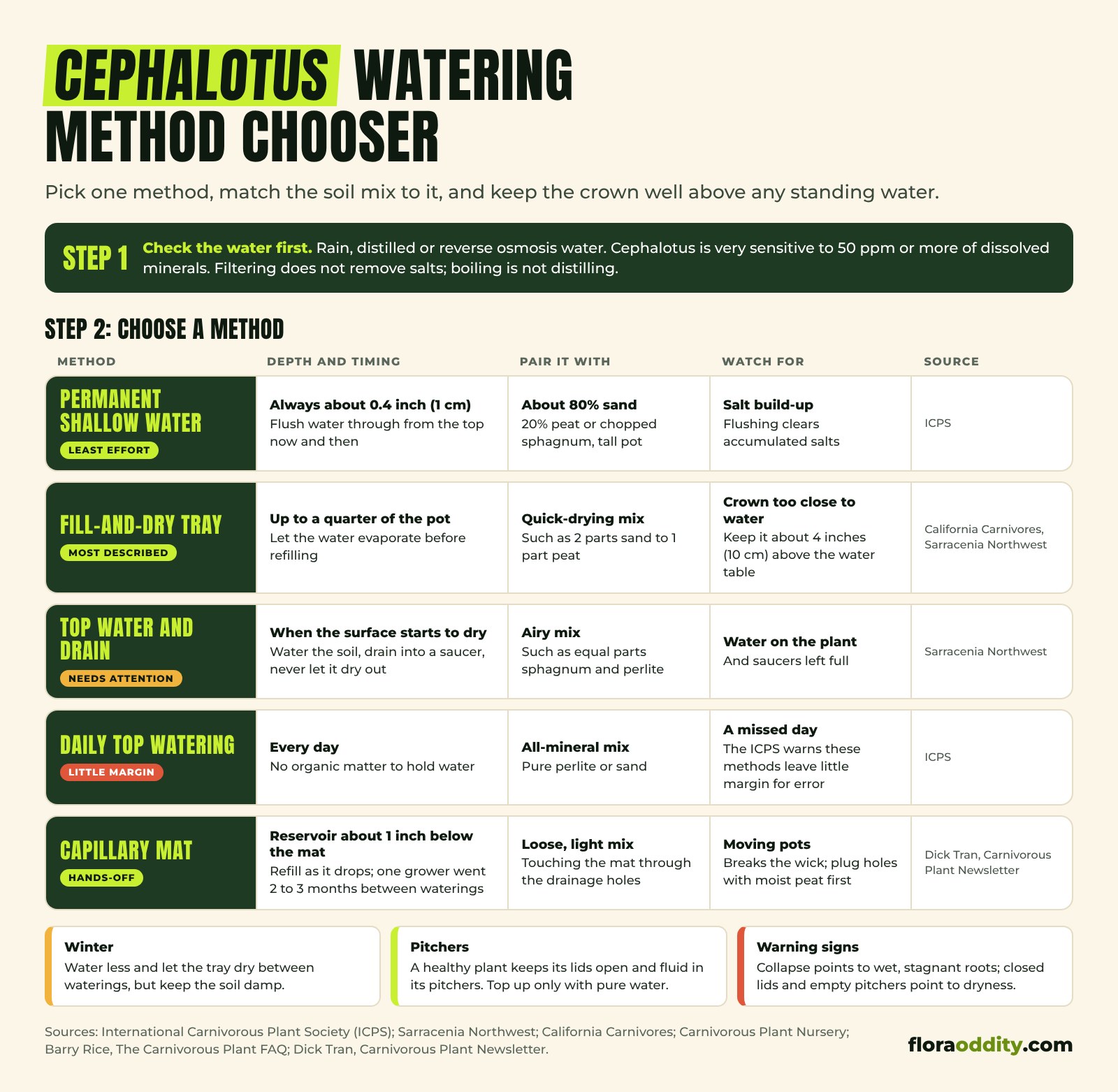
| Method | How deep, how often | Mix it suits | Watch out for | Source |
|---|---|---|---|---|
| Permanent shallow water | Pot always in about 0.4 inch (1 cm) of water; flush from above now and then | About 80% sand, 20% peat or chopped sphagnum, tall pot | Salt build-up; the ICPS flushes occasionally | ICPS |
| Fill-and-dry tray | Up to a quarter of the pot’s height; refill once the water has evaporated | Quick-drying mix such as 2 sand to 1 peat | Crown closer than about 4 inches (10 cm) to the water table for too long | California Carnivores, Sarracenia Northwest |
| Top water and drain | Water when the top of the soil starts to lose moisture; never let it dry out | Airy mix such as equal parts sphagnum and perlite | Water on the plant itself; saucers left full | Sarracenia Northwest |
| Daily top watering | Every day | All-mineral mixes such as pure perlite or sand | Little margin for error | ICPS |
| Capillary mat | Reservoir about 1 inch (2.5 cm) below the mat, refilled as it drops | Loose, light mix in contact with the mat | Moving pots breaks the wick | Dick Tran, Carnivorous Plant Newsletter |
| Winter, any method | Water less; let the tray dry between waterings | Same mix | Letting the soil itself dry out | Carnivorous Plant Nursery |
Why Cephalotus Watering Is Different
The ICPS explains the difference with two wetland types. Bogs usually have stagnant, waterlogged soil, and that is where most Sarracenia grow. Fens have water flowing through the soil. Cephalotus belongs to the second group. The Western Australian Herbarium’s Florabase sums up its habitat briefly: “Peaty soils. Around swamps & along streams.”
Robert Gibson, describing two wild sites in Carnivorous Plant Newsletter, found one population on “moist, sandy peat soil” near a sedge swamp, and another on a cliff in peaty clay “through which fresh water was constantly flowing.” That is the picture to copy: wet, but fresh and moving. A pot standing in deep, still water is closer to a bog.
The Main Watering Methods
Permanent shallow water with a sandy mix
This is the lowest-effort option. The ICPS uses about 20% peat or chopped long-fibred sphagnum to 80% sand, with the pots always sitting in about 0.4 inch (1 cm) of water, and says this “requires the least effort over time.” The sand drains so freely that the roots get air even though the base of the pot is always wet.
Two details make it work: tall pots, so the crown sits far above the water, and an occasional flush of water through the pot “to eliminate accumulated salts.”
The fill-and-dry tray
This is the method most of the nurseries describe. California Carnivores tells growers to use the tray method but to let the water evaporate before adding more, because Cephalotus “dislike long periods of being waterlogged.” It sets a hard limit: never fill the tray more than a quarter of the way up the pot. Sarracenia Northwest gives the same quarter-height limit and explains why. The roots get both moisture and air, but if the crown sits closer than about 4 inches (10 cm) to the water table for too long, the roots may rot.
The ICPS gives a similar margin in its advice on collapsing plants: keep all plant parts at least about 2 inches (5 cm) above the highest water level the pot may ever reach. Our rough arithmetic: in a pot about 6 inches (15 cm) tall, a quarter-height tray means water up to about 1.5 inches (4 cm), leaving the crown roughly 4 inches (10 cm) above it. In a shorter pot, keep the water lower.
Top watering and draining
Sarracenia Northwest says Cephalotus has water preferences similar to Nepenthes and Heliamphora, and that you can fit it into a normal houseplant routine: water from the top, let it drain into a tray or saucer, and keep the soil “moist at all times and never allowed to dry out.” In a reader Q&A about mould, Jeff Dallas of Sarracenia Northwest added the timing: water again “when the top of the soil begins to lose moisture,” and avoid getting water on the plant itself.
Top watering also gives the pot the flush the ICPS recommends, since water runs straight through and out of the drainage holes. The catch: a saucer left full turns it into an unplanned tray method.
All-mineral mixes and daily watering
The ICPS says growers on pure mineral soils such as perlite or sand top water daily, while growers on heavy organic mixes let the soil dry a little and then flush water through. Both methods “have little margin for error,” so they suit growers who check their plants every day.
Capillary mats and automatic trays
Dick Tran, writing in Carnivorous Plant Newsletter, grew more than twenty Cephalotus on a capillary mat in a 40 gallon (160 liter) tank. The mat drapes down into a reservoir of purified water kept just a few centimetres, about 1 inch, below it, and the pots stand on the mat and draw water up through their drainage holes. Tran top watered each pot only once, at potting, and advised against moving pots afterwards; if you must, plug the holes with moist peat first so the capillary action resumes. The payoff: “I can leave the plants alone for two to three months between watering!”
The medium must stay in contact with the mat, so Tran used a loose, light blend of perlite, peat, sand and orchid bark.
For a tray that tops itself up, the ICPS publishes a design by João Roberto Gabbardo that uses a cheap toilet-cistern float valve, with the water level set by bending the valve arm.
Matching the Method to the Mix
The ICPS puts it bluntly: “The trick is to use a soil mix appropriate for your growing conditions and watering methods.” Sandy mixes suit permanent shallow water, 2:1 sand and peat suits the fill-and-dry tray, and sphagnum with perlite suits top watering. Our Cephalotus soil mix guide covers the recipes and pot depth, so they are not repeated here. If you change the method, check that the mix still fits.
Water Quality: Pure Water Only
Check your water before you worry about the method. Sarracenia Northwest calls Cephalotus “very sensitive” to water with dissolved mineral levels of 50 ppm or more. California Carnivores waters with “distilled, reverse osmosis, or rainwater only,” and Carnivorous Plant Nursery simply says mineral-free water.
Test your tap water with our Carnivorous Plant Water Checker. Enter a TDS meter reading in ppm and it compares the number with the published limits. For Cephalotus, the strictest limit applies: aim for below 50 ppm.
For carnivorous plants in general, the ICPS allows tap water under 90 ppm and says to switch to distilled, reverse osmosis or clean rain water above that. Barry Rice, in the Carnivorous Plant FAQ, gives the usual target for purified water as “around 50 ppm or lower.” For Cephalotus, Sarracenia Northwest’s stricter 50 ppm limit is the one that matters.
Rain, distilled and reverse osmosis water
All three work:
- Distilled water: Rice stresses that boiling is not distilling. Boiling leaves the minerals behind in less water.
- Bottled water: the label must say “purified by distillation” or “purified by reverse osmosis,” according to Rice. “Drinking water” and “spring water” say nothing about mineral content.
- Home RO units: Rice suggests testing a cheap unit every three months. Jeff Dallas of Sarracenia Northwest adds that drinking water levels of chlorine and chloramine are “rarely harmful” to carnivorous plants.
- Rainwater: when a Sarracenia Northwest reader saw the TDS of collected rain jump in pollen season, Dallas explained that the meter also reads dissolved organic matter, so the higher number did not mean more minerals.
What does not fix hard water
The ICPS warns that ordinary filtering “will NOT remove the dissolved salts.” Rice notes that some growers, out of frustration, have even added salt to their Cephalotus, and that there is no evidence it does any good.
Summer and Winter Watering
In winter, Carnivorous Plant Nursery reduces watering and lets the tray go dry between waterings while keeping the soil evenly moist: “evenly moist, but not soaking wet” in summer, “drier, but still damp” in winter. California Carnivores sees no true winter dormancy, only slower growth. Neither lets the soil dry out.
There is a twist. Carnivorous Plant Nursery gives the wild habitat’s rainfall as about 1 inch (2.5 cm) a month in summer and 5 inches (13 cm) in winter, so wild plants are wettest in winter.
If a plant dies back, Rice’s advice is to “hold off on the water a bit and wait,” because new growth may appear a few months later.
Humidity, Misting and Terrariums
Cephalotus does not need a humid box. Sarracenia Northwest says a terrarium is not required, and Jeff Dallas warned that constant high humidity “is not at all necessary but can encourage lots of mold issues.” Carnivorous Plant Nursery rates the plant’s humidity needs as medium.
Terrariums still work. The ICPS says the plants grow well “especially in terrariums under LED bright light,” and Carnivorous Plant Nursery keeps terrariums vented and the soil “moist, but not waterlogged.” None of the care guides cited here recommend misting the plant.
Filling the Pitchers
Pitcher fluid doubles as a health check. The ICPS says “a healthy, well-adjusted Cephalotus will keep the pitcher lids open and maintain water in the pitchers.”
You do not have to top up pitchers, but several sources add water when feeding. In its propagation trials, the ICPS filled open pitchers with water and fed each one an Osmocote pellet, and it says pellets are fine “as long as there is water in the pitchers.” California Carnivores adds pellets “with distilled water,” and Tran filled the pitchers of new cuttings with water. Use the same pure water as for the soil.
Signs of Too Much or Too Little Water
Too wet or stagnant. Carnivorous Plant Nursery says the plant is prone to root rot and “may appear to ‘suddenly’ die if kept too hot or wet.” See sudden collapse and root rot for diagnosis and rescue. Fuzzy mould and powdery mildew point more to humid, still air.
Too dry. Lids closing over pitchers and pitchers that hold no fluid are signs to check; see pitchers drying up or lids closing. For dark or blackening pitchers, see the problems guide before changing the watering.
Not water at all. Flat leaves in winter are normal: Sarracenia Northwest says the winter rest brings “an abundance of flat, non-carnivorous leaves.” Out of season, see no pitchers, only flat leaves for the likely causes.
How Cephalotus Compares With Sarracenia and Butterworts
The ICPS guides show how far apart “the tray method” can be. For Sarracenia, pots “should always be sitting in about 4 to 6 cm of water,” roughly 1.5 to 2.5 inches, and should never dry out. That is several times the ICPS Cephalotus depth of 0.4 inch (1 cm), so a Cephalotus sharing a Sarracenia tray sits far wetter than any Cephalotus source accepts. Our Sarracenia care guide covers the bog-plant side.
Mexican butterworts sit closer. The ICPS author keeps them in 3.5 inch (9 cm) tall pots with up to about 0.75 inch (2 cm) of tray water while they have carnivorous leaves, does not worry if the trays dry for a few days, and lets them dry for a week or so in the succulent phase. The guide adds a tip that transfers well: with a light mix, you can judge how wet the soil is “by just picking up the pot.” See our butterwort care guide for the rest.
In watering terms, then, Cephalotus behaves less like a bog Sarracenia and more like a Mexican butterwort in a taller pot: shallow water, short dry gaps, pure water throughout.
A Simple Watering Routine
- Test the water. Measure TDS and run it through the water checker. Use rain, distilled or RO water if it reads 50 ppm or more.
- Choose one method that suits your mix and your schedule: permanent shallow water for a sandy mix, the fill-and-dry tray for sand and peat, or top watering for sphagnum and perlite.
- Know the limit. For trays, that is a quarter of the pot’s height (California Carnivores, Sarracenia Northwest), or about 0.4 inch (1 cm) for the permanent method (ICPS).
- Water around the crown, not over it. Pour onto the soil near the rim, or into the tray.
- Check by touch and weight. Feel the surface and lift the pot. Water again before the top of the soil fully dries.
- Flush now and then. Pour pure water through from the top so salts leave by the drainage holes.
- Ease off in winter. Let the tray empty between waterings, but keep the soil damp.
What Growers Report
These are single growers’ results in their own conditions, not rules.
- A grower who keeps pots of Cephalotus standing in water trays through the growing season, and occasionally top waters in hot, sunny weather, wrote that an expert had promised the method would cause root rot: “It’s now been 35 years and I’m still waiting.” The grower has switched to tall “long tom” pots to allow deeper water, so the reservoir lasts longer during trips away. (fredg, TerraForums, June 2018)
- Another grower waters Cephalotus “just like I do my mexican butterworts”: fill the tray, let it dry out for a couple of days, repeat. The same grower avoids top watering because, in that collection, wet pitchers “tend to brown.” (Baylorguy, TerraForums, February 2011)
- A terrarium grower waters from the top, with no tray or saucer, pouring around the perimeter of the pot to keep water off the crown, and in high humidity needs to water only “once every two weeks.” (Dave S., TerraForums, January 2006)
- A grower near Melbourne said trays usually work well there because of hot, dry winds, but in a cool, unusually humid summer fungal problems became “a big issue” and the grower had to take plants out of their trays and let them dry out. (Marcus B, Carnivorous Plants UK forum, May 2011)
Our takeaway: the growers disagree on trays versus top watering, but each one adjusted the water to the air around the plant. The humidity and drying rate of your room matter as much as the method.
Where Sources Differ
| Topic | One view | Another view | Context the sources give |
|---|---|---|---|
| Standing water | ICPS: pots always sitting in about 0.4 inch (1 cm) of water | California Carnivores: let the tray water evaporate before adding more; Carnivorous Plant Nursery: let the tray dry out between waterings | The ICPS pairs constant water with an 80% sand mix and occasional flushing; California Carnivores pairs its tray with a quick-drying 2:1 sand and peat mix |
| Top watering | Sarracenia Northwest: top water and drain like a houseplant | California Carnivores: “Use the tray method” | Sarracenia Northwest still offers a quarter-height tray as the alternative, and asks growers to keep water off the plant itself |
| Winter | Carnivorous Plant Nursery: reduce watering, let the tray dry between waterings | California Carnivores: no winter dormancy, only slower growth | Both keep the soil damp in winter |
| Safe crown height | Sarracenia Northwest: crown no closer than about 4 inches (10 cm) to the water table for long | ICPS: all plant parts at least about 2 inches (5 cm) above any future water level | Both are rules of thumb from different contexts: routine tray care and rescue after a collapse |
Common Mistakes
- Treating it like a Sarracenia. Deep, permanent tray water suits Sarracenia, not Cephalotus (ICPS).
- Using tap or filtered water without testing it. Filters do not remove dissolved salts, and boiling concentrates them.
- Letting the soil dry out “to be safe.” The ICPS and all three nurseries cited here want the soil damp, not dry.
- Pouring water over the whole plant. Water the soil, not the pitchers and crown.
- Forgetting the saucer. A full saucer under a top-watered pot is a tray, just without a plan.
- Never flushing. Pots that always stand in water collect salts over time, which is why the ICPS flushes them now and then.
- Keeping the same routine all year. Carnivorous Plant Nursery waters less in winter and lets the tray dry between waterings.
FAQ: How to Water Cephalotus
How often should I water Cephalotus?
There is no fixed schedule. With top watering, Sarracenia Northwest waters again when the top of the soil begins to lose moisture. With a fill-and-dry tray, refill once the tray is empty. The ICPS ties daily watering to all-mineral mixes such as pure perlite or sand.
Can I water Cephalotus with tap water?
Only if it tests below 50 ppm of dissolved minerals; Sarracenia Northwest says Cephalotus is very sensitive to 50 ppm or more. Check your reading with our water checker. Otherwise use rain, distilled or RO water.
Should I water Cephalotus from the top or the bottom?
Either works. The ICPS says pots can sit in a little water, be watered from above, or both, as long as the soil mix suits the method. If you top water, water the soil, not the plant.
Do I need to fill Cephalotus pitchers with water?
No. A healthy plant keeps its own fluid in the pitchers. The ICPS and California Carnivores add pure water when feeding, and the ICPS only puts fertilizer pellets in pitchers that hold water.
The Bottom Line
To water Cephalotus well, think fen, not bog: damp soil, pure water and a crown kept well above any standing water. Choose one method that fits your mix, whether permanent shallow water with sand, a quarter-height tray that dries between fillings, or top watering into a drained saucer. Keep your water below the 50 ppm line, flush the pot now and then, water a little less in winter, and watch the lids and pitcher fluid for early warnings.
Sources & Further Reading
- International Carnivorous Plant Society: Growing Cephalotus follicularis
- International Carnivorous Plant Society: Growing Dionaea (water quality and TDS)
- International Carnivorous Plant Society: Growing Sarracenia
- International Carnivorous Plant Society: Growing Mexican Pinguicula
- International Carnivorous Plant Society: Mechanical Tray Water Control (João Roberto Gabbardo)
- Barry Rice, The Carnivorous Plant FAQ: Cephalotus cultivation
- Barry Rice, The Carnivorous Plant FAQ: About buying purified water
- Sarracenia Northwest: How to Grow Cephalotus
- Sarracenia Northwest: Q/A #56, Fuzzy Mold on Cephalotus
- Sarracenia Northwest: Q/A #57, Is Pollen in Rainwater Bad for Carnivorous Plants?
- Sarracenia Northwest: Q/A #118, Is Chlorine Toxic to Carnivorous Plants?
- California Carnivores: Australian Pitcher Plants (Cephalotus follicularis) Growing Tips
- Carnivorous Plant Nursery: Growing Tips for Cephalotus
- Western Australian Herbarium, Florabase: Cephalotus follicularis
- Robert Gibson: Observations on Cephalotus in the wild, Carnivorous Plant Newsletter 28(1), 1999
- Dick Tran: Cephalotus follicularis, cultivation with capillary mats, Carnivorous Plant Newsletter, 2001
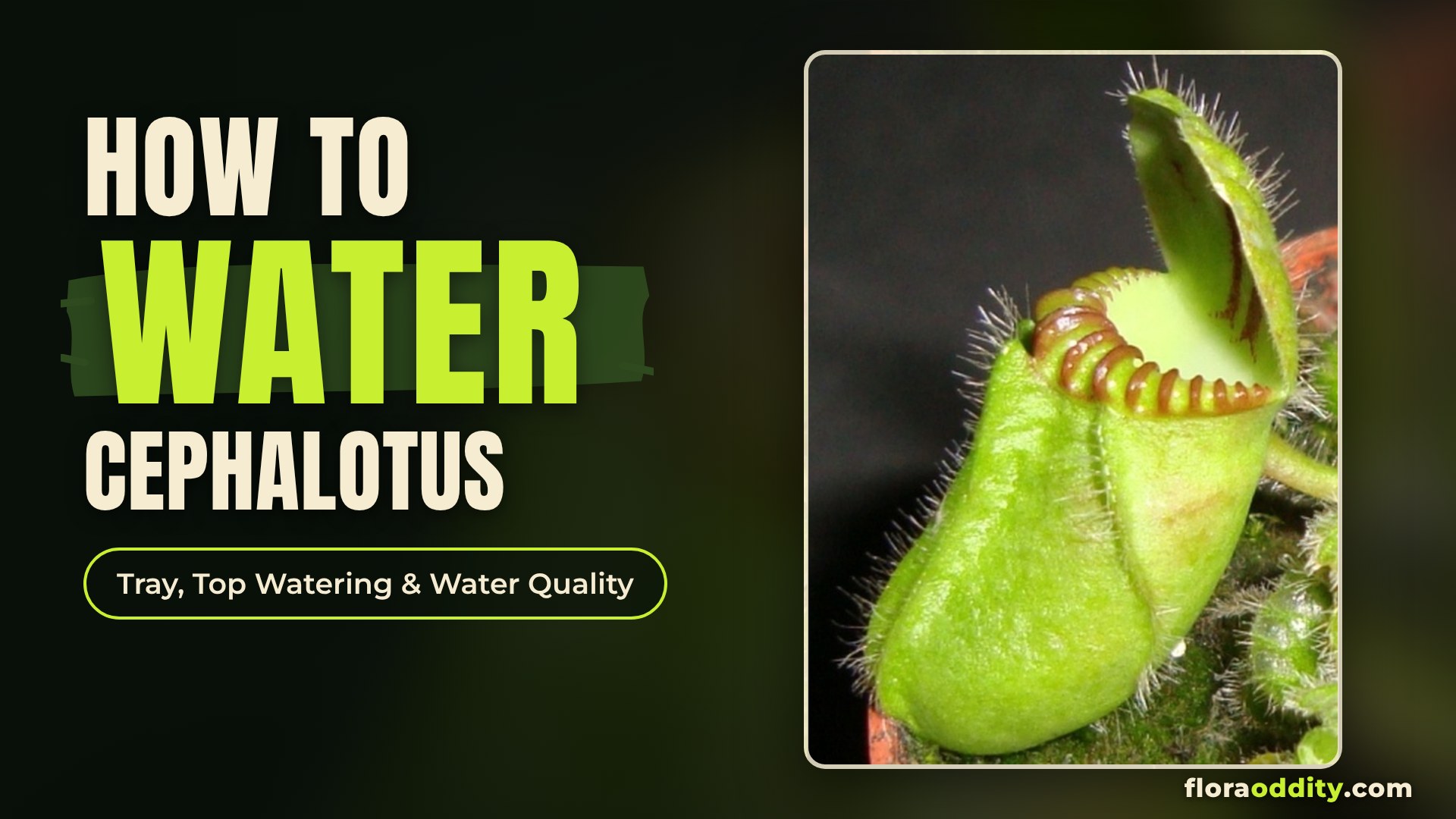
Featured image based on a photo of a Cephalotus follicularis pitcher by Enigma75 via Wikimedia Commons, public domain, with a blurred background and typography added by FloraOddity.
Final articles are editorially reviewed and factual claims are checked against cited sources. Last reviewed: October 2026.