
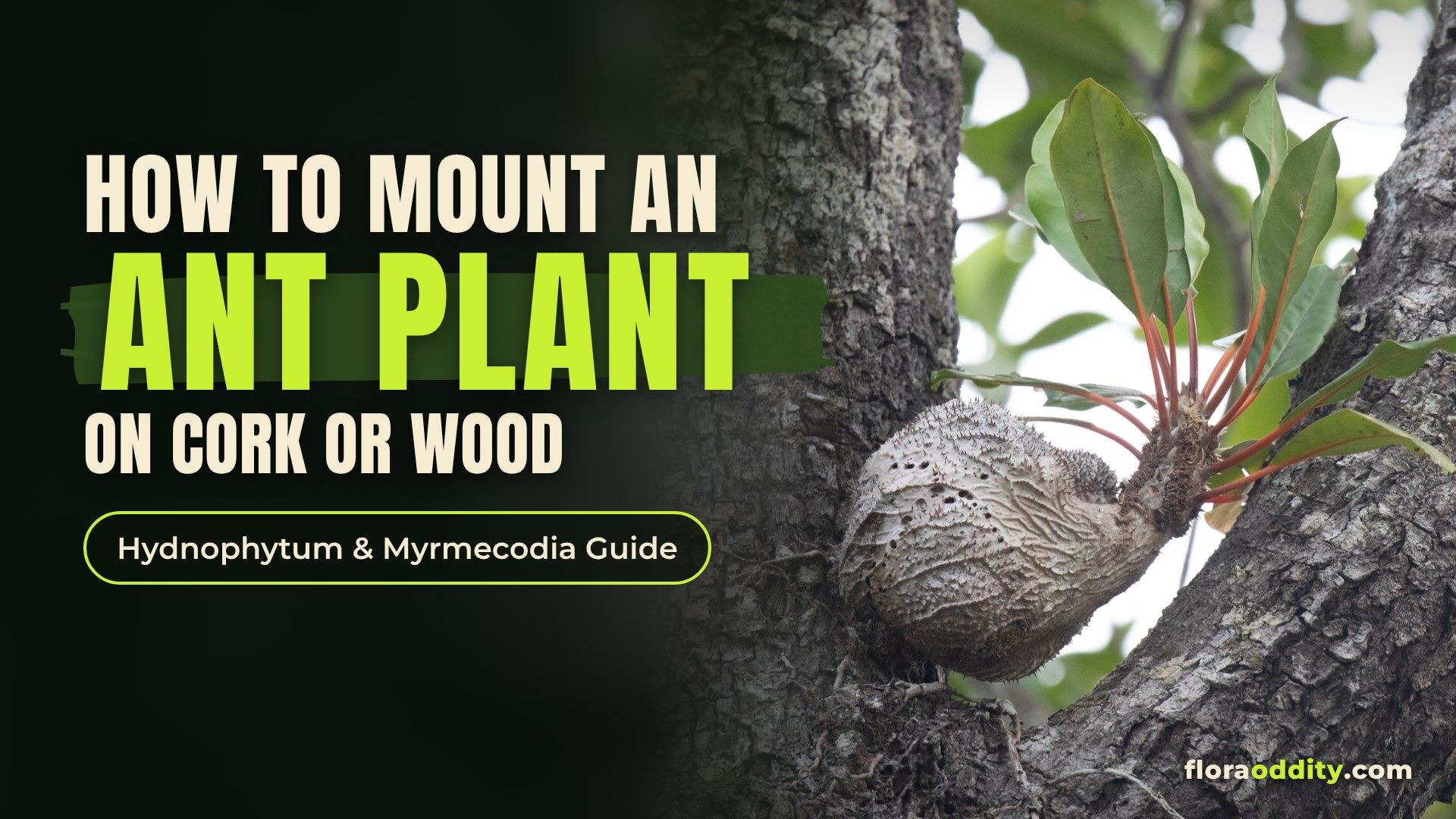
Ant plants from specialist nurseries usually arrive in a small pot. In the wild, though, a Hydnophytum or Myrmecodia never sees a pot. It sits on a branch or in the fork of a trunk, with its swollen tuber clamped to the bark and its roots running over the surface. So it is natural to ask whether you can grow one the same way, on a slab of cork or a piece of wood.
You can, and at least one botanic garden does. But mounting changes how the plant gets water, and the sources that describe it are fewer and briefer than you might hope. This guide collects what the botanical literature, a botanic garden, a horticultural society and several specialist growers actually say, and it points out the steps where nobody gives clear instructions.
The Short Answer
To mount an ant plant, you fix it to a piece of cork bark or wood instead of potting it. The Royal Horticultural Society (RHS) lists “mounted on cork” as an alternative to an orchid bark mix for Myrmecodia tuberosa. LLIFLE says plants “can be mounted on cork bark plaques for a more natural appearance”, but only “if humidity is high”, and adds that mounted plants “will, of course, require more frequent watering.” The Australian National Botanic Gardens (ANBG) grows Myrmecodia beccarii on cork slabs and waters those plants every day, against every second or third day for potted plants. So a mount suits a humid setting where you can water often; LLIFLE’s own condition points dry rooms toward a pot.
Why Ant Plants Can Live on a Mount
Hydnophytum and Myrmecodia are epiphytes, plants that grow on trees. The 2019 revision of Hydnophytum by Jebb and Huxley describes the genus as “Epiphytic, rarely terrestrial”, and lists its habitats from “strand-line trees” and mangrove forest through Eucalyptus savannah, rainforest, “agricultural trees” and heath forest up to mossy mountain forest. The 1993 Myrmecodia revision by Huxley and Jebb says Myrmecodia “is epiphytic on a wide range of trees, being common on Melaleuca, Casuarina, Castanopsis, and Nothofagus.”
Field records name individual hosts too. The paper by Lok and Tan of the National University of Singapore includes photographs of Myrmecodia tuberosa on a cicada tree (Ploiarium alternifolium) in Bako National Park, Sarawak, and Hydnophytum formicarum growing on a Garcinia tree beside a young staghorn fern in Singapore’s Nee Soon Swamp Forest.
The plants start life on bark as well. Lok and Tan describe ants carrying seeds away and “leaving them in ant tunnels along the bark of the tree, where they later germinate into a new plant.” The ANBG page notes that M. beccarii seeds “germinate readily along the stems of trees in glasshouse conditions.”
The tuber is built for a life on bark. LLIFLE describes the H. formicarum tuber as “fixed to trees by fibres like the stems of ivy”, and says the M. tuberosa tuber “clings to trees with its roots”. The Hydnophytum revision notes that in H. formicarum the roots are “confined to substrate side of tuber”, and that across the genus the entrance holes are “more numerous on substrate-facing side of tuber.”
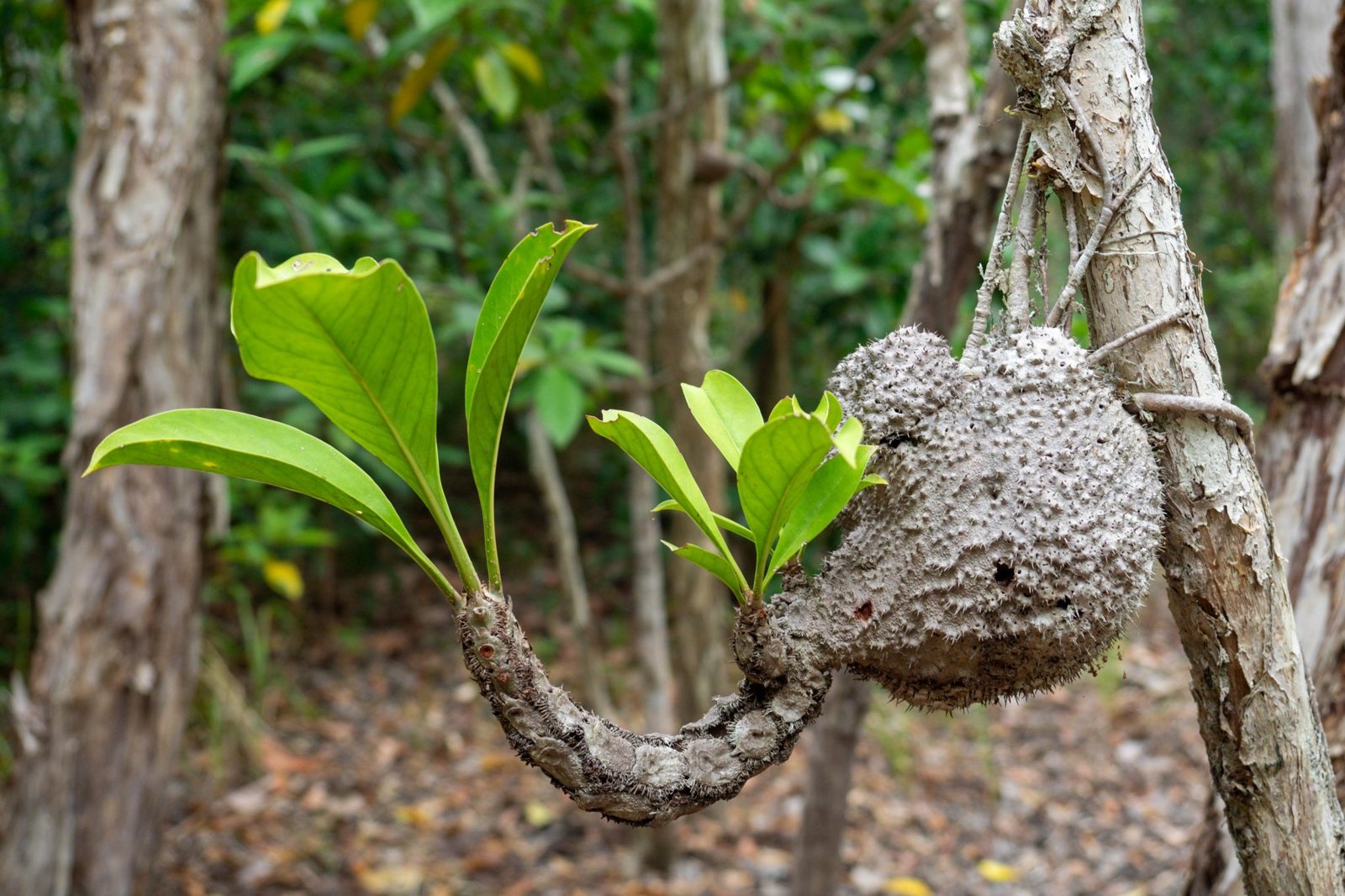
One more point from the Myrmecodia revision: the genus is “rare on trees with a smooth or non-absorbent, flaking bark, such as Eucalyptus.” The revision does not test mount materials, but it shows that in nature these plants do not grow on every kind of bark equally.
Mount or Pot? The Trade-offs
None of the sources compares mounted and potted ant plants side by side. Putting together what each one says, the trade-offs look like this.
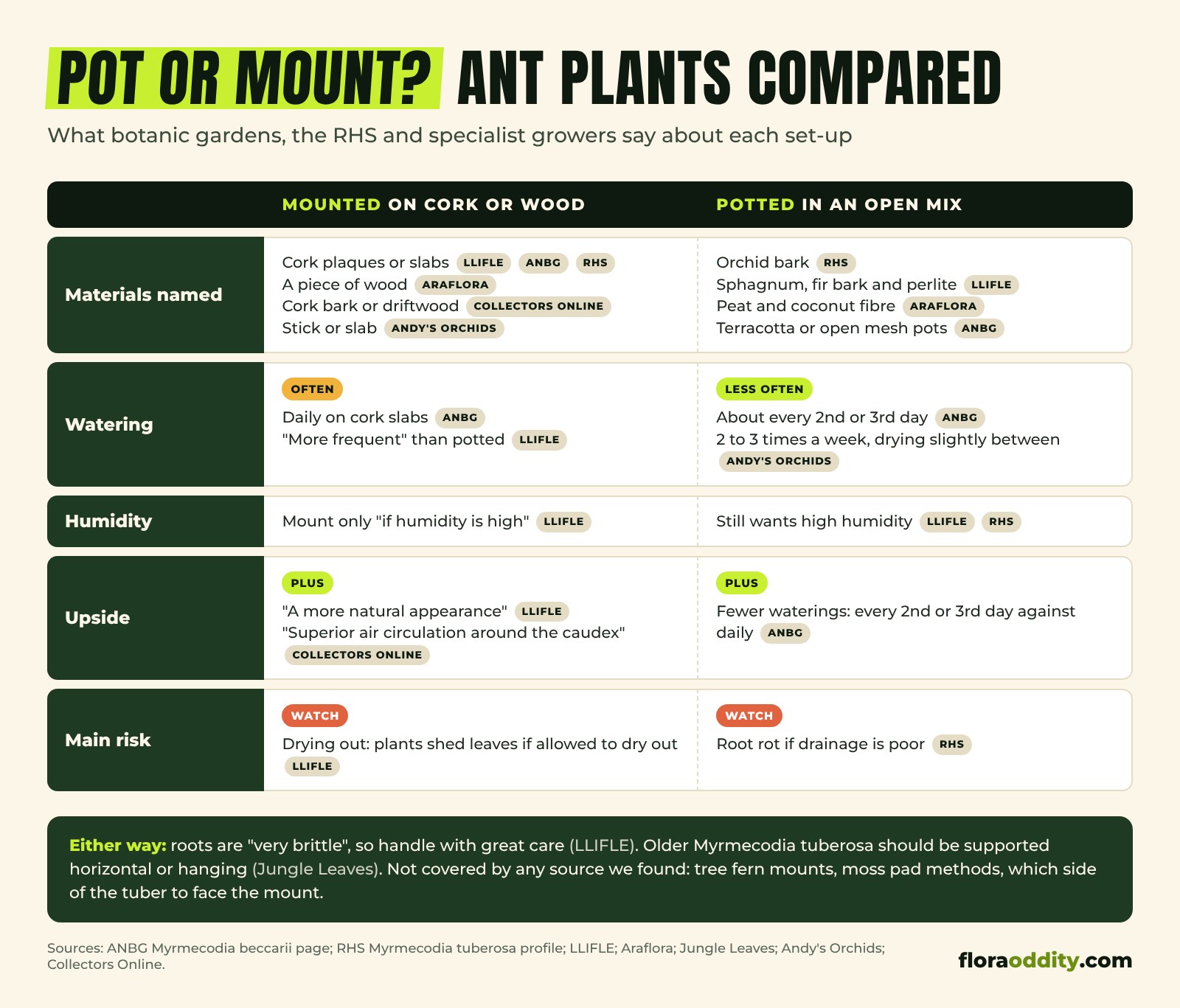
| Mounted | Potted | |
|---|---|---|
| Materials named | Cork plaques or slabs (LLIFLE, ANBG, RHS); “a piece of wood” (Araflora); cork bark or driftwood (Collectors Online); stick or slab (Andy’s Orchids) | Orchid bark (RHS); sphagnum, fir bark and perlite (LLIFLE); peat and coconut fibre (Araflora); terracotta or open mesh pots (ANBG) |
| Watering | Daily on cork slabs (ANBG); “more frequent” than potted (LLIFLE) | About every second or third day (ANBG); 2 to 3 times a week, drying slightly between (Andy’s Orchids) |
| Humidity | Mount only “if humidity is high” (LLIFLE) | Still wants high humidity (LLIFLE, RHS) |
| Main upside | “A more natural appearance” (LLIFLE); “superior air circulation around the caudex” (Collectors Online) | Fewer waterings: every second or third day against daily (ANBG) |
| Main risk | Drying out: plants shed leaves if allowed to dry out (LLIFLE) | Root rot if drainage is poor (RHS) |
The watering gap is the deciding factor. On ANBG’s numbers, a mounted plant needs two to three times as many waterings as a potted one. LLIFLE adds that ant plants are “quick to shed their leaves if they are allowed to dry out or become too cold”, so a mount that dries out on a busy day can cost you leaves.
Mount Materials the Sources Mention
Cork bark. This is the material named most often. LLIFLE suggests “cork bark plaques”, the RHS says “mounted on cork”, and the ANBG states that it uses cork for its slab-mounted M. beccarii.
Wood. Araflora’s M. tuberosa page says the plant “can of course be attached to a piece of wood as it would be in the wild, but it can also be grown in a pot.” The Australian online plant shop Collectors Online writes that many growers mount Myrmecodia “on pieces of cork bark or driftwood, mimicking their natural growth on tree branches.”
Sticks and slabs. The California nursery Andy’s Orchids offers its Myrmecodia as a “Stick or Slab Mounted Plant” as well as in 2 and 3 inch pots, and says to “grow as a terrestrial or as a mounted plant.” In a 2006 thread on Terraforums, one grower wrote that he planned to “mount them epiphytically on some dried branches”; the thread does not report how that went.
Tree fern. None of the ant plant sources we opened mentions tree fern as a mount, and we found no grower or garden describing it for Hydnophytum or Myrmecodia, so we cannot give guidance on it.
How Growers Attach the Plant
This is where the sources are thinnest. Only one gives an attachment method. Collectors Online says to “secure them gently with wire or fishing line until their roots attach.” None of the sources specifies a wire gauge, how tight to tie, or how long the roots take to grip.
What the sources do explain is why the plant will hold on once it is in place. LLIFLE writes that ant plants “seem capable of producing new roots from any part of the tuber that is in contact with a moist substrate.” The same page warns that “the roots of Hydnophytum and Myrmecodia are very brittle, so great care must be taken when repotting.” Moving a potted plant onto a mount means taking it out of its pot, so that warning applies here too.
Moss Padding: What the Sources Say
No ant plant source we opened describes padding a mount with moss. The closest evidence is botanical. The Hydnophytum revision notes that “in high-humidity conditions, or when sunken under moss-cushions, many species will develop roots on their tubers.” That fits LLIFLE’s point that new roots form wherever the tuber touches a moist surface.
Growers mention sphagnum mostly as a potting medium. LLIFLE recommends “an open orchids substrate (sphagnum moss, chopped fir bark, and perlite)” for pots, and a Terraforums grower wrote that his plants “grow well mounted or in a pot of long fibered sphagnum moss and orchid bark.” Neither says how much moss to put on a mount, so treat moss on a mount as untested by these sources.
Watering and Humidity for Mounted Plants
Water more often. The ANBG is the only source that puts a number on it: “Plants that are mounted on slabs (the ANBG uses cork) need daily watering.” Its potted plants are “watered about every second or third day.” LLIFLE agrees in direction but gives no schedule.
Let it dry a little, but not much. The ANBG says M. beccarii “should dry out between waterings, however not too much otherwise they will wilt.” The page also warns that “in cooler weather, watering must be reduced, otherwise brown and corky patches will appear on the leaves.” If you see those patches, our guide to ant plant caudex problems covers other changes on the tuber.
Misting. Collectors Online writes that “regular misting of the caudex and surrounding air is often more beneficial than drenching the substrate, especially for mounted specimens.” The RHS says M. tuberosa “may benefit from occasional misting with rainwater.”
Humidity. LLIFLE says ant plants need “warm temperatures all year round with high humidity and bright light, though some protection from mid-day sun may be warranted,” and makes high humidity the condition for mounting. The RHS asks you to “maintain high humidity” and position the plant “in bright filtered light with protection from hot sun.”
Warmth. The RHS rates M. tuberosa H1A, which it defines as “under glass all year”, above 59 °F (15 °C). The ANBG says M. beccarii thrives in a night and day range of the “low 20°s to low 30°s” (no unit is given; read as Celsius, roughly 70 to 90 °F). Andy’s Orchids lists 58 °F minimum to 88 °F maximum (about 14 to 31 °C), and Collectors Online says “ideally above 18°C” (64 °F).
For the full routine for potted plants, see our ant plant care guide.
Terrarium, Greenhouse or Home?
The sources that describe mounted plants are mostly describing a humid setting. The ANBG mounts its plants in a glasshouse, and LLIFLE ties mounting to high humidity.
Jungle Leaves, a German nursery, says M. tuberosa “is best kept in a terrarium or plant display case, but can also be kept as a houseplant after acclimatization”, and gives the same advice for its young M. beccarii. Andy’s Orchids calls its Myrmecodia “great as a house plant and in vivariums.”
Grower experience on Terraforums is mixed, and each account is a single case. One grower wrote: “I grow them all in terrariums, my house is too dry and dark to grow in the windowsill.” Another grew Hydnophytum “as a house plant on a sunny windowsill, in low humidity” at 59 to 68 °F (15 to 20 °C), but “tried one in a lowland tank once and it rotted very quickly.” Neither post says whether those particular plants were mounted.
Which Way Up? Orientation of the Caudex
Many ant plants do not grow upright in nature. Jungle Leaves says M. tuberosa “is an epiphyte and only grows upright as a young plant”, and that “in nature, the elongated caudex is horizontal or hanging, and the plant should be supported in this position to ensure good growth.” LLIFLE describes the H. formicarum tuber as “horizontal to pendent (in nature)” and the M. tuberosa caudex as “often growing hanging downward.”
The Myrmecodia revision describes the tubers of several M. tuberosa forms as “horizontal to pendulous” or “pendent”, and the German nursery Wistuba describes Myrmecodia longissima as one of the Myrmecodia species “which in nature usually hang downwards and grow downwards as epiphytes.”
Jungle Leaves does not say how to give that support, and no source we found tells you exactly which way to face the tuber on a slab. The botanical notes that roots and entrance holes cluster on the side facing the bark are the only clue we found.
Where Sources Differ
How often to water a mount. The ANBG says daily. LLIFLE says only “more frequent” than potted. Collectors Online leans on misting the caudex over drenching. The ANBG figure comes from a glasshouse collection of one species, M. beccarii, so it is a reference point rather than a rule.
How much humidity. LLIFLE and the RHS call for high humidity. One Terraforums grower disagreed, writing that “Hydnophytum and Myrmercodia ant plants are not really that fond of high humidity and being wet, they tend to melt down” and that his did “better at normal room humidity for me 20-40% as long as I remember to keep the soil moist.” He also stressed that “you will need to ensure the tank is very well ventilated”. That is one grower’s experience, and he was writing about plants in soil, not on mounts.
How dry is too dry. The ANBG wants plants to dry out between waterings but not to the point of wilting, Andy’s Orchids says to let them “dry slightly”, and LLIFLE warns that the plants shed leaves if they dry out. All three agree that a fully dry plant is a problem; they differ on how close to that point you should go.
Pot media, if you decide not to mount. LLIFLE prefers an orchid mix, Araflora uses peat and coconut fibre, and the ANBG uses a coarse mix of weathered red gum chips, sand, coco peat and scoria.
Common Mistakes With Mounted Ant Plants
- Mounting in a dry room. LLIFLE makes high humidity the condition for mounting at all.
- Watering a mount on a pot schedule. The ANBG waters slab-mounted plants daily and potted ones every second or third day.
- Letting it dry out completely. LLIFLE says the plants are quick to shed leaves if they dry out, and the ANBG says they wilt.
- Rough handling during the move. LLIFLE describes the roots as “very brittle”.
- Forcing an older M. tuberosa upright. Jungle Leaves says the caudex should be supported horizontal or hanging.
- Not cutting back water in cool weather. The ANBG links overwatering in cool weather to brown, corky patches on the leaves.
FAQ: Mounting Ant Plants
Can you mount an ant plant on tree fern?
None of the ant plant sources we opened mentions tree fern. They name cork, wood, driftwood, sticks and slabs.
How often should I water a mounted ant plant?
More often than a potted one. The ANBG waters its cork-mounted Myrmecodia beccarii daily; LLIFLE gives no schedule beyond “more frequent watering.”
Can Hydnophytum be mounted, or only Myrmecodia?
Both. LLIFLE’s cork plaque advice appears on its Hydnophytum formicarum page as well as its Myrmecodia tuberosa page.
Does a mounted ant plant need ants?
No. The Myrmecodia revision says “the plants can be cultivated readily without the ants, and form apparently normal, chambered tubers,” and LLIFLE says they “can be grown in cultivation without the ant species being present.” For more, see do ant plants need ants?
Is a mounted ant plant fine on a windowsill?
LLIFLE suggests mounting only “if humidity is high”. One Terraforums grower kept Hydnophytum on a windowsill in low humidity, but did not say whether the plant was mounted.
The Bottom Line
Hydnophytum and Myrmecodia grow on bark in the wild, and botanic gardens and nurseries grow them on cork and wood. The sources agree on the main cost: a mounted plant dries out faster, and the ANBG waters its cork slabs daily. Mount only if you can give high humidity and frequent water, support older Myrmecodia tuberosa horizontal or hanging, and handle the brittle roots gently. On the practical details of tying the plant down, moss padding and tree fern, the published advice is thin.
Sources & Further Reading
- Jebb, M. H. P. and Huxley, C. R. (2019). The tuberous epiphytes of the Rubiaceae 7: A revision of the genus Hydnophytum. Blumea 64: 23 to 91
- Huxley, C. R. and Jebb, M. H. P. (1993). The tuberous epiphytes of the Rubiaceae 5: A revision of Myrmecodia. Blumea 37: 271 to 334
- Lok, A. F. S. L. and Tan, H. T. W. (2009). Tuberous, epiphytic, rubiaceous myrmecophytes of Singapore. Nature in Singapore 2: 231 to 236
- Australian National Botanic Gardens: Myrmecodia beccarii, Growing Native Plants
- RHS Plant Profile: Myrmecodia tuberosa
- LLIFLE Encyclopedia: Hydnophytum formicarum
- LLIFLE Encyclopedia: Myrmecodia tuberosa
- Jungle Leaves: Myrmecodia tuberosa
- Jungle Leaves: Myrmecodia beccarii
- Araflora: Myrmecodia tuberosa ‘L’
- Wistuba: Myrmecodia longissima (Jayapura, Irian Jaya)
- Andy’s Orchids: Myrmecodia (Ant Plant) species
- Collectors Online: Myrmecodia, Discover Australia’s Own Fascinating Ant Plants
- Terraforums: Ant plant (thread, 2010 to 2011)
- Terraforums: Hydnophytum and Myrmecodia (thread, 2006)
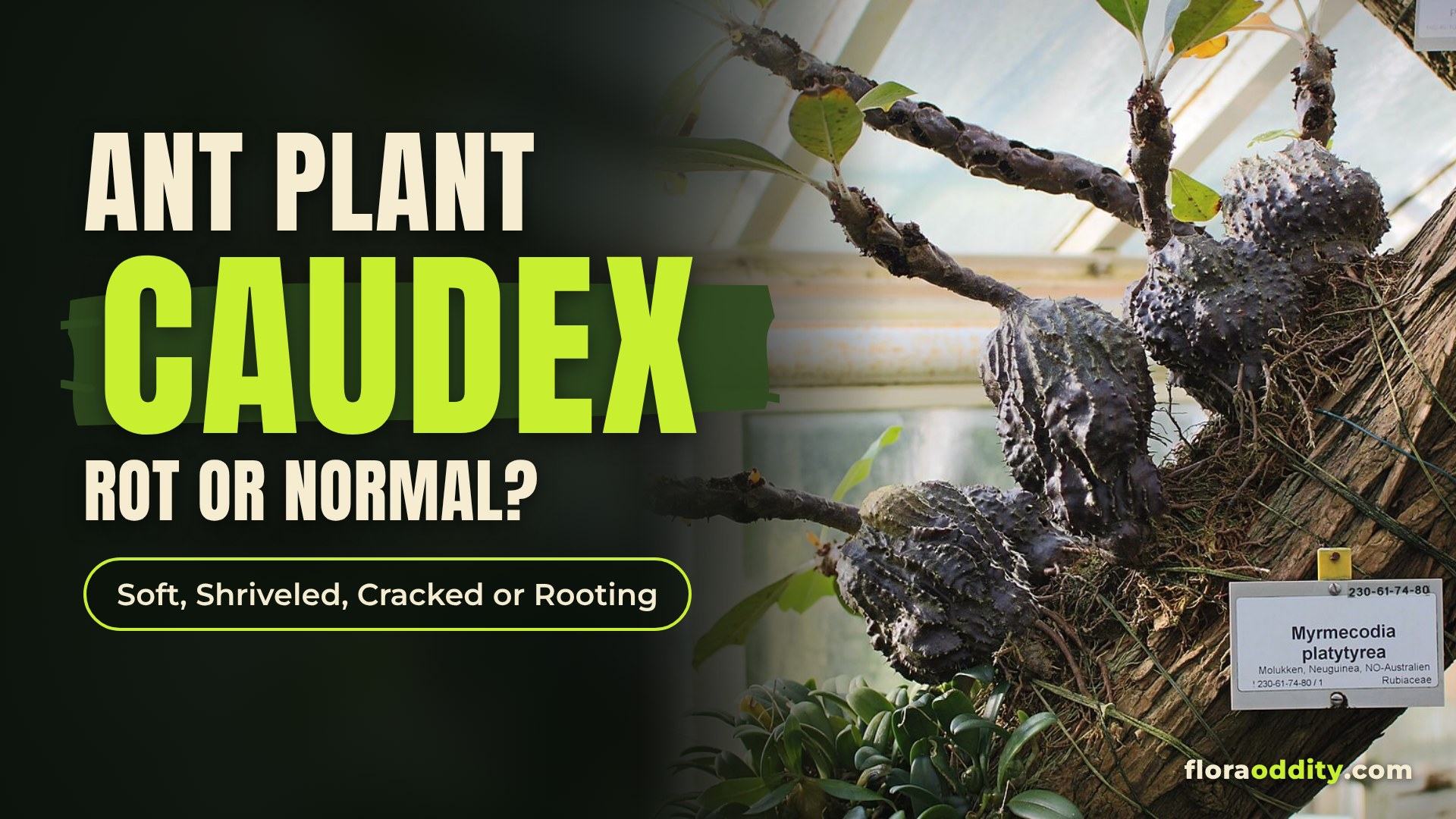
Featured image based on a photo of Myrmecodia platytyrea growing wild on Waigeo Island, West Papua, by Kristof Zyskowski via Wikimedia Commons, CC BY 4.0, with cropping and typography added by FloraOddity.
Final articles are editorially reviewed and factual claims are checked against cited sources. Last reviewed: October 2026.
One Comment