
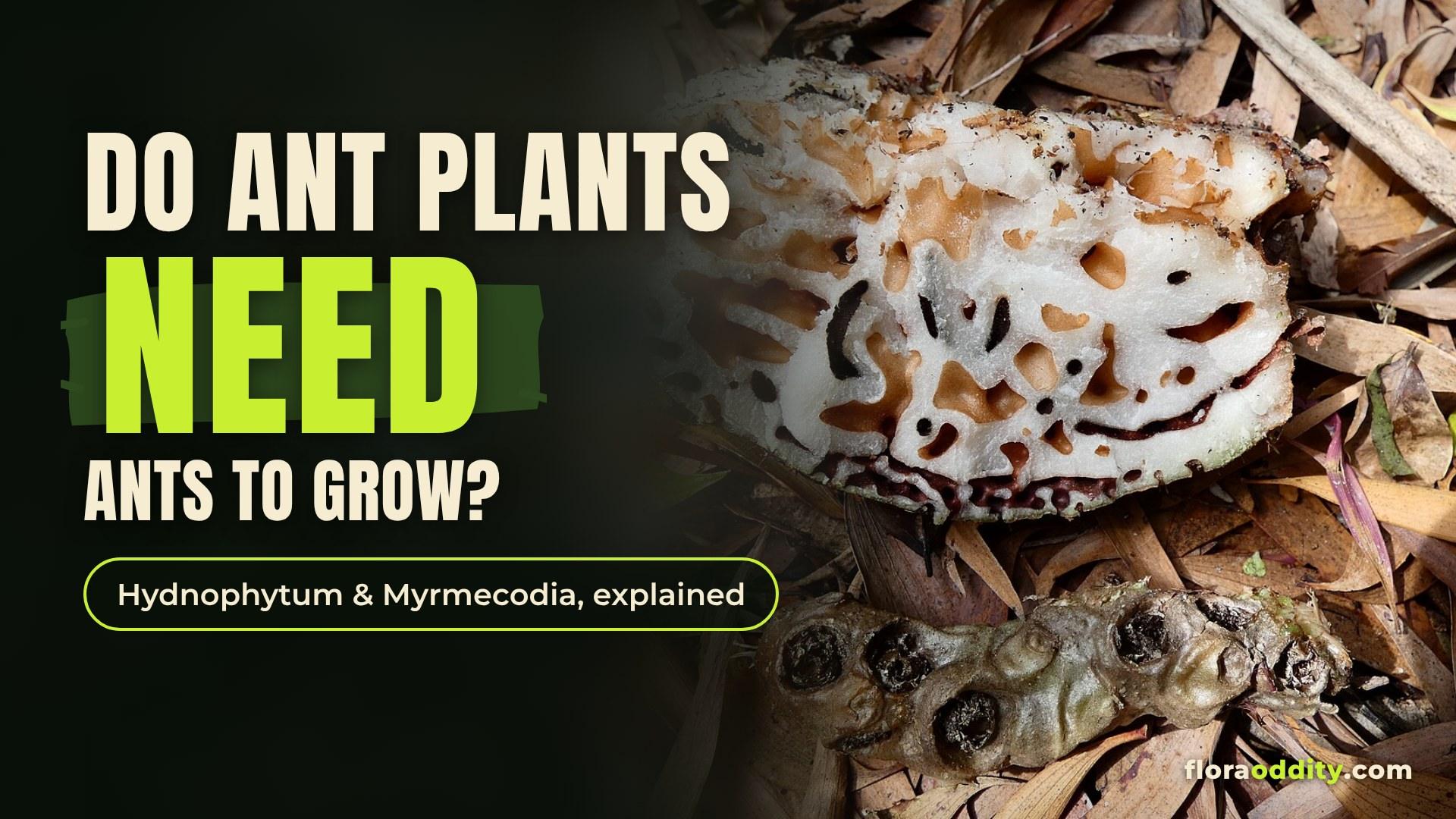
Buy a Hydnophytum or a Myrmecodia and the first question is almost always the same: where are the ants? The swollen base is full of tunnels and entrance holes that look made for a colony, and the common name practically promises one. Then the plant arrives, the holes are empty, and you start to wonder whether something is missing.
It is a fair question, because in the wild these plants really do share their homes with ants, and the ants really do feed them. This article explains what that partnership involves, which ants are involved, why so many ant plants live without ants even in nature, and what an empty set of chambers means for the way you look after your plant.
The Short Answer
Do ant plants need ants? Not in cultivation. Both Hydnophytum and Myrmecodia grow their hollow, chambered tubers with or without a colony, and specialist nurseries sell them ant free. In the wild, ants raise their young inside the tuber and leave waste and insect remains in special warted chambers, and the plant absorbs nitrogen from that debris. Indoors, a light feed through the potting mix covers that job. Do not try to add ants: the wild partners are mostly specialist ants, and ordinary house ants are more likely to bring pest problems than benefits.
What the Ants Do for the Plant in the Wild
Who lives inside
The ants found in these tubers are not random visitors. In their revision of Myrmecodia, botanists C. R. Huxley and M. H. P. Jebb write that wild plants “are almost invariably inhabited by ants and more consistently by three species of the genus Iridomyrmex than are the other Hydnophytinae.” Myrmecodia, they say, is the genus most closely associated with ants of the five related genera.
You will see different ant names depending on the age of the source. The 2019 revision of Hydnophytum by Jebb and Huxley explains that the most frequent ant inhabitants “were formerly placed in the genus Iridomyrmex” and have since been moved to other genera, mainly Philidris and Anonychomyrma. The Philidris species are small and orange; the Anonychomyrma species are larger, black and pungent smelling. For Hydnophytum formicarum, the species you are most likely to own, the revision says the tuber is “nearly always inhabited by ants, and usually by Philidris cordata.”
That is the typical partner, not the only one. The same revision records some 19 ant species from 14 genera in Hydnophytum tubers. Lok and Tan of the National University of Singapore observed that wild H. formicarum in Singapore hosted different ants depending on which other ant-associated plants grew nearby, including Crematogaster, Camponotus, Technomyrmex and Iridomyrmex species.
Nursery chambers and waste chambers
The inside of a mature tuber is not one big hole. The Myrmecodia revision describes later cavities made of three types of chamber: superficial, inner smooth, and warted. Lok and Tan’s review, drawing on C. R. Huxley’s 1978 study, explains how the ants use them: they “house their larvae and pupae in the smooth-walled chambers and leave waste material, and insect parts” in chambers lined with small, white swellings called warts, “which are highly absorptive.” The nutrients “are then absorbed via the warts and are then transported to the rest of the plant.”
The Botanic Garden of the Karlsruhe Institute of Technology (KIT) puts it more bluntly on its Myrmecodia page. The ants use some chambers “as toilet and storage for killed prey,” while other chambers are nurseries with smooth, water-repellent walls. It adds that the warts in the waste chambers let the plant take up organic nitrogen, which matters because an epiphyte has no soil to draw nitrogen from.
Evidence that the nitrogen reaches the leaves
This is not just a tidy story. In a 2022 study published in Biotropica, Volp, Cernusak and Lach of James Cook University fed ant colonies living in Myrmecodia beccarii a sugar solution labeled with a traceable form of nitrogen (15N). The label turned up in the plants’ leaves three and six weeks later, showing that nitrogen passed from the ants to the plant. The authors note that epiphytes, “with no access to soil nutrients, are thought to be more reliant on ant-derived nutrients.”
The Myrmecodia revision even suggests the ants may shape how the plant looks: Myrmecodia’s leaves “may reflect improved nutrient status due to ants,” compared with Hydnophytum, which often has small, tough (sclerophytic) leaves.
There is one more job. According to Lok and Tan, both genera are mainly ant dispersed: the ants carry seeds away and leave them in their tunnels along the bark, where they germinate.
Ant Plants Without Ants
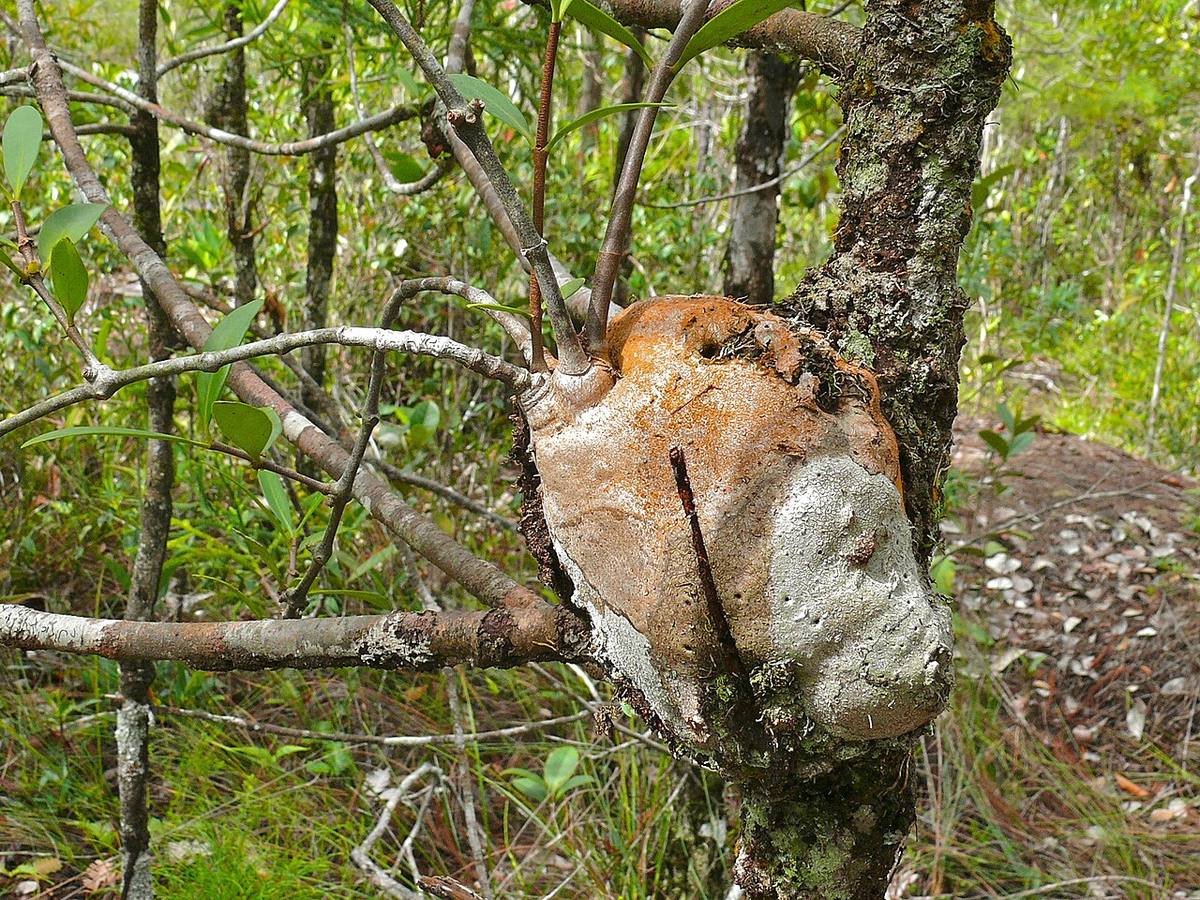
Here is the part most care guides skip: plenty of ant plants live without ants in the wild, too.
The Hydnophytum revision states plainly that the term ant-plant “is something of a misnomer when applied to Hydnophytum.” Only a small proportion of species have cavities regularly inhabited by ant colonies, and only about 14 species are regularly occupied. Many high-mountain species are recorded as “Tuber not inhabited by ants.” Other species’ cavities hold invertebrates, frogs, or simply rainwater.
The same revision makes the key point for growers: “Whether the cavities are occupied by an ant-colony or not, the tuber cavities act as an efficient nutrient and or water-gathering organ and the tissues as a storage organ.” The tuber is useful to the plant either way.
In cultivation, the answer is even clearer. Huxley and Jebb write that Myrmecodia plants “can be cultivated readily without the ants, and form apparently normal, chambered tubers.” The LLIFLE entry for Hydnophytum formicarum agrees that the plants “can be grown in cultivation without the ant species being present.” The Volp study is a good real-world example: its two-year-old M. beccarii came from a commercial nursery where they had been grown from seed and regularly fertilized, and they had not, as far as the authors knew, ever housed ants.
What the Ants Do vs What You Do Indoors
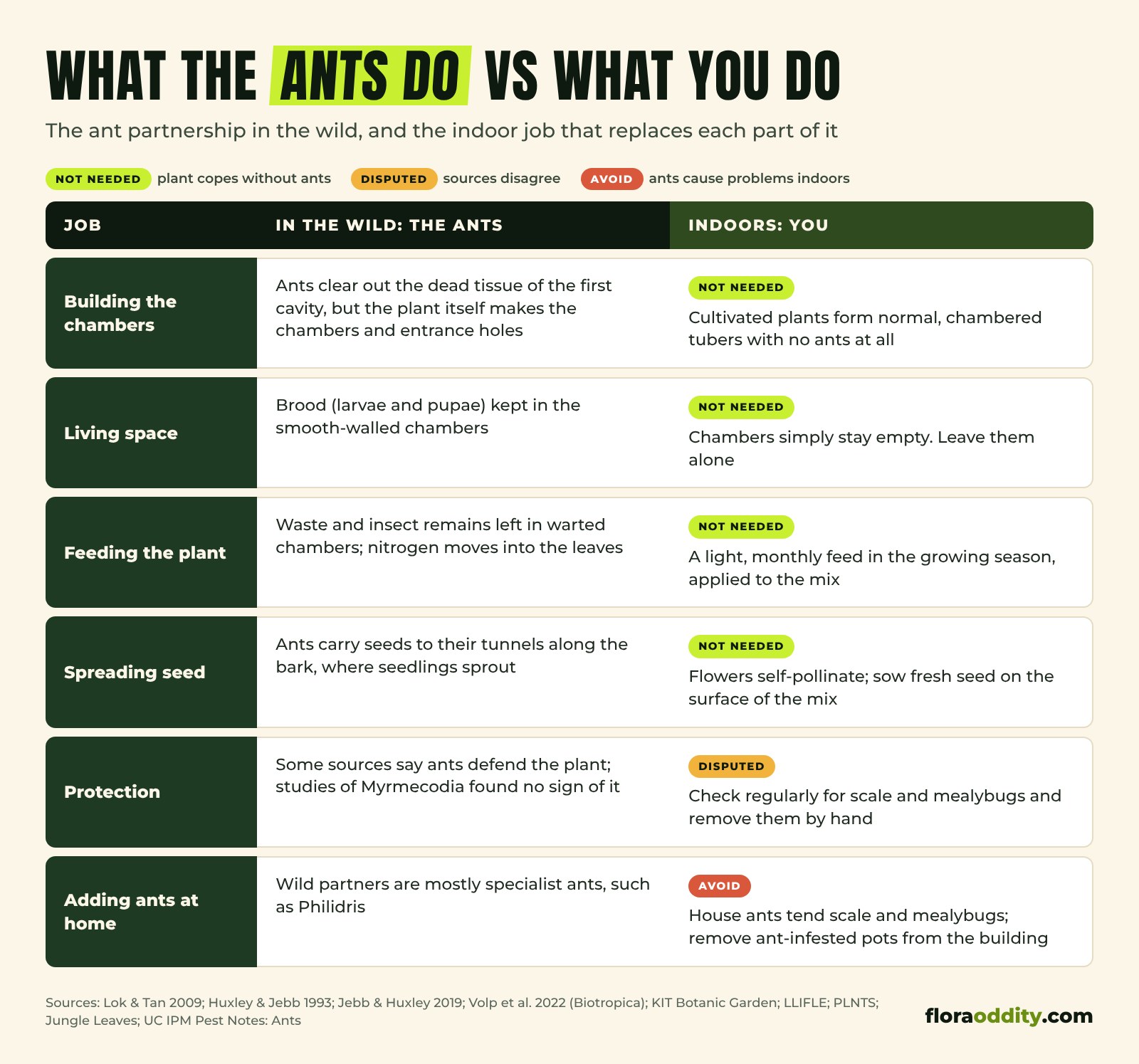
Each part of the wild partnership either does not matter indoors or has a simple substitute.
| Job | In the wild: the ants | Indoors: you |
|---|---|---|
| Building the chambers | Ants clear out the dead tissue of the first cavity, but the plant itself makes the chambers and entrance holes | Not needed: cultivated plants form normal, chambered tubers with no ants at all |
| Living space | Brood (larvae and pupae) kept in the smooth-walled chambers | Not needed: the chambers simply stay empty, so leave them alone |
| Feeding the plant | Waste and insect remains left in warted chambers; nitrogen moves into the leaves | Not needed: a light, monthly feed in the growing season, applied to the mix |
| Spreading seed | Ants carry seeds to their tunnels along the bark, where seedlings sprout | Not needed: flowers self-pollinate, and fresh seed is sown on the surface of the mix |
| Protection | Some sources say ants defend the plant; studies of Myrmecodia found no sign of it | Disputed: check regularly for scale and mealybugs and remove them |
| Adding ants at home | Wild partners are mostly specialist ants, such as Philidris | Avoid: house ants tend scale and mealybugs; remove ant-infested pots from the building |
The self-pollination and seed-sowing points come from Lok and Tan and from LLIFLE, which says the seed stays viable only briefly and should be laid on the surface of the sowing mix. The feeding advice comes from plant retailer PLNTS, which describes ant plants as “light feeders” and suggests a houseplant fertilizer once a month in the growing season.
Why Sources Seem to Disagree
Read a few pages about ant plants and you will find statements that contradict each other. Most of the conflict comes from older descriptions sitting next to newer research.
Do the ants make the tuber?
LLIFLE’s species description says that as soon as a young plant forms a stem, “the ants gnaw at the base of this, and the irritation produced causes the stem to swell.” The botanical literature describes something different. Lok and Tan explain that the seedling’s own stem base swells and that tissue inside it dies; the ants then remove that dead tissue, forming the first cavity. Specialist nursery Jungle Leaves states it directly: the ants “do not create the chambers or the entrances themselves; these are formed solely by the plant, regardless of whether ants are present or not.”
Do the ants protect the plant?
LLIFLE and PLNTS both say the ants defend the plant. The KIT Botanic Garden disagrees for Myrmecodia, describing Iridomyrmex cordatus as “a very peaceful fellow” that “does not even react” when the plant is attacked. Volp and colleagues cite a 1990 study of M. beccarii that found “no evidence” that Philidris cordata protects the plant from herbivores; ant presence actually increased damage, reportedly because the ants tended the caterpillars of a butterfly. Protection may vary by species and place, but it is not something to count on.
Iridomyrmex or Philidris?
Often these are probably the same ants under different names. The Hydnophytum revision explains that the usual ant-plant ants were once placed in Iridomyrmex and have since been moved to Philidris and Anonychomyrma. That likely explains why the ant called Iridomyrmex cordatus in older sources, such as the KIT page and the 1990 study cited by Volp and colleagues, appears as Philidris cordata in newer ones.
“Cannot thrive without the ants”
LLIFLE’s description calls the swollen stem a normal condition of plants “which cannot thrive without the ants,” yet the same page’s cultivation notes say they can be grown without them. The cultivation notes match the botanical revisions and the nursery and retailer pages we checked.
Should You Add Ants to Your Ant Plant?
No, and there are three good reasons.
First, the right ants are specific. Volp and colleagues describe M. beccarii as showing “a high degree of partner specificity” with Philidris cordata, consistent with other Myrmecodia species. Ants from your garden or kitchen are not the plant’s natural partner.
Second, the wrong ants still move in. The same study notes that the invasive African big-headed ant, Pheidole megacephala, has been recorded living in M. beccarii. In their experiment there was no detectable difference between it and the native ant in how much nitrogen reached the leaves, but the authors raise the question of whether invaders act as “exploiters” of the partnership, and they note that the variance in their data suggested the two ants may differ in how reliably they supply nitrogen.
Third, and most important for a houseplant, ants farm pests. The University of California’s UC IPM Pest Notes on ants warn that ants “protect and care for honeydew-producing insects such as aphids, soft scales, whiteflies, and mealybugs.” LLIFLE lists scale and mealybugs as the main pests of ant plants, so inviting ants is inviting the exact insects you want to avoid. If ants do appear in the pot, UC IPM’s advice for potted plants is simple: “remove the containers from the building.”
If you find mealybugs or scale, our guide to Nepenthes pests shows how to spot and remove them, and the same methods work on ant plants.
What the Empty Chambers Mean for Your Plant
An empty tuber is normal, so the practical question is how the empty space changes care.
The plant’s nitrogen now comes through the roots. With no debris collecting in the warted chambers, the mix and your fertilizer are the main supply. PLNTS recommends a monthly feed during the growing season but warns against overcompensating “with water or fertiliser, as this can do more harm than good.” Keep it weak.
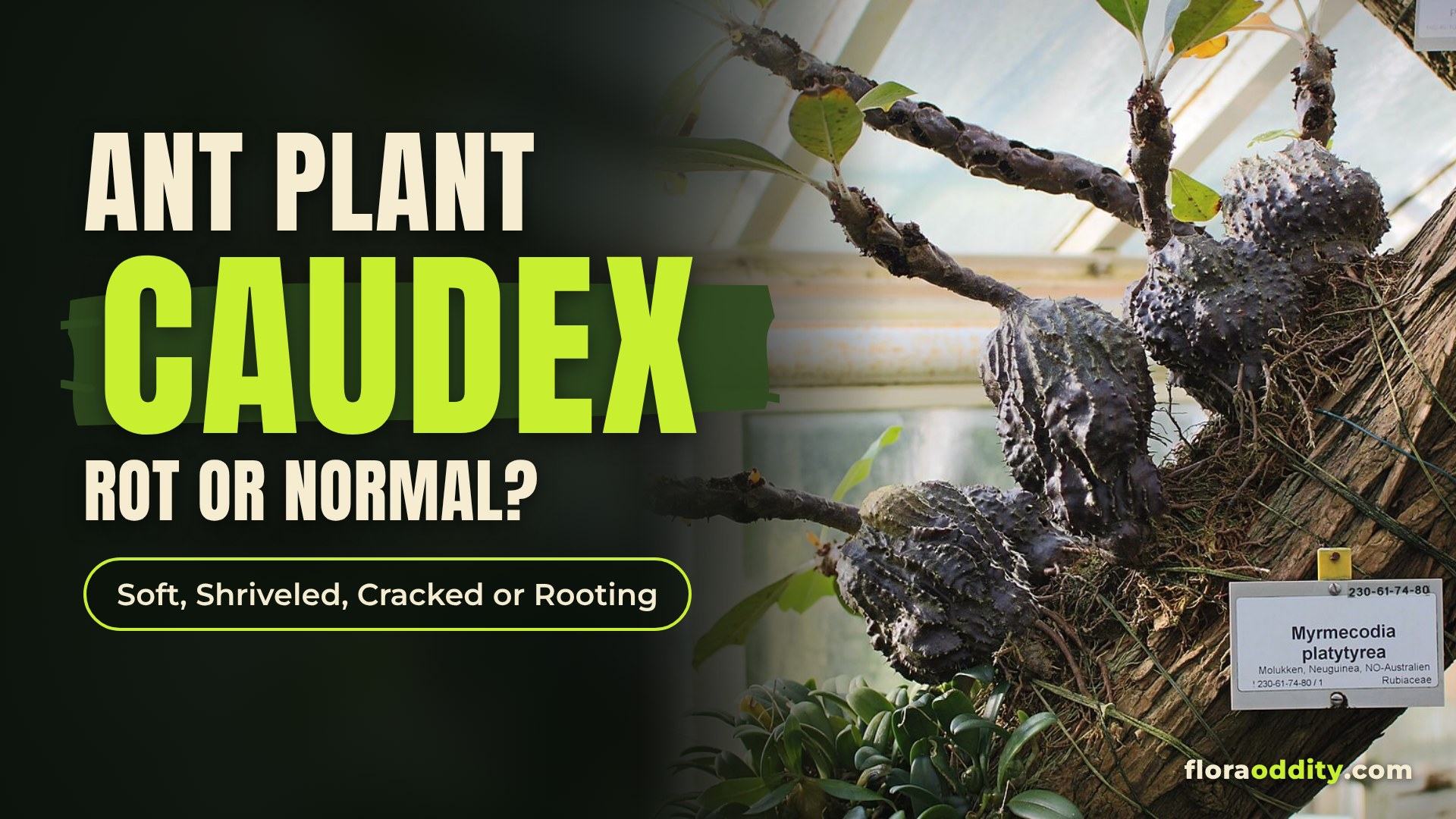
Water the mix, not the tuber. The chambers are open to the air through the entrance holes. PLNTS advises: “Always water directly into the soil, avoiding the caudex to prevent it from rotting.”
Roots on the tuber are fine. The Hydnophytum revision notes that in high humidity, many species develop roots on their tubers, and LLIFLE says new roots can form from any part of the tuber touching moist mix. Roots appearing from the base or around the holes are nothing to worry about.
A big tuber is full of air pockets. Jungle Leaves notes that very old Myrmecodia tuberosa can reach about 30 inches (75 cm) long, 12 inches (30 cm) thick and over 22 pounds (10 kg), “although they naturally have many air-filled chambers inside.” A tuber that feels light for its size is built that way. Soft patches on the outside are a different matter, and that is where the PLNTS warning about rot applies.
For the full routine of light, mix, humidity and repotting, see our ant plant care guide.
Common Mistakes
- Thinking a plant without ants is incomplete. Cultivated tubers form normal chambers with no colony at all.
- Collecting ants to “complete” the plant. Garden ants are the wrong partners and tend scale and mealybugs.
- Overfeeding to replace the ants. A light feed in the growing season is enough.
- Trusting old descriptions. Claims that ants create the tuber or that the plant cannot thrive without them do not match the botanical revisions.
- Ignoring ants that arrive on their own. UC IPM notes that ants on plants are probably attracted to honeydew, so check for scale and mealybugs.
FAQ: Do Ant Plants Need Ants?
Will my ant plant attract ants into the house?
PLNTS says a Hydnophytum houseplant “won’t be bringing any ants indoors” and that the caudex of a homegrown plant will be empty. Ants that find a honeydew source, such as a mealybug infestation, can still turn up, which is another reason to keep pests under control.
Do ant plants grow slower without ants?
None of the sources we checked measured growth with and without ants, so we cannot give a figure. What is documented is that ants supply nitrogen in the wild and that nursery plants grown from seed with regular fertilizer develop normal chambered tubers.
Are any ant plants never inhabited by ants?
Yes. The Hydnophytum revision lists many species, especially from high mountains, whose tubers are not inhabited by ants, and some whose chambers usually hold rainwater instead.
Which ants live in Hydnophytum formicarum?
In the wild it is usually Philidris cordata, according to the Hydnophytum revision, although Lok and Tan found Crematogaster, Camponotus, Technomyrmex and Iridomyrmex species in Singapore plants depending on the neighboring plants.
The Bottom Line
Ant plants do not need ants in your home. In the wild, specialist ants such as Philidris raise their brood in the smooth chambers and leave waste in the warted ones, and the plant absorbs nitrogen from it. But the plant builds its chambers on its own, many Hydnophytum species live without ants even in nature, and nursery plants grow normal tubers with no colony. Replace the ants’ contribution with a light feed through the mix, keep water off the tuber, leave the empty chambers alone, and if ants turn up, check the plant for scale and mealybugs.
Sources & Further Reading
- Lok, A. F. S. L. and Tan, H. T. W. (2009). Tuberous, epiphytic, rubiaceous myrmecophytes of Singapore. Nature in Singapore 2: 231 to 236
- Huxley, C. R. and Jebb, M. H. P. (1993). The tuberous epiphytes of the Rubiaceae 5: A revision of Myrmecodia. Blumea 37: 271 to 334
- Jebb, M. H. P. and Huxley, C. R. (2019). The tuberous epiphytes of the Rubiaceae 7: A revision of the genus Hydnophytum. Blumea 64: 23 to 91
- Volp, T. M., Cernusak, L. A. and Lach, L. (2022). Epiphytic ant-plant obtains nitrogen from both native and invasive ant inhabitants. Biotropica 54: 556 to 560
- Botanic Garden, Karlsruhe Institute of Technology: Myrmecodia (Ant Bulb)
- UC IPM Pest Notes: Ants (UC ANR Publication 7411)
- LLIFLE Encyclopedia: Hydnophytum formicarum
- Jungle Leaves: Myrmecodia tuberosa
- PLNTS: Hydnophytum care
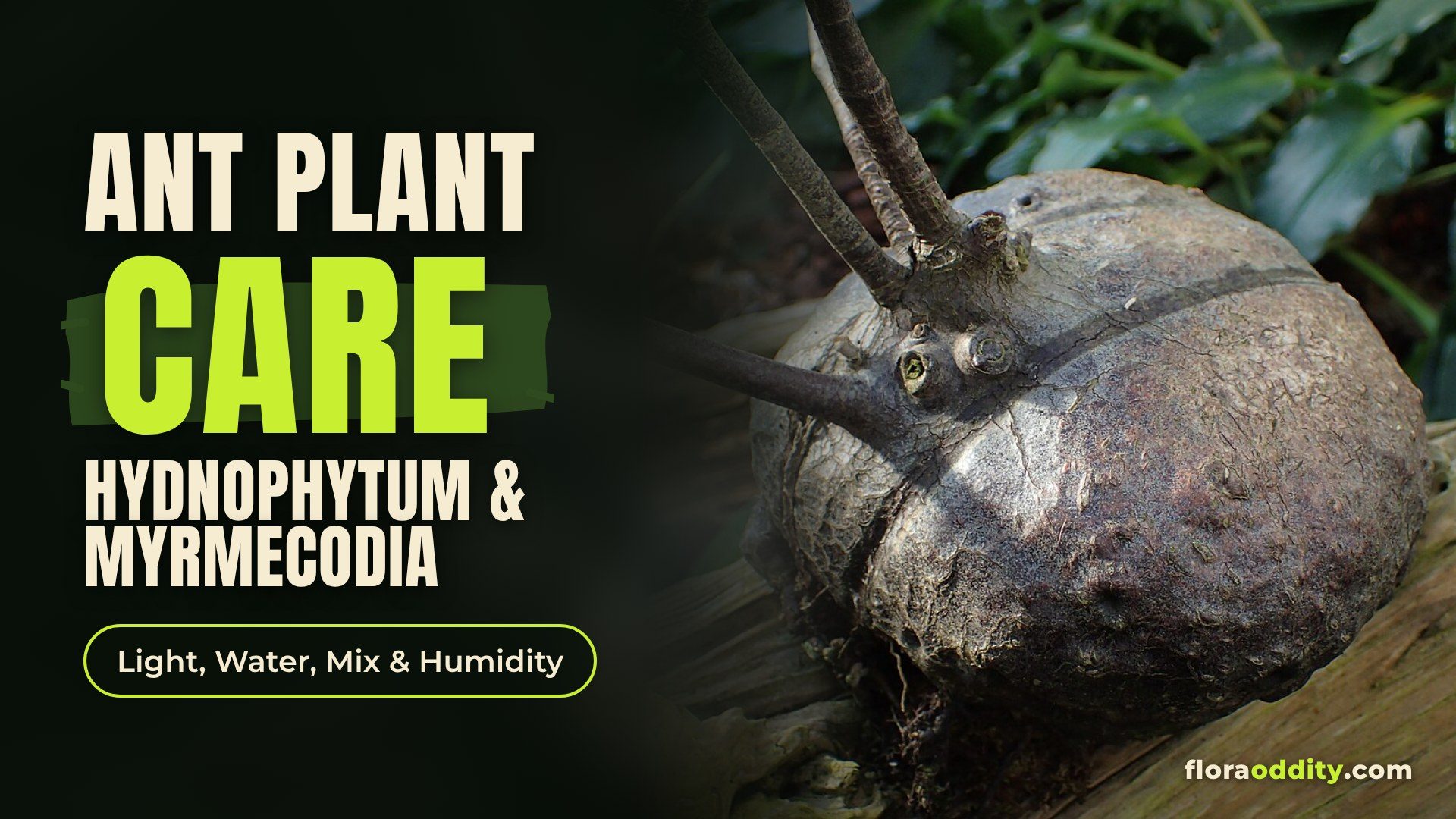
Featured image based on a photo of a Myrmecodia beccarii tuber by Steve Fitzgerald via Wikimedia Commons, CC BY-SA 4.0, with cropping and typography added by FloraOddity; the featured image is shared under the same license.
Final articles are editorially reviewed and factual claims are checked against cited sources. Last reviewed: October 2026.
2 Comments