

Sundews are the glittering ones. Every leaf carries dozens of red-tipped tentacles, each holding a drop of what looks like dew, and an insect that lands on them stays there. NC State Extension notes that the genus name Drosera comes from the Greek word for “dewy,” and that sundews are “one of the largest groups of carnivorous plants.” The good news for beginners: Barry Rice’s Carnivorous Plant FAQ says a first-time sundew “is probably one of the species that is very easy to grow,” as long as you know which kind you have.
This is the first guide in our sundew series. It covers how the sticky trap works, the main Drosera groups, and the basics of light, water, soil, dormancy, feeding, and common problems.
The Short Answer
Easy beginner sundews such as the Cape sundew (Drosera capensis; see our Cape sundew care guide), the spoon-leaf sundew (D. spatulata), and D. aliciae are subtropical plants that grow all year without a winter rest. Give them very bright light: full sun or strong white LEDs, not an ordinary windowsill. Stand the pot in a tray of rainwater, distilled water, or reverse osmosis water so the soil stays wet, and plant it in fertilizer-free sphagnum peat mixed with clean silica sand, or in sphagnum moss. Never fertilize the soil. If your sundew has lost its dew, the usual suspects, according to Barry Rice’s Carnivorous Plant FAQ, are low humidity, heat, low light, impure water, or fertilizer. Temperate species from cold climates are different: they need a cold winter rest and do best outdoors.
What a Sundew Is and How the Sticky Trap Works
NC State Extension places sundews in the sundew family, Droseraceae, and says they are found in “bogs, fens, and marshes.” If you already grow a Venus flytrap, another bog plant, much of our Venus flytrap care guide will feel familiar. NC State describes the leaves as spoon-shaped, strap-shaped, or linear, often in a basal rosette, and coloured anything from green or yellow-green to red.
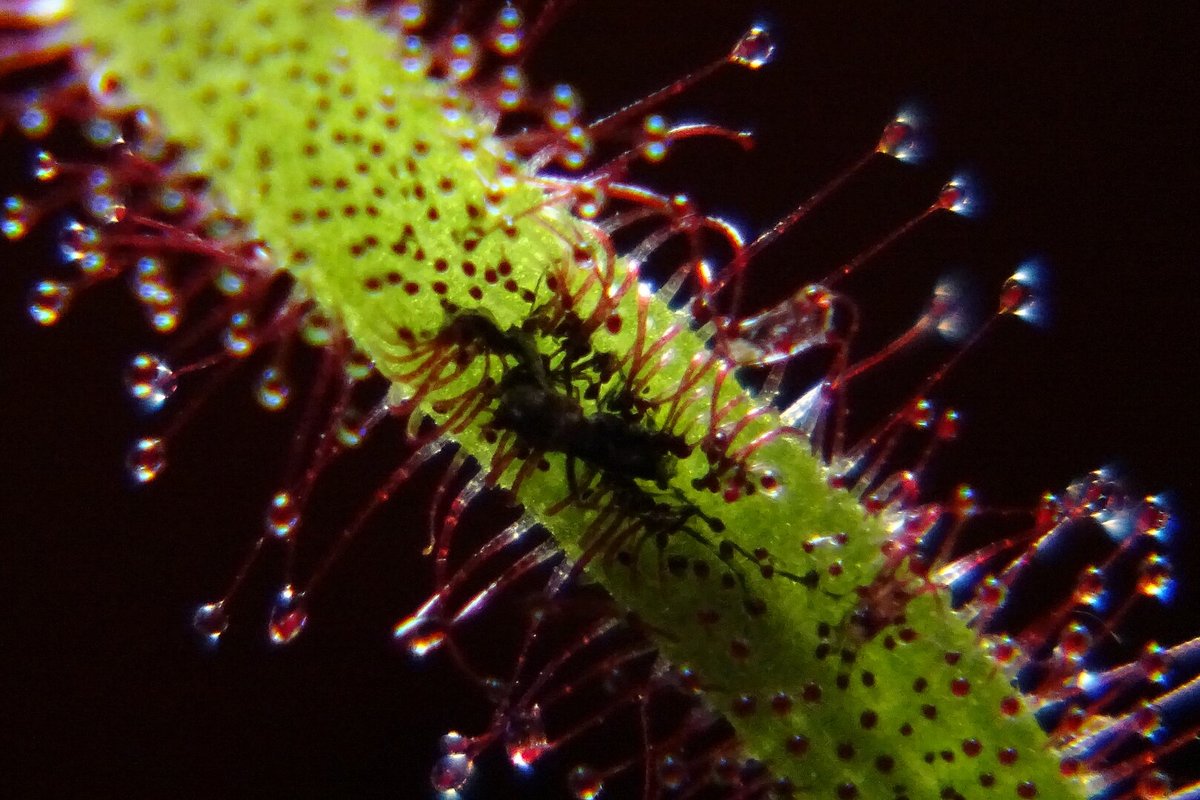
Rice’s FAQ calls sundews “sticky flypaper plants” whose tentacle glands “exude attractive nectar, adhesive compounds, and digestive enzymes.” An insect that lands sticks fast, nearby tentacles bend towards it, and on many species the whole leaf coils around it, usually over “minutes or hours.”
The International Carnivorous Plant Society (ICPS) says Drosera tentacles “snag prey, move to bring as many tentacles as possible into contact with the prey and smother it in slime, and release digestive enzymes,” then absorb the nutrients along with glands on the leaf surface. On the Cape sundew, Carnivorous Plant Nursery says the leaves “slowly roll over on to the prey in about 30 minutes,” that digestion takes a few days, and that the leaf then uncurls and leaves the remains behind.
The Five Main Groups, and the Best Beginner Sundews
Rice says sundews grow on every continent except Antarctica, and that “you must know the kind of plant you have in order to know how to grow it.” The ICPS growing guides sort them into groups; these five matter most at home.
Subtropical sundews. The ICPS calls these “the best terrarium and greenhouse sundews.” They grow at 50 to 95 °F (10 to 35 °C) and “don’t have dormancy or light cue requirements to survive long term.” Rice names D. capensis, D. capillaris, D. dielsiana, and D. spatulata as very easy first sundews, and Carnivorous Plant Nursery rates D. capensis and D. spatulata “Very Easy” and D. aliciae “Easy,” all with no dormancy.
Warm temperate sundews. These come from places with “a definite but mild winter,” says the ICPS. They tolerate frost but “can not tolerate extensive freezes,” and grow outdoors year round in USDA zone 9 and warmer. The ICPS puts the D. capillaris group of the Americas here, and treats the forked-leaf D. binata as warm temperate too: “All Drosera binata forms go through a period of dormancy,” during which the plant “effectively die[s] back to the ground.”
Cold temperate sundews. The ICPS lists four northern hemisphere species: D. rotundifolia, D. anglica, D. intermedia, and D. linearis. Northern forms rest through winter as tight buds called hibernacula; the ICPS says D. rotundifolia “expects to spend six months of the year in dormancy” and suggests growing local plants outside.
Pygmy sundews. There are “over 50 species,” mostly from southern Western Australia, and the ICPS says they are typically 0.6 to 0.8 inch (15 to 20 mm) wide. Most grow and bloom in winter and spring, rest through summer as a bud, and make small reproductive buds called gemmae in autumn. Our pygmy sundew care guide covers them in full.
Tuberous sundews. These grow in the cool, wet winters of Australia and nearby regions and die back to an underground tuber for the hot, dry summer. The ICPS warns that “most tuberous Drosera are quite challenging to grow,” and recommends the D. peltata complex, D. stolonifera complex, and D. menziesii for beginners.
Which Sundew Do You Have?
The chart below sums up how care changes across the five groups.

| Group | Examples | Rest period | Light | Winter | Watch out for |
|---|---|---|---|---|---|
| Subtropical | D. capensis, D. aliciae, D. spatulata | None needed | More than a windowsill gives: strong LEDs or full to part sun | Grows at 50 to 95 °F (10 to 35 °C) | Dry indoor air; self-seeds freely |
| Warm temperate | D. binata, D. capillaris | Mild winter rest; D. binata dies back to the ground | Full sun; hardier forms do best outdoors | Frost but no hard freezes; outdoors all year in zone 9 and up | Plants that look dead but are only resting |
| Cold temperate | D. rotundifolia, D. anglica, D. intermedia, D. filiformis | Winter, about 6 months, as a hibernaculum | Full sun outdoors with a natural day length | Keep buds cool and just damp; best grown outside | Decline in terrariums; moss mats in pots |
| Pygmy | Tiny rosettes, often 0.6 to 0.8 inch (15 to 20 mm) | Summer, most species; gemmae in autumn | Intense; a sunny window may not be enough | Outdoors all year where winters are mild | Moss; broken roots when transplanting |
| Tuberous | D. peltata complex, D. menziesii | Summer, as a tuber, pot left to dry | Lots of light at cool temperatures | Grows in winter; light frost OK, heat over about 77 °F (25 °C) harms it | Terrariums and heat; needs very deep pots |
Light
Rice calls inadequate lighting “the single underlying cause for most carnivorous plant deaths at the hands of beginning growers,” and warns that a windowsill “will probably not be bright enough.”
Outdoors, California Carnivores recommends “full to part sun” for sundews in general. Indoors, the ICPS says subtropical sundews “want more light than they can get on a window sill.” Its LED guide rates most Drosera species as needing intense light: about 15,000 to 25,000 lux of white light for 12 to 16 hours a day. The top of that range takes about 30 watts of white LED lighting per square foot (a square about 30 by 30 cm) of growing area, according to the ICPS.
Seasonal groups also need a natural day length. The ICPS says temperate sundews “need a natural light cycle to keep from going dormant permanently,” and suggests a timer that follows local sunrise and sunset for pygmy and tuberous sundews grown indoors.
Water: Pure Water and the Tray Method
Use pure water
NC State Extension’s rule for all sundews is to “always use rainwater or distilled water for irrigation.” Rice is even firmer: “Play it safe. Use water purified by either distillation or reverse osmosis.” Boiled water does not count, he explains, and bought water must say “purified by distillation” or “purified by reverse osmosis”; “drinking water” and “spring water” mean nothing.
The tray method
Rice says carnivorous plants “always need to be sitting in wet soil,” as wet as “a wrung-out sponge.” California Carnivores says “most sundews thrive on the tray method, which keeps the soil permanently wet,” and its care sheets say the pot should always sit in “at least two inches” (5 cm) of distilled, rain, or reverse osmosis water. The ICPS agrees that cold temperate pots “must always be sitting in water when they are growing.”
The exception is the summer rest of winter-growing sundews, when California Carnivores says “the soil has to be dried out.”
Do not mist the leaves
Rice warns that spraying “is not going to help. It will hurt,” because the dew drops are “a special mix of compounds” and not just water.
Soil and Pots
To work out how much of each ingredient your pots need, try our soil mix calculator.
The ICPS says most subtropical sundews “are not very picky about soil.” They grow in pure sphagnum moss, live or dried, or in the standard peat and sand “CP mix,” which the ICPS describes as anything from 30% to 100% peat. Its CP mix page recommends Canadian or German sphagnum peat with no fertilizer, and sharp silica or quartz sand with grains of about 1.5 to 2 mm. It warns that play sand and builder’s sand can make the mix “like concrete.”
Some groups want a sandier mix. The ICPS suggests one part peat to two parts sand for pygmy sundews, at least in the top 1.2 inches (3 cm), to help keep moss down, and the same 1:2 mix for tuberous sundews.
California Carnivores uses four parts fertilizer-free peat moss to one part perlite instead, and its warning applies to every mix: “Never pot them into regular potting soil as the nutrients and fertilizers will kill them over time.”
On pots, the ICPS is relaxed for subtropicals (“IT DOESN’T MATTER. Mostly.”), but says D. binata likes large pots and tuberous sundews “require very deep pots.” Both the ICPS and California Carnivores suggest repotting most sundews every 3 to 5 years. Cold temperate sundews are the exception: the ICPS repots the smaller species every year in early spring, because moss can form a dense mat that makes the plants “decline and die.”
Humidity and Temperature
Rice calls low humidity “the most common reason for a dewless sundew,” and his humidity page says a terrarium provides the 50 to 90% humidity “most carnivorous plants desire,” but should not be sealed, because most plants want some air circulation. The ICPS notes that subtropical sundews “tend to prefer higher humidity than is typical in houses,” though some growers succeed on open shelves under lights.
Not every group belongs in a terrarium. The ICPS says pygmies “will probably do better outdoors,” and most tuberous sundews “do NOT make good terrarium plants” because terrariums get too warm.
For temperatures, the ICPS gives subtropical sundews 50 to 95 °F (10 to 35 °C). California Carnivores gives rosetted sundews 25 to 80 °F (minus 4 to 27 °C), with brief spells from freezing to 100 °F (38 °C), and says they “would appreciate cool nights.” Tuberous sundews are the heat-sensitive group: the ICPS says temperatures above about 77 °F (25 °C) “can cause them to die back and will kill seedlings.”
Dormancy
To check whether your sundew needs a winter rest and whether your climate gives one, try our dormancy checker.
Whether your sundew needs a rest depends entirely on its group.
Subtropical sundews need none. Carnivorous Plant Nursery lists “Dormancy: No” for D. capensis, D. spatulata, and D. aliciae. It adds that outdoors in its zone 6 bog boxes, D. capensis “dies back in the Fall and re-emerges from the roots in Spring.”
Temperate sundews need a winter. California Carnivores says temperate sundews go dormant in winter, triggered by “shorter photo periods and colder temperatures from October to February,” and that many leaves die back. It suggests leaving them outdoors in full sun in distilled water, or, where it snows, moving them to a sunny windowsill in an unheated room or garage. The ICPS says to keep D. rotundifolia hibernacula “cool and just damp.” Every overwintering method is covered in our sundew dormancy guide.
D. binata rests too. The ICPS says typical Tasmanian and New Zealand forms grow outside year round in zone 9 and warmer; where the soil could freeze, move them to a garage or another cool, protected place. Our forked sundew care guide covers D. binata and its forms in full.
Pygmy and tuberous sundews rest in summer. California Carnivores says to let winter-growing sundews go brown as summer approaches, then let the soil dry slowly over about a month and keep them cool and dry.
Feeding
For a quick plan, try our carnivorous plant feeding guide: pick your plant and see what to feed, how often and what never to give.
California Carnivores says outdoor sundews “will catch their own food.” Indoors, the ICPS suggests small insects or dried bloodworms from a pet shop, soaked in water and placed on the dewy leaves, with two firm rules: “only feed a plant that is dewy and only with live or wet food.” The ICPS bloodworm guide adds that if it is warm enough, a Drosera “will curve the leaf over the DBWs in 30 minutes,” with no further stimulation needed. Avoid brands with additives, which the same guide says can damage plants. Our guide on how to feed a Venus flytrap covers soaking bloodworms.
If food goes mouldy, the ICPS says to use less next time, and that a dab of 70% isopropyl alcohol on a small paintbrush will help control the fungus.
Do not fertilize the soil. NC State Extension says “Do not apply fertilizers,” and the ICPS says, “Do not put fertilizer of any kind in the soil.” Some growers do feed the leaves with a weak foliar fertilizer instead; see Where Sources Differ.
Flowers and Seeds
Sundew flowers rise on stalks well above the sticky leaves. NC State says they are usually white to pink and “open in the mornings on sunny days.”
The easy subtropicals set seed freely. Carnivorous Plant Nursery says D. capensis “generously produces seeds” and “can become a wonderful ‘weed’ in your carnivorous plant collection,” that D. spatulata seeds “quickly sprout in neighboring pots,” and that D. aliciae is self-fertile. Short-lived species are different: the ICPS advises cutting off warm temperate flower stalks “when you first notice them,” because a plant left to bloom “is likely to severely decline or die.”
Not every sundew pollinates itself: the ICPS says most cultivated D. binata and most pygmies need a second, unrelated plant to set seed.
To sow seed of subtropical sundews, the ICPS says to scatter it on the surface, never bury it, mist it lightly, and keep it at about 68 to 77 °F (20 to 25 °C). It warns that it “can easily take two years to get mature plants.” Cold temperate seed needs a “winter” first: about 4 weeks in damp, chopped sphagnum in the refrigerator, at 34 to 39 °F (1 to 4 °C), or a pot left outside over winter.
Propagation in Brief
The ICPS says leaf cuttings produce exact clones of the parent and “tend to produce mature plants quicker than from seed.” Take a healthy, dewy leaf, cut it from the plant, and float it tentacle side up in about 0.4 inch (1 cm) of distilled or reverse osmosis water in a closed jar, or lay it on wet peat or sphagnum at very high humidity. Little happens for the first month or so, the ICPS says, though D. binata may “explode out fairly quickly the second month.”
The ICPS calls leaf cuttings “impractical” for pygmy and tuberous sundews, which are grown from gemmae and seed, and Carnivorous Plant Nursery notes that D. aliciae “easily makes leaf and root cuttings.” Every method is covered step by step in how to propagate sundews.
Common Problems
No dew on the leaves
Rice puts it simply: “Only a happy Drosera makes mucus.” He lists low humidity as the most common cause, followed by temperatures that are too high, light that is too low, impure water, and fertilizer. California Carnivores puts light first: if a rosetted sundew is “not producing dew it most likely needs more direct sunlight.” A plant moving into its rest period can also lose its dew. Rice notes that D. capensis “occasionally dies back to the ground,” looking dreadful as it does, and that the plant is fine and “will resprout from the base.” For a step-by-step check, see sundew not making dew.
Green instead of red
Colour follows light. The ICPS describes a D. brevifolia that “would be dark red in brighter light,” a D. intermedia that “outdoors in full sun” can “turn a maroon color,” and pygmy sundews that “have more color and bloom more under brighter light.” A green sundew is not necessarily sick; these examples simply show that more light usually brings out more red.
Pests
Carnivorous Plant Nursery says aphids “seem to be more of an issue on emerging Venus Flytraps and Sundews than other carnivorous plants.” They attack new growth, deform leaves, and can be squeezed off by hand or washed off with a spray bottle every week or two. For aphids and mealybugs, Rice suggests isopropyl alcohol on a cotton swab. Our Nepenthes pests guide covers common pests in more depth.
Fungus gnats are a special case. The ICPS says their larvae “damage and eat seedlings” and have been shown to spread root fungi. Its fix is a layer of medium to coarse sand about 0.2 inch (5 mm) deep on the soil surface, which “most Drosera don’t mind” once they are mature.
Mould and rot
The ICPS mentions mould mainly on leftover food: feed smaller portions and dab the spot with 70% isopropyl alcohol. In temperate pots, the ICPS warns that moss can smother the plants, so it repots every spring and tops the pot with a shallow layer of sand to protect the newly planted hibernacula.
Where Sources Differ
Reputable sources disagree on a few points, mostly because they grow in different conditions.
| Topic | One view | Another view |
|---|---|---|
| Main cause of no dew | Rice: low humidity is “the most common reason for a dewless sundew” | California Carnivores: a dewless sundew “most likely needs more direct sunlight” |
| Foliar fertilizer | California Carnivores: dilute MaxSea (1/4 teaspoon per gallon) on the leaves once a month, never through the soil | NC State: “Do not apply fertilizers”; ICPS: feed bloodworms instead, and if you must use fertilizer, mist the leaves “with care” |
| Soil grit | California Carnivores: 4 parts peat to 1 part perlite | ICPS: silica sand is the default; perlite can be salty, so wash it and use it with care |
| Windowsill growing | Rice: some easy South African sundews have “a fighting chance” on a bright windowsill | ICPS: subtropicals want more light than a windowsill gives |
| Number of species | California Carnivores: “somewhere around 130 species” | NC State: “at least 250 species” |
How to read these:
- No dew. Rice lists both low humidity and low light among the causes, so check both.
- Fertilizer. All three agree on no fertilizer in the soil; the ICPS prefers bloodworms to leaf feeding.
- Species counts. Rice’s FAQ simply says there are “hundreds”; the number makes no difference to your care.
Common Mistakes
- Treating a temperate sundew like a houseplant. The ICPS says D. rotundifolia, D. anglica, and the North American and European D. intermedia need a definite winter season to survive long term.
- Using tap, bottled, or boiled water. Use rainwater, distilled, or reverse osmosis water, as NC State and Rice advise.
- Potting into ordinary potting soil. California Carnivores warns that its nutrients and fertilizers “will kill them over time.”
- Relying on a dim windowsill. Most sundews need intense light, and Rice blames poor light for most beginner losses.
- Throwing out a “dead” plant. D. binata dies back to the ground when dormant, and D. capensis can resprout from the base.
FAQ: Sundew Care
Is a sundew a good first carnivorous plant?
Yes, if you choose a subtropical species. Rice names D. capensis, D. capillaris, D. dielsiana, and D. spatulata as very easy, and Carnivorous Plant Nursery calls D. capensis “a great beginner’s plant.”
Do sundews need to be fed?
Outdoor plants catch their own food. Indoors, the ICPS suggests small insects or soaked dried bloodworms placed on dewy leaves. Never fertilize the soil.
Why is my sundew dying back in winter?
A temperate species is going dormant, which California Carnivores says happens from about October to February. D. binata rests too, and Carnivorous Plant Nursery says even D. capensis dies back outdoors in its zone 6 beds.
Should I let my sundew flower?
For D. capensis, D. spatulata, and D. aliciae, there is no harm, and you will probably get plenty of seedlings. For warm temperate species and short-lived annuals, the ICPS advises cutting flower stalks early.
The Bottom Line
Good sundew care starts with knowing your group. Subtropical sundews such as D. capensis, D. spatulata, and D. aliciae grow all year and are the easiest place to start: give them intense light, a tray of pure water, fertilizer-free peat and silica sand, and more humidity than a typical room. Temperate sundews need a cold winter outdoors, pygmy and tuberous sundews follow the seasons and rest in summer, and D. binata takes a winter break. If the dew disappears, check humidity, light, heat, and water quality before anything else.
Sources & Further Reading
- International Carnivorous Plant Society: Growing Subtropical Drosera
- International Carnivorous Plant Society: Growing warm temperate Drosera
- International Carnivorous Plant Society: Growing cold temperate Drosera
- International Carnivorous Plant Society: Repot Cold Temperate Drosera in Spring
- International Carnivorous Plant Society: Growing Drosera binata
- International Carnivorous Plant Society: Growing pygmy Drosera
- International Carnivorous Plant Society: Growing tuberous Drosera
- International Carnivorous Plant Society: Peat, Sand, Perlite
- International Carnivorous Plant Society: LED Plant Lighting
- International Carnivorous Plant Society: Feeding Dried Blood Worms Step-by-Step
- International Carnivorous Plant Society: Fungus Gnat Larvae
- International Carnivorous Plant Society: Drosera Leaf Cuttings
- International Carnivorous Plant Society: Carnivorous Plant Trapping Mechanisms
- Barry Rice, The Carnivorous Plant FAQ: Introduction to the sundews
- Barry Rice, The Carnivorous Plant FAQ: African and Madagascan species
- Barry Rice, The Carnivorous Plant FAQ: Why doesn’t my sundew have “dew” on its leaves?
- Barry Rice, The Carnivorous Plant FAQ: About light
- Barry Rice, The Carnivorous Plant FAQ: About water
- Barry Rice, The Carnivorous Plant FAQ: About buying purified water
- Barry Rice, The Carnivorous Plant FAQ: About humidity and air circulation
- Barry Rice, The Carnivorous Plant FAQ: How do I kill bug XXX?
- NC State Extension Gardener Plant Toolbox: Drosera
- California Carnivores: Sundews (Drosera)
- California Carnivores: Sundews (Drosera) Growing Tips
- California Carnivores: Rosetted Sundew Care Tips
- California Carnivores: Temperate Sundew Care Tips
- California Carnivores: Forked Leaf Sundew Care Tips
- Carnivorous Plant Nursery: Drosera capensis
- Carnivorous Plant Nursery: Drosera spatulata
- Carnivorous Plant Nursery: Drosera aliciae
- Carnivorous Plant Nursery: Pests on Carnivorous Plants
Featured image based on a photo of a Cape sundew (Drosera capensis) by James Johnstone via Wikimedia Commons, CC BY 2.0, with a dark gradient and typography added by FloraOddity.
Final articles are editorially reviewed and factual claims are checked against cited sources. Last reviewed: October 2026.

9 Comments