
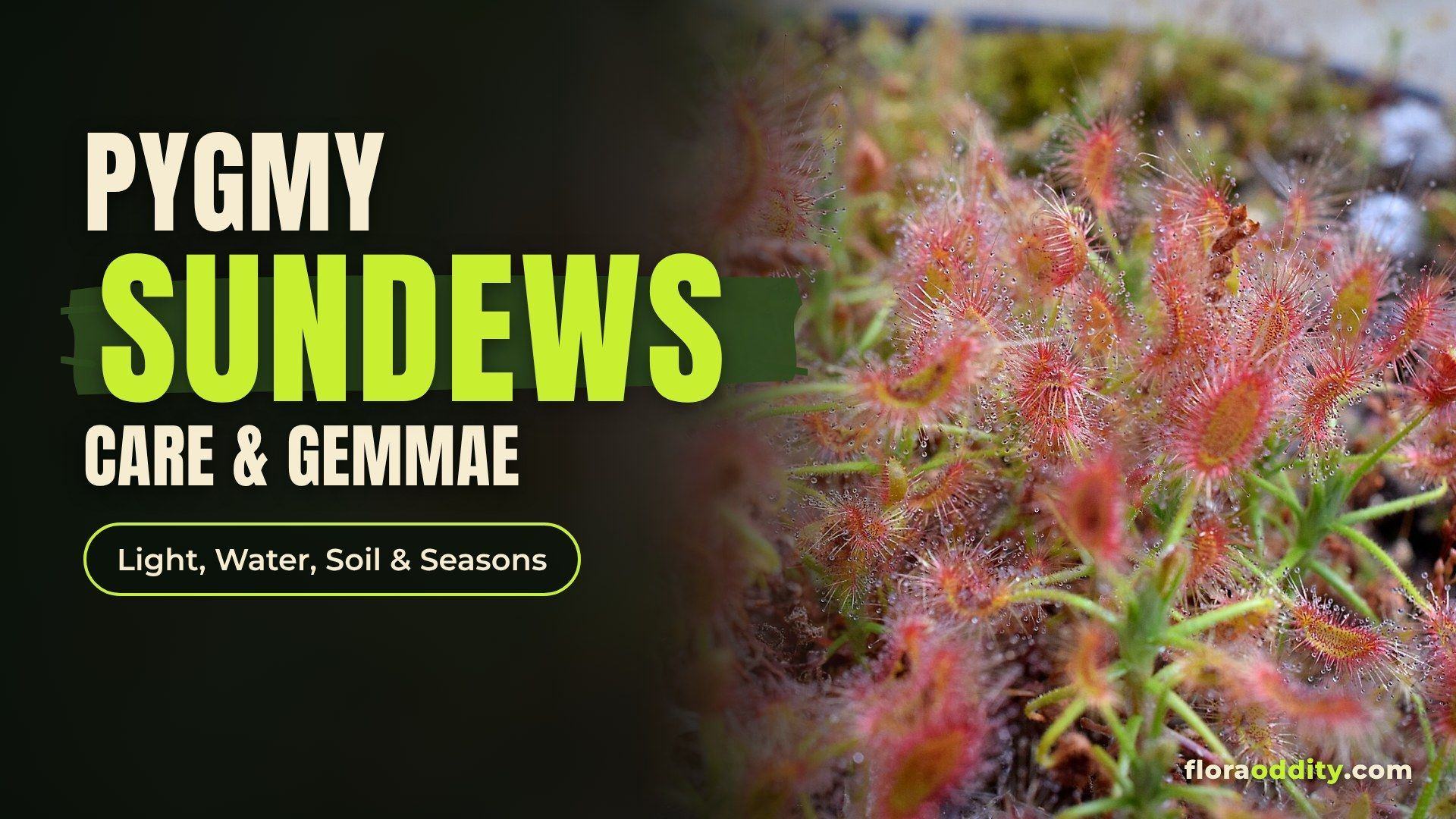
Pygmy sundews are the smallest sundews most growers will ever own. The International Carnivorous Plant Society (ICPS) says a typical plant is 0.6 to 0.8 inch (15 to 20 mm) wide, and Barry Rice’s Carnivorous Plant FAQ says their leaves “are often nearly microscopic in structure.” Rice also calls them “delightful to behold, like tiny jewels,” and the ICPS rates them “very easy to grow indoors with or without a terrarium,” as long as they get intense light.
Pygmy sundew care differs from the care of the familiar Cape sundew in three ways: these plants follow the seasons, they hate being moved, and they multiply from little buds called gemmae. If you are not sure your plant is a pygmy, start with which sundew do you have in our general sundew care guide.
The Short Answer
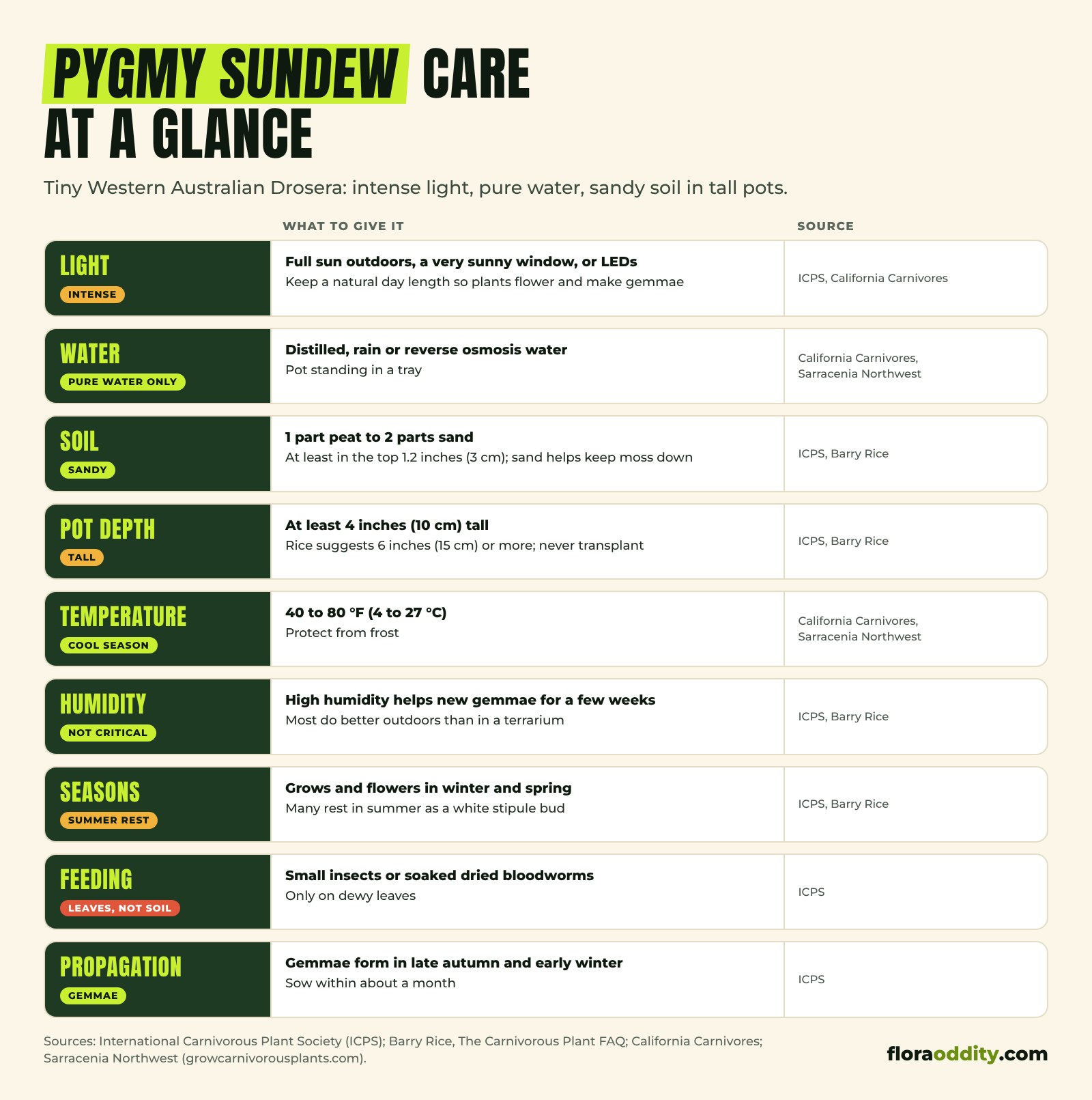
Give pygmy sundews intense light: full sun outdoors, a very sunny window, or strong LEDs on a timer that follows the natural day length. Stand the pot in a tray of distilled, rain or reverse osmosis water, and plant them in a sandy, fertilizer-free mix, such as one part peat to two parts sand, in a tall pot they can live in for good, because they grow one long, fragile root. Most species grow and flower through the cool months, may rest in summer as a small bud, and make gemmae in late autumn and early winter. Sow those gemmae on the surface of fresh pots within about a month. Feed small insects or soaked bloodworms, never fertilizer in the soil.
| Need | Key point | What to give it | Source |
|---|---|---|---|
| Light | Intense | Full sun outdoors, a very sunny window, or LEDs; keep a natural day length so plants flower and make gemmae | ICPS, California Carnivores |
| Water | Pure water only | Distilled, rain or reverse osmosis water; pot standing in a tray | California Carnivores, Sarracenia Northwest |
| Soil | Sandy | 1 part peat to 2 parts sand, at least in the top 1.2 inches (3 cm); sand helps keep moss down | ICPS, Barry Rice |
| Pot depth | Tall | At least 4 inches (10 cm) tall; Rice suggests 6 inches (15 cm) or more; never transplant | ICPS, Barry Rice |
| Temperature | Cool season | 40 to 80 °F (4 to 27 °C); protect from frost | California Carnivores, Sarracenia Northwest |
| Humidity | Not critical | High humidity helps new gemmae for a few weeks; most do better outdoors than in a terrarium | ICPS, Barry Rice |
| Seasons | Summer rest | Grows and flowers in winter and spring; many rest in summer as a white stipule bud | ICPS, Barry Rice |
| Feeding | Leaves, not soil | Small insects or soaked dried bloodworms, only on dewy leaves | ICPS |
| Propagation | Gemmae | Gemmae form in late autumn and early winter; sow within about a month | ICPS |
What Makes Pygmy Sundews Different
Rice says the pygmy sundews “are almost all found only in Western Australia, a land of Mediterranean climate,” and that all of them belong to section Bryastrum. The ICPS counts “over 50 species,” with two exceptions to the Western Australian rule: D. pygmaea, which also grows in south eastern Australia, Tasmania and New Zealand, and D. meristocaulis, found only on tepuis on the Venezuela and Brazil border.
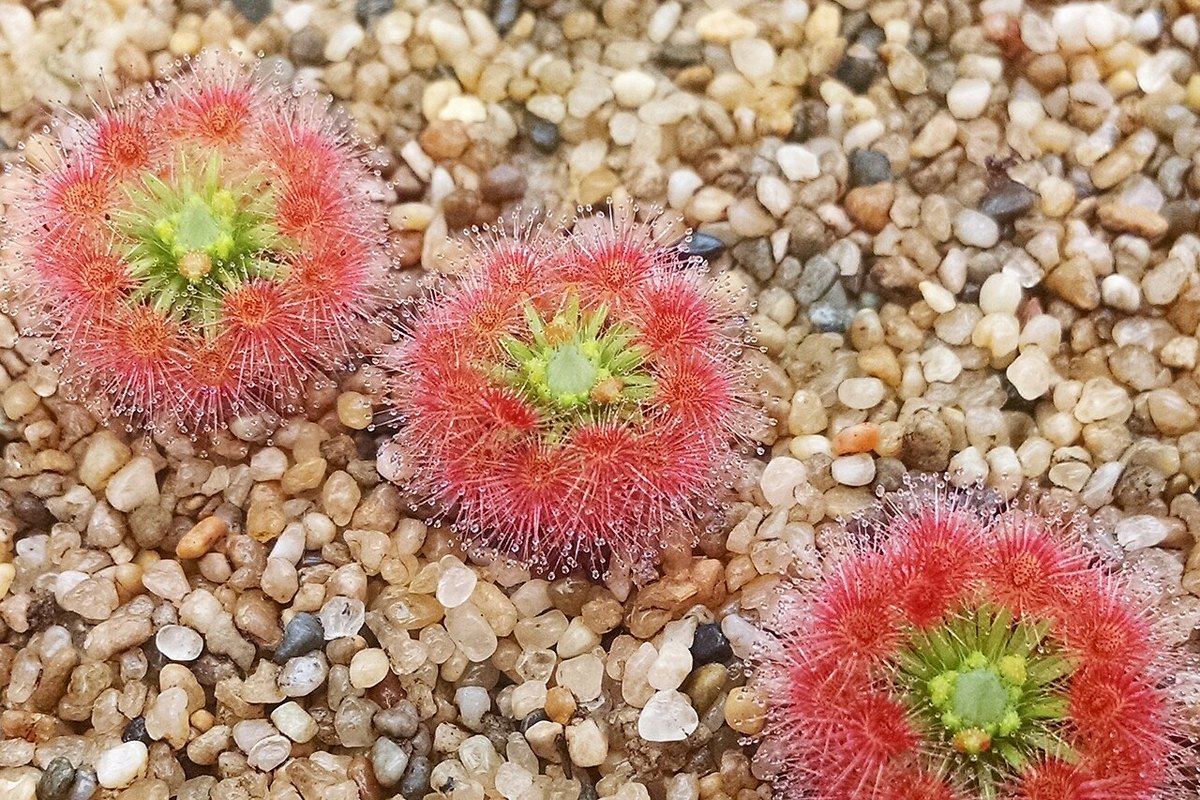
Size. Most hug the ground at 0.6 to 0.8 inch (15 to 20 mm) across, but the ICPS says the larger species can reach about 2 inches (50 mm) across and 2 inches (50 mm) tall in one season. Older plants can become “quite tall,” with a stem wrapped in dead leaves.
Stipules. Rice explains that in summer the leaves die back and “only the leaf stipules remain as a shiny white bundle of hairs or bristles at the rosette center.” The ICPS calls this a stipule bud and says the white, furry stipules of D. echinoblastus “protect the dormant growth apex during the hot, dry summer months.”
One long root. The ICPS says the plants’ long roots “anchor the plant and bring up moisture from deep in the soil,” and that pygmies “tend to have one long root and do not readily put out new ones if it is broken.” That single root shapes almost every care decision below.
Light
The ICPS says pygmies “do require intense light” and warns that “a sunny window may not provide enough light,” recommending LEDs instead. Its LED guide places most Drosera in the intense band: about 15,000 to 25,000 lux of white light, with the lights on for 12 to 16 hours a day. It also notes that the plants “will tend to have more color and bloom more under brighter light.”
California Carnivores gives pygmies “Full sun, outdoors or in a very sunny windowsill or under lights.” Sarracenia Northwest says of its D. nitidula x pulchella hybrid that “a south window with several hours of direct sunlight is ideal.”
Day length matters too. The ICPS warns that under lights that stay on for the same hours every day, “the plants may not bloom or produce gemmae,” and suggests a timer that follows local sunrise and sunset. If you bring outdoor plants inside for winter, “make sure they continue under a natural light cycle.”
Water and the Tray Method
Use pure water. California Carnivores keeps pygmies “always sitting in at least two inches of distilled, rain or reverse osmosis water,” which is 2 inches (5 cm). Sarracenia Northwest asks for low-mineral water of “50 ppm or less” and says to “keep the soil wet by setting the plant in a dish of standing water.”
The ICPS says the long roots “bring up moisture from deep in the soil,” and goes as far as saying that once the plants are established, “the soil surface can be completely dry all the time.” Aaron May, who writes the growsundews.com guides, raises the water level while gemmae sprout (about 3 inches, or 8 cm, in an 8 inch, 20 cm, pot), then lowers it “back to an inch or less” (2.5 cm or less) once the young plants have 3 or 4 leaves.
Soil and Deep Pots
The ICPS says pygmies “aren’t very picky about soil,” but recommends “one part peat to two parts sand or at least that has that much sand in the top 3 cm.” Rice uses the same 2:1 ratio of sand to peat. The reason is moss: the ICPS calls being overgrown with moss “the biggest problem with growing pygmies,” and says the extra sand, and growing outdoors in sun, help keep it down. Other growers use different mixes, from California Carnivores’ four parts peat to one part perlite to Sarracenia Northwest’s equal parts peat and perlite; see Where Sources Differ.
Pot depth matters more than width. The ICPS uses “standard 3.5 inch (9 cm) square, 4 inch (10 cm) tall pots” for gemmae, and grows plants outdoors in pots about 3 inches (8 cm) wide by 3.7 inches (9.5 cm) tall. Rice wants pots “at least 15cm (6 inches) deep” and likes “tall plastic drinking cups with a few drill holes in the bottom,” which give plenty of root room without much soil. He fits “about 7-10 plants in a single pot about 10cm across,” about 4 inches.
Above all, plant them where they will stay. California Carnivores says to “avoid re-potting as these tiny plants are very sensitive,” and the ICPS says “it is almost impossible to transplant pygmies without a high mortality rate.”
Temperature and the Seasons
Most pygmies are cool-season plants. The ICPS says they come from “areas with wet winters and dry summers,” and that “during the winter and spring the plants grow and bloom.” Rice describes them flowering and growing “during the moist and cool winters,” then going dormant through “a long hot summer.”
California Carnivores lists 40 to 80 degrees, read as °F (4 to 27 °C), and says they “can even take temperatures from freezing to 100 degrees but only if kept wet,” which is 32 to 100 °F (0 to 38 °C). Sarracenia Northwest says to protect its pygmies from frost. The ICPS grows them outdoors all year where winters are mild; elsewhere, bring them indoors or into a greenhouse for winter.
The optional summer rest
Whether your plants rest in summer depends on the species and on how hot it gets. The ICPS says that in summer most “go dormant and survive (or not) with only a stipule bud above ground,” but that D. pulchella, from places that are cooler and wetter in summer, does not usually form one. It also grows pygmies under a fiberglass panel whose “lower light and heat helps keep some of the species from going dormant in the summer.” California Carnivores says pygmies “may experience brief summer dormancy when temperatures rise but it is not necessary and care remains the same during this period.”
Rice calls the summer “the greatest stumbling block with this group,” because older plants especially often die during it. His safety net is to take “about 20 plants in at least two pots” into each summer, so at least one survives to make gemmae. For how other sundews rest, see the dormancy section of our sundew care guide.
Feeding
California Carnivores says sundews grown outdoors “will catch their own food.” For plants indoors, the ICPS says that once they are large enough, “you can try feeding them small insects or get some dried blood worms at a pet shop,” dipped in water and placed on dewy leaves, and adds: “don’t feed a plant that isn’t dewy.” If the food goes mouldy, use less next time; a dab of 70% isopropyl alcohol on a small paintbrush “will kill the fungus.”
California Carnivores takes a different route, misting the leaves once a month with MaxSea diluted to 1/4 teaspoon per US gallon (3.8 litres) of water. Its general sundew page says to “avoid pouring through the soil.”
Gemmae in Brief
Gemmae are what make pygmies special. Rice describes them as “modified leaves which detach, root, and form new plants,” packed at the rosette center like “a bundle of little grapes or flat scales.” When a raindrop hits a ripe cluster, the stipules flex back “in an explosive burst,” throwing the gemmae “as far as a few meters.”
When they form. The ICPS says plants with “sufficient seasonal light cues” make gemmae “in the late fall and early winter.” Aaron May says production is triggered mainly by shorter days, and that growers raising pygmies indoors “often gradually reduce the photoperiod to below 10 hours.” Some species also need cooler temperatures, he says, around 70 to 73 °F (21 to 23 °C) or below.
How to sow them. Sow them on the surface of a tall, sandy pot, spaced as you want the adult plants to stand. Rice says orientation is not important, because “they will figure out what to do no matter what way you have them situated.” Do not wait: the ICPS says there is “only a window of about a month when the gemmae are ‘good’.” Rice says plants grown from gemmae “should mature from gemmae to flowering size in a single season.”
Our propagation guide covers collecting and sowing gemmae step by step.
Flowering
Pygmies bloom generously for their size. Rice says they “flower freely,” and that the flowers are often “as big as the rest of the plant” in “white, pink, yellow, orange, and red.” Seed is another matter. Rice says the flowers “rarely produce seed,” and that the hybrids are “usually sterile.” The ICPS explains that most species set seed only when “cross pollinated with a different clone of the same species or a different species,” though a few self-pollinate.
If you do get seed, the ICPS sows it on the surface of a sandy mix at 68 to 77 °F (20 to 25 °C), where it “should germinate in a few weeks.” It warns that seedlings are slow at first and best left unmoved, since even tiny plants “can have very long roots.”
Good Pygmy Sundews to Start With
- D. scorpioides. The ICPS calls it “among the largest of the pygmy Drosera and probably the easiest from which to collect gemmae.” Sarracenia Northwest says it grows up to 2 inches (5 cm) tall in its first year and seems to stop at about 8 inches (20 cm), with brown lower leaves below a green top.
- D. pulchella. Carnivorous Plant Nursery calls it “one of the larger and easy-to-grow pygmy sundews,” with “very broad lime green petioles and orange traps.”
- D. pygmaea. Rice says this widespread species is “comparatively easy to grow,” can be kept in tropical sundew conditions, and grows so readily from seed that it can colonize other pots.
- D. omissa. The ICPS calls it one of the larger pygmies, at about 1.2 inches (30 mm) across, and says it sets seed when self-pollinated and is “relatively easy” from seed.
- D. occidentalis and hybrids. Rice names some hybrids, D. occidentalis and D. pygmaea as the exceptions that cope with terrarium life. Sarracenia Northwest sells a D. nitidula x pulchella hybrid that “gets up to 3/4 inch in diameter,” about 2 cm.
Common Problems
Moss. The ICPS names moss as the main problem with pygmies. Use the sandy mix and give the plants sun. When a pot gets old, the ICPS renews it by starting over from gemmae in a different pot, since the plants “can not be transplanted.”
No gemmae and no flowers. This usually points to light that never changes. The ICPS says pygmies under a constant light cycle in a terrarium “will not make gemmae,” and its LED guide says most species under a constant day length “will grow very well but not bloom or produce gemmae.”
Losses in summer. Rice says older plants often die during the dry season. Keep several pots going so one bad summer does not end your collection.
Plants in the wrong pots. The ICPS warns that gemmae “migrating between pots,” knocked out by raindrops, are the most common reason traded gemmae are misnamed, and says it is best to protect plants with gemmae from rain. Rice suggests removing ripe gemmae so you do not get volunteers “everywhere you do not want them.”
No dew. Dew loss has several possible causes. Our guide on why a sundew stops making dew works through the usual causes.
Where Sources Differ
| Topic | One view | Another view | Why they may differ |
|---|---|---|---|
| Terrariums | ICPS: “very easy to grow indoors with or without a terrarium” | Rice: “most find terrarium life toxic,” apart from some hybrids, D. occidentalis and D. pygmaea | The ICPS also says they “will probably do better outdoors than under lights in a humid terrarium” |
| Pot depth | ICPS: 4 inch (10 cm) tall pots | Rice: at least 6 inches (15 cm) deep; Aaron May uses an 8 inch (20 cm) pot | All three choose tall pots because of the long root |
| Soil mix | ICPS and Rice: 1 part peat to 2 parts sand | California Carnivores: 4 parts peat to 1 part perlite; Sarracenia Northwest: equal parts peat and perlite | The ICPS adds the extra sand to keep moss down |
| Summer rest | Rice: a long summer dormancy, the “greatest stumbling block” | California Carnivores: a brief summer dormancy that “is not necessary” | The ICPS says D. pulchella does not usually form a summer bud, and that less light and heat keep some species growing |
| Feeding | ICPS: small insects or soaked dried bloodworms | California Carnivores: monthly MaxSea mist on the leaves | California Carnivores applies it to the leaves, not the soil |
Common Mistakes
- Transplanting established plants. The single root breaks easily; sow gemmae where the plants will live instead.
- Using shallow pots. The ICPS, Rice and Aaron May all choose tall pots for the long root.
- Running lights on a fixed schedule all year. Without changing day length, most species skip flowers and gemmae.
- Letting gemmae sit. They last only about a month, the ICPS says.
- Throwing out a “dead” pot in summer. A white stipule bud at the center means the plant may only be resting.
FAQ: Pygmy Sundew Care
How big do pygmy sundews get?
Most are 0.6 to 0.8 inch (15 to 20 mm) wide, according to the ICPS. Larger species such as D. omissa reach about 1.2 inches (30 mm), and D. scorpioides can grow upward over the years to several inches tall.
Why is my pygmy sundew not making gemmae?
Most likely it never gets a change in day length. The ICPS says gemmae form in late autumn and early winter only with seasonal light cues, and Aaron May notes that some species also need cooler temperatures.
Can I grow pygmy sundews in a terrarium?
Some can. Rice names D. pygmaea, D. occidentalis and some hybrids as terrarium-tolerant, but the ICPS expects most to do better outdoors, or under lights that follow the natural day length.
Is my pygmy sundew dead in summer?
Not necessarily. Rice says the leaves die back in summer and only a white bundle of stipules stays at the center. That bud can put out gemmae and new leaves in autumn.
The Bottom Line
Pygmy sundew care comes down to intense light, pure water in a tray, a sandy mix in a tall pot, and respect for the seasons. Let the plants grow and flower through the cool months, expect some species to rest in summer, and sow their gemmae within a month of collecting them, where they can stay for life. Keep a few pots going, protect them from moss, and these tiny sundews will multiply year after year.
Sources & Further Reading
- International Carnivorous Plant Society: Growing pygmy Drosera
- International Carnivorous Plant Society: Pygmy Drosera Gemmae Step-by-Step
- International Carnivorous Plant Society: LED Plant Lighting
- Rice, B. The Carnivorous Plant FAQ: Pygmy Drosera
- California Carnivores: Pygmy Drosera Care Tips
- California Carnivores: Sundews (Drosera) Growing Tips
- Carnivorous Plant Nursery: Drosera pulchella
- Sarracenia Northwest: Drosera scorpioides
- Sarracenia Northwest: Drosera nitidula x pulchella
- May, A. growsundews.com: Propagating Sundews
Featured image based on a photo of pygmy sundews (Drosera scorpioides) by incidencematrix via Wikimedia Commons, CC BY 2.0, cropped with a dark gradient and typography added by FloraOddity.
Final articles are editorially reviewed and factual claims are checked against cited sources. Last reviewed: October 2026.
One Comment