
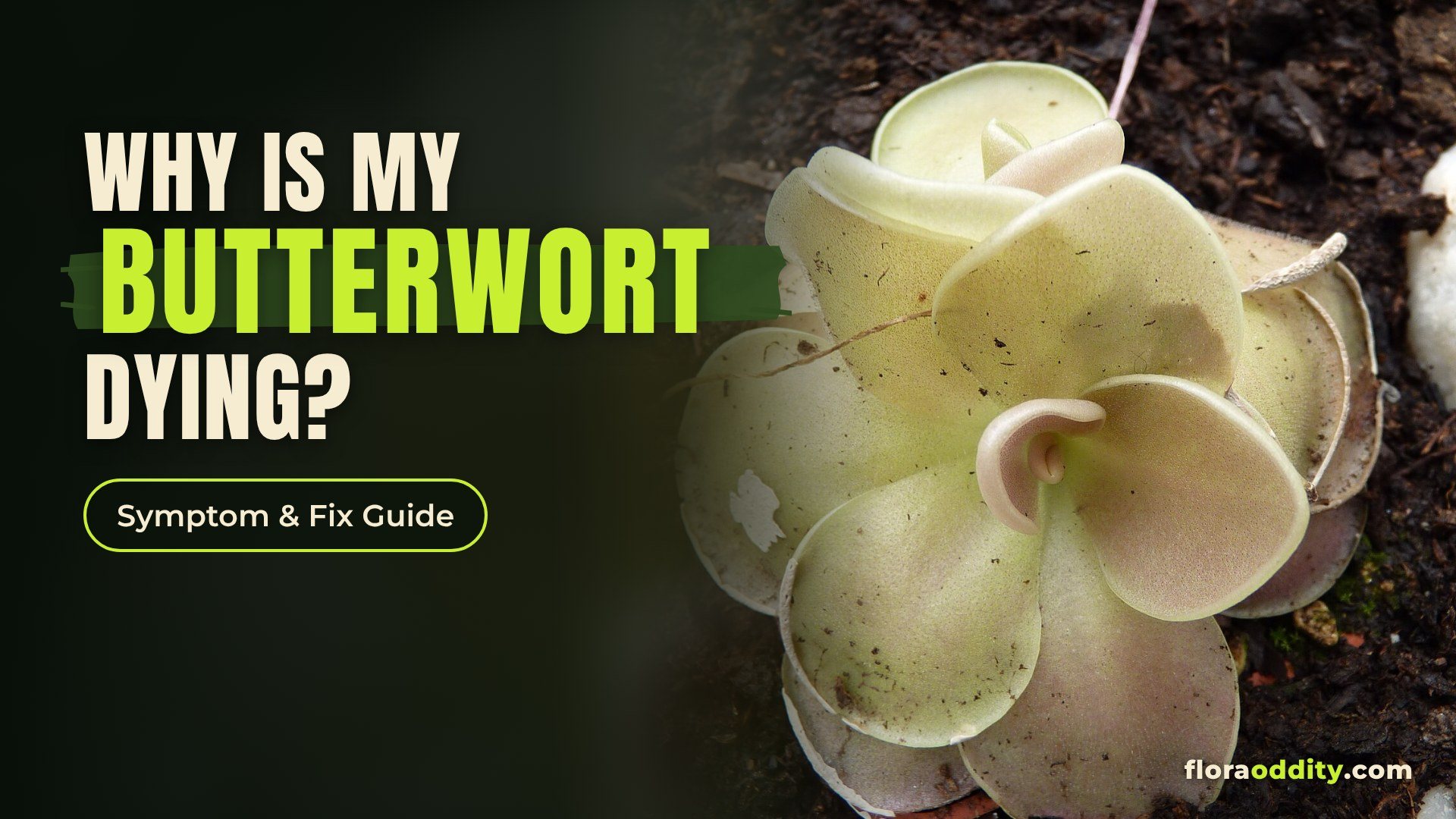
A butterwort that looks wrong is not always a butterwort in trouble. Mexican species shrink and lose their sticky leaves every winter on purpose, old leaves brown at the base as new ones form, and many butterworts blush pink in strong light. Real trouble usually shows in one place first: the centre of the rosette and the base where the leaves meet the soil. Sarracenia Northwest puts the test simply: small, healthy succulent leaves “usually indicate normal seasonal growth,” while “soft tissue, rapid browning, or a deteriorating crown indicates a genuine problem.”
If your butterwort is dying, or looks it, sort the symptom first: normal, stressed or sick. This guide goes symptom by symptom, deeper than the short list in our butterwort care guide.
The Short Answer
Most butterworts that seem to be dying are suffering from too much water, too little air, or too much heat. A soft, dark, collapsing base means rot: let the pot drain, increase air movement, water less, use a coarse mix and keep the crown above the soil. Do not reach for a fungicide; the International Carnivorous Plant Society (ICPS) says “Do NOT ever use any kind of fungicide on Pinguicula.”
A smaller, non-sticky rosette in autumn or winter is usually the normal succulent stage of a Mexican butterwort, not a dying plant (see our butterwort dormancy guide). Outside winter, missing stickiness and shrinking point to low light, heat or soggy soil. Crispy, curled or holed leaves have their own causes, from heat and fertilizer burn to aphids and a poor potting mix. The table below matches each symptom to its likely cause.
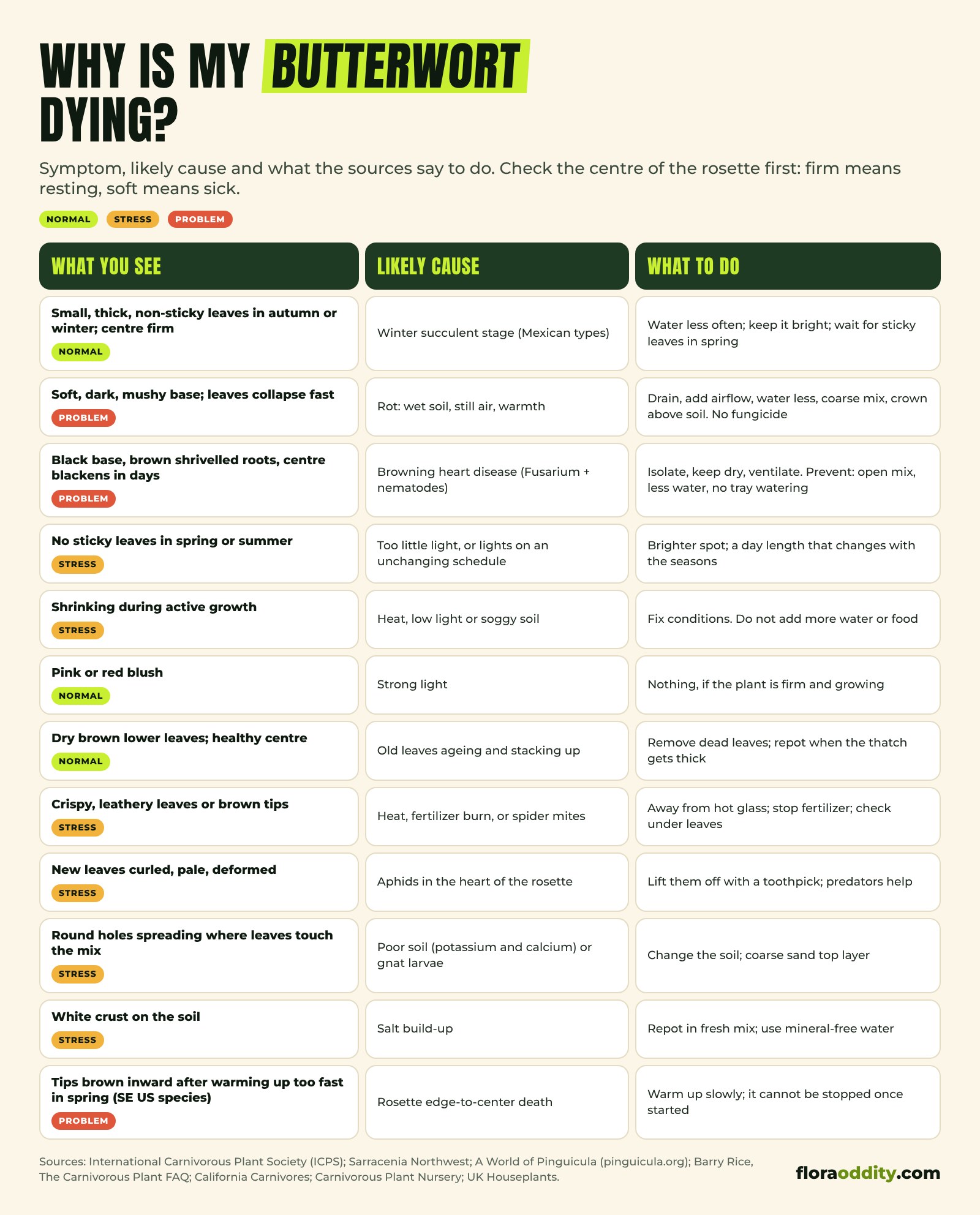
| Symptom | Likely cause | What the sources say to do |
|---|---|---|
| Small, thick, non-sticky leaves in autumn or winter, centre firm | Normal winter succulent stage (Mexican types) | Water less often; keep the plant bright; wait for sticky leaves in spring |
| Soft, dark, mushy base; leaves collapse quickly | Rot from wet soil, still air and warmth | Drain the pot, add air movement, water less, use a coarse mix, keep the crown above the soil; no fungicide |
| Roots brown and shrivelled, base turns black, centre blackens within days | Browning heart disease (Fusarium fungus with nematodes) | Isolate the plant, keep it dry, ventilate; prevent with an open mix, less water and no tray watering |
| No sticky leaves in spring or summer | Too little light; or lights on an unchanging schedule | Move to brighter light; give lights a day length that changes with the seasons |
| Rosette shrinking during active growth | Heat, low light or overly wet soil | Correct the conditions; do not add more water or food |
| Pink or red blush on leaves | Strong light (often normal) | No action needed if the plant is firm and growing |
| Lower leaves brown and dry, new centre healthy | Old leaves ageing and stacking up | Remove dead leaves; repot when the thatch of old leaves gets thick |
| Crispy, dry or leathery leaves; brown tips | Heat, fertilizer burn, or spider mites in the centre | Move away from hot glass; stop or reduce fertilizer; check under leaves for mites |
| New leaves curled, pale or deformed | Aphids feeding in the heart of the rosette | Lift them off with a toothpick; ladybirds or lacewing larvae help |
| Round holes spreading from where leaves touch the mix | Poor mix (potassium and calcium deficit) or fungus gnat larvae | Change the soil; add a sand top layer against gnats |
| White crust on the soil surface | Salt build-up | Repot into fresh mix; use low-mineral water |
| Tips brown inward after a fast spring warm-up (southeastern US species) | Rosette edge-to-center death | Prevent with slow temperature rises; it cannot be stopped once started |
First, Rule Out the Winter Stage
Before treating anything, check the calendar. Most Mexican species, the ICPS explains, have sticky carnivorous leaves in summer and succulent, non-carnivorous ones in winter. Sarracenia Northwest tells growers not to be alarmed if the plant “becomes noticeably smaller or stops producing sticky leaves during this period,” as long as the centre of the rosette stays healthy.
Succulent leaves use less water, Sarracenia Northwest notes, so this is also when overwatering starts; our dormancy guide covers winter watering. Firm, small leaves in the centre mean a resting plant; a soft or blackening centre means a sick one, in any season. The switch can come at odd times too: one TerraForums grower in 2005 linked out-of-season winter leaves to shorter days, accidental dry spells and sudden temperature changes.
Rotting or Mushy Base
What it looks like
Sarracenia Northwest describes the classic picture: “Soft, dark, or rapidly deteriorating leaves around the base of the plant often indicate excessive moisture.”
Why it happens
The ICPS is blunt: “Mexican Pinguicula are NOT bog plants.” In a reader Q&A, Sarracenia Northwest warns that Mexican butterworts left standing in a water tray “will get root rot if kept like this for long periods.” Its rule is “moist, not wet.”
Still air and warmth make it worse. Sarracenia Northwest says constant humidity with wet soil and poor air circulation “can increase the risk of rot,” and that these plants do not need high humidity. Barry Rice says southeastern US butterworts in terrariums without air circulation “seem prone to death from fungus.” On TerraForums, one grower summed up a covered tray in summer as water plus heat plus cover (see What Growers Report).
What to do
- Pour off any standing water and let the pot drain.
- Improve air movement and take off any cover or lid.
- Water less often, letting the surface begin to dry first, as Sarracenia Northwest suggests.
- Check that the mix is coarse and the crown is not buried. Sarracenia Northwest says the base “should remain at or just above the surface of the soil.” Our butterwort soil guide has airy mixes for each group.
- Do not use a fungicide. The ICPS says fungicides “are death even in the soil,” and that includes cinnamon.
If the base is already black, save leaves rather than the plant. In a 2007 TerraForums reply, moderator Joseph Clemens advised cutting healthy leaf pieces at least 0.4 to 0.8 inch (1 to 2 cm) from rotten tissue, letting them dry, and keeping them on a dry paper towel in a sealed bag, in good light but out of direct sun, until plantlets form. See how to propagate butterworts.
How butterwort rot compares with sundews and flytraps
Rice says a tray of water suits “nearly all carnivorous plants except Nepenthes, many Pinguicula, and a few oddballs,” and Sarracenia Northwest notes that sundews are fine sitting in water while Mexican butterworts are not. So the routine that suits your sundews or Venus flytrap can rot a Mexican butterwort on the same windowsill. Temperate species such as P. vulgaris and P. grandiflora are different: California Carnivores grows temperate and warm temperate butterworts permanently wet on trays.
The Plant That Dies in a Few Days: Browning Heart Disease
A disease page on A World of Pinguicula, by Dr Laurent Legendre with additions by Eric Partrat, calls browning heart disease the most sudden killer of Mexican butterworts in cultivation, striking “during spring or hot summer days (or in hot terrarium).”
First come lost vigour, no new leaves, and dull leaves without mucilage. No new white roots form and old roots turn brown and shrivel. The rootless base becomes a black stump, the centre blackens, and the plant dies in a few days, oddly, with “the tips of the leaves are still green while their bases are brown.”
Legendre found the fungus Fusarium every time, with many nematodes that seem to open the roots to it. The page’s prevention is an open mix, no overwatering and no tray watering, which it says spreads spores. In infected collections in Australia, quarantine, better ventilation and keeping plants completely dry brought new growing points after several weeks. Joseph Clemens, on TerraForums in 2007, gave a rule of thumb: more water calls for more light, more air movement and lower temperatures.
Leaves Not Sticky Outside Winter
If new leaves come out dry in spring or summer, suspect light. Sarracenia Northwest says a lack of sticky leaves during active growth “can also indicate insufficient light,” and suggests direct morning sun with bright light for the rest of the day, or gradually stronger artificial light. Under lights, the ICPS warns that Mexican species on an unchanging schedule “will essentially get stuck in the non-carnivorous phase”; they need day length that slowly rises and falls. Dull, non-sticky leaves on a plant that has also stopped growing can be the first stage of browning heart disease, so check the roots too.
Shrinking or Not Growing
Sarracenia Northwest separates two cases. Shrinking in autumn and winter with a firm centre is seasonal. Shrinking during active growth means checking for “excessive heat, inadequate light, or overly wet soil,” and fixing those rather than adding water or food.
Heat can hit one plant and spare its neighbours. In Sarracenia Northwest Q/A #117, a reader in Southern California grew P. laueana beside two hybrids in a window that reached the upper 90s to low 100s °F (about 36 to 39 °C). The hybrids thrived; the species turned succulent, dried up and died. The nursery said “excessive heat was likely a contributing factor” and that hybrids are often more adaptable than species.
Leaves Turning Red, Brown or Yellow
Red or pink
Colour is often a good sign. California Carnivores says many butterworts grown under high-intensity lights “will blush so that the entire plant is glowing pink or red!” Carnivorous Plant Nursery says butterworts “develop their best colors in bright light.” A firm, growing plant with red tints needs nothing.
Brown lower leaves
Old leaves die as the rosette grows; the ICPS says that after about five years, plants need repotting because “the deep thatch of old leaves” blocks new roots. Dry brown leaves under healthy new growth are normal, and UK Houseplants suggests removing dying leaves and debris. A move can do the same: in a 2009 TerraForums thread, a grower noted that plants often discard old leaves after a change of conditions, and that if the central new growth is healthy, things are “usually ok.” Soft brown leaves at the base are rot, not age.
Yellow
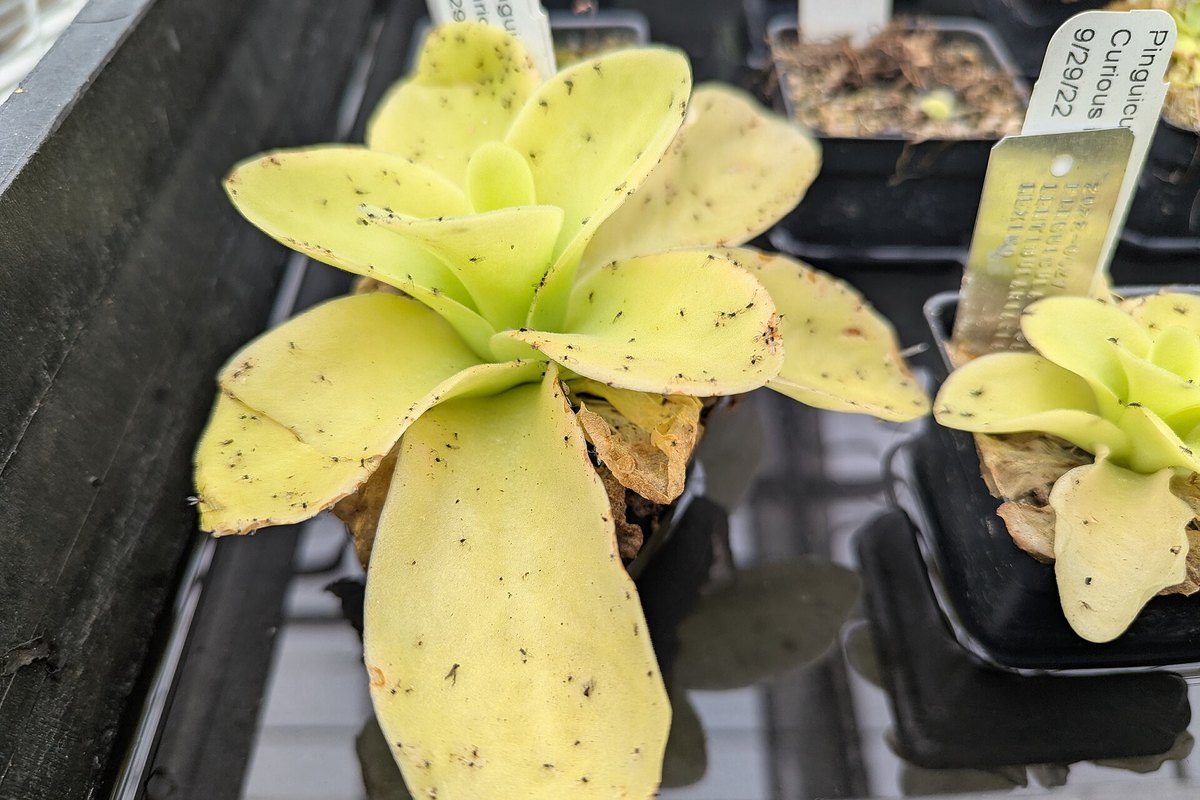
UK Houseplants links rapidly yellowing, rotting lower leaves to too little light combined with waterlogging, and names sun scorch and the wrong potting mix as other causes.
Brown from the tips inward in spring
In southeastern US butterworts, the A World of Pinguicula disease page describes rosette edge-to-center death, which appears “in late winter/early spring when the temperature is raised too rapidly”: the leaf tips brown and the browning spreads towards the centre. No pathogen was found, and slow temperature rises are the only prevention.
Crispy Edges and Dry, Leathery Leaves
Crisp leaves are a different signal from mushy ones. The sources point to three causes:
- Heat and strong sun. Sarracenia Northwest warns that glass “can amplify heat,” and that too much heat and sun can make leaves shrink or the plant decline.
- Too much fertilizer. The ICPS leaf-pulling guide shows over-fertilized plants with burned leaves and “leathery, almost dry leaves,” and warns that fertilizer in the crown can kill a plant.
- Spider mites. A World of Pinguicula shows a butterwort with brown tips from mites feeding in its heart during a hot, dry summer.
Sarracenia Northwest also says not to let the soil dry out completely during active growth.
Leaves Curling, Puckering or Getting Holes
Curled edges are not always a symptom. The ICPS notes that the summer leaves of P. cyclosecta have upturned edges that “keep the digestive juices from flowing off the edge of the leaves.” Pale, misshapen new leaves are another story: A World of Pinguicula says aphids feeding in the heart of the rosette make young leaves emerge “more or less deformed, even curled and paler than normal leaves.”
Holes have two common explanations. The disease page describes round holes that start where leaves touch the mix and spread over a few days; it blames a potassium and calcium deficit from poor soil, and says a change of soil ends the problem within a few weeks. Fungus gnat larvae are the other suspect: the ICPS says they “like to eat Pinguicula leaves.”
White Crust on the Soil
The ICPS mentions that a salt crust can form on the soil surface of potted Mexican butterworts, and recommends repotting more often than every five years if it does. Check your water with our water checker; Carnivorous Plant Nursery recommends mineral-free water for tropical butterworts.
After a short spell of hard water, Rice’s general advice for carnivorous plants is to flush the pot with pure water a few times; after months of it, with the plant declining, replace the soil.
A fuzzy white haze is a different thing. In a 2002 TerraForums thread about “a haze of white fungus” on a pot of Mexican butterworts, one reply suggested spraying the surface with mineral-free water, lowering humidity, and repotting before trying chemicals.
Pests
Fungus gnats. The adults are prey, but the ICPS warns that the larvae eat butterwort leaves and can do considerable damage to small plants, and Sarracenia Northwest reads an outbreak as a sign that “the soil of your butterwort is too wet.” A layer of coarse sand on top helps; see butterworts for fungus gnats for the full plan.
Aphids. A World of Pinguicula describes adults 2 to 3 mm long in many colours. A few can be lifted off with a toothpick; ladybirds and lacewing larvae help, though the plant may eat its own allies.
Spider mites. The same site calls them “a severe pest for our Mexican Pinguicula.” They are 0.3 to 0.5 mm long, hide under leaves and in the heart, and thrive at 73 to 86 °F (23 to 30 °C) and humidity below 50%. Small yellow spots turn into dry, spotty leaves, and heavy attacks can kill. It recommends the predatory mite Phytoseiulus persimilis.
Mealybugs. UK Houseplants lists root mealybugs among butterwort pests. The ICPS mealybug page, written mainly for Sarracenia, says the first sign is usually white fluff; clear dead leaves and debris, keep ants away, and swab weekly with 70% rubbing alcohol plus a few drops of dish detergent.
Go carefully with sprays: the ICPS says some pesticides “will harm and possibly kill Pinguicula.”
Flowering, Then Declining
A butterwort that looks smaller after flowering has often split, not failed. In a 2005 TerraForums thread, one grower’s P. ‘Mola’ split into four and took about 4 to 5 months for each to reach the original size; in a 2008 thread, another noted that plants “will split into more than one plant sometimes, usually after flowering.” Timing misleads too: Sarracenia Northwest says many species, such as P. laueana, bloom heavily in their winter phase, so flowers may be followed by weeks as a small, non-sticky rosette. Real decline after flowering looks like any other: a soft centre or black base.
When a Butterwort “Falls Apart”
Butterworts are loosely built. The ICPS notes they have little in the way of roots and stems; of P. ehlersiae in its succulent stage it warns, “If you are too rough the whole plant can fall apart,” and says P. gigantea can fall apart if repotted in summer. A plant that comes to pieces in your hands is not necessarily diseased; treat firm pieces as leaf pullings. One that falls apart on its own is different: UK Houseplants calls this basal collapse, and says to unpot it, cut away rot, and replant only if the base is still hard.
What Growers Report
These are single growers’ results in their own conditions, from public forum posts, not rules.
- A grower kept Mexican butterworts in a covered tray with shallow water in a garage at 75 to 98 °F (24 to 37 °C), with 14 hours of light a day. After a 10-day holiday, “my moranensis is rotted to the ground,” while P. ehlersiae was “doing great.” (CP30, TerraForums, July 2006)
- After moving plants to a new set-up of 100% Turface on a tray under T5 lights, at mid to high 80s °F (about 29 to 32 °C) by day, a grower saw blackened leaves and suspected crown rot. It was not: “Healthy growth emerged from the black leaves,” and everything improved after the fan was removed; the grower had blamed “the fan + heat wave.” (cwatson1414, TerraForums, June 2016)
- On a P. esseriana with suspected Fusarium crown rot, an experienced grower wrote: “I have tried many times and never saved one or its leaf cuttings.” The grower repotted healthy pot-mates and threw the infected plants out. (theplantman, TerraForums, February 2016)
- Asked whether flowering would kill a P. moranensis, a first-year grower reported that “any reasonably healthy plant can be allowed to flower without detrimental effects,” and that rosettes that split after flowering regained size quickly. (Ispahan, TerraForums, November 2005)
Our takeaway: heat runs through the first two cases, and in the third the grower’s priority was protecting the healthy neighbours.
Where Sources Differ
Each row gives only the context the sources themselves state.
| Topic | One view | Another view | Context the sources give |
|---|---|---|---|
| Fungicides | ICPS: never use any fungicide on any Pinguicula, not even cinnamon | A World of Pinguicula disease page lists fungicides used against Fusarium; one TerraForums grower used a commercial-grade fungicide on healthy pot-mates | The disease page calls most fungicides fungistats that only stop the fungus for about two weeks |
| Spider mites | Sarracenia Northwest: “pretty rare on Pinguicula” | A World of Pinguicula: a severe pest of Mexican Pinguicula | The French site describes greenhouse outbreaks in hot, dry summers; Sarracenia Northwest was answering a home grower whose webbing turned out to be a harmless spider |
| Saving a rotting plant | Joseph Clemens: cut healthy leaf pieces and root them in a sealed bag | theplantman: never saved a Fusarium plant or its leaf cuttings | Legendre’s quarantine and dry method produced new growing points after several weeks |
| How wet to keep the soil | Sarracenia Northwest and the ICPS: moist, not wet; not bog plants | UK Houseplants: continually moist soil, base standing in about 0.4 inch (1 cm) of water | UK Houseplants writes about butterworts in general; the ICPS and Sarracenia Northwest are writing about Mexican types |
Common Mistakes
- Treating the winter rosette as a dying plant. Check the centre first; small, firm leaves are normal.
- Watering more when a plant shrinks. Sarracenia Northwest says to fix light, heat and soil instead.
- Growing Mexican butterworts like sundews. A permanent water tray suits sundews, not Mexican Pinguicula.
- Covering plants to raise humidity. Wet soil, warmth and still air are the conditions linked to rot.
- Reaching for fungicide or cinnamon. The ICPS says both can kill butterworts.
- Feeding with fertilizer water. The ICPS shows burned, leathery leaves from overfeeding.
FAQ: Butterwort Dying
Is my butterwort dying or dormant?
Look at the centre. Small, thick, firm leaves in autumn or winter usually mean the normal succulent stage of a Mexican butterwort. A soft, dark or collapsing centre, black roots, or browning that spreads fast means a real problem in any season.
Can a rotting butterwort be saved?
If only outer leaves are soft, let the pot drain, water less often, improve airflow and keep the crown above the soil. If the base is black, save healthy leaf tissue as leaf pullings. Growers disagree about plants with Fusarium crown rot; one experienced grower says neither the plant nor its cuttings survived.
Should I cut off a dying butterwort leaf?
Yes, once it is dead. UK Houseplants suggests removing dying leaves with clean tools and not cutting through yellowed tissue.
The Bottom Line
A butterwort dying outside winter is usually reacting to wet soil, still air, heat or low light. Decide first whether the centre is firm. If it is, the plant is probably resting, ageing old leaves, blushing in good light, or splitting after flowering. If the base is soft or black, cut the water, add air, cool it down, keep fungicides away, and save healthy leaves while you still can. For other plants and symptoms, try our symptom checker.
Sources & Further Reading
- Sarracenia Northwest: How to Grow Tropical Butterworts (Pinguicula)
- Sarracenia Northwest: Q/A #117, Pinguicula laueana Didn’t Like the Hot Window
- Sarracenia Northwest: Q/A #20, Spider Mite Web?
- International Carnivorous Plant Society: Growing Mexican Pinguicula
- International Carnivorous Plant Society: Mexican Pinguicula Leaf Pullings
- International Carnivorous Plant Society: Mealybugs
- A World of Pinguicula: Diseases (Laurent Legendre and Eric Partrat)
- A World of Pinguicula: Aphids
- A World of Pinguicula: Spider Mites
- Barry Rice, The Carnivorous Plant FAQ: Pinguicula cultivation
- Barry Rice, The Carnivorous Plant FAQ: About water
- Barry Rice, The Carnivorous Plant FAQ: I goofed by using bad soil or water
- California Carnivores: Butterworts (Pinguicula) Growing Tips
- Carnivorous Plant Nursery: Growing Tips for Tropical Butterworts
- UK Houseplants: How to Grow Your Indoor Butterworts (Pinguicula)
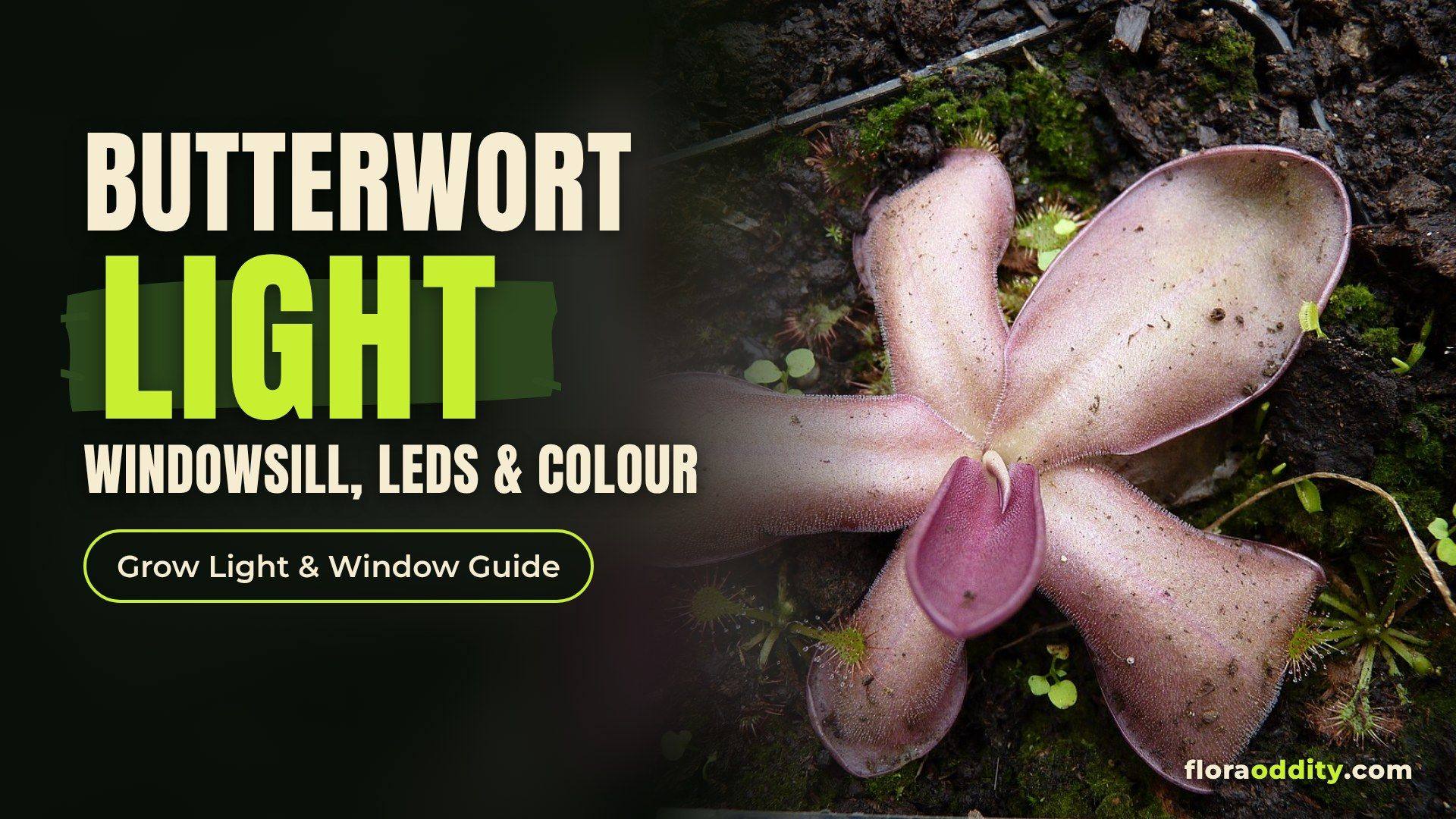
Featured image based on a photo of Pinguicula ‘Sethos’ by Michal Klajban via Wikimedia Commons, CC BY-SA 3.0, cropped, with a dark gradient and typography added by FloraOddity; the adapted image is offered under the same licence.
Final articles are editorially reviewed and factual claims are checked against cited sources. Last reviewed: October 2026.
3 Comments