

Most carnivorous plants are sun lovers, and beginners are told to give them as much light as they can. Butterworts break that rule a little. The International Carnivorous Plant Society (ICPS) rates Mexican butterworts as plants for “moderate light,” a step below the “intense light” it gives most sundews and Venus flytraps. Many of them, it notes, grow on north-facing cliffs “with little or no direct sunlight.” Get butterwort light right and the plant stays compact, sticky and often flushed with pink. Get it wrong in either direction and it stretches and stays plain green, or cooks in a hot window.
This guide goes deeper than the short Light section of our butterwort care guide: real light levels, windows, LED set-ups, day length cues, outdoor sun and colour.
The Short Answer
Mexican butterworts want bright light without heat. Sarracenia Northwest recommends several hours of gentle direct sun, ideally morning sun from an east window, and warns that a window in hot afternoon sun can overheat sensitive species. Under lights, white LEDs work well: Sarracenia Northwest starts with about 2,500 lumens at about 12 inches (30 cm) for about 14 hours a day. The ICPS puts the target at about 8,000 to 15,000 lux, and Carnivero suggests 30 to 200 µmol/m²/s of PPFD. Most Mexican species also need day length that changes slowly with the seasons, or the ICPS says they can get “stuck in the non-carnivorous phase.”
Temperate and southeastern US butterworts are outdoor-style plants that take more sun: Barry Rice grows them in full sun or “under bright sun,” while Carnivorous Plant Nursery suggests partial sun. Pale, stretched, plain green rosettes usually mean too little light; shrinking, browning plants in a hot window usually mean too much heat.
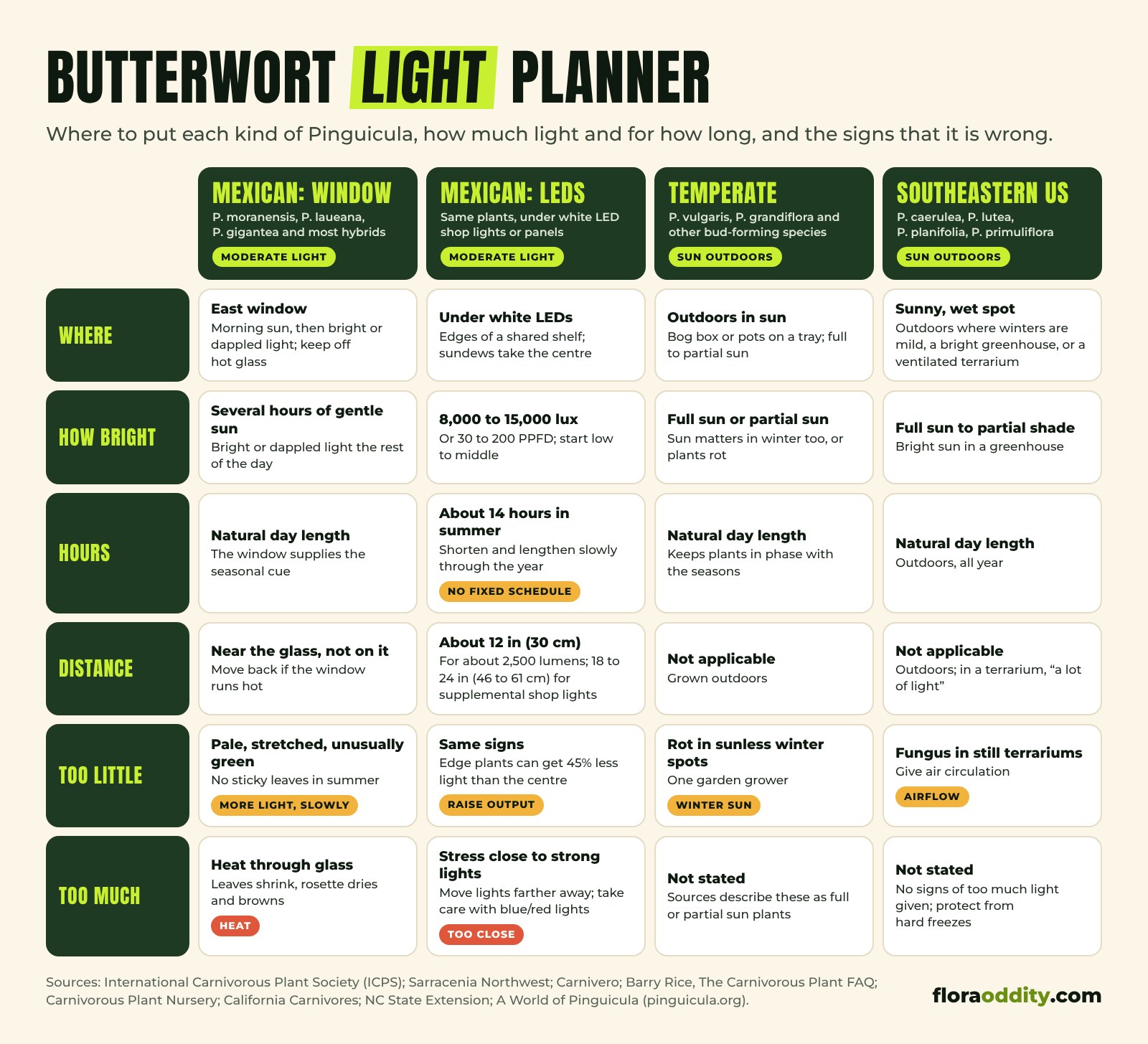
| Mexican, windowsill | Mexican, under LEDs | Temperate (hibernaculum-forming) | Southeastern US | |
|---|---|---|---|---|
| Placement | East window with morning sun, then bright or dappled light; keep off hot glass in summer | White LED shop lights or panels; edges of a shared light shelf | Outdoors in sun, in a bog box or pots on a tray; full sun to partial sun | Outdoors in sunny, ever-wet spots where winters are mild; a bright greenhouse; or a well-lit, ventilated terrarium |
| Light level | Several hours of gentle direct sun | About 8,000 to 15,000 lux (ICPS); 30 to 200 PPFD (Carnivero) | Full sun (Rice) or partial sun with dappled light (CPN) | Full sun to partial shade (NC State); bright sun (Rice) |
| Hours | Natural day length, which supplies the seasonal cues | About 14 hours in active growth (SNW); change the schedule slowly with the seasons | Natural day length outdoors; sun matters in winter too | Natural day length outdoors |
| Distance | Close to the window, but not touching hot glass | About 12 in (30 cm) for 2,500 lumens (SNW); 18 to 24 in (46 to 61 cm) for supplemental shop lights | Not applicable outdoors | Not applicable outdoors |
| Too little light | Pale, stretched, unusually green; no sticky leaves in summer | Same signs; plants on the edges of the light get much less | Not stated; one garden grower links a sunless winter spot to rot | Not stated; in terrariums, fungus without air circulation (Rice) |
| Too much | Heat through glass: shrinking, drying, a dying centre | Heat and stress close to strong lights; take care with blue/red lights | Not stated in the sources | Not stated in the sources |
| Sources | SNW, ICPS, Partrat | SNW, ICPS, Carnivero | Rice, CPN, ICPS, A World of Pinguicula | Rice, NC State, ICPS, California Carnivores |
How Much Light Is a Butterwort’s “Moderate”?
The ICPS LED lighting guide, by John Brittnacher, sorts carnivorous plants into three bands of white light. “Intense light” is about 15,000 to 25,000 lux, for plants such as Cephalotus, Venus flytraps, Heliamphora and most sundews. “Moderate light” is about 8,000 to 15,000 lux, and that is where it puts both Mexican and temperate Pinguicula. For scale, it puts full noon sun at about 100,000 lux, bright shade at about 15,000 lux and office lighting at 1,000 lux. A Mexican butterwort wants roughly bright shade: far more than an office, far less than full sun.
Carnivero, a carnivorous plant seller linked to the Florawave lighting brand, publishes PPFD figures (photosynthetic photon flux density, the measure plant light meters use). It lists Pinguicula at 30 to 200 µmol/m²/s, assuming a 12 to 14 hour photoperiod, and advises “targeting around the low-middle at first,” then adjusting to the plants’ response. It adds that some figures rest on greenhouse experience rather than tests under lights.
Habitat explains the modest numbers. Carnivorous Plant Nursery says tropical butterworts are “more commonly found on the north facing cliffs and outcrops,” where they “benefit from the dappled light provided by accompanying grasses and vegetation.” Eric Partrat, writing on A World of Pinguicula, adds that Mexico is very sunny: even in the shade of grass and shrubs, the plants get more light there than they would in direct sun in France. Even so, he does not advise full sun in a greenhouse, and grows under light shade cloth or “dirty” glass instead.
Choosing and Taming a Window
For a Mexican butterwort, the window is about light without heat.
East is the safe default. Sarracenia Northwest names an east-facing window with morning sun as “often an excellent location,” followed by bright or dappled light for the rest of the day.
Hot afternoon sun is the risk. Sarracenia Northwest warns against windows that get intense afternoon sun in summer and says “Glass can amplify heat.” In its Q/A #117, it explains that sun passing through glass “can create much hotter conditions around the plant than the temperature elsewhere in the room.” Its fixes: move the plant back from the glass, shade it from afternoon sun, or move it under LEDs.
Species are touchier than hybrids. The same Q/A says some species, including P. laueana, are “less forgiving” of high temperatures, and that the nursery once lost a pot of a species to overheating while hybrids beside it were fine.
Dry air is part of the picture. Barry Rice, in his Carnivorous Plant FAQ, says to “use moderate sunlight” for Mexican butterworts and that they “can often be grown on a windowsill if the air is not too dry.”
An ICPS photo caption shows the trade-off: P. cyclosecta grown next to a window is “greener and larger than plants grown in a bright greenhouse,” and looks more like wild plants. A window can give a healthy plant that is simply less colourful.
Reading the Leaves: Too Little or Too Much Light
Signs of too little light
Sarracenia Northwest gives the clearest checklist: plants that remain “pale, stretched, or unusually green” may need stronger light. During active growth, it adds, a lack of sticky leaves “can also indicate insufficient light”; raise the light gradually. For a plant shrinking in the growing season, it lists inadequate light alongside heat and soggy soil.
Two cautions. Small, thick, non-sticky leaves in autumn and winter are usually the normal succulent stage (see our butterwort dormancy guide). And green is not automatically a problem: Rice notes that some P. laueana, a species often dull red, are “a more conventional, bright green.”
Signs of too much light, or too much heat
For butterworts, “too much light” is usually too much heat. Sarracenia Northwest says excessive heat and sunlight can make leaves shrink or cause the plant to decline. In Q/A #117, the warning sign was the whole rosette drying out; the nursery separates normal succulent growth with “firm new leaves” in the centre from “progressive drying, browning, or deterioration of the entire rosette,” which means stress.
Under lights, the ICPS flags Mexican Pinguicula as “use caution, could be too much light” under blue/red plant lights, and temperate Pinguicula as “use caution.” A photo caption in the same guide adds that Pinguicula “can be grown under purple light as long as the light is not too bright.”
Grow Lights for Butterworts
Which LEDs
White LEDs are the simple choice. Sarracenia Northwest uses white LED shop lights of about 2,500 lumens or more and says specialised red-and-blue grow lights “are not necessary.” In a video guide, Sean Springfield, who manages the nursery’s tropical greenhouse, says staff tried “blurple” red and blue lights and were not happy with the results; they also caused eye strain and made problems hard to spot. Cool white or warm white, he says, does not seem to matter.
The ICPS guide advises checking a fixture’s actual wattage rather than “watt-equivalent” claims, and notes that LEDs dim: after 35,000 hours, 70% of the original brightness is not unusual.
How bright and how high
Sarracenia Northwest’s care guide starts with about 2,500 lumens at about 12 inches (30 cm) above the plants. Its video, about supplementing greenhouse sunlight, suggests 20 to 40 watt shop lights at 18 to 24 inches (46 to 61 cm).
The ICPS guide works from area instead. Intense light for sundews and flytraps takes about 2,000 lumens or 30 watts of white LED lighting per square foot (about 30 by 30 cm) of growing area. For moderate-light plants such as butterworts, it suggests about 40% lower wattage, spreading the same lights over a larger area, or “not using side reflectors.” On a shared shelf, it puts lower-light plants at the edges, where light falls off fast: in one ICPS example, plants at the edges of two trays under one 30 cm panel got 45% less light than those in the centre.
The ICPS says it “helps to have a Lux meter when using white lighting”; otherwise, light levels come down to trial and error.
How many hours
Sarracenia Northwest gives its tropical butterworts about 14 hours of light a day during active growth, on an electrical timer. Carnivero’s PPFD figures assume 12 to 14 hours. For most Mexican species, that schedule should not stay fixed all year.
Day Length: the Signal Mexican Butterworts Follow
Most Mexican butterworts switch between two kinds of leaves: sticky, carnivorous summer leaves and small, succulent winter leaves. Carnivorous Plant Nursery says “Seasonal changes in light, not moisture, trigger the switch,” and advises varying the lighting with the seasons.
The ICPS says these species need seasonal cues from a greenhouse, a sunny window, or lights on a timer whose times change with the seasons. Its key point: “Day length is not as important as slowly increasing or decreasing day length.” Plants kept on an unchanging light period “will essentially get stuck in the non-carnivorous phase.” The LED guide adds that most Mexican Pinguicula “require seasonal day length changes in order to live long term and to bloom,” and that “abruptly changing the number of hours is not effective.” Its preferred tool is a timer that changes the on and off times daily by date and latitude.
The exception is P. gigantea, which the ICPS says forms no succulent winter leaves and grows under a constant light cycle, though it may not bloom. It calls it “a great window sill plant” that blooms in early winter.
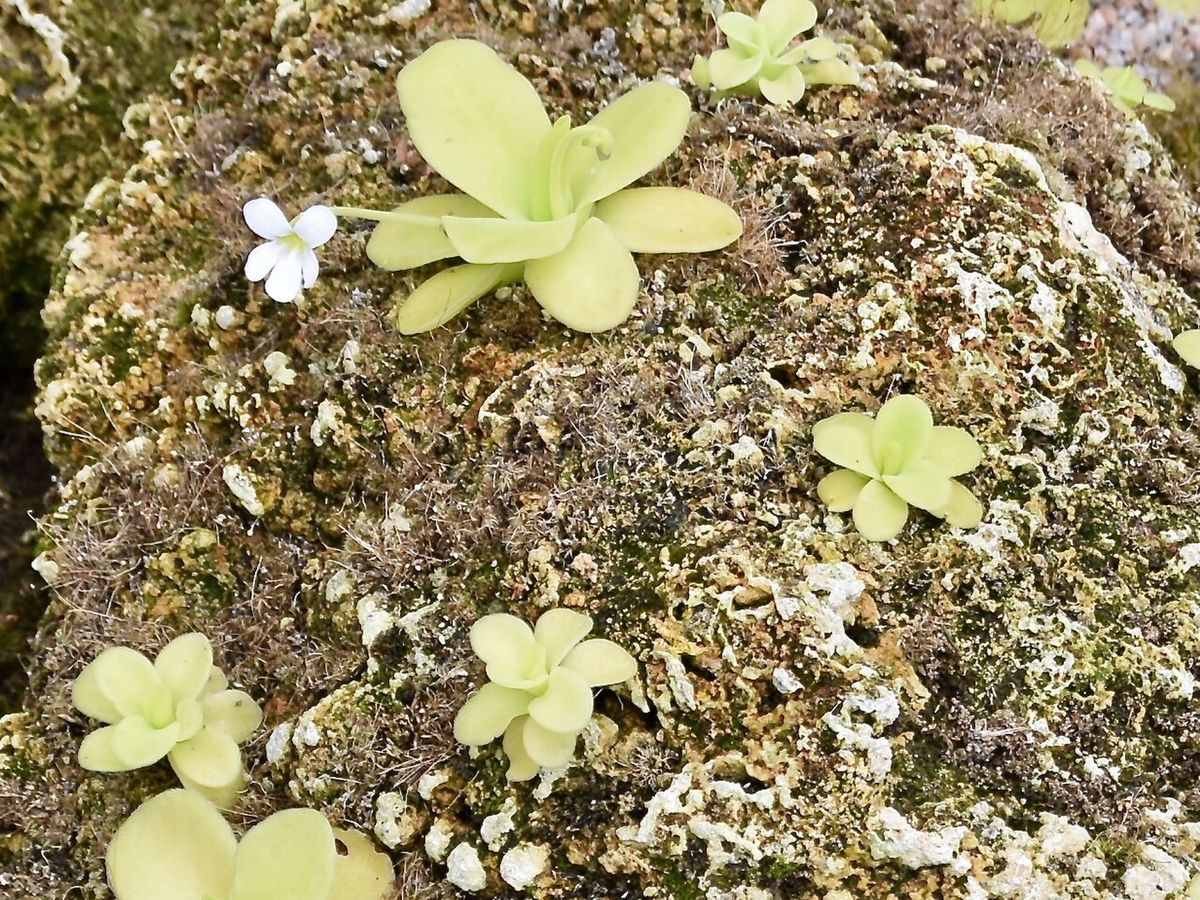
A windowsill supplies the cue for free. Under lights, use a timer that follows local sunrise and sunset, or change an ordinary timer a little at a time over weeks; the sources give no step size.
Temperate and Southeastern US Butterworts Outdoors
Temperate species
The butterworts that form winter buds (hibernacula) are sun plants. Rice says the arctic-temperate species he has grown all like “full sun, acid soils, watering by tray.” The ICPS puts seedlings “in a bright sunny location” in spring, on a natural light cycle so they stay “in phase with the seasons.” Carnivorous Plant Nursery takes a gentler line: partial sun, with the “dappled light provided by accompanying grasses and vegetation.”
Winter sun still matters. A garden page on A World of Pinguicula, where temperate species grow in plastic boxes along a house wall in sun from 10 AM to 2 PM, warns: “It is important to have sun also in winter or you’ll have many rotten plants.” The cold side of winter care is in our butterwort dormancy guide.
Southeastern US species
NC State Extension says butterworts grow “in sunny, open, wet locations throughout the southeastern US” and recommends “full sun to partial shade” in consistently moist soil. Rice grows the southeastern species in greenhouses “under bright sun,” and says they can even grow in a terrarium “with a lot of light” if humidity stays below 100% and there is some air circulation; without it, he finds terrarium plants “prone to death from fungus.” The ICPS suggests growing them outside if you live within their natural range, with protection in freezing weather, and California Carnivores says they do best outdoors where winters are mild.
Colour: Why Butterworts Blush Pink or Red
Strong light brings it out. California Carnivores says that under high-intensity fluorescent grow lights, many butterworts “will blush so that the entire plant is glowing pink or red!” Carnivorous Plant Nursery says butterworts “develop their best colors in bright light.”
Spectrum matters as well as brightness. Carnivero says pigment production “is influenced by absolute light levels as well as the spectra,” and that higher pigment levels give plants “a darker, reddish hue.”
Some colour belongs to the plant. Rice notes that P. laueana foliage “is often dull red, especially in dormancy,” though some plants are bright green, and that P. planifolia usually has “reddish leaves.” A green clone is not a light problem.
Colour is not the target. Sarracenia Northwest’s hot-window case shows that pushing a sensitive species can cost the plant. Aim for compact, sticky rosettes; colour, where the clone has it, follows.
How Butterwort Light Compares With Nepenthes and Sundews
Put the published numbers side by side and butterworts land with Nepenthes, not with sundews.
| Mexican butterworts | Nepenthes | Most sundews (Drosera) | |
|---|---|---|---|
| ICPS rating | Moderate light | Moderate light | Intense light |
| ICPS white light level | About 8,000 to 15,000 lux | About 8,000 to 15,000 lux | About 15,000 to 25,000 lux |
| Carnivero PPFD range | 30 to 200 | 30 to 200 | 100 to 500+ |
| Blue/red lights (ICPS) | Use caution, could be too much | Yes | Use caution; some species sensitive |
See our Nepenthes light guide and the Light section of our sundew care guide. One butterwort breaks the pattern: Rice says the little annual P. lusitanica should be treated “like a brightly lit Drosera.”
Setting Up Butterwort Light, Step by Step
- Identify the group. Mexican, temperate or southeastern US decides everything else; our pillar guide shows how to tell which butterwort you have.
- For a Mexican butterwort on a windowsill, start in an east window. If it runs hot in summer, move the plant back from the glass or shade it from afternoon sun, as Sarracenia Northwest advises.
- Under lights, start with white LEDs of about 2,500 lumens at about 12 inches (30 cm), or aim for 8,000 to 15,000 lux on a lux meter, or the low-middle of 30 to 200 PPFD.
- Set a timer for about 14 hours in summer, and let the day shorten and lengthen slowly through the year, ideally with a sunrise and sunset timer.
- Watch the new leaves over the next few weeks. Pale, stretched or non-sticky summer leaves: more light, gradually. Drying, browning or a shrinking rosette: less heat.
- Put temperate and southeastern species outdoors in sun where the climate suits them, and keep winter sun on temperate plants.
What Growers Report
These are single growers’ set-ups and results, not rules.
- A grower kept P. debbertiana, P. kondoi, P. cyclosecta and P. jaumavensis on a south windowsill with “a lot of full sun” and was “still waiting for a better colouration,” while leaf cuttings of the same plants on an east windowsill coloured better, especially P. kondoi. (C.Weinberger, CPUK Forum, April 2007)
- Another grew a batch of butterworts outdoors in intense summer sun for about four months, and “all were a bright green”; under fluorescent lights indoors in autumn, about 15 inches (38 cm) from four T8 tubes, they “turned a nice pink color.” (rattler_mt, CPUK Forum, April 2007)
- A grower with P. ‘Florian’ and other new butterworts about 12 inches (30 cm) under a four-tube T5 HO fixture, lights on 11 hours a day, worried that the plants were “getting alot of red”; replies in the thread judged the light fine, with one member noting that many butterworts show red under strong enough light. (Steverd, TerraForums, December 2015)
- A reader in Southern California gave P. laueana, P. ‘Aphrodite’ and P. gigantea × laueana the same window, with “about five hours of direct sunlight” and a summer window temperature in the upper 90s to low 100s °F (about 36 to 39 °C); the two hybrids thrived but the P. laueana dried up and died, which Sarracenia Northwest blamed mainly on heat. (Reader question, Sarracenia Northwest Q/A #117, June 2020)
Our takeaway: more sun did not mean more colour for these growers, and cooler, steady artificial light often coloured plants better than hot direct sun; heat, not light, was what killed a plant.
Where Sources Differ
| Topic | One view | Another view | Context the sources give |
|---|---|---|---|
| Light schedule for Mexican species | ICPS: change the day length slowly with the seasons, ideally with a sunrise and sunset timer; a constant period can leave plants stuck in the non-carnivorous phase | Sarracenia Northwest: about 14 hours on a timer; “A consistent light cycle is more important than trying to adjust the lights manually each morning and evening” | Sarracenia Northwest is warning against irregular manual switching; the ICPS is describing slow seasonal change. The ICPS says homophyllous species such as P. gigantea tolerate a constant period |
| Lamp height | Sarracenia Northwest care guide: about 12 inches (30 cm) for about 2,500 lumens | Sarracenia Northwest video: 18 to 24 inches (46 to 61 cm) for 20 to 40 watt shop lights | The video describes lights that supplement greenhouse sunlight; the ICPS says height depends on the fixture |
| Pink leaves | California Carnivores and Carnivorous Plant Nursery: strong light brings out pink and red; a TerraForums member: many butterworts show red under strong enough light | Another TerraForums member (jeff 2, 2016): pink means too much light, as plants in the wild are green-yellow | jeff 2 was writing about P. rotundiflora, a gypsum-growing species; Rice notes some species and clones are naturally red or green |
| Sun for temperate species | Rice: full sun | Carnivorous Plant Nursery: partial sun, dappled light | Rice describes his own collection; the nursery describes habitat among grasses and vegetation |
Common Mistakes
- Treating a Mexican butterwort like a sundew. It wants moderate light; a hot, sunny window can kill sensitive species.
- Judging light by eye. A lux meter reading of 8,000 to 15,000 lux is a better guide than “it looks bright.”
- Running lights on one fixed schedule all year, or changing it in one big jump. Most Mexican species need slow seasonal change.
- Mistaking the winter rosette for a light problem. Small, thick, non-sticky leaves in winter are normal.
- Chasing colour at any cost. Some clones stay green, and heat stress is a bigger risk than a plain-coloured plant.
FAQ: Butterwort Light
How many hours of light does a butterwort need?
Under lights, about 14 hours a day in active growth (Sarracenia Northwest), rising and falling slowly with the seasons for most Mexican species (ICPS). On a windowsill or outdoors, natural day length does the job.
Can a butterwort get too much light?
Yes, mostly through heat. Sarracenia Northwest says too much heat and sun can shrink leaves or make the plant decline, and sun through glass makes a window much hotter than the room.
Do butterworts need a grow light?
No, if you have a suitable window. The ICPS says Mexican species make great house plants “in a bright sunny window or under lights.” A grow light helps when no window gets several hours of gentle sun, or when a window runs too hot.
Why is my butterwort turning red or pink?
Usually because it is getting strong light, especially from grow lights, as California Carnivores describes. Some species and clones, such as many P. laueana, are naturally reddish.
The Bottom Line
Butterwort light is about balance. Mexican butterworts want moderate light, about 8,000 to 15,000 lux or 30 to 200 PPFD, from an east window or white LEDs, with day length that changes slowly through the year and no heat build-up behind glass. Temperate and southeastern US species take more sun outdoors. Watch the new leaves: pale and stretched means more light, drying and shrinking means less heat, and pink is a bonus, not the goal.
Sources & Further Reading
- International Carnivorous Plant Society: LED Plant Lighting (John Brittnacher)
- International Carnivorous Plant Society: Growing Mexican Pinguicula
- International Carnivorous Plant Society: Growing cold temperate Pinguicula
- International Carnivorous Plant Society: Growing warm temperate Pinguicula
- Carnivero: Genera Specific PPFD Recommendations
- Sarracenia Northwest: How to Grow Tropical Butterworts (Pinguicula)
- Sarracenia Northwest: Q/A #117, Pinguicula laueana Didn’t Like the Hot Window
- Sarracenia Northwest: LED Lights for Tropical Plants (Sean Springfield)
- California Carnivores: Butterworts (Pinguicula) Growing Tips
- Carnivorous Plant Nursery: Growing Tips for Tropical Butterworts
- Carnivorous Plant Nursery: Growing Tips for Temperate Butterworts
- Barry Rice, The Carnivorous Plant FAQ: Pinguicula cultivation
- Barry Rice, The Carnivorous Plant FAQ: Heterophyllous species of Mexico and Central America
- Barry Rice, The Carnivorous Plant FAQ: Pinguicula of the USA and Canada
- A World of Pinguicula: Growing Mexican Pinguicula (Eric Partrat)
- A World of Pinguicula: Growing Pinguicula in a Garden
- NC State Extension Gardener Plant Toolbox: Pinguicula
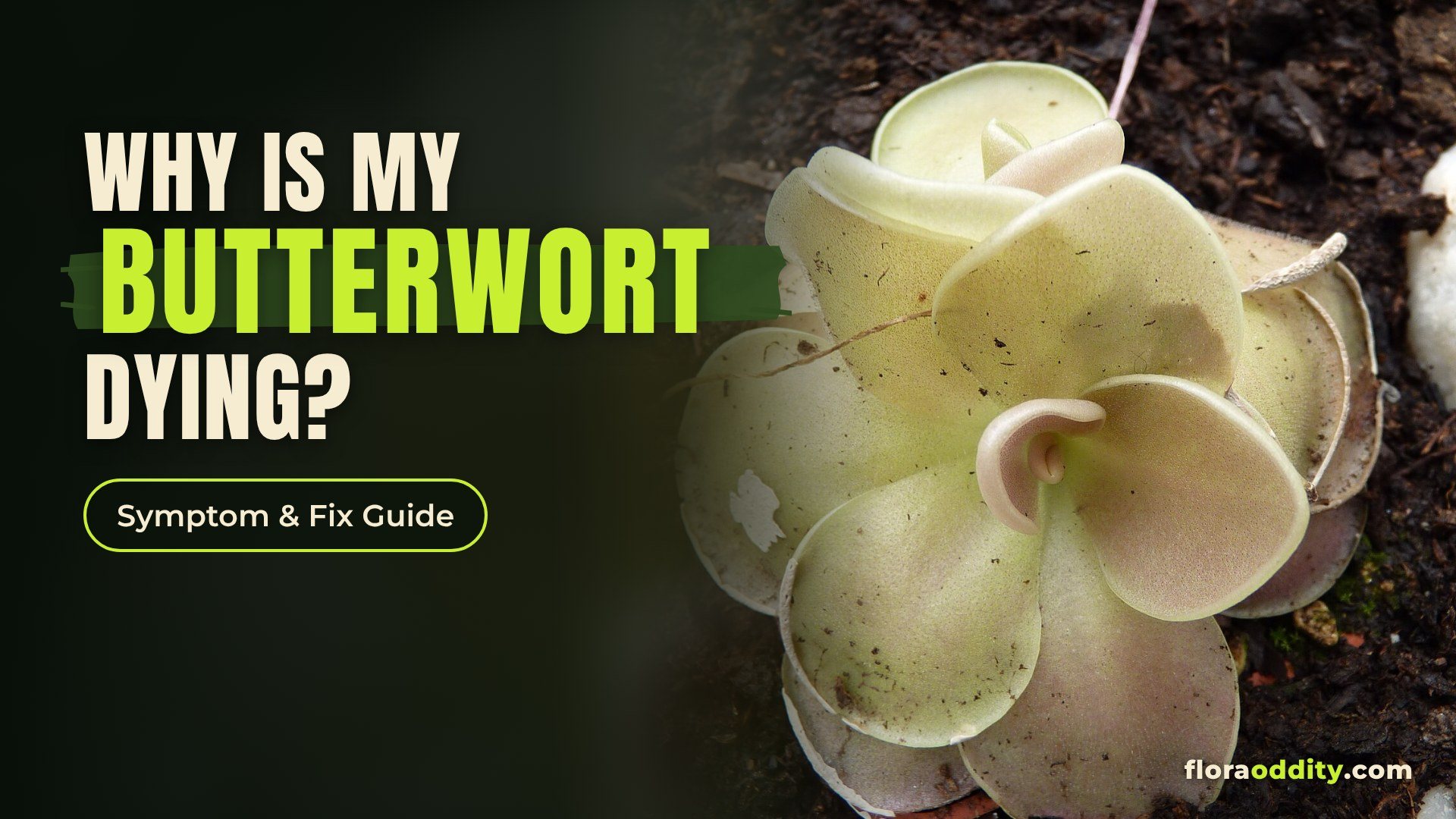
Featured image based on a photo of Pinguicula laueana by Michal Klajban via Wikimedia Commons, CC BY-SA 3.0, with a dark gradient and typography added by FloraOddity; the adapted image is offered under the same licence.
Final articles are editorially reviewed and factual claims are checked against cited sources. Last reviewed: October 2026.

One Comment