Every autumn, someone with a healthy Albany pitcher plant notices that the new pitchers have stopped coming. Instead, the plant pushes out small, flat, green leaves that catch nothing. Nothing is wrong. Sarracenia Northwest describes a winter rest of “approximately three months” in the wild, when growth slows dramatically and the plant makes “an abundance of flat, non-carnivorous leaves.”
Cephalotus dormancy is a gentler thing than the deep, cold sleep of a Sarracenia or a Venus flytrap. The sources do not even agree that it is a true dormancy: California Carnivores says there is “no winter dormancy,” only slower growth. This guide goes deeper than the winter section of our Cephalotus care guide: what happens during the rest, the temperatures and day lengths the sources use, how to handle light and water, what windowsill, terrarium and greenhouse growers each need to do, how much frost the plant can take, and what spring growth looks like.
The Short Answer
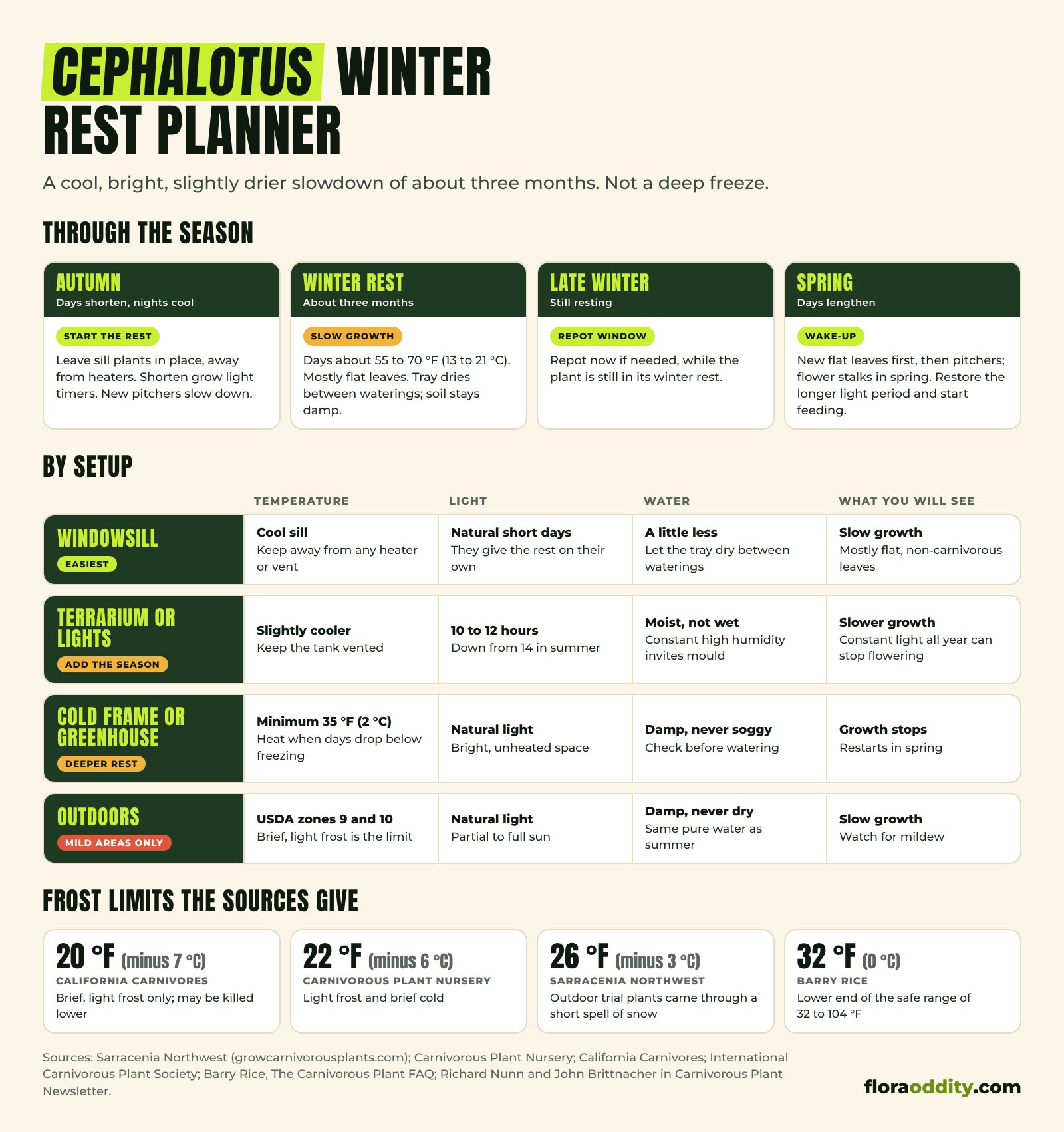
From autumn to early spring, give Cephalotus a cooler, shorter-day rest of about three months. Sarracenia Northwest puts the natural winter days at 55 to 70 °F (13 to 21 °C), and Carnivorous Plant Nursery wants it only “slightly cooler” than in summer. Keep the light bright. On a windowsill, shorter days provide the rest on their own; under lights, shorten the timer. Water a little less: let the tray dry between waterings, but keep the soil damp. Expect slow growth and flat leaves. Brief, light frost is the limit, so protect the plant from long or hard freezes. Spring brings new leaves, then pitchers, then flowers.
| Setup | Temperature | Light and day length | Water | What you will see | Sources |
|---|---|---|---|---|---|
| Windowsill indoors | A cool sill, away from heaters and vents | Natural shorter days give the rest | Tray allowed to dry between waterings; soil still damp | Slow growth, mostly flat leaves | Sarracenia Northwest, Carnivorous Plant Nursery |
| Terrarium or grow lights | Slightly cooler than summer; keep the terrarium vented | Shorten the timer: 12 hours (Sarracenia Northwest) or 10 hours (Carnivorous Plant Nursery) in winter | Moist, not waterlogged | Slower growth; a constant photoperiod all year can stop flowering | Sarracenia Northwest, Carnivorous Plant Nursery, ICPS, John Brittnacher |
| Cold frame or unheated greenhouse | Heat to a minimum of 35 °F (2 °C) when days fall below freezing | Natural light | Damp, never soggy | Growth stops altogether until spring | Sarracenia Northwest |
| Outdoors in a mild climate | USDA zones 9 and 10 only; brief light frost is the limit | Natural light | Damp, never dry | Slow growth; watch for mildew | Sarracenia Northwest, California Carnivores, ICPS |
What the Winter Rest Is
Cephalotus grows in the far southwest of Western Australia. John Brittnacher, writing in Carnivorous Plant Newsletter, describes the area as having “a winter rainy season and summer dry season.” Winter there is cool and wet rather than freezing. Carnivorous Plant Nursery gives mean temperatures of 68 °F (20 °C) in summer and 53 °F (12 °C) in winter.
Richard Nunn, also in Carnivorous Plant Newsletter, sums up the accepted understanding of the plant’s year: flat leaves in spring as the weather improves, then pitchers that can last up to 12 months, flowers in late summer, and then, as daylight and temperatures fall, growth “slows to the point where the plants are dormant.” Sarracenia Northwest adds that the plant keeps growing through the rest, only much more slowly.
Is this true dormancy? The sources do not agree. Carnivorous Plant Nursery lists “Dormancy: yes” and calls the winter rest “normal for mature plants.” California Carnivores says Cephalotus have “no winter dormancy but may grow slowly in the winter.” Both describe a plant that slows down in cool, short days; neither describes one that needs to freeze.
There may be a longer cycle behind this too. Nunn visited about 20 wild sites over 10 years and found that plants grow strongly for a few years after a bushfire, then get crowded out by regrowing shrubs and survive in a “semi-dormant state,” making only flat leaves, for up to 10 years or more. Barry Rice, in The Carnivorous Plant FAQ, suggests the plant’s fire adaptation “may be related to the dormancy behavior that is so irksome to cultivators.” Rice also warns that a cultivated plant can occasionally become “almost entirely dormant,” then send up new growth “after a few to several months.”
Why the Rest Matters
Sarracenia Northwest calls the winter rest “an essential part of this plant’s care.” The nursery notes that many growers have seen adult plants kept for years suddenly die “for no apparent reason,” and suggests that stress from years without a winter rest might be the cause. It is a suggestion, not a proven link.
Flowering is the clearest effect. Brittnacher kept Cephalotus in two places: an indoor terrarium at 66 to 79 °F (19 to 26 °C) under a constant 14-hour photoperiod, and a garage at 50 to 68 °F (10 to 20 °C) with a light period that followed local sunrise and sunset. Indoors, mature plants “have not bloomed over a 13-year period.” In the garage, the plants “produce foliage leaves during the winter and bloom in the spring.” The ICPS growing guide says the same in general terms: plants under a constant light period “will not bloom.”
The rest also seems to pay off in pitcher size. Carnivorous Plant Nursery says the plants get their “largest traps after dormancy.”
Temperatures and Day Length
The temperature target is cool, not cold. Sarracenia Northwest gives winter days of 55 to 70 °F (13 to 21 °C) in the plant’s habitat, and Carnivorous Plant Nursery asks for “slightly cooler temperatures” while reminding growers that the plant “prefers moderate temperatures year round.” Brittnacher’s garage plants, which flowered every spring, sat at 50 to 68 °F (10 to 20 °C). Our climate checker can help you judge whether a sill, porch or cold frame fits.
Day length matters as much as temperature. Carnivorous Plant Nursery says the rest begins “as day length and temperature diminish,” and that the plant does best with seasonal light and temperature changes. Under lights, the sources give two schedules:
- Sarracenia Northwest: 14 hours in spring and summer, 12 hours in autumn and winter.
- Carnivorous Plant Nursery: about 12 hours in spring, 14 in summer, 12 in autumn and 10 in winter.
Either gives the seasonal cue that constant lighting removes. The ICPS adds that light timers are available that follow a natural light cycle automatically.
Light in Winter
A resting plant still needs bright light. Sarracenia Northwest’s year-round advice is about 4 or more hours of direct sun, and the ICPS says south-facing windows are best. Shorter days are the cue for the rest; a dim corner is not. Our light checker can help you judge a window.
Watering in Winter
A slower plant uses less water, but the soil should never dry out. Carnivorous Plant Nursery reduces watering in winter and lets the tray “become dry in between watering,” while keeping the soil “evenly moist.” Its summary is “drier, but still damp in winter.” Sarracenia Northwest’s general rule still applies: the soil should be moist at all times and never allowed to dry out.
Use the same pure water as in summer; if you are unsure about yours, try our water checker.
If a plant dies back in winter, Rice’s advice is to “hold off on the water a bit and wait,” since regrowth may follow a few months later.
Flat Leaves in Winter
Flat leaves are the most visible sign of the rest. Brittnacher explains that Cephalotus has two kinds of leaves, pitchers and flat “foliage” leaves, and that the foliage leaves provide photosynthesis “especially under low light conditions and during seasons with fewer ants.” Winter is a season for making food from light, not for catching insects.
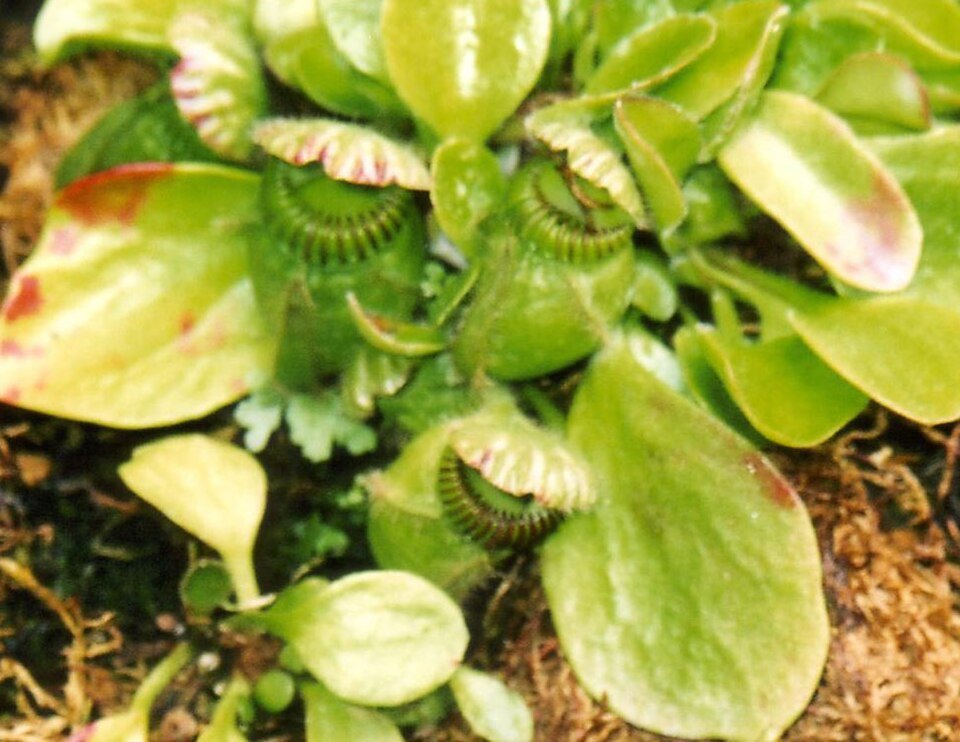
You may also see odd in-between forms. Brittnacher describes a “complete range of intermediate leaves that can appear in the fall and winter,” from dished leaves with a hint of a keel to small, half-formed pitchers. A study cited in that article suggests these appear as a result of stress during changing seasons. They are a curiosity, not a problem.
Existing pitchers can stay through the rest, since Nunn notes that they can last for as long as 12 months. Some older ones may brown over winter; Carnivorous Plant Nursery says a resting plant “may die back.”
Windowsill, Terrarium, Greenhouse or Outdoors
On a windowsill
This is the easiest place to give a rest. Sarracenia Northwest says the decrease in daylight hours gives the plant its rest naturally, as long as it stays away from “any strong heat source, such as a heater or vent.”
In a terrarium or under lights
Terrarium plants miss the seasons unless you add them. Carnivorous Plant Nursery suggests adjusting the timer seasonally, down to about 10 hours in winter, and reminds growers to keep the terrarium vented and the soil moist but not waterlogged. Brittnacher’s terrarium plants, on a constant 14-hour period, never bloomed in 13 years, while plants given natural day lengths bloomed each spring.
Humidity needs care in winter. Sarracenia Northwest says a terrarium is not required and warns that constant high humidity “is not at all necessary but can encourage lots of mold issues.” A cool, closed tank with still air is a likely place for mildew.
In a cold frame or unheated greenhouse
Here the rest is deeper. Sarracenia Northwest says a plant in a cold frame greenhouse “will actually go dormant and stop growing altogether,” and can tolerate brief episodes of light frost. Its advice is to use a heater to keep a minimum of 35 °F (2 °C) if daytime temperatures fall below freezing. Sarracenia Northwest suggests this route for growers in USDA zone 8 or colder.
Outdoors
Sarracenia Northwest calls Cephalotus “technically a warm-temperate plant” for USDA zones 9 and 10, and says growers in zone 9 or warmer could grow it outdoors. The ICPS agrees that it can be grown outside in a mild climate, but warns that Cephalotus is “highly susceptible to mildew.” Carnivorous Plant Nursery offers a middle path: grow outdoors in summer and indoors in winter.
Frost Limits
Cephalotus takes a little frost, not a hard freeze. The sources give these limits:
- California Carnivores: tolerates “brief, light frost down to 20 F degrees,” that is 20 °F (minus 7 °C), “but may be killed in lower temperatures.”
- Carnivorous Plant Nursery: tolerates light frost and brief temperatures as low as 22 °F (minus 6 °C).
- Sarracenia Northwest: a few plants grown outdoors as an experiment came through a short spell of snow, with lows of about 26 °F (minus 3 °C), “with no adverse effects.”
- Barry Rice: keep temperatures “somewhere in the broad range of 0-40°C (32-104°F).”
The key words are “brief” and “light.” Rice’s range stops at freezing, and Sarracenia Northwest’s heater rule keeps a cold frame just above it. No source recommends a long or hard freeze.
How Other Carnivorous Plants Rest
Sarracenia take a much colder rest. The ICPS says potted Sarracenia “will survive a few weeks frozen solid if they are fully dormant,” and that winter storage must be cool to cold, because plants kept too warm can start growing too early. Cephalotus cannot take weeks of hard freezing. See our Sarracenia dormancy section for that very different routine.
Mexican butterworts are a closer match. The ICPS describes their winter leaves as succulent and not carnivorous, and says the plants should then be kept “cooler and drier,” conditions it calls typical of a house. Like Cephalotus, they swap trapping leaves for non-trapping ones in winter, slow down and need less water. Our butterwort dormancy guide covers that rest in detail.
When the Rest Ends: Spring Growth
The rest ends gradually as the days lengthen. In Nunn’s summary of the plant’s year, flat leaves come first in spring “as the weather improves and daylight hours increase,” followed by pitchers. A burst of new flat leaves in early spring is a good sign.
Flowers follow. Brittnacher’s garage plants bloomed in spring, and that article notes that flower scapes appear in early spring. The ICPS says that under a natural light cycle, plants start blooming in late spring, and each stalk may flower for about a month.
Spring is also the time for jobs that disturb the plant:
- Repotting. Sarracenia Northwest says the best time to repot is “late winter or early spring while the plant is in its winter rest.” Our soil mix guide explains how.
- Feeding. Carnivorous Plant Nursery feeds during the active growth of spring and summer, with wingless fruit flies, ants or other small insects.
- Cuttings. Carnivorous Plant Nursery takes leaf, trap or root cuttings “early in the growing season.” Our Cephalotus propagation guide has the methods.
A Winter Rest Plan, Step by Step
- Autumn, as the days shorten. Leave a windowsill plant where it is, unless a heater sits nearby. For a terrarium, shorten the timer step by step toward 12 hours, or 10 if you follow Carnivorous Plant Nursery.
- Let it cool. Aim for days in the 55 to 70 °F (13 to 21 °C) range the sources describe. Do not chase cold.
- Water a little less. Let the tray dry between waterings, but keep the soil damp.
- Keep the air moving. Vent terrariums and avoid constant high humidity.
- Watch the weather. In a cold frame or outdoors, add heat or bring the plant in before anything harder than brief, light frost.
- Late winter. If the plant needs a new pot, repot now, while it is still resting.
- Spring. Restore the longer light period, return to normal watering as growth picks up, and start feeding once new pitchers open.
Problems During the Rest
Mildew and fuzzy mould
A cool, still, humid winter is ideal for fungus. Sarracenia Northwest says stagnant air and high humidity “seem to promote it,” and recommends plenty of air movement, moderate humidity and watering the soil rather than the plant. The ICPS warns that “whole collections have been lost from fungus attacks.” See our mildew guide for treatment.
Dying back or sudden collapse
Some dieback is normal in winter, but Carnivorous Plant Nursery’s “sudden death syndrome” is usually unseen root rot from soil that is too damp and poorly aerated, or long periods of heat. A slow-growing winter plant leaves the soil wet for longer, so following the sources and watering less is the safer course. Do not throw out a plant that looks dead: Carnivorous Plant Nursery says it often regrows from the rhizome, which “may take several months.” Our sudden collapse guide covers what to check.
What Growers Report
These are single growers’ setups and results, not rules.
- One grower kept Cephalotus in an unheated greenhouse with Venus flytraps and Sarracenia, where the plants had “4 months of cold with frosts” and stopped growing “before restarting again in spring.” (Alexis, TerraForums, October 2008)
- Another noted that in the Northern Hemisphere growth slows “around December to January or February,” watered less in those months and did little else, and said the plants “flower regularly.” (BigBella, TerraForums, October 2008)
- A grower in Scotland never induced dormancy: the largest plant grew on a kitchen windowsill in a deep pot in a saucer of water all year. Because it grew in natural light, it “naturally slows down in winter,” which the grower would not call a dormancy. (mobile, CPUK Forum, January 2010)
- A grower in Massachusetts tried a much colder rest: plants moved to a cooler room while the light was cut back over a few weeks, then to a basement at 40 to 45 °F (4 to 7 °C) with “only 6 hours of light.” A month in, the plants and cuttings “seem to be doing great.” (This Island Earth, CPUK Forum, January 2010)
Our takeaway: growers succeed with anything from a kitchen sill to a cold greenhouse. What they share is a real seasonal change in light and temperature, with no hard, lasting freeze.
Where Sources Differ
| Topic | One view | Another view | Context the sources give |
|---|---|---|---|
| Is there a dormancy? | Carnivorous Plant Nursery: “Dormancy: yes”; Sarracenia Northwest: the rest is “essential” | California Carnivores: “no winter dormancy but may grow slowly in the winter” | Sarracenia Northwest says plants on a windowsill keep growing slowly, while plants in a cold frame stop altogether |
| When flat leaves appear | Sarracenia Northwest: many flat leaves during the winter rest | Nunn’s summary of the accepted cycle: flat leaves in spring, before pitchers | Brittnacher’s garage plants made foliage leaves in winter and bloomed in spring; both may happen |
| Winter light period | Sarracenia Northwest: 12 hours in autumn and winter | Carnivorous Plant Nursery: 12 hours in autumn, 10 in winter | Both cut back from a longer summer period |
| Lowest safe temperature | California Carnivores: brief frost to 20 °F (minus 7 °C); Carnivorous Plant Nursery: briefly to 22 °F (minus 6 °C) | Rice: keep within 32 to 104 °F (0 to 40 °C); Sarracenia Northwest: heat a cold frame to 35 °F (2 °C) | All agree that only brief, light frost is tolerated |
Common Mistakes
- Treating it like a Sarracenia. Weeks of hard cold or a dark, frozen garage are not what this plant needs.
- Keeping it warm and lit all year. Constant light and warmth mean no seasonal cue, and Brittnacher’s terrarium plants never bloomed.
- Letting the soil dry out. Water less, but keep the soil damp.
- Closing up a terrarium for winter. Still, humid air invites mildew.
- Mistaking flat leaves for decline. They are the normal winter form.
- Throwing out a plant that died back. It may regrow from the rhizome after several months.
FAQ: Cephalotus Dormancy
Does Cephalotus need dormancy?
It benefits from a cooler, shorter-day winter rest of about three months, which Sarracenia Northwest calls essential. It does not need a freezing dormancy, and California Carnivores says it has “no winter dormancy,” only slower growth.
What temperature should Cephalotus have in winter?
Sarracenia Northwest gives natural winter days of 55 to 70 °F (13 to 21 °C). Carnivorous Plant Nursery says slightly cooler than summer. Brief light frost is the lower limit.
How long does Cephalotus dormancy last?
About three months, according to Sarracenia Northwest. Indoors the end is gradual: new flat leaves in early spring, then pitchers and flowers.
Why is my Cephalotus only making flat leaves in winter?
That is the normal winter rest. The flat leaves photosynthesise when light is low and prey is scarce. Pitchers return in spring.
Should I repot Cephalotus during dormancy?
Sarracenia Northwest repots in late winter or early spring, while the plant is still in its winter rest.
The Bottom Line
Cephalotus dormancy is a cool, bright, slightly drier slowdown, not a deep freeze. Give the plant about three months of shorter days and cooler temperatures, keep it away from heaters, let the tray dry between waterings without letting the soil dry out, keep the air moving, and protect it from anything more than brief, light frost. Expect flat leaves in winter, then new growth, pitchers and flowers in spring.
Sources & Further Reading
- Sarracenia Northwest: How to Grow Cephalotus
- Sarracenia Northwest: Q/A #56, Fuzzy Mold on Cephalotus
- Carnivorous Plant Nursery: Growing Tips for Cephalotus
- California Carnivores: Australian Pitcher Plants (Cephalotus follicularis) Growing Tips
- International Carnivorous Plant Society: Growing Cephalotus follicularis
- International Carnivorous Plant Society: Growing Sarracenia
- International Carnivorous Plant Society: Growing Mexican Pinguicula
- Barry Rice, The Carnivorous Plant FAQ: Cephalotus cultivation
- Barry Rice, The Carnivorous Plant FAQ: Cephalotus range and conservation status
- Richard Nunn: New insights into the growth cycle of Cephalotus follicularis, Carnivorous Plant Newsletter 43(3), 2014
- John Brittnacher: Evolution of the Cephalotus pitcher, Carnivorous Plant Newsletter 49(3), 2020
- John Brittnacher: Observations on Cephalotus follicularis reproductive biology, Carnivorous Plant Newsletter 51(4), 2022
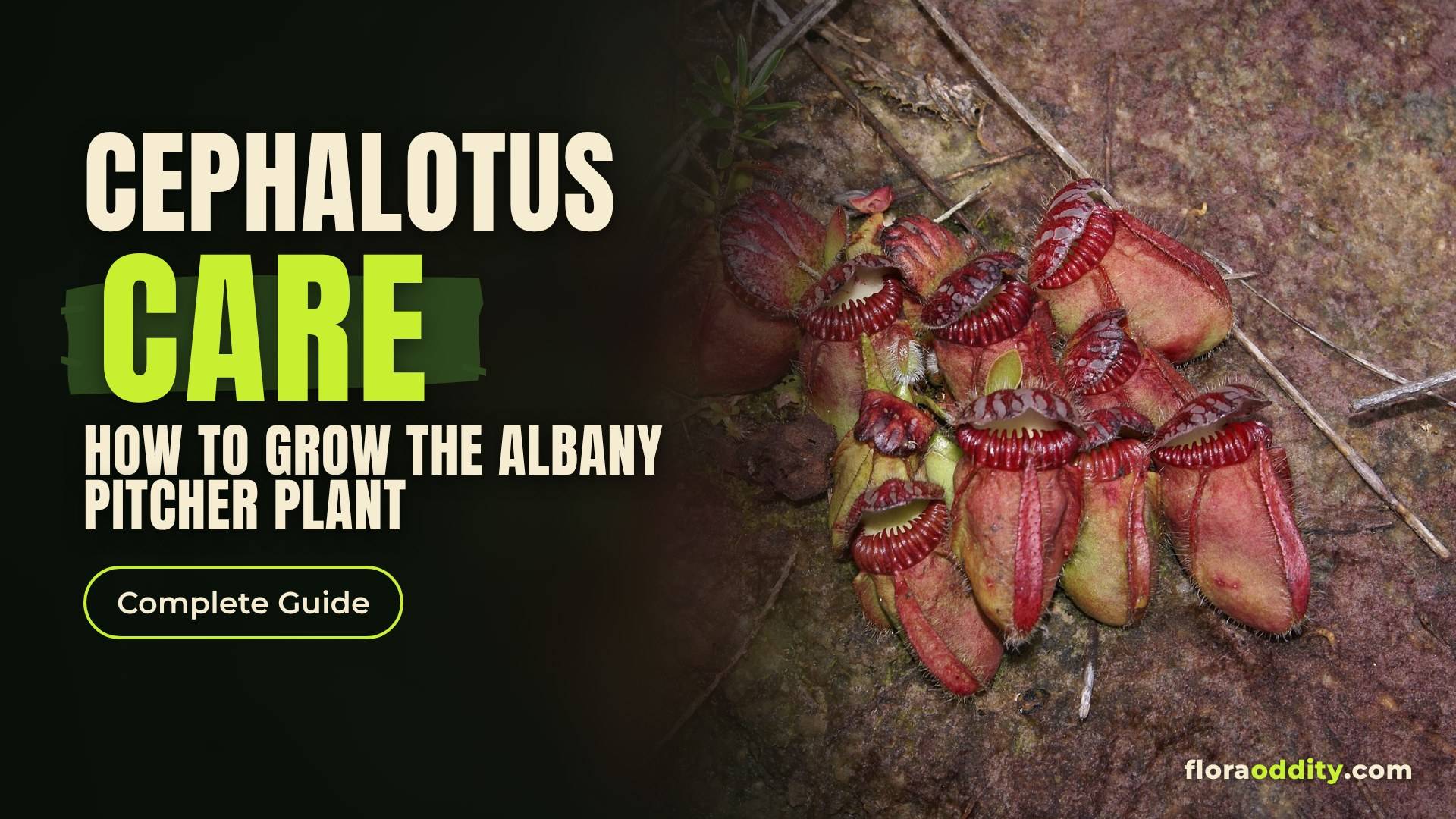
Featured image based on a photo of Cephalotus follicularis pitchers by H. Zell via Wikimedia Commons, CC BY-SA 3.0, with a dark gradient and typography added by FloraOddity; the adapted image is offered under the same licence.
Final articles are editorially reviewed and factual claims are checked against cited sources. Last reviewed: October 2026.