
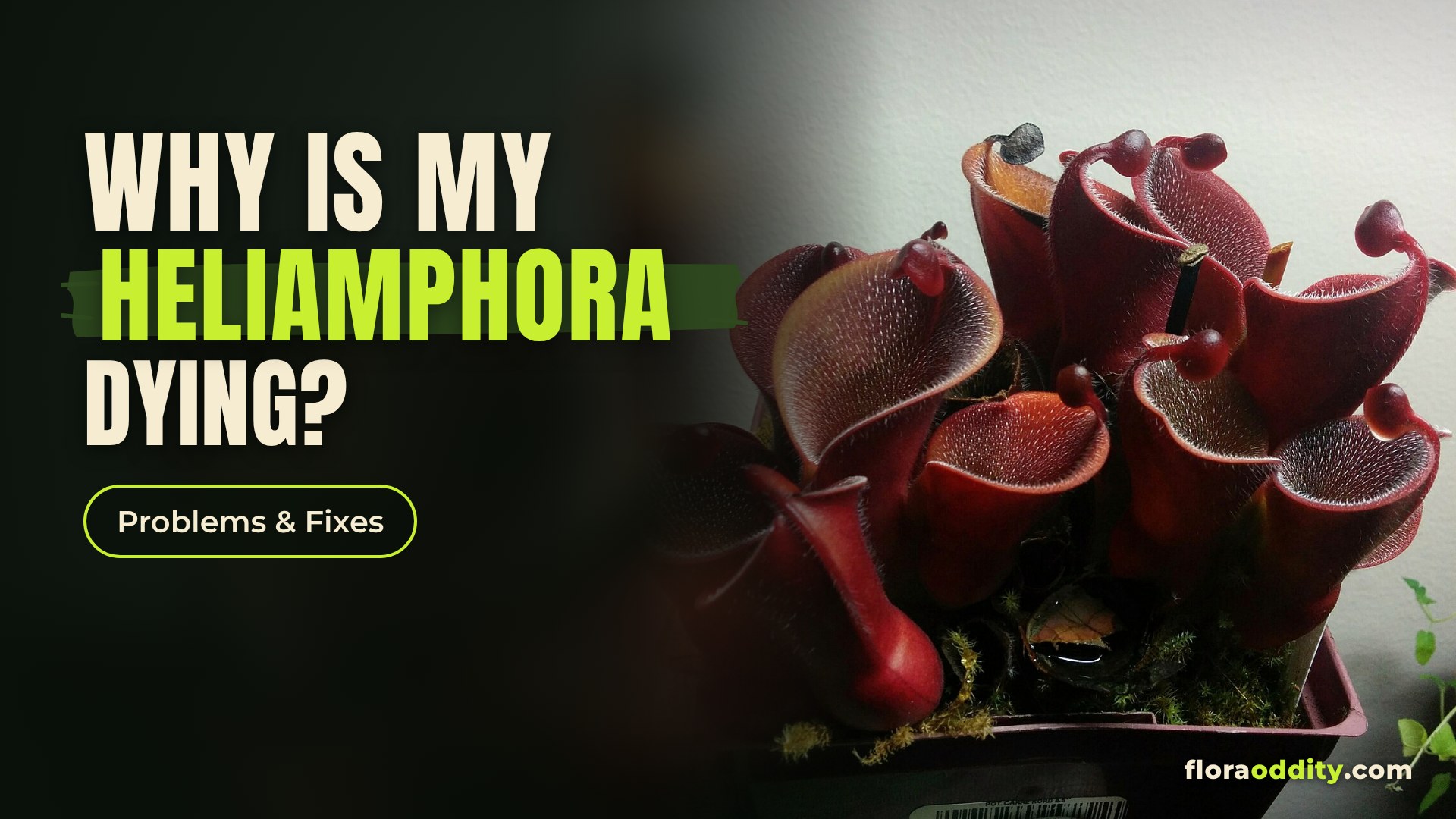
Barry Rice, author of the Carnivorous Plant FAQ, sums up the sun pitcher in two lines. Keeping it bright, humid and cool “is not easy, and that is why most growers are unsuccessful with their Heliamphora,” yet for growers who manage it, the plant is “a veritable unkillable beast.” Most Heliamphora problems sit somewhere between those two statements: the plant is tough, but it reacts badly to heat, poor light and disturbance.
When a Heliamphora dying back has you worried, start by sorting normal ageing from real trouble. Old pitchers fade on every healthy plant, and new plants often sulk for a few weeks. The dangerous pattern is different: a plant that wilts within days during a warm spell, with the base of its leaves turning brown while the tips are still green. This guide goes symptom by symptom, with what growing guides, nurseries and the Carnivorous Plant Newsletter say causes each one and what to do about it.
The Short Answer
Look at the newest growth first. Sarracenia Northwest says healthy new pitchers are a better guide to the plant’s condition than the look of its oldest leaves. If new growth is firm and coloured, brown outer pitchers are most likely ageing, a recent move or a passing spell of stress.
If the plant wilts quickly, especially in hot weather, act the same day. The International Carnivorous Plant Society (ICPS) describes a fungus inside the plant’s vascular system that can kill infected plants “in less than 10 days” at a constant 82 °F (28 °C) with high humidity. Cool the plant down, unpot it, cut away dead tissue and repot what is left in fresh mix.
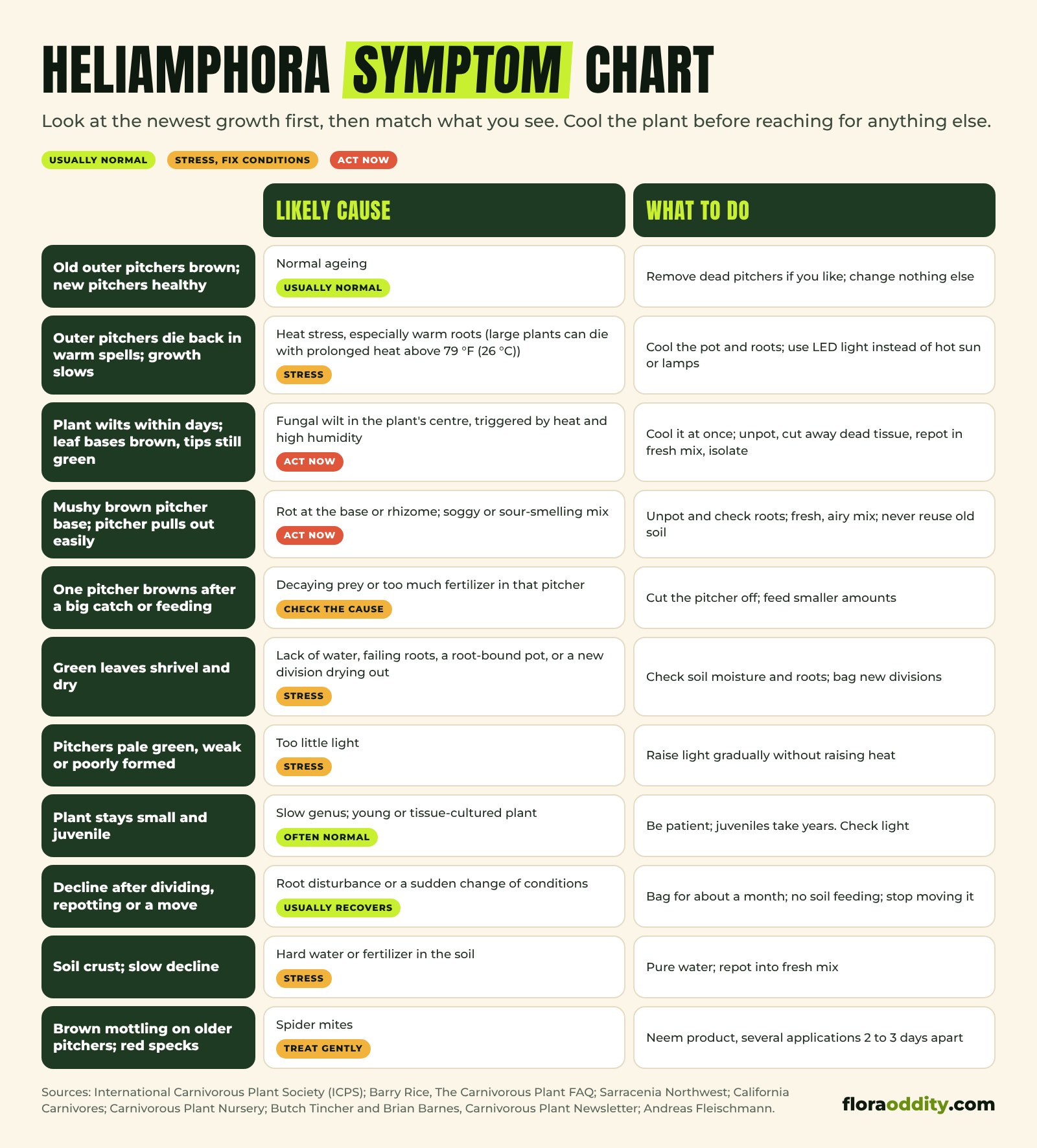
Most other problems come from heat, too little light, soil fertilizer or hard water, and root disturbance. The chart below matches each symptom to its likely cause.
Quick Diagnosis
| Symptom | Likely cause | What to do | Source |
|---|---|---|---|
| Old outer pitchers brown; new pitchers healthy | Normal ageing | Remove dead pitchers if you like; change nothing else | Sarracenia Northwest |
| Outer pitchers die back in warm spells; growth slows | Heat stress, especially warm roots | Lower the heat; get light without heat; keep the pot cool | ICPS, Sarracenia Northwest, Butch Tincher (CPN) |
| Whole plant wilts within days; leaf bases brown while tips stay green | Fungal wilt in the plant’s centre, triggered by heat and high humidity | Cool the plant at once; unpot, cut away dead tissue, repot in fresh mix; isolate it | ICPS, Andreas Fleischmann |
| Pitcher base mushy and brown; pitcher pulls out easily | Rot at the base or rhizome | Unpot and check roots and rhizome; fix soil and watering | ICPS, TerraForums growers |
| One pitcher browns after a big catch or feeding | Decaying prey or too much fertilizer in that pitcher | Cut the pitcher off; feed smaller amounts | Sarracenia Northwest, ICPS |
| Green leaves shrivel and dry | Lack of water or failing roots; new divisions dry out fast | Check soil moisture and roots; bag new divisions | ICPS, Sarracenia Northwest, Butch Tincher (CPN) |
| Pitchers pale green, weak or poorly formed | Too little light | Raise light gradually without raising heat | Sarracenia Northwest, California Carnivores, Barry Rice |
| Plant stays small and juvenile | Slow genus; young or tissue-cultured plant | Be patient; check light | Sarracenia Northwest, Barry Rice |
| Decline after repotting, dividing or moving | Root disturbance or a sudden change of conditions | Bag for about a month; no soil feeding; do not keep moving it | ICPS, Carnivorous Plant Nursery, Sarracenia Northwest |
| Soil crust; slow decline with tap water or soil fertilizer | Mineral or fertilizer build-up | Switch to pure water; repot into fresh mix | ICPS, Butch Tincher (CPN) |
| Brown mottling on older pitchers; tiny red specks | Spider mites | Neem product, several applications 2 to 3 days apart | Sarracenia Northwest |
First, Is It Dying or Just Ageing?
Every Heliamphora loses pitchers. Sarracenia Northwest says old pitchers “naturally decline” and that growth can be slow, so a plant with a few brown outer pitchers and a fresh one opening in the centre is behaving normally. The same nursery points out that slow growth on its own is not a symptom: juvenile plants can take several years to make adult pitchers, and established plants grow much more slowly than Nepenthes.
Two other things look worse than they are. Barry Rice warns that plants fresh from tissue culture show “unnatural vitality for about a year” before slowing down and behaving more naturally, so a slowdown in the second year is not necessarily decline. And the ICPS notes that healthy mature plants divide naturally, especially when they bloom, so a crowded clump with some tired pitchers may simply be splitting into new growth points.
What separates ageing from trouble is where and how fast the damage starts. Outer pitchers browning slowly from the tip while new ones form is ordinary. Damage that starts at the base of the leaves, spreads to the newest growth, or takes the whole plant down in days is not.
The Causes One by One
Heat stress
Heat is the problem the sources mention most. The ICPS, citing Andreas Wistuba, says plants tolerate up to 86 °F (30 °C) in cultivation, while 104 °F (40 °C) is fatal for most species, and that large plants are “especially susceptible to heat” and can die with prolonged temperatures above 79 °F (26 °C). Sarracenia Northwest recommends about 60 to 80 °F (16 to 27 °C) and says to avoid prolonged temperatures above the mid-80s °F.
The roots matter more than the air. The ICPS reports wild root temperatures of 60 to 68 °F (16 to 20 °C), even while air temperatures swing more widely, and says night cooling is not needed “as long as the soil temperatures were not elevated during the day.” California Carnivores recommends light-coloured pots, preferably white, and big ones, because “their mass will resist warming,” and suggests watering with cold water on warm days.
Butch Tincher, writing in Carnivorous Plant Newsletter, notices a difference in plant health when temperatures stay above 75 °F (24 °C) for long periods, and notes that outbreaks of what growers call “Heliamphora Sudden Death Syndrome” have long been linked with temperatures above 79 °F (26 °C). Sarracenia Northwest adds that sunlight through glass heats a windowsill fast; if a plant needs far more water in hot weather, it suggests moving it somewhere cooler rather than watering more.
What to do: measure the temperature at the plant, not in the room, and compare it with the published ranges in our climate checker, which has a Heliamphora option. Shade or enlarge the pot, avoid afternoon sun through glass, add a fan, and consider LED lighting, which Sarracenia Northwest recommends because it gives strong light without the heat of direct sun.
Sudden wilt and rot
This is the emergency. The ICPS describes experiments by Andreas Fleischmann with a pathogenic fungus found in Heliamphora both in the wild and in cultivation. It grows in the vascular system, and infected plants kept at a constant 82 °F (28 °C) and high humidity died in under 10 days. The ICPS says plants can become infected from soil, rainwater and other plants, and that reusing soil, contaminated soil ingredients and overhead watering can spread it.
In a forum post that grower Av8tor1 reposted on TerraForums in April 2011, Fleischmann’s description of the signs is quoted. The fungus normally lives harmlessly inside the plant, but in prolonged warmth and high humidity it fills the vessels in the plant’s centre. The leaves and roots die “from the centre to the tip,” so leaf tips stay “fresh and green, whereas the base is already brown and rotting.” The post says no cure was known, though regrowth from side buds sometimes follows “if growth conditions are changed at once,” and it calls cool temperatures, “especially cool root temperatures,” essential for prevention.
Not every brown base is this fungus. One member of a 2009 TerraForums thread suggested a simple test: tug gently on a pitcher, and if it comes out easily with a mushy brown base, it is rotting. The ICPS also offers a soil check: the mix “should never be stinky from the organic ingredients rotting,” and Tincher says a bad smell at repotting means the watering and substrate are wrong.
What to do: lower the temperature immediately. Unpot the plant, cut away brown, soft tissue back to firm growth, and repot healthy pieces in fresh mix. Because the ICPS lists reused soil and other plants among the routes of infection, discard the old soil and keep the plant apart from the rest of your collection while you watch for new growth.
Brown or dying pitchers
Besides ageing and heat, the sources name three causes of single brown pitchers.
Decaying prey. In a Sarracenia Northwest reader question, a newly bought H. heterodoxa x minor developed a fast-spreading brown spot at the base of one pitcher. The nursery suspected the pitcher was dying from decaying prey and suggested cutting it off; the reader found a slimy film where the decay began, and the plant then made healthy new growth with more water and topped-up pitchers. The nursery’s care guide gives the same advice: if only one pitcher is affected, remove it once it deteriorates and watch the new growth.
Overfeeding. The ICPS warns that in-pitcher fertilizer must not overflow into the soil, and Carnivorous Plant Nursery says never to feed meat or cheese, which “will likely rot and kill the trap.”
Burns. Brian Barnes, writing in Carnivorous Plant Newsletter, places the lights on top of the tank’s glass to reduce the “risk of pitcher burn,” keeps the pitchers about 4 inches (10 cm) from the glass and lamps, and calls a constant light breeze “VERY important” when pitcher tops are that close. The ICPS warns that fluorescent tubes need fans or a Plexiglas sheet to keep their heat off the plants.
Drying out and shrivelling
The ICPS says the soil “should never dry out,” and Sarracenia Northwest advises watering thoroughly from the top, letting excess drain, and never letting the mix dry completely. Tincher adds that Heliamphora “dry out much faster when root bound” and knows of good growers who lost prized plants this way.
Green leaves that shrivel point to the roots. Either the plant has not had enough water, or the roots or rhizome have died and cannot supply it. Tincher says newly received divisions often have damaged roots and can dry out “in as little as a day,” which is why he bags them.
No pitchers, small pitchers or weak growth
Light is the first thing to check. Barry Rice writes that plants in inadequate light “do not produce the leaf morphology characteristic of their species,” and Sarracenia Northwest says inadequate light is one of the first things to check when pitchers are weak, unusually green or poorly developed. Its fix is to increase light gradually while watching the temperature, using white LEDs of about 2,500 lumens or more, about 12 inches (30 cm) above the plant for about 14 hours a day. Our light checker lists published light ranges for Heliamphora.
If the light is good, check age and history. Juvenile plants take years to pitcher properly, and divisions and repotted plants can stall for months (see below).
Green pitchers instead of red
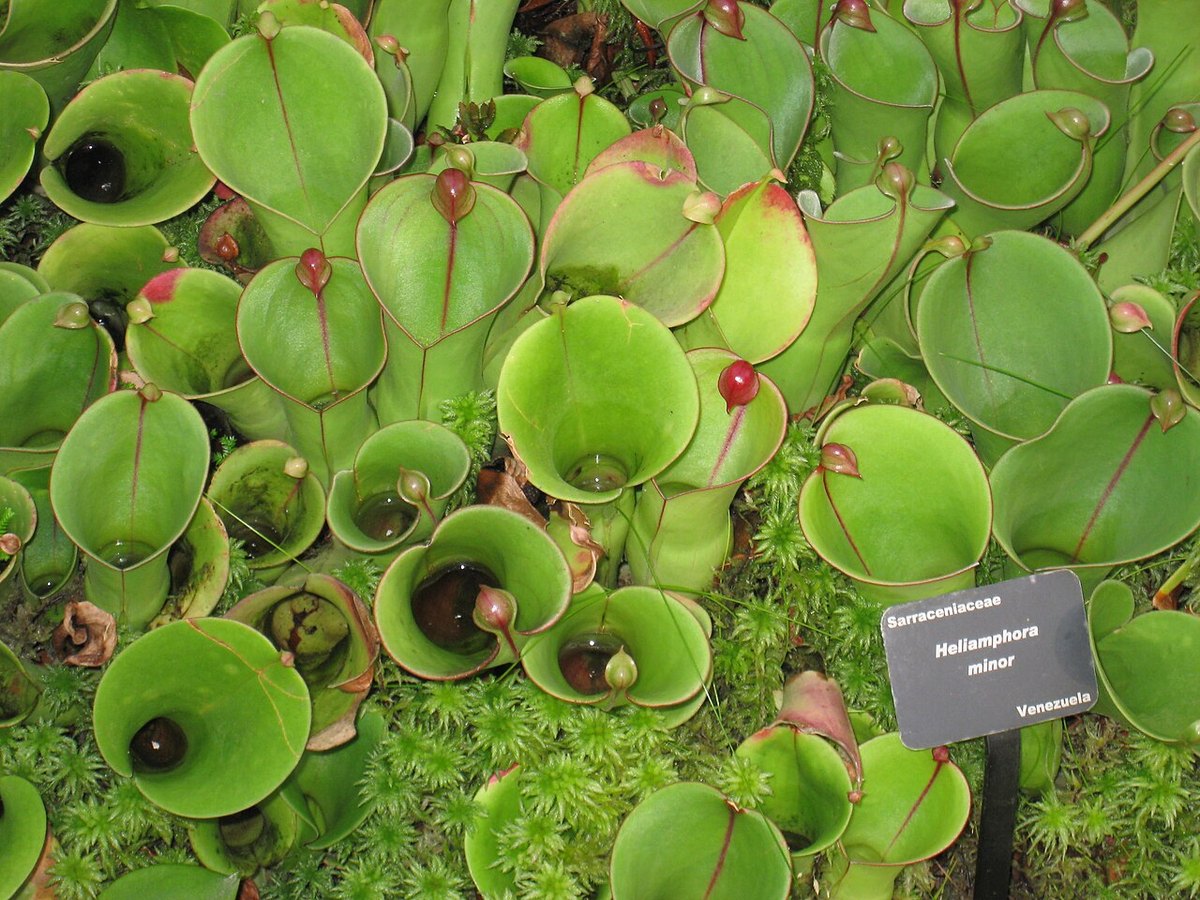
Colour is mostly a light gauge. California Carnivores says Heliamphora “may be grown with less light, but they will remain much greener,” and Sarracenia Northwest says many develop rich colours in bright sunlight. The light source matters too: the ICPS shows a hybrid grown under 3000K fluorescent tubes and notes that such lights generally give “somewhat shorter and redder plants” than 6500K lamps. Green pitchers on a firm, growing plant are not a disease. Raise the light step by step, never at the cost of more heat.
Mineral water and fertilizer burn
The ICPS advises “pure water (reverse osmosis is most common)” or tap water very low in dissolved minerals, adds that well water is generally too salty, and says filtering or softening “will not make the water less salty.” Tincher found that a clay-based mix watered with hard water gradually builds up mineral salts that “may reach toxic levels over time.” If you are not sure about your source, test it with our water checker.
Fertilizer is a balancing act. The ICPS says Heliamphora “requires fertilization to grow well,” but also that “One of the easiest ways to kill a Heliamphora plant is to put too much fertilizer in the soil,” because it cannot take the levels Sarracenia enjoys. It points out that a solution of 1/2 teaspoon of fertilizer per gallon is about 350 ppm, far too strong for the soil, and says about 70 ppm is generally safe in the soil if you top water well between feedings. Sarracenia Northwest, by contrast, treats feeding as optional and warns against using it to make up for poor light or heat. Our feeding guide sets out the options for each plant.
Decline after dividing, repotting or moving
The ICPS calls division “a dangerous time for plants,” especially large ones, and advises against dividing in late spring and summer if your plants get above 79 °F (26 °C). After division it bags plants for about a month if terrarium humidity is below 85%, with a warning that “High temperatures in the bag will kill the plant,” and holds back soil fertilizer until the plant is growing again. Carnivorous Plant Nursery says repotting and division “can set back plant growth for several months.”
Rice reports that, in warm conditions, plants many times responded to repotting “by dying,” while growers with cooler conditions had no such trouble. Moving a plant counts as well: Sarracenia Northwest says a move changes light, temperature, humidity and airflow at once, and advises against repeated moves. Our repotting advisor helps with timing.
Pests
Spider mites are the pest the sources describe in detail. In a Sarracenia Northwest Q&A, a reader growing a Heliamphora under LEDs at 40 to 50% humidity noticed little red specks. The nursery said Heliamphora mites are very small and often make no webs, and that older leaves develop “a brown mottled appearance in the upper parts.” It suggested a neem product, applied several times 2 to 3 days apart; two weeks later the reader reported the mites “much reduced, and the plants did not mind it.”
A Rescue Plan, Step by Step
- Check the newest growth. Firm and coloured: watch, and fix conditions slowly. Wilting or browning from the base: go to step 5.
- Check the temperature at the pot. Prolonged readings above 79 °F (26 °C) call for cooling first.
- Check water and soil. Moist but draining mix, pure water, no sour smell, no soil fertilizer.
- Check light. Bright light from above and the sides, without heat.
- Emergency. Cool the plant, unpot it, cut away soft brown tissue, repot healthy parts in fresh mix, bag if your humidity is low, isolate it and wait.
If you are still unsure, our symptom checker points you to the right guide for other carnivorous plants on the same shelf.
How Heliamphora Problems Compare with Its Relatives
Heliamphora shares the pitcher plant family with Sarracenia, but its problems are different. The ICPS says the most common way to grow Sarracenia is in pots standing in 1.6 to 2.4 inches (4 to 6 cm) of water, while Sarracenia Northwest says Heliamphora should not sit continuously in a tray. Feeding differs too: the ICPS sees little benefit in soil feeding mature Sarracenia, while Heliamphora needs some fertilizer but far less of it.
The closer match is Cephalotus. Our Cephalotus problems guide describes a similar sudden collapse linked to heat and wet roots. With both plants, cool roots are the best prevention and speed is the best treatment.
What Growers Report
These are single growers’ observations in their own conditions, from public forum posts, not rules.
- A grower kept an H. heterodoxa x minor and an H. minor under compact fluorescents on an office windowsill at 50 to 60% humidity; after a spell when the room reached “about 30 degs” (86 °F), both started drying up. Moved to a cooler greenhouse, the hybrid was “making a decent recovery” with new leaves about two and a half weeks later, while the H. minor did less well. (Yossu, CPUK Forum, July 2016)
- Another grower in the same thread said “brown-heart disease,” recognisable by the brown centre, killed many of their plants after they watered them from above in winter at low temperatures, and added that live Sphagnum growing over a plant’s centre and staying very wet can cause the same thing. (lilacina, CPUK Forum, July 2016)
- Growing Heliamphora in terrariums at household temperatures of about 68 to 73 °F (20 to 23 °C), one grower found that the outer pitchers of their H. minor and H. pulchella died back whenever temperatures rose: “78 seems to be the die back point for me,” about 26 °C. (RSS, TerraForums, December 2013)
- One grower who tried fertilizer pellets in the pitchers found that “each time it has resulted in the top of the pitcher browning soon afterward,” though the pitchers still lasted a long time. (nimbulan, TerraForums, January 2016)
Our takeaway: growers who saved a declining plant usually changed the temperature first, and the most common warning in these threads is about warmth combined with wet, still conditions.
Where Sources Differ
| Topic | One view | Another view | Context the sources give |
|---|---|---|---|
| Water trays | Sarracenia Northwest: never sit continuously in a tray; Carnivorous Plant Nursery: avoid standing water for long | California Carnivores: tray method, soil damp to wet; ICPS author: pots sit in a few mm of water | The ICPS ties standing in water to a mix chosen for it; all agree the mix must stay airy |
| Feeding | ICPS: Heliamphora “requires fertilization to grow well” | Sarracenia Northwest: feeding is optional; Carnivorous Plant Nursery: weak feeders | Everyone warns against strong fertilizer in the soil |
| Humidity | ICPS: a terrarium unless room humidity is above 70% | Sarracenia Northwest: plants can acclimate to household humidity | Sarracenia Northwest stresses stable temperature and air movement instead |
| Night cooling | California Carnivores: nights in the 40s to 50s °F; Carnivorous Plant Nursery: a 10 °F (5 °C) day to night drop | ICPS: not needed if the soil stays cool by day; Tincher: no significant day to night variation | All agree heat in the root zone is the real danger |
| Overhead watering | Sarracenia Northwest: water thoroughly from the top | ICPS: overhead watering can spread the wilt fungus | Fleischmann’s post says growers using pure water indoors reported no wilt problems |
Common Mistakes
- Treating every brown pitcher as a disease. Check the newest growth first.
- Adding light by adding heat. Sun through glass or hot lamps raise temperatures; Sarracenia Northwest and the ICPS both recommend LED lighting.
- Waiting too long with a wilting plant. Fast wilt with brown leaf bases needs action the same day.
- Fertilizing the soil to speed up a weak plant. The ICPS calls it one of the easiest ways to kill one.
- Dividing or repotting in summer heat, or moving a struggling plant again and again.
- Reusing old soil after a plant has died. The ICPS lists reused soil as one way the wilt fungus spreads.
FAQ: Heliamphora Dying
Why is my Heliamphora dying suddenly?
Usually heat combined with high humidity. The ICPS describes a vascular fungus that can kill a plant in under 10 days at 82 °F (28 °C). Cool the plant, unpot it, remove dead tissue and repot in fresh mix.
Why are my Heliamphora pitchers turning brown?
Old pitchers brown naturally. Single pitchers can rot after a large catch or too much fertilizer, and brown mottling on older leaves can mean spider mites, says Sarracenia Northwest. Browning from the base on several leaves at once is more serious.
Why are my Heliamphora pitchers green and not red?
Too little light. California Carnivores says plants grown with less light “will remain much greener.” Add light gradually without adding heat.
Can a Heliamphora recover after dividing or repotting?
Usually, but slowly. Carnivorous Plant Nursery says growth can be set back for several months; the ICPS bags divisions for about a month and holds back soil fertilizer until they grow again.
The Bottom Line
A Heliamphora dying back is not always a Heliamphora dying. Old pitchers fade, new plants settle in slowly, and green pitchers mean low light rather than disease. Real danger shows at the base of the leaves and in the speed of the decline, and it nearly always follows heat. Keep the roots cool, the water pure, the light bright without warmth, and the soil free of fertilizer, and act fast when a plant starts to wilt.
Sources & Further Reading
- International Carnivorous Plant Society: Growing Heliamphora
- International Carnivorous Plant Society: Growing Sarracenia
- Barry Rice, The Carnivorous Plant FAQ: Heliamphora cultivation
- Barry Rice, The Carnivorous Plant FAQ: Heliamphora, the marsh (or sun) pitchers
- Sarracenia Northwest: How to Grow Heliamphora
- Sarracenia Northwest: Q/A #73, Heliamphora Has a Brown Spot That Is Spreading
- Sarracenia Northwest: Q/A #33, Spider Mites on Heliamphora
- California Carnivores: Sun Pitchers (Heliamphora) Growing Tips
- Carnivorous Plant Nursery: Growing Tips for Heliamphora
- Butch Tincher: My techniques for the indoor cultivation of Heliamphora, Carnivorous Plant Newsletter 42(4), 2013
- Brian Barnes: Growing Heliamphora indoors year-round, Carnivorous Plant Newsletter 39(1), 2010
Featured image based on a photo of Heliamphora minor var. pilosa by Dals093838 via Wikimedia Commons, CC BY-SA 4.0, cropped with a dark gradient and typography added by FloraOddity; the adapted image is offered under the same licence.
Final articles are editorially reviewed and factual claims are checked against cited sources. Last reviewed: October 2026.
One Comment