
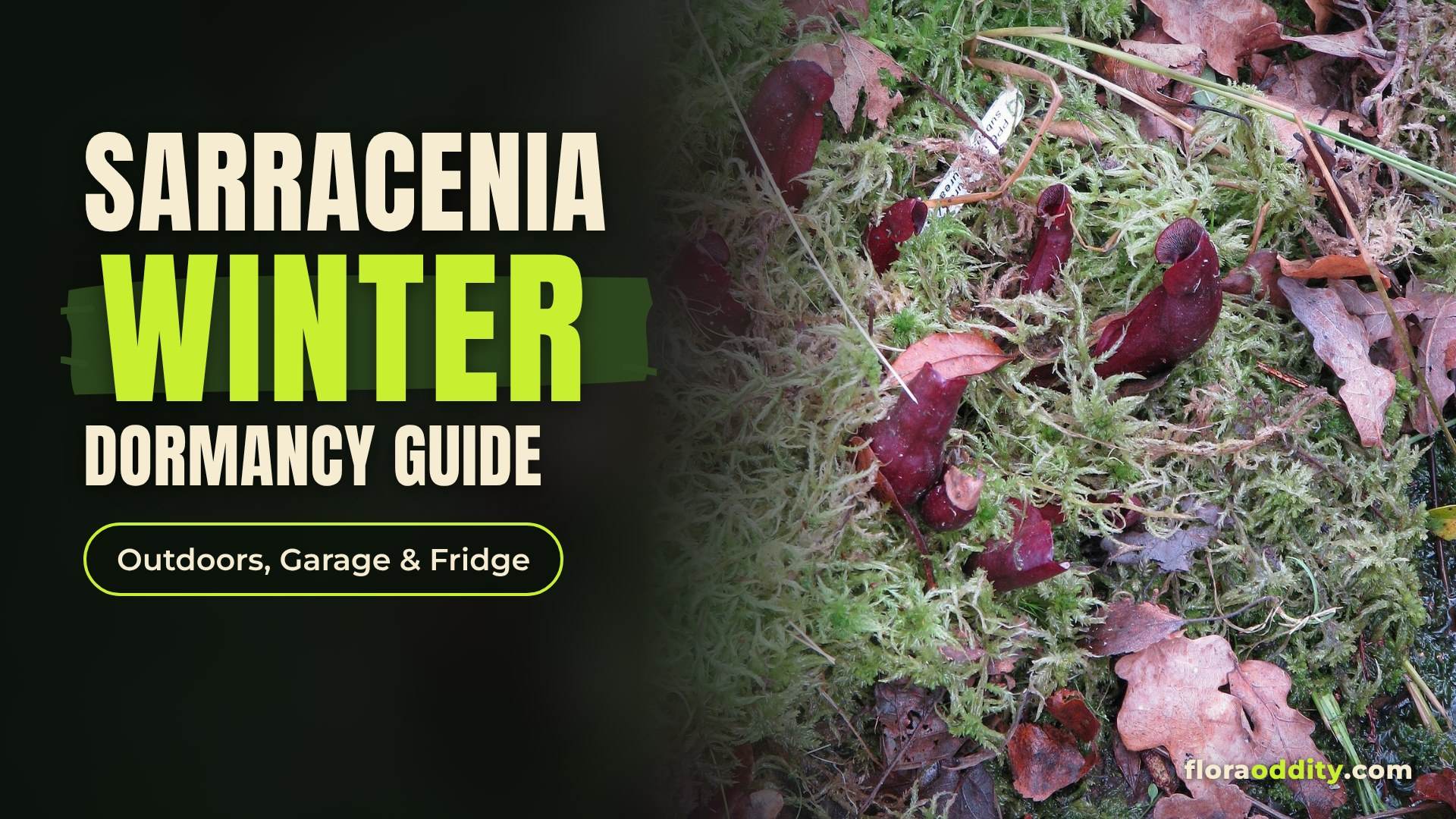
By late autumn, a Sarracenia that stood tall and colourful all summer can look like a pot of brown paper. Barry Rice, in his Carnivorous Plant FAQ, admits that “a mature plant in mid-winter often looks old and miserable,” with pitchers “tattered by a long season of work.” Carnivorous Plant Nursery warns that “it’s a common mistake for the new grower to confuse dormancy with plant death or disease.”
Sarracenia dormancy is not optional, and it is not a sign of trouble. California Carnivores calls the winter rest “essential to their health.” This guide covers only the winter half of the year: how to recognise a resting plant, how cold and how long the rest should be, where your plants should spend winter in your climate, and how to bring them back in spring. For light, water, soil and feeding the rest of the year, see our Sarracenia care guide.
The Short Answer
Mature American pitcher plants need a cool winter rest of roughly three months, with the soil kept moist the whole time. Rice puts the dormancy at “about three months,” and the New England Carnivorous Plant Society (NECPS) says temperatures from just above freezing to 50 °F (10 °C) are ideal. Where winter nights rarely fall below 20 °F (minus 7 °C), leave plants outdoors in full sun. In colder places, protect them with mulch or move them to an unheated garage, porch or cold frame. The refrigerator is a last resort. Expect most pitchers to turn brown, trim the dead growth in late winter or early spring, and look for flower buds before new pitchers.
Why Sarracenia Need a Winter Rest
The International Carnivorous Plant Society (ICPS) says the genus “consists of 15 species and subspecies found naturally only in North America,” with all but one restricted to the southeast USA and the centre of diversity on the Gulf of Mexico coast. Sarracenia Northwest describes their home as “sunny bogs, seepage wetlands, and wet savannas” along the Gulf and Atlantic coastal plains. Carnivorous Plant Nursery adds that winters there “are generally mild with occasional cold spells and even light frosts.”
Rice explains why that matters. Most carnivores grow where some season is inhospitable, and “if you attempt to grow a plant that anticipates a resting period, you must respect its dormancy requirements or else the plant will simultaneously try to both grow and rest.” He puts Sarracenia among the plants that “simply slow or stop growth” in winter instead of forming a special bud, and says they “desire chilly temperatures, but still expect some sunlight.”
Skipping the rest catches up with a plant. California Carnivores says “you can skip a dormancy period once or twice,” but in the long term “your plant will begin to do poorly and will eventually die.” Carnivorous Plant Nursery says temperate plants kept in artificial summer indoors “will remain green in the short term but slowly decline and ultimately perish.”
Signs That Dormancy Is Starting
California Carnivores says the rest is triggered by “shorter photo periods and colder temperatures from October to February.” Sarracenia Northwest describes the start simply: “growth will slow and many pitchers will gradually turn brown.”
The browning has a pattern. Carnivorous Plant Nursery says “the tops of the hoods start to wither, dry and brown,” and the drying “works its way down the tube.” Often “the lower third of the traps stay green throughout the Winter, as the plant continues to absorb nutrients from the summer’s catch.” Rice says that as pitchers shrivel, they “translocate nutrients from the leaves back to the underground rhizome.”
Not every plant goes brown. California Carnivores says that in winter “the pitchers turn brown and die back to the rhizome, or non-carnivorous leaves (phyllodia) grow during this time.” Rice describes S. flava producing “tall sword-shaped leaves lacking pitchers, called phyllodia” that let it photosynthesise all winter, and notes that S. oreophila makes “recurved (not straight) phyllodia.” Under the brown pitchers, the plant is fine: California Carnivores says “the rhizome remains healthy and intact throughout winter dormancy even if you cannot see anything growing,” and that “the rhizome can be brown and still be healthy.”
How Cold and How Long
To check whether your climate gives a natural winter rest, try our dormancy checker.
Rice gives Sarracenia and Venus flytraps “a cool dormancy period of about three months.” NECPS says the rest typically runs “from November through March in New England.” For plants grown indoors, Carnivorous Plant Nursery sets a floor of 45 days at 45 °F (7 °C) and says you can keep plants cool “for 3 to 6 months, depending upon their native area.”
The best range is cool, not frozen. NECPS recommends above freezing to 50 °F (10 °C), adding that “most plants will survive brief periods below freezing.” California Carnivores says plants can stay outside if nights drop below 20 °F (minus 7 °C) as long as days rise above 40 °F (4 °C). For his own outdoor method, Rice describes a suitable “chilly” winter as one with daytime highs not much above 75 °F (24 °C) and nights that rarely drop below 32 °F (0 °C).
Established plants can take more. The ICPS says potted plants “will survive a few weeks frozen solid if they are fully dormant and do not freeze-dry,” and shows S. jonesii coated in hoarfrost at 19 °F (minus 7 °C), unharmed “because they were fully dormant at the time.” It also warns that “it is the early and late freezes that can be deadly.”
Where Should Your Sarracenia Spend Winter?
Your climate decides the method. The ICPS sorts winter care by USDA hardiness zone, and the table below brings its advice together with the other sources.
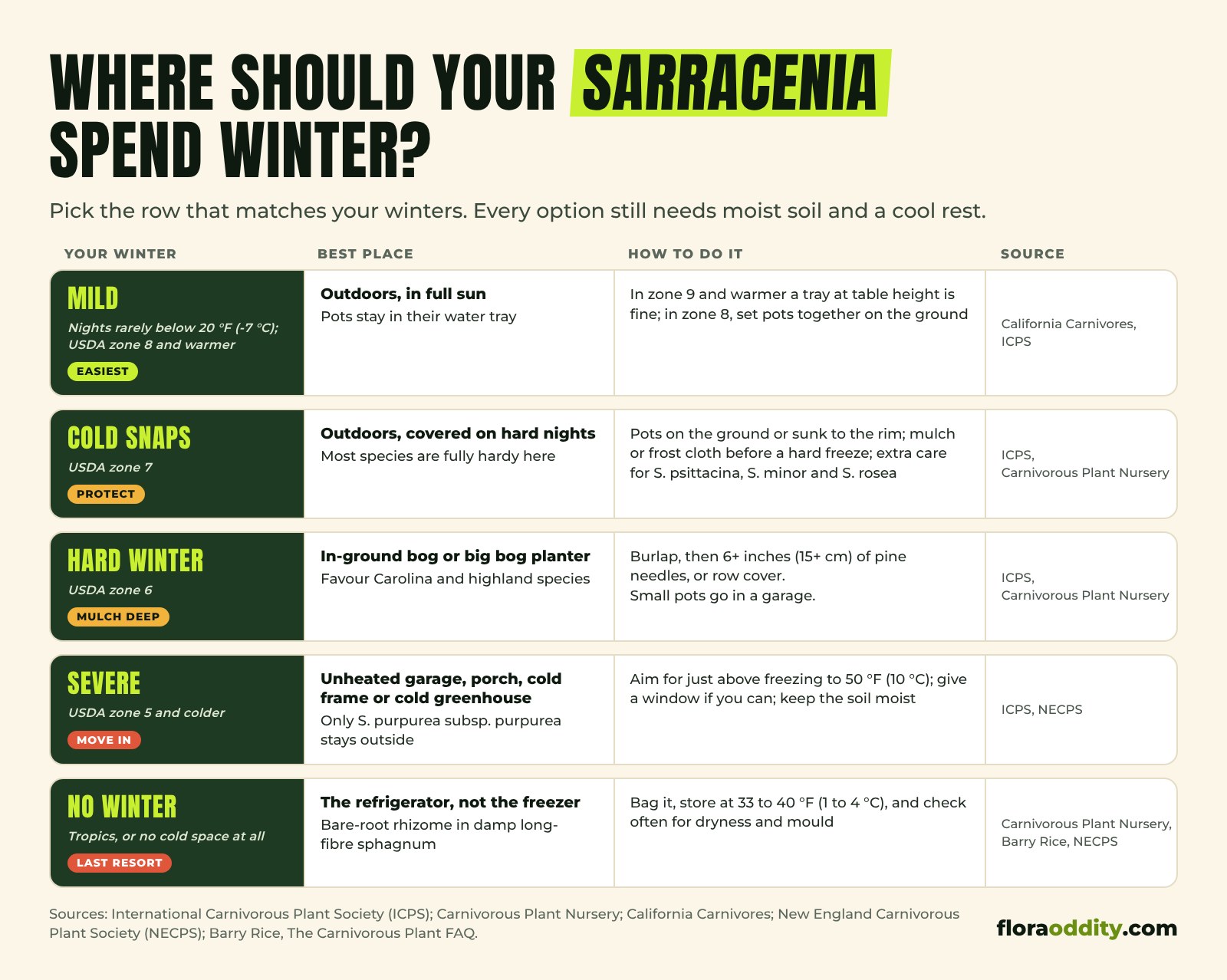
| Your winter | Best place | How to do it | Source |
|---|---|---|---|
| Mild (Easiest): nights rarely below 20 °F (minus 7 °C); USDA zone 8 and warmer | Outdoors, in full sun; pots stay in their water tray | In zone 9 and warmer a tray at table height is fine; in zone 8, set pots together on the ground | California Carnivores, ICPS |
| Cold snaps (Protect): USDA zone 7 | Outdoors, covered on hard nights; most species are fully hardy here | Pots on the ground or sunk to the rim; mulch or frost cloth before a hard freeze; extra care for S. psittacina, S. minor and S. rosea | ICPS, Carnivorous Plant Nursery |
| Hard winter (Mulch deep): USDA zone 6 | In-ground bog or big bog planter; favour Carolina and highland species | Burlap, then 6 inches (15 cm) or more of pine needles, or row cover; small pots go in a garage | ICPS, Carnivorous Plant Nursery |
| Severe (Move in): USDA zone 5 and colder | Unheated garage, porch, cold frame or cold greenhouse; only S. purpurea subsp. purpurea stays outside | Aim for just above freezing to 50 °F (10 °C); give a window if you can; keep the soil moist | ICPS, NECPS |
| No winter (Last resort): tropics, or no cold space at all | The refrigerator, not the freezer; bare-root rhizome in damp long-fibre sphagnum | Bag it, store at 33 to 40 °F (1 to 4 °C), and check often for dryness and mould | Carnivorous Plant Nursery, Barry Rice, NECPS |
How to Overwinter Sarracenia
Outdoors in pots
Sarracenia Northwest says that during dormancy you should keep plants outdoors “whenever your climate permits,” because “the plants tolerate frost and freezing temperatures, and the soil may freeze during cold weather.” Its nursery is in USDA zone 8, with lows as cold as 10 °F (minus 12 °C). The danger for pots is not the cold itself: Sarracenia Northwest names “dehydration from cold, drying winds and repeated cycles of freezing and thawing.”
Position matters. The ICPS says pots on a table work year round in zones 9 and warmer, but in zone 8 and colder “the plants in pots should be snugged together on the ground during the winter.” Carnivorous Plant Nursery treats a 16 inch (40 cm) pot as the smallest that can safely stay put all winter, and suggests burying smaller pots to the soil surface and mulching them in. California Carnivores recommends at least 4 inches (10 cm) of mulch “on top of the plants and all around the sides.” Snow helps: the ICPS calls it “a great insulator” and suggests shovelling extra onto the plants.
In a bog garden
In-ground plantings ride out winter best. Carnivorous Plant Nursery says “the best pot is the earth,” and that the ground smooths out sudden drops in temperature; in its experience “the actual low temperature isn’t as important as how fast it drops.” For beds, it lays a sheet of burlap, then 6 inches (15 cm) or more of pine needles, held down with bird netting. It prefers pine needles to leaves such as oak, which “compact into dense mats.” On larger beds it uses three layers of frost protection fabric, which keeps temperatures about 10 to 20 °F (6 to 11 °C) above the outside air. The ICPS says that in zone 6, plants do best “in artificial bogs in the ground and heavily mulched and/or covered with row cover.”
Unheated garage, porch or cold frame
Where winters are too harsh, the ICPS lists cold greenhouses, cold frames, unheated garages, unheated sun porches “and even basements” as options. NECPS member Mike Stiffler prefers an attached garage, which “receives some heat from the house and protection from freezing winds.” He sets plants by a window where possible, keeps tray water shallow, and brings them into the house during strings of very cold days. California Carnivores suggests a sunny windowsill in an unheated room or garage where nights dip to 50 to 60 °F (10 to 16 °C).
The ICPS stresses that the space must stay cool, because “if it is too warm the plants can start growing prematurely and have trouble with the transition to outdoors in the spring.”
The refrigerator
The fridge suits growers in the tropics or anyone without a cold, protected space. Carnivorous Plant Nursery bare-roots the plants, trims foliage longer than 1 inch (2.5 cm), wraps the rhizomes in moist long-fibre sphagnum and places them in a freezer bag with about a dozen small holes, stored in the crisper drawer at 33 to 40 °F (1 to 4 °C). The moss “should remain moist, but never be saturated,” and “if there’s standing water in the bag it’s too wet.” California Carnivores leaves its plants in the fridge from October to February, checking that they are “still moist and not growing mold or fungus.”
Mould is the risk with this method. Carnivorous Plant Nursery and NECPS both mention a light dusting of fungicide before storage. Stiffler is blunt about the results: “I advise against this method unless no other option is available; I’ve experienced frequent losses especially with smaller plants.” Rice, by contrast, calls it “probably the best method for people in the tropics to use.” Rice gives Venus flytraps the same three-month rest, and our Venus flytrap dormancy guide covers the fridge method for them in more detail.
Water and Light During Dormancy
Never let a dormant Sarracenia dry out. Carnivorous Plant Nursery says to “let the soil become drier; yet remain somewhat moist, during winter dormancy,” and Sarracenia Northwest says the soil “does not need to remain as wet as during the growing season.” When a reader lost Sarracenia and flytraps after being told not to water them in a 40 °F (4 °C) garage, Sarracenia Northwest replied that “bogs and swamps don’t dry out in winter” and told growers to keep plants in trays of water. California Carnivores lets outdoor plants dry a little between rains, but not “so dry that it pulls away from the edges of the pots.”
Light is less clear cut. Rice says Sarracenia still “expect some sunlight” in dormancy, and he warns that a dark basement or garage “will NOT work” unless the plant is in deep, fridge-level dormancy, because otherwise it “will still be trying to do photosynthesis.” Carnivorous Plant Nursery takes the opposite view: “Dormant plants require no light.”
How Species Differ
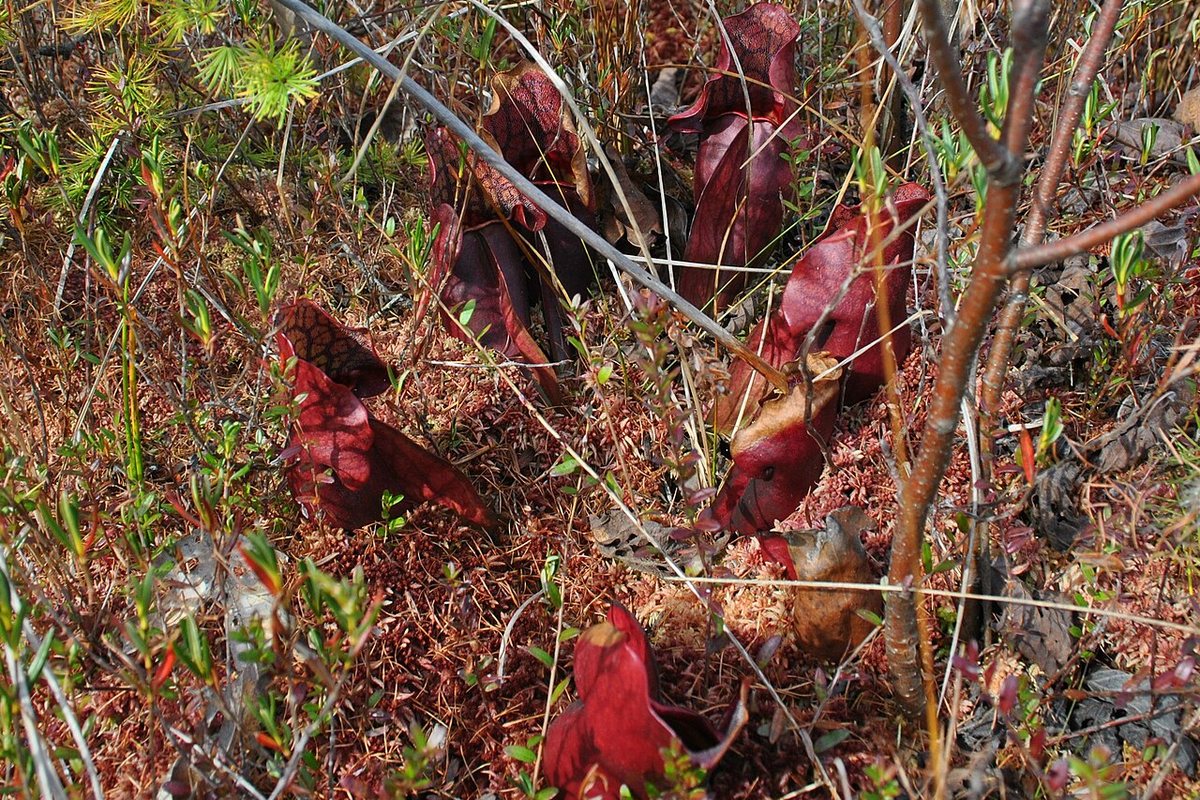
S. purpurea. The ICPS calls the northern subspecies, S. purpurea subsp. purpurea, “very cold temperate,” and says that in zone 5 and colder it is the only Sarracenia you can keep outdoors all year. The RHS rates it H6, “hardy in all of UK and northern Europe,” which it defines as minus 4 to 5 °F (minus 20 to minus 15 °C). Sarracenia Northwest says it “will also retain its gorgeous pitchers throughout winter.” The southern subspecies is a different matter: the RHS rates S. purpurea subsp. venosa only H3, “hardy in coastal and relatively mild parts of the UK,” or 23 to 34 °F (minus 5 to 1 °C).
S. psittacina. The ICPS describes the parrot pitcher plant as “freeze sensitive” and best suited to the long seasons and mild winters of the Gulf Coast. Sarracenia Northwest says it “retains leaves from the previous year,” needs only minimal protection in zones 7 to 9 with mulch further north, and is “usually the last plant to break dormancy” at its Oregon nursery.
S. minor. Rice says S. minor reaches “much further south than any other Sarracenia,” as far as Lake Okeechobee in Florida. The ICPS rates S. minor and S. rosea “fully hardy to USDA zone 8.” Sarracenia Northwest told a Portland grower that S. minor and its hybrids show little growth until there are “some strings of days in the 70’s,” with significant new growth usually in May.
S. rubra and S. rosea. Carnivorous Plant Nursery says S. rubra and S. alata “hold their pitchers into the cold, but not as well” as S. purpurea. The ICPS notes that the S. rubra complex often forms “a dense thatch of leaves.” Sarracenia Northwest says S. rosea “will go dormant and will drop its leaves during significant frost,” yet is one of the few Sarracenia it has grown on a sunny windowsill year round without a dormancy.
Trimming Dead Pitchers
Cut away only what is dead before late winter. The ICPS says that in most cases “it is best only to cut off the brown part of leaves,” because the plant recovers nutrients from old leaves. Its exception is plants stored in a garage, basement or cold frame, where old leaves “can harbor pests or reduce air circulation,” so long-tubed varieties stored under cover “should benefit from a haircut in the fall.”
Sources split on when to clear the rest. Sarracenia Northwest cuts all old pitchers “down to the rhizome” in mid to late winter so new growth gets full sun; it found that pitchers shaded by old ones came up “very weak and floppy.” Carnivorous Plant Nursery cuts old traps “in the Spring, well after they have had a chance to absorb their nutrient rich catch,” and NC State Extension advises waiting to remove dead foliage “in the spring just before the flowers emerge.” Both Sarracenia Northwest and the ICPS make an exception for S. purpurea and S. psittacina: remove only pitchers that have turned brown, because their pitchers can last into the next season.
Waking Up in Spring: Flowers First
Rice describes the order clearly: “With the resumption of spring growth, the first thing the plant does is make flowers.” Only after pollination does the plant produce its new pitchers. If a flower bud appears on a bare rhizome, that is normal. Sarracenia Northwest says an established plant, at least a year from division, “has enough starch reserves to support both flower and leaves,” but a recent division should have its flower removed.
Timing varies by species and climate. At Sarracenia Northwest in Oregon, S. psittacina shows spring growth “by the end of the month” in April, and S. purpurea subsp. purpurea is “usually one of the last plants to break dormancy.” For late-season plants, it says new growth appears “when you have some sustained days in the 70’s and warmer.”
Bring stored plants back gradually. California Carnivores pots fridge plants back up in February and puts garage plants outside again once nights stay consistently above 20 °F (minus 7 °C). One NECPS grower in Connecticut removes “a few inches of the wood chips at a time as the weather warms up.” The ICPS advises putting row cover over unmulched plants if a surprise late freeze arrives.
Where Sources Differ
| Topic | One view | Another view | Context |
|---|---|---|---|
| Light in dormancy | Carnivorous Plant Nursery: “Dormant plants require no light” | Rice: a dark basement or garage “will NOT work” unless the plant is in fridge-level dormancy | Rice says a plant that is only somewhat chilly still tries to photosynthesise |
| Winter water | Sarracenia Northwest: keep plants in trays of water; “bogs and swamps don’t dry out in winter” | RHS: discard any excess “rather than letting the container stand in water” | The RHS advice is general guidance for carnivorous plants in containers; Sarracenia Northwest was answering a grower whose plants died dry in a garage |
| When to clear old pitchers | Sarracenia Northwest: cut all old pitchers in mid to late winter | Carnivorous Plant Nursery and NC State: wait until spring | Sarracenia Northwest says the nutrients are already absorbed by late winter; Carnivorous Plant Nursery says cutting sooner could deprive the plant |
| S. psittacina and cold | ICPS: S. psittacina is “freeze sensitive” | Carnivorous Plant Nursery: S. minor and S. psittacina “stand up well to the cold” | Carnivorous Plant Nursery is describing how well pitchers hold up in cold weather; the ICPS is describing freezes |
| The refrigerator | Rice: “probably the best method for people in the tropics” | Stiffler (NECPS): avoid it unless there is no other option | Stiffler’s losses were mostly with smaller plants; both Carnivorous Plant Nursery and NECPS name mould as the risk |
| Spring flowers | Sarracenia Northwest: let established plants bloom | Carnivorous Plant Nursery: “generally a good idea to remove the flower spike” | Sarracenia Northwest removes flowers only from recent divisions; Carnivorous Plant Nursery says flowering can weaken a potted plant |
Common Mistakes
- Letting the soil dry out. Sarracenia Northwest traced one grower’s losses to “low soil moisture” and said “it’s important that the soil is always moist,” even in winter.
- Leaving pots up on a bench or on rocks. When a Nebraska grower lost plants that sat in a raised pond form, Sarracenia Northwest said the elevated setup left them “more vulnerable during very cold weather.”
- Mulching only the top. Sarracenia Northwest says you need “to insulate the sides of the pot, not just the top,” and that shredded leaves insulate better than whole ones.
- Keeping a mature plant growing all winter. Without a rest, Carnivorous Plant Nursery says mature plants “slowly dwindle, becoming less vigorous.”
- Throwing out a brown plant. California Carnivores says the rhizome stays healthy through dormancy “even if you cannot see anything growing.”
FAQ: Sarracenia Dormancy
Do Sarracenia need dormancy indoors?
Yes, for most species. Carnivorous Plant Nursery says indoor temperate plants need “an extended cool period” of at least 45 days at 45 °F (7 °C). Sarracenia Northwest says S. rosea is an exception it has grown on a windowsill without a dormancy.
Can Sarracenia stay outside in winter?
In mild climates, yes. California Carnivores leaves them outdoors where nights do not dip below 20 °F (minus 7 °C) for long. In zone 5 and colder, the ICPS says only S. purpurea subsp. purpurea stays out all year.
Should I cut off brown Sarracenia pitchers?
Cut off the brown parts at any time. Remove the rest of the old pitchers in late winter or early spring, before new growth and flowers come up, but leave healthy S. purpurea and S. psittacina pitchers in place.
How long does Sarracenia dormancy last?
About three months, according to Rice. NECPS gives November through March in New England, and California Carnivores gives October to February.
The Bottom Line
Sarracenia dormancy is a cool, moist rest of about three months that every mature plant needs. Leave plants outdoors in full sun where winters are mild, set pots on the ground and mulch them where hard freezes come, and move them to an unheated garage or cold frame in the coldest zones. Keep the soil damp all winter, use the fridge only when nothing else is possible, trim dead pitchers before spring growth, and expect flowers to appear before the new pitchers.
Sources & Further Reading
- International Carnivorous Plant Society: Growing Sarracenia
- Rice, B. The Carnivorous Plant FAQ: About dormancy requirements
- Rice, B. The Carnivorous Plant FAQ: Dormancy tricks that may work
- Rice, B. The Carnivorous Plant FAQ: Introducing the North American pitcher plants
- Rice, B. The Carnivorous Plant FAQ: Sarracenia flava
- Rice, B. The Carnivorous Plant FAQ: Sarracenia minor
- Rice, B. The Carnivorous Plant FAQ: Sarracenia oreophila
- Carnivorous Plant Nursery: Dormancy in Carnivorous Plants
- Carnivorous Plant Nursery: Overwintering Carnivorous Plants
- Carnivorous Plant Nursery: Growing Tips for Sarracenia
- California Carnivores: American Pitcher Plants (Sarracenia) Growing Tips
- California Carnivores: Sarracenia rubra ssp. wherryi (care notes)
- Sarracenia Northwest: How to Grow Sarracenia
- Sarracenia Northwest: Q/A #159, Trim All Sarracenia Pitchers in Late Winter
- Sarracenia Northwest: Q/A #113, Sarracenia Didn’t Survive Winter in Nebraska
- Sarracenia Northwest: Q/A #89, Sarracenia Didn’t Survive Winter
- Sarracenia Northwest: Q/A #89, Is It My Dad’s Fault My Plants Died?
- Sarracenia Northwest: Q/A #62, Sarracenia Isn’t Breaking Dormancy
- Sarracenia Northwest: Q/A #79, Outdoor Plants Not Waking Up
- Sarracenia Northwest: Q/A #78, Should I Cut Off Sarracenia Flowers?
- Sarracenia Northwest: Sarracenia psittacina
- Sarracenia Northwest: Sarracenia purpurea purpurea
- Sarracenia Northwest: Sarracenia rosea
- New England Carnivorous Plant Society: Overwintering Temperate Carnivorous Plants (Mike Stiffler)
- New England Carnivorous Plant Society: Outdoor Dormancy, My Technique
- Royal Horticultural Society: Sarracenia purpurea subsp. purpurea
- Royal Horticultural Society: Sarracenia purpurea subsp. venosa
- Royal Horticultural Society: How to grow carnivorous plants
- NC State Extension Gardener Plant Toolbox: Sarracenia
Featured image based on a photo of a purple pitcher plant (Sarracenia purpurea) by peganum (Steve Law) via Wikimedia Commons, CC BY-SA 2.0, cropped with a dark gradient and typography added by FloraOddity. The adapted featured image is shared under the same licence.
Final articles are editorially reviewed and factual claims are checked against cited sources. Last reviewed: October 2026.
2 Comments