
Heliamphora soil is not a single recipe. It is a partnership between the mix, the pot and the way you water. John Brittnacher, who wrote the International Carnivorous Plant Society (ICPS) growing guide, puts it plainly: plants watered every day “require a different soil mix” from plants watered less often or kept sitting in a little water.
This guide goes deeper than the water and soil notes in our Heliamphora care guide: water purity, watering methods, every published mix, live moss, pots and repotting.
The Short Answer
Use pure water. The ICPS recommends reverse osmosis water or tap water “very low in dissolved minerals,” and says filtering or softening will not make salty water less salty. Butch Tincher, writing in Carnivorous Plant Newsletter, prefers water of about 10 to 20 ppm rather than absolute zero.
Pick a watering method first, then a mix to suit it. The best-known long-term Heliamphora soil is Tincher’s equal parts long-fibred sphagnum, perlite and aquatic plant soil, which the ICPS calls the current consensus among North American growers. Equal parts long-fibred sphagnum and perlite, or live sphagnum alone, are common simpler options. Whatever you use, the ICPS test is the same: the mix “should never dry out,” roots should grow all through it, and it should never smell bad.
Choose a large, light-coloured pot with good drainage, and repot only when the mix breaks down or the plant outgrows its pot, in a cool part of the year.
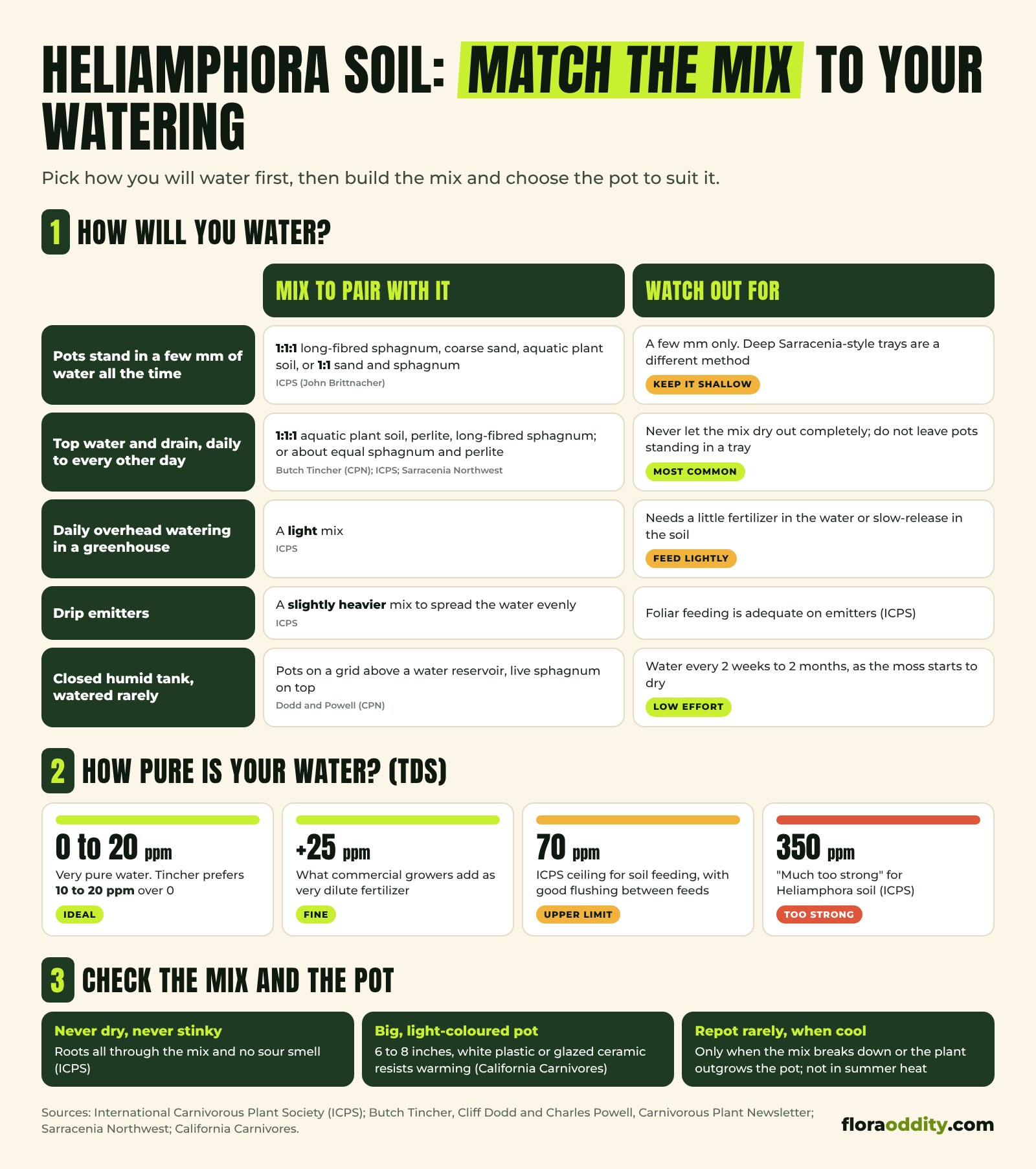
| How you water | Mix the sources pair with it | Notes | Source |
|---|---|---|---|
| Pots stand in a few mm of water all the time | Equal parts long-fibred sphagnum, coarse sand and aquatic plant soil, or 1:1 sand and long-fibred sphagnum | Keep the water level to a few mm | ICPS (Brittnacher) |
| Top water and let it drain, every day to every other day | Equal parts aquatic plant soil, perlite and long-fibred sphagnum | 6 by 6 by 6 inch (15 cm) pots | Tincher (CPN); ICPS |
| Overhead watering every day in a greenhouse | A light mix | Add a little fertilizer to the water or slow-release fertilizer to the soil | ICPS |
| Drip emitters | A slightly heavier mix to spread the water evenly | ICPS | |
| Closed, humid tank watered rarely | Live sphagnum over the pots | Pots on a grid above a water reservoir; watered every two weeks to two months | Dodd and Powell (CPN) |
Why the Roots Need Water and Air at Once
In the wild, the ICPS says, Heliamphora can be found partly submerged or “at least flooded by daily showers.” That rain is the key detail. It flows through the habitat, limits bacteria and fungi, and brings oxygen to the roots. The ICPS adds that you need not copy this by flooding the plants daily; what matters is a mix matched to your watering schedule.
Tincher makes the same point from the grower’s side. Plants in the wild are often photographed standing in water, but that water is “fresh and highly oxygenated” from frequent rain. Tincher explains why draining helps in a pot: as water runs out, it pulls fresh air into the root zone behind it, which keeps the mix from going anaerobic.
The pitchers drink too. Don Schnell, summarising field studies by Jaffe and colleagues in Carnivorous Plant Newsletter, notes that pitchers also absorb rainwater through the leaf, and that after a few dry days the pitcher fluid falls and prey capture drops, while “artificial addition of water causes capture to resume promptly.” Sarracenia Northwest says it is perfectly fine for water to run into the pitchers when you water.
Water Quality: How Pure Is Pure Enough?
Every source agrees that Heliamphora needs low-mineral water. Sarracenia Northwest names distilled water, reverse osmosis (RO) water and rainwater, and warns against hard or softened tap water, which lets minerals build up in the soil. The ICPS adds that well water is generally too salty.
The one real debate is about how pure. Tincher finds Heliamphora “do not seem too picky about water quality,” believes that 0.00 ppm water “is neither natural nor desirable,” and aims for 10 to 20 ppm. The ICPS gives a useful scale for everything above that. Commercial growers add about 1/2 teaspoon of fertilizer per 10 gallons (1 g per 40 litres), which raises the total dissolved solids (TDS) by about 25 ppm. A stronger solution of 1/2 teaspoon per gallon adds about 350 ppm, “much too strong” for the soil, and the ICPS considers about 70 ppm generally safe in the soil if you top water well a few times between feedings.
Put together, that gives a rough ladder:
- 0 to 20 ppm: very pure water; Tincher prefers 10 to 20 ppm.
- About 25 ppm added: the dilute fertilizer level commercial growers use.
- About 70 ppm: the ICPS ceiling for soil feeding, with good flushing in between.
- 350 ppm: far too strong for Heliamphora soil.
Two hidden sources of salt are worth knowing. Tincher found that a mix containing aquatic plant soil, watered with hard water, slowly collects mineral deposits that “may reach toxic levels over time.” And the ICPS page on soil ingredients warns that some perlite is salty, because it is kept damp with whatever water is to hand during packaging. Brittnacher washes it and uses only the pieces that float.
Check your water with our Water Checker before you use it, and see our problems guide for what mineral build-up looks like.
How to Water: Three Methods That Work
Standing in a few millimetres of water
Brittnacher keeps the plants in the ICPS guide “sitting in a few mm of water all the time,” in a mix chosen for it. The ICPS fertilizer trial photo shows H. nutans in 1:1 sand and long-fibred sphagnum, sitting in a few millimetres of water. California Carnivores also recommends the tray method, with the soil “damp to wet” all year.
Top water and drain
This is the method Sarracenia Northwest and Rice recommend. Water thoroughly from the top, let the excess run out, and never let the mix dry completely. Sarracenia Northwest says Heliamphora “should not sit continuously in a tray of water,” and Carnivorous Plant Nursery advises against pots standing in water for long. Tincher runs an automated flood and drain system every other day: the top chamber fills until the water is about 0.5 cm below the plant surface, then drains.
How often depends on your conditions. Robert Ziemer, growing in a cool greenhouse in northern California, watered from the top every several days so that water flushed through the mix and the pitchers stayed full. Ziemer once let the moss dry until the plants wilted; they survived, but the tops of mature pitchers died. Ziemer concluded it is better to keep Heliamphora “slightly on the dry side rather than too wet.”
A closed, humid tank watered rarely
Cliff Dodd and Charles Powell set potted plants on a plastic grid above a water reservoir in a 30 gallon aquarium, under a glass or plastic lid. In that constant humidity, the plants needed watering only “every two weeks to two months” as the moss began to dry. Excess water drained into the reservoir below, which they say prevents suffocation of the roots and slows the breakdown of the moss.
Water temperature and timing
Cool water helps cool the roots. California Carnivores finds refrigerated water “quite helpful” on warm days. Brian Barnes waters with lightly chilled RO water, about 59 °F (15 °C), before the lights go off, pouring it around the outside edges of the pots to avoid shocking the roots.
Sarracenia Northwest adds a warning: if a plant suddenly needs far more water because it is hot, move it somewhere cooler instead of watering more. Plan for holidays as well. The ICPS asks growers to think about what will happen to the plants during vacations when choosing a mix.
Potting Mix: Every Published Recipe Compared
| Mix | Who uses or recommends it | Notes |
|---|---|---|
| 1:1:1 aquatic plant soil, perlite, long-fibred sphagnum | Butch Tincher (CPN); ICPS consensus for North America | Holds moisture, almost free of air pockets, easy for young divisions to root into |
| 1:1:1 long-fibred sphagnum, coarse sand, aquatic plant soil | John Brittnacher (ICPS) | Used with pots sitting in a few mm of water |
| Long-fibred sphagnum and perlite, about equal parts | Sarracenia Northwest; ICPS alternative | Simple and airy |
| Long-fibred sphagnum and coarse sand | ICPS alternative | |
| Pure live or long-fibred sphagnum | Barry Rice; Sarracenia Northwest; Barnes (live) | Rice has also had luck with 2:1 sphagnum and perlite |
| Mostly long-fibred sphagnum with some pumice or lava rock | California Carnivores | Rock keeps the mix “open and cool” |
| 2:2:1 perlite, sand, peat | Carnivorous Plant Nursery | Or long-fibred sphagnum with a quarter perlite |
| 2:1:1 perlite, peat, sand | Barry Rice | One of Rice’s working mixes |
| Equal parts fine pine bark, long-fibred sphagnum, Aggrofoam | Andreas Wistuba, as reported by the ICPS (Europe) | Aggrofoam is a German plastic that does the job of perlite |
| Cork, pine bark, meranti wood shavings, polystyrene foam, charcoal, a little peat | Andreas Wistuba, CPN 1990 | No sphagnum at all |
The ingredients, one by one
Long-fibred sphagnum. The ICPS soil pages say the species matters. Chilean and New Zealand long-fibred sphagnum break down very slowly and make a good long-term medium, while dried Wisconsin sphagnum “breaks apart too easily.” The same page recommends gloves when handling sphagnum, because of sporotrichosis, a disease caused by a soil fungus.
Aquatic plant soil. This pond product contains the clay minerals arcillite and zeolite, which the ICPS says “hold moisture and nutrients but do not break down.” Tincher calls it an excellent moisture buffer. It can be hard to find; the ICPS suggests stores that specialise in ponds.
Perlite. It keeps the mix open. Wash it first, as the ICPS advises, because some bags are salty, and avoid perlite from fertilizer brands.
Sand. The ICPS soil guide wants sharp silica or quartz sand of about 1.5 to 2 mm. It warns against play sand, plaster sand, builders sand and pool filter sand, whose fine particles can set the mix “like concrete.”
Bark. The ICPS author found orchid bark in the USA variable and sometimes toxic, presumably from added fertilizer, and notes that it breaks down quickly. Since it is “not uncommon” to grow Heliamphora two or more years without repotting, the ICPS prefers ingredients that last that long.
Never use standard potting soil, compost or anything with added fertilizer, warns Sarracenia Northwest.
To scale any of these recipes to your pot, try our Soil Mix Calculator.
Live Sphagnum on Top: Help or Hazard?
Many growers dress the surface with live sphagnum. The ICPS says the plants “like this very much,” but the moss tends to overgrow small plants. Brittnacher uses a 1 cm layer of sand instead, to limit moss and fungus gnats, accepting that the plants like it less.
Barnes takes the opposite approach and grows in pure live sphagnum, mounded so the surface is level with the rim. Moving air passes over the raised moss and cools it by evaporation, day and night.
Live moss also changes underneath. Ziemer found that a few centimetres below the green surface, live sphagnum begins to break down and, within a year, forms a waterlogged layer. Ziemer’s fix was to repot into fresh live sphagnum once a year, preferably in spring. Dodd and Powell sterilise sphagnum by boiling or pressure-cooking it before use, so that ferns and weeds do not sprout in the tank and compete with the plants.
Pots: Size, Colour and Drainage
Heliamphora grows a large root system. Tincher calls it “a case where bigger is better,” uses 6 by 6 by 6 inch (15 cm) pots, and warns that root-bound plants dry out much faster; Tincher knows of good growers who lost prized plants that way. Ziemer found 8 inch (20 cm) plastic pots about right for large plants, while 4 inch (10 cm) pots were too small and tipped over easily.
Material and colour. California Carnivores recommends light-coloured, preferably white, plastic or glazed ceramic pots of 6 to 8 inches, because “their mass will resist warming.” Ziemer tried clay pots, but plants in plastic grew much better.
Depth and drainage. Carnivorous Plant Nursery recommends a deep pot of 4 to 6 inches (10 to 15 cm) or more to keep roots clear of standing water. Dodd and Powell cut extra-large drainage holes into two sides of their pots for aeration. Sarracenia Northwest asks for good drainage and enough room to grow, “without greatly oversizing” the pot.
Repotting Without the Setback
When to repot
Sarracenia Northwest lists three reasons to repot: the mix is breaking down, drainage has become poor, or the plant has clearly outgrown its pot. A sour smell is a fourth; Tincher says a bad-smelling mix at repotting means the watering and substrate do not match.
Timing matters more than technique. The ICPS advises against dividing in late spring and summer if your plants get above 79 °F (26 °C). Barry Rice admits that, in Rice’s warm conditions, plants many times responded to repotting “by dying,” while growers with cooler conditions had no such trouble. Carnivorous Plant Nursery says root disturbance can set growth back for several months. Our Repotting Advisor can help you pick a window.
Step by step
- Water the plant well the day before, as both the ICPS and Tincher advise. Hydrated roots are more flexible, and Carnivorous Plant Nursery warns that the roots are “very stiff and brittle.”
- Prepare damp mix. The ICPS soil pages recommend keeping ingredients damp, because it is easier to measure and mix and safer for you.
- Unpot the plant on its side and brush away surface moss. The ICPS tries to keep as much soil as possible around the roots. If you need to tease out old mix, Tincher works with the root mass submerged in water.
- Set the plant at the same depth. Sarracenia Northwest says to keep the crown at about the depth it grew before, not buried.
- Fill without packing. Add mix a little at a time and tap the pot on the bench to settle it. The ICPS warns not to leave air spaces under the plant and not to press the mix down with your fingers.
- Flood the pot a few times. This settles the mix; top up if needed. The ICPS says the water “should run through the pot quickly.”
- Fill adult pitchers with pure water or very dilute fertilizer of about 70 ppm, and hold back soil feeding until the plant grows again (ICPS).
- Bag the plant if your humidity is below 85%, keeping the bag away from lights and sun, for about a month or until it grows normally (ICPS).
If repotting turns into dividing, our care guide covers propagation.
How Heliamphora Compares With Its Relatives
Sarracenia. Heliamphora’s North American relatives like wet feet. The ICPS says Sarracenia pots should always sit in about 4 to 6 cm (1.6 to 2.4 inches) of water. Sarracenia Northwest, by contrast, says Heliamphora “should not sit continuously in a tray,” unlike Sarracenia and Venus flytraps. See our Sarracenia care guide.
Cephalotus. The ICPS Cephalotus guide describes the same choice between standing water and top watering, and finds that a mix of about 20% peat or chopped long-fibred sphagnum to 80% sand, with pots always sitting in about 1 cm of water, needs the least effort, provided water is flushed through occasionally to remove salts. That mix is far sandier than any Heliamphora recipe above. Our guide on how to water Cephalotus goes deeper.
Highland Nepenthes. Rice says general Heliamphora care is “much like growing highland Nepenthes”: large pots, sphagnum-rich mixes and top watering rather than trays. See our Nepenthes potting mix guide.
Put simply: Sarracenia takes the wettest pot, Cephalotus the sandiest, and Heliamphora wants sphagnum’s moisture with plenty of air.
What Growers Report
These are single growers’ conditions and results, not rules.
- A grower who has raised many divisions uses 1:1:1 long-fibred sphagnum, perlite and aquatic plant soil, calling the aquatic plant soil “really the key” for moisture and structure. The grower found 1:1 sphagnum and perlite blends gave “inadequate moisture buffering,” puts a shallow layer of cypress bark over the drainage holes, and fills pots “without packing the substrate.” (Av8tor1, TerraForums, September 2011)
- Another grower kept plants healthy in 50/50 dried long-fibred sphagnum and perlite, saying they do fine “as long as you flush the pots with water regularly and leave no standing water in the trays,” but that if the moss is packed too densely and the pot stands in water too long, “rot is inevitable.” (flytrap59, TerraForums, July 2009)
- A grower who mostly uses pure peat or pure dead sphagnum said: “I have never had problems with repotting Heliamphora,” and found them easier to repot than Nepenthes, except possibly while flowering. (Michael Z, CPUK Forum, January 2008)
- A UK grower tried a mix of minced dead tree fern trunk, perlite and a little dried sphagnum, in pond baskets watered overhead about once a week and never left standing in water. After about six months the grower saw “a much faster rate of growth.” (An D Smith, CPUK Forum, January 2008)
Our takeaway: the growers’ mixes differ, but every success here drains freely, and the one failure pattern they agree on is dense mix sitting in water.
Where Sources Differ
| Topic | One view | Another view | Context |
|---|---|---|---|
| Standing water | ICPS author: pots sit in a few mm of water; California Carnivores: tray method | Sarracenia Northwest: never sit continuously in a tray; Rice: top water, not trays | The ICPS ties standing water to a mix chosen for it |
| Sphagnum | Rice, Sarracenia Northwest, Barnes: pure live or long-fibred sphagnum works | Wistuba (CPN 1990): the genus never grows in sphagnum in nature, so Wistuba did not recommend it | Wistuba’s later mix, as reported by the ICPS, includes long-fibred sphagnum |
| Water purity | ICPS: pure water, RO most common | Tincher: 0 ppm is “neither natural nor desirable”; 10 to 20 ppm preferred | Both rule out hard, well or softened water |
| Repotting risk | Rice: warm-grown plants often died after repotting; Carnivorous Plant Nursery: set back for months | A CPUK grower: never had problems | Rice links the losses to warm conditions |
| How often to repot | Ziemer: once a year in live sphagnum | ICPS: two or more years is common, so use long-lasting ingredients | Live moss breaks down faster than clay-based mixes |
Common Mistakes
- Using softened or filtered hard water. The ICPS says neither makes water less salty.
- Pairing a dense mix with a deep tray. Choose the mix for the watering method, not the other way round.
- Ignoring a sour smell. Tincher says it means the watering and the mix do not match; repot into fresh mix.
- Small, dark pots. They heat quickly and root-bound plants dry out fast.
- Repotting in a heatwave. The ICPS advises against dividing in late spring and summer if your plants get above 79 °F (26 °C).
- Feeding through the soil at full strength. The ICPS calls too much fertilizer in the soil one of the easiest ways to kill a Heliamphora.
FAQ: Heliamphora Soil and Water
What is the best Heliamphora soil?
There is no single best mix. The ICPS calls Butch Tincher’s equal parts long-fibred sphagnum, perlite and aquatic plant soil the current consensus among North American growers, and equal parts long-fibred sphagnum and perlite or pure live sphagnum also work. Match the mix to how you water.
Can I use tap water for Heliamphora?
Only if it is very low in dissolved minerals. The ICPS recommends RO water or very soft tap water, and Tincher aims for about 10 to 20 ppm. Test yours before you use it.
Should Heliamphora sit in a tray of water?
Sources differ. Sarracenia Northwest says no, and recommends top watering with free drainage. The ICPS author keeps pots in a few millimetres of water, with a mix chosen for that. Never use the deep trays that suit Sarracenia.
How often should I repot a Heliamphora?
Only when the mix breaks down, drains poorly or the plant outgrows the pot. With long-lasting ingredients, the ICPS says two years or more between repottings is common. Repot when temperatures are cool.
The Bottom Line
Good Heliamphora soil is the one that matches your watering. Start with pure water of roughly 0 to 20 ppm, choose top watering with free drainage or a shallow water level, and build the mix around that choice, usually long-fibred sphagnum with perlite, sand or aquatic plant soil. Use a large, light-coloured pot, keep the roots cool, and repot rarely, gently and only in cool weather.
Sources & Further Reading
- International Carnivorous Plant Society: Growing Heliamphora (John Brittnacher)
- International Carnivorous Plant Society: Peat, Sand, Perlite (CP mix)
- International Carnivorous Plant Society: Sphagnum Moss
- International Carnivorous Plant Society: Growing Sarracenia
- International Carnivorous Plant Society: Growing Cephalotus
- Barry Rice, The Carnivorous Plant FAQ: Heliamphora cultivation
- Sarracenia Northwest: How to Grow Heliamphora
- California Carnivores: Sun Pitchers (Heliamphora) Growing Tips
- Carnivorous Plant Nursery: Growing Tips for Heliamphora
- Butch Tincher: My techniques for the indoor cultivation of Heliamphora, Carnivorous Plant Newsletter 42(4), 2013
- Brian Barnes: Growing Heliamphora indoors year-round, Carnivorous Plant Newsletter 39(1), 2010
- Cliff Dodd and Charles Powell: A practical method for cultivation of Heliamphora spp., Carnivorous Plant Newsletter 17(2), 1988
- Robert R. Ziemer: Some personal observations on cultivating the Heliamphora, Carnivorous Plant Newsletter 8(3), 1979
- Andreas Wistuba: Growing Heliamphora from the Venezuelan tepui, Carnivorous Plant Newsletter 19(1-2), 1990
- Don Schnell: Heliamphora, the nature of its nurture, Carnivorous Plant Newsletter 24(2), 1995
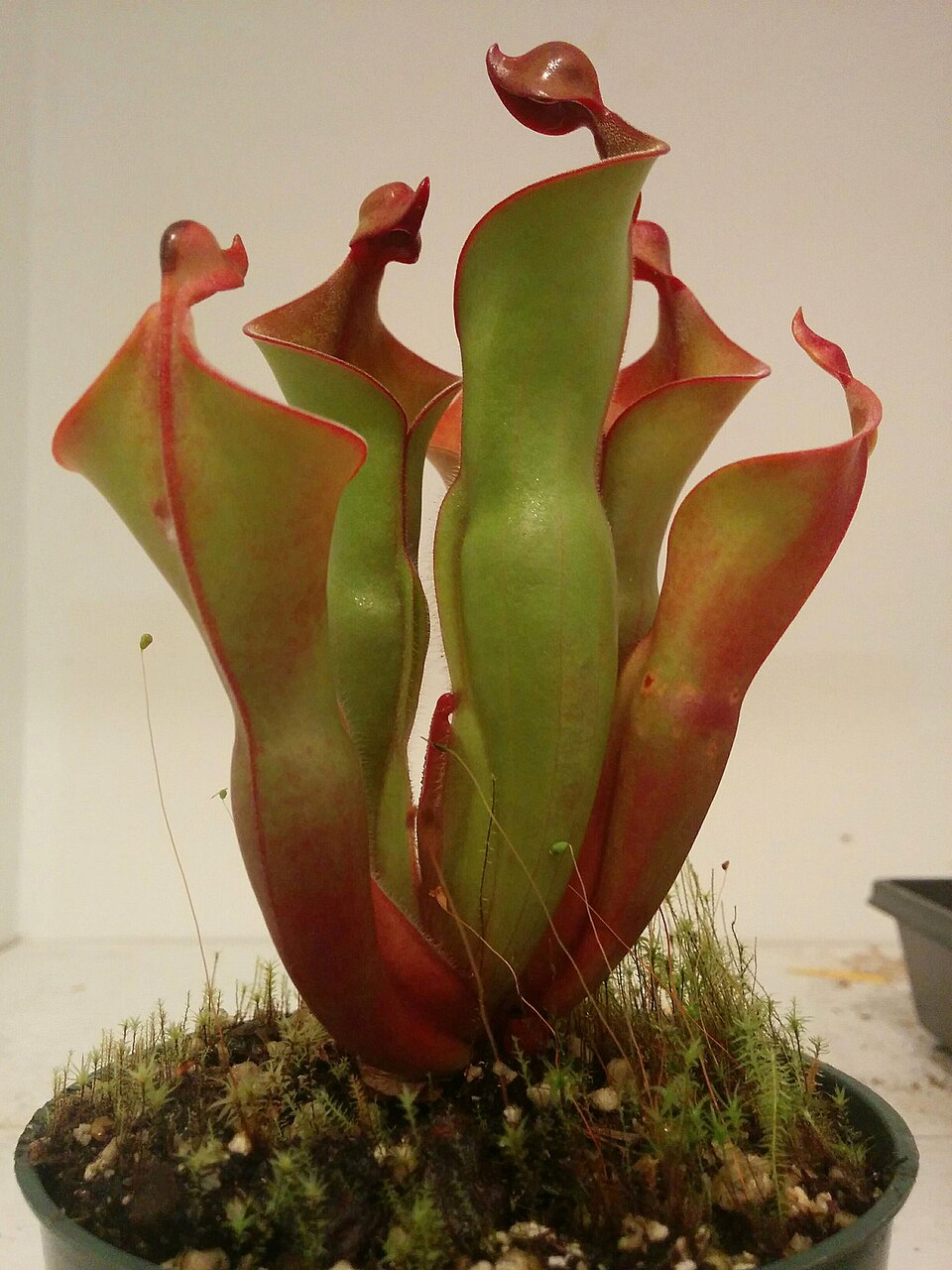
Featured image based on a photo of Heliamphora ‘Red Mambo’ by Dals093838 via Wikimedia Commons, CC BY-SA 4.0, with a blurred background and typography added by FloraOddity; the adapted image is offered under the same licence.
Final articles are editorially reviewed and factual claims are checked against cited sources. Last reviewed: October 2026.
One Comment