
The standard carnivorous plant soil is peat and sand, which the International Carnivorous Plant Society (ICPS) calls “CP mix,” kept wet. Butterworts break that rule. Sarracenia Northwest warns that a Mexican butterwort’s soil should not stay “continuously saturated like the soil of a Venus flytrap or Sarracenia,” and the ICPS puts it even more simply: Mexican Pinguicula “are NOT bog plants.” Temperate butterworts from cold climates and the southeastern United States, on the other hand, are happy in the acid peat mixes that bog plants like.
So the best butterwort soil depends on which butterwort you have. This guide goes deeper than the soil section of our butterwort care guide: recipes with the ratios the sources give, peat-free options, pots, repotting, and what goes wrong.
The Short Answer
For Mexican butterworts, use a coarse, airy mix that holds some moisture but drains fast. Sarracenia Northwest uses about 1 part sphagnum peat to 2 parts perlite; the ICPS uses equal parts peat, coarse sand and perlite with dolomitic lime, because most Mexican species “prefer an alkaline soil mix.” Many greenhouse growers skip peat altogether and use an all-mineral mix. Keep pots small and repot only when the mix breaks down, drains poorly or the plant outgrows its pot, for most species while the plant is in its winter succulent stage.
For cold temperate butterworts such as P. vulgaris and P. grandiflora, the ICPS recommends an acid mix of 2 parts peat to 1 part each of silica sand, perlite and vermiculite. Southeastern US species grow well in 3 parts peat to 1 of sand and 1 of perlite, or even pure peat. Never use ordinary potting soil, compost or fertilized mixes.

| Group | Mix recipe (ratios as the sources give them) | Pot | When to repot |
|---|---|---|---|
| Mexican, windowsill or house | 1 peat : 2 perlite (Sarracenia Northwest); 1 peat : 1 coarse sand : 1 perlite plus about 1 tablespoon dolomitic lime per cup (ICPS); 2 peat : 1 sand : 1 perlite plus 1 tablespoon pelletized limestone per 6-inch pot (Carnivorous Plant Nursery); equal parts sand, perlite, vermiculite and peat, plus a part of lava rock or pumice if handy (California Carnivores) | Small and not deep, with drainage holes; plastic or glazed ceramic; the ICPS uses 3.5-inch (9 cm) tall plastic pots | When the mix breaks down, drains poorly or the plant outgrows the pot; about every five years for the ICPS, sooner if a salt crust forms; best in the winter succulent stage |
| Mexican, greenhouse or all-mineral | 2 perlite : 2 vermiculite : 1 lava rock : 1 aqualite (or another part of lava rock) : 1 fine sand : 1 coarse sand : 1 calcareous clay (Eric Partrat, A World of Pinguicula); 100% pumice for some growers (Carnivorous Plant Nursery) | Plastic rather than clay; avoid black pots in hot sun; Partrat uses pots about 5 inches (12.5 cm) and 8 inches (20 cm) wide, both 4.7 inches (12 cm) deep | As above |
| Cold temperate (P. vulgaris, P. grandiflora) | 2 peat : 1 silica sand : 1 perlite : 1 vermiculite (ICPS); 2 peat : 1 sand : 1 perlite (California Carnivores); 50/50 silica sand and peat (Barry Rice) | Small; Rice uses 2-inch (5 cm) pots standing in purified water | About every second year, at the start of dormancy (Rice); for planting hardy carnivorous plants outdoors, the RHS prefers spring, as they come into growth |
| Southeastern US (warm temperate) | 3 peat : 1 silica sand : 1 perlite, or pure peat (ICPS); 1 peat : 1 sand (California Carnivores) | Drained pots on a wet tray; California Carnivores says undrained containers can work if the water level is allowed to fluctuate | Move seedlings to fresh media if moss or cyanobacteria overgrow them (ICPS) |
| Peat-free | Mineral mixes above; or one part each specialist peat-free mix, coarse sand, horticultural grit and dolomitic limestone chippings (RHS, for the Mexican P. rotundiflora) | As for the group | Peat-free mixes with pine bark may need repotting about every two years (Hampshire Carnivorous Plants, via the RHS) |
Why Butterwort Soil Differs by Group
The difference starts in the wild. The ICPS says many Mexican butterworts grow on limestone cliffs and tree trunks, some in moss and others in cracks in the rock, and Carnivorous Plant Nursery says their native soils “are slightly alkaline from the limestone bedrock.” Temperate butterworts, by contrast, grow in “damp peaty soils” (Carnivorous Plant Nursery), and the ICPS says the cold temperate species “prefer acid soils.”
That gives two families of mix. Mexican butterworts get an open, gritty mix, often with lime or limestone. Temperate and southeastern species get a classic acid peat mix. If you are unsure which group your plant belongs to, our pillar guide explains how to tell which butterwort you have.
Even within a group there is no perfect recipe. Barry Rice, in The Carnivorous Plant FAQ, writes of “a large amount of lore” about Mexican media: his own 2:1 sand and peat mix works for many growers, while “others do very poorly in it.” The ICPS explains why. The job is to match how much water the mix holds to your watering, temperature and humidity: a light, loose mix in a humid greenhouse with overhead watering, a heavier, more absorbent one in a typical house.
Mexican Butterworts: Airy, Gritty and Often Limed
Peat-based mixes for the windowsill
Sarracenia Northwest uses about 1 part sphagnum peat to 2 parts perlite; the high share of perlite keeps the mix open while it still holds enough water. If a mix stays “dense, soggy, or slow to drain,” it says, it holds too much water.
The ICPS recipe is heavier, because its author rarely top waters and keeps his pots in about 0.4 inch (1 cm) of water from spring to fall. He uses one part each of peat, coarse sand and perlite, plus “about 1 tablespoon of dolomitic lime per cup of soil mix” to offset the acidity of the peat; limestone or dolomitic sand would be better still.
Carnivorous Plant Nursery uses 2 parts peat to 1 of sand and 1 of perlite, with 1 tablespoon of pelletized limestone per 6-inch (15 cm) pot or aquarium aragonite sand. California Carnivores prefers “a more open mix” of equal parts sand, perlite, vermiculite and peat, plus a part of lava rock or pumice when handy, and has not found added dolomite necessary. Sarracenia Northwest calls 1 tablespoon of dolomite per cup useful but not essential, since the plants also get minerals from insects.
All-mineral mixes
Some mixes have no organic matter at all. The ICPS says “most growers prefer a pure mineral soil mix” in greenhouse conditions, and Carnivorous Plant Nursery notes that some growers use “100% mineral/inorganic media such as pumice.”
Eric Partrat, who has grown Mexican butterworts for about 15 years in a greenhouse and writes on A World of Pinguicula, gives his basic medium by volume: 2 perlite, 2 vermiculite, 1 pouzzolane (lava rock), 1 aqualite (or another unit of pouzzolane), 1 fine sand, 1 coarse sand and 1 calcareous clay. He stopped using peat because it “is difficult to water it again after drying and finally it provides nothing to the plant.”
Some growers go further and plant on bare rock. Alvin Liu, writing in Carnivorous Plant Newsletter, says vesicular volcanic rocks, “especially pumice and scoria,” are ideal because their cavities hold water, and that “pumice tends to wick water more reliably.” He warns that dark scoria in strong summer sun “can heat up very quickly and bake your plants.”
Ingredients and substitutes
The ICPS lists a few swaps for non-greenhouse growers. Pumice can replace perlite. Vermiculite works but “breaks down quickly getting slimy and requiring you to repot often.” Fine orchid bark “will degrade in a year or two,” and many orchid bark products contain an unknown amount of added fertilizer and can harbor fungus.
Pierre Gelinaud’s substrate page on A World of Pinguicula rates common materials for water retention and drainage. In his table, peat moss and dried long-fibered sphagnum hold water well but drain poorly; lava rock and pumice drain very well but hold less water; perlite, vermiculite and zeolites score well on both.
Finish with a top layer. The ICPS puts up to 0.2 inch (5 mm) of coarse silica sand on the surface after planting to discourage fungus gnats, whose larvae “like to eat Pinguicula leaves.”
Temperate and Southeastern Butterworts: Acid Peat Mixes
Soil for these groups is simpler. For cold temperate species, the ICPS recommends 2 parts peat to 1 part each of silica sand, perlite and vermiculite. California Carnivores uses 2 parts peat to 1 of sand and 1 of perlite. Rice, writing in Carnivorous Plant Newsletter about boreal butterworts, keeps his plants “in a 50/50 silica sand/peat moss mix” in pots that stand in purified water all the time. Carnivorous Plant Nursery says “the ratio is not critical.”
For southeastern US species, the ICPS suggests 3 parts peat to 1 of silica sand and 1 of perlite, and says that depending on conditions “they may also do as well or better in pure peat.” California Carnivores uses equal parts peat and sand, and Rice grows the US temperate-subtropical species in “a standard sand:peat mix.”
Gelinaud warns against black peat, which “is rich and unstable” and releases too many mineral salts, and flushes freshly potted peat with plenty of pure water.
How this compares with flytrap and Sarracenia mixes
Temperate butterworts sit close to the bog plants. The ICPS gives “standard 1:1 peat:sand CP mix” as the default for Sarracenia, and says Venus flytraps also grow in pure peat or sphagnum. Mexican butterworts go the other way: for flytraps the ICPS says to “avoid perlite, pumice, and other potentially salty soil components” and keep the soil always wet, while for Mexican butterworts perlite or pumice often makes up most of the pot and lime is added. Our Venus flytrap care guide and Sarracenia care guide cover those plants’ soil in full.
Peat-Free Options the Sources Mention
The all-mineral mixes above are already peat-free. For organic peat-free mixes, the Royal Horticultural Society (RHS) is the most detailed source. Its carnivorous plant growing guide says growers traditionally used peat, but that “the use of peat is harmful to the environment,” and that alternatives include milled pine bark, fibrous materials such as coir, or sustainably farmed live sphagnum moss, mixed with sharp sand or perlite. For the Mexican species P. rotundiflora, the RHS plant page suggests “one part each specialist peat-free mix, coarse sand, horticultural grit and dolomitic limestone chippings.”
The RHS’s own peat-free trials were run on Sarracenia, not butterworts. From that work it recommends 75% sustainably produced sphagnum moss with 25% finely sieved pine bark (0.16 inch, 4 mm or smaller), or 100% dried, chopped sphagnum, and reports that so far all five peat-free blends it tested did better than peat. Hampshire Carnivorous Plants, a UK nursery that also grows Pinguicula, told the RHS that sphagnum gives “exceptional” results, but that a medium with pine bark rotted, so plants needed repotting more often: it suggests every two years.
None of the sources we read reports a peat-free trial on temperate or southeastern butterworts, so treat sphagnum and bark blends for them as options, not tested recipes.
Pots: Type, Size and Depth
To work out how much of each ingredient your pots need, try our soil mix calculator.
Keep pots small. Sarracenia Northwest says Mexican butterworts have small root systems and “generally do not need deep or oversized pots.” The ICPS guide’s author uses 3.5-inch (9 cm) tall plastic pots on trays, and Rice uses 2-inch (5 cm) pots for boreal species. Partrat’s greenhouse plants get pots about 5 to 8 inches (12.5 to 20 cm) wide, and he notes the challenge of fitting both the winter rosette and a summer rosette “sometimes four times larger.”
Material matters too. Partrat prefers plastic, because the substrate stays moist longer than in porous clay pots. California Carnivores recommends plastic or glazed ceramic pots with drainage holes. It says Mexican species can also grow in shallow undrained ceramics “with very careful watering.” Avoid black pots: Partrat says they act “as a heat pump,” and the pot can run up to 9 °F (5 °C) above the air, or 113 °F (45 °C) on a 104 °F (40 °C) day in his greenhouse.
Pot height changes how wet the mix stays, especially on a tray. For flytraps, the ICPS says “the wetter the soil the taller the pot.” Partrat waters with rain water, and Liu uses distilled or deionized water, warning that tap water high in dissolved solids leaves “crusty, unpleasant deposits.” Check yours with our water checker before you set up a tray.
When to Repot a Butterwort
Mexican butterworts
Sarracenia Northwest says tropical Pinguicula “do not require frequent repotting”: repot when the soil begins to break down, drainage becomes poor, or the plant has outgrown its container. The ICPS repots after about five years, when “the deep thatch of old leaves” gets between new roots and the soil, and sooner “if a salt crust forms at the soil surface.”
The winter succulent stage is usually the best time. The ICPS calls it the best time to repot or refresh the mix for dormant P. moranensis-type plants, and says the same of P. cyclosecta. There are exceptions. P. ehlersiae “can fall apart during the winter if repotted,” while P. gigantea, which does not form succulent winter leaves, can fall apart if repotted in summer. Our butterwort dormancy guide explains the winter stage in detail.
Temperate butterworts
Rice repots his boreal butterworts “every second year or so,” at the start of dormancy, once the summer leaves have rotted away and before the pots go into the refrigerator. For planting hardy carnivorous plants outdoors, the RHS gives a different timing: spring, “when they are coming into growth,” and not while they are dormant.
Southeastern US butterworts
The ICPS calls warm temperate species “short lived perennials” and advises saving seed. Its repotting tip is for seedlings: if moss or cyanobacteria overgrow them, transplant them to new media.
How to Repot a Butterwort, Step by Step
- Make up the mix first. Use a recipe for your group and moisten it; California Carnivores tells buyers of its ready-made mix to “just add a little distilled water.”
- Lift the plant gently. Mexican butterworts have few roots. Liu says “most Mexican Pinguicula have very little in the way of roots,” and he washes the old media from them before replanting.
- Take leaf pullings if you want them. With a dormant P. moranensis-type plant out of its pot, the ICPS says you can peel off up to half the outer leaves “without hurting the plant.” Lay them on a damp 1:2 mix of vermiculite and perlite.
- Set the crown high. Sarracenia Northwest says not to bury the crown or pack soil tightly around it; the base of the plant “should remain at or just above the surface of the soil.”
- Top dress. Add the thin layer of coarse sand the ICPS recommends against fungus gnats.
- Water lightly. Sarracenia Northwest waters lightly to settle the soil, then keeps it moist but not saturated while the plant establishes.
What Growers Report
These are single growers’ results in their own conditions, from public forum posts, not rules.
“In my conditions I’ve noticed the following: in shorter than average pots, the pings do great with straight turface, or a mixture of turface & sand. In average & taller pots, the straight turface does not seem able to wick up enough moisture to reach the delicate, shallow roots of the pings, and so I use a heavier and more absorbent mixture of peat/sand/perlite with good effects.”
Radagast, TerraForums, December 2015
Radagast, who called themselves “still a Ping newbie,” was answering a grower of mostly Mexican butterworts.
“I find pure perlite and 50/50 perlite/APS to be the best as far as root systems and growth. In this mix I get ~2″ long roots on most pinguicula and with a peat mixture I get very small roots, less than 1″.”
31drew31, TerraForums, August 2011
This grower kept tray water no higher than about 0.75 inch (2 cm) and humidity at 70 to 80%. APS is an aquatic planting medium.
“I grow my Mexican pinguicula as houseplants. Usually, they do really well and thrive under my conditions. However, this year I have had a few losses to browning heart disease.”
DroseraLover, TerraForums, April 2016
The mix was about 40/60 peat to silica sand with dolomitic lime. The grower then planned a more mineral mix with only 10 to 20% peat; the thread does not establish the cause of the losses.
“I use equal parts of sand, perlite, peat and Tesco lightweight dust-free cat litter and it works really well. You probably can’t get that particular cat litter so you can use lava rock or pumice instead.”
SoLongFairWell, CPUK Forum, August 2014
Our takeaway: these growers matched the mix to pot height and watering. If a peat mix stays wet for days, try a more mineral one; if a mineral mix cannot keep shallow roots moist, use a shorter pot or add some peat, as Radagast did.
Where Sources Differ
Each row gives only the context the sources themselves state.
| Topic | One view | Another view | Context the sources give |
|---|---|---|---|
| Peat in Mexican mixes | ICPS, Sarracenia Northwest, Carnivorous Plant Nursery, California Carnivores: peat-based mixes with perlite, sand or pumice | Partrat: no peat, 100% mineral; ICPS: most greenhouse growers prefer pure mineral | The ICPS ties the choice to watering method, temperature and humidity; Partrat grows in a greenhouse and top waters |
| Lime or dolomite | ICPS: about 1 tablespoon dolomitic lime per cup “may seem like a lot but the plants do much better with it there” | California Carnivores: some growers add dolomite or gypsum, “although we have not found it necessary”; Sarracenia Northwest: “not essential” | The ICPS uses silica sand and peat, so the lime offsets the peat’s acidity |
| Potting soil | Sarracenia Northwest: “Never use standard potting soil, compost, or mixes containing added fertilizer” | ICPS leaf pulling guide: prefers pH-balanced potting soil with worm castings plus 2 or 3 parts perlite for young plants | The ICPS writes that Pinguicula appreciate light soil fertilization, but warns it is easy to over-fertilize |
| Vermiculite | California Carnivores and Partrat include it | ICPS: it “breaks down quickly getting slimy and requiring you to repot often” | Vermiculite is 2 parts in 9 of Partrat’s mix |
| Repotting temperate species | Rice: every second year or so, at the start of dormancy | RHS: plant hardy carnivorous plants in spring as they come into growth, not when dormant | Rice stores his repotted plants in the refrigerator; the RHS advice is for hardy carnivorous plants in general |
Common Mistakes
- Potting a Mexican butterwort in bog-plant mix and keeping it wet. A wet 1:1 peat and sand mix suits flytraps and Sarracenia, but Mexican butterworts are not bog plants.
- Using ordinary potting soil, compost or fertilized mixes. Sarracenia Northwest warns these contain minerals and nutrients that can damage or kill carnivorous plants.
- Burying the crown. Keep the base of the rosette at or just above the soil surface.
- Leaving a salt crust in place. The ICPS repots sooner when one forms. Liu links mineral deposits to tap water high in dissolved solids, so check yours with the water checker.
- Black pots in hot sun. Partrat says the pot can run up to 9 °F (5 °C) above the air.
- Treating rot with fungicide. The ICPS says fungicides are “death even in the soil” for Pinguicula, cinnamon included. See our pillar guide’s common problems.
FAQ: Butterwort Soil
Can I use regular potting soil for a butterwort?
Not on its own. Sarracenia Northwest says never to use standard potting soil, compost or fertilized mixes. The ICPS leaf pulling guide uses pH-balanced potting soil for young Mexican plants, but only with 2 or 3 parts perlite per part of soil.
Can I use Venus flytrap soil for a butterwort?
For temperate and southeastern species, yes: the 1:1 peat and sand mix used for flytraps and Sarracenia is close to what the ICPS, California Carnivores and Rice recommend for them. For Mexican butterworts, add plenty of perlite or pumice first, and consider a little dolomitic lime.
How often should I repot a butterwort?
Mexican butterworts only need it when the mix breaks down, drains poorly or the plant outgrows the pot; the ICPS manages about five years between repottings. Rice repots temperate butterworts about every second year. Peat-free mixes with pine bark may need repotting about every two years.
The Bottom Line
The best butterwort soil fits the group and your conditions. Mexican butterworts want a coarse, airy mix: about 1 part peat to 2 parts perlite, equal parts peat, coarse sand and perlite with a little dolomitic lime, or an all-mineral mix in a humid greenhouse. Temperate and southeastern species want acid peat mixes with sand and perlite. Peat-free growers can use mineral mixes for Mexican plants and sphagnum or bark blends for the others. Use small pots, keep the crown above the soil, and repot only when the mix tells you to.
Sources & Further Reading
- International Carnivorous Plant Society: Growing Mexican Pinguicula
- International Carnivorous Plant Society: Mexican Pinguicula Leaf Pullings
- International Carnivorous Plant Society: Growing cold temperate Pinguicula
- International Carnivorous Plant Society: Growing warm temperate Pinguicula
- International Carnivorous Plant Society: Growing Dionaea muscipula
- International Carnivorous Plant Society: Growing Sarracenia
- Barry Rice, The Carnivorous Plant FAQ: Pinguicula cultivation
- Barry Meyers-Rice (2002), Cold Pinguicula in a Hot Climate, Carnivorous Plant Newsletter 31(1): 25 to 27 (PDF)
- Alvin Liu (2020), Lithophytic culture of Mexican Pinguicula, Carnivorous Plant Newsletter 49(3): 132 to 135 (PDF)
- Sarracenia Northwest: How to Grow Tropical Butterworts (Pinguicula)
- California Carnivores: Butterworts (Pinguicula) Growing Tips
- California Carnivores: Pinguicula Soil Mix
- Carnivorous Plant Nursery: Growing Tips for Tropical Butterworts
- Carnivorous Plant Nursery: Growing Tips for Temperate Butterworts
- A World of Pinguicula: Growing Mexican Pinguicula (Eric Partrat)
- A World of Pinguicula: Pinguicula Substrates, Growing Media (Pierre Gelinaud)
- RHS: How to grow carnivorous plants
- RHS: Pinguicula rotundiflora plant profile
- RHS: Peat-free case study, Hampshire Carnivorous Plants
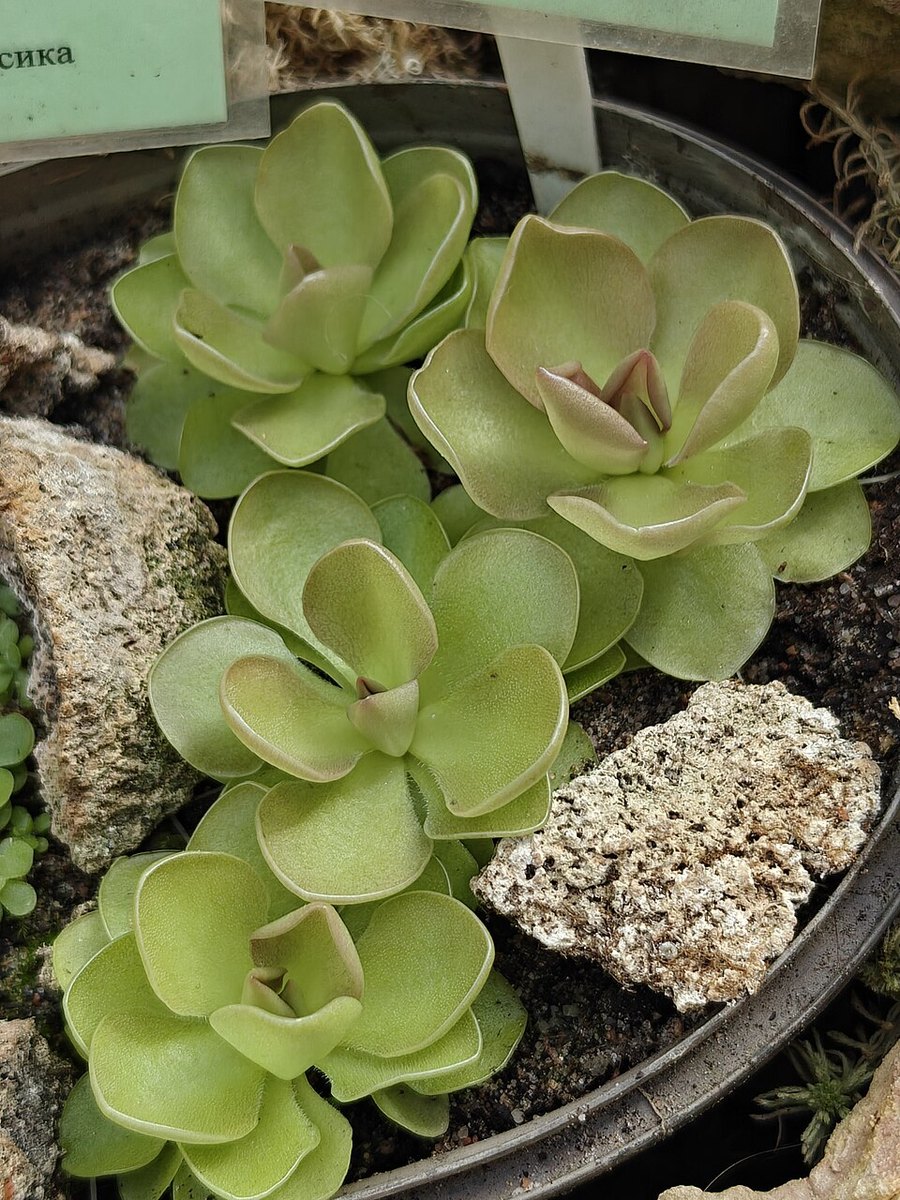
Featured image based on a photo of Mexican butterworts (Pinguicula agnata) by Krzysztof Golik via Wikimedia Commons, CC BY-SA 4.0, with a dark gradient and typography added by FloraOddity; the adapted image is offered under the same licence.
Final articles are editorially reviewed and factual claims are checked against cited sources. Last reviewed: October 2026.
3 Comments