
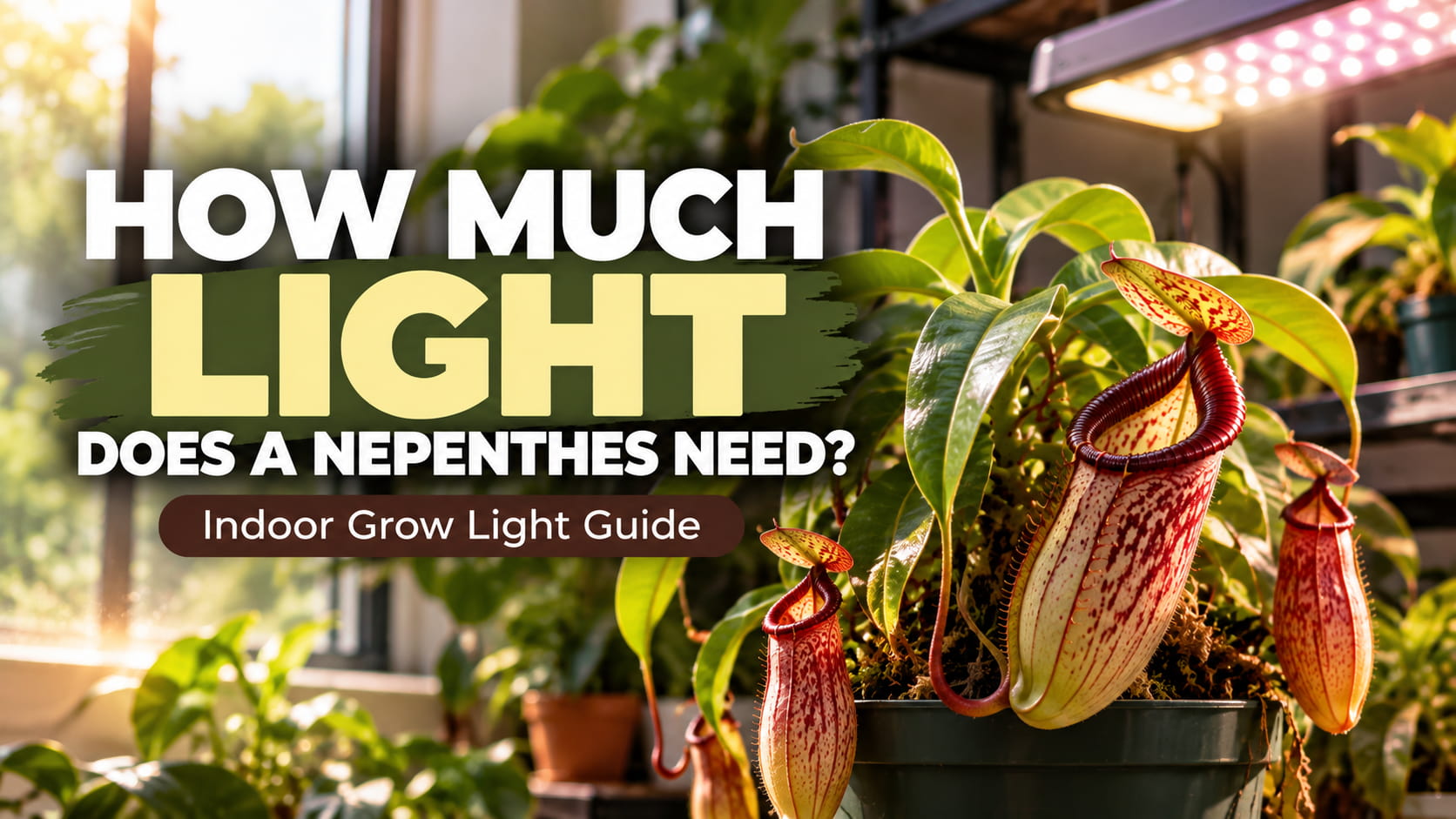
Your Nepenthes does not need a mysterious “perfect” lamp. It needs enough usable light, delivered consistently, without turning the growing area into a small furnace.
For many indoor growers, light is the first thing worth checking when a Nepenthes keeps producing leaves but seems reluctant to make pitchers. Clemson Extension recommends bright, diffused light for tropical pitcher plants, while experienced Nepenthes growers at Sarracenia Northwest also place light near the top of their troubleshooting list. The exact amount varies with species, hybrid, acclimation, temperature, window exposure, and the type of artificial light you use.
This guide gives you a practical way to judge Nepenthes light without getting trapped by one magic number.
Quick Answer: How Much Light Does a Nepenthes Need?
Start with bright, consistent light. A practical indoor setup is a bright east- or west-facing window with several hours of direct morning or late-afternoon sun, or a good LED grow light used on a regular schedule. Clemson Extension specifically suggests bright, diffused light and says Nepenthes can tolerate some direct morning or late-afternoon sun. Sarracenia Northwest recommends several hours of direct sun for commonly grown Nepenthes and suggests supplemental lighting when a sunny window is not available.
For growers who use a PAR meter, around 100 to 200 µmol/m²/s (PPFD) at leaf level is a useful starting range for many common indoor Nepenthes. This is a practical grower reference, not a universal biological requirement. Carnivero lists a broader genus-level range of 30 to 200 PPFD while also documenting Nepenthes grown successfully at higher levels, so species, acclimation, and the rest of the growing setup clearly matter.
For light duration, 12 to 14 hours per day is a sensible starting point for artificial lighting. Use a timer and give the plant a dark period rather than leaving the light on continuously.
Why Light Matters So Much for Nepenthes
A Nepenthes pitcher is not just a decorative container hanging from the leaf. It is a highly specialized structure developed by the plant, and producing new growth requires energy generated through photosynthesis.
That creates an interesting situation for indoor growers: a Nepenthes can sometimes continue making leaves under mediocre light while pitcher production becomes weak or inconsistent. Sarracenia Northwest describes this pattern repeatedly in its grower Q&A material: a plant may remain alive and produce foliage while insufficient light limits pitcher development.
Light is also closely connected to appearance. A plant grown in stronger light may develop tighter growth and stronger pigmentation, depending on its genetics. A darker green, stretched plant with long spaces between leaves can be a clue that the plant is reaching for more light. It is a clue, not a diagnosis by itself.
What “Bright Indirect Light” Actually Means
“Bright indirect light” sounds precise until you put a light meter next to a window and discover how wildly different two rooms can be.
For a Nepenthes, the phrase should not be interpreted as “keep it several feet away from the window because direct sun is bad.” In many homes, that position is simply too dim. A window that looks brilliantly bright to your eyes can provide far less usable light to a plant once distance, glass, curtains, walls, weather, and the sun’s position are taken into account.
Clemson Extension recommends placing Nepenthes near an east- or west-facing window, with bright diffused light and some direct morning or late-afternoon sun tolerated by many plants. Sarracenia Northwest takes a more sun-forward approach for commonly grown Nepenthes, recommending several hours of direct sunlight when possible.
So think about light reaching the leaves, not how bright the room feels.
Window Light: Is a Sunny Window Enough?
It can be. It can also be surprisingly weak.
An unobstructed, bright window is often the simplest Nepenthes lighting setup because it gives the plant natural light across the day. The challenge is that window direction matters, and seasonal changes can be substantial.
| Window situation | What to expect | What to watch |
|---|---|---|
| East-facing | Gentler morning sun with bright light afterward | Good starting point for many indoor plants; check how quickly the light falls away. |
| West-facing | Strong afternoon and late-day light | Watch heat buildup against hot glass. |
| South-facing | Potentially strong light for much of the day, depending on location and season | Heat and leaf stress can become the issue rather than lack of light. |
| North-facing | Often much lower direct-light exposure | Supplemental lighting may be useful, especially in darker seasons. |
These are starting points, not rules. Your latitude, nearby buildings, window glass, curtains, season, and local weather can completely change the result.
How to Tell if Your Nepenthes Is Getting Too Little Light
Look at the plant’s growth pattern rather than waiting for a single dramatic symptom.
Large, very dark-green leaves with little or no pitcher production can point toward insufficient light. Long spaces between leaf nodes and stretched growth are another useful clue. Sarracenia Northwest describes these traits in Nepenthes troubleshooting cases and repeatedly identifies inadequate light as a common cause of poor pitcher production.
Another clue is what happens to new tendrils. If the plant repeatedly forms tendrils but they stall instead of enlarging into pitchers, light is worth checking before you start changing five other variables at once.
And remember the reverse problem: a plant can also receive too much light too quickly. Sudden exposure to intense sun can cause leaf bleaching or burn, especially when a plant has been growing indoors under much weaker conditions.
How to Tell if the Light Is Too Strong
Do not assume that darker red or purple pigmentation automatically means your Nepenthes is being damaged. Some plants naturally color dramatically under stronger light.
The more useful question is whether the plant is showing actual stress. Look for bleached areas, crispy patches, scorched tissue, unusually rapid drying, or a decline that started immediately after moving the plant into much stronger light.
Acclimation matters. A Nepenthes that spent months in a dim room should not suddenly be placed against harsh midday sun and left there because “more light is better.” Increase exposure gradually.
PPFD, Lux, Lumens, and Watts: What Should You Actually Measure?
This is where indoor plant lighting gets unnecessarily confusing.
Watts tell you how much electrical power a light consumes. They do not directly tell you how much useful light reaches the plant.
Lumens describe visible light weighted for human vision. They can be useful when comparing ordinary household lights, but they are not a direct measure of the light available for photosynthesis.
Lux also measures visible illumination from the perspective of human vision. A lux reading can help compare locations, but converting lux into PPFD is only approximate because the relationship depends on the light spectrum. Waveform Lighting specifically notes that an accurate lux-to-PPFD conversion requires information about the light source’s spectral power distribution.
PPFD is more useful for plant lighting because it measures the photosynthetically active photons arriving at a surface each second. If you own a PAR meter, this is the number I would pay the most attention to.
A Practical PPFD Starting Point for Nepenthes
There is no single PPFD value that every Nepenthes should receive.
Carnivero’s published genus recommendations list Nepenthes at roughly 30 to 200 µmol/m²/s and state that the figures assume a 12 to 14 hour photoperiod. The same organization also shows Nepenthes being grown under substantially higher PPFD in other cultivation examples. That is a useful reminder that a published range should be treated as a cultivation reference, not a hard biological ceiling.
For a typical indoor grower who wants a practical number to work from, 100 to 200 PPFD at the leaves is a reasonable starting zone for many common Nepenthes hybrids. From there, watch the plant and adjust rather than chasing a number for its own sake.
If your Nepenthes is healthy, growing steadily, and producing pitchers, you have more useful information than a meter can give you.
How Far Should a Grow Light Be From a Nepenthes?
There is no universal distance such as “exactly 12 inches.” Two lights can have completely different output at the same distance.
A small LED bulb may need to sit relatively close to a plant. A high-output panel may need to be much farther away. The manufacturer’s PPFD map, when available, is far more useful than wattage alone.
A sensible approach is to start conservatively, watch the newest leaves, and adjust the lamp height gradually. A light that is too far away may produce stretched growth and weak pitcher development. A light that is too close can overheat or bleach the plant.
Also check the entire plant. A climbing Nepenthes can have the top leaves sitting directly under the lamp while the lower leaves receive much less light. If only the top section gets good illumination, the plant can still develop unevenly.
How Many Hours of Grow Light Does Nepenthes Need?
12 to 14 hours per day is a practical starting schedule for supplemental lighting.
Sarracenia Northwest recommends a 14-hour daylight cycle in its Nepenthes care guide, while the University of Minnesota Extension gives 12 to 14 hours as a general supplemental-light guideline for foliage houseplants.
Use a timer. Consistency is much easier to achieve when the light turns on and off automatically.
Do not assume that leaving the light on for 20 or 24 hours will compensate for weak equipment. Photoperiod and intensity work together. Give the plant a reliable cycle rather than trying to overwhelm it with continuous light.
What Kind of Grow Light Is Best?
You do not need a purple “carnivorous plant” bulb for Nepenthes.
White or balanced LED lighting is a straightforward choice for indoor growing because it provides a broad spectrum while making the plants easier to view. The University of Minnesota Extension notes that LED lights are energy efficient, long-lasting, and available in a wide range of styles, while white or balanced lights are suitable for most plants.
For a Nepenthes shelf, cabinet, or small growing area, the important characteristics are usable output, coverage, adjustability, and heat management.
Watch: Nepenthes Care and Lighting Basics
This older Sarracenia Northwest guide covers Nepenthes care with specific attention to sunlight, water, soil, and humidity. It is broader than a grow-light tutorial, but it is useful for seeing how lighting fits into the plant’s overall growing conditions.
Do not buy a lamp simply because the box says “100W.” Check whether the number represents actual electrical draw, what area it is designed to cover, and whether the manufacturer provides a PPFD map or other meaningful output data.
LED Panel vs. LED Bulb for Nepenthes
| Setup | Advantages | Things to watch |
|---|---|---|
| LED bulb | Cheap, simple, easy to place over one or two plants | Coverage can be uneven; output falls quickly with distance. |
| LED bar | Excellent for shelves and plant cabinets | Check whether the plant canopy is getting even coverage. |
| LED panel | Better for larger groups and more uniform illumination | Can be unnecessarily powerful for a tiny growing area; manage height and heat. |
For one small Nepenthes, an enormous panel is usually solving a problem you do not have. For a shelf full of vining plants, a bar or panel can make more sense.
Do Nepenthes Need Full-Spectrum Grow Lights?
“Full spectrum” is useful as a shopping description, but it should not be your only buying criterion.
A good white LED can provide an appropriate spectrum for plant growth. What matters in practice is whether the light delivers enough usable photons to the leaves at a workable distance and covers the growing area evenly.
This is one reason PPFD maps are more useful than marketing phrases. “Full spectrum” does not tell you whether the lamp is powerful enough.
Should You Put a Nepenthes Under a Grow Light 24 Hours a Day?
No need.
A reliable 12 to 14 hour cycle is a much more sensible starting point. Plants use dark periods as part of their normal daily rhythm, and a grow light should imitate a useful day rather than create permanent daylight.
A timer also prevents accidental schedule changes when you forget to turn the lamp off at night.
What About Humidity? Can a Grow Light Fix No Pitchers?
Light cannot solve every Nepenthes problem.
Humidity, temperature, root condition, watering, potting medium, acclimation, and the plant’s genetics still matter. FloraOddity has a dedicated guide on Nepenthes humidity indoors for growers who want to examine humidity and humidity-dome questions separately.
But humidity is often blamed too early. In its recent Nepenthes troubleshooting material, Sarracenia Northwest argues that adequate light and suitable temperatures are more important drivers of pitcher production for many commonly grown Nepenthes, and that many plants can acclimate to ordinary household humidity.
Clemson Extension takes a more humidity-conscious approach and recommends humidity above 60% for tropical pitcher plants. These recommendations are not necessarily contradictory: growers are dealing with different species, hybrids, environments, and cultivation goals.
In practical terms, fix the obvious light problem before buying an expensive humidifier just because your plant stopped making pitchers.
My Nepenthes Gets Enough Light but Still Has No Pitchers
This is where you stop blaming the lamp.
If the plant is receiving strong, consistent light and still refuses to pitcher, check temperature and drafts next. Lowland and highland Nepenthes can have very different temperature preferences, and even hybrids can respond differently depending on their parentage. For the details, see our Nepenthes temperature guide.
Then look at watering and roots. A stressed root system can limit growth even when the leaves look reasonably healthy. Recent repotting, shipping, a major change in environment, or moving the plant repeatedly can also interrupt pitcher production while the plant acclimates. For the practical watering side of this check, see How to Water a Nepenthes Indoors: Water Type, Frequency, and Drainage.
For a deeper diagnostic sequence, read Why Is My Nepenthes Not Producing Pitchers? 8 Causes and How to Fix It.
A Simple Indoor Nepenthes Lighting Setup
Here is a setup that avoids most of the unnecessary complexity:
- Place the plant near the brightest suitable window you have, ideally where it receives several hours of direct morning or late-afternoon sun.
- If the window is too weak or inconsistent, add a white or balanced LED grow light above the plant.
- Start with a 12 to 14 hour timer schedule.
- Keep the light far enough away to avoid rapid bleaching or heat stress, then adjust gradually.
- If you have a PAR meter, begin around 100 to 200 PPFD at leaf level and adjust according to the plant’s response.
- Give the setup several weeks before deciding that a small adjustment “didn’t work.”
The last point is easy to underestimate. A Nepenthes does not need to respond to every change instantly. Pitchers develop over time, and newly adjusted plants may spend their energy on roots and leaves before visible pitcher production catches up.
What Growers Report
Light comes up again and again in grower forums, both as the fix for a plant that will not pitcher and as the cause of bleached or burnt leaves. Here is what a few growers said happened when they changed how much light their Nepenthes received.
“Since seeing Christian’s plants and doing quite a bit of rebuilding of the nurseries, I’ve managed to triple the light levels without too much overheating and drying out in the middle of the day. The improvements are dramatic.”
Rob Cantley, Terraforums, September 2002
“I have bleached older plants a couple of times with envirolites but they do seem to adapt quickly.”
Leo, Carnivorous Plants UK forum, August 2010
“For a couple of years it didn’t make any pitchers (18 W cfl @ 15 cm from the plant + another @ 30 cm). Then suddenly it started to make pitchers to every leaf and the only thing I did was increase the distance from the light.”
pmatil, Carnivorous Plants UK forum, January 2011
“pmatil – interesting you should mention that as my ‘Harlequin’ absolutely loves the 250W fluorescent I use at about 30cm away.”
Amori, Carnivorous Plants UK forum, January 2011
These reports fit the points covered above. The first shows how much a plant can gain when weak light is the limiting factor, as long as the extra light does not bring heat and drying with it. The bleached leaves are the “too strong” side of the same story, which is why light should be increased gradually and lamp height adjusted while you watch the newest leaves. The last two growers saw opposite results at similar distances, a reminder that Nepenthes vary, that more light is not always better, and that the plant’s own response is better feedback than any single distance or wattage.
Common Nepenthes Lighting Mistakes
Keeping the plant several feet from the window because the room looks bright. Human eyes adapt extremely well to different brightness levels. Your eyes and your Nepenthes are not measuring the same thing.
Choosing a grow light by wattage alone. Watts describe electricity consumption, not the PPFD reaching the leaves.
Putting a plant adapted to low light straight into harsh midday sun. Increase exposure gradually.
Changing light, humidity, water, fertilizer, and potting mix simultaneously. You will not know what actually helped or hurt the plant.
Assuming more light is always better. Nepenthes vary. Some can handle substantially brighter conditions than others, while sudden high light can cause stress.
Measuring the wrong place. If you use a light meter, measure around the leaf canopy where the plant is actually growing, not several inches above it, and not at the floor of the cabinet.
FAQ
Can Nepenthes grow under artificial light only?
Yes. Many Nepenthes can be grown indoors with supplemental or entirely artificial lighting when the light is strong enough, consistent, and appropriately timed. Sarracenia Northwest specifically recommends artificial lighting when a sufficiently sunny window is unavailable.
Is a north-facing window enough for Nepenthes?
It depends on your latitude, season, window design, and local conditions, but it is often a lower-light option than an unobstructed east-, west-, or south-facing window. If the plant is stretching or not pitchering, supplemental lighting is worth considering.
Do red and blue grow lights work for Nepenthes?
Plants use red and blue wavelengths for photosynthesis, but a white or balanced LED is generally easier to live with and can provide a broad usable spectrum. The more important question is whether the light provides enough usable intensity at the plant.
Can too much light stop pitcher production?
Severe light stress can damage leaves and developing growth, so yes, excessive or rapidly increased light can create problems. However, pigment changes alone do not prove that the plant is receiving too much light.
Should I buy a PPFD meter?
You do not need one to grow Nepenthes. A meter becomes useful when you are trying to compare several indoor locations or tune an artificial-light setup with precision. Otherwise, plant growth and gradual adjustment can still get you a long way.
Bottom Line
A Nepenthes does not need you to memorize one magical light number. It needs a dependable supply of usable light that matches the plant and remains stable long enough for the plant to respond.
For most indoor growers, the practical recipe is simple: start with a bright window or a good white LED, aim for a consistent 12 to 14 hour cycle under artificial lighting, increase light gradually, and use the plant’s growth pattern as feedback. If the leaves are growing but pitchers are missing, check the light before you start rebuilding the entire growing environment.
Sources & Further Reading
- Clemson Cooperative Extension: Tropical Pitcher Plants (Nepenthes spp.)
- North Carolina State University Extension: Nepenthes
- Sarracenia Northwest: Grow Nepenthes
- Sarracenia Northwest: Troubleshooting a Pitcherless Nepenthes
- Carnivero: Genera Specific PPFD Recommendations
- University of Minnesota Extension: Lighting for Indoor Plants
- Waveform Lighting: Convert Lux to PPFD
- Annals of Botany / PMC: Photosynthesis and nutrient uptake in Nepenthes × ventrata
Last reviewed: September 2026. Growing recommendations can vary by species, hybrid, climate, acclimation, and equipment.

12 Comments