
Heliamphora temperature is the part of sun pitcher care that decides whether a plant thrives or slowly fades. Sun pitchers come from cool, rainy plateaus in South America, and Barry Rice, author of the Carnivorous Plant FAQ, says a “very bright, humid, but cool environment” is hard to maintain, which is “why most growers are unsuccessful.” The good news is that sun pitchers are tougher than their reputation. The International Carnivorous Plant Society (ICPS) calls them “pretty tough” and “preadapted to cool human house temperatures.”
So the job is not to copy a mountaintop. It is to avoid the heat that harms the plant, keep the roots cool, and give it enough humidity. This guide gathers the published numbers and shows how growers apply them in different setups.
The Short Answer
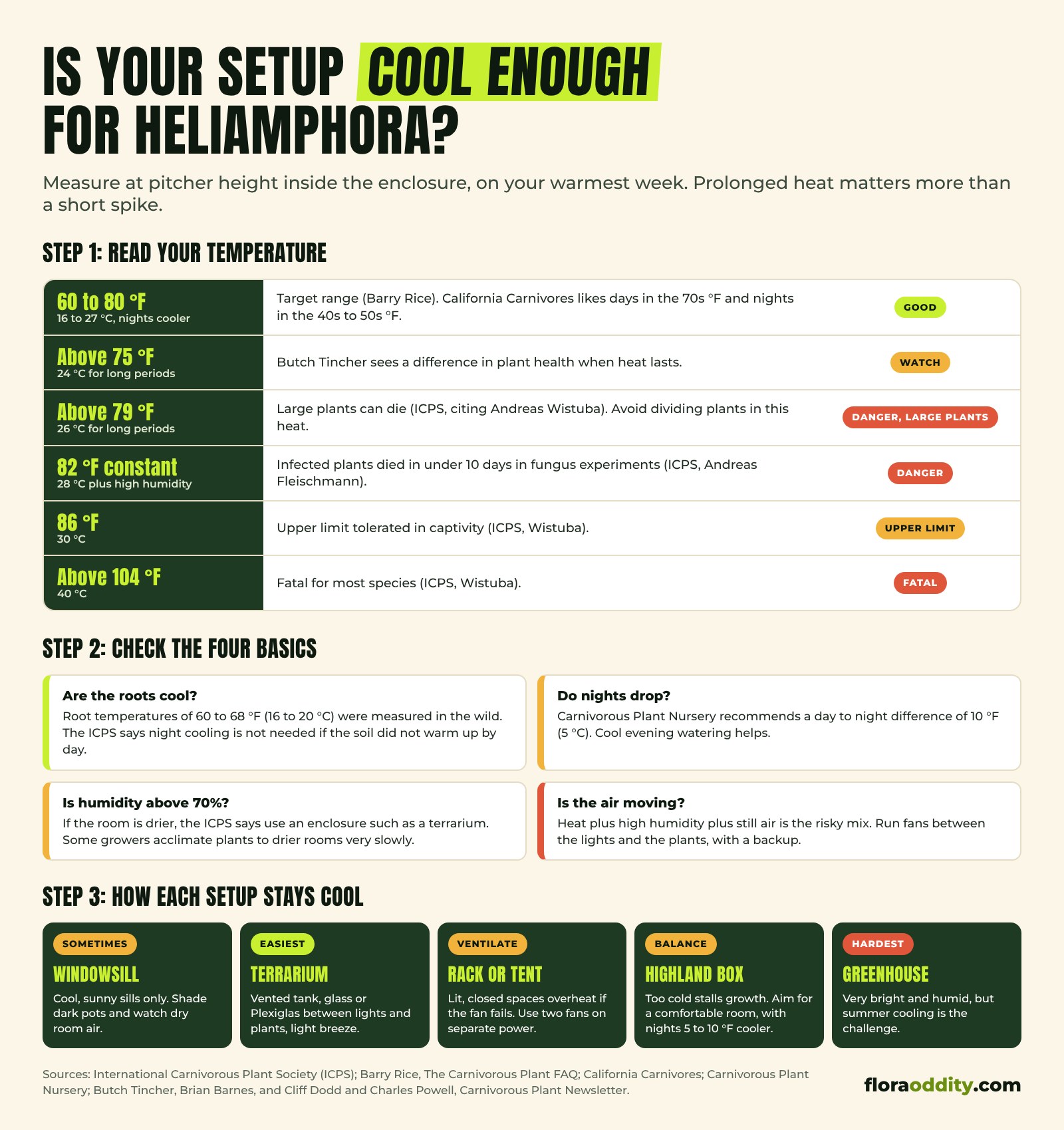
Aim for days of about 60 to 80 °F (16 to 27 °C), the target Rice gives, with nights cooler than days. Treat 79 °F (26 °C) as your warning line: the ICPS says large plants can die after prolonged temperatures above it, and Andreas Wistuba reports that most species die above 104 °F (40 °C). Keep the soil cool, because the ICPS says night cooling is not essential “as long as the soil temperatures were not elevated during the day.”
For humidity, the ICPS says plants grown indoors need an enclosure such as a terrarium unless the room stays above 70%. Some growers acclimate plants to much drier rooms, slowly. Whatever the setup, move the air, keep lights from heating the plants, and plan for your hottest week of summer, not your average day.
| Temperature at the plant | What the sources say | Status |
|---|---|---|
| Days 60 to 80 °F (16 to 27 °C), cooler nights | Rice’s target range; California Carnivores likes days in the 70s °F and nights in the 40s to 50s °F | Good |
| Above 75 °F (24 °C) for long periods | Butch Tincher notices a difference in plant health | Watch |
| Above 79 °F (26 °C) for long periods | ICPS: large plants especially at risk; Tincher notes it has long been linked to “Heliamphora Sudden Death Syndrome” | Danger for large plants |
| Constant 82 °F (28 °C) with high humidity | Infected plants died in under 10 days in Andreas Fleischmann’s experiments (ICPS) | Danger |
| Up to 86 °F (30 °C) | Wistuba (ICPS): tolerated in captivity | Upper limit |
| Above 104 °F (40 °C) | Wistuba (ICPS): fatal for most species | Fatal |
| Light frost | ICPS: plants survive light frosts | Survivable |
The Tepui Climate: Cool, Wet and Misty
Heliamphora grows only in the Guiana Highlands of Venezuela and nearby Guyana and Brazil. According to the ICPS, most species live at 4,000 to 9,200 feet (1,200 to 2,800 m) on tepuis, the sandstone table mountains of the region, with a few on lower slopes above about 2,500 feet (800 m).
The tepuis lie only a few degrees north of the equator, yet their tops are cool. The sources describe a narrow, mild band:
- ICPS: summit temperatures are generally 45 to 74 °F (7 to 23 °C), sometimes higher or lower, but not below freezing.
- Barry Rice: 46 to 68 °F (8 to 20 °C), “with cold but generally frostless nights.”
- Carnivorous Plant Nursery: typical daily temperatures of 46 to 68 °F (8 to 20 °C), with a yearly range of about 34 to 90 °F (1 to 32 °C).
Rain is the other constant. The ICPS gives about 2 to 4 cm (roughly 0.8 to 1.6 inches) of rain a day on most tepuis, and Rice puts the annual total at 80 to 160 inches (200 to 400 cm). Even the so-called dry season is not dry. Don Schnell, writing in Carnivorous Plant Newsletter, notes that visitors in the February to March “dry” season report “the nightly cold, hard rains and heavy morning fog often lasting until past noon.”
Two details matter for growers. First, there is no real winter to copy. Rice tells growers not to expect a significant yearly variation in temperatures, and Carnivorous Plant Nursery says no dormancy is required, only somewhat cooler winter temperatures. Second, the soil stays cooler than the air. The ICPS cites a field study by Jaffe and colleagues that found root temperatures of 60 to 68 °F (16 to 20 °C) while air temperatures swung more widely.
Heat Limits: What the Numbers Say
The most useful heat figures come from the ICPS guide, which draws on Andreas Wistuba, a German grower and nurseryman who has described several Heliamphora species:
- Plants tolerate up to 86 °F (30 °C) in captivity.
- Large plants are “especially susceptible to heat” and can die with prolonged temperatures above 79 °F (26 °C).
- Temperatures above 104 °F (40 °C) are fatal for most species.
Butch Tincher, an indoor grower writing in Carnivorous Plant Newsletter, sets an even lower comfort line. As a rule of thumb, Tincher writes, “the higher the temperatures the more difficult Heliamphora cultivation will be,” and reports a visible difference in plant health when temperatures stay above 75 °F (24 °C). Tincher’s plants average the low 70s °F (low 20s °C) in summer.
Heat and fungus work together
Heat also works together with disease. The ICPS describes experiments by Andreas Fleischmann with a fungus that lives in the plant’s vascular system, found in wild and cultivated plants alike. Infected plants kept at a constant 82 °F (28 °C) with high humidity could die in less than 10 days. The fungus can spread from soil, rainwater and other plants, and overhead watering and reused soil can carry it.
Tincher’s account matches: temperatures above 79 °F (26 °C) have long been thought to be one of the conditions behind outbreaks of “Heliamphora Sudden Death Syndrome.” Because the deaths in those experiments came with heat and high humidity together, a hot, sealed tank is a bigger risk than a warm, breezy room.
A short spike is a different matter. Rice reports plants that “have experienced peak temperatures of 41°C (105°F) and still flowered,” while admitting they grow poorly in that collection. The sources warn about prolonged heat, especially for large plants.
Night Temperatures and Cool Roots
Most care sheets ask for cool nights. Wistuba wrote that sun pitchers “do best with cool nights, but day temperatures for them and the Nepenthes are not as critical.” California Carnivores calls even cooler nights “ideal,” and Carnivorous Plant Nursery recommends a day to night difference of 10 °F (5 °C).
The ICPS adds an important nuance: night cooling is not necessary “as long as the soil temperatures were not elevated during the day.” The root zone is the real target; a cool night is just the easiest way to cool warm roots.
That is why so much advice is about pots and water rather than air:
- Big, light-coloured pots. California Carnivores prefers white or light plastic or glazed ceramic pots of 6 to 8 inches, because “their mass will resist warming.”
- Cold water. California Carnivores keeps the soil cool by watering with cold water, and finds refrigerated water “quite helpful” on warm summer days. Brian Barnes, growing in Florida, waters with lightly chilled reverse osmosis water, about 59 °F (15 °C), before lights out.
- Evaporation. Barnes keeps the soil surface high in the pot, level with the rim, so moving air cools it by evaporation during the day and at night.
Use pure water whichever way you chill it. The ICPS recommends reverse osmosis water or very low-mineral tap water, and notes that filtering or softening does not make water less salty. Check your tap water with our Water Checker before you rely on it.
Barnes also found that H. hispida, H. ionasii, H. neblinae and H. elongata needed a bigger nightly drop than other species in those conditions.
Humidity: When You Need an Enclosure
The ICPS sets the clearest line: indoors, “unless the humidity in the basement or room with the plants is higher than 70%,” the plants need an enclosure such as a terrarium. Carnivorous Plant Nursery rates humidity needs as medium to high. Wistuba found that misting several times a day helped plants in the greenhouse.
The line is not absolute. Barnes kept the chambers at 60 to 65% in winter and 70 to 75% in summer, with short peaks to 85 to 90% after misting. Tincher says sun pitchers can grow in moderate humidity, but adds that “for optimum growth and nectar spoon development” growers will want more. One desert grower keeps plants in open rooms at 20 to 45% after slow acclimation (see What Growers Report).
Humidity matters most during recovery. After division, the ICPS bags plants for about a month if terrarium humidity is below 85%, but warns that the bag must stay away from lights and sun, because “high temperatures in the bag will kill the plant.”
High humidity helps; humidity plus heat plus still air is the dangerous combination.
Airflow
In the sources, moving air does two jobs: it carries lamp heat away from the pitchers and it cools the soil surface by evaporation.
Barnes calls “a constant, light breeze” very important when pitchers grow within a few inches of the lights, and checks it with strips of reflective Mylar that should be moving “at all times.” Tincher runs two low-velocity fans blowing just above the pitchers and below the lights, to “form a region of cool air between them and the plants” without cooling the bulbs themselves.
There is a trade-off. Tincher notes that more airflow means a “significant drop in relative humidity,” so stronger fans may need a humidifier or misting to balance them.
Setups Compared: How Growers Keep Them Cool
Windowsill
California Carnivores says sun pitchers “may be grown on cool, sunny windowsills sometimes.” The risks are sun through glass on a dark pot and dry room air below the ICPS 70% line, so a windowsill plant needs either a slow acclimation or a cover.
Terrarium under lights
The ICPS calls indoor growing under artificial light “the easiest way to grow Heliamphora,” with an enclosure unless the room is humid. Carnivorous Plant Nursery recommends a vented terrarium in an air-conditioned room with lights about 6 inches (15 cm) above the plants. The ICPS does not recommend fluorescent tubes unless their heat can be kept away from the plants, with small fans or a sheet of Plexiglas between lights and plants.
Barnes turns aquariums on their sides, so the open side faces forward and the lights sit on top of the glass, which insulates the plants from the bulbs, with pitchers about 4 inches (10 cm) below.
Enclosed racks
Tincher warns that enclosed plant racks under T5 fixtures “will reach critical temperatures” if their only ventilation fails, and runs two fans on separate power supplies.
Highland chambers and cooled boxes
Hard cooling is trickier than it sounds. Dodd and Powell tried a converted refrigerator, which kept plants at about 45 °F (7 °C) and gave almost no growth over six months, and an ice cream freezer with a thermostat, where humidity and drying rates were hard to control. They settled on a simple aquarium kept in a home where people are comfortable “without perspiring”: no warmer than 80 to 82 °F (27 to 28 °C) in summer, 65 to 70 °F (18 to 21 °C) in winter, and nights 5 to 10 °F (3 to 6 °C) cooler.
Greenhouse
The ICPS says plants grow very well in a cool, humid greenhouse with very bright light, but that cooling in summer and heating in winter are the problems. Dodd and Powell found greenhouse plants in Florida and California stressed, with Florida summer temperatures in the low 90s °F (about 32 to 34 °C) even in front of an evaporative (swamp) cooler. Robert Ziemer, growing on the foggy northern California coast, had better luck: a greenhouse that seldom passed 77 °F (25 °C), a heater set at 54 °F (12 °C), and best growth between 55 and 72 °F (13 and 22 °C). Ziemer’s plants even survived a night when pitcher water froze, at about 28 °F (minus 2 °C), with some frost damage.
Cooling Methods Described in the Sources
- Chilled pure water before lights out (Barnes; California Carnivores).
- Evaporation from a high, airy soil surface or live moss (Barnes).
- Fans between lights and plants, with backup power (Tincher).
- Glass or Plexiglas between lamps and plants, or higher lamps (ICPS; Barnes).
- An ultrasonic humidifier feeding into the fan airflow; Tincher found the evaporating mist also cools.
- An aquarium air pump on the floor feeding an air stone under the plants, which Dodd and Powell say brings in cool air and pushes warm air out.
- Large, light-coloured pots (California Carnivores).
- An air-conditioned room as the starting point (Carnivorous Plant Nursery).
To check your own numbers against the published ranges, try our Climate Checker, which includes a sun pitcher option.
How Heliamphora Compares With Highland Nepenthes and Cephalotus
Rice sums up the overlap: in general care, Heliamphora is “much like growing highland Nepenthes,” but in temperature and light it is more like the cobra lily, Darlingtonia. That combination of very bright, humid and cool is the hard part.
Highland Nepenthes. Clemson Extension gives highland species days of 70 to 80 °F (21 to 27 °C) with nights of 50 to 60 °F (10 to 16 °C), and notes that in terrariums they may need reusable ice packs at night. Those numbers sit close to the sun pitcher targets above, which is why the two share setups. The difference is light: sun pitchers want far more of it, which brings more lamp heat to manage. Our guide to Nepenthes temperature covers the highland side.
Cephalotus. Plants in Sarracenia Northwest’s collection occasionally see 100 °F (38 °C), and the nursery says a night drop below 70 °F (21 °C) is essential when days are very warm. It also says a terrarium is not required. That makes Cephalotus more heat tolerant on paper than any sun pitcher figure in this guide, though it shares the same weak point: warm, wet roots. See our Cephalotus care guide for its temperature and humidity needs.
Put simply: Cephalotus forgives hot days if nights are cool, highland Nepenthes want cool nights, and sun pitchers want cool roots all the time under the brightest light of the three.
A Summer Heat Plan
- Measure at the plant, at pitcher height inside the enclosure, and plan for your warmest week.
- Hold prolonged temperatures below 79 °F (26 °C), lower for large plants.
- Separate lights from leaves with glass, distance and a fan.
- Chill the roots with cool pure water in the evening.
- Do not divide or bag plants in a heatwave. The ICPS says to avoid dividing in late spring and summer if your plants get above 79 °F (26 °C).
What Growers Report
These are single growers’ conditions and results, not rules.
- A grower in Florida reported that the only Heliamphora known locally to do well for years were grown in a greenhouse next to evaporative pads, where summer nights dropped below 68 °F (20 °C). In the grower’s view, “It is not the daytime highs in the nineties F that is a problem, but a lack of cool nights.” (Trent, TerraForums, April 2010)
- A grower in the desert keeps sun pitchers in ordinary rooms with no terrarium, at 20 to 45% humidity, about 64 to 70 °F (18 to 21 °C) in winter and 74 to 82 °F (23 to 28 °C) in summer, after bagging new plants and opening the bag gradually over weeks to months. The grower uses live sphagnum on top, which “serves as a big evaporative cooling pad.” (Werdna, TerraForums, February 2023)
- A grower kept H. heterodoxa x minor “thriving” in a terrarium at 75 °F (24 °C) by day and 65 to 70 °F (18 to 21 °C) at night, above 90% humidity, with a computer fan for air movement. (chloroplast, TerraForums, May 2005)
- Another grower found that dark pots heat up when sun hits them, and said sun pitchers grew very well when evening temperatures dropped by about 15 °F (8 °C). (Steve L, TerraForums, May 2005)
Our takeaway: growers who succeed in warm places protect the roots and the night, with evaporative pads, live moss or shaded pots. Humidity proved more flexible than heat.
Where Sources Differ
| Topic | One view | Another view | Context |
|---|---|---|---|
| Night cooling | California Carnivores: cooler nights are ideal; Carnivorous Plant Nursery: a 10 °F (5 °C) day to night difference | ICPS: not necessary if soil did not warm during the day; Tincher: no significant day to night variation in Tincher’s own setup | Both camps aim at cool roots; a night drop is one way to get there |
| Humidity | ICPS: enclosure needed below 70% room humidity | A TerraForums grower: open rooms at 20 to 45% after slow acclimation | The ICPS describes a general rule; the grower describes one acclimated collection |
| Peak heat | ICPS (Wistuba): above 104 °F (40 °C) is fatal for most species | Rice: plants survived 105 °F (41 °C) and flowered | Rice describes a short peak; Rice also says the plants grow poorly in that collection |
| Rainfall | ICPS: 2 to 4 cm a day | Rice: 200 to 400 cm a year; Carnivorous Plant Nursery: 80 to 100 inches (200 to 400 cm) a year | The nursery’s inch and centimetre figures do not match each other; 400 cm is about 160 inches |
| Frost | ICPS: summits not below freezing, plants survive light frosts | Carnivorous Plant Nursery: winter frosts common, but it rarely freezes | Wording differs; all agree a light frost is survivable but not a target |
Common Mistakes
- Watching the room thermostat, not the tank. Lamps and sun can push a closed terrarium far above room temperature.
- Over-chilling. Dodd and Powell’s refrigerator setup kept plants alive but gave almost no growth.
- Bagging a plant under a hot light. The ICPS warns that heat inside a bag will kill the plant.
- Small, dark pots in sun. They heat fast; large, light-coloured pots resist warming.
- Sealed, still, warm air. Heat with high humidity is the combination the ICPS links to fast fungal losses, and Barnes and Tincher both rely on constant air movement.
- Buying a demanding species first. Start with hybrids or common forms of H. heterodoxa, H. nutans and H. minor, as the ICPS advises.
FAQ: Heliamphora Temperature and Humidity
What is the ideal Heliamphora temperature?
Barry Rice suggests targeting 60 to 80 °F (16 to 27 °C), and California Carnivores likes days in the 70s °F with cooler nights. Keep the roots cool and avoid prolonged temperatures above 79 °F (26 °C).
How much heat can Heliamphora take?
According to the ICPS, citing Andreas Wistuba, plants tolerate up to 86 °F (30 °C), large plants can die after prolonged heat above 79 °F (26 °C), and temperatures above 104 °F (40 °C) are fatal for most species. Short spikes are less dangerous than long hot spells.
Do Heliamphora need a night temperature drop?
Most nurseries recommend one. The ICPS says it is not necessary as long as the soil did not heat up during the day. If your days are warm, a cooler night and cool evening watering are the easiest ways to bring root temperatures back down.
Does Heliamphora need a terrarium?
The ICPS says yes, unless the room stays above 70% humidity. Some growers acclimate plants to drier rooms very slowly, but a vented terrarium is the safer starting point.
The Bottom Line
Heliamphora temperature comes down to roots and duration. Wild root temperatures were measured at 60 to 68 °F (16 to 20 °C), and the plants cope with short warm spells far better than long ones. Keep prolonged temperatures below about 79 °F (26 °C), cool the roots with chilled pure water and evaporation, keep air moving, and use a terrarium unless your room is humid or you acclimate the plant slowly. Choose the setup that stays coolest in your summer, and start with a hybrid.
Sources & Further Reading
- International Carnivorous Plant Society: Growing Heliamphora (John Brittnacher)
- Barry Rice, The Carnivorous Plant FAQ: Heliamphora, the marsh (or sun) pitchers
- Barry Rice, The Carnivorous Plant FAQ: Heliamphora cultivation
- California Carnivores: Sun Pitchers (Heliamphora) Growing Tips
- Carnivorous Plant Nursery: Growing Tips for Heliamphora
- Butch Tincher: My techniques for the indoor cultivation of Heliamphora, Carnivorous Plant Newsletter 42(4), 2013
- Brian Barnes: Growing Heliamphora indoors year-round, Carnivorous Plant Newsletter 39(1), 2010
- Andreas Wistuba: Growing Heliamphora from the Venezuelan tepui, Carnivorous Plant Newsletter 19(1-2), 1990
- Cliff Dodd and Charles Powell: A practical method for cultivation of Heliamphora spp., Carnivorous Plant Newsletter 17(2), 1988
- Robert R. Ziemer: Some personal observations on cultivating the Heliamphora, Carnivorous Plant Newsletter 8(3), 1979
- Don Schnell: Heliamphora, the nature of its nurture, Carnivorous Plant Newsletter 24(2), 1995
- Clemson Cooperative Extension: Tropical pitcher plants (Nepenthes spp.)
- Sarracenia Northwest: How to Grow Cephalotus
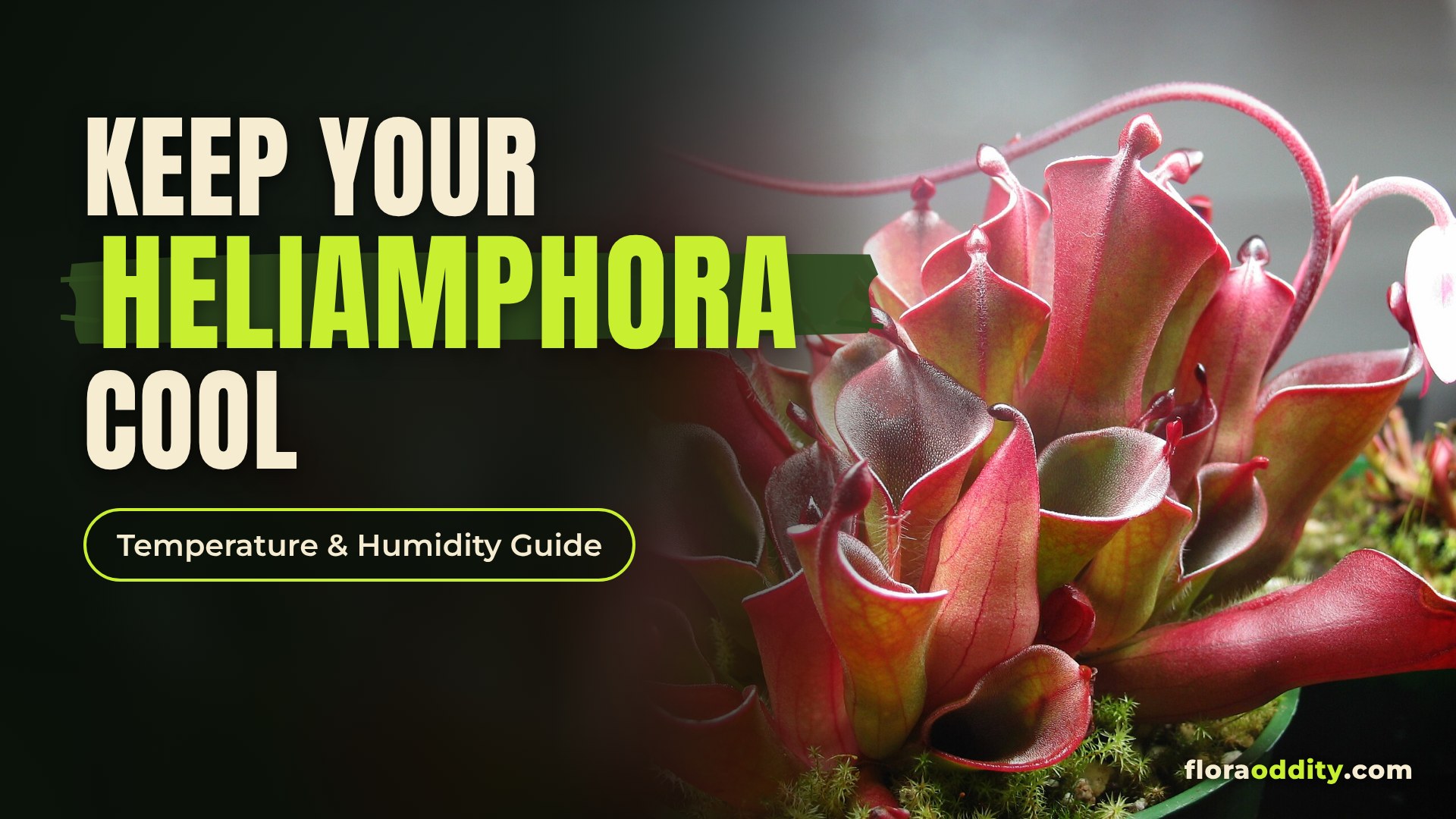
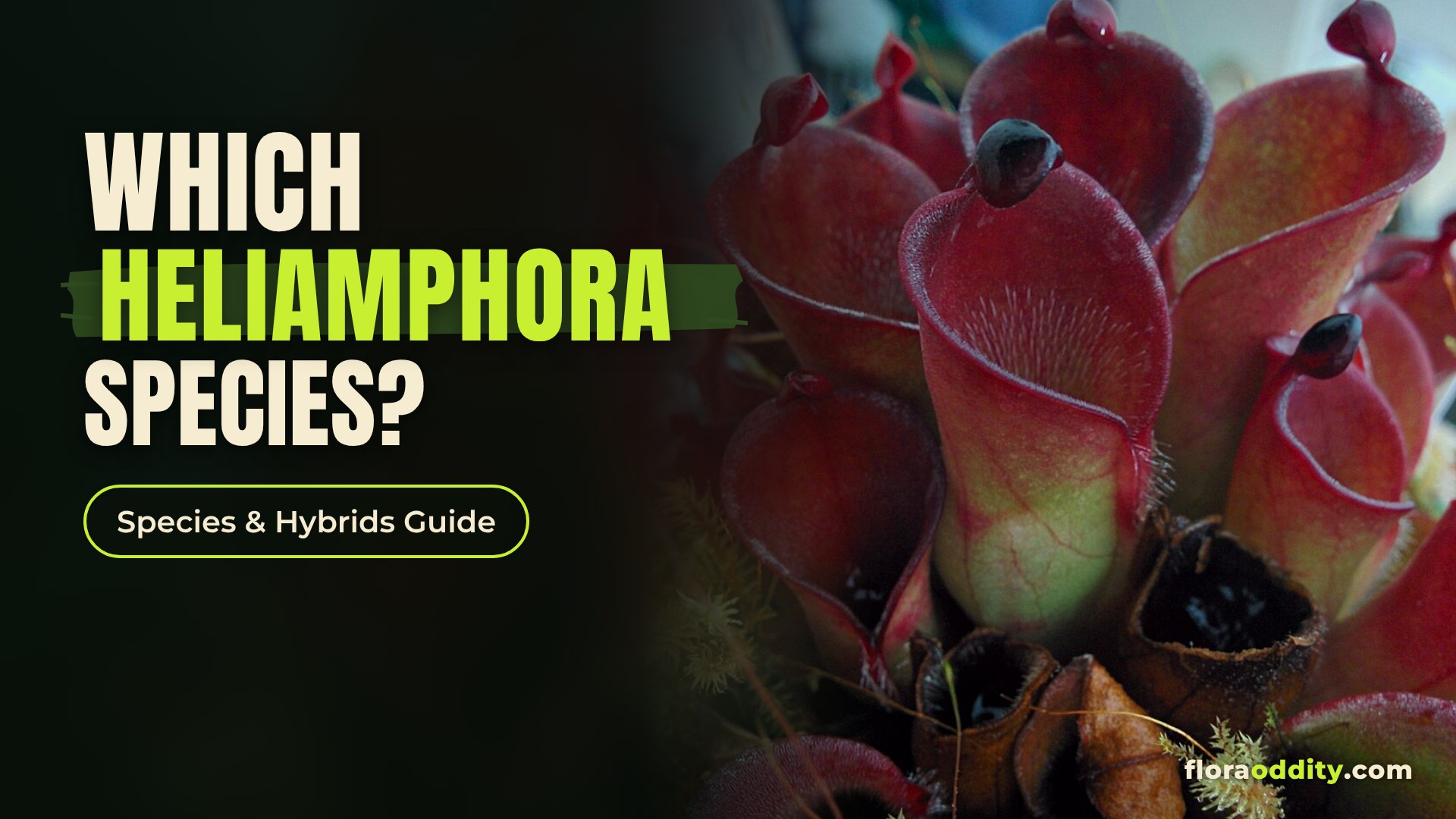
Featured image based on a photo of Heliamphora pulchella by Dals093838 via Wikimedia Commons, CC BY-SA 4.0, with a blurred background and typography added by FloraOddity; the adapted image is offered under the same licence.
Final articles are editorially reviewed and factual claims are checked against cited sources. Last reviewed: October 2026.

One Comment