
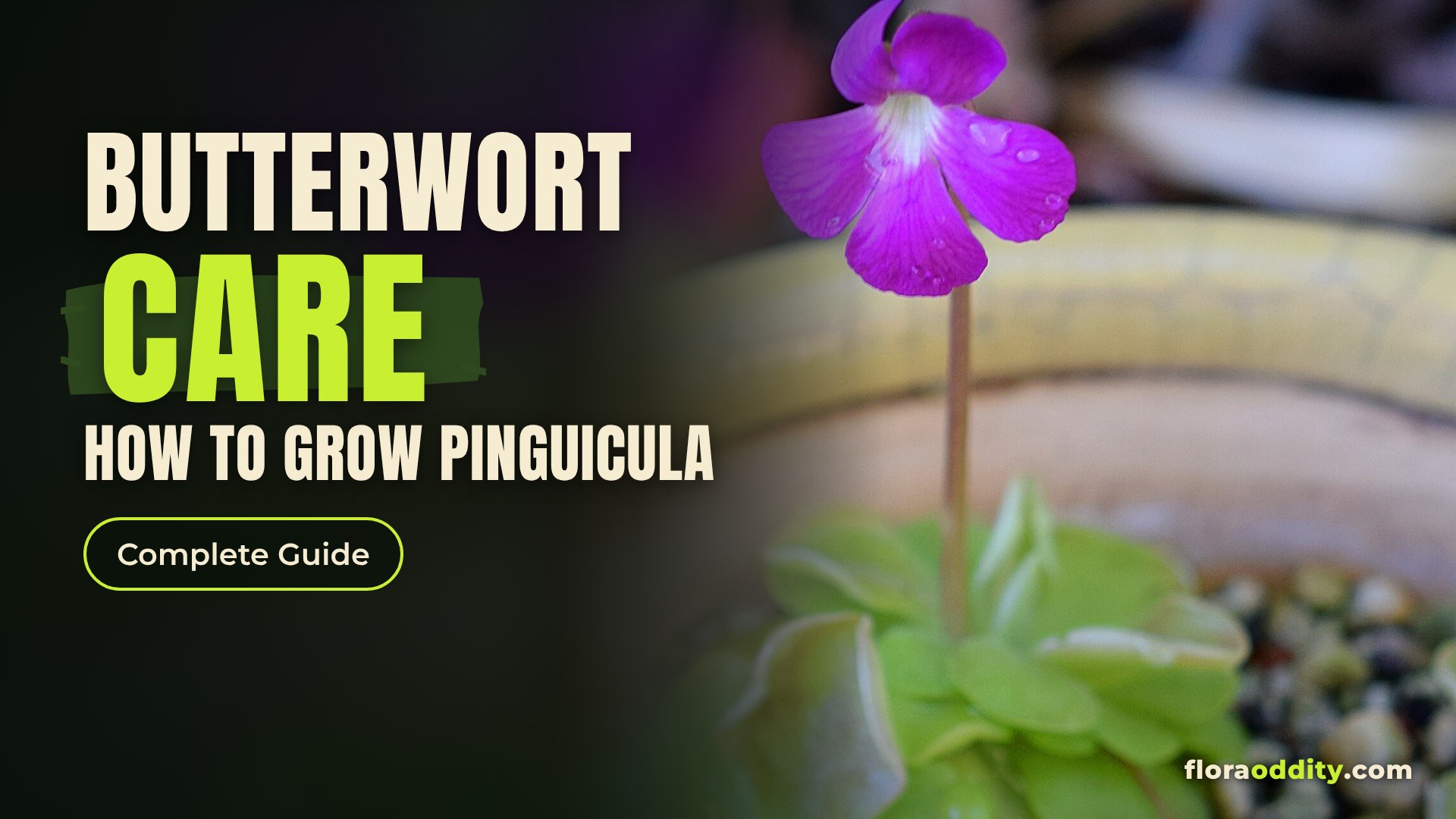
Butterworts do not look like carnivores. Barry Rice, author of the Carnivorous Plant FAQ, calls Pinguicula “a genus of most-uncarnivorous-looking, yet quite carnivorous plants”: flat rosettes of glossy leaves with pretty flowers on tall stalks. NC State Extension explains that the name means “little greasy one,” after the greasy feel of the leaves.
Good butterwort care starts with one question: which kind do you have? The popular Mexican butterworts are, in the words of the International Carnivorous Plant Society (ICPS), “among the easiest carnivorous plants to grow,” but they are not bog plants: Sarracenia Northwest warns that their soil should not stay “continuously saturated like the soil of a Venus flytrap or Sarracenia.” Butterworts from cold climates and the southeastern United States need different handling. This is the first guide in our Butterwort series, covering the main groups and the basics of light, water, soil, winter care, feeding, and common problems.
The Short Answer
Mexican butterworts and their hybrids, which the ICPS says “make excellent house plants,” want a bright windowsill with gentle morning sun, or white LED lights, and a coarse, airy soil mix that drains well. Water them with rain, distilled, or reverse osmosis water, keep the soil “moist, not wet,” as Sarracenia Northwest puts it, and let any water in the tray dry up before adding more. In winter many form a tight rosette of small, non-sticky, succulent leaves; that is normal, and they need less water until the sticky leaves return.
Temperate butterworts such as P. vulgaris and P. grandiflora like wetter soil and form a winter bud, a hibernaculum, that needs real cold. Southeastern US species stay in leaf all year on a wet tray. All of them catch their own gnats, so feeding is optional.

| Need | What to give it | Source |
|---|---|---|
| Light | Bright window with gentle morning sun, or white LEDs about 12 inches (30 cm) above the plants; avoid hot afternoon sun through glass | Sarracenia Northwest, California Carnivores |
| Water quality | Rain, distilled, reverse osmosis or deionized water; ordinary jug filters do not remove enough dissolved salts | California Carnivores |
| Watering, Mexican types | Moist, not wet; a shallow tray, no more than about 1/2 inch (1.3 cm), allowed to dry before refilling | Sarracenia Northwest, ICPS |
| Watering, temperate and southeastern US types | Permanently wet on a tray of about 1/2 to 1 inch (1.25 to 2.5 cm) in the growing season | California Carnivores, Carnivorous Plant Nursery |
| Soil, Mexican types | Coarse and airy: peat with plenty of perlite, often with sand and a little dolomite or limestone | Sarracenia Northwest, ICPS, Carnivorous Plant Nursery |
| Soil, temperate types | Acid mix of peat with sand and perlite | ICPS, California Carnivores |
| Temperature | Mexican types: mild room temperatures, no prolonged heat; temperate types: a cold winter | Sarracenia Northwest, ICPS |
| Humidity | Normal household humidity is usually enough; stagnant, humid air with wet soil invites rot | Sarracenia Northwest |
| Winter | Mexican types: small succulent leaves, water less; temperate types: hibernacula, kept cold | California Carnivores, Barry Rice |
| Feeding | Optional; they catch gnats and fruit flies on their own | Sarracenia Northwest, Carnivorous Plant Nursery |
| Fungus gnats | A thin top layer of coarse horticultural sand; drier soil | ICPS, Sarracenia Northwest |
How the Sticky Leaves Trap Prey
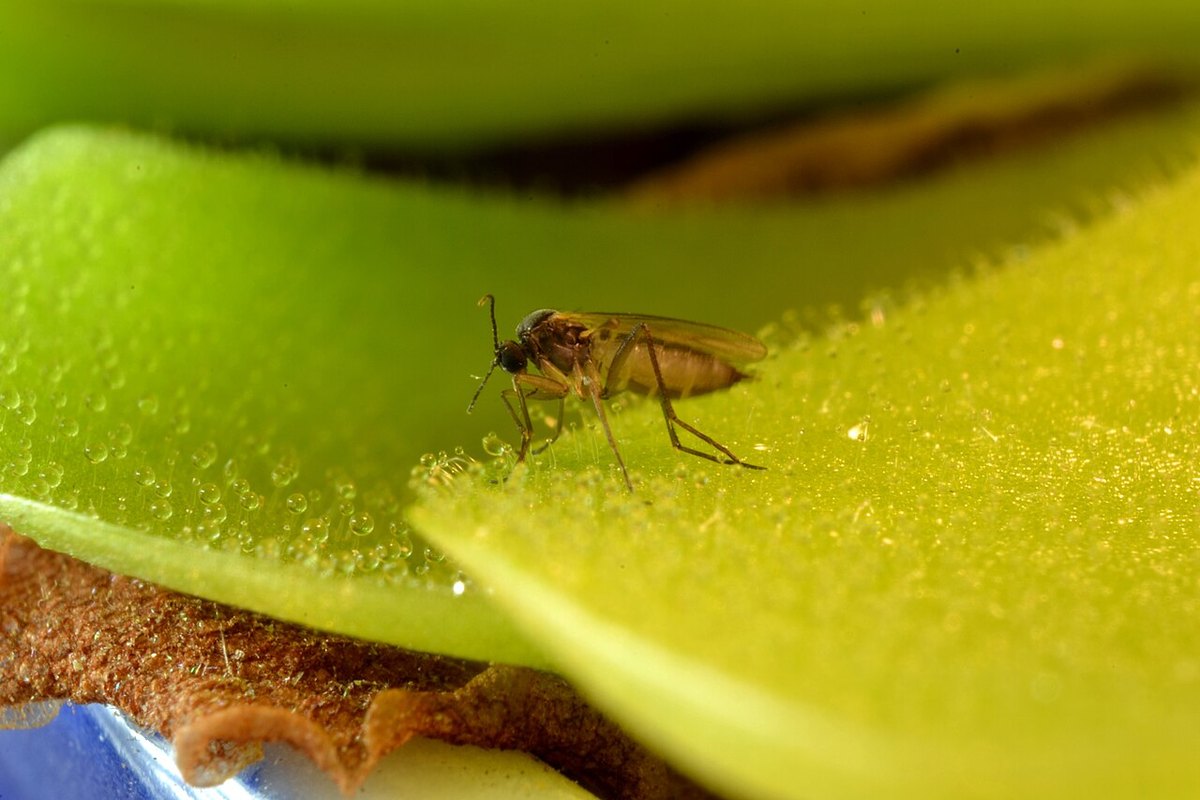
The ICPS describes the butterwort as the simplest kind of carnivorous trap, a flypaper. The leaves carry “specialized short stalked glands that secrete a sticky mucilage that traps small creatures,” and because the glands sit on stalks, the leaf “doesn’t smother in slime while it waits for a prey.” Rice adds that the leaves give off a faint fungal scent that gnats find “irresistible.”
Rice explains that each stalked gland sits on a reservoir cell of digestive enzymes, which empties over the insect when stimulated; too slow to help with the catch, but it improves digestion. Flat, sessile glands release more enzyme-rich fluid and may do most of the work, and their reservoir cells do not recharge.
Unlike sundew tentacles (see our sundew care guide), the leaves do not wrap around prey; NC State says simply that “the leaves do not move.” Rice notes two small exceptions: the leaf often dimples under a catch, and the edges, especially on temperate species, roll upward. On P. cyclosecta, the ICPS says upturned edges “keep the digestive juices from flowing off the edge of the leaves.” Rice has seen wild plants covered with flies nearly 0.4 inch (1 cm) long.
Pollinators stay safe, Rice suggests, because the colourful flowers stand on tall stalks while the musty-smelling leaves sit close to the ground.
Which Butterwort Do You Have?
NC State puts the genus at about 130 species. Rice names four centres of diversity: Mexico, Cuba, the southeastern United States, and northern Europe. For growing purposes, the ICPS splits the cultivated plants into Mexican, warm temperate and cold temperate groups, each with its own care guide.
Mexican butterworts (summer sticky, winter succulent)
Sarracenia Northwest says most tropical Pinguicula in cultivation come from Mexico, and nurseries often sell them as tropical butterworts. The ICPS counts 55 to 65 species in the Central American and Caribbean subgenus, many growing “in seasonal fog forests on limestone cliffs and tree trunks.” Rosettes range from more than 6 inches (15 cm) across to barely an inch (2.5 cm), according to Sarracenia Northwest.
Most are heterophyllous, which simply means “different leaves.” The ICPS explains that “the summer leaves are slimy and carnivorous; the winter leaves are succulent and not carnivorous.” Rice says P. moranensis, the most widespread species, can pull in so tightly in winter that it “looks more like a species of Sempervivum than anything carnivorous,” while P. agnata and P. gigantea barely change. The ICPS calls P. agnata “an easy to grow species” and P. gigantea “a great window sill plant.”
Rice says hybrids are “often highly vigorous, and are more forgiving of cultivation cock-ups.” His examples include ‘Pirouette’ (P. agnata × (P. moranensis × P. ehlersiae)), ‘Gina’ (P. moranensis × P. agnata), ‘Aphrodite’ (P. agnata × P. moctezumae), and ‘Weser’.
Temperate butterworts (winter hibernacula)
The ICPS groups P. vulgaris, P. macroceras, P. grandiflora and others as cold temperate butterworts, found across the northern hemisphere where winters are cold. “At the beginning of autumn these species form winter buds so the plants can survive being frozen.” Rice describes these hibernacula as “tight little resting buds that look like small heads of garlic.” He finds the group “somewhat challenging to grow,” because its winter rest must be respected, but calls P. grandiflora, with its large spring flowers, “one of the easier to maintain in cultivation.”
Southeastern US butterworts (in leaf all year)
The ICPS calls a third group warm temperate butterworts: P. pumila, P. lutea, P. planifolia, P. primuliflora, P. ionantha and others from warmer parts of the northern hemisphere, plus the annual P. lusitanica. They keep the same type of leaves all year and “don’t have any special adaptations to survive freezing weather,” though Rice says they get a bit smaller in very cold winters.
Rice found P. caerulea “one of the easiest of the temperate-subtropical species to grow”; P. lutea has bright yellow flowers, and P. ionantha, from northwestern Florida, is listed as Threatened under the US Endangered Species Act. The ICPS warns that these are “short lived perennials,” so pollinate the flowers and save seed if you want to keep them.
| Group | Examples | Winter form | How to water |
|---|---|---|---|
| Mexican (tropical) | P. moranensis, P. agnata, P. gigantea, P. laueana; hybrids ‘Pirouette’, ‘Gina’, ‘Aphrodite’ | Small, non-sticky succulent leaves (barely different in P. agnata and P. gigantea) | Moist, not wet; shallow tray allowed to dry; drier in winter |
| Temperate | P. vulgaris, P. grandiflora, P. macroceras, P. alpina | Hibernacula: tight winter buds that need cold | Wet, on a tray, in the growing season |
| Southeastern US (warm temperate) | P. caerulea, P. lutea, P. planifolia, P. primuliflora, P. pumila | In leaf all year, a bit smaller in winter | Wet, on a tray |
Light
For Mexican butterworts, Sarracenia Northwest recommends “several hours of gentle direct sunlight each day,” ideally direct morning sun followed by bright or dappled light, and says an east-facing window is often excellent. Avoid intense afternoon sun in summer, “particularly through glass.” California Carnivores notes that under strong lights many butterworts blush pink or red.
Under lights, Sarracenia Northwest uses white LED shop lights of about 2,500 lumens or more, about 12 inches (30 cm) above the plants, on a timer for about 14 hours a day during active growth; plants that stay “pale, stretched, or unusually green” need more light. The ICPS adds that heterophyllous species need seasonal cues: “Day length is not as important as slowly increasing or decreasing day length,” and plants under an unchanging light period “will essentially get stuck in the non-carnivorous phase.”
Advice for temperate and southeastern species varies. Rice grows his arctic-temperate plants in full sun and the southeastern species “under bright sun” in greenhouses, while Carnivorous Plant Nursery lists partial sun and says the plants “develop their best colors in bright indirect light.”
Water and the Tray Method
Start with pure water. California Carnivores says all carnivorous plants need “a pure, low mineral water,” such as rain, distilled, reverse osmosis, or deionized water, ideally below 160 ppm of total dissolved solids.
How much water depends on the group. Rice says a tray of water suits “nearly all carnivorous plants except Nepenthes, many Pinguicula, and a few oddballs.”
Mexican butterworts. Sarracenia Northwest’s rule is “think moist, not wet.” Water from the top when the surface begins to dry, and do not let the soil dry out completely during active growth. A tray is fine if the water is shallow, “no more than about 1/2 inch,” and allowed to evaporate before you add more. Answering a reader whose Mexican butterwort sat in a water tray, the nursery wrote that the plants “will get root rot if kept like this for long periods. They are not bog plants.” The ICPS grower uses up to about 0.75 inch (2 cm) of water in his trays, but with a heavier soil, and Carnivorous Plant Nursery says the plants “benefit from the water in the tray going dry between waterings.”
Temperate and southeastern US butterworts. These want it wetter. California Carnivores grows them “permanently wet on the tray system, with frequent overhead watering,” and Carnivorous Plant Nursery keeps about 1/2 to 1 inch (1.25 to 2.5 cm) of water in the tray through the growing season.
Skip the mister. In the same reply, Sarracenia Northwest told the reader to stop misting, because most Mexican butterworts “are used to drier air.”
Soil and Pots
To work out how much of each ingredient your pots need, try our soil mix calculator.
Mexican butterworts need a mix that holds moisture but lets air reach the roots. Sarracenia Northwest uses about 1 part sphagnum peat to 2 parts perlite, and says a mix that stays “dense, soggy, or slow to drain” holds too much water. The ICPS uses equal parts peat, coarse sand, and perlite with dolomitic lime, because most Mexican species prefer an alkaline mix, and Carnivorous Plant Nursery uses 2 parts peat to 1 of sand and 1 of perlite with a little limestone. Whatever the recipe, avoid standard potting soil, compost, or mixes with added fertilizer, Sarracenia Northwest warns.
Temperate species prefer acid soil. The ICPS suggests 2 parts peat to 1 each of silica sand, perlite and vermiculite for cold temperate butterworts, and 3 parts peat to 1 of sand and 1 of perlite, or even pure peat, for warm temperate species.
Keep pots small. Sarracenia Northwest says Mexican butterworts have small root systems and do not need deep or oversized pots, and warns against burying the crown: the base of the plant should sit at or just above the soil surface. California Carnivores recommends plastic or glazed ceramic pots with drainage holes. The ICPS repots Mexican butterworts after about five years, when a thatch of old leaves blocks new roots, or sooner if a salt crust forms. Our butterwort soil guide has the full recipes and a step-by-step repot.
Temperature and Humidity
Mexican butterworts like it mild. Carnivorous Plant Nursery describes summers of about 75 to 100 °F (24 to 38 °C) in their habitat, cooling to 45 to 75 °F (7 to 24 °C) in a dry winter, and says most “do quite well at room temperature.” Heat through glass is the bigger risk. Sarracenia Northwest warns that pure species “can also be less forgiving than hybrids,” and describes a P. laueana that declined in a hot window while hybrid butterworts beside it stayed healthy.
Temperate butterworts need the opposite. The ICPS is blunt: “the plant needs cold winter temperatures to survive!” Southeastern species sit in between. California Carnivores says they “tolerate light frost and brief freezes” and do best outdoors where winters are mild, and the ICPS suggests protecting them outdoors during freezing weather.
Humidity matters less than many growers think. “Contrary to popular belief, Pinguicula do not require high ambient humidity,” says Sarracenia Northwest, adding that constant humidity combined with wet soil and poor air circulation “can increase the risk of rot.”
Dormancy
To check what kind of winter rest your butterwort needs, try our dormancy checker.
Mexican butterworts: the winter succulent stage. As days shorten, many stop making sticky leaves and form a tight rosette of small, thick ones. Sarracenia Northwest stresses that this “does not necessarily mean your Pinguicula is dying.” California Carnivores waits until the succulent leaves have formed, then keeps the soil “on the dry side,” and says the size of the winter leaves tells you how dry to go: tight, small rosettes such as P. gypsicola, and bulb-like species such as P. heterophylla and P. macrophylla, “require bone-dry conditions,” while P. agnata and some P. moranensis forms like their soil “just slightly damp.” When carnivorous leaves return, go back to normal watering. Some bloom now: Sarracenia Northwest says P. laueana “will bloom profusely” in its winter phase.
Temperate butterworts: hibernacula. These plants shrink to a tight, leafy bud and need a real cold rest. Carnivorous Plant Nursery says the hibernacula “may be cleaned and stored in damp peat in a refrigerator,” and Rice, who lives in a mild Mediterranean climate, refrigerates his plants until they resume growth. For another carnivore with a cold winter rest, see our Sarracenia care guide.
Southeastern US butterworts: a winter rest. Carnivorous Plant Nursery says these “experience winter rest with smaller leaves, rather than full dormancy,” and should be kept somewhat cooler and drier, with the soil still evenly moist.
Our butterwort dormancy guide covers the winter succulent stage and hibernacula in more detail.
Feeding
For a quick plan, try our carnivorous plant feeding guide: pick your plant and see what to feed, how often and what never to give.
Butterworts usually feed themselves. Sarracenia Northwest says they “do not need to be fed to survive,” and that fungus gnats, fruit flies, and other tiny insects get stuck readily, “so supplemental feeding is usually unnecessary.” If insects are scarce indoors, place a very small insect, such as the wingless fruit flies Carnivorous Plant Nursery suggests, directly on a sticky leaf, not in the centre of the rosette.
Fertilizer is optional and easy to overdo. Rice suggests a foliar spray of orchid fertilizer for the Mexican species, avoiding acid-based fertilizers. The ICPS grower says “Pinguicula can grow almost explosively with light soil fertilization,” but warns that it is easy to over-fertilize the soil and that fertilizer sprayed on the leaves can collect in the crown and kill the plant, and shows over-fertilized plants with burned, “almost dry leaves.”
Flowers
Rice describes butterwort flowers as “often spectacularly pretty,” nodding singly from the top of tall, tender stalks. The ICPS says many hybrids bloom over a longer period than pure species.
In Mexican butterworts the stigma forms a flap over the anthers, so “most if not all Mexican Pinguicula cannot self pollinate”; in the wild, hummingbirds usually do the job. The ICPS describes hand-pollinating with a toothpick. Among the warm temperate species, P. lusitanica self-pollinates and “can become a weed in collections,” while P. pumila needs a small brush and tends “to bloom themselves to death.” Seed of cold temperate species needs 8 to 12 weeks at 14 to 41 °F (minus 10 to 5 °C) to germinate.
Propagation in Brief
Leaf pullings. The ICPS calls leaf pullings “the easiest way to propagate Mexican Pinguicula.” Winter succulent leaves usually work best, taken in spring just before or as the first carnivorous leaves appear. For dormant moranensis-type plants, lift the plant and peel off outer leaves, up to half of them, then lay them on a damp mix of 1 part vermiculite to 2 parts perlite, or on your usual mix in a small lidded container, out of direct sun. Small plants appear in 1 to 2 months. Carnivorous Plant Nursery tears each leaf away “with a small section of the stem still intact,” and finds leaf pulls less reliable for temperate butterworts.
Gemmae. For temperate butterworts, Rice says mature plants produce small daughter hibernacula as they enter dormancy, called gemmae, “an excellent way to propagate the plants.” They are only about a millimetre long, so handle them gently.
Our guide on how to propagate butterworts covers leaf pullings, gemmae, offsets and seed step by step.
Common Problems
Fungus gnats
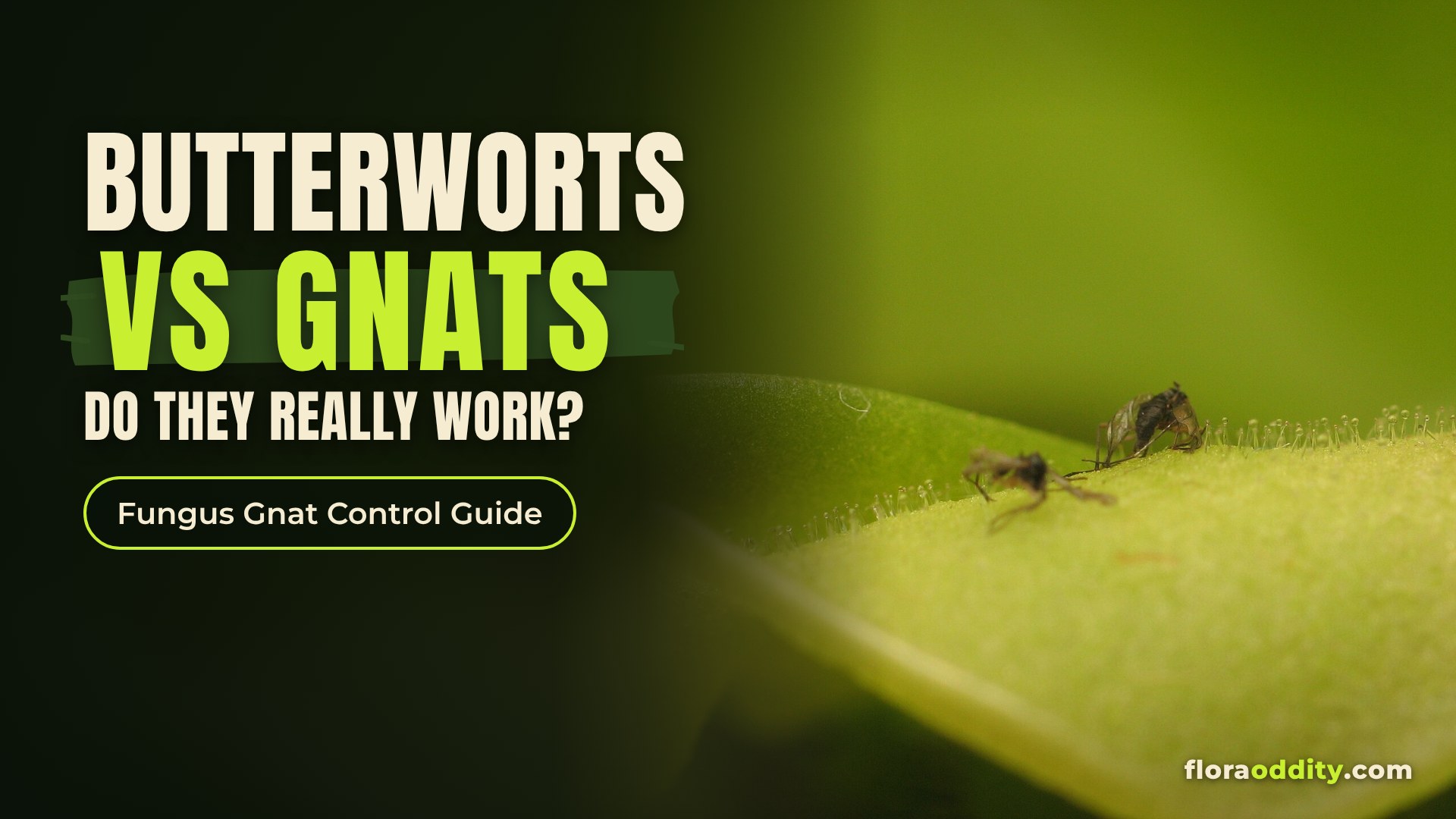
The adult gnats stuck on the leaves are only half the story. The ICPS warns that the larvae “like to eat Pinguicula leaves,” especially leaves touching the soil, damage seedlings, and have been shown to spread pathogenic root fungi. Sarracenia Northwest reads an outbreak as a symptom: “If you have a problem with fungus gnats (or springtails), the soil of your butterwort is too wet.”
The fix is mostly cultural: drier soil and a top layer of sand. The ICPS recommends about 0.2 inch (5 mm) of medium to coarse horticultural sand to stop adults laying eggs, not play sand or builder’s sand, and says Pinguicula “actually seem to do better” with 0.2 to 0.4 inch (5 to 10 mm) of sand on the surface. It says chemical pesticides “are best avoided” unless you are a trained commercial grower. For using butterworts as gnat catchers alongside these steps, see butterworts for fungus gnats.
Rot
Soft, dark, quickly collapsing leaves at the base often mean too much water. Sarracenia Northwest advises letting excess water drain, improving air circulation, watering less often, and checking that the mix is coarse and the crown is not buried. Do not reach for a fungicide. The ICPS is emphatic: “Do NOT ever use any kind of fungicide on Pinguicula,” a warning that includes cinnamon. For a symptom-by-symptom guide, see why is my butterwort dying.
No sticky dew
A butterwort that loses its sticky leaves in autumn may simply be entering its succulent winter stage; look at the new leaves in the centre of the rosette. During active growth, Sarracenia Northwest says a lack of sticky leaves “can also indicate insufficient light.” Under lights, remember the ICPS warning that an unchanging day length can leave heterophyllous plants stuck in the non-carnivorous phase. Our butterwort light guide covers windowsills and grow lights in detail.
Shrinking or not growing
If a Mexican butterwort shrinks outside its winter stage, Sarracenia Northwest suggests checking for excessive heat, inadequate light, or overly wet soil, and warns against responding with more water or food.
Where Sources Differ
Advice on butterworts often conflicts. Rice notes that “sometimes the recommendations of different experts are in direct conflict.” Each row gives only the context the sources themselves state.
| Topic | One view | Another view | Context the sources give |
|---|---|---|---|
| Tray watering, Mexican types | ICPS: pots usually in about 0.4 inch (1 cm) of water from spring to fall, up to about 0.75 inch (2 cm) | Sarracenia Northwest: no more than about 1/2 inch (1.3 cm), allowed to evaporate before refilling; never “sitting in water” | The ICPS grower uses a heavier soil because his pots sit in water, and says greenhouse growers who top water use lighter mixes |
| Soil, Mexican types | Sarracenia Northwest: 1 peat to 2 perlite; ICPS: equal peat, coarse sand and perlite with dolomitic lime | Rice: many growers favour pure vermiculite or vermiculite and perlite; his own 2:1 sand and peat works for some growers, not others | Rice calls it “a large amount of lore”; the ICPS says the mix should match the watering method, temperature and humidity |
| Potting soil | Sarracenia Northwest: never use standard potting soil, compost or mixes with added fertilizer | ICPS leaf pulling guide: prefers pH-balanced potting soil with worm castings plus perlite for young plants | The ICPS writes that Pinguicula appreciate light soil fertilization; Sarracenia Northwest says these products contain nutrients that can damage carnivorous plants |
| Winter dryness, Mexican types | California Carnivores: tight, small rosettes “require bone-dry conditions” | Sarracenia Northwest: water less, but do not leave the plant or soil completely dry for extended periods | California Carnivores ties dryness to the size of the winter leaves; Rice notes that some master growers do not withhold water in winter “and they do just fine” |
| Light schedule | Sarracenia Northwest: about 14 hours a day on a timer during active growth | ICPS: heterophyllous species need slowly changing day length or they get stuck in the non-carnivorous phase | The ICPS says homophyllous species such as P. gigantea tolerate an unchanging light period |
| Fertilizer | Sarracenia Northwest: feeding is optional; no fertilized soil | ICPS: light soil fertilization; Rice: foliar orchid fertilizer for Mexican species | The ICPS warns that over-fertilizing burns the plants and that leaf sprays can collect in the crown |
| Dormancy | NC State: “A dormancy period is necessary to regrow and bloom each spring” | Carnivorous Plant Nursery, tropical butterworts: “Dormancy: No,” a winter “rest” rather than hibernation | NC State’s page features the southeastern species P. caerulea and P. lutea; the nursery’s page is about tropical butterworts from Central America and the Caribbean |
Common Mistakes
- Growing Mexican butterworts like bog plants. Sarracenia Northwest and the ICPS both say they are not bog plants; soggy soil leads to root rot.
- Panicking in winter. A small, non-sticky succulent rosette is a normal seasonal stage, not a dying plant.
- Using tap water or ordinary potting soil. Use low-mineral water and a carnivorous plant mix.
- Misting and closed, airless terrariums. Constant humidity with wet soil and still air encourages rot.
- Using fungicide on rot. The ICPS says fungicides are “death” for Pinguicula, even in the soil.
- Keeping temperate butterworts warm all winter. Hibernacula-forming species need cold winter temperatures to survive.
FAQ: Butterwort Care
Do butterworts get rid of fungus gnats?
They catch adult gnats readily, but the ICPS warns that “where you find adults, usually larvae follow,” and the larvae damage butterwort leaves and seedlings. Drier soil and a layer of coarse sand on top deal with the cause.
Why has my butterwort stopped being sticky?
If it is autumn or winter and the new leaves are small and thick, a Mexican butterwort is probably entering its succulent stage, which Sarracenia Northwest calls normal. During the growing season, it says, a lack of sticky leaves can mean too little light.
Can I grow a butterwort on a windowsill?
Yes, if it is a Mexican type. The ICPS says that “if you can grow African violets you can grow most Mexican Pinguicula,” and Rice lists Mexican butterworts such as P. moranensis among the easily grown plants to try on a windowsill. Choose a window with morning sun and avoid hot afternoon sun through glass.
Do butterworts need to be fed?
No. Sarracenia Northwest says they do not need feeding to survive and usually catch enough small insects on their own. Indoors, an occasional tiny insect placed on a sticky leaf is enough.
The Bottom Line
Butterwort care depends on the group. Mexican butterworts want bright light without heat, pure water, and an airy, fast-draining mix that stays moist but never soggy, with less water in winter while they sit as small succulent rosettes. Temperate butterworts want wet soil and a cold winter rest as hibernacula, and southeastern US species grow on a wet tray all year. Skip fungicides, keep fungus gnats down with drier soil and a sand top layer, and let the leaves do the feeding.
Sources & Further Reading
- International Carnivorous Plant Society: Growing Mexican Pinguicula
- International Carnivorous Plant Society: Growing warm temperate Pinguicula
- International Carnivorous Plant Society: Growing cold temperate Pinguicula
- International Carnivorous Plant Society: Growing Pinguicula alpina
- International Carnivorous Plant Society: Mexican Pinguicula Leaf Pullings
- International Carnivorous Plant Society: Fungus Gnat Larvae
- International Carnivorous Plant Society: Carnivorous Plant Trapping Mechanisms
- Barry Rice, The Carnivorous Plant FAQ: Pinguicula, the butterworts
- Barry Rice, The Carnivorous Plant FAQ: Heterophyllous species of Mexico and Central America
- Barry Rice, The Carnivorous Plant FAQ: Pinguicula of the USA and Canada
- Barry Rice, The Carnivorous Plant FAQ: Temperate and Arctic species
- Barry Rice, The Carnivorous Plant FAQ: Pinguicula hybrids
- Barry Rice, The Carnivorous Plant FAQ: Pinguicula cultivation
- Barry Rice, The Carnivorous Plant FAQ: What can I grow on my windowsill?
- Barry Rice, The Carnivorous Plant FAQ: About water
- Sarracenia Northwest: How to Grow Tropical Butterworts (Pinguicula)
- Sarracenia Northwest: Q/A #20, Spider Mite Web?
- California Carnivores: Butterworts (Pinguicula) Growing Tips
- California Carnivores: General Carnivorous Plant Growing Tips
- Carnivorous Plant Nursery: Growing Tips for Tropical Butterworts
- Carnivorous Plant Nursery: Growing Tips for Temperate Butterworts
- NC State Extension Gardener Plant Toolbox: Pinguicula
Featured image based on a photo of a Mexican butterwort (Pinguicula moranensis) by incidencematrix via Wikimedia Commons, CC BY 2.0, cropped with a dark gradient and typography added by FloraOddity.
Final articles are editorially reviewed and factual claims are checked against cited sources. Last reviewed: October 2026.
6 Comments