
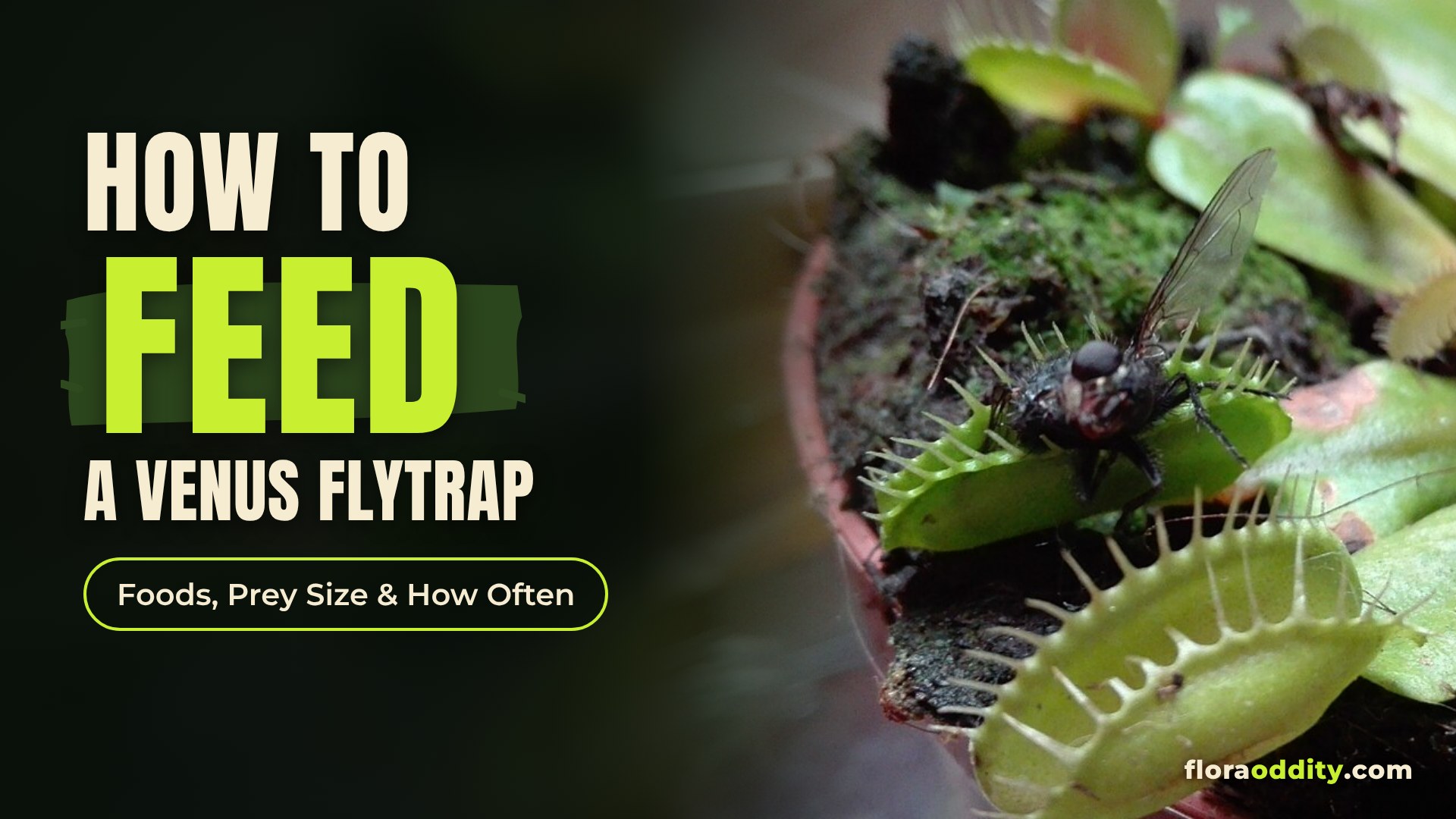
Feeding is the fun part of owning a Venus flytrap, and also where many plants get into trouble. Hamburger, a cricket too big to fit, or a dead fly that never gets digested can all end in a black, rotting trap. Done well, feeding helps an indoor plant grow bigger.
This guide covers whether your plant needs food at all, which foods work, how big a meal should be, how to make a trap digest dead food, how often to feed, and why a trap may blacken after eating. Expert growers do not agree on every detail, so we also show where they differ.
The Short Answer
An outdoor Venus flytrap (Dionaea muscipula) usually catches all the food it needs. Indoors, feed it only if it is not catching prey. Use small insects or rehydrated freeze-dried bloodworms, sized at about 1/3 of the trap. If the food is dead, gently massage the closed trap or tickle its trigger hairs until it seals tightly. Feed one or a few traps at a time, roughly once a week to once a month during the growing season, and never feed meat, cheese, or other human food. Skip feeding while the plant is dormant in winter, and fix light, water, and soil before worrying about food.
Does a Venus Flytrap Need to Be Fed?
A flytrap is a plant first. The U.S. Fish and Wildlife Service (USFWS) explains that its “main source of energy is provided through photosynthesis,” while digesting insects supplies “nutrients that are not readily available in the surrounding environment.”
Outdoors, feeding is rarely needed. California Carnivores says outdoor flytraps “will catch plenty of food and do not need supplementation,” and Peter D’Amato, writing in Carnivorous Plant Newsletter (CPN) in 1998, said that outdoors “feeding them certainly will not be necessary.”
Indoors, the picture changes. The International Carnivorous Plant Society (ICPS) says that if the plant “is not catching its own food, it needs to be fed in the traps.” John Brittnacher, writing in CPN in 2019, calls strong light and regular feeding “the keys to growing VFTs indoors long term.”
Food does not fix poor conditions. Tom’s Carnivores, a UK grower’s blog, says a plant does better with good light, water, and dormancy than “with bits of food being dropped into its traps.” Our Venus flytrap care guide covers those basics.
How a Trap Decides to Eat
NC State Extension says the trap snaps shut when an insect touches “any two of the six tactile hairs” inside it. Closing is only the first step. A 2016 study in Current Biology by Jennifer Böhm and colleagues found that “more than three” further electrical signals are needed before the plant switches on the genes for its digestive enzymes. A trapped insect supplies those signals by struggling; the study describes how “panicking preys repeatedly touch the trigger hairs over the subsequent hours, leading to a hermetically closed trap.”
A dead fly does not struggle. That is why, as Tom’s Carnivores explains, a dead bug dropped into a trap is often rejected, with the trap reopening only hours later.
Closing also has a real cost. A 2010 Annals of Botany study by Andrej Pavlovič and colleagues found that triggering the hairs briefly lowered photosynthesis and raised respiration in the trap. Science News adds that traps “fall off after several closures or partial closures and have to be regrown.”
Feeding a Venus Flytrap at a Glance
Growing other carnivorous plants too? Our feeding guide gives a plan for each one.
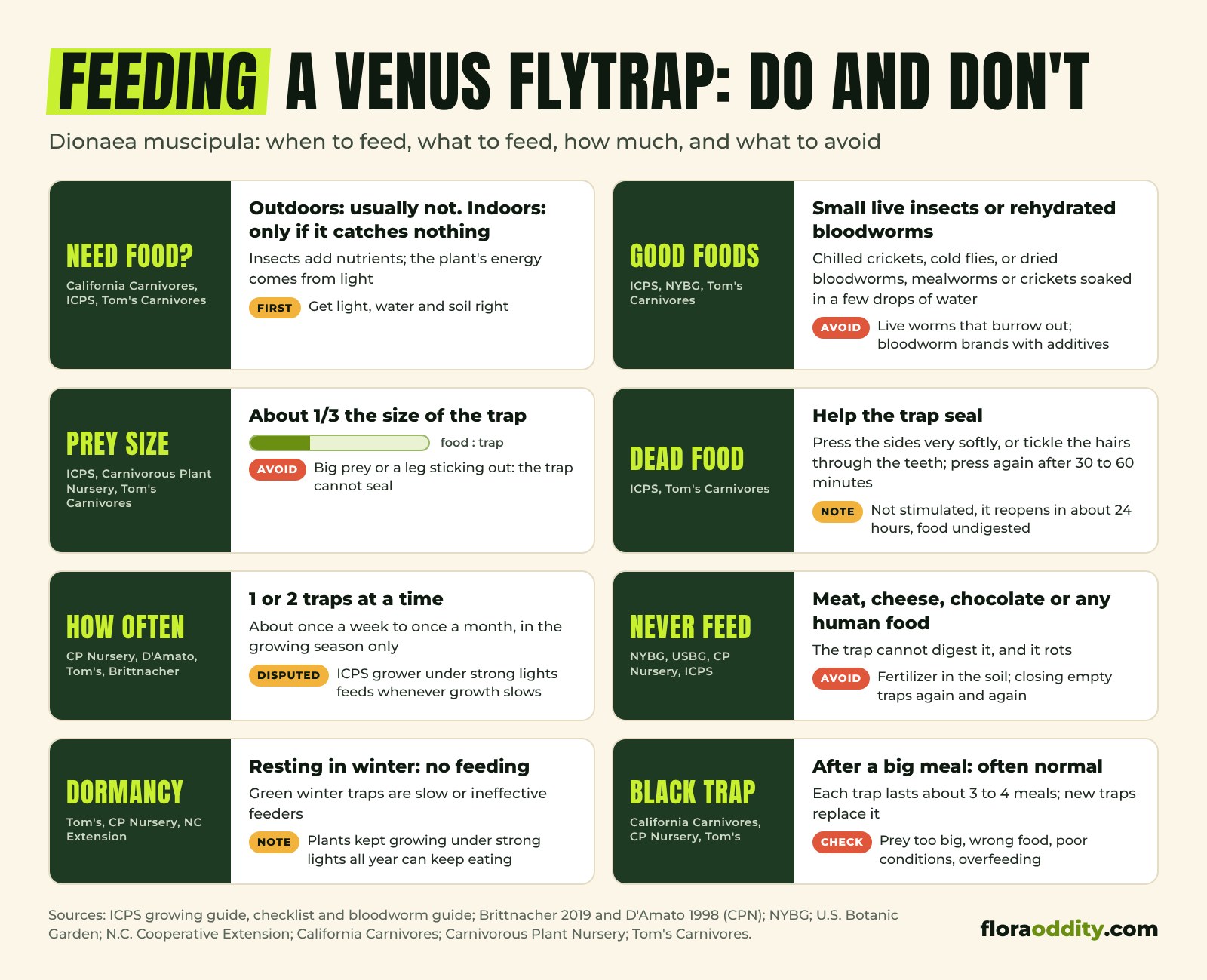
| Question | Do | Avoid or note |
|---|---|---|
| Does it need food? | Outdoors usually not; indoors only if it catches nothing | Fix light, water, and soil first |
| What to feed | Small live insects, or rehydrated bloodworms, mealworms, or crickets | Live worms that burrow out; bloodworms with additives |
| How big | About 1/3 the size of the trap | Big prey or a leg sticking out stops the seal |
| Dead food | Press the trap softly or tickle the hairs until it seals | Without stimulation it reopens in about 24 hours |
| How often | 1 or 2 traps at a time, about weekly to monthly in the growing season | Disputed: some growers feed whenever growth slows |
| Never feed | Insects only | Meat, cheese, chocolate, fertilizer in the soil, empty closures for fun |
| Dormancy | No feeding while resting in winter | Plants kept growing under strong lights can keep eating |
| Black trap | Often normal after a big meal; traps last about 3 to 4 meals | Check prey size, food type, conditions, overfeeding |
What to Feed a Venus Flytrap
Live insects
Live prey does the stimulating for you. The New York Botanical Garden (NYBG) says “crickets work really well” and suggests the smallest ones a pet store sells, chilled in the fridge for 10 to 15 minutes so they are sluggish. The ICPS suggests “cold flies”: catch flies in a jar and refrigerate it for a few hours, because “cold flies can’t fly.” California Carnivores recommends live mealworms.
Live worms come with a catch. The ICPS warns that worms “can eat their way out” of a trap, and Tom’s Carnivores says mealworms “have been known to burrow out of traps.” D’Amato also suggested putting a windowsill plant outdoors for a while to hunt for itself, in shade so it does not burn.
Rehydrated bloodworms
The ICPS calls rehydrated freeze-dried bloodworms “the easiest food to use to feed VFTs.” They are midge larvae sold as fish food. Read the label first: the ICPS bloodworm guide warns that “some DBW brands have additives that can damage your plants,” and says not to buy a product listing anything other than dried bloodworms. The same food works for many other carnivorous plants; see how to feed a Nepenthes for the pitcher plant method.
Dried mealworms, crickets, and fish food
Tom’s Carnivores prefers dried food to live: freeze-dried mealworms, bloodworms, or small dried crickets, rehydrated with a few drops of water.
What about fish food pellets? The ICPS growing guide includes “other kinds of fish food high in insect-derived protein that can be conveniently rehydrated,” alongside bloodworms. No source we read gives a separate method for pellets.
Prey Size: About One Third of the Trap
The ICPS bloodworm guide says to “be sure the piece is about 1/3 size of the trap you want to feed,” and Carnivorous Plant Nursery and Tom’s Carnivores give the same figure.
Too big a meal stops the trap from sealing. Tom’s Carnivores warns that if the insect is too large, “or if a stray leg or antennae is left poking out,” the trap probably cannot seal fully and the leaf will die. The ICPS bloodworm guide adds that an oversized piece “will work, but the trap will die after the digestion.”
How to Feed a Venus Flytrap, Step by Step
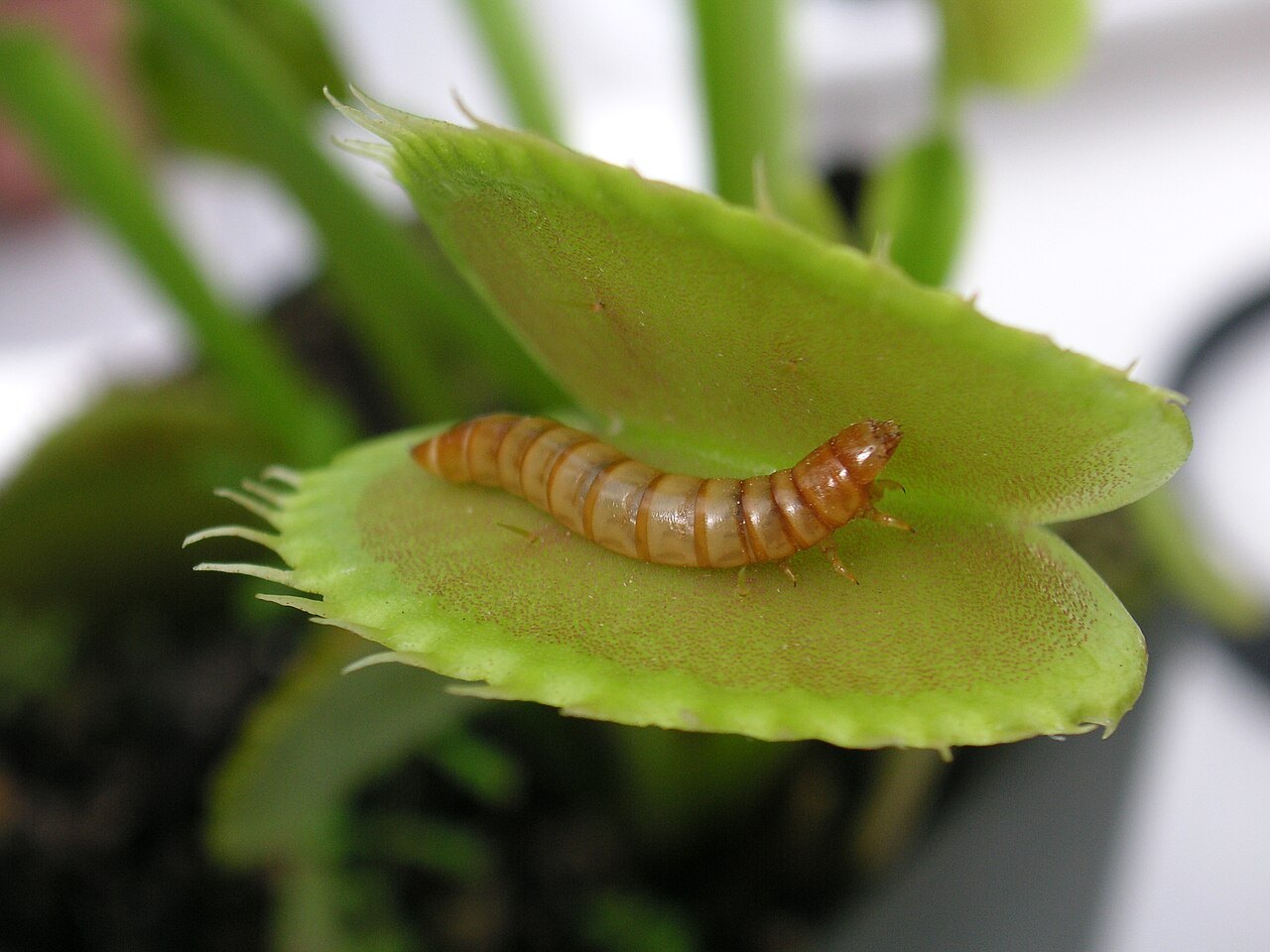
Live food. NYBG says to set the chilled insect in the trap and touch “at least two of the hairs” so it closes. The first closure is loose; the insect’s struggling makes the trap close tighter and seal.
Dead food. The ICPS bloodworm guide describes the method in detail. Put a drop or two of water on a pinch of dried worms (on a dish, not in the pot), blot off the excess, and use a toothpick to lift a piece about 1/3 the size of the trap. Place it in the trap and touch the trigger hairs until it closes. Then use forceps to “press each side of the trap, very softly,” wait 30 minutes to 1 hour, and press again. The ICPS warns that pressing too hard can damage the trap.
Tom’s Carnivores instead touches several trigger hairs through the gaps with a toothpick “every 30 seconds or so” until the teeth close up. Either way, you are imitating a struggling insect. The ICPS says that if you do not stimulate the trap enough, “it will reopen after 24 hours and the DBWs will remain undigested.” If that happens, add a drop of water to re-moisten the food, then trigger and squeeze the trap again.
After the meal. Digestion takes days: Carnivorous Plant Nursery gives 3 to 5, Science News 5 to 12, and the USFWS up to 20 before the trap reopens. You may then see the insect’s empty shell. California Carnivores says it “does not need to be removed,” and NYBG calls removal “more of an aesthetic thing.”
How Often to Feed a Venus Flytrap
There is no single schedule, and the sources range from cautious to generous.
- About once a month. Carnivorous Plant Nursery says flytraps “only need to ‘feed’ about once a month during active growth.” D’Amato suggested “a once-a-month feeding schedule from spring through autumn.”
- About one trap a week. Tom’s Carnivores says “one trap per week is more than enough,” and in another post suggests feeding 3 or 4 large open traps each month of the growing season.
- Whenever growth slows. Brittnacher feeds his indoor plants “when their growth slows down somewhat,” and writes that “the more you feed the plants, the faster they grow and larger they get.” The ICPS checklist says that if the plant stops producing leaves, “feed it as soon as you can.”
Whatever the schedule, feed only a few traps at a time. Tom’s Carnivores warns that if you feed every trap on a plant, “it’s likely that some of the leaves will turn black and die.” Each trap also has only a few meals in it. Carnivorous Plant Nursery says traps work for 3 to 4 feedings “and then naturally die and turn black,” and the ICPS bloodworm guide notes that a healthy trap “can reopen 3 or 4 times.”
What Never to Feed
Meat and human food. NYBG says to “NEVER use beef or chicken or any other animal flesh,” because their proteins and fats “will kill the trap.” The U.S. Botanic Garden says carnivorous plants are “incapable of digesting complex proteins.” Carnivorous Plant Nursery says “do not feed them meat or cheese,” since hamburger “will only sit and rot and possibly kill the trap.” Tom’s Carnivores sums it up: “Bugs only!”
Fertilizer in the soil. NC State Extension says “do not fertilize the plant,” and the ICPS warns: “DO NOT fertilize your plants unless you don’t care if you kill them. Feed them in the traps with Dried Blood Worms.”
Nothing at all. Triggering empty traps for fun costs the plant energy. Carnivorous Plant Nursery says “repeated closures without a feeding may kill the plant,” though “one or two closings to show off the plant are okay.”
Feeding New, Small, or Weak Plants
A newly bought or struggling plant needs good conditions more than a meal. Tom’s Carnivores says that if a flytrap cannot digest food, “your plant might be unhealthy or weak,” and that plants from garden centers or hardware stores are often “exhausted or stressed.” It lists “thin, spindly leaves or traps turning black or yellow” as warning signs.
Be gentle with small plants. Tom’s Carnivores says to avoid feeding more than one trap per week, “especially on small plants,” and to cut mealworms down for seedlings. For seedlings, the ICPS bloodworm guide suggests feeding “once a week, 1 or 2 traps on each seedling,” which it says will “dramatically increase the growing speed.”
If a plant refuses food, look at the roots. Brittnacher writes that salty soil can kill the roots so that “the new traps turn black before they open,” and advises repotting in fresh soil “as soon as possible if the plant will not eat.”
Do Not Feed During Dormancy
Outdoor and windowsill plants rest in winter, and they do not need food then. Tom’s Carnivores states that “Venus flytraps do not require feeding during winter,” and Carnivorous Plant Nursery says traps that stay green in winter “will be slow or ineffective feeders.”
The exception is a plant kept growing under strong lights all year. N.C. Cooperative Extension says growers using dedicated grow lights can skip dormancy if they keep strong light “14+ hours daily” and “feed the plant regularly,” and Brittnacher keeps feeding his indoor plants through winter because they never go dormant.
When a Trap Turns Black After a Meal
A trap that blackens after eating is common and usually not a crisis. California Carnivores says “traps often die back after a big meal; new ones will grow, and the plant benefits greatly from the nutrients.” The ICPS checklist reminds growers that “individual leaves only last a few months.”
Tom’s Carnivores lists the usual causes when blackening goes beyond that:
- Unsuitable food. Meat, sausage, or chocolate is “a guaranteed way to cause the trap to rot.”
- Prey too big, or a leg left sticking out, so the trap cannot seal.
- Poor growing conditions, which can make traps blacken “every time they’re fed.”
- Overfeeding or triggering traps for fun.
- Old age, if the trap had already eaten several times.
After overfeeding, Tom’s Carnivores suggests you “hold off from feeding for a month or two.” If new traps blacken before they open, Brittnacher points to the soil and a repot.
Where Sources Differ
Growers disagree on several feeding questions, usually because they grow in different conditions.
| Topic | One view | Another view |
|---|---|---|
| How often | Carnivorous Plant Nursery and D’Amato (CPN 1998): about once a month in the growing season | Brittnacher (ICPS, CPN 2019): feed whenever growth slows; more food means faster growth |
| Live or dead food | California Carnivores: use live prey; inert food often makes traps reopen too soon | ICPS and Tom’s Carnivores: rehydrated dried food works well if you stimulate the trap |
| Fertilizer | California Carnivores: optional monthly foliar feed of dilute MaxSea on the leaves | ICPS and NC State Extension: do not fertilize; feed the traps instead |
| Triggering empty traps | ICPS checklist: “It is OK to trigger the leaves as often as you want” | Carnivorous Plant Nursery: repeated empty closures “may kill the plant” |
How to read these:
- Frequency. Brittnacher’s generous feeding is for plants he grows under strong LED light and propagates, so they are growing nonstop; he writes that he keeps feeding them “because they are plants I am propagating.” The monthly schedules come from growers writing for ordinary home plants.
- Fertilizer. California Carnivores applies it to the leaves only, never the soil, while the ICPS calls fertilizing “tricky to do safely” and points growers to feeding the traps instead.
- Triggering. The ICPS checklist is telling beginners that “VFT’s are not fragile plants so don’t be afraid of hurting it.” The energy studies explain why repeated empty closures still cost the plant something.
FAQ: Feeding a Venus Flytrap
Can I feed my Venus flytrap a dead fly?
Yes, if you help it. After the trap closes, gently press its sides or touch the trigger hairs through the teeth until it seals. Without that, the ICPS says the trap will reopen within about 24 hours with the food undigested.
What happens if I never feed my Venus flytrap?
Outdoors it will feed itself. Indoors, a plant that catches nothing will slowly weaken: the ICPS says that if you stop feeding them “they will decline,” and D’Amato described plants growing weaker year after year without insect food.
Can I feed my Venus flytrap hamburger or other meat?
No. NYBG says animal flesh will kill the trap, and the U.S. Botanic Garden says carnivorous plants cannot digest its complex proteins. Feed insects or bloodworms only.
The Bottom Line
An outdoor Venus flytrap feeds itself; an indoor one may need your help, but only after it has bright light, pure water, and the right soil. Feed small insects or rehydrated bloodworms about 1/3 the size of the trap, help dead food along by massaging the trap until it seals, and keep it modest: a trap or two at a time, roughly weekly to monthly in the growing season. Never feed meat, cheese, or fertilizer, skip feeding during winter dormancy, and do not worry when a well-fed trap turns black. New traps will replace it.
Sources & Further Reading
- International Carnivorous Plant Society: Growing Dionaea muscipula
- International Carnivorous Plant Society: Checklist for Growing Dionaea muscipula
- International Carnivorous Plant Society: Feeding Dried Blood Worms Step-by-Step
- Brittnacher, J. (2019). Grow Venus flytraps indoors. Carnivorous Plant Newsletter 48(4): 178 to 182
- D’Amato, P. (1998). The Savage Garden: Feeding your plants. Carnivorous Plant Newsletter 27(1): 4 to 5
- Böhm, J. et al. (2016). The Venus flytrap Dionaea muscipula counts prey-induced action potentials to induce sodium uptake. Current Biology 26(3): 286 to 295
- Pavlovič, A., Demko, V. and Hudák, J. (2010). Trap closure and prey retention in Venus flytrap (Dionaea muscipula) temporarily reduces photosynthesis and stimulates respiration. Annals of Botany 105(1): 37 to 44
- Science News: To catch a meal, a Venus flytrap counts to five
- U.S. Fish and Wildlife Service: Venus flytrap
- NC State Extension Gardener Plant Toolbox: Dionaea muscipula
- N.C. Cooperative Extension, New Hanover County Center: Venus Flytrap Dormancy
- New York Botanical Garden: Advice on growing and caring for a Venus flytrap
- U.S. Botanic Garden: Cultivating Carnivorous Plants
- California Carnivores: Venus Flytrap Care
- California Carnivores: Venus Flytrap Growing Tips
- Carnivorous Plant Nursery: Growing Tips for Venus Flytraps
- Tom’s Carnivores: What should I feed my Venus flytrap?
- Tom’s Carnivores: Can I feed my Venus flytrap dead bugs?
- Tom’s Carnivores: Why is my Venus flytrap turning black or yellow?
- Tom’s Carnivores: What is winter dormancy?
Featured image based on a photo of a Venus flytrap during a meal by AleksanderSandi via Wikimedia Commons, CC BY-SA 4.0, cropped and darkened with typography added by FloraOddity; the featured image is shared under the same license.
Final articles are editorially reviewed and factual claims are checked against cited sources. Last reviewed: October 2026.
5 Comments