
Sooner or later, most Nepenthes growers end up with a plant that has outgrown its spot. The vine climbs, the lower stem goes bare, and the newest pitchers hang somewhere near the ceiling. The good news is that this long, awkward stem is exactly what you need to make new plants. Nepenthes are propagated from stem cuttings by hobbyists and small nurseries alike, and the method is simpler than it looks.
The catch is patience. A cutting can root in a month, or it can sit there, green and apparently doing nothing, for most of a year. This guide explains where to cut, which kind of cutting to take, how to plant it so it has the best chance, and how to tell whether it is working.
The Short Answer
Cut a healthy, green section of stem that includes at least one node, using a new razor blade, ideally with the stem held under water. Remove the lowest leaf, plant the cutting so at least one growth bud sits below the surface of a damp, airy medium such as long-fiber sphagnum moss or a 50:50 mix of sphagnum and perlite, then seal it in a clear plastic bag in bright light out of direct sun. The International Carnivorous Plant Society (ICPS) says rooting can take anywhere from one month to a year. Leave the bag closed until you see new growth, then open it gradually.
How a Nepenthes Cutting Becomes a New Plant
Knowing what is happening inside the stem makes every later step easier to understand.
Nodes and the hidden growth bud
A node is the point where a leaf joins the stem. According to the ICPS guide to Nepenthes stem cuttings, each node carries a growth bud a few millimeters above the spot where the leaf attaches. That bud is what will eventually produce a new shoot, so every cutting needs at least one node or the growing tip. A piece of stem with no node has nothing to grow from.
Why roots form at the cut, not at the node
It is easy to assume roots will appear at the nodes, but the ICPS notes that Nepenthes roots form at the bottom cut, not at the leaf nodes. This is why the condition of the cut end matters so much, and why some growers split it to give roots more surface to form on (more on that below).
Green stems vs woody stems
Barry Rice’s Carnivorous Plant FAQ recommends using green stems and notes that woody, brown stems have a lower success rate. If the only material you have is older and tougher, the ICPS suggests taking longer cuttings from those sections, which we cover in the next part.
When to Take Cuttings
You do not need to wait for a particular season. The ICPS says cuttings can be taken at any time of year, but cuttings from a parent plant that is actively growing tend to root faster and more reliably. In other words, the health of the parent matters more than the date on the calendar. The same guide warns that temperatures that are too hot or too cold for the plant can stop cuttings from rooting, so take cuttings when the plant is in conditions it handles well. If you are not sure what those are for your plant, our guide to Nepenthes temperature for highland and lowland types explains the differences.
Where to Cut Your Plant
Where you cut depends on what you want: one new plant, as many plants as possible, or a tidier parent.
- One new plant. Take the growing tip with about 2 to 3 leaves. The ICPS notes that the parent usually sprouts again near the cut within a few months, as long as some green leaves remain on the stem.
- As many plants as possible. Remove the whole climbing stem and cut it into sections, leaving the parent with only its basal rosette (the cluster of leaves at the base).
- A parent with no basal rosette yet. You have two options from the ICPS guide. Either cut now and leave at least 4 green leaves on the remaining stem, or lay the pot on its side so the long stem grows horizontally or hangs down. A new rosette should appear within a few months, and you can take cuttings after that.
Cutting a basal rosette (for advanced growers)
Some Nepenthes form a compact rosette and rarely produce a long stem. These can still be propagated, but the ICPS describes it as delicate work. The growing point and leaves are packed into about 1 inch (2.5 cm) or less, and there is often only one rosette, so the parent is at risk. The method is to cut through the rosette below the fourth leaf from the tip with a razor or scalpel, so the cutting is roughly 0.4 inch (1 cm) long with one or two leaves. It is planted 0.2 to 0.4 inch (0.5 to 1 cm) deep in sphagnum, held in place with a small U-shaped piece of wire, and sealed in a bag. Expect the parent to be set back by six months to a year, so this is not a method for your only plant of a variety unless it is already in trouble.
Which Cutting Should You Take?
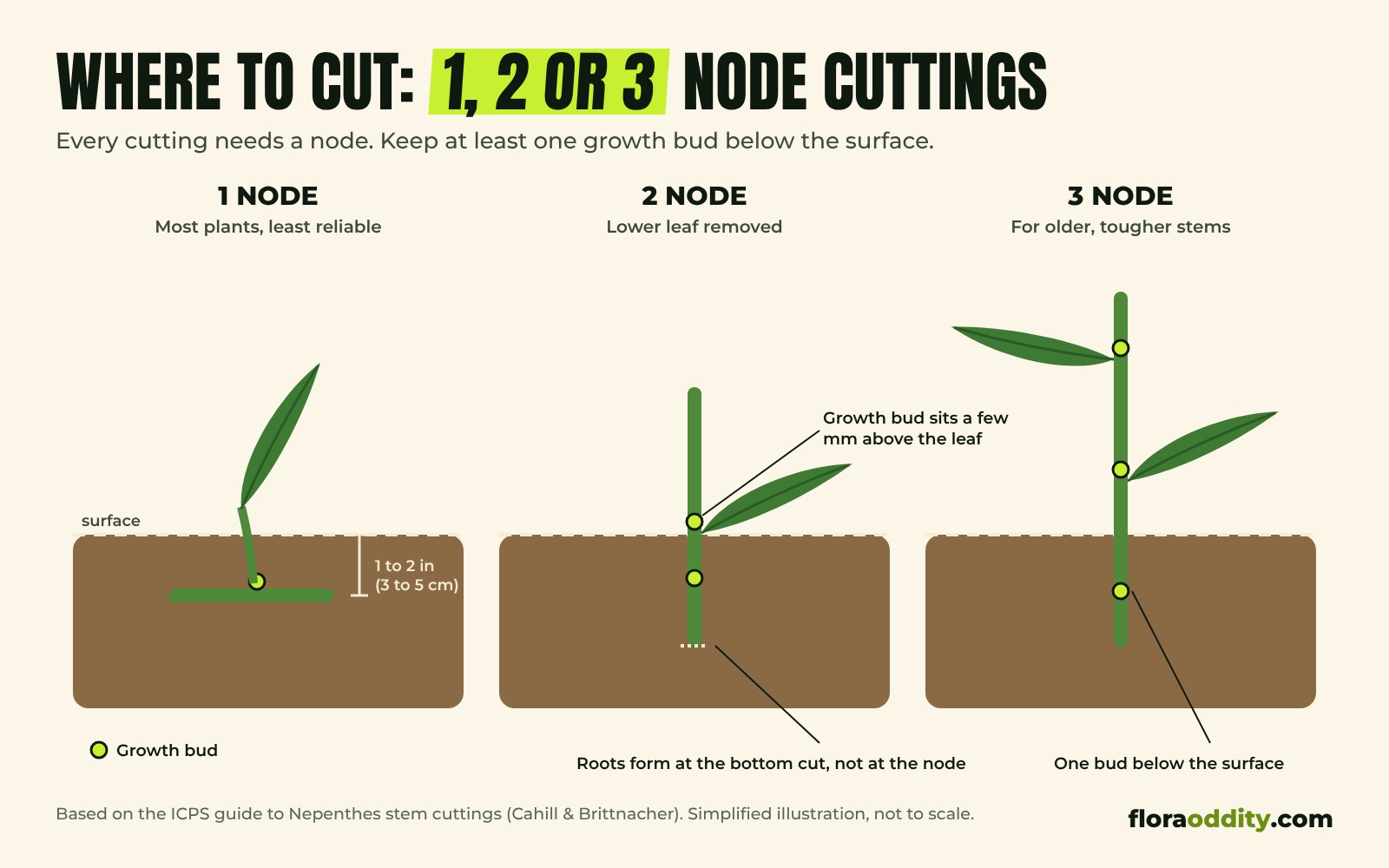
Once you have a section of stem, you can divide it into cuttings with one, two, or three nodes. The ICPS describes all three, and each suits a different situation.
| Cutting | Best for | How to plant it | Reliability |
|---|---|---|---|
| 1 node | Easy species, or fresh growth just below the tip | Short pieces lie flat with the leaf up, buried 1 to 2 inches (3 to 5 cm); longer pieces go in upright | Least reliable, but gives the most plants |
| 2 node | Most stems | Remove the lower leaf; lower node below the surface, upper node and leaf at the surface | More successful than 1 node cuttings |
| 3 node | Older, less vigorous stem sections | Remove the bottom leaf; one node below the surface, two leaves above | Recommended for tougher material |
| Growing tip | One new plant from the top of the vine | Tip with 2 to 3 leaves, at least one bud below the surface | Parent resprouts if green leaves remain |
The rule that matters for every type: make sure at least one growth bud ends up below the surface of the medium. The ICPS explains that a bud below the surface lets the cutting sprout again if the top is damaged and helps it form a basal rosette. In their experience, cuttings planted with buds about 2 inches (5 cm) above the surface formed rosettes in mid air, which looked odd and were easy to break.
What You Need
- A new single-edged razor blade. The ICPS recommends a fresh blade because a sharp edge cuts cleanly instead of crushing the stem. If you are making many cuttings, change blades often.
- A bowl of water to make the cut under water (see the steps below).
- A rooting medium that is loose, airy, and low in nutrients. The ICPS lists long-fiber sphagnum moss, a 50:50 mix of sphagnum and perlite, or a 50:50 mix of coir and perlite. If you use coir, it should be rain-leached; the ICPS suggests looking for packaging that says it was exposed to rain water for at least three monsoon seasons. Carnivero, a carnivorous plant nursery, uses 2 parts perlite to 1 part sphagnum for its Nepenthes cuttings. Our guide to the best potting mix for Nepenthes explains why these ingredients work.
- Small pots.
- Clear plastic bags or another cover, such as a clear container or cloche.
- Labels and a pen.
One warning from the ICPS: the “sheet moss” sold for lining hanging baskets is not sphagnum, whatever the label says. Make sure you are buying real sphagnum moss.
Step by Step: Taking and Planting a Nepenthes Cutting
1. Prepare the medium first
Moisten your medium before you cut, so the cuttings can go straight in. It should be damp but never soggy or standing in water. Use rainwater or distilled water, just as you would for the parent plant; our guide on how to water a Nepenthes indoors covers water quality.
2. Cut under water
This is the step most guides skip, and two of the most respected sources agree on it. The ICPS recommends making the cut under water to stop air from blocking water uptake in the stem’s veins. Barry Rice reports that in his own experiments, making stem cuttings under water significantly improved rooting success, and he suspects it prevents cavitation, which is air entering the water-conducting tissue of the stem.
In practice, submerge the section of stem in a bowl of water and make your cut there. Make sure each cutting includes a node, and cut high enough above the node below to keep the growth bud, which sits a few millimeters above the leaf.
3. Trim leaves and remove pitchers
Remove the lowest leaf on 2 and 3 node cuttings, as described in the table above. The sources differ on what to do with the leaves that stay. Barry Rice suggests trimming each leaf to about one third of its full size. The ICPS notes that cutting leaves in half reduces water loss, but says it is unnecessary if the cutting will be sealed in a bag with high humidity. If you are bagging your cuttings, trimming is optional; if you cannot keep the humidity high, trim.
Pitchers can stay on, but the ICPS author usually removes them because they make bagging awkward.
4. Optional: split the base of the stem
Because roots form at the bottom cut, you can give them more room to form. The ICPS describes splitting the cut end of the stem about 0.4 inch (10 mm) upward, under water, then tucking a small piece of sphagnum into the split to hold it open. Always keep the blade pointed away from your body when you do this.
5. Plant with a bud below the surface
Plant each cutting according to its type, with at least one growth bud below the surface. Barry Rice’s general guideline is to bury the bottom half of the cutting.
6. Bag, label, and place in bright, indirect light
Label each cutting with the plant name and the date. Then seal the pot in a clear plastic bag so the cutting does not dry out. The ICPS recommends bright light out of direct sun. If you want to know what counts as bright light for a Nepenthes, our guide on how much light a Nepenthes needs explains how to judge it.
Rooting Hormone: Why the Sources Disagree
Rooting hormone is where the sources disagree most clearly. It helps to look at the context behind each one.
- The ICPS guide says the author does not find hormone helpful and that too strong a dose can actually prevent roots. A callus forming at the cut without any roots is a sign the hormone was too strong. If you do use it, the ICPS advises never dipping cuttings into the jar. Pour a small amount onto paper or apply it with a brush, and for liquid products use the rate recommended for softwood cuttings.
- Barry Rice writes that rooting hormone may help, but says he is not sure.
- Carnivero treats hormone as optional and says it can raise success rates.
- A 2025 study by Ryan Budi Setiawan in Jurnal Agronomi Indonesia tested the hormone IBA at five concentrations, from 0 to 20 mg per liter, on cuttings of Nepenthes reinwardtiana. It found no significant effect of IBA on any of the growth measures recorded.
The practical takeaway is that hormone is not required. Healthy material, a clean cut, and stable humidity matter more. If you want to try it, use very little, and treat a callus with no roots as a sign to use less next time.
Can You Root Nepenthes Cuttings in Water?
Yes, some growers do, but the results depend heavily on the plant.
The usual method is to stand the cutting with its lowest node under rainwater or distilled water in a warm, bright spot, sometimes covered with a bag for humidity, and to change the water regularly. Homes & Gardens suggests moving the cutting into sphagnum once it has about six roots, each 1 to 2 inches long. Carnivorous Plant Nursery also lists rooting in water as an option for Nepenthes cuttings.
On the other side, Barry Rice says he is unsure whether rooting in pure water helps. A small 2016 trial at Universiti Malaysia Sarawak, an unpublished undergraduate project on N. ampullaria, N. gracilis, and N. mirabilis, recorded 0% rooting for the cuttings placed in water. Cuttings with their leaves kept on did best in that trial, at 21.7% in sand. It was one small study under one set of conditions, so it is not proof that water never works, but it is a useful reality check.
Grower experience fills in some of the gap. In a TerraForums discussion, one grower reported rooting vigorous plants such as N. ventricosa and N. x ventrata in water, but found that more demanding species, such as N. hamata, preferred a solid medium. That is a single grower’s experience, but it fits a pattern: water rooting seems most worth trying with vigorous hybrids. For anything rare or slow, a bagged cutting in sphagnum is the safer choice.
What About Air Layering?
Air layering means encouraging roots to form on a stem while it is still attached to the parent, then cutting it off once it has roots. Carnivorous Plant Nursery mentions air layering as a way to propagate Nepenthes, and a TerraForums tutorial describes the general idea: make an angled cut into a node on a vining stem without cutting through, pack the area with wet long-fiber sphagnum, wrap it in clear plastic, and cut below the roots once they appear.
The honest caveat is that we found very little documented evidence on how well this works for Nepenthes specifically. The tutorial’s author had not yet reported results, and another grower in the thread mentioned reading about poor success. The Missouri Botanical Garden says air layers on indoor plants in general need the moss kept moist for four to sixteen weeks while roots form, but that guidance covers common houseplants, not pitcher plants. Air layering is an interesting experiment if you have a long vine to spare, but standard cuttings are the better documented method.
How Long Do Nepenthes Cuttings Take to Root?
Expect a wide range. Barry Rice says roots usually form within about a month, although some stubborn species take several months. Carnivero says its Nepenthes cuttings typically stay covered for about two months until roots develop. The ICPS gives the widest window: from one month to a year, depending on the vigor of the parent, the species, and the conditions.
The ICPS also gives a simple rule for deciding whether to keep waiting: as long as a cutting’s leaves stay green, it still has a chance. Some species are simply slow.
Signs that a cutting is working:
- The leaves stay green and firm.
- A new leaf or shoot appears from a bud, which is the signal the ICPS uses for when to start opening the bag.
- Older parts of the cutting may turn yellow and then brown. In Sarracenia Northwest’s Q/A #86, Jeff Dallas explains that the older portion of a stem sometimes does this without meaning the plant is dying, and points out a new shoot that had grown from the original cutting just below the soil line.
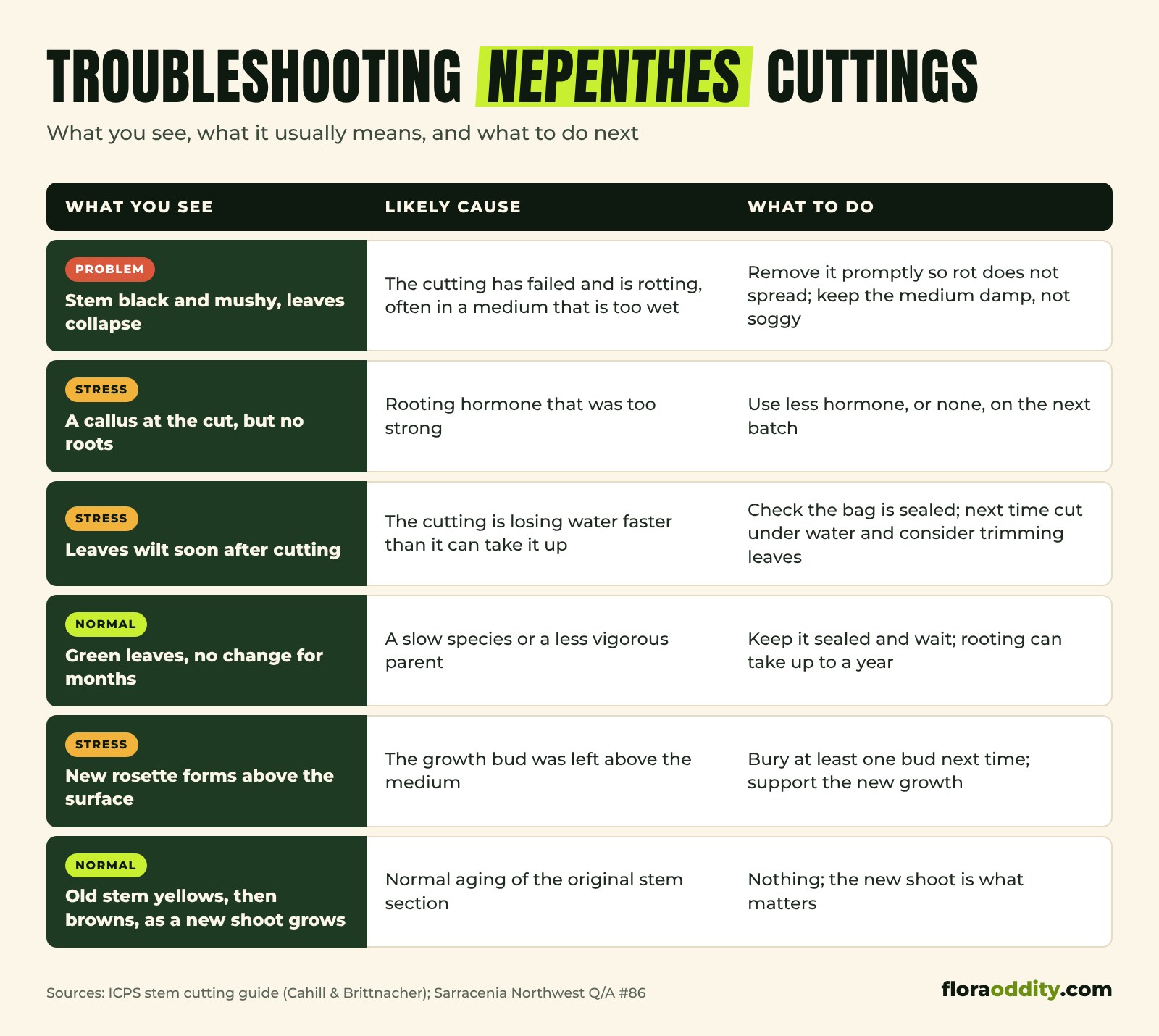
Troubleshooting Your Cuttings
| What you see | Likely cause | What to do |
|---|---|---|
| Stem turns black and mushy, leaves collapse | The cutting has failed and is rotting, often in a medium that is too wet | Remove it promptly so the rot does not spread; keep the medium damp, not soggy |
| A callus at the cut, but no roots | Rooting hormone that was too strong | Use less hormone, or none, on the next batch |
| Leaves wilt soon after cutting | The cutting is losing water faster than it can take it up | Check that the bag is sealed; next time cut under water and consider trimming the leaves |
| Leaves stay green, but nothing happens for months | A slow species or a less vigorous parent | Keep it sealed and wait; rooting can take up to a year |
| A new rosette forms above the surface | The growth bud was left above the medium | Bury at least one bud next time; support the new growth so it does not snap |
| The old stem turns yellow, then brown, as a new shoot grows | Normal aging of the original stem section | Nothing; the new shoot is what matters |
Black, soft tissue on a cutting is the same warning sign it is on an established plant. Our guide on why Nepenthes leaves turn yellow, black, or red explains how rot shows up on rooted plants and how to deal with it.
Aftercare: From the Bag to a Pot
The main skill at this stage is patience. The ICPS advises waiting for new growth before removing the bag. When it appears, lower the humidity gradually, using a terrarium or a partly opened bag, so the young plant can adjust.
One grower on the FlytrapCare forum described a simple way to do this: cut one corner off the bag, then cut away more over several days until the plant is sitting in normal room humidity. If your home is dry, our guide on whether Nepenthes need high humidity explains what to expect and how to help.
Do not rush to repot, either. Carnivero recommends waiting until the roots fill the pot. When you do move the cutting, the same FlytrapCare grower suggests moving the whole root ball and medium together into the larger pot and filling the gap with fresh mix, rather than pulling the young roots free. Our guide on how to repot a Nepenthes covers the process in detail.
What Happens to the Parent Plant
The parent plant usually recovers. Carnivorous Plant Nursery notes that new growth will emerge from the remaining plant base once the upper vines are removed, and the ICPS says a parent left with green leaves on its stem usually sprouts again near the cut within a few months. The exception is the rosette cutting described earlier, which can set a compact plant back by six months to a year.
Give the parent the same steady care you always do. If the cut back plant takes a while to produce new pitchers, our guide on why a Nepenthes is not producing pitchers explains what to check.
Common Mistakes
- Taking a cutting with no node. Without a node or a growing tip, there is no bud to grow from.
- Burying every bud too high. Keep at least one growth bud below the surface.
- Using a dull blade or cutting in open air. A crushed or air-blocked stem has a harder time taking up water.
- Using sheet moss instead of sphagnum. They are not the same material.
- Keeping the medium soggy. Damp is right; standing water invites rot.
- Overdoing rooting hormone. More is not better and can prevent roots completely.
- Opening the bag before there is new growth. The ICPS advises waiting for new growth, then lowering the humidity gradually.
- Throwing out a green cutting too early. If the leaves are still green, it may simply be slow.
FAQ: Nepenthes Cuttings
Can you propagate a Nepenthes from a single leaf?
No. The ICPS says every cutting needs a node or a growing tip, because that is where the new growth bud is. A leaf removed without a piece of stem and its bud has nothing to grow from. Always include a node.
Should I leave the pitchers on a cutting?
You can, but there is no need. The ICPS author usually removes pitchers because they make it hard to fit the cutting into a bag.
What is the best time of year to take Nepenthes cuttings?
Any time of year can work. The ICPS says that cuttings from a plant that is actively growing tend to root faster and more reliably, so choose a time when your plant is healthy and putting out new leaves.
How do I know if my Nepenthes cutting has rooted?
The clearest sign is new growth: a new leaf or shoot appearing from a bud. That is also the signal to start opening the bag gradually. Until then, a cutting with green, firm leaves is still in with a chance.
Can I use an old, woody stem?
You can try, but expect lower success. Barry Rice notes that woody, brown stems root less reliably than green ones, and the ICPS suggests 3 node cuttings for older, less vigorous sections of stem.
The Bottom Line
A Nepenthes that has outgrown its space is an opportunity, not a problem. Choose healthy green stem, include at least one node in every cutting, cut under water with a fresh blade, and plant so a growth bud sits below the surface of a damp, airy medium. Seal the cutting in a bag in bright, indirect light and leave it alone. Rooting hormone is optional, water rooting works best with vigorous hybrids, and air layering is still more experiment than method. Above all, be patient: a green cutting that seems to be doing nothing may simply be taking its time, and the ICPS says that can mean anything from a month to a year.
Sources & Further Reading
- International Carnivorous Plant Society: Nepenthes Propagation via Stem Cuttings (Thomas Cahill with John Brittnacher)
- Barry Rice, The Carnivorous Plant FAQ: Nepenthes, advanced cultivation
- Carnivero: How to Propagate from Cuttings
- Carnivorous Plant Nursery: Growing Nepenthes Pitcher Plants
- Sarracenia Northwest: Q/A #86, Nepenthes Stem Looks Yellow
- Setiawan, R. B. (2025). IBA-induced rooting in Nepenthes reinwardtiana Miq. cuttings for germplasm conservation. Jurnal Agronomi Indonesia 53(1): 72 to 79
- Karim, N. S. (2016). Vegetative propagation of selected Nepenthes species by stem cuttings. Final year project, Universiti Malaysia Sarawak
- Homes & Gardens: How to Propagate a Pitcher Plant
- Missouri Botanical Garden: How do I air layer an indoor plant?
- TerraForums: Nep cuttings, root in mix, in water, or by air layering?
- TerraForums: Air layering tutorial
- FlytrapCare Forums: Growing Nepenthes from cuttings
Final articles are editorially reviewed and factual claims are checked against cited sources. Last reviewed: October 2026.
4 Comments