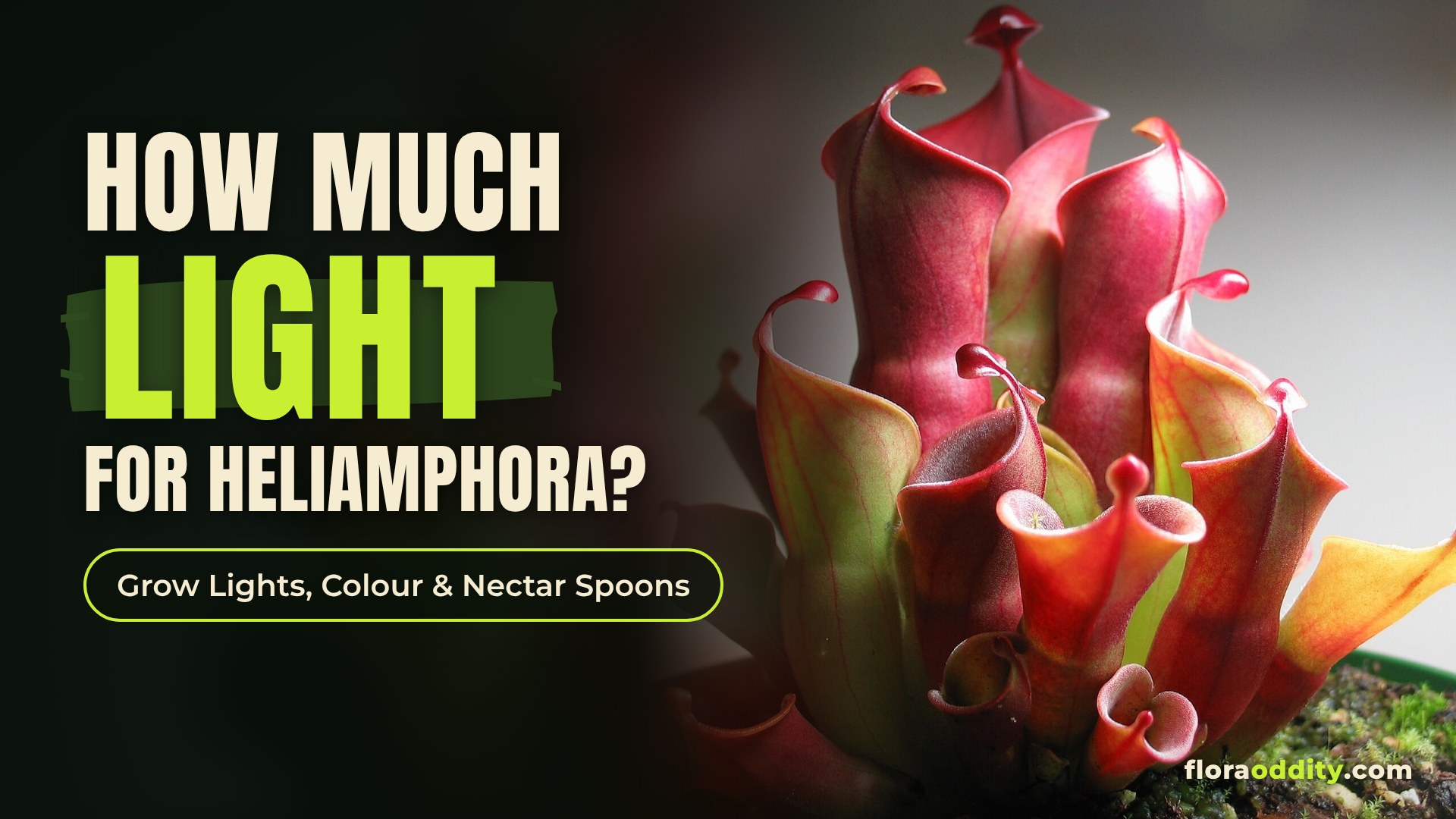
Heliamphora light is the setting most growers get wrong in one of two ways: too little of it, or too much heat along with it. Sun pitchers come from open tepui summits in South America, and Barry Rice, author of the Carnivorous Plant FAQ, says that in sunlight intensity they are more like the cobra lily (Darlingtonia) than the highland Nepenthes they otherwise resemble in care. The International Carnivorous Plant Society (ICPS) rates them as “intense light” plants, the same band as Venus flytraps.
The good news: the ICPS calls indoor growing under artificial light “the easiest way to grow Heliamphora.” This guide gathers the published numbers on brightness, lamp power, distance and hours, explains why pitchers need side light, and shows what colour and nectar spoons tell you.
The Short Answer
Give Heliamphora intense light: the ICPS puts that at about 15,000 to 25,000 lux of white light, and the nursery Carnivero gives 100 to 400 µmol/m²/s of PPFD on a 12 to 14 hour day. In a terrarium with reflective sides, the ICPS recommends at least 20 watts of LED or 1,200 lumens per square foot for 15 hours a day, about 4 to 6 inches (10 to 15 cm) above the plants. Sarracenia Northwest starts with white LED shop lights of about 2,500 lumens, 12 inches (30 cm) above the plant, for about 14 hours.
Light the pitchers from the sides as well as the top. Red colour, full nectar spoons and well-formed pitchers show that the light is right; green, wide, spoonless pitchers usually mean too little. Raise light gradually, and never let more light mean more heat.
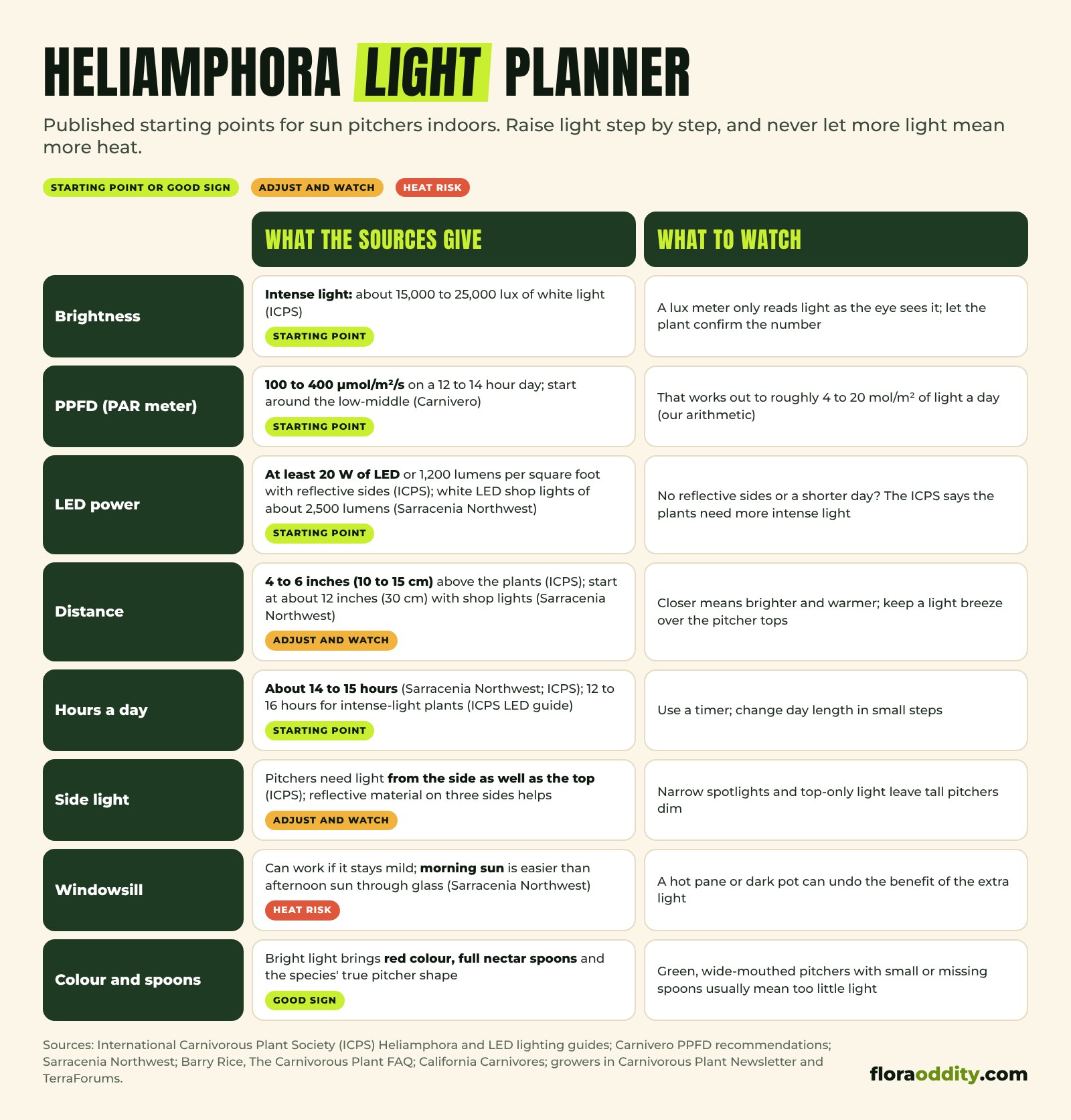
| Setting | What the sources give | Source |
|---|---|---|
| Brightness | About 15,000 to 25,000 lux of white light (“intense light”) | ICPS LED guide |
| PPFD | 100 to 400 µmol/m²/s, assuming a 12 to 14 hour day | Carnivero |
| LED power | At least 20 W of LED or 1,200 lumens per square foot with reflective sides; 25,000 lux needs about 2,000 lumens or 30 W per square foot | ICPS |
| Shop lights | White LEDs of about 2,500 lumens or more | Sarracenia Northwest |
| Distance | 4 to 6 inches (10 to 15 cm) with LEDs in a terrarium; 12 inches (30 cm) as a starting point for shop lights | ICPS; Sarracenia Northwest |
| Hours | 15 hours (ICPS); about 14 hours (Sarracenia Northwest); 16 hours (Carnivorous Plant Nursery) | As listed |
| Direction | Light from the side as well as the top; reflective material on three sides | ICPS |
| Windows | Morning sun is easier than hot afternoon sun through glass | Sarracenia Northwest |
Why Sun Pitchers Need So Much Light
Light decides what a Heliamphora looks like. Rice writes that plants in inadequate light “do not produce the leaf morphology characteristic of their species.”
Andreas Wistuba, a German grower who has co-described several species, uses “much light” and shades only above 86 °F (30 °C). Writing in Carnivorous Plant Newsletter in 1990, Wistuba warned that deep shade “only results in soft and ugly plants which do not resemble the colorful plants in nature.”
Sarracenia Northwest agrees that plants need very bright light “to grow well and produce their characteristic adult pitchers and coloration.” Our Heliamphora care guide covers light in brief; this guide goes into the numbers.
How Much Light: Lux, PPFD and Daily Light
Lux
The ICPS LED lighting guide, written by John Brittnacher, puts Heliamphora in its “intense light” group, which it defines as “About 15,000 to 25,000 lux of white light.” For scale, it gives full noon sun at about 100,000 lux, bright shade at about 15,000 lux and typical office lighting at 1,000 lux.
The ICPS adds that a lux meter reads light as the human eye sees it, so its figures apply to white light only.
PPFD
If you own a PAR meter, Carnivero lists Heliamphora at 100 to 400 µmol/m²/s, the same band it gives Venus flytraps and low-growing Sarracenia, assuming a 12 to 14 hour photoperiod. Carnivero says many of its figures come from greenhouse experience rather than tests under lamps, and that “Targeting around the low-middle at first” should suit most species and hybrids.
Daily light integral
Hort Americas, publishing Apogee Instruments’ conversion, turns PPFD into a daily total by multiplying by 3,600 seconds an hour and dividing by a million, a method meant for electric lights with constant output. By that formula, Carnivero’s range works out to roughly 4 to 20 mol/m² a day (100 for 12 hours is about 4.3; 400 for 14 hours is about 20.2). That is our arithmetic, not a published target.
To check your own reading, our light checker has a sun pitcher option and works out the daily total for you.
Grow Lights for Heliamphora: LEDs, Distance and Hours
Which kind of light
The ICPS says Heliamphora grows well under only blue and red LEDs, but prefers white light for display, because plant-tuned light can make leaves “appear black, brown, or purple.” Sarracenia Northwest says red and blue grow lights “are not necessary” and uses white LED shop lights. Brittnacher calls fluorescent lighting “an obsolete technology.”
Colour temperature has a small effect. The ICPS notes that 3000K tubes “generally result in somewhat shorter and redder plants than those grown under 6500K lighting.” Butch Tincher, writing in Carnivorous Plant Newsletter in 2013, got the best results from 5000 K T5 bulbs, but adds that with good bulbs “the performance differences are minimized.”
Watts and lumens
The ICPS Heliamphora guide gives the clearest figure: in an enclosure with reflective sides, the plants need “at least 20 watts of LED lighting or 1200 lumens per square foot” for 15 hours a day. Without reflective sides, or with a shorter day, it says they need more intense light. The LED guide adds that reaching 25,000 lux takes “2000 lumens or 30 watts of white LED lighting per square foot,” or about 15 watts per square foot of blue and red plant lighting.
One ICPS example grows H. minor var. pilosa under 22 watt white LED panels, one per square foot, which “works out much better than using higher wattage panels farther from the plants.” Check the real wattage, not “watt-equivalent” claims, and expect LEDs to dim: the ICPS calls 70% of the original brightness after 35,000 hours “not unusual.”
Distance
The ICPS sets lights “about 10 to 15 cm (4 to 6 in) above the plants.” Brian Barnes, writing in Carnivorous Plant Newsletter in 2010, kept pitchers about 4 inches (10 cm) from the lamps with glass in between, which “safely gives the plants superb coloration.” Tincher keeps plants “within a few inches” of T5 tubes but sees “a point of diminishing returns”: too close, and the plant loses the benefit of the neighbouring bulbs.
Sarracenia Northwest starts shop lights at about 12 inches (30 cm), then moves them closer if the plant stays green and further if it shows heat or light stress.
Hours
The ICPS uses 15 hours a day for Heliamphora and gives 12 to 16 hours for intense-light plants in general. Sarracenia Northwest uses about 14 hours on a timer and says “A consistent daily light cycle is more important” than adjusting lights by hand. Carnivorous Plant Nursery runs 16 hours.
Seasonal change is optional. Tincher runs 18 hours in summer and 12 in winter and saw “no effect” on flowering; Barnes cuts from 14 to 11 hours for three months, which “seems to induce flowering.”
Side Light: Why Light From Above Is Not Enough
This is the detail most setups miss. The ICPS warns that “light only from the top will not be very effective because the pitchers need light from the side as well as the top.”
The fixes are simple:
- Reflective walls. The ICPS says reflective material on three sides “will help immensely.”
- Wide, even light rather than spotlights. The ICPS says an LED spotlight’s beam “is so narrow it would not work well with pitcher plants such as Heliamphora even if the plants were surrounded by mirrors.”
- Mind the edges. In one ICPS example, plants at the edges of two trays under one panel got 45% less light than those in the centre, so put sun pitchers in the middle.
Windowsills and Greenhouses
Natural light can work if it stays cool. Sarracenia Northwest says a bright window can work “if temperatures remain mild,” and that morning sun “is generally easier to manage than intense afternoon sunlight through glass.” Carnivorous Plant Nursery lists full to part sun.
Full sun is not required, though. Robert Ziemer, writing in Carnivorous Plant Newsletter in 1979 from the foggy northern California coast, grew three species in a greenhouse with about 2 hours of direct sun a day plus fluorescent tubes about 1 m above the plants on a 10 hour day, and believed they grew best “under less than full sunlight.” The ICPS says greenhouse plants “do require very bright light,” and the hard part is keeping temperatures in range.
Pitcher Colour and Nectar Spoons
Colour is the most visible sign of light. California Carnivores says Heliamphora “may be grown with less light, but they will remain much greener,” and Sarracenia Northwest says many “will develop rich colors if given bright sunlight.” Carnivero explains that light level and spectrum drive anthocyanin and other pigments, which “give plants a darker, reddish hue.” A figure caption in Tincher’s article puts it plainly: intense, good quality lighting “is essential for colorful indoor Heliamphora.”
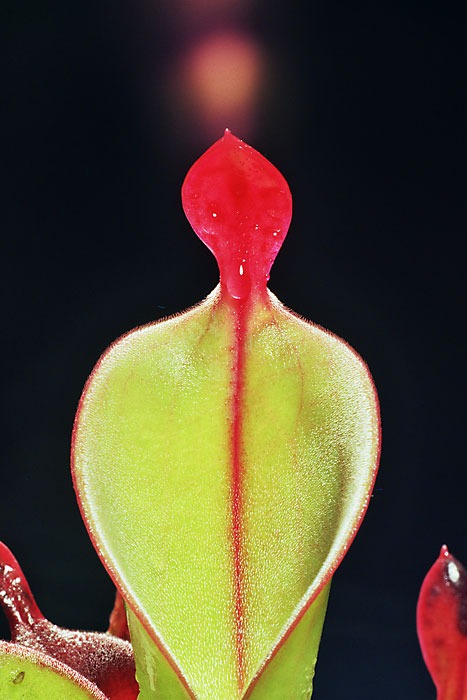
The nectar spoon, the small cap at the top of an adult pitcher, is the second gauge. Rice explains that flying insects are drawn to the spoon’s nectar glands and, as they feed, risk slipping into the pitcher, so the spoon is part of the trap, not just decoration (see the nectar spoon section of our care guide). Spoons also respond to humidity: Tincher adds humidity “for optimum growth and nectar spoon development.”
Read the plant as a whole:
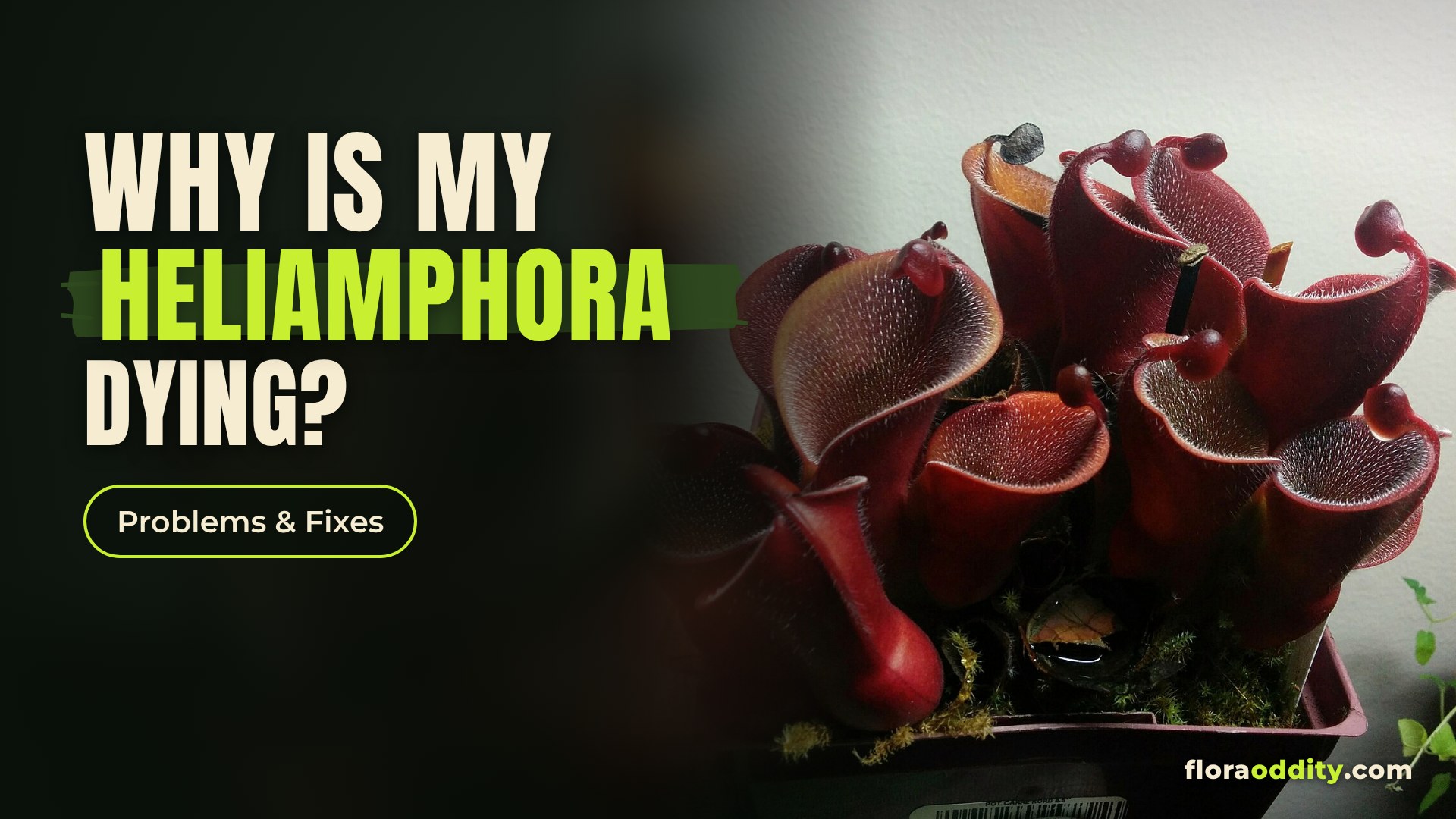
- Red or deeply veined pitchers, full spoons, narrow upright tubes: the light is right.
- Green pitchers on a firm, growing plant: usually too little light, not disease (see our guide to green pitchers).
- Wide, flat mouths and small or missing spoons: too little light, as growers below describe.
- Scorched edges or splotchy patches after a move into stronger light: too much, too fast, or too much heat. One TerraForums grower finds that H. parva “gets splotchy in too much light,” and another advises giving as much light as the plant tolerates “without discolouration or the burning of the leaf edges.”
Judge colour under white light, since purple plant light distorts it.
Light Without Heat
The ICPS warns that large plants can die after prolonged temperatures above 79 °F (26 °C), and Sarracenia Northwest’s rule is that “increasing light should not mean increasing heat.” Every light source adds some heat:
- Prefer LEDs. The ICPS does not recommend fluorescent tubes unless fans or a sheet of Plexiglas keep their heat away from the plants. Tincher notes that T5 tubes run “over 65°C” (about 149 °F).
- Let LEDs breathe. The ICPS says 35 watt panels can run roughly 30 °F (18 °C) above room temperature and may need a small fan in enclosed spaces.
- Put glass between lamp and leaf. Barnes lays the lights on top of a sideways aquarium; the glass “is the perfect insulator for the bulbs” and lets pitchers come closer “with less risk of pitcher burn.”
- Move the air. Barnes calls “a constant, light breeze” very important when pitcher tops are within a few inches of the bulbs. Tincher’s fans “form a region of cool air” between tubes and plants.
- Raise the lamp before the tank overheats. Dodd and Powell kept their tubes “high enough above the tank so as not heat the terrarium beyond 82° F” (about 28 °C), on a spacer that let air flow over the cover glass.
Our climate checker has a Heliamphora heat option, and our heat stress section explains what overheating looks like.
Acclimatising Heliamphora to Stronger Light
Plants grown in dim conditions need time. Sarracenia Northwest tells growers to “Increase light gradually while monitoring temperature,” and warns that a move changes light, temperature, humidity and airflow all at once, so it advises against repeated moves. Raise intensity in small steps, lowering the lamp a little or adding a fixture, and check the temperature at the pitcher tops after each change. Barnes changes day length in one hour steps over three weeks. Judge by new growth: Sarracenia Northwest says healthy new pitchers are a better guide than old leaves, which formed under the old light.
Patience matters. The ICPS notes that quick changes in lighting type “may induce plants to do things they may not do” once settled, and that it can take a year to judge whether a setup works. Freshly divided or bagged plants are a special case: the ICPS warns to keep the bag away from lights and sun, because “High temperatures in the bag will kill the plant.”
How Heliamphora Compares With Cephalotus, Nepenthes and Sarracenia
The ICPS LED guide rates genera on one scale, which makes comparison easy. Heliamphora, Cephalotus, Venus flytraps and Sarracenia seedlings sit in “intense light”; Nepenthes and butterworts sit one band lower, in “moderate light” of about 8,000 to 15,000 lux. Carnivero’s PPFD table agrees: Nepenthes at 30 to 200, Cephalotus at 45 to 300, Heliamphora at 100 to 400, and upright Sarracenia at 200 to 500 or more.
In practice:
- Highland Nepenthes share the cool conditions but want less light; the ICPS puts lower-light plants at the edges of a grow area. See our Nepenthes light guide.
- Cephalotus sits close to Heliamphora on both scales, but its low pitchers are easy to light from above, while tall sun pitchers need side light. See our Cephalotus light guide.
- Sarracenia, Heliamphora’s North American relatives, want even more light; the ICPS LED guide says plants that need full sun are best grown outdoors as much as possible. See our Sarracenia care guide.
For eight plants side by side, see carnivorous plant care compared.
A Simple Light Setup in Six Steps
- Choose white LEDs of about 20 to 30 real watts per square foot (ICPS).
- Line three sides with reflective material and put sun pitchers in the centre.
- Set the lamp about 4 to 6 inches (10 to 15 cm) above an LED terrarium, or start shop lights at about 12 inches (30 cm), with glass or a breeze between lamp and leaves.
- Use a timer for about 14 to 15 hours a day.
- Measure light and temperature at pitcher height, and check the light in the light checker.
- Watch the next few pitchers for colour, spoons and shape, and change one thing at a time.
What Growers Report
These are single growers’ conditions and results, not rules.
- A desert grower who raises sun pitchers only under full spectrum LEDs aims for “200 PPFD measured at nectar spoon height,” finds most plants tolerate 100 to 600 or more, and starts at about 25 W of LED per square foot. In that grower’s experience, plants short of light make “reduced or non-existent nectar spoons” and pitchers with wider, flatter mouths. (Werdna, TerraForums, February 2023)
- A grower kept Heliamphora on an outdoor window ledge in full sun, where they grew well with good spoons and pitcher shape, but as winter came the pitchers turned “very wide, very green and no nectar spoon.” (The body snatcher pod, CPUK Forum, November 2012)
- A grower who moved sun pitchers from a basement light setup to a south-facing windowsill with about 5 hours of direct summer sun, plus two desk lamps with 100 watt fluorescent bulbs, reported healthier plants. (flytrap59, TerraForums, July 2009)
- A grower keeps a Heliamphora “just a few inches” under a four-bulb T8 fixture with 3500K and 6500K tubes and says it “gets plenty red.” (Benurmanii, TerraForums, May 2016)
Our takeaway: whether the light came from LEDs, tubes or the sun, the growers judged it by the same signs, red colour and full spoons, and falling winter light showed up as wider, greener pitchers with smaller spoons.
Where Sources Differ
| Topic | One view | Another view | Context |
|---|---|---|---|
| Lamp distance | ICPS: 4 to 6 inches (10 to 15 cm); Barnes: about 4 inches (10 cm) through glass | Sarracenia Northwest: start at about 12 inches (30 cm) | The ICPS figure assumes LED wattage per square foot in a reflective enclosure; Sarracenia Northwest starts higher and adjusts to the plant |
| Day length | ICPS: 15 hours; Sarracenia Northwest: about 14 hours; Carnivorous Plant Nursery: 16 hours | Ziemer: 10 hours of lamp light plus some sun; Tincher: 18 hours in summer, 12 in winter | The ICPS says that with a shorter day the plants need more intense light |
| Seasonal change | Barnes: a shorter winter day seems to induce flowering | Tincher: day length had no effect on flowering | Both grew under lights; neither needed a dormancy |
| Sun | Carnivorous Plant Nursery: full to part sun; Wistuba: much light, shade only above 86 °F (30 °C) | Ziemer: best growth under less than full sunlight | Ziemer grew on the foggy northern California coast; Wistuba shades only when it gets hot |
| Colour temperature | ICPS: 3000K tends to give shorter, redder plants than 6500K | Tincher: best results at 5000 K | The ICPS calls the effect “somewhat”; Tincher says good bulbs minimize the differences |
Common Mistakes
- Lighting only from above. Tall pitchers need side light; add reflective walls.
- Using a narrow spotlight. The beam misses most of the pitcher.
- Trusting “watt-equivalent” labels. Check the real wattage, as the ICPS advises.
- Chasing colour with heat. A hot window or an unventilated lamp can do more harm than pale pitchers.
- Changing everything at once. You cannot tell what worked.
- Judging by old pitchers. Leaves that formed under weak light will not change; look at the new ones.
- Bagging a plant under a hot light. The ICPS warns that heat in the bag can kill it.
FAQ: Heliamphora Light
How much light does a Heliamphora need?
Intense light. The ICPS gives about 15,000 to 25,000 lux of white light, and Carnivero gives 100 to 400 µmol/m²/s of PPFD on a 12 to 14 hour day. Red colour and full nectar spoons tell you that you are in range.
How far should a grow light be from Heliamphora?
The ICPS suggests about 4 to 6 inches (10 to 15 cm) with LEDs in a reflective terrarium. Sarracenia Northwest starts shop lights at about 12 inches (30 cm). Adjust to the plant and keep the pitcher tops cool.
How many hours of light do Heliamphora need?
About 14 to 16 hours a day under lights: 15 hours in the ICPS guide, 14 at Sarracenia Northwest and 16 at Carnivorous Plant Nursery. Use a timer and change day length gradually.
Why are my Heliamphora pitchers green with no nectar spoons?
Usually too little light. California Carnivores says plants in less light “will remain much greener,” and growers report wide, flat pitchers with small or missing spoons in low light. Raise the light gradually without raising the heat.
The Bottom Line
Heliamphora light comes down to three things: enough of it, from the right directions, without the heat. Aim for intense light, about 15,000 to 25,000 lux or 100 to 400 µmol/m²/s, from white LEDs of about 20 to 30 W per square foot, for 14 to 15 hours a day, with reflective walls so the pitchers get side light. Keep glass or moving air between lamp and leaf, raise light in steps, and let the newest pitchers and their nectar spoons tell you when it is right.
Sources & Further Reading
- International Carnivorous Plant Society: Growing Heliamphora (John Brittnacher)
- International Carnivorous Plant Society: LED plant lighting (John Brittnacher)
- Carnivero: Genera specific PPFD recommendations
- Hort Americas: Conversion, instantaneous PPFD to integrated PPFD (Apogee Instruments)
- Barry Rice, The Carnivorous Plant FAQ: Heliamphora cultivation
- Barry Rice, The Carnivorous Plant FAQ: Heliamphora, the marsh (or sun) pitchers
- Sarracenia Northwest: How to Grow Heliamphora
- California Carnivores: Sun Pitchers (Heliamphora) Growing Tips
- Carnivorous Plant Nursery: Growing Tips for Heliamphora
- Butch Tincher: My techniques for the indoor cultivation of Heliamphora, Carnivorous Plant Newsletter 42(4), 2013
- Brian Barnes: Growing Heliamphora indoors year-round, Carnivorous Plant Newsletter 39(1), 2010
- Andreas Wistuba: Growing Heliamphora from the Venezuelan tepui, Carnivorous Plant Newsletter 19(1-2), 1990
- Cliff Dodd and Charles Powell: A practical method for cultivation of Heliamphora spp., Carnivorous Plant Newsletter 17(2), 1988
- Robert R. Ziemer: Some personal observations on cultivating the Heliamphora, Carnivorous Plant Newsletter 8(3), 1979
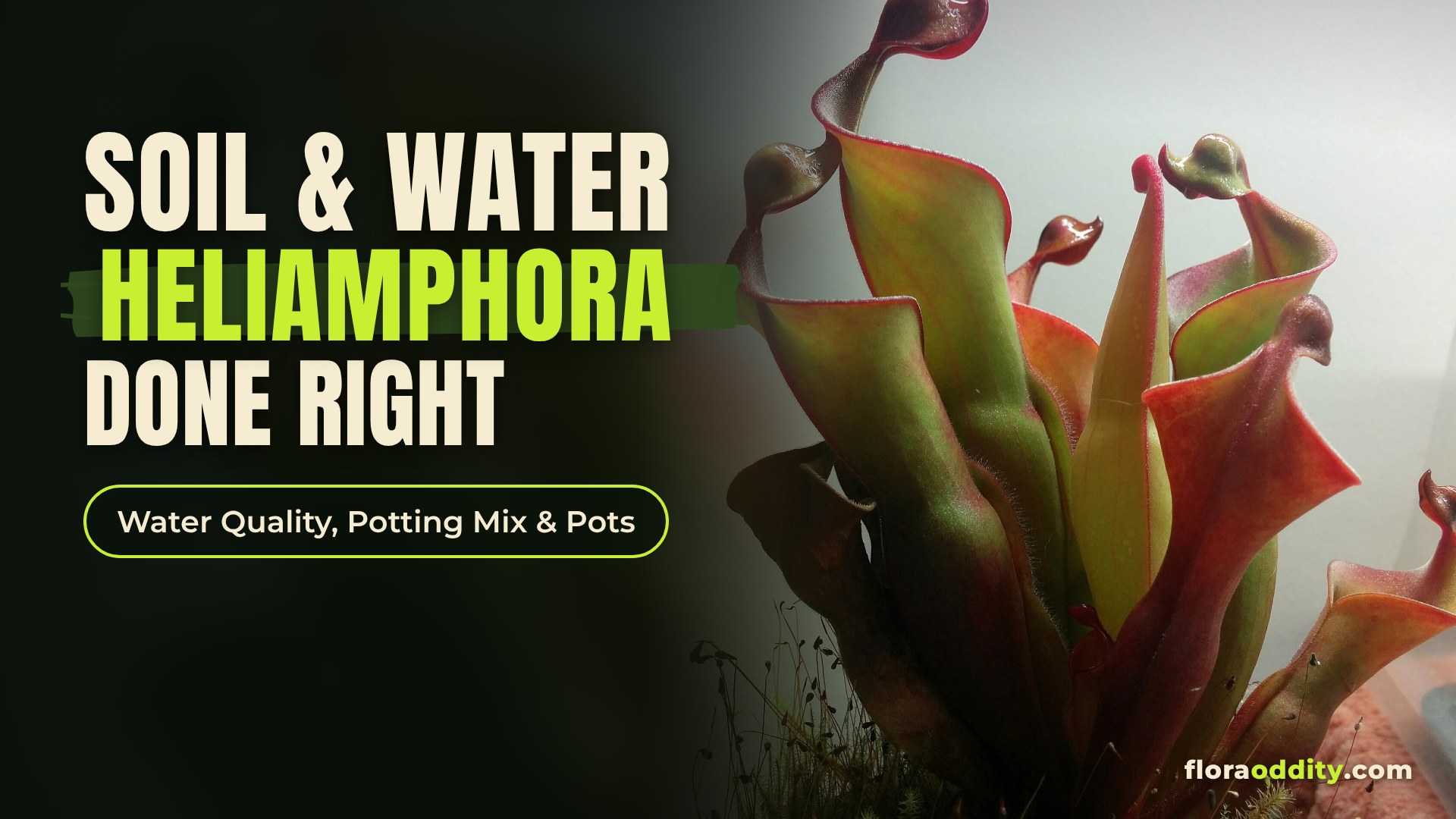
Featured image based on a photo of Heliamphora minor var. minor by Dals093838 via Wikimedia Commons, CC BY-SA 4.0, with a blurred background and typography added by FloraOddity; the adapted image is offered under the same licence.
Final articles are editorially reviewed and factual claims are checked against cited sources. Last reviewed: October 2026.