
The same Cephalotus can grow apple-green pitchers in one home and near-black ones in another. In most cases the difference is light. The International Carnivorous Plant Society (ICPS) says the Albany pitcher plant “grows best and are the most colorful with a lot of light,” and its LED guide places Cephalotus in its highest band, “intense light,” together with Venus flytraps and most sundews.
Getting Cephalotus light right is less about one magic number and more about matching a setup to what the plant needs: several hours of real sun on a windowsill, or a strong lamp close above the plant indoors, without letting that light cook the pot. Our Cephalotus care guide sums up light in two paragraphs; this guide goes deeper, with the numbers the sources give for sun, lux, watts, PPFD, hours and lamp distance, what light does to pitcher colour and size, and how to tell too little light from too much.
The Short Answer
Give Cephalotus as much light as you can without heat stress. Sarracenia Northwest recommends “approximately 4 or more hours of direct sunlight” plus bright filtered light for the rest of the day, and calls cooler morning sun ideal. The ICPS names south-facing windowsills as best, with east and west sometimes working.
Under LEDs, the ICPS target for intense-light plants is about 15,000 to 25,000 lux of white light, which it says takes about 30 watts of white LED lighting per square foot (30 cm square), for 12 to 16 hours a day. Carnivero, a nursery that publishes PPFD figures, lists Cephalotus at 45 to 300 µmol/m²/s over a 12 to 14 hour day. The nurseries keep lamps about 6 to 12 inches (15 to 30 cm) above these low plants.
More light usually means darker red or purple pitchers. Green pitchers on a healthy plant usually mean the light is on the low side, not that the plant is sick. Raise the light in stages, never suddenly, and never put a closed dome or terrarium in direct sun.
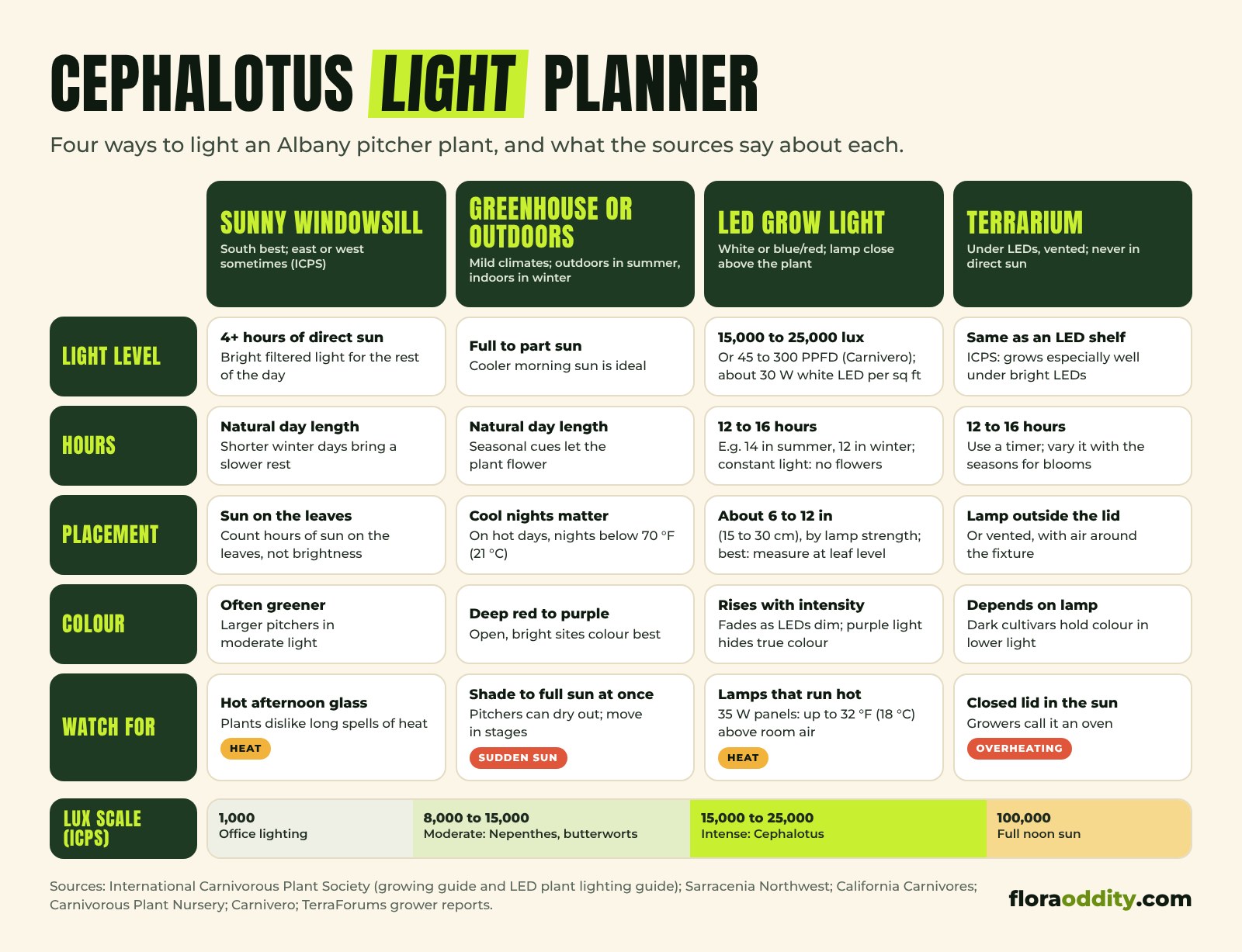
| Sunny windowsill | Greenhouse or outdoors | LED grow light | Terrarium | |
|---|---|---|---|---|
| Light level | 4 or more hours of direct sun, bright filtered light the rest of the day (Sarracenia Northwest) | Full to part sun; outdoors only in mild climates (California Carnivores) | About 15,000 to 25,000 lux (ICPS); 45 to 300 PPFD (Carnivero) | ICPS: grows especially well under bright LEDs |
| Hours | Natural day length | Natural day length | 12 to 16 hours (ICPS); 14 in summer, 12 in winter (Sarracenia Northwest) | Same as LED; seasonal changes needed for flowers |
| Placement | South best; east or west sometimes (ICPS); morning sun is cooler | Keep away from long spells of very hot weather | About 6 to 12 inches (15 to 30 cm) above the plant, depending on lamp strength | Lamp outside or vented; never in direct sun with a closed lid |
| Colour to expect | Often greener, larger pitchers | Strongest colour in open, bright sites | Colour rises with intensity; fades as LEDs dim | Varies with lamp and cultivar |
| Watch for | Hot glass in summer afternoons | Sudden full sun after shade; heat | Lamps that run hot; purple light hides health | Trapped heat; lamps without airflow |
| Sources | ICPS, Sarracenia Northwest | California Carnivores, Sarracenia Northwest, Carnivorous Plant Nursery | ICPS LED guide, Carnivero, California Carnivores, Sarracenia Northwest, Carnivorous Plant Nursery | ICPS, Carnivorous Plant Nursery, grower reports |
How Much Sun Does Cephalotus Need?
All the nurseries put Cephalotus in sun, not shade. Sarracenia Northwest says it “requires partial to full sun.” California Carnivores lists “Full to part sun,” and Carnivorous Plant Nursery gives “full to part sun, seasonal change” and says the plant prefers “filtered bright, sunny conditions at normal room temperatures.”
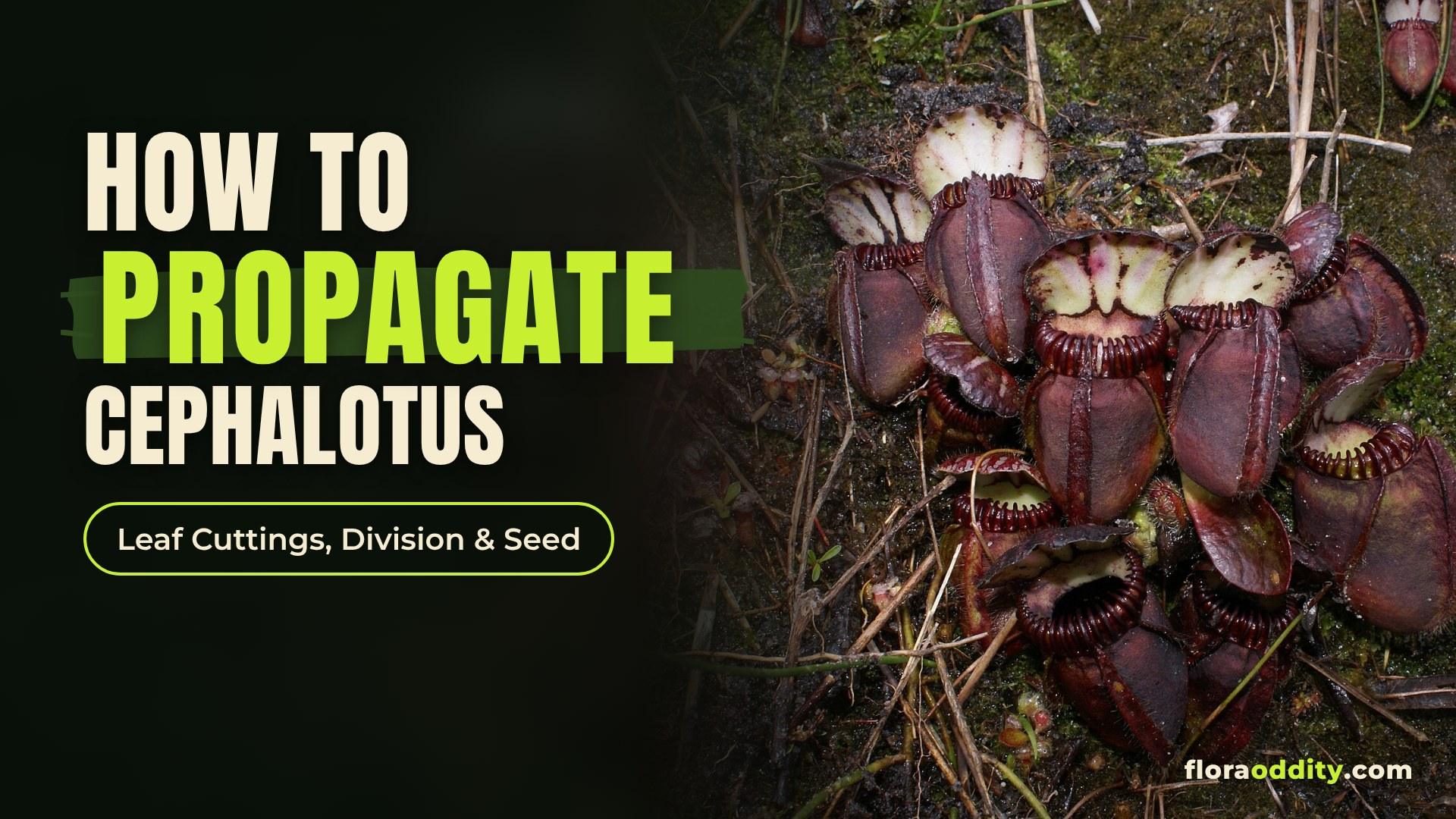
The wild plant explains why. The Western Australian Herbarium’s Florabase describes it growing in “Peaty soils” around swamps and along streams in the far southwest. Richard Nunn, writing in Carnivorous Plant Newsletter (CPN) in 2014 after visiting about 20 sites, found that Cephalotus thrives in the open ground left after bushfires, then gets crowded out as shrubs regrow. Robert Gibson, in a 1999 CPN field report, saw the contrast directly: at a shaded site near Albany most pitchers were “fully green,” while at an open, sunny site near Walpole the plants had “abundant, brightly coloured pitchers.”
Windowsills by direction
The ICPS says “South facing windowsills are the best for them, but east and west will sometimes work.” Sarracenia Northwest adds that “The cooler direct morning sun is ideal,” which points to an east window, or a sunny window where afternoons stay mild.
Count real sun, not brightness. A window that looks bright but gets only an hour or two of sun on the leaves falls short of the 4 or more hours Sarracenia Northwest asks for. In winter a windowsill plant rests as days shorten and makes many flat leaves; that is the season, not a light failure.
Greenhouse and outdoors
The ICPS says the plants “grow well in greenhouses.” Outdoors, California Carnivores says they can be grown “in full to part sun in mild climates,” and Sarracenia Northwest treats Cephalotus as a warm-temperate plant for USDA zones 9 and 10. Carnivorous Plant Nursery suggests a middle path: “Consider growing outdoors in summer and indoors in winter.”
The limit outdoors is usually heat, not light. California Carnivores warns that the plants “may die in prolonged periods of very hot weather but enjoy cool summer nights.” Sarracenia Northwest found that a drop in night temperature below 70 °F (21 °C) is “essential if day temperatures are very warm”; its plants sometimes see 100 °F (38 °C) by day, but nights usually fall into the 50s °F (10 to 15 °C). The ICPS also notes that outdoor Cephalotus is “highly susceptible to mildew.”
Grow Lights: Lux, Watts, PPFD and Hours
Cephalotus suits grow lights well. Carnivorous Plant Nursery calls it “an ideal Carnivorous Plant for a terrarium” because its low growth lets lamps be brought close to the plants.
How bright
The ICPS LED plant lighting guide, by John Brittnacher, sets “intense light” at “About 15,000 to 25,000 lux of white light.” For scale, it puts full noon sun at about 100,000 lux, bright shade at about 15,000 lux and typical office lighting at 1,000 lux. It says reaching 25,000 lux takes “2000 lumens or 30 watts of white LED lighting per square foot,” and that for blue and red plant lighting, “15 watts per square foot” works well. Reflective material on three sides “will help immensely.”
The ICPS photos show what that looks like in practice. One group of plants grows under “21W of 3000K white LED lighting per square foot” for 14 hours a day; an ‘OG Black’ plant grows under 24 W per square foot for 15 hours a day in a terrarium.
If you own a PAR meter, Carnivero lists Cephalotus at 45 to 300 µmol/m²/s, assuming a 12 to 14 hour photoperiod. It says its figures for many genera come from greenhouse experience rather than tests under lamps, and advises “Targeting around the low-middle at first.” Hort Americas, publishing Apogee Instruments’ conversion, multiplies PPFD by 3,600 seconds an hour and divides by a million to get moles. By that formula, Carnivero’s range works out to roughly 2 to 15 mol/m² of light a day (45 for 12 hours is about 1.9; 300 for 14 hours is about 15.1). Hort Americas adds that this conversion is accurate only under electric lights, because sunlight changes through the day.
To compare your own lux or PPFD reading and hours with these ranges, use our light checker: pick Cephalotus, enter the reading at leaf level and the hours your lamp runs, and it shows where you sit and your daily light integral.
How close
The nurseries agree on a short distance. California Carnivores grows plants 6 to 12 inches (15 to 30 cm) from the grow light, “Depending on the strength of the light.” Carnivorous Plant Nursery puts lamps about 6 inches (15 cm) from the plants. Sarracenia Northwest, writing about fluorescent tubes, says “approximately 8 inches.” Dick Tran, describing a tank setup in CPN in 2001, kept four 40-watt fluorescent tubes 15 cm (6 inches) above the soil.
How many hours
Sarracenia Northwest runs lights 14 hours a day in spring and summer and 12 in fall and winter. Carnivorous Plant Nursery suggests 16 hours, or a seasonal schedule of 12, 14, 12 and 10 hours for spring, summer, fall and winter. Tran used 16 hours in spring and summer and 14 in fall and winter. The ICPS gives 12 to 16 hours for intense-light plants.
Day length matters for flowers more than for growth. The ICPS LED guide says Cephalotus needs changes in day length “to bloom” but otherwise does fine under a constant light cycle. Its growing guide confirms that plants under a constant light period “will not bloom,” and notes that timers exist which follow a natural light cycle.
Which colour of light
The ICPS says Cephalotus will grow well under only blue and red lighting. The catch is that purple light makes the plants hard to read. The guide says it is “difficult to determine how well the plants are doing or if they need feeding” under pure deep blue and red, and recommends adding some white light. It also warns that plant-tuned light can make plants “appear black, brown, or purple,” so a dark pitcher under a purple lamp may look different in daylight.
The same guide warns that LEDs dim (70% of first brightness after 35,000 hours is “not unusual”) and that 35-watt panels can run up to about 32 °F (18 °C) hotter than the surrounding air, so they need air around them.
How Light Changes Pitcher Colour and Size
Colour is the most visible effect of light. Sarracenia Northwest says “Pitchers will naturally darken from green to deep purple in very bright sunlight.” Carnivorous Plant Nursery says the plants “get their best color in bright light, and largest traps after dormancy.”
Nunn’s field notes show it in the wild. At open sites, plants “attain very attractive coloration due to year round exposure to strong sunlight,” and “Tests in cultivation show that these plants attain normal dimensions in good conditions and with less light don’t color up.” Gibson’s shaded plants near Albany carried mostly green pitchers, with only one red-pigmented pitcher growing “in a more open area.”
The ICPS supplies the clearest indoor example. A display terrarium of its started at about 15,000 lux; after six years the dimming LEDs gave about 10,000 lux, and “Except for Cephalotus ‘OG Black’, the Cephalotus plants are paler colored with the lower light levels but grow just fine.” Two lessons follow. Dimmer light costs colour before it costs health, and genetics matter: a dark cultivar keeps its colour where a typical plant fades.
Size is less clear. No reference source gives a rule, though one grower below describes a colour versus size trade-off. If your pitchers are pale, our guide to pitcher colour problems explains how to tell a light issue from a sick plant.
Signs of Too Little or Too Much Light
Too little light
- Green pitchers on a growing plant. Usually harmless, as the ICPS display terrarium shows.
- Mostly flat leaves and few pitchers. In Nunn’s crowded-out swamps the plants “start to produce only non-carnivorous leaves to capture the small amounts of light that get through.” Gibson’s shaded flat leaves were “generally held horizontally, perhaps to catch as much light as they could.”
- Rule out other causes first. The ICPS notes that soil fertilizer can also make plants “dark green” with more non-carnivorous leaves, and Sarracenia Northwest says a winter rest brings an “abundance of flat, non-carnivorous leaves.” So look at the season and your feeding before you blame the lamp.
Too much light, or too much heat
- Pitchers that dry out soon after a move to stronger light. None of the nursery guides describes sunburn on Cephalotus in detail, but growers report losing pitchers when a plant goes from low light straight into very strong light (see below).
- A plant that declines in hot weather. Carnivorous Plant Nursery warns that Cephalotus “may appear to “suddenly” die if kept too hot or wet.”
- Very dark pitchers alone are not a warning sign. On a firm plant that keeps making new growth, deep red or purple is the colour bright light produces.
Acclimatising Cephalotus to Stronger Light
None of the nursery guides cited here gives a schedule for moving Cephalotus into brighter light. The growers in What Growers Report below describe the risk: one lost every pitcher after a sudden jump to strong light and now moves plants up “in stages,” and another’s plant took a full summer of sun only after acclimating. Sarracenia Northwest’s preference for cooler morning sun and the ICPS warnings about heat from lamps point the same way: raise the light without raising the heat.
Terrarium Heat Traps
Glass and plastic trap heat as well as humidity. Carnivorous Plant Nursery reminds terrarium growers to “keep the terrarium vented.” The ICPS LED guide says spotlights over 10 watts “should not be in any sort of enclosure like a desk lamp,” that panel lights need air circulating around them, and that “A small fan may be necessary if the light fixtures are in enclosed spaces.”
One grower warns that a little sun is enough to turn a domed pot into an oven. Remember too that Sarracenia Northwest found cool nights essential for Cephalotus when days are warm: a sealed box that holds the day’s heat into the night takes that away. If you use a dome, light it with LEDs from above rather than with sun through the glass.
How Cephalotus Compares with Nepenthes and Butterworts
The ICPS LED guide is useful for comparing genera because it rates them on one scale. It puts Cephalotus in “intense light” with Venus flytraps and most sundews, but places Nepenthes and both Mexican and temperate butterworts one band lower, in “moderate light,” which it sets at about 8,000 to 15,000 lux. Carnivero’s PPFD table points the same way: Nepenthes and Pinguicula at 30 to 200 µmol/m²/s, Cephalotus at 45 to 300.
So Cephalotus can share a shelf with them if it sits in the centre: the ICPS puts plants that prefer less light “on the edges of the grow area,” with intense-light plants directly under the lamps. Our Nepenthes light guide and butterwort light guide give the details for those plants.
What Growers Report
These are single growers’ results in their own conditions, not rules.
- Growing a typical plant in a lowland terrarium about 4 inches below six 20-watt fluorescent tubes, one grower had been getting pitchers “primarily green with dark teeth and red splotches.” After raising the pot about 3.5 to 4 inches closer to the lights, the new pitchers came in “solid burgundy with green banding between the teeth.” (SirKristoff, TerraForums, November 2010)
- An indoor grower in Texas described the choice as a trade-off: “The increased lighting will give you smaller pitchers with much better colors or the windowsill will give you bigger pitchers with greener colors.” The same grower lost every pitcher and leaf on one plant “due to the shock of increased light”; new pitchers grew from the base within weeks, and the grower now moves plants into strong light “in stages.” (RSS, TerraForums, December 2014)
- One plant spent a whole summer outside in full sun with long spells above 90 °F (32 °C) and “never missed a beat, after acclimating to the higher light levels.” (SubRosa, TerraForums, December 2014)
- Asked whether a domed plant could sit in a window with many hours of direct sun, a grower warned: “if your gonna put it in the window DO NOT have a dome over it at all. It won’t take much sun to turn the thing into an oven.” (droseraguy, TerraForums, May 2007)
Our takeaway: growers agree that more light brings more colour, but they reach strong light gradually, and they treat heat, not light, as the real danger in sunny windows and closed containers.
Where Sources Differ
| Topic | One view | Another view | Context |
|---|---|---|---|
| Hours under lights | Carnivorous Plant Nursery: 16 hours, or seasonal 12 to 14 hours | ICPS: 12 to 16 hours; Sarracenia Northwest: 14 in summer, 12 in winter | All allow seasonal changes; the ICPS says they are needed only for flowers |
| Lamp distance | Carnivorous Plant Nursery: about 6 inches (15 cm) | California Carnivores: 6 to 12 inches (15 to 30 cm); Sarracenia Northwest: about 8 inches (20 cm) | Depends on lamp type and power; older advice was written for fluorescent tubes |
| How much direct sun | Sarracenia Northwest: 4 or more hours, partial to full sun | Carnivorous Plant Nursery: filtered bright, sunny conditions | Both pair sun with moderate temperatures |
| Light intensity | ICPS: about 15,000 to 25,000 lux | Carnivero: 45 to 300 µmol/m²/s | Different units; Carnivero’s figures are partly based on greenhouse experience |
Common Mistakes
- Treating green pitchers as disease. On a firm, growing plant, green usually just means moderate light.
- Moving a plant from shade to full sun in one step. Raise the light gradually.
- Putting a closed dome or terrarium in direct sun. It overheats quickly.
- Judging health under purple light. Switch on white light to check the colour of new growth.
- Running constant light and expecting flowers. Cephalotus needs changing day length to bloom.
FAQ: Cephalotus Light
How many hours of light does a Cephalotus need?
On a windowsill, Sarracenia Northwest recommends about 4 or more hours of direct sun plus bright filtered light for the rest of the day. Under lamps, the sources range from 12 to 16 hours, often shorter in winter.
Can Cephalotus grow in a north-facing window?
None of the sources we read recommends one. The ICPS names south as best, with east and west only sometimes working, so a north window would usually need a grow light to reach the “intense light” the ICPS lists.
Why are my Cephalotus pitchers green instead of red?
Usually because the light is moderate. Sarracenia Northwest says pitchers darken “in very bright sunlight,” and the ICPS saw typical plants turn paler as its LEDs dimmed while they kept growing well. Some cultivars, such as ‘OG Black’, also hold dark colour where others do not.
Is an LED grow light enough for Cephalotus?
Yes. The ICPS says the plants grow especially well “in terrariums under LED bright light” and grows its own plants under about 21 to 24 watts of white LED light per square foot. Check the reading at leaf level with our light checker.
The Bottom Line
Cephalotus light needs are high: several hours of direct sun, or about 15,000 to 25,000 lux under LEDs for 12 to 16 hours a day, with the lamp close above the plant. Light sets pitcher colour, from green in moderate light to deep red or near black in strong light, while heat sets the limit on how much sun the plant can take. Raise light gradually, keep sun off closed containers, and measure at leaf level with the light checker rather than guessing.
Sources & Further Reading
- International Carnivorous Plant Society: Growing Cephalotus follicularis (John Brittnacher and Tom Cahill)
- International Carnivorous Plant Society: LED Plant Lighting (John Brittnacher)
- Sarracenia Northwest: How to Grow Cephalotus
- California Carnivores: Australian Pitcher Plants (Cephalotus follicularis) Growing Tips
- Carnivorous Plant Nursery: Growing Tips for Cephalotus
- Carnivero: Genera Specific PPFD Recommendations
- Hort Americas: Conversion, Instantaneous PPFD to Integrated PPFD (Apogee Instruments)
- Richard Nunn (2014), New insights into the growth cycle of Cephalotus follicularis, Carnivorous Plant Newsletter 43(3): 93 to 96 (PDF)
- Robert Gibson (1999), Observations on Cephalotus in the Wild, Carnivorous Plant Newsletter 28(1): 30 to 31 (PDF)
- Dick Tran (2001), Cephalotus follicularis: Cultivation with Capillary Mats, Carnivorous Plant Newsletter 30(3): 88 to 89 (PDF)
- Western Australian Herbarium, Florabase: Cephalotus follicularis
Featured image based on a photo of Cephalotus follicularis flowers by J.Stonor via Wikimedia Commons, CC BY-SA 4.0, with a dark gradient and typography added by FloraOddity; the adapted image is offered under the same licence.
Final articles are editorially reviewed and factual claims are checked against cited sources. Last reviewed: October 2026.
One Comment