
Growing Sarracenia from seed is a long project. The International Carnivorous Plant Society (ICPS) calls American pitcher plants “fairly easy to grow from seed if you have patience,” then adds the catch: “It takes at least 4 years to go from a just-pollinated flower to a mature, blooming plant.” In return, NC State Extension says a single seed pod holds anywhere from 20 to 300 seeds, and the ICPS notes that seedlings from one batch can vary a great deal.
This guide covers the seed route from start to finish: pollinating the flowers, collecting and storing seed, the cold treatment the seed needs, sowing, the first two years of seedling care, and when to pot seedlings on. It is not a general care guide. For light, water, soil and dormancy in adult plants, see our Sarracenia care guide.
The Short Answer
Pollinate the flowers by hand in spring with a natural bristle brush, using pollen from a different plant. About five months later, pick the seed pods as soon as they start to turn brown. Store the dry seed in a sealed container in the refrigerator. Before sowing, give it about 4 weeks of cold, damp stratification, for example mixed with damp chopped sphagnum in a small bag in the fridge. Then spread the seed on the surface of a wet peat and sand mix, keep the pots humid and brightly lit (but out of direct sun), and expect sprouts in 2 to 4 weeks at 68 to 77 °F (20 to 25 °C), sometimes much longer. Pot seedlings on at about one year, and expect the first flowers in year four or later.
From Seed to Flowering Plant: The Timeline
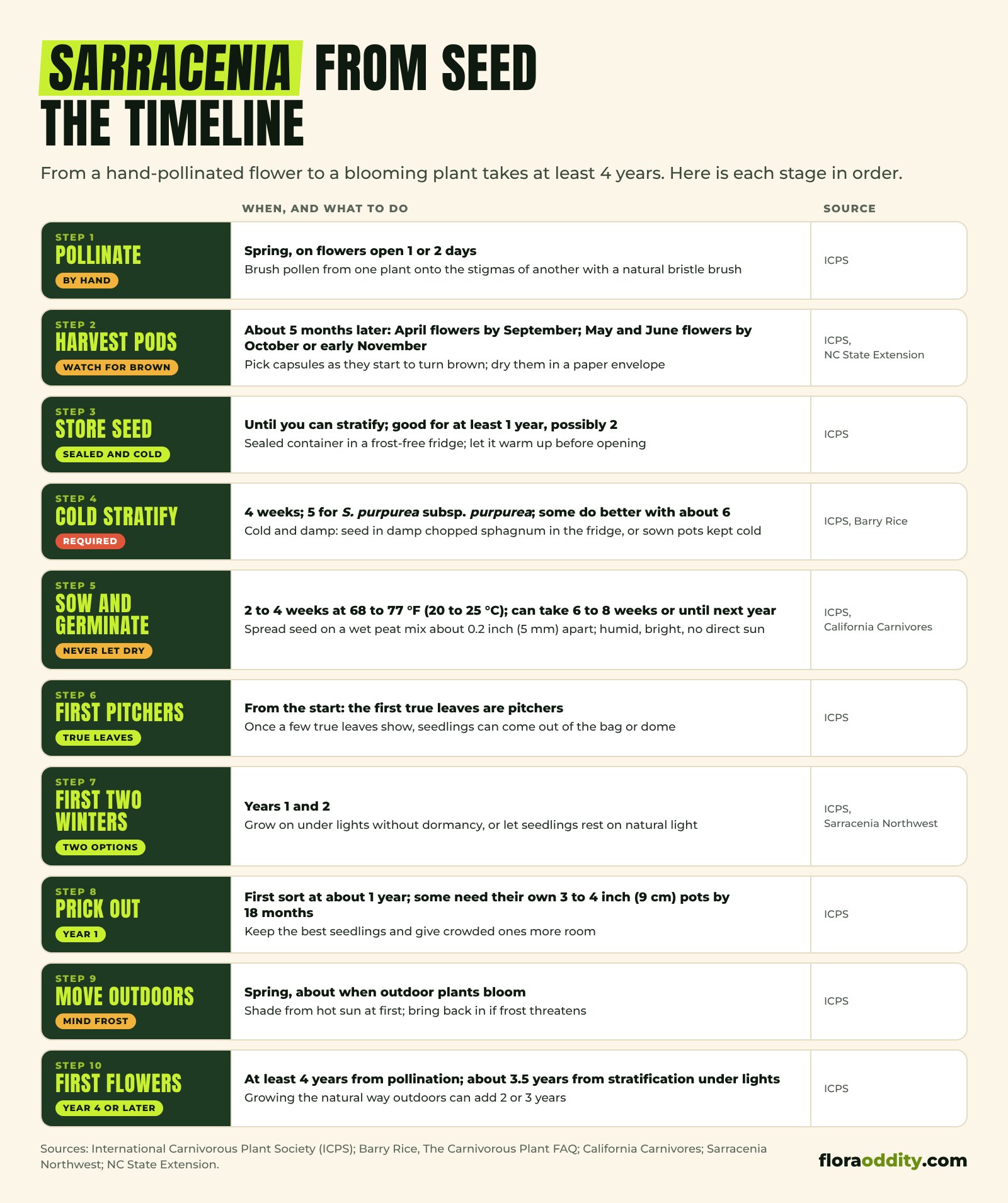
The chart below puts each stage in order, with the timings the sources give.
| Stage | When | What to do | Source |
|---|---|---|---|
| 1. Pollinate | Spring, on flowers open 1 or 2 days | Brush pollen from one plant onto the stigmas of another with a natural bristle brush | ICPS |
| 2. Harvest pods | About 5 months later: April flowers by September; May and June flowers by October or early November | Pick capsules as they start to turn brown; dry them in a paper envelope | ICPS, NC State Extension |
| 3. Store seed | Until you can stratify; good for at least 1 year, possibly 2 | Sealed container in a frost-free fridge; let it warm up before opening | ICPS |
| 4. Cold stratify | 4 weeks; 5 for S. purpurea subsp. purpurea; some do better with about 6 | Cold and damp: seed in damp chopped sphagnum in the fridge, or sown pots kept cold | ICPS, Barry Rice |
| 5. Sow and germinate | 2 to 4 weeks at 68 to 77 °F (20 to 25 °C); can take 6 to 8 weeks or until next year | Spread seed on a wet peat mix about 0.2 inch (5 mm) apart; humid, bright, no direct sun | ICPS, California Carnivores |
| 6. First pitchers | From the start: the first true leaves are pitchers | Once a few true leaves show, seedlings can come out of the bag or dome | ICPS |
| 7. First two winters | Years 1 and 2 | Grow on under lights without dormancy, or let seedlings rest on natural light | ICPS, Sarracenia Northwest |
| 8. Prick out | First sort at about 1 year; some need their own 3 to 4 inch (9 cm) pots by 18 months | Keep the best seedlings and give crowded ones more room | ICPS |
| 9. Move outdoors | Spring, about when outdoor plants bloom | Shade from hot sun at first; bring back in if frost threatens | ICPS |
| 10. First flowers | At least 4 years from pollination; about 3.5 years from stratification under lights | Growing the natural way outdoors can add 2 or 3 years | ICPS |
Getting Seed: Pollinating the Flowers
NC State Extension describes the Sarracenia flower as an upside-down umbrella on a stalk 6 to 24 inches (15 to 61 cm) tall, blooming in early spring before the first pitcher forms. To get seed from it, you will almost certainly have to play bumblebee.
Why you have to do it yourself
The ICPS explains that the flowers “do not self pollinate” and need certain bumblebees. In many areas no pollinators know how to work them, or the plants bloom before any are about. “If you don’t pollinate the flowers yourself, it will not happen and you will not get any seeds.” That gives you control over the cross, although if bumblebees do visit, the ICPS suggests a mesh bag over flowers you want to keep for a specific cross.
Finding the pollen and the stigmas
Barry Rice’s Carnivorous Plant FAQ calls the big umbrella in the middle of the flower “a huge, modified style,” with the receptive stigma as “that little hook that points downward.” To collect pollen, lift a petal: the ICPS says you will see the stamens hanging inside and, once it has been released, piles of pollen on the floor of the umbrella. Use a natural bristle paint brush, because pollen “will not stick to synthetic bristles,” and keep it off the sticky nectar globules on the ovary. Then bend up the sepals of the flower you are pollinating and dab pollen onto its stigmas, checking that it sticks.
Timing and choosing a partner
The ICPS says the stigmas are usually receptive once the petals extend and before the flower releases its own pollen, and the advice from large breeders is to pollinate flowers that have been open one or two days. Pollen can be saved by folding it into a foil envelope and freezing it; the ICPS has been told it lasts “for a month or so,” which helps when the two parents bloom at different times.
Cross with a different plant where you can. The ICPS warns that self-pollination “can result in lower seed viability and a higher frequency of runt plants,” a known problem in S. flava. Rice adds that two plants divided from the same parent are genetically identical, so crossing them “is really just the same as selfing.”
When Seed Pods Ripen and How to Collect Them
The ICPS says you “wait 5 months to see if your pollinations were successful,” and NC State Extension agrees that the pod takes five months to mature. It forms at the top of the flower, then turns brown and splits to scatter its seeds.
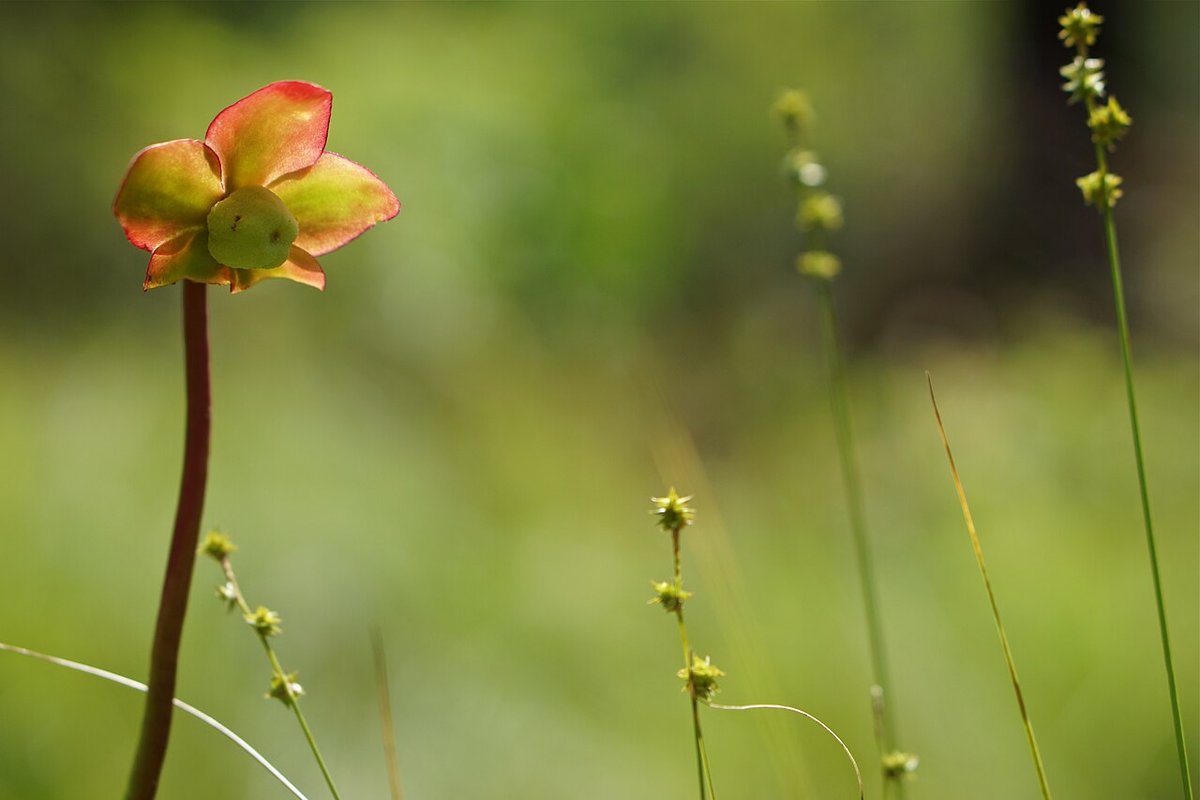
The ICPS gives the timing by flowering date: plants that bloom in April may give viable seed by mid August, “but it is best to wait until September,” while May and June bloomers may not be ready until October or early November. Pick the capsules as soon as they start turning brown, before they split, then dry them in a paper envelope and split them open. Picking earlier gains a few months, but the ICPS author rarely does it because “it is too easy to collect the seed capsules too early.”
Storing seed
Keep the seed in a sealed container in a frost-free refrigerator, and let the container warm to room temperature before opening it, or water will condense on the cold seed. “Moisture is the bane of seeds,” the ICPS says. Stored this way, Sarracenia seed should stay viable for at least a year and possibly two. California Carnivores, which also keeps seed sealed in the fridge, says it “can be stored for at least a few years.” Either way, the ICPS advice is to stratify and sow as soon as you can.
Cold Stratification
Sarracenia seed will not sprout well straight from the packet. Rice explains that seed from places with real winters is “looking for a signal to tell them that a winter has just passed,” and that Sarracenia seed “must experience a cold spell before they will germinate well.” The ICPS adds that the seed has a waxy, water-repelling coat, and is blunt about shortcuts: “There are all sorts of claims about quick methods of germinating Sarracenia seeds. DON’T WASTE YOUR TIME OR SEEDS.”
How long
The ICPS standard is 4 weeks, or 5 weeks for S. purpurea subsp. purpurea. Rice calls about four weeks “the optimal stratification time for most Sarracenia”: shorter periods give less complete germination, and longer ones can lower germination in S. leucophylla. Some, including S. purpurea subsp. purpurea, germinate faster after about six weeks, he says, though the final germination rate is the same. Carnivorous Plant Nursery sets a longer minimum; see Where Sources Differ below.
Method 1: In a bag in the fridge
Dry seed in the fridge is not stratification. The ICPS defines it as “storing the seed in a cold and damp environment,” and its easiest method is:
- Finely chop a little sphagnum moss (live is best) and dampen it with purified water, so it shows water when squeezed but leaves no free water in the bag.
- Mix the seed into the moss in a small plastic bag and refrigerate.
- If you only have peat, wet it, squeeze out most of the water, and leave plenty of air in the bag. “The seeds need air.”
Method 2: Sow first, then chill the pot
You can also sow straight onto pots and keep the whole pot cold, in a bag or under a dome, in the fridge or in a garage that stays around refrigerator temperature out of the sun. The ICPS says the pots may freeze before the seed germinates, but “the time frozen does not count toward the four weeks.” Rice prefers this route, giving sown pots “a wet, chilly winter just like the mature plants get.”
Method 3: Let winter do it
If you live where Sarracenia grow naturally, or could, the ICPS says you can sow outside in fall in 6 inch (15 cm) or larger pots of peat and sand and let nature take its course, protecting the seedlings from heavy rain. California Carnivores suggests sowing outdoors in late winter where winters are mild, so the seed gets about a month of cold nights between 20 and 40 °F (minus 7 and 4 °C). Sarracenia Northwest leaves its seed outdoors or in an unheated greenhouse all winter, and its Sarracenia “usually germinate in May.”
Sowing the Seed
After stratification, the ICPS sows on its default mix of equal parts peat and coarse sand, spreading the seed about 0.2 inch (5 mm) apart and across several pots rather than one. If you stratified in a bag, spread the moss and seed over the surface with a spoon. Carnivorous Plant Nursery uses finely milled peat with an equal amount of clean, washed horticultural sand, watered until “soaking wet.” Use purified water: the ICPS germination guide says carnivorous plants “can be killed by regular planter mix, fertilizer, and water with moderate or high dissolved solids.”
Then cover and light the pots. The ICPS puts them in plastic bags or under a humidity dome under LED lights, out of direct sun, at an ideal 68 to 77 °F (20 to 25 °C), and says “The seeds should germinate in 2 to 4 weeks.” California Carnivores places covered seed in bright indirect light with some ventilation, and warns that long spells of direct sun under a cover “may cook your little seedlings.” Label each pot with the name and date; the ICPS warns that the wait “will seem like an eternity and without the dates to check, it will be.”
Germination and Seedling Care
An ICPS photo caption of a young sprout reads: “The first true leaves are pitchers.” Once seedlings have a few true leaves they can come out of the bags, although the ICPS says keeping them covered may be more convenient, because “the pots should never dry out.” A sunny window is not enough light.
Light
The ICPS raises juvenile Sarracenia indoors under lights for two years, with lights on 16 to 18 hours a day. In the second year, it switches to a timer that follows local sunrise and sunset, because seedlings out of step with the seasons when moved outside “can lose a year of growth.”
Humidity and mold
Answering a Texas reader whose seedlings had brown tips, Jeff Dallas of Sarracenia Northwest saw mold below the browned areas and advised against a high-humidity grow tent: “Sarracenia do not need high humidity.” He also suggested separating clustered seedlings, which are “more likely to get fungal issues.” In another answer, about seed that went moldy during stratification, he warned that if mold sat on the seeds for a while, “they’re likely toast.”
Feeding
Seedlings start out tiny. Carnivorous Plant Nursery says a typical pitcher plant takes 3 to 4 years to reach a height of over 2 inches (5 cm). The ICPS says you can soil fertilize seedling and juvenile Sarracenia “if you are careful,” but warns “it is very easy to over fertilize the plants.” Once plants are big enough, it feeds dried bloodworms into the pitchers, a little at a time. This is a seedling exception: the same page calls soil fertilizing adult plants “problematic, verging on dangerous.”
The First Winters
The ICPS keeps seedlings growing: “For the first two years you can grow seedlings under lights without dormancy,” and with enough light and food, two-year-olds can match four-year-old plants grown outside with dormancy.
The alternative is to let them rest. Sarracenia Northwest says seedlings on natural light simply go dormant: “Even at our nursery, our Sarracenia seedlings stop growing and turn brown at the tips during the winter. They resume growth in Spring.” For a UK reader whose covered seedlings were browning on a heat mat by a west window, Dallas blamed lack of light and excess humidity, advised turning off the mat, and suggested removing the cover gradually over about 2 weeks. Do not throw out seedlings that look dead, he added; “they may just be dormant.” Wait until spring, remove any still brown, and do not fertilize while they rest. For browning on older plants, see why Sarracenia pitchers turn brown, and once your plants are on a natural cycle, our Sarracenia dormancy guide covers the cool winter rest they need.
When to Prick Out and Transplant
In a caption on seedling variation, the ICPS sowing guide advises planting many more seeds than you need so you can select the best plants. For Sarracenia, it says “A good time to make a first pass on keepers is when the plants are one year old,” or earlier if you sowed too thickly, and after about 18 months some plants may need their own 3 to 4 inch (9 cm) pots. Sarracenia Northwest suggested to its UK reader that late spring or early summer is the time to pot up the keepers and move them outside.
The ICPS says the best time to move indoor-raised juveniles outdoors is about when the outdoor plants bloom in spring. If frost threatens, bring them back in, and if it is hot and sunny, give a little shade so the pitchers do not burn. Sarracenia Northwest suggests partial sun at first, then full sun as they grow larger.
How Long Until Flowering Size
The ICPS says that with intense plant lights indoors or a heated greenhouse, plants can bloom about 3.5 years after the seed starts stratification, and “some of the plants will bloom at the start of their fourth year” if all goes well. Growing the natural way outdoors is fine too, but it may take an extra two or three years, depending on your climate.
Why Seedlings Differ from Their Parents
Rice notes that in Sarracenia, “all the species can hybridize, and the hybrids are fertile.” A first-generation cross is usually intermediate between its parents, but backcrosses can be very hard to spot. He describes raising what looked like a fine red S. flava from seed, only for its red petals to reveal a hybrid the first time it flowered.
Bought seed may be open pollinated. Carnivorous Plant Nursery says all of its seed is “the product of open pollination at the nursery,” so “seed offspring will often express traits unlike the parent plant,” and named cultivars “will not breed true from seed.” By contrast, Rice notes, plants propagated asexually from the same parent are genetically identical.
Expect variety even within one sowing. The ICPS says some seedlings grow exceptionally large, some always stay small, and some of the big ones may be accidental hybrids: growers wanting pure species have kept the hybrids “and tossed the real deal.” Its caption on a photo of two very different two-year-olds sums it up: “These two year old plants are siblings.” If you are unsure of your seed parent’s species, see which Sarracenia do you have.
Where Sources Differ
| Topic | One view | Another view | Context the sources give |
|---|---|---|---|
| Stratification length | ICPS: 4 weeks (5 for S. purpurea subsp. purpurea); Rice: about 4 weeks is optimal for most | Carnivorous Plant Nursery: at least 45 days below 45 °F (7 °C), and longer may help; Sarracenia Northwest calls 6 weeks “fairly short” | Rice says longer stratification can lower germination in S. leucophylla. Carnivorous Plant Nursery stratifies outdoors under cover for 28 to 35 days, with temperatures swinging between 25 and 45 °F (minus 4 and 7 °C). Sarracenia Northwest leaves its seed outdoors all winter |
| Covering the seed | Rice and Carnivorous Plant Nursery: sow on the surface, do not bury; the ICPS germination guide says most carnivorous plant seed does best unburied | ICPS seed guide: cover with one or two layers of sand; Sarracenia Northwest: a thin layer of peat, just enough to hide the seed | Carnivorous Plant Nursery says the seed needs light to germinate. Sarracenia Northwest says the peat layer helps with fungal issues; an ICPS photo caption says its sand layer is meant to reduce moss growth |
| Humidity dome | ICPS: bags or a dome until a few true leaves, and keeping the dome on can be convenient; California Carnivores: a dome or bag helps, with some ventilation | Sarracenia Northwest has stopped using domes for Sarracenia: “They cause more problems than they solve” | Sarracenia Northwest gave this answer to a UK grower whose covered seedlings were browning in winter on a heat mat by a west window |
| Time to germinate | ICPS: 2 to 4 weeks at 68 to 77 °F (20 to 25 °C) | California Carnivores: usually 6 to 8 weeks after stratification ends, and some seed not until the following year | Sarracenia Northwest says its outdoor-wintered seed usually germinates in May |
| Light for germination | ICPS: under LED lights, not direct sun | Carnivorous Plant Nursery: the same conditions as mature plants, but slightly filtered; California Carnivores: bright indirect light | Both nurseries are describing covered pots, and California Carnivores warns direct sun under a cover can cook seedlings |
| Seed storage life | ICPS: at least a year, possibly two; poorly stored seed may fail in nine months | California Carnivores: at least a few years | Both store seed sealed in the refrigerator |
| Feeding seedlings | ICPS: careful soil fertilizing; does not find foliar feeding useful | California Carnivores: a diluted fertilizer mist after germination and a monthly leaf-only feed | California Carnivores warns that feeding too often encourages moss and algae; the ICPS warns it is easy to over fertilize |
Common Mistakes
- Calling dry fridge storage stratification. The ICPS is clear that the seed must be cold and damp.
- Opening cold seed containers straight away. Condensation wets the seed. Let the container warm up first.
- Counting frozen weeks. Both the ICPS and Carnivorous Plant Nursery say time frozen does not count.
- Self-pollinating one clone. Pollen from the same plant, or a division of it, risks poor seed and runts.
- Picking pods at the wrong time. Too early and the seed may not be ripe; too late and the capsule splits and drops it.
- Sowing too thickly. An ICPS tray with too many seeds per pot gave smaller plants than expected.
- A cover in direct sun, or a window as the only light. Covered pots can overheat, and a window is not enough light.
- Throwing out “dead” seedlings in winter. Sarracenia Northwest says they may just be dormant.
FAQ: Growing Sarracenia from Seed
Can I grow Sarracenia from seed without a refrigerator?
Yes, if your winters are cold enough. The ICPS says growers in areas where Sarracenia grow, or could grow, can sow outside in fall and let winter do the stratifying, with protection from heavy rain. California Carnivores suggests a month of cold nights between 20 and 40 °F (minus 7 and 4 °C) for seed sown outdoors in late winter.
How long do Sarracenia seeds take to germinate?
After stratification, the ICPS expects 2 to 4 weeks at 68 to 77 °F (20 to 25 °C). California Carnivores says it is usually 6 to 8 weeks after stratification ends, and some seed waits until the following year. Seed wintered outdoors at Sarracenia Northwest usually comes up in May.
Do Sarracenia seedlings need dormancy in their first winter?
Not necessarily. The ICPS says you can keep seedlings growing under lights without dormancy for their first two years, switching to a natural day length in the second year. Seedlings on natural light will go dormant on their own, and Sarracenia Northwest says brown tips at that stage are normal.
Will my seedlings look like the parent plant?
Often not. Rice says all Sarracenia species can hybridize and the hybrids are fertile, and Carnivorous Plant Nursery says open-pollinated seed often gives offspring with traits unlike the parent. Named cultivars do not come true from seed.
The Bottom Line
Growing Sarracenia from seed is mostly a test of patience. Pollinate by hand with pollen from a different plant, wait about five months for the pods, and store the seed cold and sealed. Give it about 4 weeks of cold, damp stratification, sow it on the surface of a wet peat mix, and keep the pots bright, humid and never dry, but out of direct sun under a cover. Pot seedlings on at about a year, and expect the first flowers in year four or later, each plant a little different from the last.
Sources & Further Reading
- International Carnivorous Plant Society: Growing Sarracenia from Seed
- International Carnivorous Plant Society: Seed Germination Guide
- International Carnivorous Plant Society: Sowing Carnivorous Plant Seeds Step-by-Step
- Barry Rice, The Carnivorous Plant FAQ: How do I stimulate seeds to germinate?
- Barry Rice, The Carnivorous Plant FAQ: My plant is flowering! What do I do?
- Barry Rice, The Carnivorous Plant FAQ: How do I propagate my plants by sexual reproduction?
- Barry Rice, The Carnivorous Plant FAQ: Sarracenia hybrids
- California Carnivores: Seed Sowing Tips
- Carnivorous Plant Nursery: Carnivorous Plants from Seed
- Carnivorous Plant Nursery: Propagation
- Sarracenia Northwest: Q/A #17, Sarracenia Seedlings Past the Point of No Return?
- Sarracenia Northwest: Q/A #21, Sarracenia Seedlings Under Humidity Dome
- Sarracenia Northwest: Q/A #31, Moldy Seeds Won’t Germinate
- NC State Extension Gardener Plant Toolbox: Sarracenia
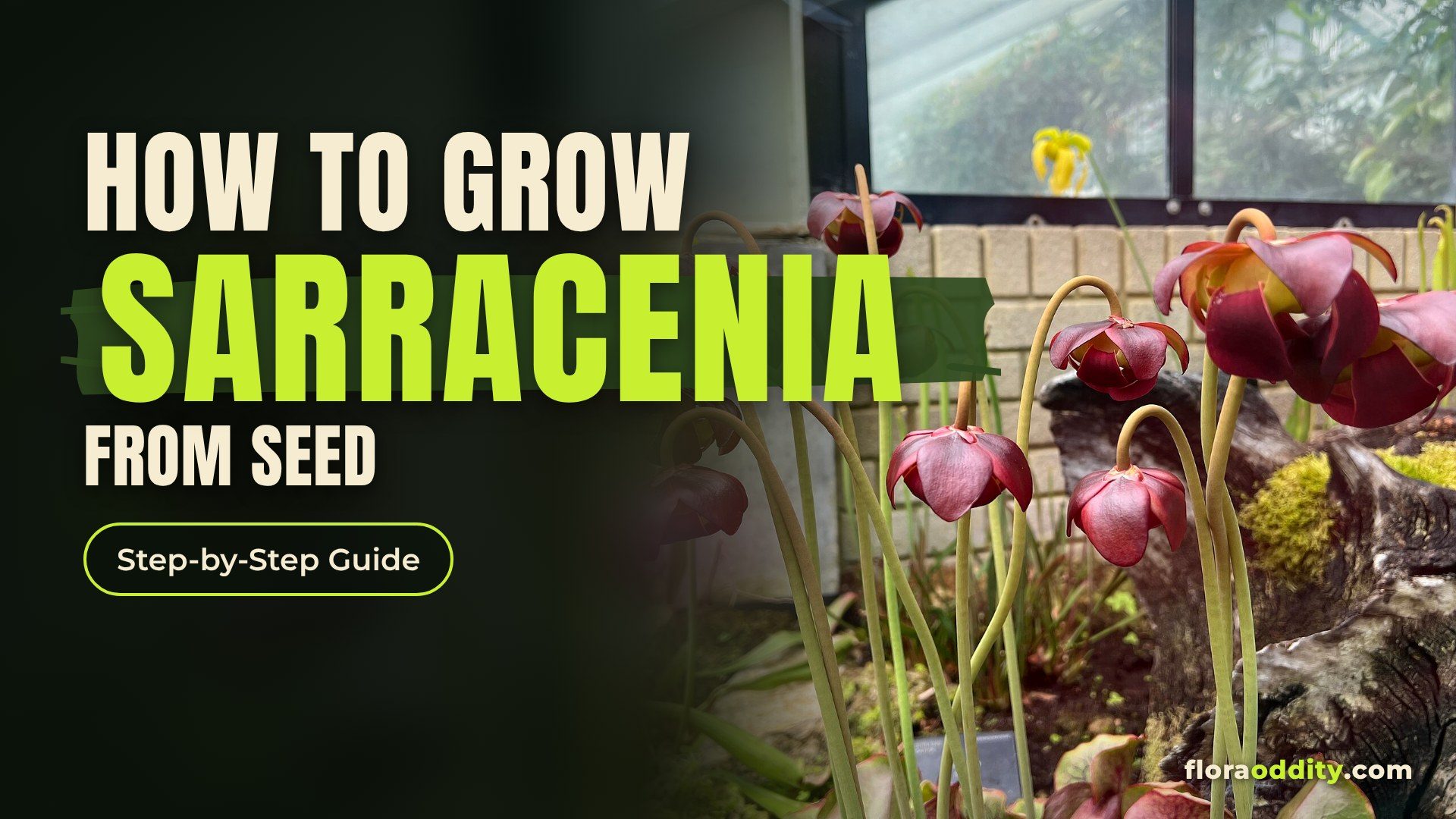
Featured image based on a photo of purple pitcher plants (Sarracenia purpurea subsp. purpurea) by Eddie Johnston via Wikimedia Commons, CC BY-SA 4.0, cropped with a dark gradient and typography added by FloraOddity. The adapted featured image is shared under the same licence.
Final articles are editorially reviewed and factual claims are checked against cited sources. Last reviewed: October 2026.
One Comment