
Seeing your Nepenthes pitchers turning brown and crispy can feel like a warning that the whole plant is in trouble. Most of the time, it is not. Pitchers are temporary structures, and every one of them eventually turns yellow, then brown, then dry. The real question is not whether a pitcher is dying, but which pitchers are dying, how many at once, and what the rest of the plant looks like while it happens.
This guide helps you tell normal aging apart from a genuine growing problem. It starts with how long pitchers actually last, then walks through the patterns that point to a specific cause, and ends with what to trim, what to leave alone, and what recovery looks like.
The Short Answer
If one of your oldest pitchers is browning from the lid or rim while the leaves and new growth look healthy, that is almost certainly normal aging. If several pitchers are drying out at the same time, or new pitchers die before they open, something in the plant’s environment has changed or is not working, and the leaves and roots are the best place to look first. Either way, a dead pitcher will not regrow on the same leaf, so recovery is measured in new leaves, not in the pitchers you already have.
Every Pitcher Has a Lifespan
A Nepenthes pitcher is not a separate organ hanging off the plant. It is part of the leaf: the leaf blade extends into a tendril, and the tendril swells into the pitcher at its tip. That matters, because it means each pitcher ages along with the leaf that made it.
According to Clemson Cooperative Extension, individual pitchers last roughly 2 to 3 months on faster-growing varieties and 6 to 12 months on slower-growing ones. When a pitcher reaches the end of that lifespan, it turns brown or black and dries out. Nothing has gone wrong. The plant is simply retiring an older trap while it puts energy into newer growth.
How long a given pitcher lasts depends on more than the calendar. Specialist growers point to a few patterns:
- Pitcher texture. Tom’s Carnivores notes that tough, woody pitchers tend to last longer than thin, papery ones.
- Species. Some species simply keep their pitchers for a shorter time. Sarracenia Northwest points out that pitchers on N. ventricosa, a common species in the hobby, do not last as long as those on many other species.
- Prey load. The same Tom’s Carnivores guide observes that pitchers that catch a lot of insects tend to die sooner. Treat this as a grower observation rather than a measured rule, but it is a useful reminder that a busy, well-fed pitcher browning early is not automatically a bad sign.
- Season. Shorter, darker winter days can lead to some pitcher loss, which Tom’s Carnivores describes as a normal response to reduced light.
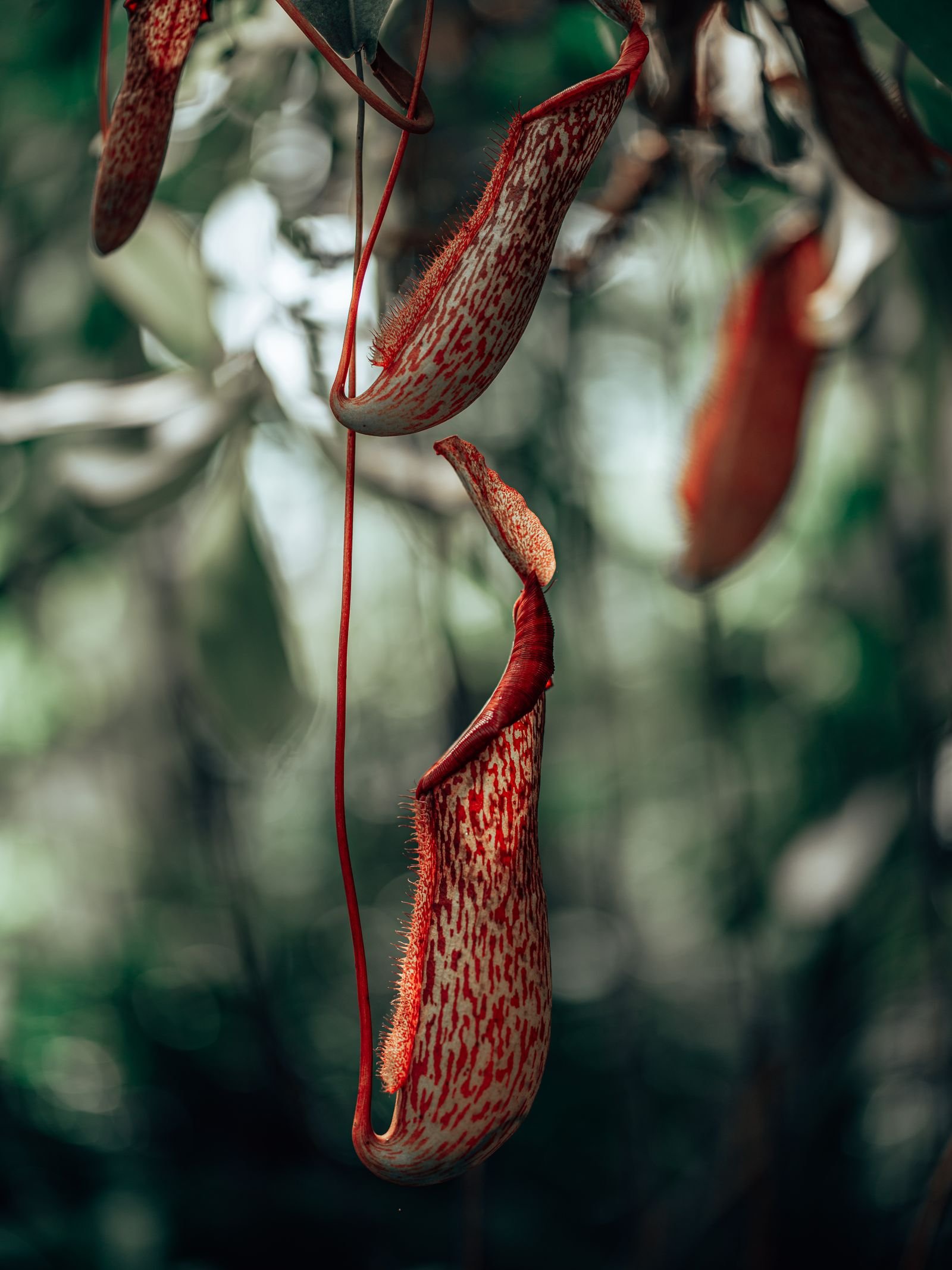
One more fact surprises many growers. Once a pitcher dies, that leaf will never make another one. As Clinton Morse of the University of Connecticut explained through Ask Extension, the pitcher is a leaf modification, so if it dies back, it does not regrow on the same leaf. The green leaf blade still photosynthesizes and is still worth keeping. New pitchers come from new leaves.
Read the Pattern Before You Change Anything
A single brown pitcher tells you very little. The pattern tells you a lot. Before you move the plant, change its watering, or buy a humidifier, look at three things: which pitchers are affected (oldest, newest, or all of them), how many are going at once, and what the leaves and potting mix look like.
The table below matches the most common patterns to their most likely causes. It is a starting point for diagnosis, not a verdict, and more than one row can apply at the same time.
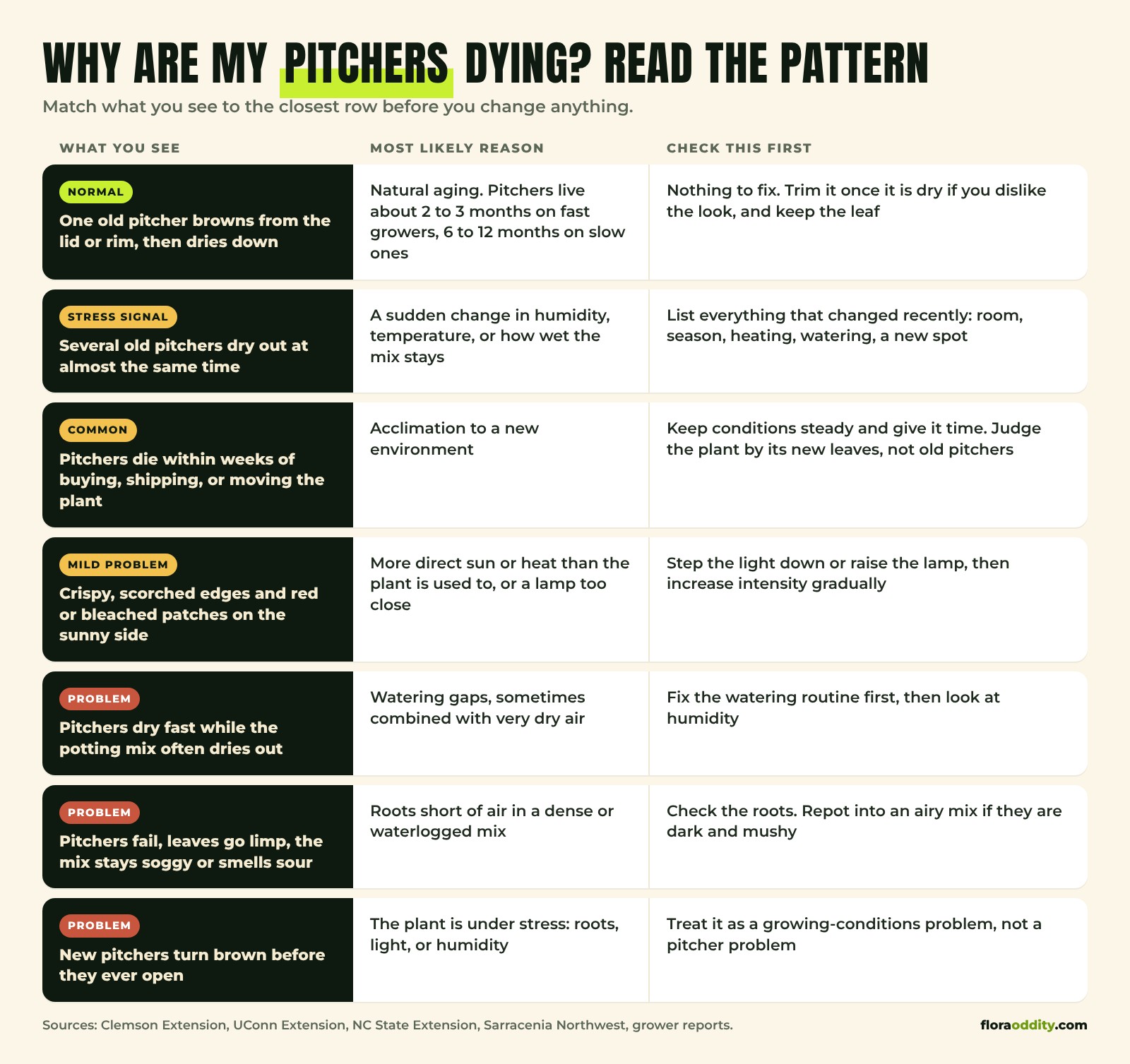
| What you see | Most likely reason | Check this first |
|---|---|---|
| One old pitcher browns from the lid or rim, then dries down | Natural aging | Nothing to fix. Trim it once it is dry if you like, and keep the leaf |
| Several old pitchers dry out at almost the same time | A sudden change in humidity, temperature, or how wet the mix stays | Make a list of what changed recently: room, season, heating, watering, location |
| Pitchers die within weeks of buying, shipping, or moving the plant | Acclimation to a new environment | Keep conditions steady and judge the plant by its new leaves |
| Crispy, scorched edges and red or bleached patches on the sunny side | More direct sun or heat than the plant is used to, or a lamp too close | Reduce the intensity, then increase it gradually |
| Pitchers dry fast while the potting mix often dries out | Watering gaps, sometimes combined with very dry air | Fix the watering routine first, then look at humidity |
| Pitchers fail, leaves go limp, the mix stays soggy or smells sour | Roots short of air in a dense or waterlogged mix | Check the roots and repot into an airy mix if they are dark and mushy |
| New pitchers turn brown before they ever open | General stress from roots, light, or humidity | Treat it as a growing-conditions problem, not a pitcher problem |
The most important split is between old pitchers and new ones. Old pitchers dying one at a time is the plant’s normal rhythm. Old pitchers dying together usually means something changed. New pitchers dying before they open means the plant is not happy with its current conditions at all.
When It Is Not Just Old Age
If your pattern points beyond normal aging, the causes below are the ones growers and extension services mention most often. They are listed roughly in the order you should rule them out.
A Recent Move or a New Plant
Pitcher loss after a move is so common that it is almost expected. Many nursery plants are grown in greenhouses with steady warmth, bright light, and high humidity. A box, a few days of shipping, and a living room with different light and drier air add up to a lot of change at once.
Sarracenia Northwest answers this question repeatedly. In one case, a reader’s N. ventricosa started blackening from the top one to two weeks after arrival, and the response was that environmental stress from changing locations commonly triggers pitcher loss, especially when the foliage itself still looks vibrant (Q/A #8). In another, a hybrid lost a pitcher lid within a week of arrival, and the advice was to allow at least a couple of months for the plant to acclimate (Q/A #82).
The mistake to avoid here is trying to fix everything at once. A grower who answers pitcher loss by misting twice a day, watering heavily, and moving the plant around is adding even more change. Pick a reasonable spot, keep the care steady, and watch the newest leaf rather than the oldest pitcher.
Sudden Changes in Humidity or Temperature
Clemson Extension makes a specific point that is easy to miss: a sudden change in the environment can cause several older pitchers to dry out at the same time. The trigger is often seasonal and unrelated to anything you did on purpose. Turning on the heating in autumn can drop indoor humidity sharply. A plant moved closer to a window in winter can be hit by cold nights. A spot that was fine in spring can turn into an oven in midsummer.
Sarracenia Northwest also lists drafts from vents and fans as something to check, because a steady stream of hot or cold air dries the plant out faster than the room average suggests.
If you see several pitchers go at once, think back over the past few weeks and ask what changed. That simple timeline usually points to the cause faster than any single measurement. For the temperature side of this, our guide to Nepenthes temperature for highland and lowland types explains how day and night ranges differ between groups.
Dry Media and Very Dry Air
Pitchers are thin, exposed tissue, so they are often the first part of the plant to show water stress. Bloomscape describes brown, crispy pitchers as a typical result of a plant being left too dry, with low humidity making it worse, and explains that the plant sheds pitchers to conserve energy during drought stress.
Look at the potting mix before you look at the air. If the mix regularly dries out between waterings, that is the first thing to correct. Nepenthes like a mix that stays evenly moist without sitting in water, and a steady watering routine is usually easier to fix than the humidity of a whole room. Our guide on how to water a Nepenthes indoors covers water type, frequency, and drainage in detail.
Very dry air can still play a role, especially next to a heater. NC State Extension notes that when humidity is too low, pitchers may not develop properly or may die back. How low is too low is where sources start to disagree, which we cover in its own section below.
Too Much Sun or a Lamp Too Close
Nepenthes need bright light to grow well and to keep making pitchers, but they can burn. Tom’s Carnivores lists excessive direct sun as one of the most common causes of browning on tropical pitcher plants, and recommends an east or west window that gets direct sun for part of the day rather than all day.
Sun damage usually looks different from aging. Instead of one pitcher browning from the lid down, you see crispy edges, bleached or reddened patches on the side facing the light, and damage on leaves as well as pitchers. A sudden jump in light is the usual trigger. Sarracenia Northwest describes exactly this in Q/A #13, where a plant moved to a sunny balcony picked up minor burn while the rest of it stayed healthy. Pale, bleached patches dotted with tiny black spots point to something else: thrips, which our guide to Nepenthes pests covers.
Grow lights can do the same thing. In Q/A #82, a compact fluorescent bulb placed about 6 to 8 inches (15 to 20 cm) from the plant was flagged as a possible source of drying heat. If you grow under lights, raise the fixture or lower the intensity and increase it again in steps. Our guide to how much light a Nepenthes needs explains how to judge window light and lamp distance.
Roots That Stay Too Wet
This is the cause that most quick guides skip, and it can look confusingly similar to dryness. When roots sit in a dense, waterlogged mix, they run short of air and start to fail. Damaged roots cannot supply water properly, so pitchers dry out even though the pot is wet.
A thread on TerraForums about N. pulchra is a good example. The grower kept humidity near 100 percent and misted constantly, yet the pitchers kept blackening before or soon after opening. Experienced members suspected the roots: the mix was dense and moisture-retentive, air movement was poor, and the plant was effectively sitting in stagnant conditions. Their advice was to repot into a lighter, airier mix and improve airflow. This is one grower’s case rather than a controlled test, but it matches a broader principle: more water and more humidity are not always the fix.
Warning signs that point to the roots include leaves that look limp or dull despite moist mix, a sour smell from the pot, and a mix that has broken down into fine, compacted material. If you suspect root trouble, our guide to the best potting mix for Nepenthes explains what an airy mix looks like, and how to repot a Nepenthes covers the process and what to expect afterward.
Pitchers That Die Before They Open
Sometimes the problem is not old pitchers dying but new ones failing before they ever get going. Some growers call this pitcher blasting, a term used by Collectors Online for pitchers that brown and dry out before fully opening. Barry Rice’s Carnivorous Plant FAQ also notes that with inadequate humidity, tendrils may not successfully develop pitchers.
This pattern overlaps with a plant that is not making pitchers at all, and the causes are largely the same: light, humidity, roots, and recent changes. Rather than repeat them here, our guide to why a Nepenthes is not producing pitchers walks through each one.
The Humidity Question: Why Growers Disagree
If you search for why Nepenthes pitchers dry out, you will find very different answers about humidity. It is worth understanding why, because it changes what you should do.
Some sources treat high humidity as essential. Collectors Online states that humidity falling below 50 percent for extended periods will usually stop pitcher production entirely, and Tom’s Carnivores suggests aiming for around 60 to 70 percent during the day. NC State Extension also lists high humidity among the plant’s needs.
Others push back hard. Jeff Dallas of Sarracenia Northwest argues that most Nepenthes commonly found in cultivation do fine in household humidity and that misting does the plant no good (Q/A #37).
Both views can be true in their own context. Many plants sold today are hybrids that adapt well to average homes, especially once they have had time to acclimate, while some species are far less forgiving. A plant that grew up in a humid greenhouse may also need time before it can produce pitchers that hold up in drier air. That is why a sudden drop in humidity can cause losses even for a plant that would eventually cope with lower levels.
The practical takeaway: before you invest in humidity equipment, rule out watering, light, and roots. If those are right and pitchers still dry out early, then humidity is a reasonable next suspect. Our indoor humidity guide goes deeper into which plants are most sensitive and how to raise humidity without creating stagnant air.
Should You Cut Off Dead Pitchers?
You can, but you do not have to. A brown pitcher no longer does anything useful, and removing it is mostly about appearance and tidiness.
A few guidelines keep it simple:
- Wait until it is mostly dry. A pitcher that is only partly brown may still be working, especially if its lower half is firm. Bloomscape suggests removing pitchers once they are more than half brown and dried out.
- Cut the pitcher, keep the leaf. Use clean scissors and cut through the tendril just below the dead pitcher. The green leaf blade still photosynthesizes, as UConn’s Clinton Morse explains, so leave it in place unless it is also dying.
- Do not expect a new pitcher in its place. Sarracenia Northwest points out in Q/A #162 that removing dead pitchers does not trigger new ones. Only better growing conditions do that.
- Remove whole leaves only when they are dead. A yellowing older leaf with a dead pitcher can be removed once it has fully browned. Healthy green leaves are worth keeping even without a pitcher.
What Recovery Looks Like
Because dead pitchers do not come back, the old ones will not tell you whether your changes worked. The new growth will.
Signs that the plant is recovering include a new leaf unfolding at the growing tip, a tendril that stays firm and green, and a tendril tip that starts to swell into a small pitcher. If the next one or two pitchers develop and open normally, your conditions are likely on track.
How long this takes depends on the plant. Sarracenia Northwest notes that a healthy, established plant may bounce back quickly, while a plant that lost roots or was shipped bare-root can take much longer. For a plant that is settling into a new home, the advice in Q/A #82 is to allow at least a couple of months. Slow-growing species may need longer still. Patience is part of the fix.
Common Mistakes
- Changing everything at once. If you move the plant, change its water, start misting, and repot in the same week, you will not know what helped, and the plant has to adjust to all of it at once.
- Treating every brown pitcher as an emergency. One old pitcher dying is normal. Check the pattern before you act.
- Misting heavily to fix dry pitchers. Constant misting rarely raises humidity for long, and combined with soggy mix and poor airflow it can make root problems worse.
- Cutting off healthy leaves. The leaf feeds the plant even after its pitcher is gone.
- Repotting in a panic. Repotting can fix a broken-down mix, but Barry Rice’s FAQ notes that it often sets plants back a bit. Do it when the roots or mix give you a real reason, not as a first reaction to a brown pitcher.
- Moving a plant straight into strong sun. More light is often the right long-term goal, but raise it gradually.
FAQ: Nepenthes Pitchers Turning Brown
Is my Nepenthes dying if the pitchers are turning brown?
Usually not. If the leaves are firm and green and the plant is still producing new leaves, browning pitchers are most likely aging or a reaction to a recent change. Worry more if the leaves are also yellowing, wilting, or turning black, or if new growth has stopped.
What is the difference between pitchers turning yellow and turning brown?
Yellowing is often the first stage of a pitcher aging, and it usually continues to brown and then dry. Yellowing across the leaves themselves is a different issue and points to the plant as a whole rather than the pitchers, so look at light, roots, and watering. Our guide to Nepenthes leaves turning yellow, black, or red covers that in detail.
Will a dead pitcher grow back?
No. The pitcher is part of the leaf, so once it dies, that leaf will not make another. New pitchers form on new leaves.
Why did my pitcher turn black from the top after catching insects?
Pitchers that catch a lot of prey can age faster, according to Tom’s Carnivores, so a heavily fed pitcher browning a little early is not unusual. If the lower part of the pitcher still looks firm, it may still be working. Remove it once it is mostly dry. If you feed your plant yourself, our guide on how to feed a Nepenthes explains how much to give.
How long until my Nepenthes makes new pitchers?
It varies with the plant and its conditions. An established, healthy plant usually responds faster once conditions improve, while a recently shipped, bare-root, or repotted plant may need a couple of months or more to settle in before new pitchers form.
The Bottom Line
Brown and dry pitchers are a normal part of growing Nepenthes. Each pitcher has a limited lifespan, and the oldest ones will always be the first to go. What matters is the pattern: one old pitcher at a time is routine, several at once suggests a recent change, and new pitchers dying before they open points to the plant’s growing conditions. Check what changed, look at the roots and watering before buying equipment, keep conditions steady, and judge success by the next new leaf rather than the pitchers you already have.
Sources & Further Reading
- Clemson Cooperative Extension: Tropical Pitcher Plants (Nepenthes spp.)
- Ask Extension (University of Connecticut): Does Nepenthes replace lost pitchers?
- NC State Extension Gardener Plant Toolbox: Monkey Cups (Nepenthes)
- Sarracenia Northwest: Q/A #8, Nepenthes Pitchers Turning Black
- Sarracenia Northwest: Q/A #13, Nepenthes Identified with Sunburn
- Sarracenia Northwest: Q/A #37, Nepenthes Needs Time to Acclimate
- Sarracenia Northwest: Q/A #82, Nepenthes Pitcher Is Drying Up
- Sarracenia Northwest: Q/A #162, Troubleshooting a Pitcherless Nepenthes
- Barry Rice, The Carnivorous Plant FAQ: Nepenthes
- Tom’s Carnivores: Why is my pitcher plant dying or turning brown?
- Collectors Online: Nepenthes Pitcher Failure Guide
- Bloomscape: Why are the pitchers on my Pitcher Plant brown and crispy?
- TerraForums: Pitcher die-off on Nepenthes pulchra
Final articles are editorially reviewed and factual claims are checked against cited sources. Last reviewed: October 2026.

3 Comments