
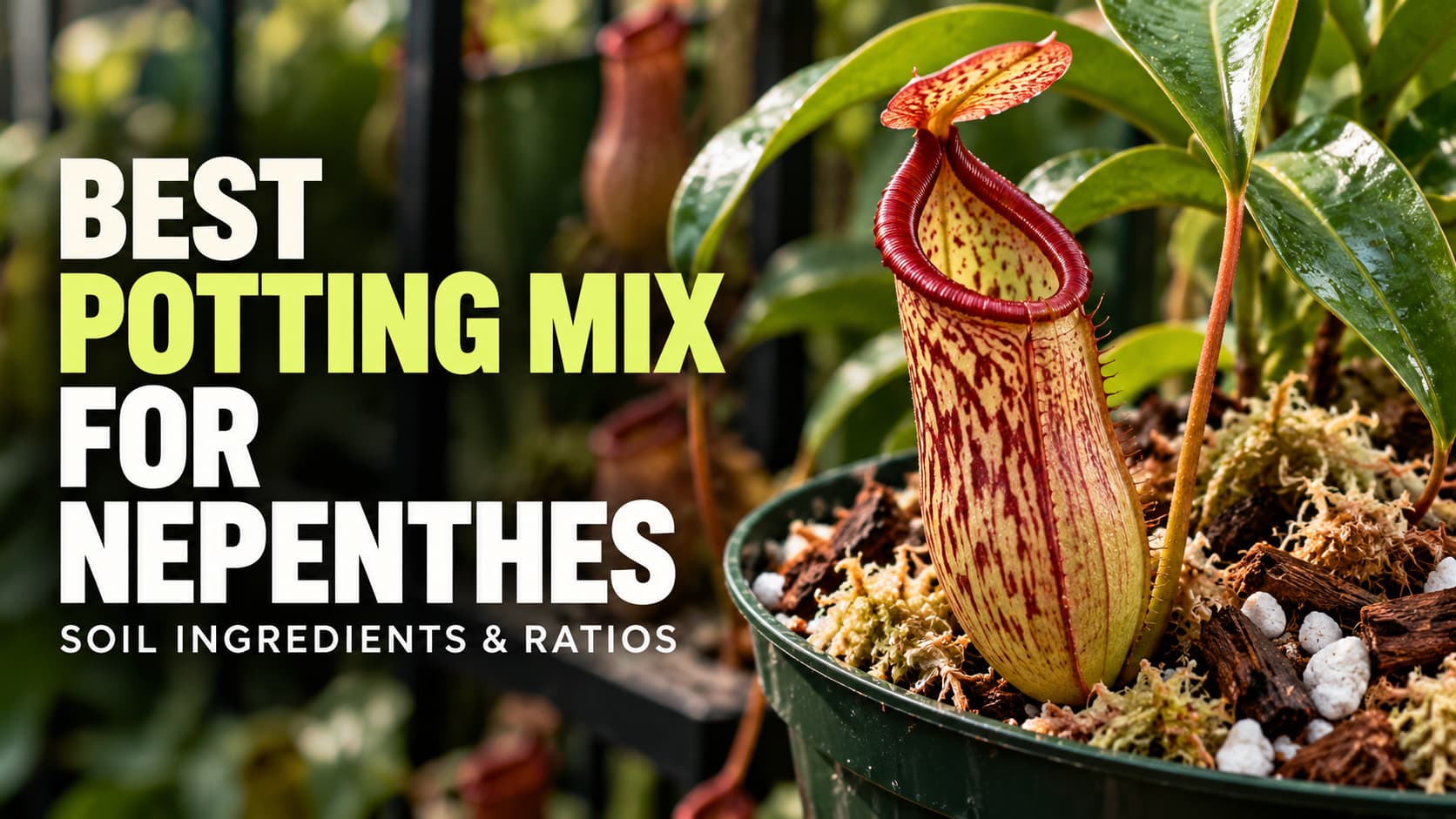
The best potting mix for Nepenthes is not the same thing as ordinary houseplant soil. Tropical pitcher plants need a growing medium that stays moist while leaving plenty of air around their roots. If the mix becomes dense, stays saturated for too long, or contains added fertilizer, the root environment can become a bigger problem than the watering routine itself.
Fortunately, Nepenthes do not need a complicated recipe. A simple mix built around long-fiber sphagnum moss and a coarse aerating ingredient such as perlite is enough for many commonly grown plants. Orchid bark, coco chips, or tree fern fiber can also be useful depending on the grower’s conditions and the size of the plant.
The trick is understanding why each ingredient is there, because a recipe that looks perfect on paper can still behave badly in a particular pot.
What Kind of Soil Does a Nepenthes Need?
Nepenthes generally prefer a light, acidic, low-nutrient medium that can hold moisture without collapsing into a compact mass. NC State Extension describes Nepenthes as thriving in sphagnum moss or orchid-style mixes with additions such as peat and perlite, while Clemson Extension recommends a light, low-nutrient mix built from sphagnum moss or tree fern fiber, perlite or pumice, and orchid bark.
Sarracenia Northwest takes an even simpler approach for many commonly cultivated Nepenthes: one part dried sphagnum moss to one part perlite. Their care guide emphasizes that the medium should stay moist while still allowing excess water to drain and air to reach the roots.
That gives us a useful principle:
Nepenthes media should be moist, airy, free-draining, and low in nutrients.
The Most Useful Ingredients for a Nepenthes Potting Mix
You do not need to buy every ingredient you see in specialist mixes. Start with the materials that solve the two basic jobs: water retention and aeration.
Long-fiber sphagnum moss
Long-fiber sphagnum, often shortened to LFS, is one of the most common Nepenthes media ingredients. It holds moisture, provides structure, and is much more open than ordinary garden soil.
Quality matters. Avoid sphagnum products with fertilizer or added nutrients. Rehydrate dried sphagnum thoroughly before potting, then gently tease it apart rather than packing it into the pot as a dense block.
Sphagnum can work particularly well for growers who want a medium that is easy to inspect and that holds moisture around the roots without behaving like heavy soil.
Long-fiber sphagnum, alone or mixed with perlite, is also one of the standard media for rooting stem cuttings. Our guide on how to propagate Nepenthes from cuttings covers that use.
Perlite
Perlite is the aerating partner in many Nepenthes mixes. It creates larger air spaces, reduces compaction, and allows water to move through the pot more freely.
Carnivero specifically recommends perlite as an aerating ingredient and notes that it helps reduce media compaction. Pre-wet perlite before mixing if dust is a concern.
Use horticultural perlite that is free of fertilizer additives. Coarser particles are generally more useful for creating lasting air space than very fine dust.
Orchid bark
Orchid bark adds physical structure and aeration while retaining a smaller amount of moisture. Clemson Extension includes orchid bark in its recommended Nepenthes substrate approach.
The important part is choosing a bark intended for horticultural use, not softwood chunks that break down rapidly. Sarracenia Northwest has specifically warned that softwood bark can deteriorate and reduce long-term aeration.
Coco chips or coco coir
Coco products can be useful in more open mixes. Carnivero uses leached coco chips in one of its Nepenthes recipes because they contribute both aeration and moisture retention.
The word leached matters. Coco products can contain salts, so they should be prepared appropriately for carnivorous plants rather than assuming every bag of coir is ready to use.
Pumice
Pumice can substitute for perlite when you want a heavier, durable mineral component. Both Clemson Extension and specialist growers mention pumice as an aerating option.
Pumice is especially useful in situations where lightweight perlite shifts easily or becomes difficult to keep evenly distributed through the mix.
Tree fern fiber
Tree fern fiber appears in some Nepenthes-growing recipes and is listed by Clemson Extension as an option alongside sphagnum moss. It can provide structure, moisture retention, and long-lasting aeration.
Availability varies by country, so there is no reason to make it mandatory for a beginner setup.
Simple Nepenthes Potting Mix Ratios
To work out how much of each ingredient your pots need, try our soil mix calculator.
There is not one official ratio that every Nepenthes grower follows. Different respected growers use different recipes because the ingredients behave differently and growing conditions are different.
Here are three practical recipes based on current extension and specialist guidance.
| Mix | Ratio by volume | Best use |
|---|---|---|
| Simple mix | 1 part sphagnum + 1 part perlite | Reliable starting point for many common Nepenthes |
| Extra airy mix | 1 part sphagnum + 2 parts perlite | Small pots, wetter rooms, or growers who need faster drainage |
| Structured mix | 1 part sphagnum + 1 part perlite + 1 part orchid bark | Plants that benefit from additional long-term structure |
Sarracenia Northwest recommends a 1:1 dried sphagnum to perlite mix for many Nepenthes. In another grower Q&A, the same nursery has suggested that peat can be used with considerably more perlite, around one part peat to two or three parts perlite, when aeration needs to be increased.
Clemson Extension’s published indoor mix is different again, listing approximately 60% sphagnum moss, 20% perlite, and 20% orchid bark. That difference is worth paying attention to. It shows that the ingredient list matters, but the final behavior of the medium matters more than copying a recipe blindly.
How to Choose the Right Mix for Your Room
The best mixture for your Nepenthes depends partly on how quickly your particular pot dries.
Suppose the plant sits in a warm room with bright artificial light, an open pot, and strong air movement. The mix may lose moisture quickly. In that situation, a higher proportion of sphagnum can help maintain a steadier root environment.
Now imagine a dimmer room with cooler temperatures, high ambient humidity, and a large pot. The same moisture-retentive mix may stay wet for far too long. A chunkier, more heavily aerated mix can make more sense.
This is why there is no magic “Nepenthes soil ratio” that wins in every home.
FloraOddity’s guides on How to Water a Nepenthes Indoors and Does Nepenthes Need High Humidity? cover the environmental side of this equation. The substrate is one part of the system, not a separate variable.
Should You Use Peat Moss for Nepenthes?
You can, but peat-heavy mixes need caution.
NC State Extension includes peat as a possible ingredient in Nepenthes mixes, while Sarracenia Northwest explains that peat can be used when enough aerating material is added. Their example is around one part peat to two or three parts perlite, rather than a dense equal-parts peat and perlite mix.
The problem with a peat-heavy medium is not simply that peat is “bad.” The problem is that a dense, fine medium can retain water while losing the air spaces Nepenthes roots need.
If your mix becomes muddy, compacted, or slow to drain, the issue is the physical structure of the medium rather than the name on the bag.
Can You Use Regular Potting Soil?
No. Avoid standard houseplant potting soil and garden soil for Nepenthes.
NC State Extension states that carnivorous plants cannot tolerate garden soil as a potting medium. Specialist growers likewise warn against conventional potting soil and compost because the nutrient and mineral content can damage carnivorous plants.
The same warning applies to mixes advertised as “fertilized,” “feed enriched,” or “slow-release.” Nepenthes are not ordinary foliage plants that need a nutrient-loaded root medium.
If you want to feed a Nepenthes, that is a separate decision from choosing the potting mix. Our guide on how to feed a Nepenthes covers insects, dilute fertilizer, and what to avoid.
What Should Not Be in a Nepenthes Potting Mix?
- Garden soil
- Standard fertilized houseplant mix
- Compost
- Slow-release fertilizer pellets
- Mineral-rich amendments added without a specific reason
- Very fine material that turns the pot into a dense, airless mass
Be especially skeptical of “all-purpose” soil blends. They may look fluffy in a bag and then collapse after several waterings.
Why Drainage Matters More Than the Recipe on the Label
A recipe can contain the correct ingredients and still behave badly.
How you pack the medium, how fine the ingredients are, the size of the pot, the amount of root mass, room temperature, light, airflow, and watering habits all change how fast the pot dries.
Two plants can both be potted in a 1:1 sphagnum and perlite mix and still have completely different moisture patterns.
This is why a useful test is to water the plant thoroughly and then watch the pot for several days. Does water run through freely? Does the container become noticeably lighter as it dries? Does the medium remain saturated for an unusually long time?
Those observations tell you more than the recipe alone.
How to Mix Nepenthes Substrate Correctly
Once you have chosen the ingredients, the actual mixing process is straightforward.
- Prepare clean containers and tools. Avoid introducing fertilizer residue or garden soil into the new medium.
- Hydrate dry sphagnum thoroughly. Let it absorb water and expand before mixing.
- Rinse ingredients when appropriate. Coco products in particular should be prepared according to their source and intended use.
- Mix by volume. Use a consistent cup or container so your ratios stay repeatable.
- Keep the texture open. Do not compress the finished mix into a dense ball.
- Pre-moisten the medium. A slightly damp mix is easier to pot and reduces the chance of dry pockets.
The medium should feel springy and open rather than muddy. When you squeeze a handful, it should not collapse into a hard lump.
How Tightly Should You Pack the Pot?
This is a small detail that can change the whole result.
Nepenthes roots benefit from an airy medium. Stuffing the pot tightly with sphagnum can remove the very air spaces you added perlite or bark to create.
Fill the pot gently and settle the plant without heavily compressing the substrate. The roots should be supported, but the mix should remain open enough for water and air to move through it.
A loose mix also makes future watering easier because excess water can leave the root zone instead of pooling in a compact layer.
What Pot Should You Use With Nepenthes Mix?
The pot and the medium work together.
Choose a container with drainage holes. A hanging pot can work well for vining Nepenthes, while a standard nursery pot is practical for smaller plants.
You do not need an enormous container just because the plant eventually becomes large. An oversized pot can hold more wet medium than a small root system can use, which may slow drying.
On the other hand, a root-bound plant or rapidly growing vine may eventually need more room.
When you repot, think about the condition of the existing medium rather than automatically following a calendar. Clemson Extension suggests repotting when the plant outgrows the container or the potting medium has broken down, while Sarracenia Northwest likewise recommends repotting when the mix becomes compacted or stops draining well.
When Should You Repot a Nepenthes?
Look for practical signs.
- The medium has broken down into a dense mass.
- Water no longer drains the way it used to.
- The plant has clearly outgrown its current container.
- The substrate has become difficult to re-wet evenly.
- The plant is declining and the root-zone condition is suspicious.
Do not repot simply because a calendar says two years have passed. Clemson Extension currently gives two to three years as a general repotting interval, but its actual triggers are the condition of the pot and medium.
That distinction matters because repotting itself can disturb roots and temporarily interrupt pitcher production.
How Do You Know Your Nepenthes Mix Is Working?
A healthy substrate does not need to look glamorous. It needs to behave predictably.
You are generally looking for:
- Moisture that persists without the pot staying permanently saturated
- Fast, obvious drainage when you water
- A texture that remains open after repeated watering
- Roots that are not sitting in stagnant conditions
- New growth that continues when the rest of the environment is appropriate
When a Nepenthes refuses to produce pitchers, do not automatically replace the medium. Check the timeline first. Was the plant recently repotted? Did the light change? Did watering change? Did humidity change?
FloraOddity’s pitcherless Nepenthes troubleshooting guide walks through those questions in a broader diagnostic order.
Three Nepenthes Mixes to Try
1. The simple beginner mix
1 part long-fiber sphagnum + 1 part perlite
This is the easiest place to start. It is close to the 1:1 recipe published by Sarracenia Northwest and provides a straightforward balance between moisture retention and aeration.
2. The extra-airy mix
1 part sphagnum + 2 parts perlite
This is useful when your room is humid, the pot stays wet too long, or you are using a small container where drainage needs to be especially quick. It also follows the general direction of Sarracenia Northwest’s more heavily aerated peat-based example.
3. The structured mix
1 part sphagnum + 1 part perlite + 1 part orchid bark
This adds a chunkier component that can help maintain structure as the medium ages. Clemson Extension’s current recommended ingredients also combine sphagnum, an aerating mineral component, and orchid bark.
None of these recipes is a law. Start with one, observe how it behaves, and adjust only when you have a reason.
What Growers Report
Potting mix recipes are one of the most discussed topics on grower forums. These are single growers’ results in their own conditions, not rules, but they show how pot size, plant type and preparation change the way the same ingredients behave.
- A grower who uses coconut husk chips alongside perlite and long-fiber sphagnum found that the chips act like small sponges that roots grow into, and that chips from plants potted several years earlier were “slightly darker but still fully intact” when unpotted. The same grower soaks the chips well first in case the husk holds salt (Tony Paroubek, Terraforums, June 2005)
- A grower in Montana finds that pure long-fiber sphagnum works well in pots of 4 inches (10 cm) and smaller, but that “over 4 inches and it tends to pack down” and starts to harm the plant, so larger pots get orchid bark or a similar chunky ingredient mixed in (rattler, Terraforums, April 2011)
- A grower who repotted a whole collection into 70 parts dried Chilean sphagnum, 20 parts peat and 10 parts orchid bark forgot to soak the peat first. Some plants showed stress soon after, the pots floated when set in a tray of water, and every plant had to be unpotted so the mix could be properly soaked and repotted, this time with bark in the bottom of each pot for faster drainage. Five days after a thorough watering, “this media is still fairly damp”, which made the grower question how sphagnum-heavy a mix should be (summit, Terraforums, March 2016)
- A grower on the Carnivorous Plants UK forum uses two mixes: lowland plants get one fifth dead sphagnum, one fifth perlite, one fifth peat and two fifths Orchiata bark of 9 to 12 mm, while highland plants get two thirds dead sphagnum and one third perlite, because in that grower’s conditions “highland plants are not growing very well in peat-base medium” (vincent, Carnivorous Plants UK forum, March 2019)
Our takeaway: none of these growers used exactly the same recipe, but the same lessons keep coming up. Pure sphagnum that suits a small pot can compact in a large one, dry ingredients must be fully soaked before potting, a sphagnum-heavy mix can stay wet for days, and lowland and highland plants may need different mixes. Start with a simple mix, then let your pot size, plants and room decide what to change.
Common Nepenthes Potting Mix Mistakes
Using a fine, compact mix because it “holds moisture better”
Holding moisture is only half the job. If the medium loses most of its air spaces, the roots can suffer.
Adding fertilizer to the substrate
Nepenthes do not need a nutrient-loaded root medium. Keep the substrate low in nutrients and treat feeding separately.
Using soft bark that decomposes quickly
Cheap bark is not automatically equivalent to orchid bark. As it breaks down, it can change drainage and aeration.
Copying someone else’s recipe without considering the room
A mix that works in a cool greenhouse may stay too wet in one home and dry too quickly in another. Your environment changes the outcome.
Compressing sphagnum around the roots
Firmly anchoring a plant is useful. Turning the whole pot into a dense block is not.
FAQ: Nepenthes Potting Mix
What is the best potting mix for Nepenthes?
A simple starting point for many cultivated Nepenthes is equal parts long-fiber sphagnum moss and coarse perlite. Other well-aerated mixes can work too, including recipes that add orchid bark or coco chips.
Can I use peat moss for Nepenthes?
Yes, but it needs enough aerating material. Specialist guidance recommends using considerably more perlite when peat is the main moisture-retaining ingredient.
Can Nepenthes grow in orchid bark?
Yes. Orchid bark can be part of an airy Nepenthes mix and is specifically included in Clemson Extension’s recommended ingredient set. Avoid bark that breaks down quickly or has added fertilizer.
Can I use coco coir for Nepenthes?
You can, especially in a chunky mix. Make sure the coco product is appropriate for carnivorous plants and has been properly leached of salts.
Should Nepenthes soil dry out completely?
No. Nepenthes generally prefer a moist growing medium, but that does not mean the pot should remain stagnant and saturated. Read the behavior of the substrate together with your watering routine.
Why is my Nepenthes soil staying wet for days?
Check the pot size, light, temperature, humidity, airflow, and texture of the medium. A fine or compact mix can stay wet much longer than an airy mix.
When should I repot a Nepenthes?
Repot when the plant outgrows the container or when the medium has broken down, become compacted, or stopped draining properly. Avoid repotting repeatedly without a clear reason.
The Bottom Line
The best Nepenthes potting mix is not the one with the longest ingredient list. It is the one that gives the roots a stable combination of moisture, air, drainage, and low nutrients.
For many growers, a simple 1:1 sphagnum and perlite mix is enough to build a healthy starting point. From there, your room tells you whether the medium needs more structure, more aeration, or more moisture retention.
Do not chase the perfect recipe. Build a mix that behaves well in your actual growing conditions, then leave the plant alone long enough to show you whether it works.
Sources & Further Reading
- Clemson Extension: Tropical Pitcher Plants (Nepenthes spp.)
- NC State Extension Gardener Plant Toolbox: Nepenthes
- Sarracenia Northwest: How to Grow Nepenthes
- Sarracenia Northwest Q&A #131: Nepenthes Seems to Be Dying
- Sarracenia Northwest Q&A #67: Nepenthes Stem Looks Rotted and Black
- Carnivero: Soil Mixing Guide
- Sarracenia Northwest: Pot and Soil
Final articles are editorially reviewed and factual claims are checked against cited sources.

8 Comments