Most Lithops problems trace back to one thing: water arriving at the wrong moment in the plant’s yearly cycle. Wisconsin Horticulture puts it plainly when it says over-watering “is the chief cause of early demise,” and that too much water makes the plants rot or “produce new bodies at the wrong time of year.” Light comes second, then a short list of pests that live in or around the pot.
The tricky part is that a healthy living stone often looks worse than a sick one. Every year the old pair of leaves wrinkles, shrinks and dries to a papery husk while a new pair grows inside it. Water it then, mistaking the change for thirst, and you cause the trouble you meant to prevent. Below, each symptom is matched with its usual cause and the fix that extension services, nurseries and growers suggest.
The Short Answer
Before you treat anything, press the plant gently and look into the fissure between the leaves. A firm plant with wrinkles, especially while a new leaf pair is showing in the middle, is usually doing what it should. Mountain Crest Gardens advises that if you find a smaller pair of leaves developing inside, you should not water, because the plant “is transferring water from the older leaves to the younger leaves.”
Soft, squashy tissue is the real warning sign. It means rot, nearly always from watering in the wrong season, rain, or a mix that stays wet. Stop watering, unpot the plant and check the roots and base.
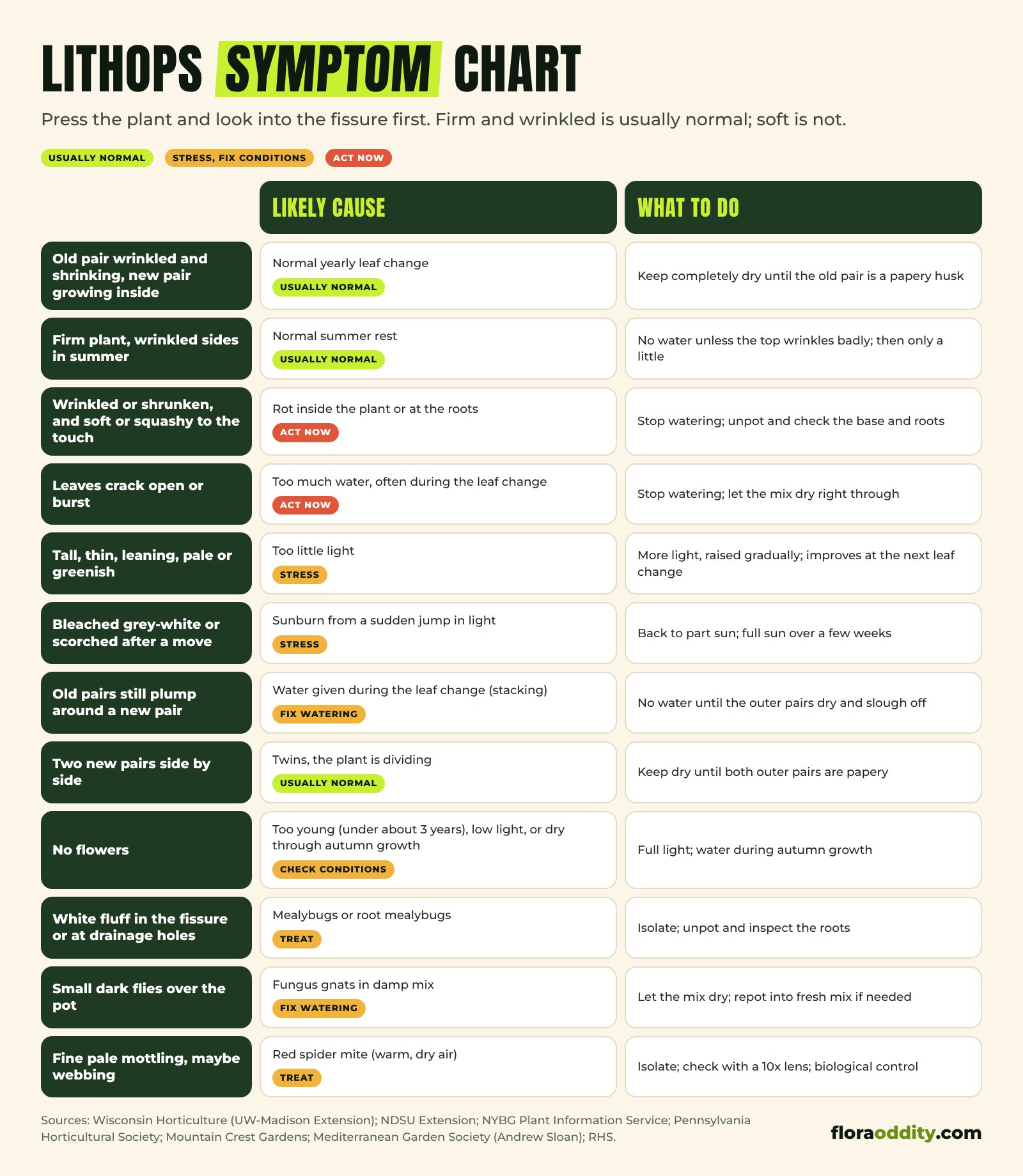
Stretching, sunburn, stacked leaf pairs and a few pests make up most of the rest. The chart below matches each symptom with its likely cause.
Quick Diagnosis
| Symptom | Likely cause | What to do | Source |
|---|---|---|---|
| Old pair wrinkled and shrinking, new pair growing inside | Normal yearly leaf change | Keep dry until the old pair is a papery husk | Wisconsin Horticulture, Mountain Crest Gardens |
| Firm plant, wrinkled sides in summer | Normal summer rest | No water unless the top wrinkles badly; then only a little | Mountain Crest Gardens, Wisconsin Horticulture |
| Wrinkled or shrunken and soft, squashy to the touch | Rot inside the plant or at the roots | Stop watering; unpot and check roots and base | Wisconsin Horticulture, TerraForums growers |
| Leaves crack open or burst | Too much water, often during the leaf change | Stop watering; let the mix dry fully | Mountain Crest Gardens |
| Tall, thin, leaning, pale or greenish | Too little light | More light, increased gradually | Wisconsin Horticulture, NDSU Extension |
| Bleached grey-white or scorched after a move | Sunburn | Back to part sun; raise light over a few weeks | Pennsylvania Horticultural Society, Wisconsin Horticulture |
| Two or more old pairs still plump around a new one | Water given during the leaf change | Withhold water until outer pairs dry and slough off | Mountain Crest Gardens |
| Two new pairs side by side | “Twins”, normal | Keep dry until both outer pairs are papery | Mountain Crest Gardens |
| No flowers | Plant too young, too little light or wrong watering season | Wait until about three years old; full light; water in autumn growth | Wisconsin Horticulture, Mediterranean Garden Society |
| White fluff on the plant or at the drainage holes | Mealybugs or root mealybugs | Isolate; unpot and inspect roots | RHS, Wisconsin Horticulture |
| Small dark flies over wet mix | Fungus gnats | Let the mix dry; repot in fresh mix if needed | RHS |
| Fine pale mottling, maybe webbing | Spider mites | Isolate; consider biological control | RHS |
Mushy or Translucent Leaves
A healthy Lithops is firm. One TerraForums member described the right feel as a grape: “soft, yet firm.” The tops of the leaves are naturally see-through; the NYBG Plant Information Service explains that the leaf tops have windows that let light into the plant. A glassy look on the windows alone is therefore not a symptom. What matters is texture, and whether the watery look spreads down the sides.
When a plant feels like a rotten grape rather than a fresh one, the inside is breaking down. In a 2004 TerraForums thread, another grower suggested exactly that test: poke it gently, and if it is squishy, “it’s rotted from too much water and is collapsing on the inside.”
Wisconsin Horticulture names over-watering as the main cause, and the Mediterranean Garden Society article by grower Andrew Sloan adds the timing: regular watering during the summer rest “would cause them to rot and turn into mush.” Replying to a Florida grower whose plant collapsed, Mountain Crest Gardens suggested monthly watering had started a mild root rot that winter humidity made worse, and that slow-draining soil or a pot without a hole would do the same.
What to do: stop watering at once and move the plant somewhere bright and airy. If the softness is limited and the rest of the plant is firm, unpot it and follow the rescue plan below.
Wrinkling and Shrivelling: Normal or Thirsty?
Wrinkles fool more new growers than any other symptom. Only one of three situations calls for water.
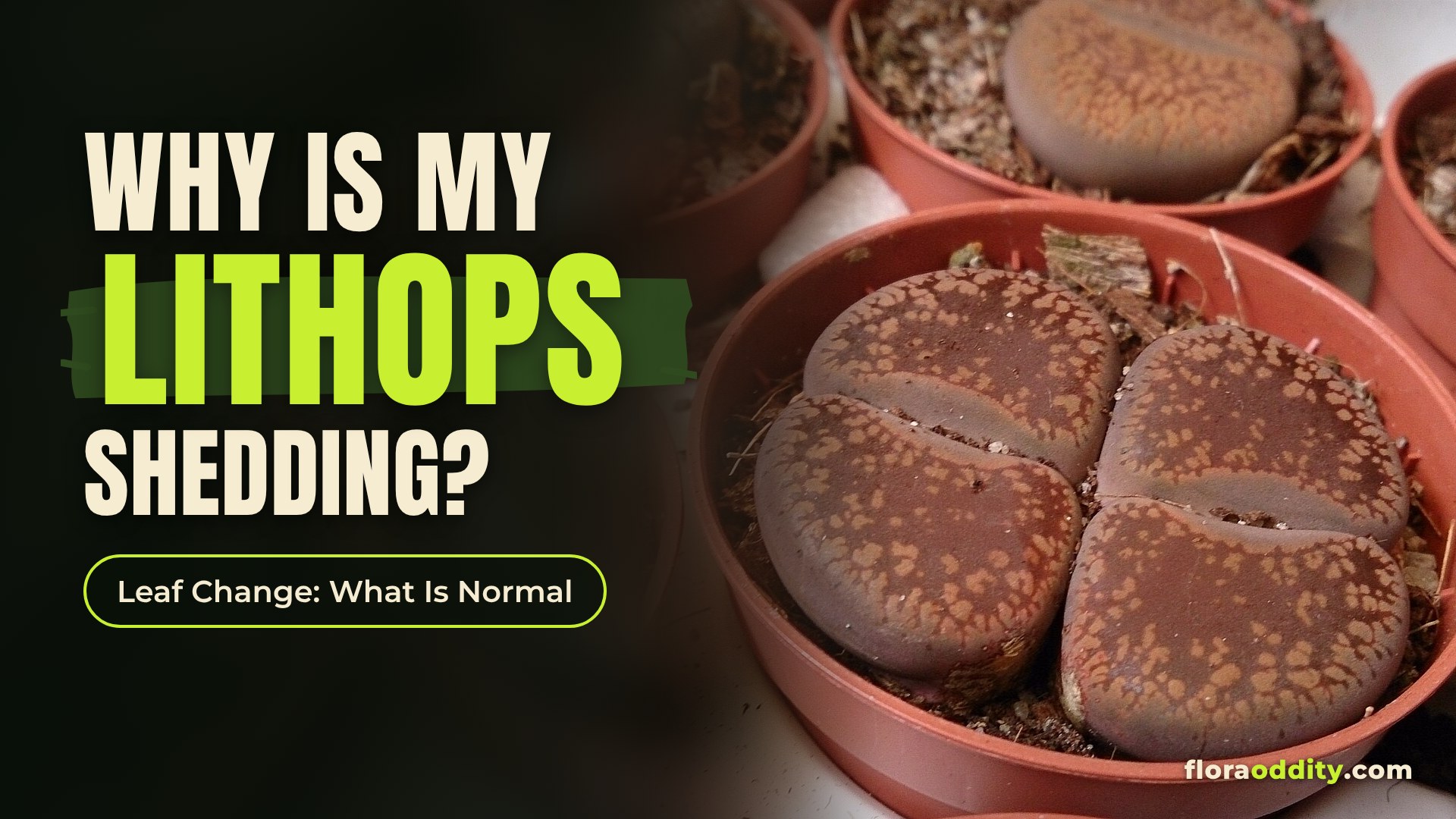
During the leaf change. Wisconsin Horticulture describes the yearly cycle: after flowering, a new body forms inside the old one, the plant reabsorbs the old leaves, and they wither “to a dry, papery sheath.” Sloan says the soil should stay “bone-dry no matter how shrivelled the plants become” while this happens in winter. A shrivelled outer pair around a fresh, firm inner pair is a plant working correctly.
In the summer rest. Mountain Crest Gardens says side wrinkles are normal in summer and “not an indicator that they need water”; it suggests watering very sparingly only when you see severe wrinkling on the top. Wisconsin Horticulture gives a similar rule: if the plant really shrivels during summer dormancy, give just enough to restore its firm look, wetting only about the top half inch (1 cm) of soil.
In the growing seasons. In autumn and spring, a wrinkly plant with no new pair inside is usually thirsty. Mountain Crest Gardens recommends watering until water runs from the drainage holes and says the plant re-inflates by the next day. Before watering, look into the fissure; if a new pair is forming, hold off.
A wrinkled plant that is also soft has rot, not thirst; more water will finish it off.
Splitting and Bursting
“Splitting” means two different things to Lithops growers. The normal kind is the yearly leaf change, when the fissure opens to show the new pair. Mountain Crest Gardens calls this splitting and says the outer leaves go soft and then dry as they pass their water to the inner pair. NDSU Extension adds: no water while new leaves form or the plant is in bloom.
The harmful kind is a crack across the side or top of a leaf, sometimes with the leaf body bursting open. Mountain Crest Gardens warns that watering a plant during the leaf change “can cause the leaves to rot or burst,” and its care guide says too much water, or water in the wrong season, leaves you with “an exploded Lithops.”
What to do: stop watering and let the mix dry right through. Then watch the base: softness there means rot has taken hold, and the rescue plan below applies.
Stretching, Etiolation and Leaning
A Lithops in good light sits low, almost flush with the gravel. Wisconsin Horticulture says a plant without enough sun “will begin to grow slender and elongated, lean to one side to receive more light, lose coloration and turn greenish,” and will eventually die if conditions do not improve. NDSU Extension adds that Lithops can “stretch or turn color” in low light, and Sloan notes that the plants become elongated without plenty of sunlight.
For a windowsill, Wisconsin Horticulture suggests about 4 or 5 hours of direct sun early in the day with partial shade in the afternoon, usually from a south window or an unobstructed east one. Mountain Crest Gardens recommends lots of direct sun and adds that grow lights help a plant avoid fading or stretching.
The stretched pair will not shrink back. A TerraForums grower in 2003 noted that the next chance to grow compact comes with the next leaf pair in proper light.
What to do: increase the light step by step (see the next section) and expect improvement only after the next leaf change.
Sunburn and Scorch Marks
More light is the cure for stretching, but too much too fast causes its own damage. Wisconsin Horticulture warns against moving a plant abruptly into brighter light, because it “could get sunburned and be fatally injured.”
The Pennsylvania Horticultural Society answered a grower whose six-month-old seedlings, raised indoors in a west window with a grow light, turned “ghost white” after a single day of full sun on a balcony. The answer called this bleaching, said the plants “may be ok,” and advised moving them into partial sun and then gradually into full sun “over a few weeks,” noting that plants grown under lamps need the same slow adjustment outdoors.
The NYBG Plant Information Service adds that afternoon shading may be needed, especially in summer.
What to do: move a burned plant back to bright light without direct afternoon sun and increase exposure over several weeks. Wisconsin Horticulture describes the old leaves withering to a papery sheath at each leaf change. Put simply: a scar stays on the current pair until the next leaf change replaces it.
Two Sets of Leaves Stacking Up
A Lithops should normally show one leaf pair, or two during the change. Mountain Crest Gardens says a plant should have “a maximum of two leaf pairs at any given time” and that three or more generations of leaves mean it has been over-watered. Its fix is to suspend watering until all the outer layers dry and slough off.
Wisconsin Horticulture explains why it happens: if water is given too soon, “the old leaves will try to continue to grow and the plant will not develop properly.” A TerraForums grower called such store-bought plants “stacked” and warned that the extra layers can constrict the new head until it topples.
Do not confuse stacking with twins. In a reader Q&A, Mountain Crest Gardens explains that Lithops “frequently produce two (occasionally three) pairs of new leaves in a single bloom cycle.” Twins sit side by side, not one inside another; that is how a plant becomes a clump. Wisconsin Horticulture also notes that many plants divide during the leaf change.
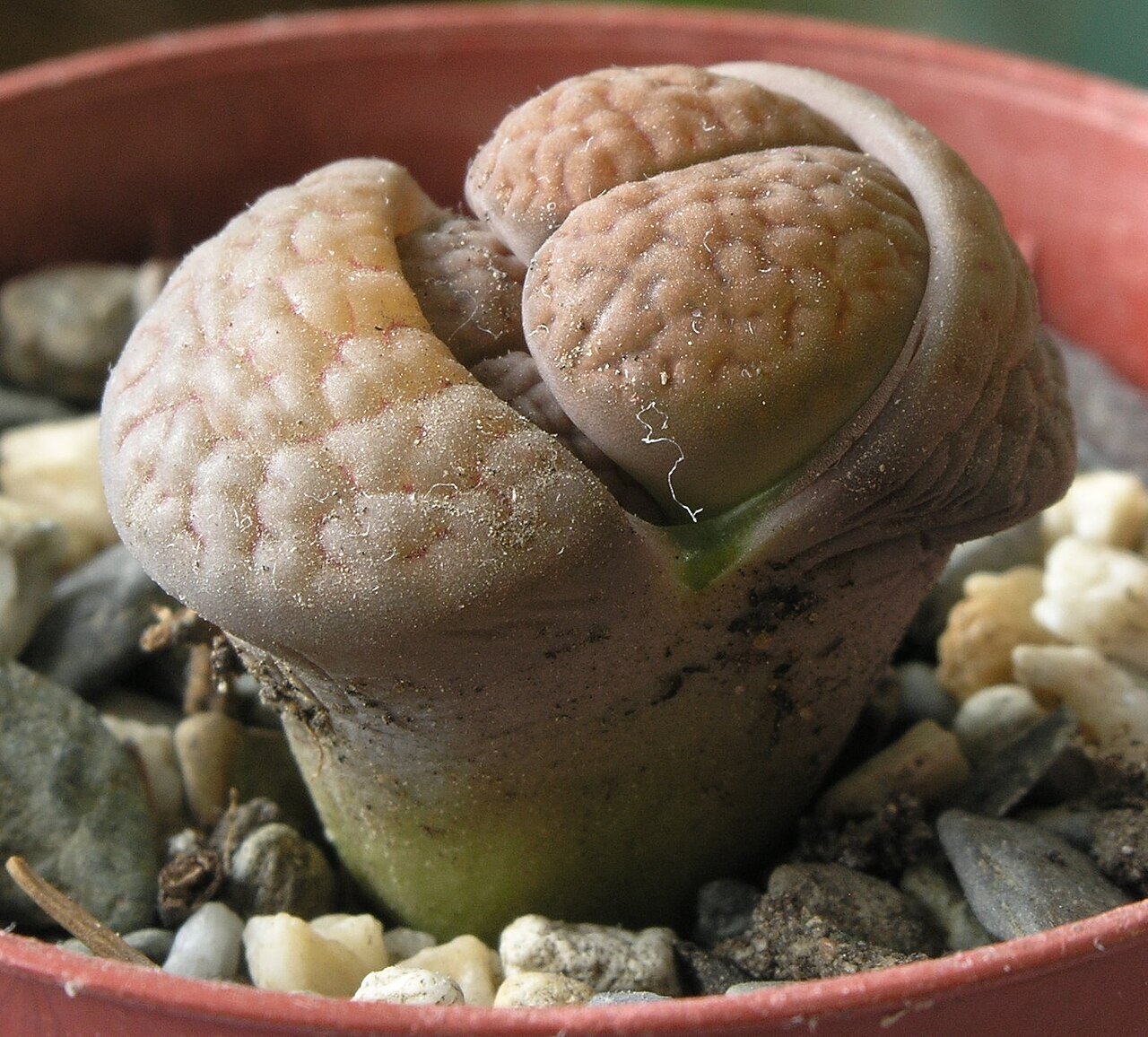
What to do: stop watering and wait, even if it takes months. If you see a second new pair forming inside the first, Mountain Crest Gardens says to go even longer without water, until both outer pairs are dry and papery.
No Flowers
Most Lithops flower in autumn and early winter, Wisconsin Horticulture says, with daisy-like yellow or white flowers that emerge from the fissure, open in the afternoon of sunny days and close in late afternoon. If your plant has never flowered, check three things.
Age. Sloan writes that Lithops “must usually be three years old before they begin flowering.” Wisconsin Horticulture says seed-grown plants can flower in 3 to 4 years “under optimal conditions,” so slower conditions mean a longer wait.
Light. Wisconsin Horticulture says the plants’ health depends on sufficient bright light, and the flowers themselves open only on sunny afternoons. A stretched or faded plant is a sign it is not getting enough light to bloom either.
Watering season. The autumn growth is when buds form. Wisconsin Horticulture says to resume watering in late summer to early autumn, when the plants start growing and bloom, and that the first sign is the fissure starting to separate. Sloan says thorough autumn watering “gives the plants energy to flower.” A plant kept bone-dry through its autumn growth misses the watering that both sources link with flowering.
Pests: Mealybugs, Root Mealybugs, Sciarid Flies and Red Spider Mite
Mealybugs. The RHS describes glasshouse mealybugs as sap-feeding insects covered in white wax, found mainly on greenhouse plants and houseplants, “especially cacti and succulents.” They tend to hide in sheltered places, so on a Lithops look in the fissure and around the base. Large populations can stunt growth.
Root mealybugs. The RHS says some mealybugs, mostly Rhizoecus species, live on the roots of glasshouse and house plants and are also covered in white wax. Wisconsin Horticulture suggests checking for white cottony masses around drainage holes and notes that yellowed or wilted foliage may point to an underground infestation.
Sciarid flies (fungus gnats). The RHS says these small dark flies are associated with damp compost, especially in house plants and seed trays. Their larvae mostly eat dead roots and decaying matter but can damage seedlings, while established plants are unlikely to be harmed. Their presence around a mature Lithops is mainly a sign the mix is staying too wet. The RHS suggests letting constantly wet compost dry out and repotting into fresh compost instead of reusing the old.
Red spider mite. The RHS describes a sap-feeding mite that thrives in warm, dry conditions and causes fine pale mottling; heavy attacks bring fine webbing, and badly damaged plants can die. The mites are easier to see with a 10x hand lens.
What to do: isolate the plant first. The RHS advises keeping new plants apart for at least a month and notes that badly infested plants may be simpler to throw away. It also lists biological controls, including a predatory ladybird for mealybugs and the predatory mite Phytoseiulus persimilis for red spider mite.
Sudden Collapse and Root Rot
A Lithops that looks fine one week and falls over the next has almost always rotted at the roots or the base. The causes are the ones above, combined: water during the rest periods, rain, humidity and a mix that stays wet. Stacked plants are a special case: as described above, the extra layers can constrict the new head until it topples.
Planting depth matters too. In habitat Lithops grow nearly buried, but NDSU Extension says that as houseplants “they should be raised out of the soil to prevent rot,” and Wisconsin Horticulture recommends placing the top of the plant slightly above the soil surface.
Watch for a soft base or a body that flops over; both appear in the grower reports below, along with a reminder that rain counts as watering.
A Rescue Plan, Step by Step
- Feel the plant. Soft anywhere: go to step 3.
- Check the calendar. Leaf change or summer rest: keep dry and wait. Autumn or spring growth with no new pair inside: water thoroughly, then let the mix dry.
- Unpot a soft or wobbly plant. Shake off the mix and look at the roots and base for soft, rotting tissue.
- Check for pests while it is out. Look for white wax on the roots and in the fissure, and for larvae in the old mix.
- Repot in fresh, dry, gritty mix, with the plant sitting slightly above the surface. Mountain Crest Gardens suggests holding back water for at least a week after repotting a newly arrived plant.
- Isolate it from other plants for a few weeks if you found pests.
- Fix the cause: more light, no water during the leaf change, no rain, a pot with a drainage hole.
- Judge recovery at the next leaf change, when a firm new pair shows the plant has pulled through.
How Lithops Problems Compare With Mexican Butterworts
Carnivorous plant growers will know the pattern from Mexican butterworts, which our butterwort problems guide describes shrinking into a succulent winter rosette, the season when overwatering starts. In both plants a smaller resting stage is normal and a soft, collapsing base is the warning sign (rotting bases). The butterworts rest in winter; Lithops rest twice, in summer heat and during the winter leaf change.
What Growers Report
These are single growers’ public posts, each describing their own plant and conditions, not rules.
- A grower who bought three Lithops from a big-box store found that one, with new growth nearly 2 inches (5 cm) above the old leaves, “flopped over at the base” with “a kinda mushy area near the bottom” soon after careful repotting without watering. (xQuinnx, TerraForums, March 2011)
- Another grower, who used a baked-clay mix that dried completely within 2 to 3 days, said this let plants drink without taking up so much water that “they would split open from too much water.” (swords, TerraForums, December 2012)
- Growing year-old seedlings that were “shriveling severely” in winter, one grower gave them water and found the next day that the new leaves had come up and tripled the plants’ size, while the old leaves stayed shrivelled at the sides. (wickedthistle, TerraForums, February 2003)
- After heavy rain, a grower found their wrinkled Lithops was squishy when pressed; they let the soil dry out and later reported the plant “croaked soon after.” (ChronoKiento, TerraForums, August 2004 and February 2005)
Put simply: the plants that failed in these threads were watered or rained on at the wrong time, while the seedlings show that very young plants follow looser rules than mature ones.
Where Sources Differ
| Topic | One view | Another view | Context |
|---|---|---|---|
| Watering seasons | Mountain Crest Gardens and Sloan: water in spring and autumn, keep dry in summer and winter | NYBG: water lightly in spring and sparingly in summer, little or none in winter; Wisconsin: water late spring into summer, stop when dormant, resume late summer | All agree: no water during the leaf change |
| Summer shrivelling | Mountain Crest Gardens: only severe wrinkling on top justifies a little water | Wisconsin: if the plant really shrivels, wet the top half inch (1 cm) | Both say small amounts, never a deep soak |
| Sun | Mountain Crest Gardens: lots of direct sun | Wisconsin: 4 to 5 hours of morning sun, partial afternoon shade; NYBG: afternoon shade in summer may be needed | Strength of sun and heat differ by climate and window |
| Exact season dates | Sloan in southern Spain stops winter watering when minimum temperatures fall below 50 °F (10 °C) and summer watering when nights exceed 72 °F (22 °C) or days 86 °F (30 °C) | Wisconsin and Mountain Crest Gardens: go by the plant’s stage | Watching the plant works in any climate |
Common Mistakes
- Watering a wrinkled plant during the leaf change. The old pair is supposed to shrivel.
- Treating every wrinkle as thirst. Check firmness and look into the fissure first.
- Leaving plants out in the rain. To a Lithops, rain is watering.
- Planting too deep in a dense, wet mix. Keep the body slightly above the surface and use a pot with a hole.
- Mistaking twins for stacking. Side-by-side pairs are normal; a plump pair inside another plump pair is not.
FAQ: Lithops Problems
Why is my Lithops mushy?
Almost always rot from water at the wrong time, rain or a wet mix. Stop watering, unpot it and check the base and roots.
Why is my Lithops wrinkly?
During the leaf change and in summer, wrinkling is normal and needs no water. In autumn or spring growth, wrinkled sides with no new pair inside usually mean thirst. Wrinkled and soft means rot.
Why does my Lithops have two sets of leaves?
Two pairs during the leaf change, or side-by-side twins, are normal. Old pairs that stay plump around new ones mean water came too early; withhold it until the outer pairs dry and slough off.
Why won’t my Lithops flower?
It may be too young (usually about three years), short of light, or dry during its autumn growth, when buds form.
The Bottom Line
Lithops problems are usually timing problems. A firm, wrinkled plant in its leaf change or summer rest is fine; a soft one is in danger. Give strong light, raised gradually, and water only during autumn and spring growth, never during the leaf change. When something goes wrong, feel the plant first, check the calendar second and reach for water last.
Sources & Further Reading
- Wisconsin Horticulture, University of Wisconsin-Madison Division of Extension: Living Stones: Lithops (Susan Mahr)
- Wisconsin Horticulture, University of Wisconsin-Madison Division of Extension: Mealybugs
- NDSU Extension, Dakota Gardener: Living stones (Carrie Knutson)
- NYBG Plant Information Service: Living stone plants (lithops) and how to grow them
- Pennsylvania Horticultural Society, Ask PHS: Living stones turned ghost white in full sun
- Mediterranean Garden Society: Lithops Cultivation (Andrew Sloan, The Mediterranean Garden No. 100)
- Mountain Crest Gardens: Lithops, Where to Buy and How to Grow
- Mountain Crest Gardens Q&A: My lithops started growing a second pair of new leaves
- Mountain Crest Gardens Q&A: Lithops care upon arrival
- Mountain Crest Gardens Q&A: The splitting phase can take 2 months, won’t it die without water?
- Mountain Crest Gardens Q&A: What did I do wrong?
- RHS: Mealybug (glasshouse)
- RHS: Fungus gnats (sciarid flies)
- RHS: Glasshouse red spider mite
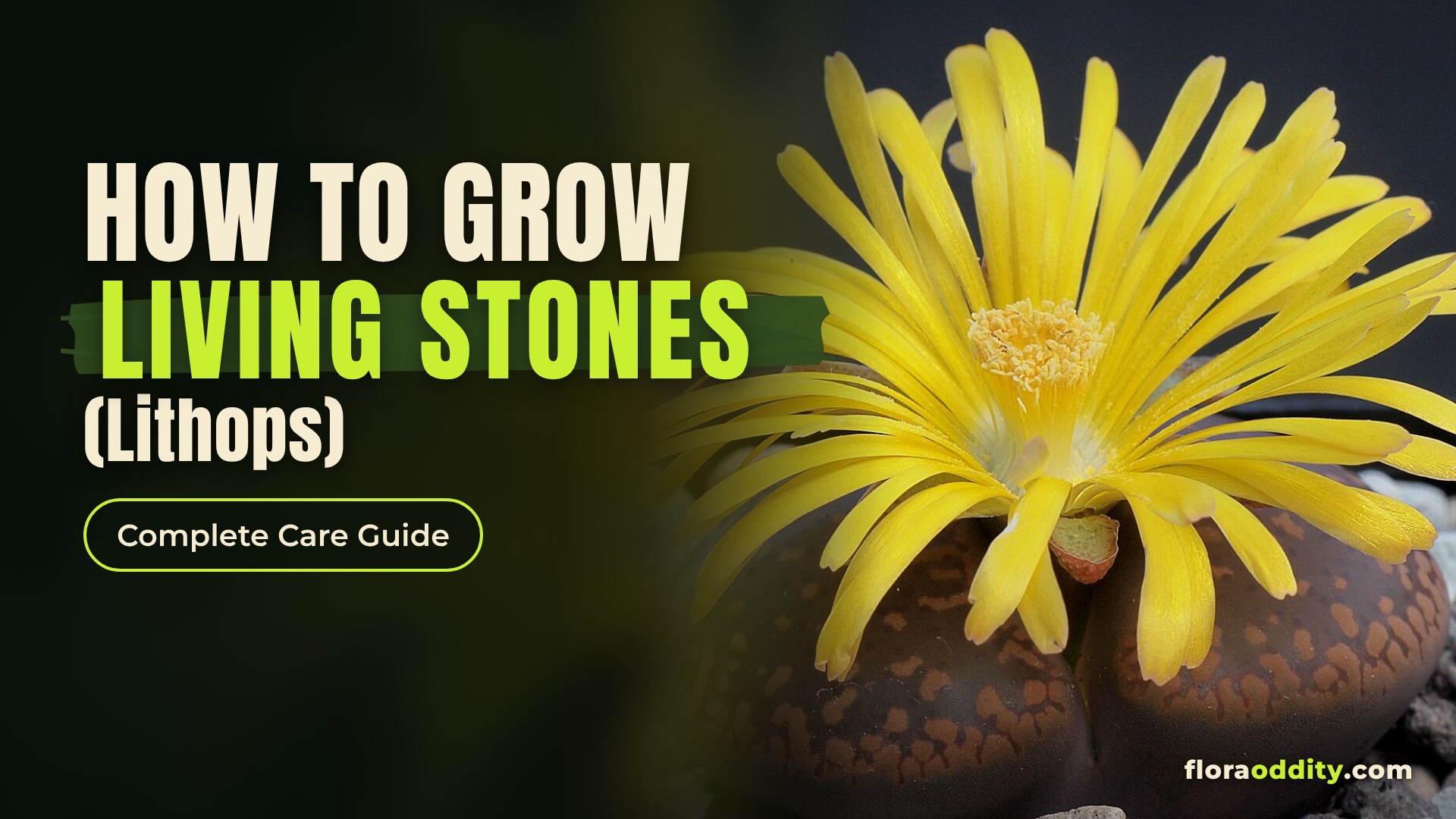
Featured image based on a photo of Lithops optica ‘Rubra’ by Michael Wolf via Wikimedia Commons, CC BY-SA 3.0, with typography added by FloraOddity; the adapted image is offered under the same licence.
Final articles are editorially reviewed and factual claims are checked against cited sources. Last reviewed: October 2026.