
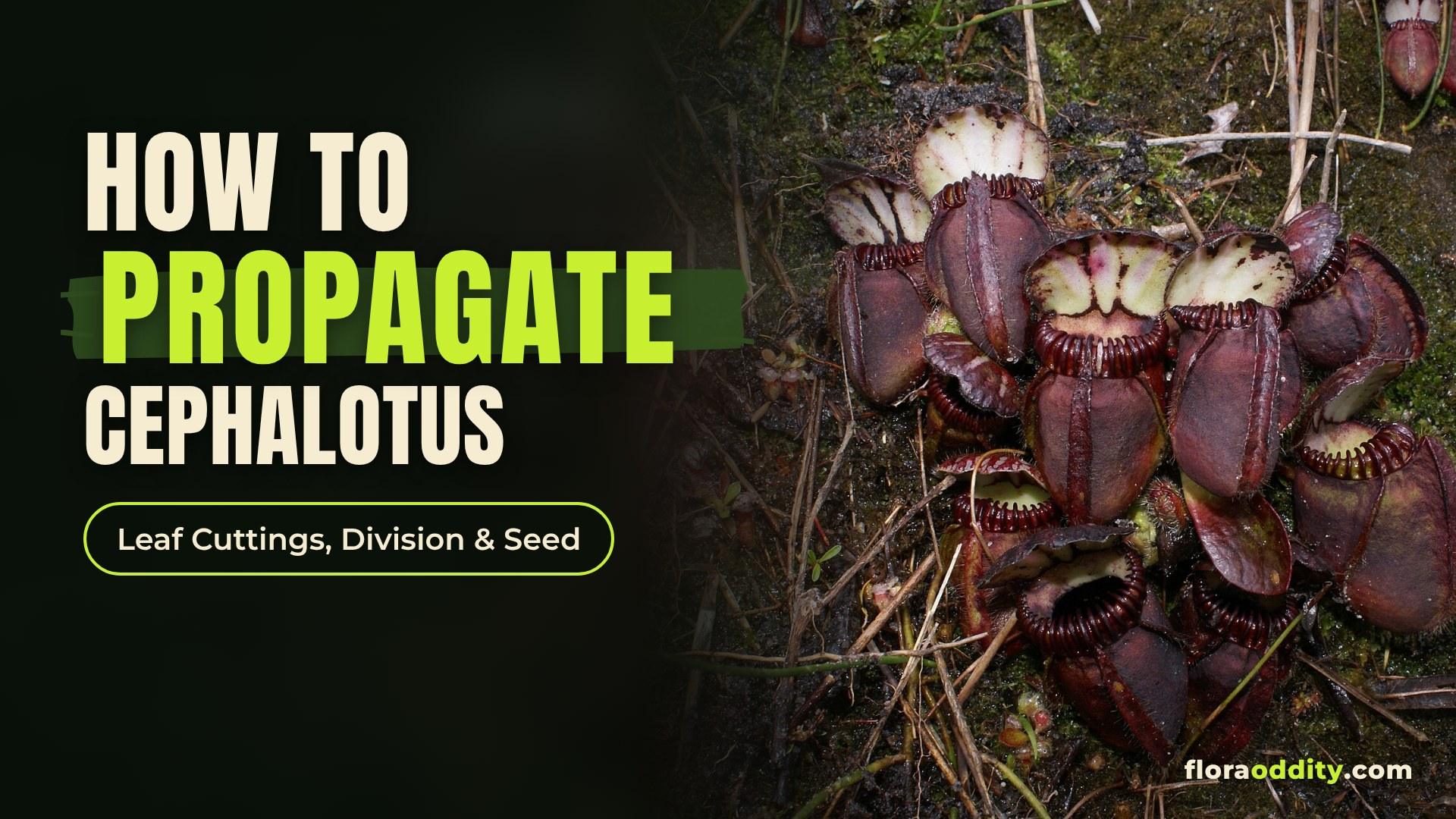
A single flat leaf, torn cleanly from the base of an Albany pitcher plant, can grow into a new plant. So can a crown snapped off an overgrown clump, a piece of the tangled underground stem, or a seed. The International Carnivorous Plant Society (ICPS) calls crown divisions and stem cuttings “the easiest and quickest way” to multiply Cephalotus follicularis, while Barry Rice, author of the Carnivorous Plant FAQ, prefers leaf cuttings. Seed works too, but it is slow and needs one specific germination temperature.
If you want to propagate Cephalotus, the right method depends on what your plant can spare and how patient you are. Our Cephalotus care guide sums up the options in a few lines; this guide takes each one step by step.
The Short Answer
If your plant has several growing points, take crown divisions or stem cuttings: the ICPS gets new, actively growing plants from them in under 6 months. If you only have spare leaves, take flat leaves or pitchers with the whole petiole, ideally with a little stem tissue at the base, and set them in moist, airy media under a clear cover. Dick Tran, writing in Carnivorous Plant Newsletter, expects roots in about 6 weeks; a plantlet can take several months, and the ICPS example needed seven. Seed usually needs two plants, hand pollination, and then about 6 to 10 weeks at roughly 59 °F (15 °C) to germinate; a refrigerator is too cold. Raising seedlings to a decent size takes years.

| Method | Best when | What you need | Time to a new plant | How reliable | Source |
|---|---|---|---|---|---|
| Crown divisions and stem cuttings | The clump has several growing points, is too dense, or is declining | Almost pure sand in short pots, a few millimetres of tray water, a humidity dome | Growing plants in under 6 months | The easiest and quickest | ICPS |
| Side shoots | A side shoot is at least half the size of the parent | Cut it back to where it joined the old stem; treat it like a leaf cutting | Not timed by the source | Tran says they “survive and grow quickly” | Dick Tran (Carnivorous Plant Newsletter) |
| Stolon (underground stem) and root cuttings | You are repotting or rescuing a collapsing plant | Firm, healthy underground pieces; same setup as divisions | Not timed by the sources | Stolon pieces can root directly | John Brittnacher (Carnivorous Plant Newsletter), Robert Gibson |
| Flat leaf pullings | You have spare non-carnivorous leaves | Whole petiole, ideally a little stem tissue; moist sphagnum or an airy mix; high humidity | Roots in about 6 weeks (Tran); plantlets after several months (ICPS: seven months) | Slower and less certain | ICPS, Tran, Rice, Gibson |
| Pitcher pullings | You have spare pitchers | As for flat leaves; set upright and fill the pitcher with water | Similar to flat leaves | Work, but one grower found them less reliable than flat leaves | Tran, Rice |
| Seed | You have two clones and natural day length | Hand pollination; surface sowing on fine media; about 59 °F (15 °C) for 6 to 10 weeks | Germination in 6 to 10 weeks or more; feeding-size pitchers take years | Slow; many achenes hold no seed | ICPS, Brittnacher |
Which Method Should You Choose?
Start with what your plant has to offer. A division, a stolon piece or a leaf gives you a copy of the parent; the ICPS makes the same point about sundew leaf cuttings, which produce “exact clones of the parent plant.” That makes vegetative methods the way to multiply a named cultivar. Seed gives new individuals, and the ICPS warns that selfing a single plant brings inbreeding depression, though it “can also produce plants with unexpected traits.”
Next, think about speed. The ICPS ranks crown divisions and stem cuttings first and calls leaf pullings “slower and less certain of success”: of four leaves in its example, two had made small plants seven months later. Carnivorous Plant Nursery tells growers to “Expect few successes, but enjoy each one.” Seed is the slowest route of all. The good news, according to John Brittnacher, co-author of the ICPS guide and of a 2022 paper on Cephalotus reproduction in Carnivorous Plant Newsletter, is that the underground parts make the plant “easy to propagate in cultivation.”
What You Are Actually Cutting: Stems, Stolons and the “Rhizome”
Most care guides, including Rice’s FAQ, call the underground part of Cephalotus a rhizome. Brittnacher argues that the word is misleading. A seedling has one short, upright stem and a tap root; mature plants spread through underground runners called stolons, which become new upright stems when they reach the surface. With age, stolons and roots thicken into tubers, so an old pot holds “a tangled mass of stolons, roots, and buried stems.”
Brittnacher adds that a growth tip dies when the plant flowers, or with age, and that this usually triggers new stolons and side branches. New stolons sprout from tubers, roots and buried stems alike, which is why small underground pieces can become plants, and why, as Carnivorous Plant Nursery notes, an apparently dead Cephalotus often regrows after several months.
Crown Divisions and Stem Cuttings
A crown is a growing point with its own rosette of leaves; a stem cutting is a growing point cut from the clump with a piece of stem attached.
- Unpot the plant. Divisions fit naturally into repotting. The ICPS also uses them to thin out plants that have grown too dense and to rejuvenate plants whose old stems have stopped growing.
- Cut away the growing points. Separate each crown with its piece of stem. The ICPS says one overgrown plant it divided “produced many divisions.”
- Plant them in nearly pure sand. The ICPS set its cuttings in “almost pure sand in short pots” standing in a few millimetres of water, with a humidity dome over the tray.
- Wait and watch. In the ICPS example, the photo of healthy young plants was taken four months after the cuttings went in. Divisions from active growth tips made the larger plants; cuttings from stems that had stopped growing with age made smaller ones.
- Feed only once pitchers mature. The ICPS filled the open pitchers of its rooted divisions with water and added one slow-release fertilizer pellet as soon as they matured.
Tran waits for side shoots to reach “at least half the size of the parent plant” before cutting them free, all the way back to where they grew from the old stem. Tran treats each one like a leaf cutting, fills any mature pitchers with dilute fertilizer solution, and finds that the new plants “survive and grow quickly.”
Using divisions to rescue a collapsing plant
If a plant starts to collapse, the ICPS advises unpotting it at once, cutting off “all the good stems for propagation,” removing anything black or rotting underground, and repotting the rest in fresh soil, with all plant parts at least 2 inches (5 cm) above any future water level. Our care guide covers the causes in its sudden collapse section.
Stolon and Root Cuttings
Pieces of the underground system can also grow on their own. Brittnacher’s study plants had been “rejuvenated multiple times from stolon cuttings,” and notes that Cephalotus stolons “can produce roots directly” when used as cuttings. Robert Gibson, writing in Carnivorous Plant Newsletter after visiting wild sites near Albany, listed root cuttings among the ways the species is propagated, along with seed, leaf cuttings and tissue culture.
The sources give few details. Carnivorous Plant Nursery groups root cuttings with leaf and pitcher cuttings: take them early in the growing season, use a rooting hormone, cover them with a clear cup, and give them warm, bright light. Collect pieces when you divide or repot, and keep only healthy material: the ICPS cuts off any rotting or all black underground parts.
Leaf Cuttings: Flat Leaves and Pitchers
Both kinds of leaf work. Rice says “Both pitcher leaves and foliage leaves work,” and Tran uses both.
Pull or cut?
This is where the sources split. The ICPS asks for the leaf stalk, or petiole, to be intact, “preferably with a small amount of stem tissue.” Rice prefers to cut: Rice snips the leaf “as close to the rhizome as you dare,” because when Rice pulled leaves, a bit of the underground stem sometimes came away and Rice worried the wound might let in disease. Tran pulls but takes no stem at all: he bends the leaf downward until it snaps off where it was attached.
All three keep the whole petiole with the leaf, never just the blade.
Step by step
- Pick the season. Tran propagates from spring through early summer, and Carnivorous Plant Nursery says leaf, pitcher and root cuttings “can be done early in the growing season.”
- Choose leaves. Tran often uses leaves that come loose during transplanting, or older growth removed to make room.
- Remove the leaf. Pull it down and away until it breaks off at its base, or cut as close to the base as you can.
- Optional rooting hormone. Tran lightly dips the dry petiole base in rooting hormone, and Carnivorous Plant Nursery also uses one. Rice does not mention it.
- Set it in the medium. Tran pushes the petiole base about 0.2 inch (0.5 cm) into the mix. A flat leaf lies on the surface; a pitcher gets a small hollow so it stays upright, and Tran fills the pitcher with water. Rice simply buries the cut end in moist sphagnum.
- Cover it. Tran uses an upturned clear cup to keep humidity high and uses no fungicide; Carnivorous Plant Nursery also uses a clear cup.
- Give it warmth and light. Rice keeps cuttings warm and in bright light; Carnivorous Plant Nursery asks for “warm, bright light.”
Which medium?
Tran reports success with perlite alone, 1:1 perlite and vermiculite, 1:1 peat and sand, 1:1:1 peat, perlite and sand, and Tran’s standard adult mix. He usually roots cuttings in their final pot so they can grow on undisturbed for 1 to 2 years. Rice uses moist sphagnum, and Gibson’s small test favours it: of leaves he took from wild plants near Albany, the one set in peat moss rotted, while the two in sphagnum stayed green.
How long it takes
Tran says roots should form within six weeks, when the cup can come off. Gibson’s sphagnum leaves had small roots by August, made small non-carnivorous leaves and a few pitchers from a callus at the base of the petiole by December, and by February the mother leaf had died while the plantlet grew well. The ICPS example took seven months to give two plants from four leaves. Some leaves turn yellow or brown long before anything happens, so do not throw them out while the base is still firm.
Use the same mineral-free water as for adult plants: Sarracenia Northwest says Cephalotus is “very sensitive to water with dissolved mineral levels of 50 ppm or more.” If you are unsure about your supply, run it through our water checker.
How Cephalotus Cuttings Compare With Butterwort and Sundew Cuttings
- Butterworts. The ICPS calls leaf pullings “the easiest way” to propagate Mexican butterworts: whole leaves are simply laid on a damp mix, and “It takes 1 to 2 months to get small plants.” Our guide to propagating butterworts covers the method.
- Sundews. The ICPS cuts sundew leaves anywhere along the stalk, and most species sprout new plants from the dewy leaf blade itself. It calls pure water “the cleanest medium” for them and warns that “Nothing much is going to happen for the first month or so,” with some species taking up to 5 months. See our guide to propagating sundews.
- Cephalotus. Gibson saw the new plant form from a callus at the base of the petiole, not on the blade, which is why the sources insist on taking the whole leaf. Timelines run from about 6 weeks for roots to seven months or more for a plantlet, which puts Cephalotus at the slow end of the sundew range rather than alongside butterworts. Floating in water, the sundew method, has also worked for some Cephalotus growers (see What Growers Report).
Growing Cephalotus From Seed
Seed is the only way to get genuinely new plants, but the ICPS states plainly that it “is not an easy and quick process.”
Getting seed: flowers and pollination
Cephalotus will not flower under a constant light period, so plants must be on a natural day length, the ICPS says. Under natural light they start blooming in late spring, and each flower stalk may bloom for about a month.
Brittnacher followed seven flowers closely. Each typical flower has 6 tepals, 12 stamens and 6 stigmas and can produce up to 6 seeds. Pollen appears on the first day, but the stigmas only start to mature on about day 4. Tips from the paper:
- The pollen is powdery and “does not stick” to the cheap brushes that work on Sarracenia. Left undisturbed until about day 5, a flower can be self-pollinated by flicking a small cloud of pollen from its anthers with a brush.
- To cross two plants, pluck pollen-laden stamens with fine forceps and dust them onto the stigmas of an older flower.
- Pollinate deliberately. Rice notes that flowers “usually do not produce seed when selfed,” though growers occasionally report viable seed from selfing, and Carnivorous Plant Nursery says seed needs flowers from separate plants.
Collecting the seed
Brittnacher found the achenes, the hairy husks that hold the seeds, dry and splay open about 30 days after a flower opens. They blow away in the slightest breeze, so Brittnacher advises a face mask to avoid scattering them with your breath. The ICPS collects them into a metal bowl, since plastic is too staticky, and handles them by the base.
Expect many empty achenes. In 2021, 44 of 94 achenes in the study held a seed (47%); in a more careful 2022 count, only 59 of 197 did (30%). The ICPS recommends separating the seeds from the achenes before sowing.
Germination conditions
Brittnacher, reproducing the 2019 germination study by Just and colleagues, found that the key factors are to hydrate the seeds and hold them at about 59 °F (15 °C). Brittnacher stresses that this is “not ‘cold stratification’ in the usual sense.” The seeds needed about 6 to 10 weeks at that temperature. Seeds he first kept at 39 °F (4 °C) in a refrigerator had still not germinated after two months, so they were moved to a wine cooler at about 57 °F (14 °C). The ICPS guide repeats the point: “Refrigerator temperature is too cold.” Seeds that do not sprout are not necessarily dead; longer at 59 °F (15 °C), or the plant hormone GA3, can coax them along.
For the medium, the ICPS suggests finely chopped long-fibred sphagnum or fine vermiculite, because seedlings stay small for so long that peat carrying moss spores or fungi becomes a problem. Saturate the medium and lay the seeds on the surface. Once a seed germinates, move it to room temperature under lights.
Seedlings
Brittnacher describes an unusual start: the seed seems to hold a mass of undifferentiated cells that swells and splits the seed coat before forming a shoot and root. The first leaf is a flat foliage leaf and the second is usually a pitcher. Young plants develop a fleshy tap root that later thickens into tubers.
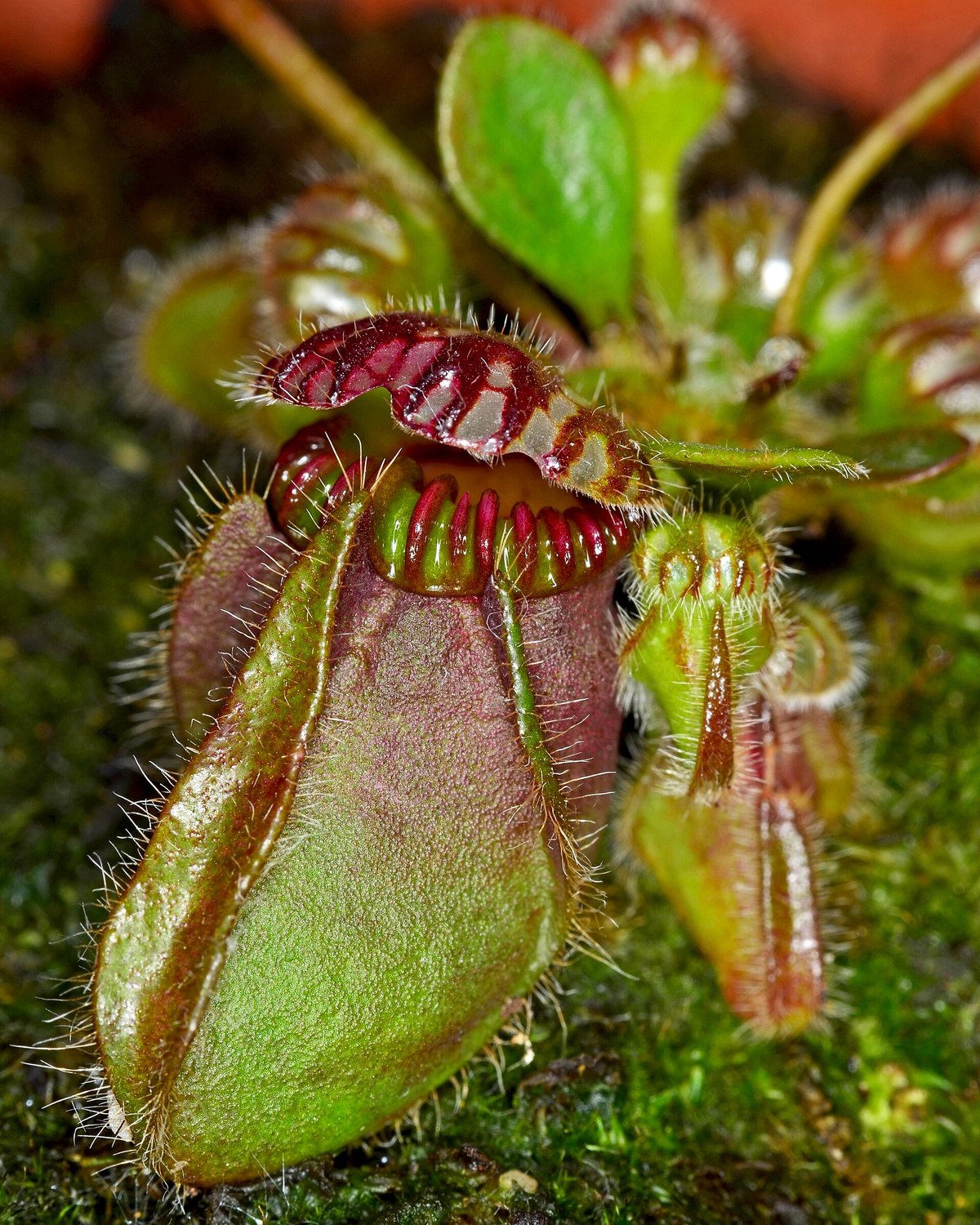
Then comes the long part. The ICPS says it “can take years” to grow pitchers big enough to feed with pieces of dried bloodworm and later fertilizer pellets. Soil feeding is risky because moss, algae and cyanobacteria can quickly smother tiny plants, and the ICPS warns that plants have been killed by feeding “too much or too soon.”
What Growers Report
These are single growers’ results in their own conditions, not rules.
- One grower was given leaf cuttings of the cultivar ‘Hummer’s Giant’; a friend’s share rooted in about a month, while the grower’s own batch, grown “under identical circumstances,” took “a year to even strike, almost to the day.” In the same thread the grower reported that mature flat leaves worked best, with pitchers at about 50% success. (BigBella, TerraForums, July 2008)
- One grower tested four pullings in water, four in soaked long-fibred sphagnum and four stuck horizontally into the top of an adult plant’s pot. “Soaked LFS rooted fastest 100%.” Of the leaves in water, one rotted within a few weeks and three made roots. (31drew31, TerraForums, September 2013)
- Another grower leaves pullings uncovered under a shop light at 30 to 50% humidity and says they “strike near 100%,” with the fastest, a pitcher, taking about 3 weeks and the slowest almost 4 months. (DJ57, TerraForums, July 2013)
- A seed grower chilled seeds on peat and perlite at about 38 °F (3 °C) for 9 weeks, then kept them under lights for 4 months with no result. Only after another two or three months, forgotten on a shady shelf, did two seedlings appear. (Huntsmanshorn, TerraForums, March 2008)
Our takeaway: timelines vary enormously even under identical conditions, so date every cutting and be slow to throw any out. The forgotten seed pot also fits Brittnacher’s finding that chilled seeds sprout only once moved somewhere cool but not cold.
Where Sources Differ
| Question | One view | Another view | Context the sources give |
|---|---|---|---|
| Best method | Rice: “Propagation is best done by leaf cuttings” | ICPS: crown divisions and stem cuttings are “the easiest and quickest way” | The ICPS calls leaf pullings slower and less certain; Carnivorous Plant Nursery expects “few successes” |
| Cut or pull leaves | Rice cuts as close to the base as possible, to avoid damaging the underground stem | ICPS wants the petiole intact, preferably with a little stem tissue; Tran pulls the leaf off at its base | All agree the whole petiole must come with the leaf |
| Rooting hormone | Tran and Carnivorous Plant Nursery use it | Rice’s method does not mention it | No source compares results with and without it |
| Seed treatment | Rice: seeds “germinate readily with no special treatment” | ICPS and Brittnacher: about 59 °F (15 °C) for 6 to 10 weeks; a refrigerator is too cold | Brittnacher’s tests and the 2019 study he cites support the 59 °F (15 °C) method |
| Selfing | Rice: flowers usually do not set seed when selfed | ICPS: selfing works but brings inbreeding depression | Brittnacher describes self-pollinating with a brush and crossing with forceps |
Common Mistakes
- Taking only the leaf blade. Every source keeps the whole petiole; the plantlet forms at its base.
- Using peat that rots. Gibson’s leaf in peat moss rotted; those in sphagnum rooted.
- Giving up too early. The ICPS example took seven months, and growers report anything from 3 weeks to a year.
- Putting seeds in the refrigerator. Fridge temperatures stall germination.
- Feeding babies too soon. Wait for mature pitchers before adding food or pellets.
FAQ: Propagating Cephalotus
Can you grow a new Cephalotus from a single pitcher?
Yes. Rice and Tran both use pitchers as well as flat leaves. Tran sets the pitcher upright with its base in the medium and fills it with water.
How long do Cephalotus leaf cuttings take?
Tran expects roots in about six weeks; a plantlet can take several months, and the ICPS example needed seven.
Do Cephalotus seeds need cold stratification?
Not in the usual sense. The ICPS and Brittnacher both say the seeds need moist conditions at about 59 °F (15 °C) for 6 to 10 weeks, and that a refrigerator is too cold.
When is the best time to propagate Cephalotus?
Tran works from spring through early summer, and Carnivorous Plant Nursery suggests early in the growing season. The ICPS also takes divisions whenever a plant needs rescuing.
The Bottom Line
To propagate Cephalotus quickly, divide the crowns or take stem cuttings and set them in nearly pure sand under a dome. For spare leaves, take whole flat leaves or pitchers with their bases intact, root them in moist sphagnum or an airy mix under a clear cover, and wait weeks to months. Seed is for growers with two plants, natural day length and years to spare; germinate it at about 59 °F (15 °C), not in the fridge. Whatever you try, label it and date it.
Sources & Further Reading
- International Carnivorous Plant Society: Growing Cephalotus follicularis (propagation sections)
- International Carnivorous Plant Society: Mexican Pinguicula Leaf Pullings
- International Carnivorous Plant Society: Drosera Leaf Cuttings
- John Brittnacher: Observations on Cephalotus follicularis reproductive biology, Carnivorous Plant Newsletter 51(4), 2022
- Dick Tran: Cephalotus follicularis, cultivation with capillary mats, Carnivorous Plant Newsletter, 2001
- Robert Gibson: Observations on Cephalotus in the wild, Carnivorous Plant Newsletter 28(1), 1999
- Barry Rice, The Carnivorous Plant FAQ: Cephalotus cultivation
- Carnivorous Plant Nursery: Growing Tips for Cephalotus
- Sarracenia Northwest: How to Grow Cephalotus
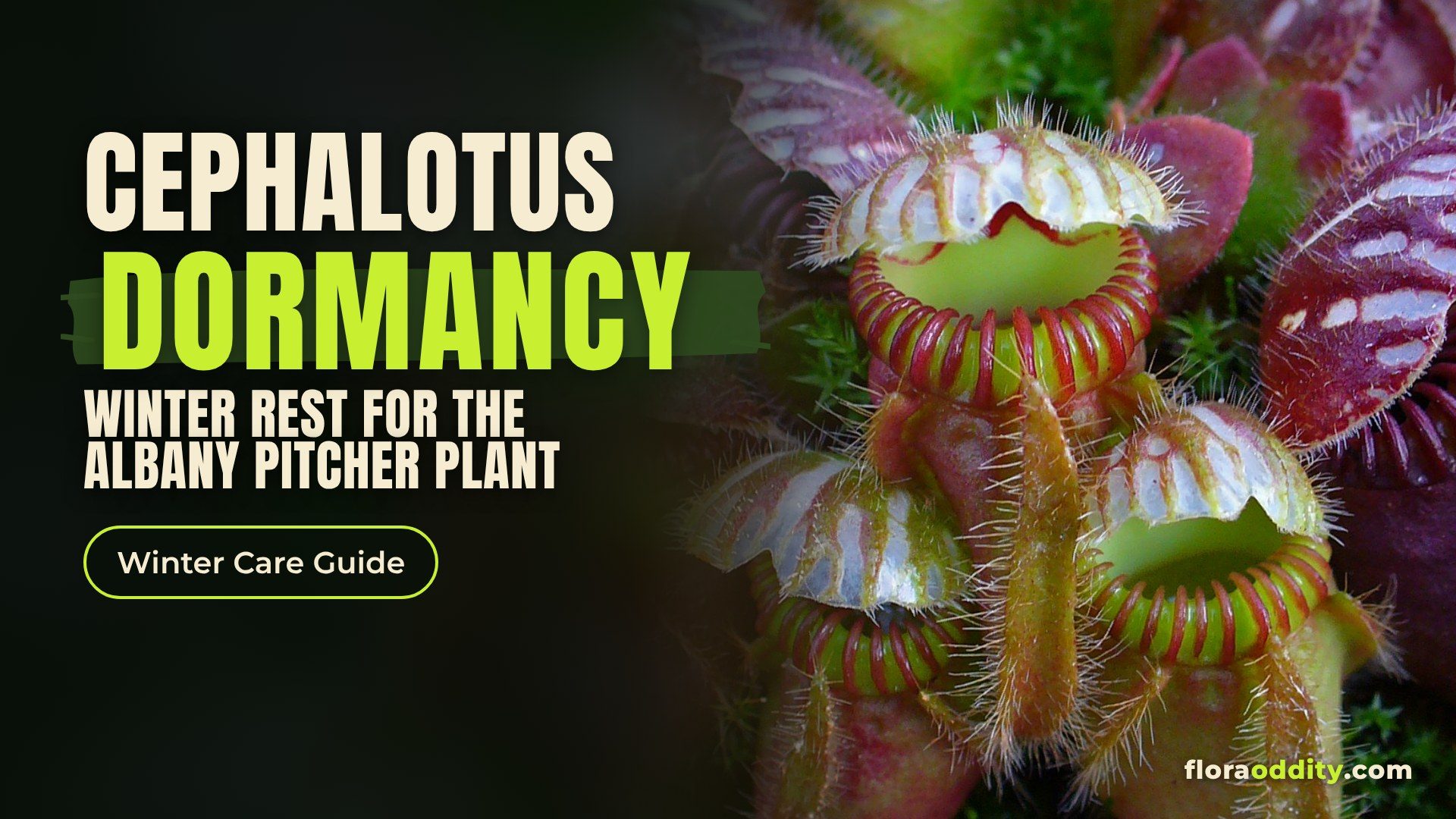
Featured image based on a photo of Cephalotus follicularis in the wild on the southwest Australian coast by Holger Hennern via Wikimedia Commons, CC BY-SA 3.0, with a dark gradient and typography added by FloraOddity; the adapted image is offered under the same licence.
Final articles are editorially reviewed and factual claims are checked against cited sources. Last reviewed: October 2026.

One Comment