
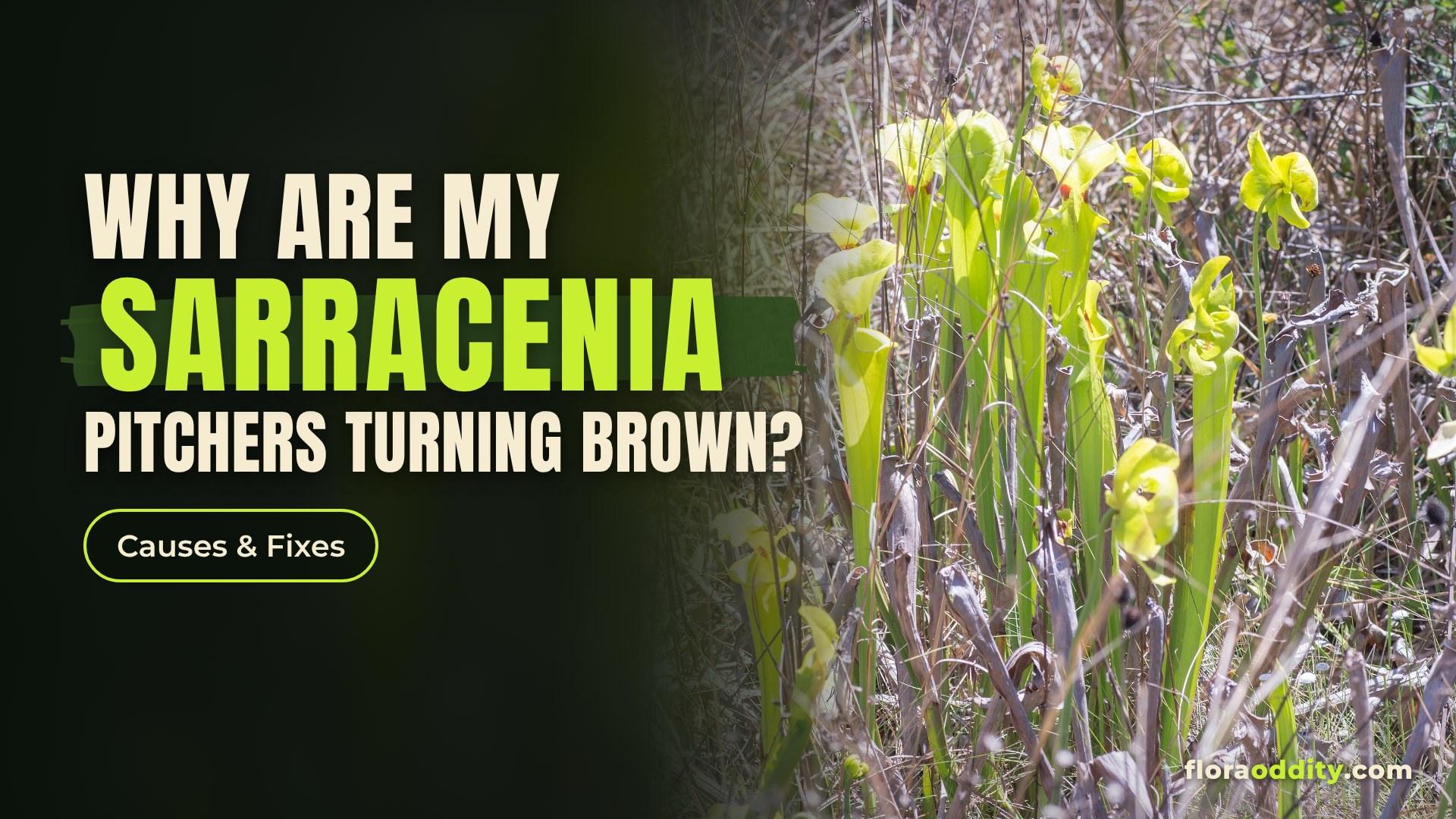
Every Sarracenia pitcher turns brown in the end. The question is whether yours is browning on schedule or for a reason you can fix. Barry Rice, author of the Carnivorous Plant FAQ, puts it plainly: “Either because of rot from indigestion, or simple old age, eventually every leaf on your plant will die.” He adds that a dying leaf “will not spread its death to the rest of the plant.” So a single brown pitcher is rarely an emergency. A plant that browns all over in midsummer, or a growth point that turns soft, is a different story.
If you see your Sarracenia turning brown, start with the season, the species and where the brown sits, then work through the causes below. For the basics of light, water, soil and winter rest, see our Sarracenia care guide; if you are not sure which species you have, its species section will help. And if your pitchers hang from the tips of leaves on a vine, you have a tropical Nepenthes, not a Sarracenia: read our guide to Nepenthes pitchers turning brown instead.
The Short Answer
Most brown pitchers are normal. Sarracenia Northwest, a specialist nursery, says individual pitchers “naturally age and die,” and that browning increases as the plants enter winter dormancy. Pitchers that have caught a lot of insects often brown from the top, and some plants, such as S. oreophila and early-season hybrids, make their best pitchers early and let them fade by mid to late summer. Sarracenia Northwest suggests judging growing-season browning against “the plant’s sunlight, water quality, pests, and the age of the affected pitchers.” Fix those if they are wrong: full sun, mineral-free water, a pot that never dries out, and no fertilizer in the soil. Cut off only the brown parts, and check the rhizome if young growth collapses.
Quick Diagnosis: Match the Symptom to the Cause
Find the row that matches what you see, then read the matching section below.

| Symptom | Likely cause | What to do | Status |
|---|---|---|---|
| Tips and whole pitchers browning in autumn as growth slows | Normal ageing and winter dormancy | Nothing. Give it its winter rest; trim only brown parts | Normal |
| Pitcher tops brown after a summer of big catches; brown spots low on the tube | Prey overload (“indigestion”) | Cut off the worst brown parts, leave the green; never feed meat | Normal |
| S. flava, S. oreophila or their hybrids fading by mid to late summer; rims dry first | Early-season species habit | Nothing. Expect new pitchers or flat winter leaves later | Normal |
| Lids or tops burned soon after a move into full sun | Sun scorch while the plant adjusts | Keep it in full sun; cut off burned leaves; new ones grow normally | Stress |
| Thin, stretched, too-green pitchers that flop and brown | Too little light | Full sun, ideally 6 or more hours of direct sun a day | Stress |
| Slow decline with tap water, or a pot that dried out | Hard water or dry soil | Rain, distilled or reverse osmosis water; flush the pot; keep the tray filled | Problem |
| Decline after fertilizer or ordinary potting soil | Fertilizer or nutrient-rich soil | Flush with pure water, or repot into peat with sand or perlite | Problem |
| Tops toppling over, chewed walls, holes, droppings | Exyra moth larvae or other caterpillars | Cut off and dispose of infested pitchers; pick off caterpillars | Problem |
| Twisted new pitchers; whitish, crisp tissue; white fluff at the base | Aphids, thrips or mealybugs | Inspect new growth closely; remove pests; swab mealybugs with alcohol | Problem |
| Young pitchers collapse; growth point soft and brown | Rhizome rot or freeze damage | Isolate; cut back to firm, white rhizome; replant | Problem |
| Slow, browning growth after division or repotting | Transplant or division stress | Wait; divide just before spring growth with at least three growth points | Stress |
Normal Browning or a Problem?
Three questions settle most cases. First, what month is it? California Carnivores says dormancy is triggered by “shorter photo periods and colder temperatures from October to February,” and that during dormancy “many of the pitchers turn brown and die back.” Brown pitchers in late autumn are expected.
Second, where does the brown start, and on which pitchers? In the sources below, browning that begins at the lid, the rim or the top of the tube on an older pitcher goes with age, a big catch or a seasonal decline. Young pitchers that suddenly flop, dry out and turn brown, as in a rot case Sarracenia Northwest answered, point down toward the rhizome.
Third, is the plant still making good new growth? In one Sarracenia Northwest case, a pitcher plant whose first pitchers browned slowly from the top while it kept producing larger new ones was “perfectly healthy.” A plant whose new pitchers are weak, twisted or collapsing has a problem worth tracking down.
The Causes in Detail
Normal ageing and dormancy
Sarracenia Northwest explains that “as temperatures cool and days shorten in fall, growth will slow and many pitchers will gradually turn brown. This is a normal part of the plant’s seasonal growth cycle.” Carnivorous Plant Nursery describes the same thing from the top down: as day length and temperature fall, “many of the traps will die back, starting at the tops.”
The browning has a purpose. Rice writes that the plant eats bugs all summer “until the pitchers die back in the fall. As the pitchers shrivel, they translocate nutrients from the leaves back to the underground rhizome.” He also warns that “a mature plant in mid-winter often looks old and miserable.” That is the plant resting, not dying. Our pillar guide covers the winter rest itself.
Species that fade in summer
Some Sarracenia brown on their own timetable. Rice says S. flava “seems to put all its growing efforts into a few pitchers at the beginning of the year,” with few more made afterwards, and that in winter it makes flat, sword-shaped leaves without pitchers, called phyllodia. NC State Extension notes that its pitchers “mostly die back as winter approaches.”
S. oreophila goes further. Rice says its pitchers “often die off long before summer is even half over,” because they are “a little more papery and flimsy than those of S. flava.” Hybrids carry the habit. Answering a grower in Jacksonville, Florida, Jeff Dallas of Sarracenia Northwest said S. oreophila hybrids “tend to enter a summer resting state when the weather gets hot.”
Early-season plants also brown from the rim. In another single case, a grower in Portland, Oregon, worried that the brown pitcher edges on a hybrid were sunburn. Dallas replied, “This isn’t burn,” and explained that the plant makes its best pitchers in early summer and starts to decline in August, beginning with the edges: “Those brown edges are nectar glands drying up.” He expected the pitcher tops to turn brown by early September. Answering a July question about S. purpurea subsp. venosa, he said brown spots “from dried nectar that occurs on the rim of the pitchers” show up on S. flava at that time of year as well.
A big catch: prey overload
A pitcher can catch more than it can digest. Rice says the rare smelly pitchers he finds in the wild “are usually overloaded by excessive prey, and are in fact suffering pitcher damage from their rotting contents.” Dallas calls brown spots low on a pitcher “a kind of ‘indigestion’ that Sarracenia often get from catching lots of insects,” and says it “doesn’t affect the overall health of the plant.”
In the Jacksonville case, he saw that most of the die-off was “in the tops of the pitchers from where the insects collect,” combined with a midsummer slowdown, and advised cutting off the worst pitchers “where they are brown and leave the green sections,” since they may still be digesting. Do not add to the load with human food: Carnivorous Plant Nursery says meat or cheese “will likely rot and kill the trap.”
Too little light
Light is the first thing to check when browning comes with weak growth. California Carnivores says pitchers “looking stretched out and too green” are not getting enough sun. Tom Skinner of Tom’s Carnivores, a UK grower, adds that a shaded spot makes the plant “weak and spindly, with pitchers that lack colour. Eventually the pitchers will go brown and die.” Sarracenia Northwest asks for 6 or more hours of direct sun a day, with a minimum of 4 plus bright light for the rest of the day.
Shade can also come from the plant itself. Sarracenia Northwest found that new spring pitchers shaded by last year’s old ones grew “weak and floppy,” and it describes a crowded display whose late-season pitchers flopped because new growth was not getting enough sun.
Sun scorch after a move
A plant moved from shade into full sun often burns a little. California Carnivores says it is common for pitcher lids to “burn” and die back at first, and that the plant “will quickly grow new pitchers.” Dallas gave the same advice to a grower whose plant had only 2 to 3 hours of direct sun: move it to full sun anyway. “If some leaves burn, cut them off. When the plant grows new ones they will look normal.”
The answer is to keep it in the sun, not to move it back into shade. The ICPS does note that in areas “with very hot temperatures and low humidity you might have trouble with the pitchers burning,” and suggests some afternoon shade there.
Dry soil and hard water
Tom’s Carnivores puts “insufficient or inappropriate water” first among its reasons for dying Sarracenia pitchers. The ICPS says the plants “should never be allowed to dry out,” and keeps pots standing in about 1.5 to 2.5 inches (4 to 6 cm) of water. If the tray has run dry in hot weather, refill it with the right water.
Water quality matters as much as quantity. Sarracenia Northwest recommends rain, distilled or reverse osmosis water, and tap water only below 50 ppm of dissolved minerals; it warns that prolonged use of hard water “can cause minerals to accumulate in the soil.” NC State says pitcher plants “are sensitive to dissolved salts in chlorinated water,” and the ICPS rhizome rot page says root tips burned by water “that is too salty” let pathogens in.
If you have used tap water for only a few weeks, Rice suggests flushing the pot thoroughly with pure water, perhaps a few times. After several months of bad water and a clearly declining plant, he says to replace the soil.
Fertilizer
Fertilizer belongs nowhere near the roots. NC State warns that “fertilizers can burn the plant,” and the ICPS says there is “little benefit to soil fertilization of mature Sarracenia” and that fertilizer touching old leaf bases “can encourage rhizome rot.” Pouring it into tall pitchers does not help, because, the ICPS explains, “the plants pump the fertilizer water into the soil.”
For a single dose of water-soluble fertilizer, Rice thinks “a good water drenching should probably fix the situation.” For a plant potted in ordinary potting soil, or anything with fertilizer in it, his advice is to replant it in a 50:50 mix of peat moss and sand “regardless of the season.”
Pests
Exyra moth larvae. Carnivorous Plant Nursery calls them a pest specific to Sarracenia. Rice says the larvae of three Exyra species “eat the pitcher walls, causing the top of the pitcher to topple over,” and that each favours different Sarracenia. Carnivorous Plant Nursery says the moths lay eggs in the pitchers and the larvae eat them “from the inside out.” It advises cutting off the infested pitcher and disposing of it, because, it warns, “Simply leaving the infected trap cutting nearby may cause reinfection.” For caterpillars in general, Rice says to look for “chewed holes in your plants and little black poops” and to remove them by hand.
Aphids and thrips. These attack young growth. Sarracenia Northwest says they cause pitchers “to emerge twisted, curled, or otherwise malformed,” with aphids more common in early spring and thrips “in hot dry weather.” Rice describes thrips damage as tissue that turns “whitish, almost like it was somehow becoming bleached,” and “dryish, or crisped,” often with tiny black tarry spots. Carnivorous Plant Nursery mentions streaks in the leaves.
Mealybugs. These hide low down. Carnivorous Plant Nursery says they settle in “the tight crevices of the lower portions of pitcher plant traps near the rhizome,” and the ICPS says they “are quite capable of giving the coup de grâce to a plant that is doing poorly.” The ICPS’s first step is to pull off all brown leaves, then swab the plant weekly with 70 percent rubbing alcohol mixed with a few drops of dish detergent. Keep ants away, since they protect mealybugs.
Rhizome rot and freeze damage
This is the cause to take seriously. The ICPS says freeze damage in cold-sensitive species “results in mushy rotting rhizomes,” usually after an early or late freeze when the plants are not fully dormant, and names S. psittacina, S. minor and S. leucophylla as the most likely victims. California Carnivores leaves plants outdoors if nights stay above about 20 °F (minus 7 °C), and Sarracenia Northwest says the bigger winter danger is “dehydration from cold, drying winds and repeated cycles of freezing and thawing.”
Rot during the growing season is “of more concern,” according to the ICPS, which blames over-fertilizing and salty water for waking up weak fungal pathogens. One pathogen it describes shows first as a pitcher that dehydrates, and “within 2 to 3 days, the entire plant will be dead.” In a Pennsylvania case, young pitchers “suddenly became floppy, then dried out, became crispy, and eventually turned brown,” and the growth point turned soft. Dallas diagnosed a fungal root rot that “can happen in during the summer months,” more often on the East Coast, and suggested isolating the plants.
The ICPS says a plant can be saved if any part of the rhizome is “firm and the usual white color.” Remove anything soft or brown and replant.
Transplant and division stress
Moving a plant at the wrong time can leave it sulking. The ICPS calls the time just before spring growth “the best and only good time of the year to divide Sarracenia,” and warns that plants divided at other times survive but “it can take them much longer to recover.” Small pieces suffer most: divisions with at least three growth points “recover much better,” while single growth points “struggle for the first year or two.”
Where Sources Differ
Each row gives only the context the sources themselves state.
| Topic | One view | Another view | Context the sources give |
|---|---|---|---|
| Cutting old pitchers | ICPS: “best only to cut off the brown part of leaves,” because plants recover nutrients from old leaves | Sarracenia Northwest: cut all old pitchers down to the rhizome in mid to late winter, even green ones | ICPS says cutting green leaves “can starve a plant that lacks a large rhizome”; Sarracenia Northwest says other species store sugars in “hefty rhizomes” and exempts S. purpurea and S. psittacina |
| When to remove dead pitchers | NC State: wait and remove dead foliage in spring, just before the flowers emerge | Carnivorous Plant Nursery: trim dead tissue in winter as pitchers die; Rice: mostly a matter of “personal aesthetics” | ICPS recommends a fall haircut for long-tube plants stored in a garage, basement or cold frame, because of poor air circulation |
| Brown pitcher edges in strong sun | California Carnivores: lids commonly “burn” when a plant is first put into full sun | Sarracenia Northwest: “This isn’t burn” for brown edges in August on an early-season hybrid; they were nectar glands drying up | California Carnivores is describing plants just moved into sun; the Sarracenia Northwest plant had been in full southern exposure since spring |
| Tap water limit | Sarracenia Northwest: tap water only below 50 ppm | Tom’s Carnivores: under 100 ppm, “ideally closer to 50 or below” | Both say to measure dissolved minerals; Tom’s Carnivores suggests a TDS meter |
| Chlorine | NC State: pitcher plants are sensitive to dissolved salts in chlorinated water | Sarracenia Northwest: chlorine is “a non-issue” | Sarracenia Northwest was answering a grower whose city water measured 25 to 35 ppm |
| How wet in summer | ICPS: pots always standing in 1.5 to 2.5 inches (4 to 6 cm) of water | Sarracenia Northwest, in one rot case: top water daily and “avoid letting them sit in water” | That advice was for plants with fungal root rot in a hot, humid East Coast summer |
How and When to Trim Brown Pitchers
Trimming is mostly tidying. Rice says keeping or removing dead leaves is “more of a matter of personal aesthetics than anything else,” and that dead leaves only spread mold when the plant is already dying for other reasons.
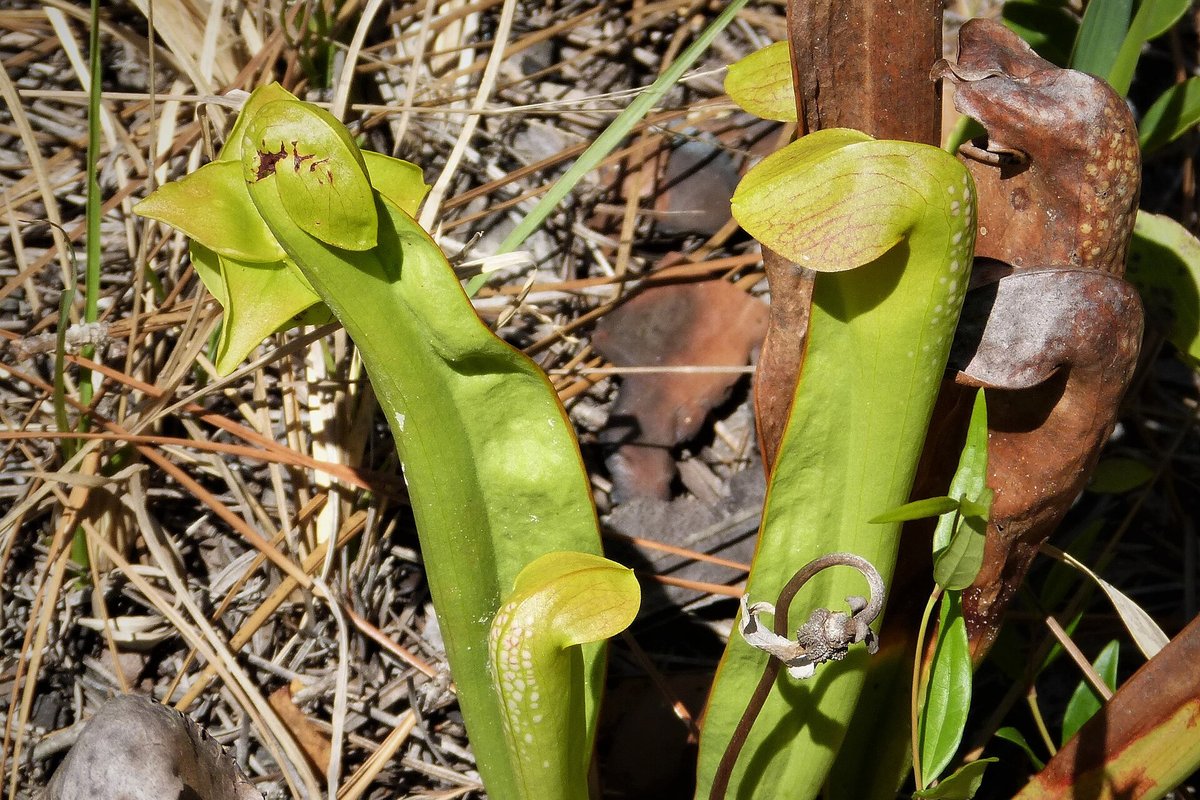
During the growing season, cut only the brown part. The ICPS explains that the plants “recover nutrients in old leaves to use with new growth” and that “cutting off green leaves can starve a plant that lacks a large rhizome.” Cut through the brown tissue just above where it meets the green, so the living lower tube stays on the plant. A half-brown pitcher can still be digesting its catch.
Remove a whole pitcher only when it is fully brown, or when it is infested with Exyra larvae, in which case Carnivorous Plant Nursery says to dispose of it rather than leave it nearby. Carnivorous Plant Nursery cuts down old traps “in the Spring, well after they have had a chance to absorb their nutrient rich catch from the summer before.”
Two species are exceptions. The ICPS says S. purpurea and S. psittacina (along with S. rosea) “should only have their pitchers removed when they turn brown,” because their pitchers can last up to two years. Sarracenia Northwest, which cuts most species right back in late winter, makes the same exception: these plants have “very small rhizomes” and keep their leaves into the next season, so it clips “only the brown pitchers.”
What Recovery Looks Like
Recovery is never a brown pitcher turning green again. Brown tissue is dead, so look at the new growth instead.
After sun scorch, California Carnivores expects new pitchers quickly, and Dallas says the new ones “will look normal.” After a summer slump, he told the Jacksonville grower that “as we get to some cooler nights in late August and September you should see a turnaround and some of the prettiest pitchers of the season.” After winter browning, California Carnivores says that “in spring the plant begins to grow vigorously again,” with flowers first and pitchers after, as Rice describes.
After rot, a smaller plant is a good result. The ICPS advises cutting off rhizome ends “until all brown material is gone,” noting that “your plant may get smaller because of all the rhizome you cut out, but that’s better than losing the plant altogether.” After division, expect the first year or two to be slower if the pieces were small.
Common Mistakes
- Cutting off green pitchers in summer. The ICPS says plants recover nutrients from old leaves; trim only the brown.
- Moving a scorched plant back into shade. California Carnivores and Sarracenia Northwest both say to keep it in full sun and let it grow new pitchers.
- Treating autumn browning as a crisis. Browning in fall is part of dormancy.
- Feeding meat or fertilizing the soil. Both can rot pitchers or roots.
- Leaving Exyra-infested pitchers on the plant or nearby. Carnivorous Plant Nursery warns that this “may cause reinfection.”
- Ignoring a soft growth point. Check the rhizome; firm, white tissue can still be saved.
FAQ: Sarracenia Turning Brown
Is it normal for Sarracenia pitchers to turn brown?
Yes, in many cases. Sarracenia Northwest says individual pitchers naturally age and die and that browning increases going into winter. A pitcher that has caught a lot of prey, or one on S. oreophila or an early-season hybrid, may also brown by late summer.
Will a brown pitcher turn green again?
No. Brown tissue is dead. Cut off only the brown part and watch for healthy new pitchers from the growth points.
Should I cut off all the brown pitchers before winter?
You do not have to. The ICPS removes only dead leaves and brown leaf ends on plants left outdoors, and Rice says trimming is largely a matter of taste. Sarracenia Northwest cuts all old pitchers in mid to late winter so new growth gets full sun, except on S. purpurea and S. psittacina.
Why are the new pitchers on my Sarracenia dying?
Check the new growth for aphids and thrips, which Sarracenia Northwest says deform pitchers while they are still developing. Then check the rhizome: the ICPS links soft, rotting rhizomes to freeze damage, fertilizer and salty water.
The Bottom Line
A Sarracenia turning brown is usually a plant doing what it should: retiring old pitchers, digesting a heavy catch, finishing an early season, or heading into dormancy. Look at the season, the species and where the brown starts. If new growth is weak, twisted or collapsing, check light, water, fertilizer, pests and the rhizome, fix what is wrong, and cut away only what is already brown.
Sources & Further Reading
- International Carnivorous Plant Society: Growing Sarracenia
- International Carnivorous Plant Society: Sarracenia Rhizome Rot
- International Carnivorous Plant Society: Mealybugs
- International Carnivorous Plant Society: Dividing Sarracenia Step-by-Step
- Barry Rice, The Carnivorous Plant FAQ: Should I trim off dead or dying leaves?
- Barry Rice, The Carnivorous Plant FAQ: I goofed by using bad soil or water. What should I do now?
- Barry Rice, The Carnivorous Plant FAQ: What is this bug eating my carnivorous plants?
- Barry Rice, The Carnivorous Plant FAQ: Introducing the North American pitcher plants
- Barry Rice, The Carnivorous Plant FAQ: Sarracenia flava
- Barry Rice, The Carnivorous Plant FAQ: Sarracenia oreophila
- Sarracenia Northwest: How to Grow Sarracenia
- Sarracenia Northwest: Q&A 121, Sarracenia Are Turning Brown
- Sarracenia Northwest: Q&A 144, Brown Edges on Sarracenia
- Sarracenia Northwest: Q&A 126, Sarracenia Purpurea Has Brown Spots
- Sarracenia Northwest: Q&A 125, Damage on Sarracenia
- Sarracenia Northwest: Q&A 124, Sudden Die Off of Sarracenia
- Sarracenia Northwest: Q&A 93, Deformed Pitchers on a Sarracenia
- Sarracenia Northwest: Q&A 159, Trim All Sarracenia Pitchers in Late Winter
- California Carnivores: American Pitcher Plants (Sarracenia) Growing Tips
- Carnivorous Plant Nursery: Growing Tips for Sarracenia
- Carnivorous Plant Nursery: Pests on Carnivorous Plants
- Tom’s Carnivores: Why is my pitcher plant dying or turning brown?
- NC State Extension Gardener Plant Toolbox: Sarracenia
- NC State Extension Gardener Plant Toolbox: Sarracenia flava
Featured image based on a photo of yellow pitcher plants (Sarracenia flava) by Andrew Cannizzaro via Wikimedia Commons, CC BY 2.0, cropped with a dark gradient and typography added by FloraOddity.
Final articles are editorially reviewed and factual claims are checked against cited sources. Last reviewed: October 2026.
One Comment