
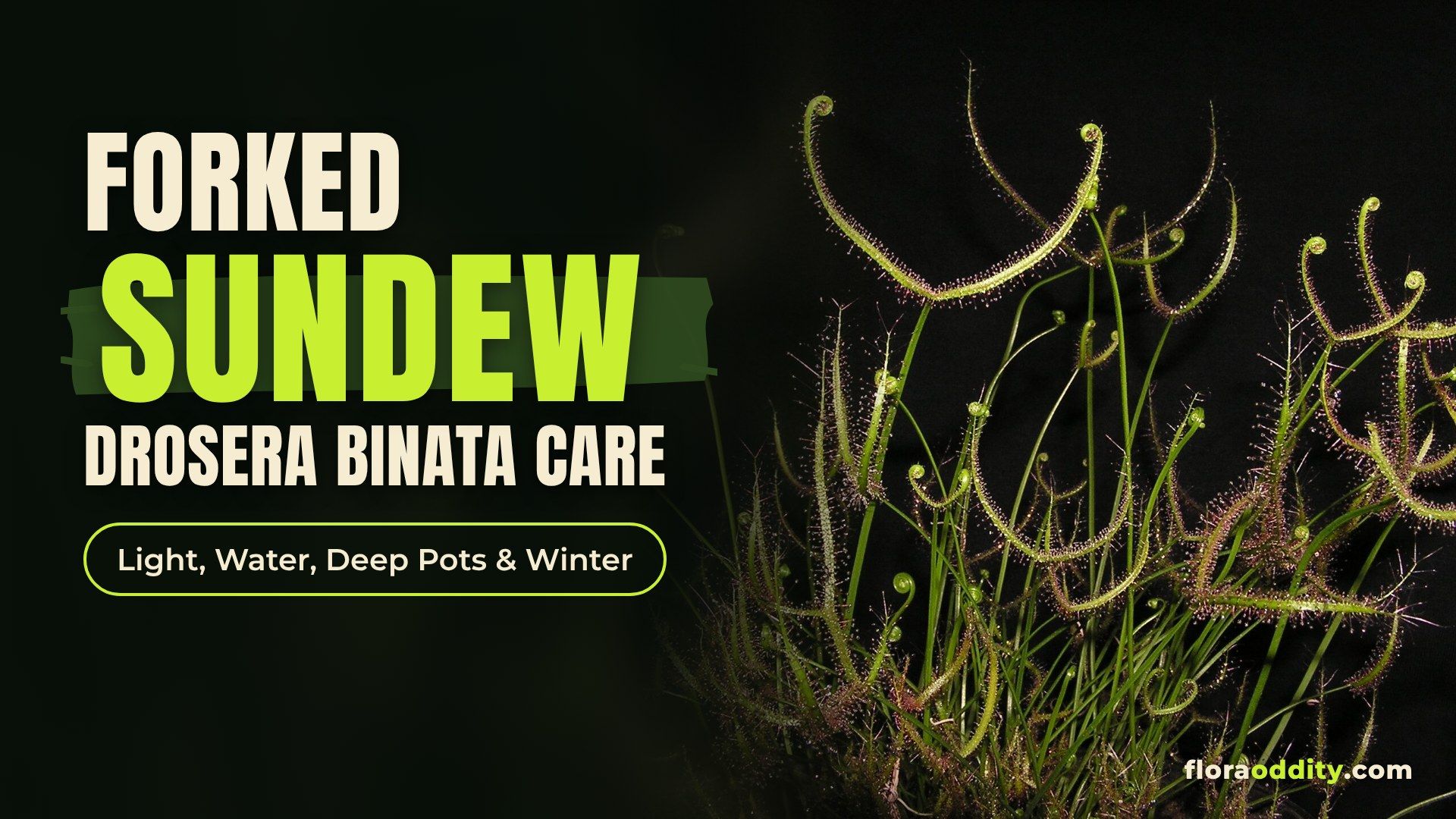
The forked sundew does not look like the round or strap-leaved sundews most people know. Each leaf is a long, thin stalk that splits into two or more sticky arms, and a mature plant becomes what grower Aaron May calls a large insect-catching “bush.” He describes Drosera binata as “very adaptable” and “great for beginning sundew growers,” and California Carnivores calls it “a hardy and easy plant.”
Drosera binata care has one twist that catches people out: most forms take a winter break and can look completely dead for months. This guide covers the species and its main forms, from the simple two-pronged plants to the many-forked giants. If you are not sure what you are growing, start with which sundew do you have in our general sundew care guide.
The Short Answer
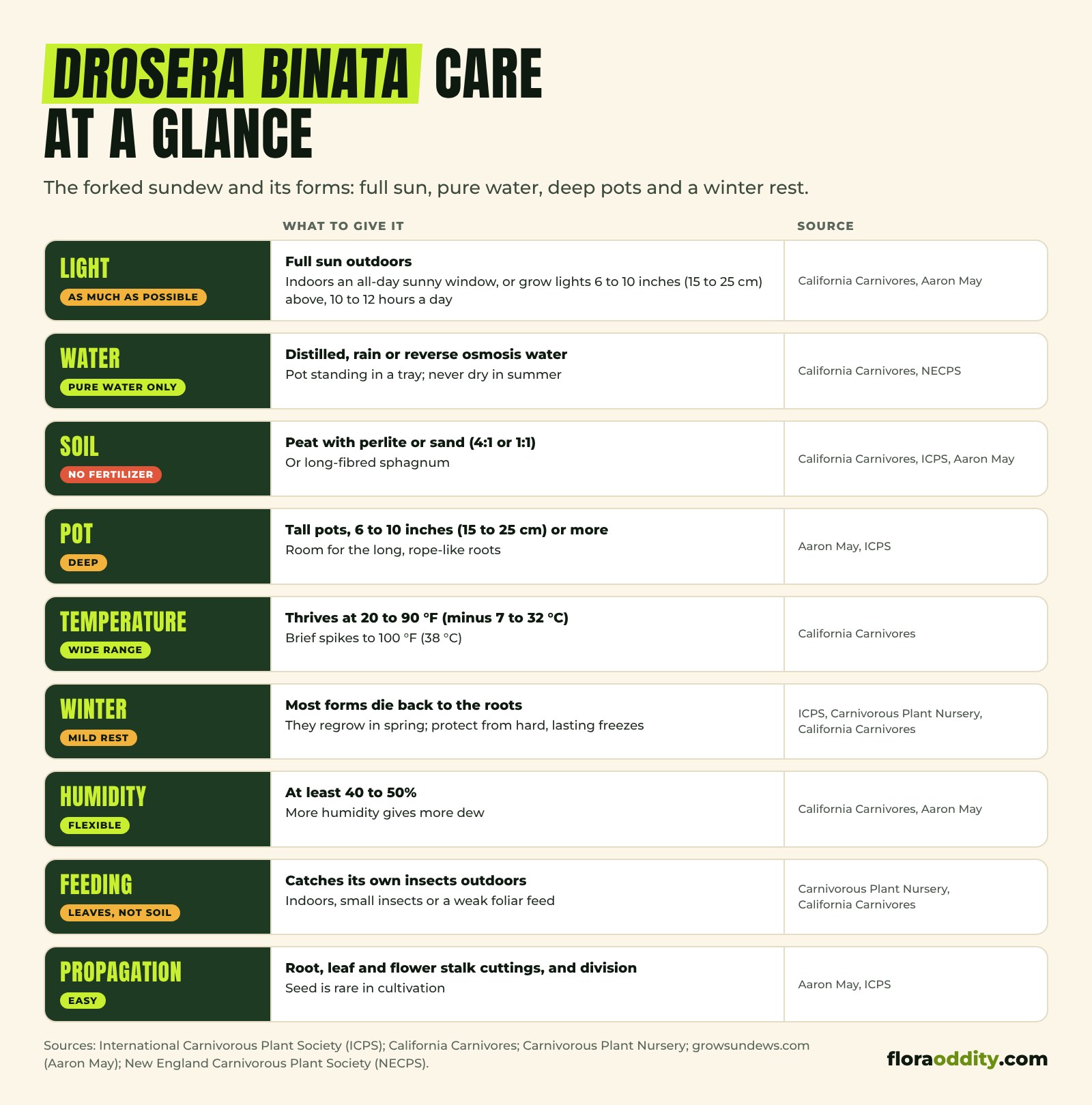
Grow Drosera binata in full sun outdoors, or on a very sunny windowsill or under strong grow lights. Stand the pot in a tray of distilled, rain or reverse osmosis water, in a fertilizer-free peat mix, and choose a tall pot, because the plant makes long, thick roots. California Carnivores says it thrives from 20 to 90 °F (minus 7 to 32 °C) and calls it a warm temperate plant that needs “warm summers and chilly winters.” Most forms die back to their roots in winter and return in spring. Outdoors it catches its own food. It rarely sets seed in cultivation, but it is easy to multiply from root and leaf cuttings.
| Need | Key point | What to give it | Source |
|---|---|---|---|
| Light | As much as possible | Full sun outdoors; indoors an all-day sunny window or grow lights 6 to 10 inches (15 to 25 cm) above, 10 to 12 hours a day | California Carnivores, Aaron May |
| Water | Pure water only | Distilled, rain or reverse osmosis water; pot standing in a tray, never dry in summer | California Carnivores, NECPS |
| Soil | No fertilizer | Peat with perlite or sand (4:1 or 1:1), or long-fibred sphagnum | California Carnivores, ICPS, Aaron May |
| Pot | Deep | Tall pots, 6 to 10 inches (15 to 25 cm) or more, for the long roots | Aaron May, ICPS |
| Temperature | Wide range | Thrives at 20 to 90 °F (minus 7 to 32 °C); brief spikes to 100 °F (38 °C) | California Carnivores |
| Winter | Mild rest | Most forms die back to the roots and regrow in spring; protect from hard, lasting freezes | ICPS, Carnivorous Plant Nursery, California Carnivores |
| Humidity | Flexible | At least 40 to 50%; more gives more dew | California Carnivores, Aaron May |
| Feeding | Leaves, not soil | Catches its own insects outdoors; indoors, small insects or a weak foliar feed | Carnivorous Plant Nursery, California Carnivores |
| Propagation | Easy | Root, leaf and flower stalk cuttings, and division; seed is rare in cultivation | Aaron May, ICPS |
Meet the Forked Sundew and Its Forms
The ICPS (International Carnivorous Plant Society) says Drosera binata grows “primarily in sandy marshes of southern and eastern Australia, Tasmania, and New Zealand.” Forms from cooler places tend to be smaller, and the ICPS says the smaller forms make good terrarium plants.
California Carnivores describes the basic plant: thick black roots send up long, thin leaf stalks, and each leaf “branch[es] into two points.” Carnivorous Plant Nursery adds that new leaves “unroll much like the fronds of a fern.” One detail surprises new growers: the ICPS says “Drosera binata seedlings do not have forked leaves.” The forks come later.
The species has many forms, and their names are a tangle. Barry Rice, in The Carnivorous Plant FAQ, says that only one variety has been validly named so far, “while horticulturists have a lot of other names in illegal use.” The main ones you will see for sale are:
- ‘T-form’. Rice says this is “really simply the typical form,” usually with “mostly one bifurcation” and deep green leaves that redden with age. Sarracenia Northwest says the leaves look like a Y when young and flop into a T as they reach up to 8 inches (20 cm) long.
- Var. dichotoma and ‘Giant’. Rice describes yellow-green leaves that regularly divide into four, sometimes a few more. Aaron May calls ‘Giant’ the largest, at 1.5 to 2 feet (46 to 61 cm) or more tall, and California Carnivores has old clumps “three feet across” with mature leaves forking 4 to 12 times.
- ‘Multifida’. According to Rice, an undescribed form with roughly 8 to 16 leaf tips.
- ‘Extrema’. As above, but with 16 to 40 or more tips, says Rice. Carnivorous Plant Nursery sells it as the Staghorn Sundew and says it is “nearly the size of a basket ball when mature.” The RHS lists the same plant as Drosera binata ‘Extrema’.
- Hybrids. Carnivorous Plant Nursery describes ‘Marston’s Dragon’ as a cross of ‘Extrema’ and ‘Giant’ with hooked leaf tips, and California Carnivores sells ‘Octopus’, a binata and dichotoma hybrid that “can fork 28 times at maturity.”
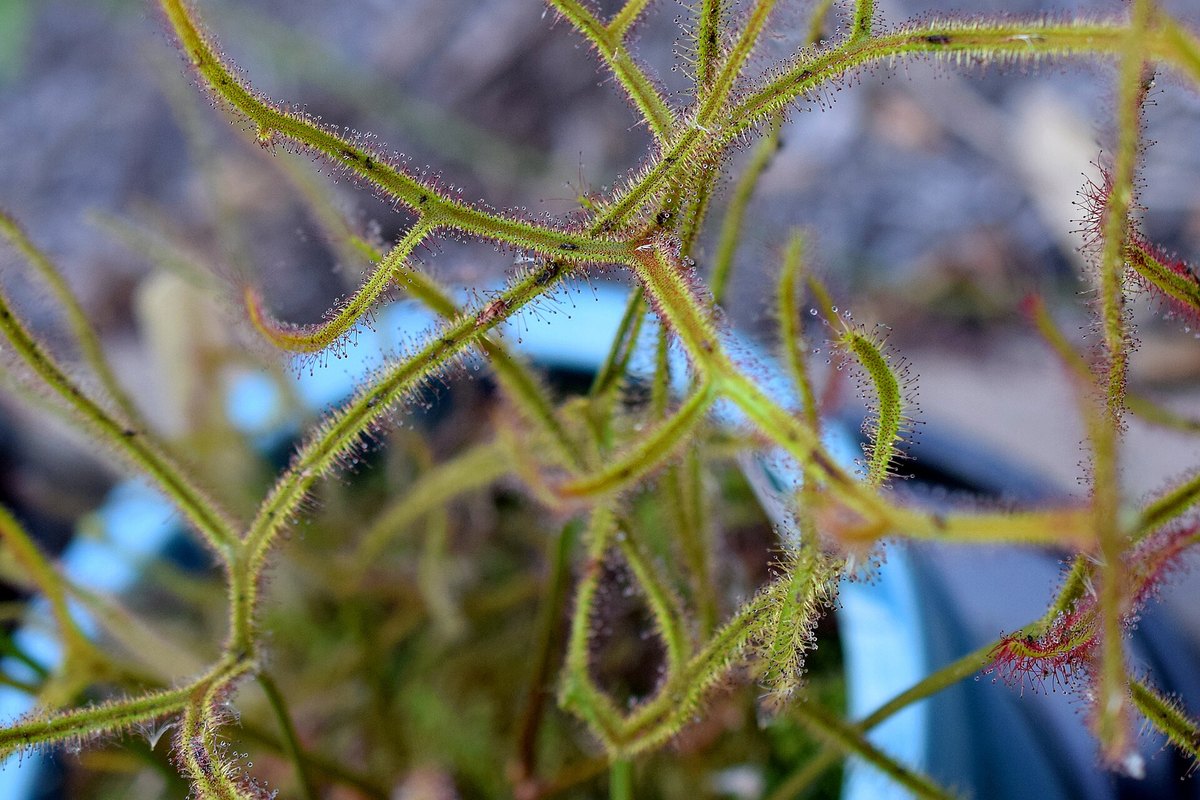
Be patient with the fancy forms. Carnivorous Plant Nursery says multi-forking appears only on plants of 2 years or more, and California Carnivores says ‘Giant’ “can take two or more years” to start branching.
Light
Aaron May’s advice is to give every form “as much light as possible,” and he notes that the leaves of all forms can turn bright red with enough light. California Carnivores asks for full sun and says that “Drosera require lots of direct sun to grow and form dew properly.”
Outdoors. California Carnivores recommends growing this species outdoors and says that in many areas it can sit in full sun. In very hot, dry places such as Arizona, it suggests morning sun with afternoon shade, or 30% shade cloth. Expect a few leaves to burn when a plant first goes out; new leaves grow in adapted to the sun.
Indoors. A window only works if it is very bright. California Carnivores says an indoor plant needs an “extremely sunny” windowsill that gets all-day sun, or grow lights placed 6 to 10 inches (15 to 25 cm) above the plant on a 10 to 12 hour day.
Aaron May also notes that ‘Extrema’ is often grown in hanging baskets because its leaves “droop” in lower light, while in plenty of light it grows into an upright bush.
Water and the Tray
Use only distilled, rain or reverse osmosis water. California Carnivores says these plants “are sensitive to their water quality,” and Sarracenia Northwest asks for low-mineral water of “50 ppm or less.”
The tray method keeps the soil wet with little effort. California Carnivores keeps its plants in a saucer with “a few inches” of water and warns: “Never let them dry out, especially in the hot summer months.” Michael Stiffler of the New England Carnivorous Plant Society (NECPS) uses half an inch (1.3 cm) or more of standing water and says “the soil should never dry out.”
Humidity. California Carnivores says the plants appreciate humidity of at least 40%, and Aaron May recommends at least 50% for best growth, rising to 75 to 85% or more if you want maximum dew.
Soil and Pots
The ICPS says Drosera binata “isn’t very picky about soil” and grows best in the standard 1:1 peat to sand carnivorous plant mix. California Carnivores uses four parts fertilizer-free peat moss to one part perlite. Aaron May has had success with 1:1 peat and silica sand and with pure long-fibred sphagnum, and he rinses his media before use.
Go deep. The ICPS says “The plants like large pots” and that a standard 1 gallon pot is “not too large,” because in nature some varieties send down “long rope-like roots to tap water under the sand.” Aaron May says the plant does well in 2 to 3 inch (5 to 8 cm) pots but the roots get crowded, and he suggests pots 6 to 10 inches (15 to 25 cm) tall or more “to encourage the largest possible growth.” California Carnivores agrees: “They do well in tall pots.”
California Carnivores repots about every 3 years, in winter while the plant is dormant, and sizes up only a few inches at a time.
Temperature and Winter
California Carnivores says Drosera binata thrives from 20 to 90 °F (minus 7 to 32 °C) and can take a brief freeze or a short spike to 100 °F (38 °C). Aaron May has grown it well at 40 to 85 °F (4 to 29 °C) and says that below that range all varieties usually go dormant.
The winter rest
The ICPS is clear: “All Drosera binata forms go through a period of dormancy.” Even plants under lights occasionally rest. New leaves stop, and the plant “effectively die[s] back to the ground.” Carnivorous Plant Nursery says it returns in spring “from resting buds on its roots.” California Carnivores says the rest can start as early as October and last as late as March, and that skipping it “once or twice” is possible, but in the long term the plant will decline.
Forms differ here. Aaron May finds that ‘T-form’ and other typical varieties do best with a cold rest, while ‘Giant’, ‘Marston Dragon’ and ‘Extrema’ can grow all year indoors. Carnivorous Plant Nursery lists its Staghorn (‘Extrema’) as “Dormancy: No” and calls it subtropical.
Keep a resting plant damp but not soggy. The RHS says to keep plants “moist, not sodden” in winter, and California Carnivores says not to let the soil get so dry “that it pulls away from the edges of the pots.” For the methods growers use to overwinter sundews, see the dormancy section of our sundew guide.
How hardy is it?
It depends on the form and the winter. The ICPS says typical Tasmanian and New Zealand forms grow outside all year in USDA zone 9 and warmer, and that where the soil could freeze, plants should go into a garage or another cool, protected place. A highland New Zealand form from Waihohonu, it adds, can survive zone 7 winters outside with protection from freeze-drying.
California Carnivores puts it in temperatures: a plant is fine outside if nights drop below 20 °F (minus 7 °C) but days climb above 40 °F (4 °C). Where nights stay below 20 °F (minus 7 °C) for long spells, it suggests an unheated room or garage with a sunny window and nights of 50 to 60 °F (10 to 16 °C), deep mulch outdoors, or the refrigerator. The RHS rates Drosera binata H3, which it defines as hardy in coastal and relatively mild parts of the UK, down to about 23 to 34 °F (minus 5 to 1 °C). The roots are the tough part: California Carnivores says the plant “will often regrow from the roots if killed by a freeze or other mishap.”
Feeding
Outdoors, the forked sundew feeds itself. California Carnivores says sundews “will catch plenty of food when grown outdoors,” and Carnivorous Plant Nursery calls ‘Extrema’ “a great bug catcher able to trap larger flying insects.”
Indoors, there are two options:
- Insects. Carnivorous Plant Nursery says sundews indoors or in a terrarium benefit from “wingless fruit flies or other very small insects,” and need feeding only a few times a month. Aaron May feeds his every two weeks for the fastest growth and says feeding also encourages flowering.
- Foliar fertilizer. California Carnivores sprays MaxSea on the leaves once a month at 1/4 teaspoon per US gallon (3.8 litres) of water, “to the foliage only.”
The RHS page for var. dichotoma says “fertilising is unnecessary,” and none of these sources puts fertilizer in the soil.
Flowering and Seed
Drosera binata flowers in summer. Carnivorous Plant Nursery says it blooms from June to September with white flowers on tall red stalks, and Aaron May describes “somewhat large” white flowers with broad petals, plus one form of var. multifida with pink flowers.
Do not count on seed. The ICPS says “Most forms of Drosera binata in cultivation are either sterile, have self-incompatible flowers, or do not otherwise self-pollinate.” Self-incompatible plants need pollen from a second, unrelated plant, which is hard to find because most plants in the trade are clones. California Carnivores says of its ‘T-form’ that “our clone never produces seed.” The exceptions, according to the ICPS, are some New Zealand forms, such as the Coromandel form, which self-pollinate; it also mentions varieties that “grow for a year or two, set a copious amount of seed, then die.”
If you do get seed, the ICPS suggests 68 to 77 °F (20 to 25 °C) for germination and says cuttings are faster than seed.
Propagation
You will rarely need seed, because Drosera binata multiplies easily from its roots. Aaron May rates root cuttings “extremely easy,” since all varieties produce long, thick roots, and he calls flower stalk cuttings “a ‘must try!'” because they form the largest plantlets fastest. Leaf cuttings floated on water are easy too. The RHS suggests taking root cuttings while the plant is dormant.
Division is just as simple. Aaron May says the plant forms clumps over time and that dormancy is a great time to divide them; afterwards, keep new divisions out of heat and dry air. For step-by-step methods, see our guide on how to propagate sundews.
Common Problems
No dew. California Carnivores says a plant without dew “most likely needs more light,” and that shipping can strip the dew, which may take a few weeks to return. If there is still none after four weeks, increase the light. Our guide to a sundew not making dew works through every cause.
It looks dead in autumn. Usually it is resting. The ICPS says most varieties have a dormant period “where the plant appears to be dead until you inspect the growth bud.” Aaron May once thought his ‘Extrema’ had died after it died back to the roots, but “it sent up a new clump of plants in the spring.” Carnivorous Plant Nursery also warns that plants ordered in winter may arrive “dormant and leafless.”
Floppy, drooping leaves. Aaron May says ‘Extrema’ leaves droop in lower light, so check the light first (see Light above).
Burnt leaves. California Carnivores expects a few scorched leaves after a move into full sun, and some burn back in a heatwave; new leaves follow.
Aphids. Carnivorous Plant Nursery says aphids attack new growth, mostly in spring, and seem to be more of a problem on sundews and flytraps than on other carnivorous plants. Small numbers can be squeezed or washed off, repeated every week or two.
Where Sources Differ
| Topic | One view | Another view | Why they may differ |
|---|---|---|---|
| Does every form need a winter rest? | ICPS: “All Drosera binata forms go through a period of dormancy” | Carnivorous Plant Nursery lists its Staghorn (‘Extrema’) as “Dormancy: No”; Aaron May grows ‘Giant’, ‘Marston Dragon’ and ‘Extrema’ all year indoors | Carnivorous Plant Nursery calls the Staghorn subtropical, from Stradbroke Island off eastern Australia; Aaron May describes his own indoor plants |
| How cold for ‘T-form’? | California Carnivores: “requires a chilly to frosty winter dormancy” | Sarracenia Northwest: “Tropical houseplant”; “always protect from frost” | Sarracenia Northwest sells it as a windowsill plant; neither page names the plant’s origin |
| How many tips does ‘Extrema’ have? | Barry Rice: 16 to 40 or more tips | Carnivorous Plant Nursery (Staghorn): “typically 8 to 12+ tips per leaf” | Rice notes the name “extrema” has never been properly described; Carnivorous Plant Nursery says multi-forking shows only on plants of 2 years or more |
| Temperature range | California Carnivores product page: 20 to 90 °F (minus 7 to 32 °C) | California Carnivores forked-leaf tips (2020): 20 to 80 °F (minus 7 to 27 °C) | Same nursery, different pages; the tips page is dated June 2020 |
| Tray depth | California Carnivores: “a few inches,” or “at least two inches” (5 cm) | NECPS: 1/2 inch (1.3 cm) or more | Both keep the soil wet at all times |
| Seed germination temperature | ICPS: 68 to 77 °F (20 to 25 °C) | RHS (var. dichotoma): about 50 to 55 °F (10 to 13 °C) | The RHS figure is for var. dichotoma; the ICPS figure is for the species generally |
Common Mistakes
- Throwing out a dormant plant. Most forms die back to the roots in winter; keep the pot damp and wait for spring.
- Growing it in a short pot. The roots are long; a tall pot gives a bigger plant.
- Keeping it in a dim room. Low light means little dew and floppy leaves.
- Letting the tray run dry in summer. California Carnivores says never to let it dry out in hot months.
- Leaving it out through long hard freezes. Brief frost is fine; long spells below 20 °F (minus 7 °C) call for a garage, mulch or the fridge.
FAQ: Drosera binata Care
Is Drosera binata good for beginners?
Yes. Aaron May calls it “great for beginning sundew growers,” and Carnivorous Plant Nursery rates it “Easy.” The main thing to learn is its winter rest.
Does Drosera binata need dormancy?
Most forms rest in winter, and the ICPS says all forms go through dormancy. Some growers keep ‘Giant’ and ‘Extrema’ growing year round indoors, but California Carnivores says that if the rest is skipped in the long term, the plant “will begin to do poorly.”
Can Drosera binata grow indoors?
Yes, if the light is strong: an all-day sunny window or grow lights 6 to 10 inches (15 to 25 cm) above the plant. California Carnivores still prefers growing it outdoors and says indoor plants “will want a winter dormancy.”
Why won’t my forked sundew make seed?
The ICPS says most cultivated plants are sterile or self-incompatible, and most are clones of one plant, so a second, unrelated plant is needed. Root and leaf cuttings are the easy way to get more.
The Bottom Line
Good Drosera binata care means full sun, a tray of pure water, a fertilizer-free peat mix and a tall pot for its long roots. Let most forms rest in winter, protect them from long hard freezes, and do not give up on a pot that looks empty. Expect few seeds but plenty of new plants from root cuttings, and give the many-forked forms two years or more to show off.
Sources & Further Reading
- International Carnivorous Plant Society: Growing Drosera binata
- Rice, B. The Carnivorous Plant FAQ: Any other Drosera species
- Rice, B. The Carnivorous Plant FAQ: What do you mean by complex names like Drosera binata var. multifida f. extrema?
- May, A. growsundews.com: Drosera binata varieties
- California Carnivores: Drosera binata
- California Carnivores: Drosera dichotoma ‘Giant’
- California Carnivores: Drosera binata ‘Octopus’
- California Carnivores: Forked Leaf Sundew Care Tips
- Carnivorous Plant Nursery: Drosera binata
- Carnivorous Plant Nursery: Staghorn Sundew, Drosera binata var. multifida extrema
- Carnivorous Plant Nursery: Giant Forked Sundew, Drosera binata var. dichotoma
- Carnivorous Plant Nursery: Marston’s Dragon
- Carnivorous Plant Nursery: Growing Tips for Sundews
- Carnivorous Plant Nursery: Pests on Carnivorous Plants
- Sarracenia Northwest: Drosera binata, T-Form
- New England Carnivorous Plant Society: Basic Cultivation of Temperate Sundews
- RHS: Drosera binata
- RHS: Drosera binata subsp. dichotoma
- RHS: Drosera binata ‘Extrema’
Featured image based on a photo of a forked sundew (Drosera binata) by Rosťa Kracík via Wikimedia Commons, CC BY 3.0 CZ, cropped with a dark gradient and typography added by FloraOddity.
Final articles are editorially reviewed and factual claims are checked against cited sources. Last reviewed: October 2026.

One Comment