

Every autumn, a round-leaved sundew that glittered all summer shrinks into a dull knot of dead leaves, and its owner starts to worry. Usually nothing is wrong. Carnivorous Plant Nursery calls dormancy “a natural protective mechanism that allows plants to survive an extended period of cold and dark,” and warns that “it’s a common mistake for the new grower to confuse dormancy with plant death or disease.”
The tricky part is that sundew dormancy is not one thing. Some Drosera need a cold winter, some only slow down, some rest through summer instead, and the popular windowsill species do not rest at all. Before you change anything, check which group your plant belongs to in our sundew care guide. This article goes deeper than the guide’s short dormancy section: how to read a resting plant, and how to get it through winter safely.
The Short Answer
Temperate sundews such as D. rotundifolia, D. anglica, D. intermedia and D. filiformis need a cold winter rest, which they spend as a tight bud called a hibernaculum. Carnivorous Plant Nursery suggests at least 45 days at 45 °F (7 °C) for plants kept indoors, and 3 to 6 months depending on where the species comes from. The forked-leaf sundew, D. binata, also rests in winter but simply dies back to its roots. Tropical and subtropical sundews such as the Cape sundew (D. capensis) do not go dormant. Pygmy and tuberous sundews rest in summer, not winter. During a winter rest, keep the soil damp but not soaked, keep the plant cool, and do not throw out a pot just because the leaves have gone brown.
Which Sundews Go Dormant, and Which Do Not
Barry Rice’s Carnivorous Plant FAQ explains that most carnivorous plants come from habitats that are “inhospitable during some season,” and survive it by resting. Many rest “during the cold of winter by forming tightly bound hibernacula,” but “excessive heat is another reason plants may hibernate.” That gives three broad patterns for sundews: a winter rest, a summer rest, and no rest at all.
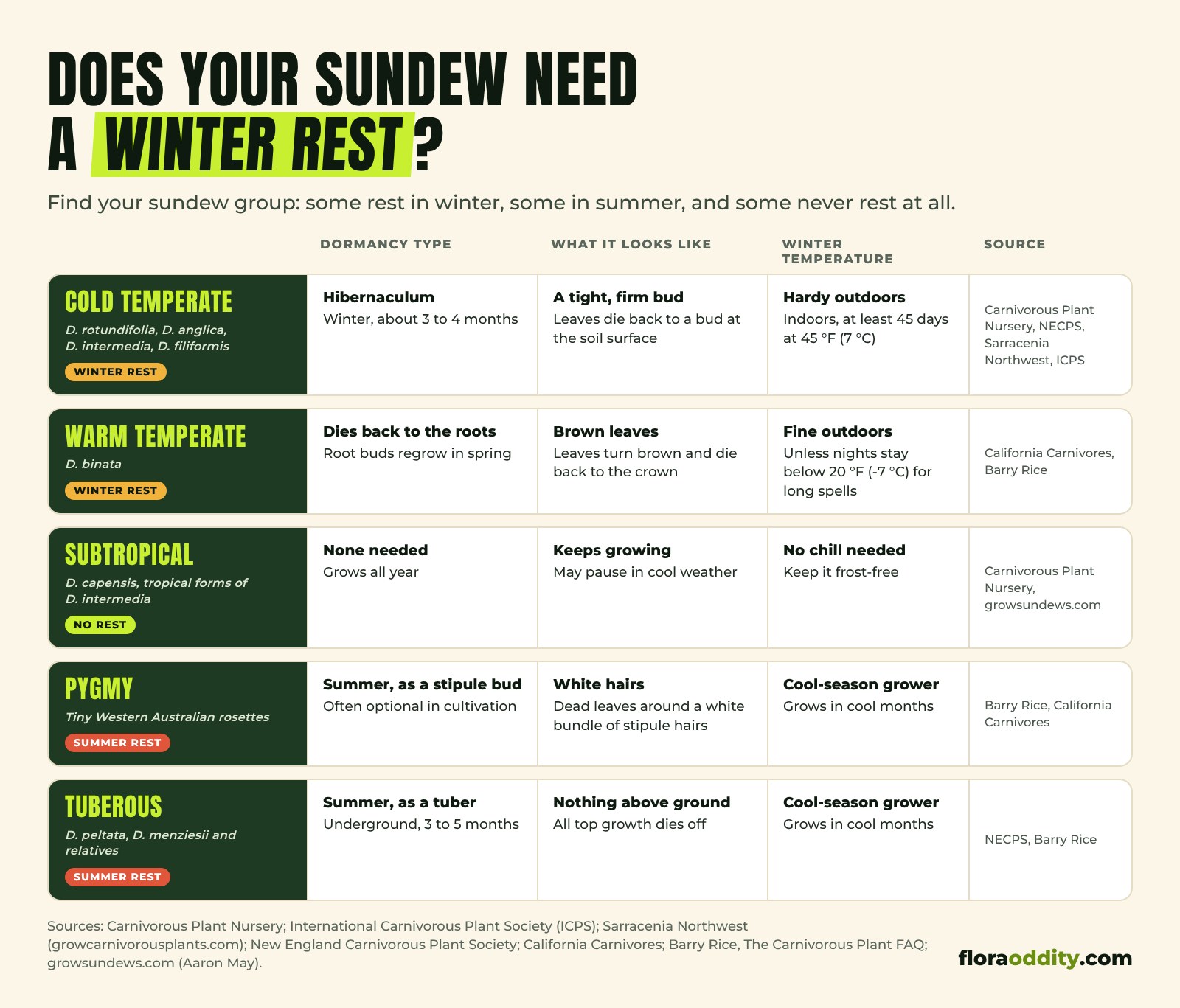
| Group | Examples | Dormancy type | What it looks like | Winter temperature | Source |
|---|---|---|---|---|---|
| Cold temperate (winter rest) | D. rotundifolia, D. anglica, D. intermedia, D. filiformis | Hibernaculum: winter, about 3 to 4 months | A tight, firm bud: leaves die back to a bud at the soil surface | Hardy outdoors; indoors, at least 45 days at 45 °F (7 °C) | Carnivorous Plant Nursery, NECPS, Sarracenia Northwest, ICPS |
| Warm temperate (winter rest) | D. binata | Dies back to the roots: root buds regrow in spring | Brown leaves: leaves turn brown and die back to the crown | Fine outdoors unless nights stay below 20 °F (-7 °C) for long spells | California Carnivores, Barry Rice |
| Subtropical (no rest) | D. capensis, tropical forms of D. intermedia | None needed: grows all year | Keeps growing: may pause in cool weather | No chill needed: keep it frost-free | Carnivorous Plant Nursery, growsundews.com |
| Pygmy (summer rest) | Tiny Western Australian rosettes | Summer, as a stipule bud: often optional in cultivation | White hairs: dead leaves around a white bundle of stipule hairs | Cool-season grower: grows in cool months | Barry Rice, California Carnivores |
| Tuberous (summer rest) | D. peltata, D. menziesii and relatives | Summer, as a tuber: underground, 3 to 5 months | Nothing above ground: all top growth dies off | Cool-season grower: grows in cool months | NECPS, Barry Rice |
Cold temperate sundews: a true winter bud
The New England Carnivorous Plant Society (NECPS) says temperate sundews “grow in climates which experience cold weather in winter, dying down to buds (called hibernacula),” and that “all species require three to four months of winter dormancy.” Rice adds that every North American species except D. brevifolia and D. capillaris produces these winter resting buds. The International Carnivorous Plant Society (ICPS) expects some to rest even longer: about six months a year for both D. rotundifolia and D. anglica, while the more northern varieties of D. intermedia “may be dormant 9 months of the year.”
California Carnivores says the rest is “triggered by exposure to a combination of shorter photo periods and colder temperatures from October to February.” Temperature matters too: Carnivorous Plant Nursery says D. rotundifolia forms its hairless hibernaculum when temperatures drop below 40 °F (4 °C), and growsundews.com notes that D. anglica needs a short day, “8 hours or a little less,” to form one.
These plants are tough. The Royal Horticultural Society (RHS) rates D. rotundifolia H5, “hardy in most places throughout the UK even in severe winters,” which it defines as 5 to 14 °F (-15 to -10 °C). NC State Extension, describing the same species grown indoors, says to “allow the plant to go dormant in winter.”
Not every plant sold under these names needs cold. Carnivorous Plant Nursery says D. intermedia ranges “from Canada to the Caribbean, where varieties do not require dormancy,” and Aaron May at growsundews.com writes that tropical forms of D. intermedia “DO NOT need a dormancy period,” though they may still form a bud “if the photoperiod is too short, the media is too dry, or it gets too cold.”
D. binata: a warm temperate rest
California Carnivores calls D. binata a warm temperate plant that needs “warm summers and chilly winters.” Rice notes that it may “stop growth and die back to the soil without forming any obviously specialized structure beyond a thick root system,” and Carnivorous Plant Nursery says it will “reemerge from resting buds on its roots in the spring.”
Subtropical sundews: no rest at all
Carnivorous Plant Nursery lists “Dormancy: No” for the Cape sundew and says that “in cooler temperatures it stops growing, but holds its traps.” Its sundew growing tips put it plainly: “Tropical sundews do not go dormant and will grow year round.” The ICPS agrees that subtropical sundews “don’t have dormancy or light cue requirements to survive long term.”
Is It Dormant or Dead?
Sarracenia Northwest (growcarnivorousplants.com) describes the normal autumn change: “As the days shorten in late summer and fall, growth slows, and the leaves gradually turn brown or black.” Most temperate species then form “a compact resting bud” at the soil surface, and “this seasonal dieback is normal and does not mean the plant is dying.” If a temperate sundew stops making dew in autumn, check for this seasonal dieback before you work through our guide to a sundew not making dew.
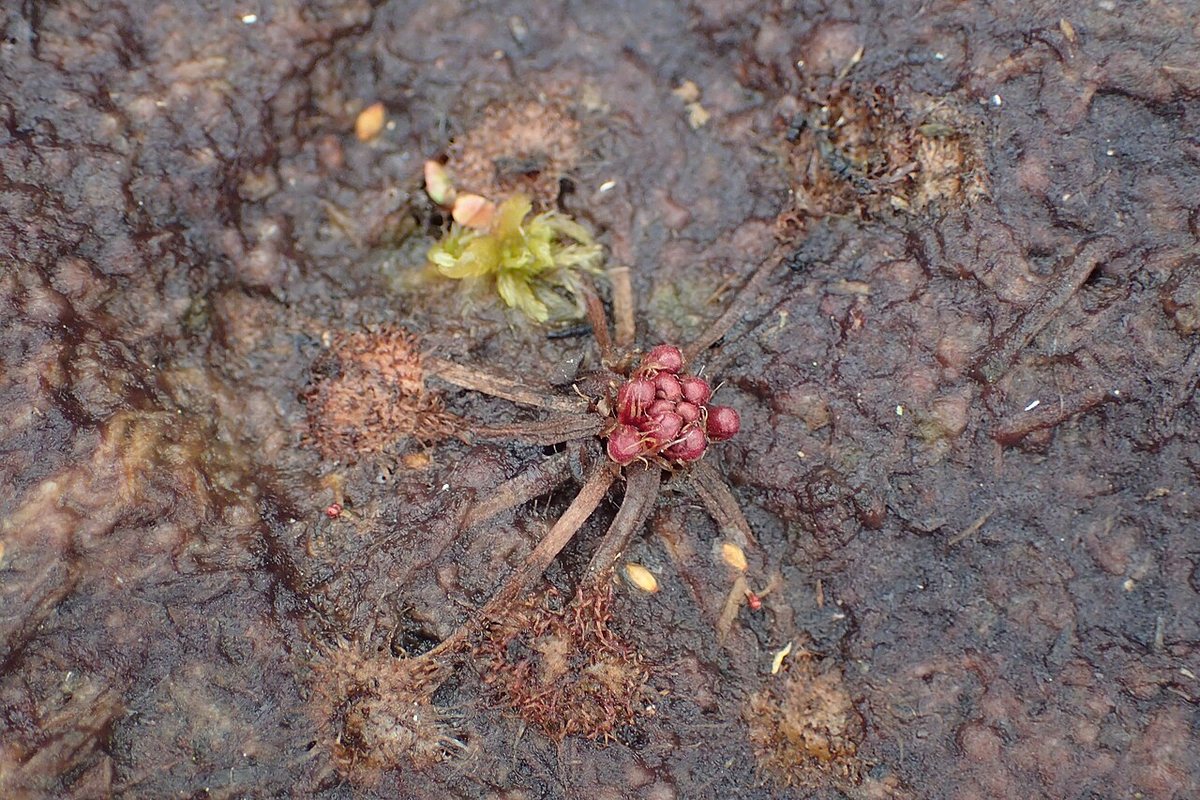
The ICPS says a D. rotundifolia winter bud “is what this species looks like a third to half of the year.” Carnivorous Plant Nursery describes a temperate sundew’s hibernaculum as resembling “a fuzzy round button with tightly curled leaves in the center,” like “a tiny set of coiled fern fronds,” adding that “some are less hairy than others.” On D. filiformis, Sarracenia Northwest says the bud is often wrapped in “a fuzzy plant material, kind of like a blanket,” usually light brown but sometimes black from broken-down peat.
To check a bud, Sarracenia Northwest suggests pressing on it: “It should be firm. If it’s soft, it likely rotted away.” You can also scrape away a little of the fuzz: “The actual resting bud should be green. If it starts to fall apart when you scrape it and the inside looks brown, the plant is dead.”
D. binata is harder to read because nothing obvious is left above the soil. The ICPS says most varieties have a dormant period “where the plant appears to be dead until you inspect the growth bud,” and May describes a plant that “died back to the roots, and I thought it died. However, it sent up a new clump of plants in the spring.” If you are unsure, leave the pot alone and keep it damp until spring.
How to Overwinter a Dormant Sundew
To check whether your climate gives a natural winter rest, try our dormancy checker.
Whichever method you choose, reduce the water. Carnivorous Plant Nursery says to “water them less. Leave the soil only slightly damp, but never dry,” and Sarracenia Northwest says the soil “does not need to remain as wet as during the growing season.”
Outdoors
Where your climate allows it, outdoors is the simplest option. Sarracenia Northwest says that “established plants tolerate frost and freezing temperatures, and the soil may freeze during cold weather.” The real danger for pots, it explains, is “dehydration from cold, drying winds and repeated cycles of freezing and thawing.” Its growers advise keeping pots “on the ground, and not up on a deck, table or any kind of bench,” and say snow is no problem: “if you get some snow, bury your plants in it.”
Pot size matters. Carnivorous Plant Nursery, which grows in USDA zone 7a, recommends a pot of at least 16 inches (40 cm) for plants left in place all year, or burying smaller pots to their rims and mulching them.
D. binata is less hardy. California Carnivores says it is fine outside on nights that drop below 20 °F (-7 °C) as long as the days climb above 40 °F (4 °C), but where nights stay below 20 °F (-7 °C) for sustained periods, it should be mulched in, moved to a garage or put in the fridge. The ICPS says a highland form from New Zealand “can survive USDA zone 7 winters outside with protection from freeze-drying.”
An unheated garage, porch or cold room
NECPS member Mike Stiffler recommends an attached garage, which gets “some heat from the house and protection from freezing winds,” and says temperatures from just above freezing up to 50 °F (10 °C) are ideal. He places plants in front of a window if one is available, keeps the tray water shallow, and brings them into the house if the garage is expected to fall well below freezing. For D. binata, California Carnivores suggests a sunny windowsill in an unheated room or garage where nights dip to 50 to 60 °F (10 to 16 °C), keeping the plant well watered.
Carnivorous Plant Nursery’s watering test: the soil “should yield under gentle pressure, but your finger shouldn’t pull away wet.”
The refrigerator
The fridge is the fallback when your winters are too warm or too harsh. Carnivorous Plant Nursery describes the method in full: bare-root the plants, trim any foliage longer than 1 inch (2.5 cm), wrap the hibernacula in moist long-fiber sphagnum moss, and put them in a freezer bag with about a dozen small holes. Store the bag in the crisper drawer at normal fridge temperatures, which it gives as 33 to 40 °F (1 to 4 °C). For D. anglica, growsundews.com suggests about 32 °F (0 °C) “or just slightly above this.”
Mould is the main risk. Carnivorous Plant Nursery says “a light dusting of sulfur powder directly on the rhizomes prior to wrapping helps to prevent mold or fungus,” and that “if there’s standing water in the bag it’s too wet.” California Carnivores, which leaves its D. binata potted inside a resealable bag, says to check periodically that plants are “still moist and not growing mold or fungus.” The method is much the same one used for flytraps, covered step by step in our Venus flytrap dormancy guide.
Not everyone likes it. Stiffler writes: “I advise against this method unless no other option is available; I’ve experienced frequent losses especially with smaller plants.”
If mould appears
Sarracenia Northwest says dead foliage around the bud “can sometimes encourage fungal growth, especially in mild or humid winter conditions.” When a reader in South Florida found a hair-like growth on a dormant D. filiformis, its growers diagnosed botrytis and advised trimming the dead leaves, then using a sulfur fungicide and making sure to “saturate the hibernacula.” They also suggested keeping plants “out in the open and not under any kind of awning or overhang.”
Waking Up in Spring
Dormancy ends with longer days and warmer weather. California Carnivores says temperate sundews “will resume vigorous growth in spring.” Timing varies: Sarracenia Northwest says its plants in Oregon emerge “in mid to late-April,” while in USDA zone 5 dormancy “might end in early May.”
If you used the fridge, Carnivorous Plant Nursery says “if you see signs of growth it’s certainly time to bring them out.” California Carnivores brings its D. binata out in February, but suggests matching the timing to your outdoor night temperatures. For D. rotundifolia and D. intermedia, Carnivorous Plant Nursery adds that the hibernaculum “is best pushed down to the surface in early Spring for best growth,” and the ICPS says cold temperate sundews “may appreciate being repotted so the base of the hibernaculum is in the soil” as they start to grow.
Uncover mulched plants gradually. One NECPS grower in Connecticut removes “a few inches of the wood chips at a time as the weather warms up,” and brings especially tender plants indoors for a few weeks to dodge spring cold snaps.
Summer Dormancy: Tuberous and Pygmy Sundews
NC State Extension notes that “some species from South Africa and Australia require summer dormancy.” Rice explains that while pygmy sundews hide from the heat “in little stipule buds, the above-ground parts of tuberous Drosera die back completely,” storing their reserves in an underground tuber.
Tuberous sundews. NECPS says these need “hot, dry summers and cool, wet winters.” After flowering, remove pots from the water tray and let them dry gradually; “all signs of living plants will die back to the tubers and this is just their normal process.” Rice warns not to disturb the soil for a few months, “even though all the leaves and stem can be completely dead,” because the shoot down to the tuber “might still be alive.” NECPS gives the rest as 3 to 5 months, after which it restarts top watering in early to mid September.
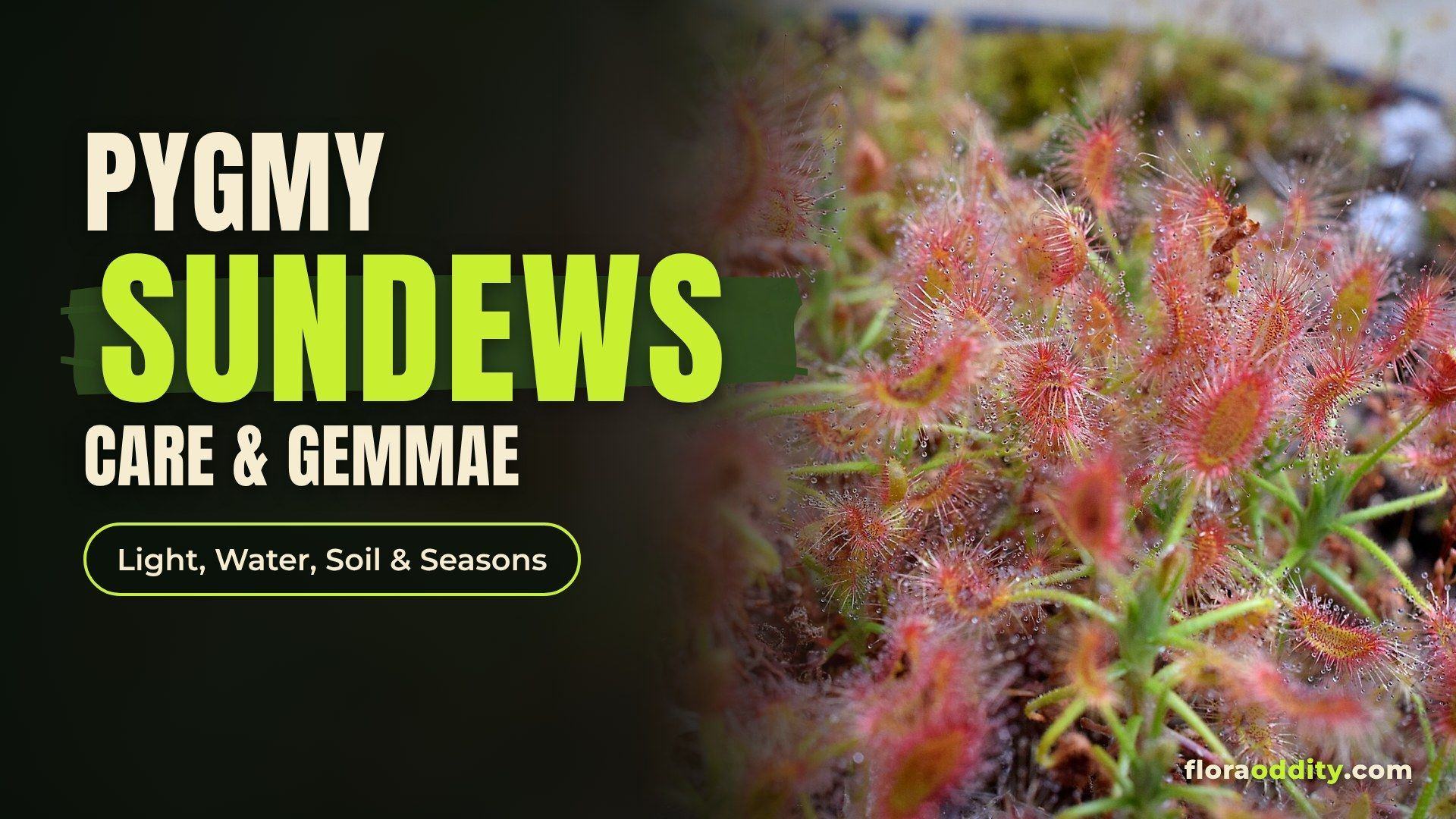
Pygmy sundews. Rice says their leaves die back in summer and “only the leaf stipules remain as a shiny white bundle of hairs or bristles at the rosette center.” Older plants often die during this period. In cultivation the rest may not happen at all. The ICPS grows pygmies under a fiberglass panel whose “lower light and heat helps keep some of the species from going dormant in the summer,” and California Carnivores says pygmies “may experience brief summer dormancy when temperatures rise but it is not necessary and care remains the same during this period.”
Where Sources Differ
| Topic | One view | Another view | Why they may differ |
|---|---|---|---|
| Winter water | California Carnivores: leave temperate sundews “sitting in distilled water” through winter | RHS: “keep just moist during the winter and do not stand the plants in water” | California Carnivores is describing plants outdoors in full sun; the RHS advice is for pots grown under glass |
| Frost | Sarracenia Northwest: established plants tolerate frost, and the soil may freeze | Rice: do not expose plants to freezing “unless you really know what you are doing” | Sarracenia Northwest’s advice is for established plants, and it names drying winds and repeated freeze and thaw as the real danger |
| Light in dormancy | Carnivorous Plant Nursery: plants “do not require light during dormancy,” so a basement works | Rice: a dark basement or garage “will NOT work” unless the plant is in deep, fridge-level dormancy | A plant kept only somewhat chilly may still try to photosynthesise, which Rice says it cannot do in the dark |
| Fridge method | Carnivorous Plant Nursery: a workable method, especially in the tropics | Stiffler (NECPS): avoid it unless there is no other option | Both agree mould is the risk; Stiffler’s losses were mostly with smaller plants |
| Length of rest | NECPS: 3 to 4 months; Carnivorous Plant Nursery: at least 45 days, up to 3 to 6 months | ICPS: about 6 months for D. rotundifolia and D. anglica, up to 9 for northern D. intermedia | Carnivorous Plant Nursery ties the length to the species’ native area, and northern forms rest longest |
| Tuberous summer rest | NECPS: tubers “must be kept bone dry” | Rice: “Do not let the tubers dry out completely” | Rice found it easy to overdo drying in a desert climate |
Common Mistakes
- Keeping temperate sundews warm all year. Carnivorous Plant Nursery says that without a rest, mature temperate plants “will slowly dwindle,” and indoors they “will remain green in the short term but slowly decline.”
- Throwing out a “dead” pot. Press the bud before you decide. A firm bud is alive, and D. binata may look completely gone until spring.
- Leaving small pots exposed. Sarracenia Northwest says the main threat is drying winds and repeated freezing and thawing, “not simply freezing.” Keep pots on the ground, not on a bench.
- Forgetting the fridge. Check bags for dryness, standing water and mould through the winter.
- Watering a tuberous sundew in summer. NECPS warns that “if tubers are left moist during dormancy, they will usually rot.”
- Expecting a Cape sundew to rest. Subtropical species do not need dormancy, so cold only stalls them.
FAQ: Sundew Dormancy
Do sundews need dormancy indoors?
Only temperate species. Carnivorous Plant Nursery says that when growing temperate species indoors, “it’s important to provide an extended cool period,” and targets at least 45 days at 45 °F (7 °C). Subtropical sundews like D. capensis can grow all year on a windowsill or under lights.
Can I put my sundew in the fridge for dormancy?
Yes, if outdoors or an unheated space is not an option. Wrap the hibernacula in moist long-fiber sphagnum, bag them with small air holes, and store them at 33 to 40 °F (1 to 4 °C), checking regularly for mould. Some growers, including Stiffler at NECPS, report frequent losses with this method.
How long does sundew dormancy last?
For temperate sundews, NECPS gives 3 to 4 months, typically November through March in New England. California Carnivores puts it at October to February. Tuberous sundews rest for 3 to 5 months over summer.
Is my sundew dead or dormant?
Press the bud. Sarracenia Northwest says a healthy hibernaculum should be firm and green inside; a soft bud that falls apart and is brown inside has died.
The Bottom Line
Sundew dormancy depends on where your plant comes from. Temperate sundews like D. rotundifolia, D. anglica, D. intermedia and D. filiformis need a cold winter as a firm bud, outdoors where possible, in a cool garage or porch otherwise, and in the fridge as a last resort. D. binata rests in winter but dies back to its roots, subtropical species need no rest at all, and pygmy and tuberous sundews rest through summer. Keep resting plants damp rather than soaked, watch for mould, and check the bud before you give up on a plant.
Sources & Further Reading
- Carnivorous Plant Nursery: Dormancy in Carnivorous Plants
- Carnivorous Plant Nursery: Overwintering Carnivorous Plants
- Carnivorous Plant Nursery: Growing Tips for Sundews
- Carnivorous Plant Nursery: Drosera rotundifolia
- Carnivorous Plant Nursery: Drosera intermedia
- Carnivorous Plant Nursery: Drosera binata
- Carnivorous Plant Nursery: Drosera capensis
- Sarracenia Northwest: How to Grow Hardy Sundews (Drosera)
- Sarracenia Northwest: Q/A #53, Is My Dormant Sundew Alive?
- Sarracenia Northwest: Q/A #7, Mold on a Drosera filiformis in South Florida
- Sarracenia Northwest: Q/A #3, Can Hardy Sundews Handle Freeze and Thaw in Rhode Island?
- California Carnivores: Sundews (Drosera) Growing Tips
- California Carnivores: Temperate Sundew Care Tips
- California Carnivores: Pygmy Drosera Care Tips
- California Carnivores: Drosera binata
- New England Carnivorous Plant Society: Temperate Sundews
- New England Carnivorous Plant Society: Overwintering Temperate Carnivorous Plants (Mike Stiffler)
- New England Carnivorous Plant Society: Outdoor Dormancy, My Technique
- New England Carnivorous Plant Society: Tuberous Sundews
- Rice, B. The Carnivorous Plant FAQ: About dormancy requirements
- Rice, B. The Carnivorous Plant FAQ: Dormancy tricks that may work
- Rice, B. The Carnivorous Plant FAQ: Drosera IV, Pygmies
- Rice, B. The Carnivorous Plant FAQ: Drosera VI, Tuberous rosetted species
- Rice, B. The Carnivorous Plant FAQ: Drosera IX, North Americans
- International Carnivorous Plant Society: Growing cold temperate Drosera
- International Carnivorous Plant Society: Growing Drosera binata
- International Carnivorous Plant Society: Growing Subtropical Drosera
- International Carnivorous Plant Society: Growing pygmy Drosera
- Royal Horticultural Society: Drosera rotundifolia
- NC State Extension Gardener Plant Toolbox: Drosera
- NC State Extension Gardener Plant Toolbox: Drosera rotundifolia
- May, A. and Kagawa, T. growsundews.com: Drosera anglica, temperate forms
- May, A. growsundews.com: Drosera binata varieties
- May, A. growsundews.com: Drosera intermedia, tropical forms
Featured image based on a photo of a round-leaved sundew (Drosera rotundifolia) hibernaculum by Michal Rubeš via Wikimedia Commons, CC BY 3.0 CZ, cropped with a dark gradient and typography added by FloraOddity.
Final articles are editorially reviewed and factual claims are checked against cited sources. Last reviewed: October 2026.


One Comment