

A sundew without its dew looks like a different plant. The tentacles are still there, but the glittering drops on their tips have dried up, and the leaves no longer catch anything. Barry Rice, author of the long-running Carnivorous Plant FAQ, sums up the problem in one line: “Only a happy Drosera makes mucus.” If your sundew is not making dew, Rice says it is “probably an indication that you are not growing it properly,” although a healthy plant can also go through what he calls “a dewless phase.”
This guide works through the causes in order, from the normal ones to the ones you need to fix. For the full routine, see our sundew care guide, which also has a short section on no dew on the leaves.
The Short Answer
Rice says “the most common reason for a dewless sundew is low humidity,” followed by heat, low light, impure water and fertilizer. California Carnivores and Sarracenia Northwest put light first. So check both: give the plant very bright light, more humidity than a typical room, no drafts, temperatures below about 100 °F (38 °C), and only distilled, reverse osmosis or rain water, with no fertilizer in the soil. Before you change anything, rule out the normal reasons. A temperate sundew going dormant, a D. binata dying back, a new plant recovering from shipping or repotting, and a leaf wrapped around a meal can all look dewless for a while. Do not spray the leaves with water; Rice says it “will hurt.”
Quick Diagnosis: Match the Signs to the Cause
Use this table to narrow it down, then read the matching section below.
| Cause | Signs | Fix | Source |
|---|---|---|---|
| Low humidity | Dry tentacle tips in open room air, no cover or terrarium | Raise humidity around the leaves with a clear cover or terrarium (not sealed); keep out of drafts | Rice FAQ; ICPS; Sarracenia Northwest |
| Too little light | Pale tentacles with little red, leaves browning, plant on a windowsill or under a weak lamp | Move to full sun or bring the light closer; aim for about 15,000 to 25,000 lux | Sarracenia Northwest; California Carnivores; ICPS |
| Heat | Dew gone in a terrarium or bag that gets sun, or a hot spell; leaves may yellow and crisp | Keep below about 100 °F (38 °C); never leave a closed container in direct sun | Rice FAQ; Curious Plant |
| Impure water | Tap, bottled “drinking” or spring water used | Switch to distilled, reverse osmosis or rain water | Rice FAQ; NC State Extension |
| Fertilizer | Fertilizer or ordinary potting soil in the pot | Stop; repot into fresh fertilizer-free mix and rinse the roots in a bad case | Rice FAQ; ICPS; California Carnivores |
| Dormancy or die-back | Temperate species in autumn or winter, D. binata, tuberous or pygmy species in summer, D. capensis dying back | Give the rest the species needs; wait for regrowth | ICPS; California Carnivores; Rice FAQ |
| New or repotted plant | Arrived recently or was just repotted; looks miserable | Do not repot again; lower humidity gradually; wait | Rice FAQ; Curious Plant |
| Recently fed leaf | One leaf curled around prey or bloodworms | Nothing; it reopens after digestion | Carnivorous Plant Nursery; ICPS |
| Pests | Aphids on new growth, white fuzzy mealybugs, webbing, deformed leaves | Remove by hand or with isopropyl alcohol on a swab | Carnivorous Plant Nursery; Rice FAQ |
Normal or a Problem?
Not every dewless sundew is in trouble. These situations are expected:
- A seasonal rest. Temperate sundews, D. binata, and pygmy and tuberous sundews all have a rest period (see below).
- A Cape sundew dying back. Rice notes that even with the best care, D. capensis “occasionally dies back to the ground,” its leaves losing their dew as it does. “Worry not, the plant is fine, and will resprout from the base.”
- A fresh transplant. After repotting, Rice says, “sundews often look just miserable. Expect that. They should recover.”
- A leaf digesting a meal. A leaf folded over its prey is working, not failing.
It is more likely a problem if a species that grows all year, such as D. spatulata or D. aliciae, loses its dew across the whole plant during the growing season, or if the tentacles look pale. Sarracenia Northwest calls pale tentacles a sign of too little light; healthy ones should show a tinge of red.
No Dew? Check These in Order
Work down this list before changing several things at once.

| Step | Question | What to do | Status |
|---|---|---|---|
| 1 | Is it a temperate, forked-leaf, pygmy or tuberous sundew in its rest season? | Give it the rest it needs. Dew returns with the new growth. | Normal |
| 2 | Did it arrive or get repotted in the past few weeks? | Do not repot again. Lower the humidity gradually and wait. | Normal |
| 3 | Is only one leaf dry, curled around food? | It is digesting. The leaf uncurls after a few days. | Normal |
| 4 | Weak light: windowsill, dim lamp, pale tentacles? | Full sun or strong LEDs: about 15,000 to 25,000 lux, 12 to 16 hours a day. | Fix |
| 5 | Dry or drafty air? | Clear cover or terrarium, not sealed. Move it out of drafts. Never mist. | Fix |
| 6 | Too hot, or a closed container in the sun? | Keep it below about 100 °F (38 °C). No sun on closed bags or tanks. | Fix |
| 7 | Tap, bottled, spring or boiled water? | Use only distilled, reverse osmosis or rain water. | Stop now |
| 8 | Fertilizer or potting soil in the pot? | Stop. Repot into fresh fertilizer-free mix; rinse the roots in a bad case. | Stop now |
| 9 | Insects on new growth, white fuzz or webbing? | Remove by hand or with isopropyl alcohol on a cotton swab. | Check |
The Causes in Detail
Low humidity
Rice names low humidity as “the most common reason for a dewless sundew.” In his FAQ page on humidity, he says a terrarium provides “the 50-90% humidity most carnivorous plants desire,” but he does not recommend sealing it, because most plants want some air circulation. He thinks a tray of water or wet pebbles helps “a tiny bit” at most, and that the best way to raise humidity where the leaves are is “to use a bit of clear plastic as a tent over the plant.”
The ICPS notes that subtropical sundews “do tend to prefer higher humidity than is typical in houses,” but adds that “there are successful growers who keep their plants under artificial lights on shelves away from drafts.” Drafts matter: Sarracenia Northwest’s Jeff Dallas warns that a sundew in a continuous draft “will always have trouble producing dew.” Our guide to raising humidity indoors was written for Nepenthes, but its section on measuring humidity applies to any plant.
Whatever you do, do not mist. Rice says the drops are “a special mix of compounds,” not water, so spraying “is not going to help. It will hurt.” Curious Plant, a carnivorous plant nursery, adds that misting washes away the dew, so the plant has to spend energy replacing it.
Too little light
California Carnivores is blunt: “if your sundew is not producing dew it most likely needs more direct sunlight.” Sarracenia Northwest goes further. Answering a reader whose sundews had lost their dew, Jeff Dallas wrote that sundews “need sufficient lighting to produce dew. Without it, no matter on the humidity or feeding, they just won’t produce dew,” and that low light also causes browning, because the plant “will shut down parts of their leaves” it cannot afford to keep. His fix was to move the light closer, perhaps 8 to 12 inches (20 to 30 cm) from the plants, or to add artificial light to a window.
How bright is bright enough? The ICPS rates most Drosera as needing “intense light,” which it defines as “about 15,000 to 25,000 lux of white light” for 12 to 16 hours a day. For comparison, it gives bright shade as about 15,000 lux and typical office lighting as 1,000 lux. Rice goes as far as to say that inadequate light is “the single underlying cause for most carnivorous plant deaths at the hands of beginning growers.” The ICPS also notes that some Drosera are fussy about LED colour, that temperate species “will go dormant prematurely” if the colour is not to their liking, and that many growers use panels with white and deep blue LEDs.
If you move a plant from dim light into direct sun, do it gradually. Curious Plant, which grows its plants under artificial or filtered light, recommends keeping a new arrival out of direct sun for 2 to 3 days, then starting with 1 to 2 hours of morning sun and adding 1 to 2 hours a day, watching for leaf burn or wilting. Colour is a useful gauge too: see green instead of red in our care guide.
Heat
Rice writes that most carnivorous plants “do fine with temperatures that do not exceed” 100 °F (38 °C), and he describes exactly how a terrarium goes wrong: strong lights push the temperature up, and if the humidity is also low, “the sundews produce no dew.” He also warns that sunlight on a terrarium near a window “can heat it to lethal temperatures very quickly.” Curious Plant gives the same warning for plastic bags: a sealed bag in the sun, even indoors on a windowsill, “can skyrocket to 100+ °F in no time.”
Groups differ. The ICPS gives subtropical sundews a comfortable range of 50 to 95 °F (10 to 35 °C). California Carnivores says its rosetted sundews can take “freezing to 100 degrees but only for short periods” and appreciate cool nights. Tuberous sundews are the most sensitive: the ICPS says temperatures above 77 °F (25 °C) “can cause them to die back.”
Impure water and minerals
Rice lists impure water among the common causes. He advises water “purified by either distillation or reverse osmosis,” and says bottled water must carry the phrase “purified by distillation” or “purified by reverse osmosis.” He calls “drinking water” meaningless and stresses that boiling is “not, absolutely not,” the same as distilling, because boiling leaves the impurities in less water. If you run your own reverse osmosis unit, he notes that “conventional wisdom” is to keep total dissolved solids “around 50 ppm or lower.” NC State Extension advises rainwater or distilled water.
Fertilizer
“Oh lord, you didn’t fertilize your plant, did you?” Rice asks in his dew entry. His general rule is “never fertilize,” because “most fertilizers will kill carnivorous plants.” The ICPS says, “Do not put fertilizer of any kind in the soil,” and California Carnivores warns that the nutrients and fertilizers in ordinary potting soil “will kill them over time.”
For a plant that has been fertilized or potted in the wrong mix, Rice describes what he calls his “cruel, invasive method”: take the plant out, wash all the old soil off the roots, give them a final rinse in purified water, and replant in fresh mix. He reserves it for cases like a fertilized plant or one “repotted by some oaf in ‘potting mix’,” and warns that the plant “will be very traumatized,” so expect a slow recovery.
Dormancy, rest and die-back
Many sundews lose their dew because they are meant to. California Carnivores says temperate sundews rest from about October to February, triggered by shorter days and colder temperatures, and resume vigorous growth in spring. The ICPS says D. rotundifolia “expects to spend six months of the year in dormancy” as a tight winter bud called a hibernaculum; keep it “cool and just damp” in this state. D. binata dies back to the ground, and the ICPS notes that warm temperate species kept in heated greenhouses and terrariums “will show periods of semi-dormancy.” Pygmy and tuberous sundews do the opposite and rest through summer.
Subtropical species such as D. capensis, D. spatulata and D. aliciae do not need a rest, but they can still die back, as Rice describes. Carnivorous Plant Nursery says of D. spatulata that “stressed plants frequently regenerate from the rootstock,” so leave the pot in place and keep it wet. If you are not sure which group your plant belongs to, start with which sundew do you have, and see dormancy for how to manage the rest.
A new plant settling in after shipping or repotting
Rice’s advice for a brand new plant is not to repot it just because you feel you should: “Now that you bought it, it will be stressed as it adjusts to your growing conditions. Why add to the trauma by screwing around with its root system?” He adds that sundews often look “just miserable” after transplanting, and that he has never found transplant-shock products such as B-1 or SUPERthrive to have “any effectiveness at all.”
Curious Plant explains why a mail-order plant struggles. Its plants are grown at 50 to 75% humidity, but they spend several days in the mail in damp wrapping. “If the humidity drops too quickly after arrival, the plant’s roots may not be able to replace water lost through the leaves fast enough,” and it may wilt, blacken or shrink. Its fix is to seal the potted, watered plant in a large freezer bag for 2 to 3 days, then open the bag by about 20% more each day until it is fully open. It calls the whole phase “a week and a half at most,” and suggests keeping daytime temperatures between 65 and 82 °F (18 and 28 °C) during it, out of direct sun while the bag is closed.
A leaf that has just been fed
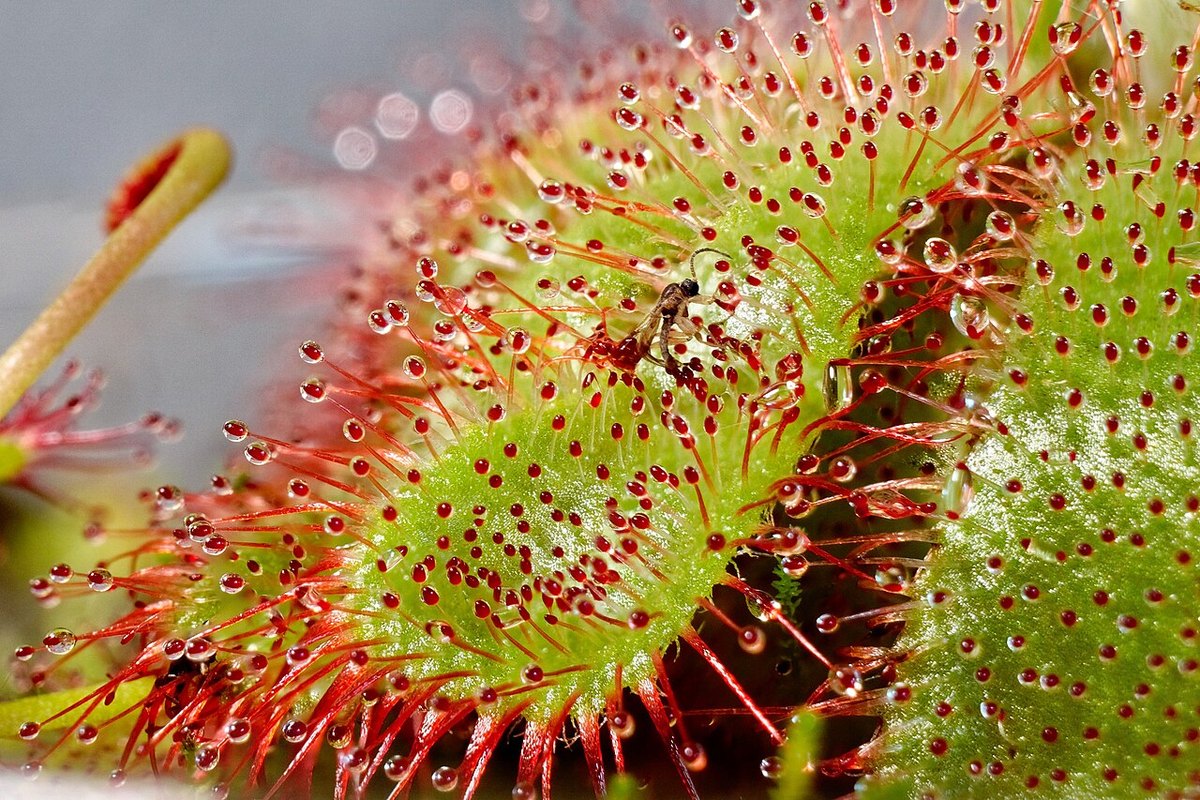
If only one leaf has changed, look at what it is holding. Carnivorous Plant Nursery says Cape sundew leaves “slowly roll over on to the prey in about 30 minutes,” that digestion “takes a few days,” and that the leaf then uncurls and leaves the remains behind. The ICPS notes the same 30-minute curl when it feeds a Drosera soaked dried bloodworms, “if the temperature is warm enough.”
The ICPS also has two feeding rules worth keeping: “only feed a plant that is dewy and only with live or wet food,” and if the food goes mouldy, “use less next time,” dabbing the spot with 70% isopropyl alcohol. A dewless plant is not ready to eat, so fix its conditions first. Our Venus flytrap feeding guide shows how to soak bloodworms; sundews take them the same way.
Pests
None of the sources we checked names pests as a direct cause of lost dew, but they are worth ruling out while you look. Carnivorous Plant Nursery says aphids attack “the growing tips of new growth,” can deform leaves, and “seem to be more of an issue on emerging Venus Flytraps and Sundews than other carnivorous plants.” It removes them by squeezing them between the fingers or washing them off, repeated “every week or two.” It adds that mealybugs often hide away from the light, and that spider mites leave leaves with “yellow spots or a greyish appearance.” Rice dabs mealybugs with “an isopropyl-soaked cotton swab.” Fungus gnat larvae mainly threaten seedlings; the ICPS says they “damage and eat seedlings” and recommends a layer of medium to coarse sand about 0.2 inch (5 mm) deep on the soil, which “most Drosera don’t mind” once they are mature. More detail is in pests in our care guide and in our Nepenthes pests guide, which covers the same insects.
Where Sources Differ
Good sources do not always agree, often because they grow in different conditions.
| Topic | One view | Another view |
|---|---|---|
| Main cause of no dew | Rice: low humidity is “the most common reason” | California Carnivores and Sarracenia Northwest: light first; without enough, “no matter on the humidity,” no dew |
| Do you need high humidity? | Rice: a terrarium or plastic tent; pebble trays help only “a tiny bit” | ICPS: some growers succeed on open shelves under lights, away from drafts |
| Spraying the plant | Rice: spraying “will hurt”; Curious Plant: misting washes off the dew | Carnivorous Plant Nursery: aphids can be washed off with a spray bottle |
| Fertilizer | Rice: “never fertilize”; NC State: “Do not apply fertilizers” | California Carnivores: dilute MaxSea on the leaves once a month, not through the soil; ICPS: bloodworms are better, foliar feed “with care” |
How to read these:
- Humidity or light? Rice himself lists both, so check both. A bright, humid spot out of drafts covers both.
- Spraying. A brief rinse to remove aphids is a pest treatment, not a humidity routine. Do not mist every day.
- Fertilizer. Every source agrees on no fertilizer in the soil. Leaf feeding is optional, and the ICPS feeds only plants that are dewy.
Common Mistakes
- Misting to “add dew.” The drops are not water, and Rice says spraying hurts.
- Repotting a new plant straight away. Rice says it only adds to the stress.
- Leaving a closed terrarium or bag in the sun. Both can overheat fast.
- Using tap, spring or boiled water. Only distilled, reverse osmosis or rain water is safe.
- Throwing out a dormant plant. Temperate species, D. binata and dying-back Cape sundews regrow from the base or winter bud.
FAQ: Sundew Not Making Dew
How long does it take for a sundew to make dew again?
None of the guides we checked gives a single timeline. Curious Plant puts the post-shipping acclimation phase at “a week and a half at most,” and expects a bare-root D. regia to settle in within 2 to 3 weeks. After a rest, the dew returns with the new growth in spring, or in autumn for winter-growing species.
Should I spray my sundew with water?
No. Rice says the dew is “a special mix of compounds” and spraying “will hurt.” Raise humidity around the plant instead.
Can a sundew get too much humidity?
Rice recommends not sealing a terrarium, because most plants want some air circulation. The ICPS says most tuberous sundews do not need the high humidity and do not make good terrarium plants, partly because terrariums “tend to get too warm.”
Should I cut off the dry leaves?
You can, but there is no rush. Curious Plant says it is fine to snip off the blackened tips and outer leaves that a D. regia often loses after shipping, “to keep mold from growing on them.” On a dormant plant, the old leaves die back on their own.
The Bottom Line
A sundew not making dew is usually reacting to its conditions. First rule out the normal reasons: a seasonal rest, die-back, a new or repotted plant, or a leaf digesting a meal. Then check light and humidity together, keep the plant out of drafts and heat, use only pure water, and never fertilize the soil. Change one thing at a time so you know what worked, and do not mist.
Sources & Further Reading
- Barry Rice, The Carnivorous Plant FAQ: Why doesn’t my sundew have “dew” on its leaves?
- Barry Rice, The Carnivorous Plant FAQ: About humidity and air circulation
- Barry Rice, The Carnivorous Plant FAQ: About light
- Barry Rice, The Carnivorous Plant FAQ: About temperature
- Barry Rice, The Carnivorous Plant FAQ: About buying purified water
- Barry Rice, The Carnivorous Plant FAQ: About fertilizer and hamburger meat
- Barry Rice, The Carnivorous Plant FAQ: How do I replant my new carnivorous plant?
- Barry Rice, The Carnivorous Plant FAQ: How do I kill bug XXX?
- International Carnivorous Plant Society: Growing Subtropical Drosera
- International Carnivorous Plant Society: Growing warm temperate Drosera
- International Carnivorous Plant Society: Growing cold temperate Drosera
- International Carnivorous Plant Society: Growing Drosera binata
- International Carnivorous Plant Society: Growing tuberous Drosera
- International Carnivorous Plant Society: LED Plant Lighting
- International Carnivorous Plant Society: Feeding Dried Blood Worms Step-by-Step
- International Carnivorous Plant Society: Fungus Gnat Larvae
- Sarracenia Northwest: Q/A #36, No Dew on Tropical Sundews
- Curious Plant: Carnivorous Plant Acclimation After Shipping
- California Carnivores: Rosetted Sundew Care Tips
- California Carnivores: Sundews (Drosera) Growing Tips
- Carnivorous Plant Nursery: Pests on Carnivorous Plants
- Carnivorous Plant Nursery: Drosera capensis
- Carnivorous Plant Nursery: Drosera spatulata
- NC State Extension Plant Toolbox: Drosera
Featured image based on a photo of an Alice sundew (Drosera aliciae) by incidencematrix via Wikimedia Commons, CC BY 2.0, cropped with a dark gradient and typography added by FloraOddity.
Final articles are editorially reviewed and factual claims are checked against cited sources. Last reviewed: October 2026.

2 Comments