
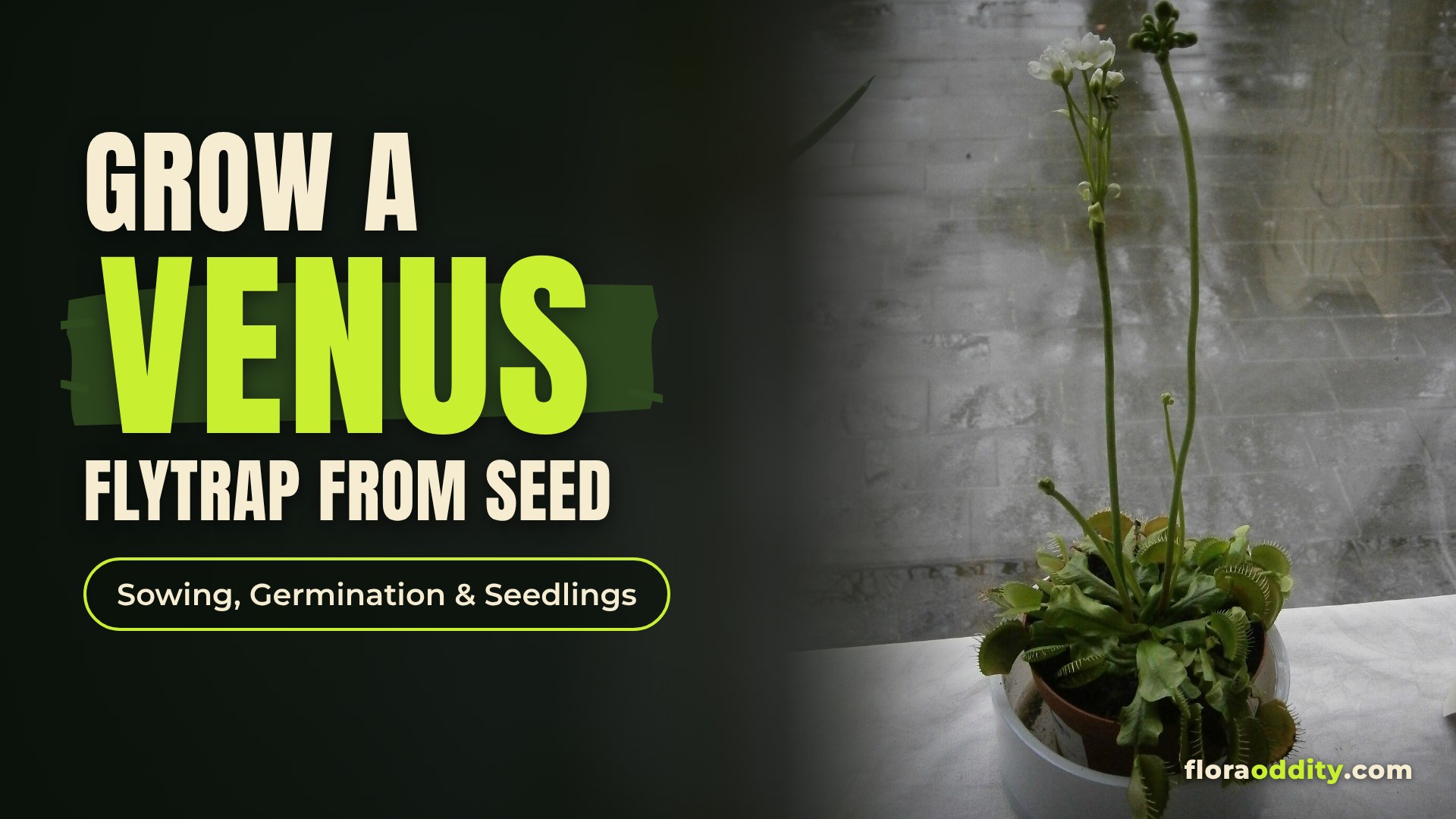
Growing a Venus flytrap from seed is cheap and surprisingly easy to start. The slow part comes after germination. Barry Rice, author of the long-running Carnivorous Plant FAQ, warns that propagating flytraps by seed “is not a satisfying tactic unless you are very skilled with carnivorous plants,” because the plants stay “amazingly tiny” for the first few years.
If you have the patience, a pinch of seed can give you dozens of new plants. This guide covers getting good seed, sowing, germination, seedling care and the usual failures, checked against the International Carnivorous Plant Society (ICPS), Rice’s FAQ, NC State Extension, a 2025 seed storage study and specialist nurseries. For the adult plant’s routine, see our Venus flytrap care guide.
The Short Answer
Start with fresh seed, or seed that has been kept in the refrigerator. Sow it on the surface of a wet, fertilizer-free mix such as 1:1 peat and sand, and do not bury it. Keep the pot standing in pure water inside a clear bag or covered box, at about 68 to 77 °F (20 to 25 °C), under bright light. Most seed sprouts within a few weeks to two months. Seedlings first show two plain seed leaves, then tiny traps. Take them out of the bag once they have a few true leaves, never fertilize, and expect a mature plant in about 3 to 5 years, depending on how well you feed it. Whether the seed needs a cold spell first is the one point where good sources disagree.
Getting Seed: Fresh Beats Old
Where seed comes from
The Venus flytrap is protected in the wild. NC State Extension calls it “an endangered species that cannot be legally collected from the wild,” and the ICPS lists Dionaea muscipula on its Imperiled Carnivorous Plant Species List, so its seed bank will not accept field-collected seed. Buy seed from cultivated plants. Tom Bennet of Tom’s Carnivores warns that “eBay and Facebook are awash with fake seeds and scams!” and says to “always buy seed from a reputable specialist nursery.”
Timing matters. Sarracenia Northwest says ripe seed is usually harvested in “August through September, depending on your climate,” and the ICPS Seed Bank says Dionaea seed is “generally available during the winter and early spring.”
Why freshness matters
Flytrap seed does not keep well at room temperature. Sarracenia Northwest advises seed “no more than a couple months old,” because “Viability declines significantly a couple months after harvest,” and adds that “Under refrigeration, flytrap seeds can last for years.” Ask the seller when the seed was harvested and how it was stored.
A 2025 study in Annals of Botany by Ballesteros and colleagues backs up the warning. It tested ICPS Seed Bank seed kept at room temperature, about 68 °F (20 °C). Two batches of Dionaea seed stored for about 1.6 years germinated at 2% and 0%. The authors note that the germination rates before storage were not known, so the figures show how poorly old seed does, not exactly how fast it declines.
Making your own seed
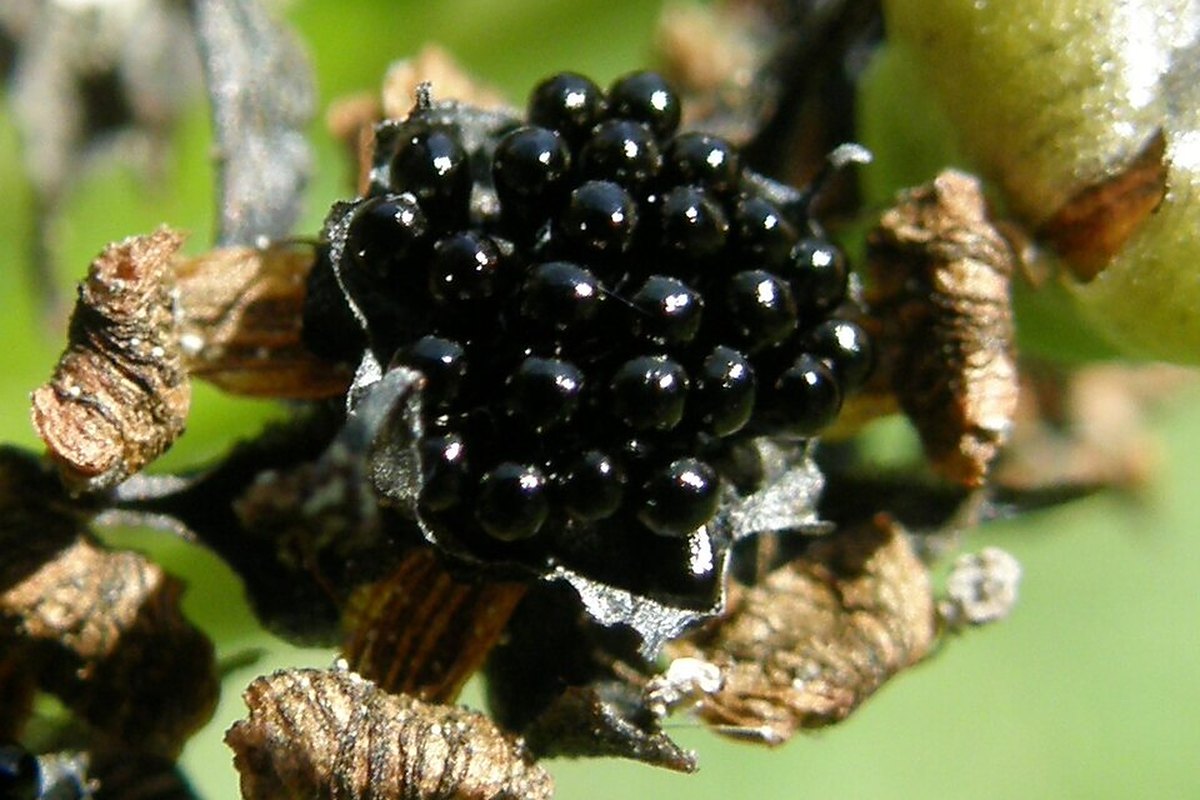
If your plant flowers, you can pollinate it yourself. Rice suggests moving pollen from the anthers to the stigma at the centre of the flower with a toothpick. Over the next few weeks the flower “will crinkle, shrivel, and blacken.” When the flower and its little stalk are fully black, look closely: a successful flower holds “20-30 black, glossy seeds.” Rice says cross-pollinating two different plants is widely believed to give more seed and stronger seedlings. Tom’s Carnivores agrees that self-pollinated seed “won’t be as vigorous,” so “you’ll need two flowering plants for best results.”
Flowering has a cost. Rice says a flytrap can be “sluggish for nearly an entire year” afterwards and advises less skilled growers to cut the stalk off early. Tom’s Carnivores notes that flowering “can exhaust a Venus flytrap” and advises against it unless you are a very experienced grower. NC State says the white flowers appear on a 4 to 12 inch (10 to 30 cm) stalk “in May and June,” and that the ripe capsule opens upward so “the seeds are dislodged by raindrops.” Collect the seed before that happens.
The ICPS says chaff matters too: “The remains of the stems, seed pods, and aborted seeds are sources of mold when starting seeds.” Pick the seed clean on a sheet of white paper before you store or sow it.
Does Venus Flytrap Seed Need Stratification?
Stratification means keeping seeds cold and moist for a few weeks to mimic winter. Here the sources split.
Rice recommends it. In his germination FAQ he says that to grow Venus flytraps from seed “you should give them a cold, wet stratification period of four weeks,” and in his propagation entry he says “Stratify the seeds for about 3-4 weeks in cold, wet conditions, then sow them on moist peat moss.” The Ballesteros study also cold-stratified its Dionaea seed, at 39 °F (4 °C) for 8 weeks, before germinating it on agar.
Sarracenia Northwest says the opposite: “Unlike other US-native carnivorous plants, flytrap seeds do not require stratification.” The ICPS sowing guide gives fridge stratification instructions only for Sarracenia, Darlingtonia and cold temperate sundews and butterworts, not for Dionaea, and its Dionaea growing guide moves straight from sowing to a warm, bright bag.
If you have plenty of seed, you can test both approaches on separate pots, in line with the ICPS advice not to sow all your seed at once. If you do stratify, the ICPS method is to mix the seed with finely chopped wet Sphagnum moss, or merely damp peat, in a small plastic bag in the refrigerator.
What You Need
- Pots: small plastic pots with drainage holes. Sarracenia Northwest uses a 4 inch (10 cm) pot for “a small pinch of these seeds (about 25 seeds).”
- Mix: the ICPS calls a 1:1 peat and sand mix “the default soil.” Sarracenia Northwest uses 50% peat moss and 50% perlite. The peat must have no added fertilizer.
- Water: the ICPS seed guide wants water with “less than 80 PPM of dissolved solids,” which in most places means rain, distilled, deionized or reverse osmosis water.
- Light: the ICPS seed guide suggests 16 hours a day, with pot tops 6 to 10 inches (15 to 25 cm) from fluorescent tubes; its Dionaea guide uses purple LED plant lights.
- A cover and labels: zip-lock bags or a clear box, and a dated tag for each pot.
Seed to Mature Plant: The Timeline
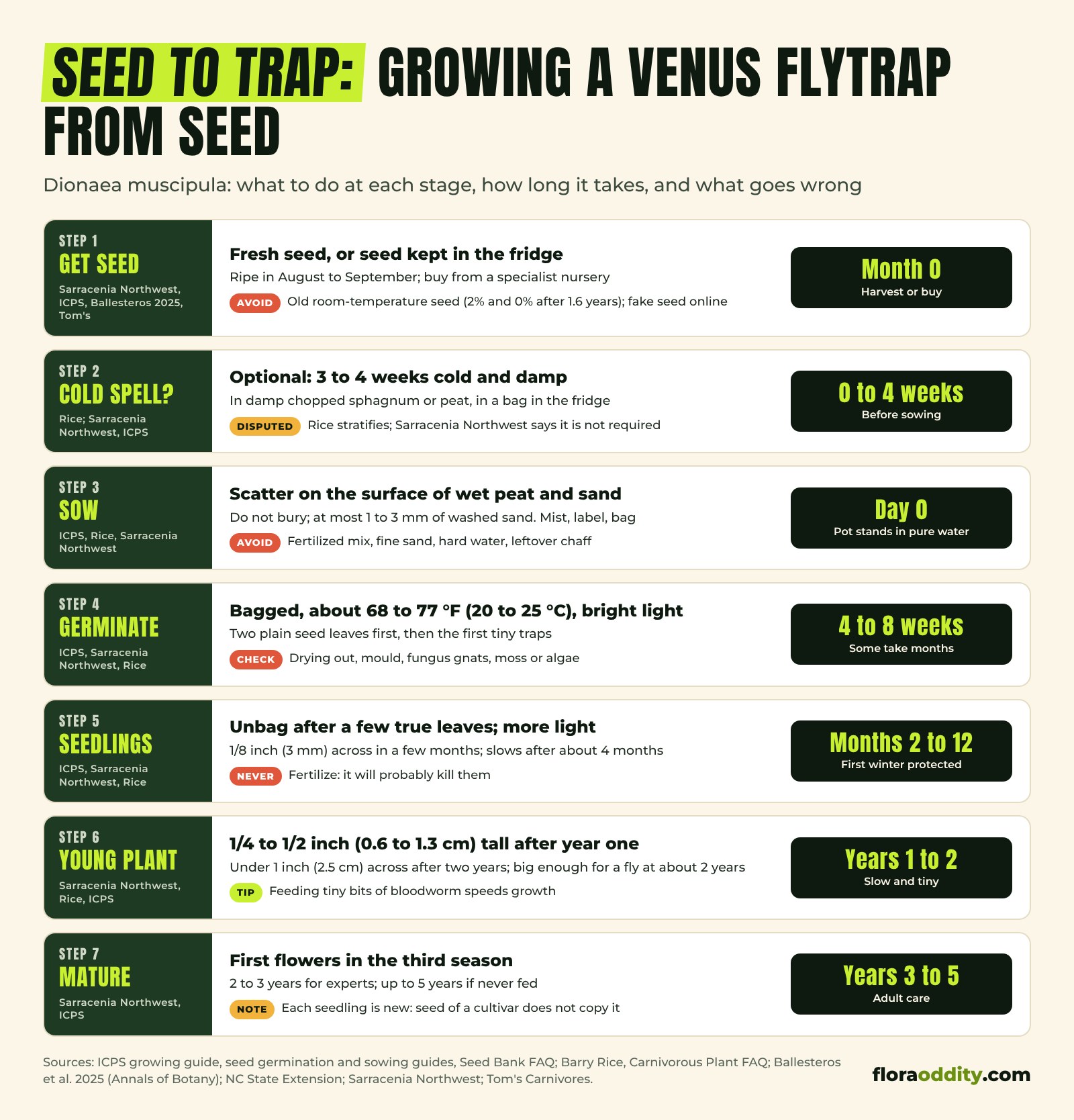
Venus flytrap growth timeline at a glance
| Step | When | What to do | Watch for | Source |
|---|---|---|---|---|
| 1. Get seed | Month 0: ripe in August to September | Buy fresh seed, or seed kept in the fridge, from a specialist nursery | Avoid old room-temperature seed (2% and 0% after 1.6 years) and fake seed online | Sarracenia Northwest, ICPS, Ballesteros 2025, Tom’s Carnivores |
| 2. Cold spell? | 0 to 4 weeks before sowing | Optional: 3 to 4 weeks cold and damp, in chopped sphagnum or peat in a bag in the fridge | Disputed: Rice stratifies; Sarracenia Northwest says it is not required | Rice; Sarracenia Northwest, ICPS |
| 3. Sow | Day 0, pot standing in pure water | Scatter on the surface of wet peat and sand; at most 1 to 3 mm of washed sand; mist, label, bag | Avoid fertilized mix, fine sand, hard water, leftover chaff | ICPS, Rice, Sarracenia Northwest |
| 4. Germinate | 4 to 8 weeks; some take months | Bagged, about 68 to 77 °F (20 to 25 °C), bright light; two seed leaves first, then tiny traps | Check for drying out, mould, fungus gnats, moss or algae | ICPS, Sarracenia Northwest, Rice |
| 5. Seedlings | Months 2 to 12; first winter protected | Unbag after a few true leaves; more light. 1/8 inch (3 mm) across in a few months; growth slows after about 4 months | Never fertilize: it will probably kill them | ICPS, Sarracenia Northwest, Rice |
| 6. Young plant | Years 1 to 2 | 1/4 to 1/2 inch (0.6 to 1.3 cm) tall after year one; under 1 inch (2.5 cm) across after two years; big enough for a fly at about 2 years | Tip: feeding tiny bits of bloodworm speeds growth | Sarracenia Northwest, Rice, ICPS |
| 7. Mature | Years 3 to 5 | First flowers in the third season; 2 to 3 years for experts, up to 5 if never fed | Note: each seedling is new; seed of a cultivar does not copy it | Sarracenia Northwest, ICPS |
How to Sow Venus Flytrap Seeds, Step by Step
1. Prepare the mix
Mix peat and sand damp, not wet, and fill the pot loosely to the top, as the ICPS sowing guide describes. Use coarse sand: the ICPS says not to use play sand, builders’ sand or beach sand unless you sieve out the fines and wash it, because “Fine sand will pack much too tightly.” Lightly level the surface without packing it hard.
The ICPS sowing guide notes that many growers wash their seed-starting ingredients to cut down on salts, nutrients and weeds. The ICPS Dionaea guide explains why: “the nutrients in peat encourage the growth of cyanobacteria (AKA bluegreen algae) that can overgrow the small, very slow growing seedlings.” Washing reduces that, though the guide adds that the little nutrient left in peat gives seedlings “a boost.”
2. Wet it thoroughly
The ICPS says “The soil should be saturated with pure water.” Sarracenia Northwest likewise says to make sure “the soil is completely moist” before sowing.
3. Scatter the seed on the surface
This is the step people get wrong. Rice says to sprinkle carnivorous plant seeds on the surface and “do not bury them.” The ICPS seed guide agrees that most species do best “if the seed is not buried.” Sarracenia Northwest scatters the seed evenly and taps it down “very gently.” The ICPS Dionaea guide allows an optional thin cover of 1 to 3 mm of washed quartz sand, or a top layer of finely chopped long-fibre Sphagnum, but warns that live Sphagnum “can overgrow the plants.”
Sow more than you need. The ICPS advises beginners not to “plant all the seed in one pot or at one time,” so you have a second try if the first fails.
4. Mist, label and cover
Mist the surface lightly with pure water, add a dated label, and put the pot inside a clear plastic bag with a little water in the bottom, as the ICPS sowing guide shows. A covered box works too. The ICPS says you will know the pots are wet enough “if the bags stay fogged up.”
5. Keep it warm and bright
The ICPS Dionaea guide says a temperature of about 68 to 77 °F (20 to 25 °C) “works best,” and Sarracenia Northwest aims for 75 °F (24 °C). Put the covered pot under lights or in bright, indirect light. Avoid direct sun on a sealed bag: in another ICPS guide, Brittnacher warns that covered pots in more than a little direct sun give you “roasted seedlings.” The ICPS seed guide also suggests good air circulation so the plants do not overheat under lamps.
6. Wait, and check weekly
Sarracenia Northwest says the seeds “will germinate within four to eight weeks, depending on temperature.” Rice puts it at “a few weeks to a few months,” and says that he does not give up on any carnivorous plant pot “until two years pass.” Check the pot every week, keep a little water in the bag, and lightly mist the surface if it looks dry.
Caring for Seedlings
What a new seedling looks like
The first thing to appear is a pair of plain green seed leaves. The ICPS describes a Dionaea sprout with “non-carnivorous cotyledons with the seed still attached,” and notes that “The first true leaves have traps.” Those first traps are tiny.
When to take off the cover
The ICPS Dionaea guide removes the pots from their bags “After the seedlings get a few true leaves (the ones with traps),” and then moves them to a bright terrarium or greenhouse. Sarracenia Northwest says that as soon as seeds germinate, the seedlings need “lots of bright sunlight,” on a bright windowsill or under strong lights. Keep the pot standing in pure water.
Feeding and fertilizer
Seedlings do not need feeding at first. Rice says the pot is full of springtails and other “almost-microscopic buglets,” and that seedlings “will grow just fine as conventional plants” even if they catch nothing. He also warns that if you “fertilize them, the plants will quite probably die.” The ICPS guide gives the same warning: “DO NOT fertilize your plants unless you don’t care if you kill them.”
Feeding speeds things up once the traps are big enough. The ICPS guide says you can get a mature plant in two years “if you feed it in the traps as much as the plant can handle,” using small pieces of rehydrated dried bloodworm. Rice says the seedlings need “about two years before they are big enough to comfortably consume a fly.” For technique, see how to feed a Venus flytrap.
The first winter
The ICPS guide notes that new seedlings “tend to grow for about 4 months then stop growing” because “They are expecting winter.” It says you can keep them growing with warmth, intense light and heavy feeding. Sarracenia Northwest grows its seedlings indoors for their first winter, then moves them outdoors in May, after the last frost. For older plants, see our guide to Venus flytrap dormancy.
How Long Until a Mature Plant?
Expect years. Sarracenia Northwest says seedlings may reach about 1/8 inch (3 mm) across within a few months, are “only 1/4 to 1/2 inch tall at the end of their first year” (0.6 to 1.3 cm), and “will reach flowering maturity by their third season.” Rice says flytraps grown from seed are “less than a few cm (1 inch) across, even after two years.”
The ICPS guide gives the widest range: “It could easily take 5 years to get a mature plant from seed if they are not fed regularly,” while experts with greenhouses can get “mature or close to mature plants in two to three years.”
Each seedling is also a new individual. The ICPS notes that “no one grows Dionaea from seed commercially except to find new varieties,” and that nurseries multiply only the best plants, “which may be one in a thousand from seed,” by tissue culture. Seed from a named cultivar will not give you copies of that cultivar.
Where Sources Differ
| Topic | One view | Another view | Why they may differ |
|---|---|---|---|
| Stratification | Rice: 3 to 4 weeks cold and wet | Sarracenia Northwest: not required; ICPS sows warm | Rice sows his seed outdoors and gives it “a wet, chilly winter”; the ICPS and Sarracenia Northwest germinate it warm indoors |
| Fungicide | Sarracenia Northwest: spray Neem oil or a sulfur fungicide | ICPS: “Damping off is not a problem for most CPs” | The ICPS relies on sealed bags and a “naturally sterile planting medium to combat fungus” |
| Mix | ICPS: 1:1 peat and sand | Sarracenia Northwest: 50% peat, 50% perlite | The ICPS warns perlite can be salty |
| Time to maturity | Sarracenia Northwest: third season | ICPS: up to 5 years unfed, 2 to 3 for experts | How much the seedlings are fed |
Common Mistakes
- Using old seed. Room-temperature seed over a year old may barely germinate.
- Burying the seed. Sow on the surface. At most, the ICPS allows a 1 to 3 mm sand cover.
- Letting the surface dry. Keep the bag fogged up.
- Leaving chaff or dirty peat. Old pod bits breed mould, and nutrients in peat feed algae and moss that smother seedlings, per the ICPS.
- Ignoring fungus gnats. The ICPS says “Fungus gnat larvae love eating the roots of CP seedlings” and keeps seed pots in sealed bags, away from other plants.
- Fertilizing to speed things up. Both Rice and the ICPS say it will probably kill the seedlings.
- Giving up too soon. Rice keeps pots for two years before giving up.
FAQ: Growing Venus Flytrap From Seed
How long do Venus flytrap seeds take to germinate?
Sarracenia Northwest says four to eight weeks, depending on temperature. Rice says a few weeks to a few months. Warmth of about 68 to 77 °F (20 to 25 °C) helps, according to the ICPS.
Should I put Venus flytrap seeds in the fridge?
For storage, yes: Sarracenia Northwest says refrigerated seed “can last for years,” while seed at room temperature declines within months. For stratification before sowing, sources disagree. Rice recommends 3 to 4 weeks cold and wet; Sarracenia Northwest says it is not required.
Can I grow a Venus flytrap from seed indoors?
Yes. The ICPS germinates Dionaea seed in plastic bags under purple LED plant lights and says the plant can be grown indoors under lights with no terrarium. Plants grown indoors all year need strong light; the ICPS seed guide suggests about 16 hours a day for seedlings.
Will seed from my ‘B52’ give me more ‘B52’ plants?
No. Every seedling is a new genetic mix. The ICPS says commercial growers raise seed only “to find new varieties” and propagate selected plants by tissue culture. To copy a cultivar, divide the plant or take leaf pullings, which we cover in how to repot a Venus flytrap.
The Bottom Line
To grow Venus flytrap from seed, start with fresh or refrigerated seed from a reputable source, scatter it on the surface of a wet, fertilizer-free mix, and keep it humid, warm and bright. Most seed sprouts within a few weeks to two months; whether it needs a cold spell first is where Rice and Sarracenia Northwest disagree. After that, the job is mostly patience: keep the seedlings wet and in good light, never fertilize, feed the traps once they are big enough, and expect a mature plant in about three to five years.
Sources & Further Reading
- International Carnivorous Plant Society: Growing Dionaea muscipula
- International Carnivorous Plant Society: Seed Germination Guide
- International Carnivorous Plant Society: Sowing Carnivorous Plant Seeds Step-by-Step
- International Carnivorous Plant Society: Drosera Seed Scarification
- International Carnivorous Plant Society: Seed Bank FAQ
- International Carnivorous Plant Society: Cleaning Seeds
- International Carnivorous Plant Society: Wild Seed Collecting
- Rice, B. The Carnivorous Plant FAQ: How do I stimulate seeds to germinate?
- Rice, B. The Carnivorous Plant FAQ: How do I sexually propagate my Venus flytrap?
- Rice, B. The Carnivorous Plant FAQ: How do I care for my tiny seedling flytrap?
- Rice, B. The Carnivorous Plant FAQ: Should I let my Venus flytrap flower?
- Ballesteros, D. et al. (2025). Longevity, cryopreservation and propagation of carnivorous plants seeds. Annals of Botany 136(1): 111 to 128
- NC State Extension Gardener Plant Toolbox: Dionaea muscipula
- Sarracenia Northwest: Seeds, Venus Flytrap
- Tom’s Carnivores: The Venus Flytrap, Complete Care Guide
- Tom’s Carnivores: Should I let my Venus Flytrap flower?
Featured image based on a photo of a flowering Venus flytrap by Meneerke bloem via Wikimedia Commons, CC BY-SA 4.0, cropped with a dark gradient and typography added by FloraOddity. The featured image is shared under the same CC BY-SA 4.0 licence.
Final articles are editorially reviewed and factual claims are checked against cited sources. Last reviewed: October 2026.
2 Comments